
Gandhi: From South Africa to India
From South Africa to India's National Movement
This document traces the remarkable transformation of Mohandas Karamchand Gandhi — from a young barrister who arrived in Durban in 1893 to the architect of a new political philosophy that would eventually reshape the history of a nation. His two decades in South Africa were not merely a legal career abroad; they were the crucible in which the methods, ideals, and moral authority of one of history's most consequential leaders were forged. From the racial humiliations of a first-class train compartment to the mass marches of thousands of indentured labourers, Gandhi's South African years produced a blueprint for non-violent resistance that would later be deployed on the far larger stage of the Indian subcontinent.
The Young Barrister Who Landed at Durban, 1893
The young barrister who landed at Durban in 1893 on a one-year contract to sort out the legal problems of Dada Abdullah, a Gujarati merchant, was to all appearances an ordinary young man trying to make a living. He had spent three years in London studying for the Bar, and neither in India nor in England had he ever come into contact with the overt racism that would confront him within days of his arrival in South Africa. He was, however, the first Indian barrister — the first highly-educated Indian — to have come to South Africa, a distinction that would soon carry enormous significance.
Indian immigration to South Africa had begun when White settlers recruited indentured Indian labour, mainly from South India, to work on the sugar plantations. In their wake had come Indian merchants, mostly Meman Muslims. Ex-indentured labourers who had settled down after the expiry of their contracts, and their children — many born in South Africa itself — constituted a third group. None of these groups had much access to education. The racial discrimination to which they were subjected, as part of their daily existence, they had come to accept as a way of life, and even if they resented it, they had little idea about how to challenge it.
The Three Communities of Indians in South Africa
Indentured labourers — recruited from South India for sugar plantations
Indian merchants — mostly Meman Muslims who arrived in the wake of labourers
Settled ex-labourers and their children — many born in South Africa itself
Gandhi's Intellectual Influences in South Africa
During his South Africa stay, Gandhi's ethical thinking was heavily shaped by a handful of transformative texts:
Plato's Apology — translated into Gujarati
John Ruskin's Unto This Last (1862) — inspired the Phoenix Farm commune
Henry David Thoreau's On the Duty of Civil Disobedience (1849)
Leo Tolstoy's The Kingdom of God Is Within You (1894)
William Salter's Ethical Religion (1889)
A Journey of Humiliations: Durban to Pretoria
Gandhi's journey from Durban to Pretoria, undertaken within a week of his arrival on the continent, consisted of a series of racial humiliations that would ignite in him a lifelong commitment to justice. The most famous incident occurred when he was bundled out of a first-class railway compartment by a White man and left to spend the night shivering in the waiting room at Pietermaritzburg — despite having a valid first-class ticket. This single night of cold and humiliation is widely regarded as the turning point of his life.
But that was not all. On the same journey, he was compelled to travel in the driver's box of a coach for which he had bought a first-class ticket. When he refused the coach leader's order to vacate even that seat and sit on the foot-board, he was soundly thrashed. On reaching Johannesburg, he found that all the hotels were suddenly "full up" the moment he asked for a room. Having secured a first-class train ticket from Johannesburg to Pretoria by quoting extensively from railway regulations, he was almost pushed out of his railway compartment again, and was only saved from further humiliation by the intervention of a sympathetic European passenger.
"Neither in India nor in England had he ever come in contact with the overt racism that confronted him within days of his arrival in South Africa."

These experiences were not merely personal indignities. They revealed to Gandhi a system of racial subjugation so deeply embedded in South African society that it had become invisible — accepted as natural by both the oppressors and, tragically, by many of the oppressed. Unlike the Indians who had preceded him, Gandhi was not willing to swallow racial insults in order to carry on with the business of making a living.
The First Spark: Gandhi's Activism Begins in Pretoria
On his arrival in Pretoria, where he was to work on the civil suit that had brought him to South Africa, Gandhi immediately convened a meeting of the Indians there. He offered to teach English to anyone who wanted to learn and suggested that they organise themselves and protest against oppression. He voiced his protest through the press as well, writing an indignant letter to the Natal Advertiser. Even though he had no plans of staying in South Africa at that stage, he tried his best to arouse the Indians in Pretoria to a sense of their own dignity and persuade them to resist all types of racial disabilities.
By virtue of being a British-educated barrister, Gandhi demanded many things as a matter of right — first-class train tickets, rooms in hotels — which other Indians before him had never probably even had the courage to ask for. Having settled the lawsuit for which he had come, Gandhi prepared to leave for India. But on the eve of his departure from Durban, he raised the issue of the bill to disenfranchise Indians, which was in the process of being passed by the Natal legislature.
The Indians in South Africa begged Gandhi to stay on for a month and organise their protest, as they could not do so on their own — not knowing even enough English to draft petitions. Gandhi agreed to stay for a month. He stayed for twenty years. He was then only twenty-five years old.
Community Organising
Convened meetings of Indians in Pretoria; offered English lessons; urged collective resistance against racial oppression.
Press Advocacy
Wrote to the Natal Advertiser, using journalism as a tool to publicise Indian grievances to a wider audience.
Legal Rights
Asserted rights as a British subject, demanding first-class travel and accommodation — challenges no Indian had dared make before him.
1894–1906
The Moderate Phase of Struggle (1894–1906)
Gandhi's political activities from 1894 to 1906 may be classified as the 'Moderate' phase of the struggle of the South African Indians. During this phase, he concentrated on petitioning and sending memorials to the South African legislatures, the Colonial Secretary in London, and the British Parliament. He believed that if all the facts of the case were presented to the Imperial Government, the British sense of justice and fair play would be aroused, and the Imperial Government would intervene on behalf of Indians who were, after all, British subjects.
His attempt was to unite the different sections of Indians and to give their demands wide publicity. To this end, he established the Natal Indian Congress in 1894 and started a newspaper called Indian Opinion in 1903, published in Gujarati, Hindi, Tamil, and English. The Phoenix Settlement in Natal was established in 1904, inspired by a single reading of John Ruskin's Unto This Last. Gandhi's abilities as an organiser, fund-raiser, journalist, and propagandist all came to the fore during this period.
1894
Natal Indian Congress founded to unite Indian communities under a common political voice
1896
Gandhi visits India; writes and circulates the Green Pamphlet exposing conditions of indentured labourers
1900
During the Boer War, Gandhi forms an ambulance corps of 1,100 Indian volunteers to serve on front lines
1903
Indian Opinion newspaper launched in four languages: Gujarati, Hindi, Tamil and English
1904
Phoenix Settlement founded in Natal, inspired by Ruskin's Unto This Last — a commune of austere communal living
1906
Gandhi volunteers Indians for British forces in Zulu War; moderate methods now clearly proving insufficient
During the Boer War, Gandhi volunteered in 1900 to form a group of ambulance drivers, raising eleven hundred Indian volunteers who were trained and medically certified to serve on the front lines. He wanted to disprove the notion that Indians were not fit for demanding activities. In 1906, during the British war against the Zulu Kingdom, Gandhi again encouraged Indians to support the war effort, arguing this would legitimise their claims to full citizenship. But by 1906, having fully tried the Moderate methods of struggle, Gandhi was becoming convinced that these would not lead anywhere.
The Green Pamphlet: Exposing the Truth About South Africa
By 1896, Gandhi had established himself as a leader of the Indians in South Africa. Wishing to come back to India to see his family, he travelled via Calcutta. At Rajkot, he wrote and issued what would come to be known as the "Green Pamphlet" — a document that would have far-reaching consequences.
What the Green Pamphlet Contained
In the Green Pamphlet, Gandhi exposed in vivid and unflinching detail the conditions of Indian indentured labourers and coolies in South Africa. He documented the racial indignities, the economic exploitation, the denial of basic rights, and the daily humiliations endured by Indians across every class. He also made speeches across India on the subject of human rights and the conditions of his compatriots abroad, reaching audiences far beyond those who could read his pamphlet.
The pamphlet was widely read and attracted significant public attention both in India and, crucially, in Britain. However, the British government took the Green Pamphlet as an anti-government publication — a provocative act of dissent rather than a legitimate exposure of injustice.
The Price Gandhi Paid
When Gandhi returned to Durban, his ship was not allowed to dock for three days. When he finally disembarked, he was beaten by a White mob. Despite this brutal reception and the public humiliation it entailed, Gandhi refused to press charges against his attackers and continued his work for the Indian Natal Congress with unwavering resolve.
This episode revealed a quality that would define Gandhi's entire political life: the willingness to absorb violence without retaliation, and to treat personal suffering as a tool of moral persuasion.
1906–1915
Satyagraha: The Birth of Passive Resistance (1906–1915)
The second phase of the struggle in South Africa, which began in 1906, was characterised by the use of passive resistance or civil disobedience, which Gandhi named Satyagraha — truth-force or soul-force. It was first used when the Government enacted legislation making it compulsory for Indians to carry certificates of registration bearing their fingerprints at all times. At a huge public meeting on 11 September 1906 in the Empire Theatre in Johannesburg, Indians resolved unanimously that they would refuse to submit to this law and would face the consequences.
Gandhi formed the Passive Resistance Association to conduct the campaign. The Government started legal proceedings against the resisters, who pleaded guilty, were ordered to leave the country, and on refusing to do so, were sent to jail. The fear of jail disappeared, and it was popularly renamed "King Edward's Hotel." General Smuts called Gandhi for talks and promised to withdraw the legislation if Indians voluntarily registered themselves. Gandhi accepted and was the first to register — but Smuts played a trick, ordering that the voluntary registrations be ratified under the very law they had resisted. The Indians retaliated by publicly burning their registration certificates.
Registration Act
Compulsory fingerprint certificates; Indians resolve en masse to defy the law at the Empire Theatre meeting, Sept. 1906
Mass Jail Campaign
Passive resisters sent to jail; fear of imprisonment evaporates; Satyagraha Association formed to coordinate resistance
Certificate Burning
Smuts breaks his promise; Indians publicly burn registration certificates in defiance
Tolstoy Farm
Gandhi establishes Tolstoy Farm (1910–1913) to house Satyagrahi families; funded by Indian donors including Sir Ratan Tata
The Final Struggle: Mass Satyagraha and the Great March
By 1913, new fuel was added to the raging fire. A Supreme Court judgement invalidated all marriages not conducted according to Christian rites and registered by the Registrar of Marriages. Indians treated this as a profound insult to the honour of their women, and many women — including Kasturba, Gandhi's wife — entered the movement because of this indignity. The movement also widened to include resistance to the poll tax of three pounds imposed on all ex-indentured Indians, a charge so burdensome for poor labourers that its inclusion immediately drew the indentured and ex-indentured labourers into the struggle, giving Satyagraha a truly mass character.
The Great March
Gandhi decided the time had come for the final struggle. The campaign was launched by sixteen Satyagrahis — including Kasturba — marching from Phoenix Settlement in Natal to Transvaal. A group of eleven women then crossed from Tolstoy Farm into Natal without a permit, reaching New Castle, a mining town, where they persuaded Tamil mine workers to strike. Gandhi took charge and marched an army of over two thousand men, women and children over the border, resulting in his arrest and imprisonment.
The Government's Brutal Response
The marchers were put into trains and sent to Natal jails. The Government's action inflamed the entire Indian community; workers on plantations and mines went on a lightning strike. Even the Viceroy, Lord Hardinge, condemned the repression as "one that would not be tolerated by any country that calls itself civilised" and called for an impartial enquiry into the charges of atrocities. Gokhale toured India to arouse public opinion on a national scale.
Eventually, through negotiations involving Gandhi, Lord Hardinge, C.F. Andrews, and General Smuts, an agreement was reached. The Government of South Africa conceded the major Indian demands relating to the poll tax, registration certificates, and marriages solemnised according to Indian rites, and promised to treat the question of Indian immigration in a sympathetic manner.
Non-violent civil disobedience had succeeded in forcing the opponents to the negotiating table and conceding the substance of the demands put forward by the movement.
The Significance of Gandhi's South African Experiment
The South African years were not a prelude to Gandhi's real career — they were his real education. The blueprint for the Gandhian method of struggle was evolved on South African soil, and it was now to be tried on a much wider scale on the Indian subcontinent.
Leadership of the Poor
Gandhi had the invaluable experience of leading poor Indian labourers — seeing their capacity for sacrifice, their ability to bear hardship, and their extraordinary morale in the face of repression. South Africa built his deep faith in the capacity of the Indian masses to participate in and sacrifice for a cause that moved them.
Unity Across Divisions
Gandhi led Indians belonging to different religions — Hindus, Muslims, Christians, and Parsis — united under a single leadership. They came from different regions (mainly Gujaratis and Tamils), different social classes (rich merchants alongside poor indentured labourers), and both men and women participated together.
The Lessons of Leadership
Gandhi learnt the hardest way that leadership involves facing the anger not only of the enemy but also of one's own followers. He faced life threats twice: once when a White mob chased him in Durban in 1896, and once when a Pathan Indian assaulted him for making a compromise with the Government. He learnt that leaders often must take decisions unpopular with their most enthusiastic followers.
A Proven Political Method
South Africa provided Gandhi the opportunity to evolve his own style of politics and leadership, to try out new techniques of struggle on a limited scale, unencumbered by contending political currents. He had already taken the movement from its Moderate phase into its Gandhian phase — and he knew both the strengths and the weaknesses of his method intimately.
Gandhi Returns to India, January 1915
Gandhi returned to India in January 1915 at the request of Gokhale, conveyed to him by C.F. Andrews. He brought with him an international reputation as a leading Indian nationalist, theorist, and organiser. His efforts in South Africa were well known not only among the educated classes but also among the masses. He decided to tour the country for the next year and see for himself the condition of the people.
On Gokhale's advice, and in keeping with his own style of never intervening in a situation without first studying it with great care, Gandhi decided that for the first year he would not take a public stand on any political issue. He spent the year travelling around the country and in organising his Sabarmati Ashram in Ahmedabad in 1917 (having earlier established the Satyagraha Ashram at the Kocharab Bungalow of Jivanlal Desai, a barrister, in 1915), where he and his devoted band of followers from South Africa would lead a community life.
Why Gandhi Did Not Join Existing Organisations
Gandhi continued to maintain his distance from political affairs, including the Home Rule Movement. His own political understanding did not coincide with any of the political currents active in India at the time. In his own words:
"At my time of life and with views firmly formed on several matters, I could only join an organisation to affect its policy and not be affected by it."
He could only join an organisation or movement that adopted non-violent Satyagraha as its method of struggle.
His Position on the Home Rule Movement
Gandhi's faith in Moderate methods had long eroded. Nor did he agree with the Home Rulers that the best time to agitate for Home Rule was when the British were in difficulty because of the First World War. He thought it premature and strategically unsound. He was willing to wait, study, and act only when the time and the method were right — a patience born of his long South African experience.
Rise to Leadership
Why Gandhi Rose: The Sources of His Wide Popular Appeal
Gandhi's emergence as the dominant figure of the Indian national movement was not accidental. It was the product of a convergence of personal qualities, historical circumstances, political vision, and a deeply intuitive understanding of the Indian masses. Several factors combined to make him uniquely positioned to lead at the precise moment when India needed a new kind of leader.
The Proven Innovator
He offered something entirely fresh — Satyagraha, marches, civil disobedience — methods with proven efficacy in South Africa. For a younger generation frustrated by endless quarrels between Moderates and Extremists, this was a revelation.
The Man of the Masses
His use of vernacular languages, his wearing of half-naked cloth, his discarding of the sacred thread as protest against caste discrimination — all brought him closer to ordinary people. He became a symbol of India's poverty and the hardship of common life.
The Unifying Figure
His name was not associated with any existing political group. He subscribed neither to the Moderates nor the Extremists, and could make a fresh start and receive an all-India welcome across religious, caste, and class divides.
The Spiritual Politician
He used religious idioms — not revivalism, but religious morality — to mobilise the masses. He talked of swaraj as a goal but never rigidly defined it, allowing every community to interpret it in its own way.
The most immediate context was also favourable. World War I had led to a phenomenal increase in defence expenditure, resulting in huge national debt, rising taxes, and escalating prices. Near-famine conditions existed in many areas, compounded by the influenza epidemic. While the prices of industrial and imported goods rose, raw materials remained cheap to export, devastating the common farmer. These conditions gave rise to numerous Kisan movements — and into this landscape stepped Gandhi, whose concern for the masses, identification with their suffering, and rootedness in Indian soil made him not merely a political leader but a living embodiment of their aspirations.
1917
Champaran Satyagraha (1917): The First Civil Disobedience in India
Gandhi was requested by Rajkumar Shukla to look into the problems of the indigo planters of Champaran in Bihar. The European planters had been forcing peasants to grow indigo on 3/20 of their total land under the tinkathia system. When German synthetic dyes replaced indigo towards the end of the nineteenth century, the European planters — unwilling to lose their profits before peasants could shift to other crops — began demanding high rents and illegal dues. Peasants were also forced to sell their produce at prices fixed by the Europeans.
When Gandhi, joined by Rajendra Prasad, Mazhar-ul-Haq, Mahadeo Desai, Narhari Parekh, and J.B. Kripalani, reached Champaran to probe the matter, the authorities ordered him to leave the area at once. Gandhi defied the order and preferred to face punishment. This act of passive resistance or civil disobedience against an unjust administrative order was a novel method at that time in India. The authorities retreated, permitted Gandhi to make his enquiry, and a Government committee on which Gandhi was nominated as a member was appointed.
The Outcome
Gandhi convinced the authorities to abolish the tinkathia system and compensate peasants for the illegal dues extracted from them. As a compromise with the planters, only 25% of the money taken was to be compensated. Critics asked why not a full refund. Gandhi explained that even this had done enough damage to the planters' prestige — and his assessment proved correct. Within a decade, the planters had left the district altogether.
It was during this agitation that Gandhi was first addressed by the people as Bapu (Father) and Mahatma (Great Soul).
Beyond the Legal Victory: Community Building
Gandhi established an ashram in Champaran and organised scores of veteran supporters and fresh volunteers. He conducted a detailed study and survey of villages, documenting atrocities and the state of degenerate living conditions. He then began leading clean-up drives, building schools and hospitals, and encouraging village leadership to address purdah, untouchability, and the suppression of women. Young nationalists from across India — including Brajkishore Prasad, Rajendra Prasad, and Anugrah Narayan Sinha — joined him.
1918
Ahmedabad Mill Strike (1918): The First Hunger Strike
Gandhi next intervened in a dispute between the mill owners of Ahmedabad and the workers over the issue of the discontinuation of the plague bonus. The Mill Owners wished to withdraw the bonus entirely, while the workers demanded a 50% wage increase. Gandhi asked the workers to go on strike and demand a 35% increase in wages; the employers were willing to concede only a 20% bonus.
Gandhi advised the workers to remain non-violent throughout the strike. After some days, however, the workers began to exhibit signs of weariness. Attendance at the daily meetings declined, and attitudes towards those who broke the strike began to harden. In this precarious situation, Gandhi decided to go on a fast unto death — to rally the workers and strengthen their resolve to continue. This was Gandhi's first use of the fast as a political tool in India, a technique that would become one of the most powerful and distinctive instruments in his political arsenal.
The fast had a dual effect: it rallied the workers' flagging morale and placed moral pressure on the mill owners. The owners finally agreed to grant the workers a 35% increase in wages — exactly what Gandhi had originally demanded.
1918
Kheda Satyagraha (1918): The First Non-Cooperation
Because of drought in 1918, the crops failed in Kheda district of Gujarat. According to the Revenue Code, if the yield was less than one-fourth of normal produce, farmers were entitled to remission of land revenue. The authorities refused to grant remission. Gandhi supported the peasants' cause and asked them to withhold their revenue payments, initiating what would be recognised as the first organised non-cooperation campaign in India.
The government's response was aggressive. Collectors and inspectors sent in agents to seize property and cattle, while the police forfeited lands and all agrarian property. The farmers, however, did not resist arrest, nor did they retaliate with violence. Instead, they used their cash and valuables to donate to the Gujarat Sabha — of which Gandhi was President — which was officially organising the protest. Indians who sought to buy the confiscated lands were ostracised from their communities.
An Extraordinary Display of Discipline
The revolt was astounding in terms of discipline and unity. Even when all their personal property, land, and livelihood were seized, a vast majority of Kheda's farmers remained firmly united. The authorities, not willing to openly concede the peasants' demands, issued secret instructions that only those who could afford to pay should pay — an implicit admission of defeat.
During the Kheda Satyagraha, many young nationalists became Gandhi's followers for the first time, including Sardar Vallabhbhai Patel, Indulal Yagnik, N.M. Joshi, and Shankerlal Pareekh — figures who would play central roles in the independence movement.
The Triple Legacy
Gandhi demonstrated the efficacy of Satyagraha to the Indian people
He found his feet among the masses and developed a surer understanding of their strengths and weaknesses
He acquired the respect and commitment of many young nationalists, especially the youth who would carry the movement forward
1919
The Rowlatt Act and the First Mass Strike
Just when the nationalists were expecting post-War constitutional concessions, the Government came out with the repressive Rowlatt Act, passed by the Imperial Legislative Council on 10 March 1919. Gandhi called it the "Black Act"and called for a nationwide protest. Passed on the recommendations of the Rowlatt Committee, named after its president, British judge Sidney Rowlatt, the Act indefinitely extended the emergency measures of the Defence of India Regulations Act enacted during the First World War.
Imprisonment Without Trial
Authorised the government to imprison any person suspected of terrorism for up to two years without trial
Press Censorship
Provided for stricter control of the press, arrests without warrant, and indefinite detention without trial
Juryless Trials
Allowed in-camera trials for proscribed political acts; the accused were denied the right to know their accusers or see the evidence against them
Post-Release Restrictions
Those convicted were required to deposit securities and were prohibited from taking part in any political, educational, or religious activity
Gandhi and others found that constitutional opposition to the measure was fruitless. On 6 April 1919, a nationwide hartal(strike) accompanied by fasting and prayer, and civil disobedience against specific laws, was launched. Gandhi roped in younger members of Home Rule Leagues and Pan-Islamists. The masses had found a direction — they could now act, not merely express grievances verbally. Peasants, artisans, and the urban poor were drawn permanently into the national struggle. The orientation of the entire national movement turned to the masses — and it never turned back.
Tragedy
Jallianwala Bagh Massacre: 13 April 1919
On Baisakhi day, a large crowd of people — mostly from neighbouring villages, unaware of the prohibitory orders that had been issued in the city — gathered in the small, enclosed park of Jallianwala Bagh in Amritsar to protest the arrest of their leaders, Dr. Saifuddin Kitchlew and Dr. Satyapal. The situation in Punjab had already become extremely volatile due to wartime repression, forcible recruitment for the war, and the ravages of disease. The army had been called in.
General Dyer surrounded the gathering, blocked the only exit point, and ordered his troops to open fire on the unarmed crowd. Approximately 1,000 people were killed. After the massacre, martial law was proclaimed in Punjab. Uncivilised brutalities followed upon the inhabitants of Amritsar.
The National and International Response
The entire nation was stunned. Rabindranath Tagore renounced his knighthood in protest, declaring that he could not accept an honour from a government capable of such an act. Gandhi was overwhelmed by the total atmosphere of violence that had engulfed the movement and made the painful decision to withdraw the Satyagraha on 18 April 1919, expressing his anguish that the masses were not yet ready for mass civil disobedience. The Congress boycotted the special committee headed by Lord Hunter that was appointed to enquire into the killings.
Aftermath and Legislative Consequences
Accepting the report of the Repressive Laws Committee, the Government of India eventually repealed:
The Rowlatt Act
The Press Act
Twenty-two other repressive laws
This was done in March 1922 — but the damage had been done. The massacre had permanently and irrevocably transformed the relationship between India and its colonial rulers.
The Arc of a Transformation: Gandhi's Political Evolution
From the shivering young lawyer in a Pietermaritzburg waiting room to the acknowledged leader of a mass movement capable of shaking the British Empire, Gandhi's journey was one of the most remarkable political transformations in modern history. It is worth pausing to trace the arc of that transformation through the phases of his activism.
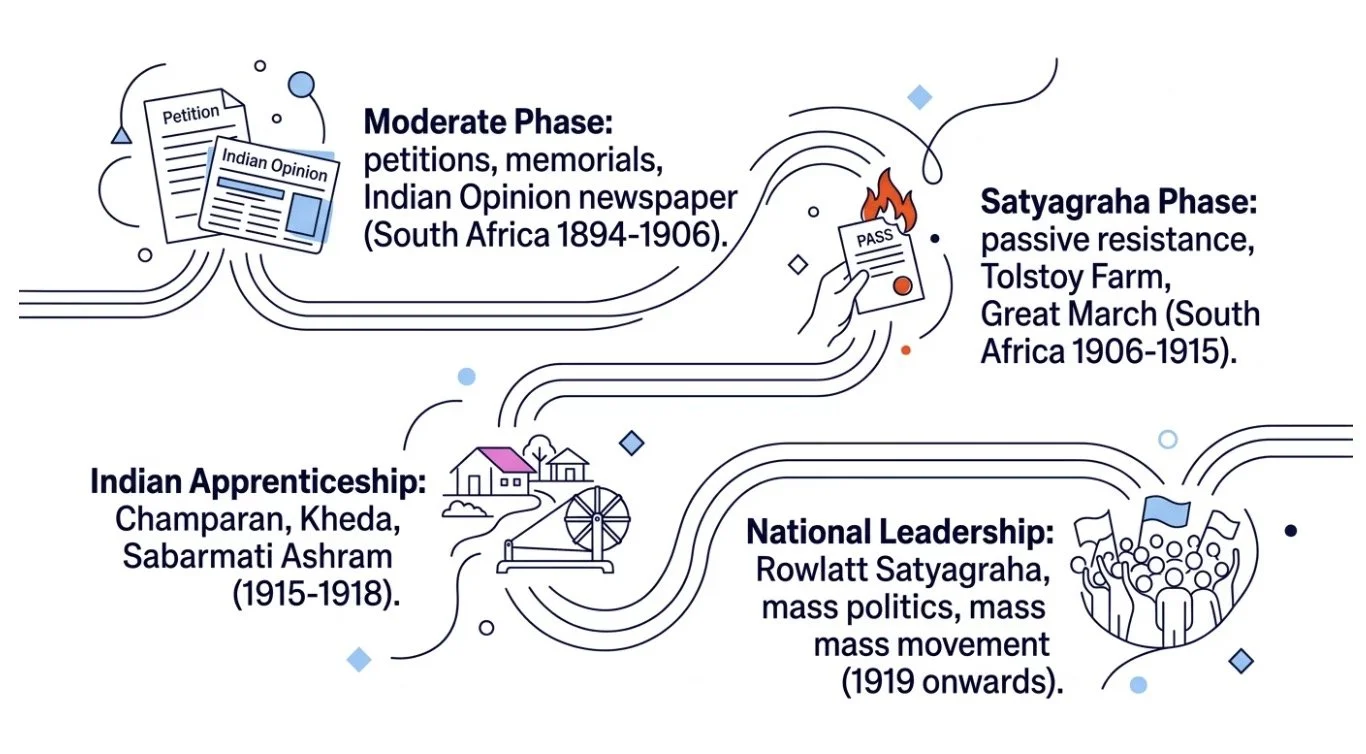
The Arc of a Transformation: Gandhi's Political Evolution
Each phase built upon the last. The Moderate phase taught Gandhi the limits of petitioning a government that was not morally accountable to those it governed. The Satyagraha phase in South Africa proved that non-violent resistance could compel concessions from a powerful state. The Indian apprenticeship gave him ground-level knowledge of the Indian masses and their capacity for sacrifice. And the mass politics of 1919 demonstrated that the Gandhian method could mobilise not just a community of migrant labourers in a foreign country, but the entirety of a vast, diverse, and ancient civilisation.
Gandhi and the Indian Masses: A Unique Bond
What set Gandhi apart from every other major political figure of his era was not just his methods, but the nature of his relationship with the Indian masses. He did not merely represent them or speak on their behalf — he became one of them, in a way that was visible, immediate, and undeniable.
The Language of Appearance
Gandhi's half-naked clothing, his discarding of the sacred thread as a token of protest against discrimination against Shudras, and his use of vernacular languages all communicated something that no speech or pamphlet could — that this leader shared, or had chosen to share, the conditions of the poorest Indian.
The Language of Religion
Gandhi used religious idioms to mobilise the masses — but this was not revivalism. He was not referring to history or invoking Hindu or Muslim glories of the past; he was speaking the language of religious morality, a language that cut across sectarian lines and resonated with the deepest values of the Indian people.
The Language of Inclusivity
He talked about swaraj as his political goal but deliberately left it undefined, so that every community — peasant, merchant, woman, Hindu, Muslim, Dalit — could interpret it in its own way and find within the movement something to fight for. This was a political masterstroke born of deep empathy rather than calculation.
Gandhi also had a clear vision of the pluralistic nature of Indian society, and remained deeply committed to the idea of a united India. He was more prepared than any other leader of his era to shift the centre of gravity of political power from the western-educated elite to the masses. His concern for Hindu-Muslim equality, the upliftment of Harijans, and the end of the exploitation of depressed classes manifested a political outlook of unusual breadth and moral seriousness.
Key Figures in Gandhi's Early Career
Gandhi's early activism — in South Africa and in the first years back in India — was never a solo performance. It was shaped by a constellation of individuals who challenged him, supported him, taught him, and in many cases gave everything they had to a cause he led.
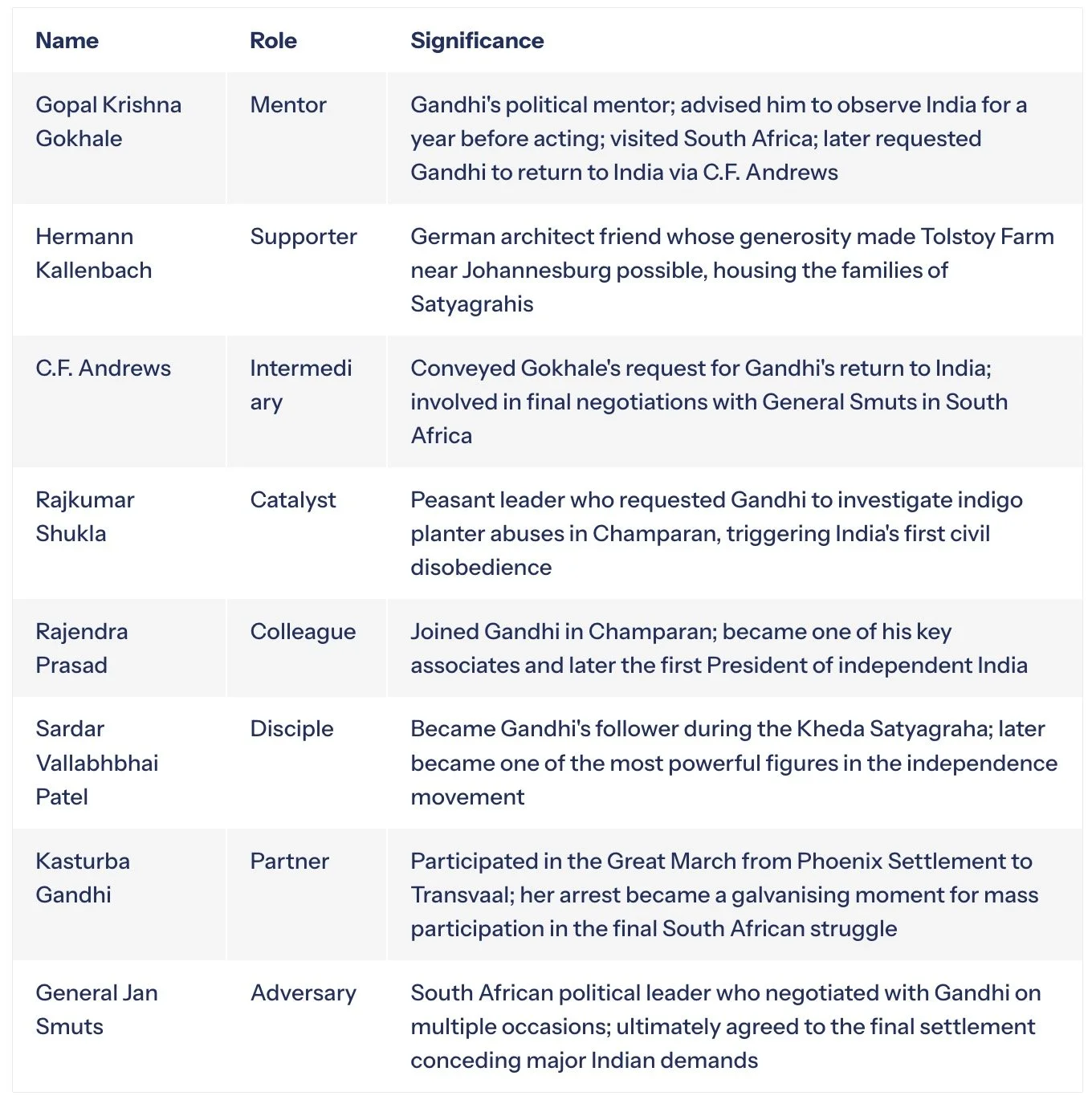
Key Figures in Gandhi's Early Career
