
The Home Rule Movement & the Lucknow Pact (1915–1916)
The years 1915–1916 mark a decisive turning point in India's freedom struggle. The Home Rule Movement — led by Bal Gangadhar Tilak and Annie Besant — injected fresh urgency into the demand for self-government, while the Lucknow Pact of 1916 forged an unprecedented alliance between the Indian National Congress and the All India Muslim League. Together, these developments shifted Indian nationalism from cautious deliberation toward aggressive, mass-oriented politics, laying the groundwork for the Gandhian era that would follow.
Origins of the Home Rule Movement
The Home Rule Movement was India's most effective domestic political response to the upheaval of the First World War. While Indians abroad channelled their energies into the ill-fated Ghadar adventure, a quieter but far more consequential mobilisation was taking shape at home. Inspired directly by the Irish Home Rule Leagues, the movement sought Dominion status for India — the same autonomous self-governance enjoyed by Australia, Canada, South Africa, New Zealand, and Newfoundland within the British Empire.
The movement represented the emergence of aggressive, popular politics as opposed to the polite petitioning of the Moderate era. Its two principal architects — Annie Besant, the Irish theosophist who had been based in India since 1896, and Bal Gangadhar Tilak, who had just been released from his Mandalay imprisonment in June 1914 — recognised that constitutional lobbying alone could not compel the British government to act. Popular pressure, organised and sustained, was needed.
B.G. Tilak's League
Founded April 1916 in Poona, Maharashtra. Covered Maharashtra (excluding Bombay city), Karnataka, Central Provinces and Berar. Six branches. Demanded swarajya, linguistic states, and vernacular education.
Annie Besant's League
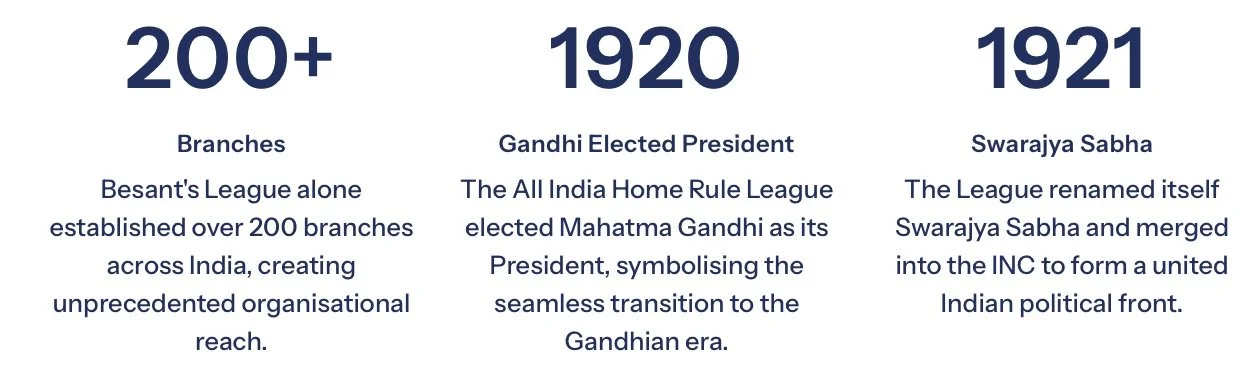
Founded September 1916 in Madras. Covered the rest of India including Bombay city. Over 200 branches, loosely organised. George Arundale served as organising secretary, with B.W. Wadia and C.P. Ramaswamy Aiyar doing key work.
Factors That Sparked the Movement
The Home Rule Movement did not arise in a vacuum. A confluence of political disillusionment, wartime grievances, and ideological realignment created fertile ground for an aggressive new politics.
Disillusionment with Morley-Minto Reforms
The Moderates, who had championed constitutional cooperation with the British, found the 1909 Morley-Minto reforms deeply inadequate. The promised expansion of legislative councils fell far short of genuine self-government, leaving even loyalist nationalists frustrated and politically directionless.
Wartime Economic Hardship
The First World War brought crippling economic burdens — high taxation, soaring prices, and general misery — to ordinary Indians. This widespread suffering made the population ready to participate in movements of protest that they might otherwise have avoided. The war, ironically, broadened the political constituency for Home Rule.
Exposure of White Racial Superiority
The spectacle of European powers engaged in savage, mutually destructive warfare shattered the myth of white superiority that had long underpinned imperial ideology. Indians who had been told that British rule was a civilising mission now watched their rulers tear each other apart through naked propaganda and mass slaughter, undermining the moral legitimacy of empire.
Tilak's Return and Reconciliatory Posture
After his release in June 1914, Tilak adopted a carefully calculated conciliatory tone — reassuring the Government of his loyalty, urging Indians to support Britain in its hour of crisis, and signalling to the Moderates that he sought administrative reform, not the overthrow of government. This repositioning was essential to broadening the coalition behind Home Rule.
Building the Leagues: Strategy and Structure
Both Tilak and Besant understood that the movement's success depended on securing the sanction of a Moderate-dominated Congress while simultaneously energising the Extremist camp. Having failed at the 1914 Congress session to broker a Moderate-Extremist rapprochement, they resolved to act independently — but strategically.
By early 1915, Besant had launched a sustained public campaign through her newspapers New India and Commonweal, through public meetings and conferences, and through a tireless schedule of propaganda work. At the 1915 annual Congress session, their joint efforts yielded partial results: the Extremists were readmitted to the Congress. However, Besant's proposal for Home Rule Leagues was not adopted. Frustrated, she issued an ultimatum — if the Congress failed to implement its commitments, she would form her own League. True to her word, she did.
1914
Tilak released from Mandalay; Moderate-Extremist rapprochement fails at Congress session.
Early 1915
Besant launches press and public-meeting campaign; Congress readmits Extremists at annual session.
April 1916
Tilak establishes his Home Rule League in Poona with six branches.
September 1916
Besant establishes her League in Madras with over 200 branches across the rest of India.
December 1916
Lucknow Pact signed; Home Rule agitation gains momentum nationally.
The two Leagues were kept deliberately separate to avoid friction between their leaders' differing styles and constituencies. Tilak's League had a tighter organisational structure and concentrated on western and central India, while Besant's was more loosely run but covered an enormously wider geographic area. Together, they formed the most extensive nationwide political network India had yet seen outside of Congress itself.
Who Joined — and Who Did Not
The Home Rule agitation attracted a remarkable cross-section of the nationalist elite. Beyond Tilak and Besant's core supporters, figures who would define Indian politics for the next three decades joined the movement: Motilal Nehru, Jawaharlal Nehru, Bhulabhai Desai, Chittaranjan Das, Madan Mohan Malaviya, Mohammad Ali Jinnah, Tej Bahadur Sapru, and Lala Lajpat Rai — several of whom became heads of local branches. Even many Moderate Congressmen disillusioned with Congress inactivity, and some members of Gokhale's Servants of India Society, joined the agitation.
Who Joined
Educated Indians, college students, city-dwellers, many Moderate and Extremist Congressmen, members of the All India Muslim League (post-Lucknow Pact), and leaders from previously politically inactive regions such as Gujarat, Sindh, Punjab, and United Provinces.
Who Stayed Away
Anglo-Indians, most Muslims, and non-Brahmans from South India largely refused to participate. Their concern was that "Home Rule" was code for the rule of the Hindu upper-caste majority — a fear that the League's predominantly Brahman leadership in Madras, Maharashtra, and Karnataka did little to dispel, despite some untouchable support.
The Home Rule League Programme
The League's programme was deliberately designed to reach beyond the educated elite and penetrate new social and geographic constituencies. The central message — Home Rule as self-government — was to be carried to the common man through every available medium and institution.
Political Education
Public meetings, conferences, and classes for students on politics. Libraries and reading rooms stocked with books on national politics.
Mass Media & Culture
Propaganda through newspapers, pamphlets, posters, illustrated postcards, plays, and religious songs — making Home Rule a cultural as well as a political phenomenon.
Organisation Building
Collecting funds, organising social work, and participating in local government activities to build grassroots networks that linked town to country.
Geographic Expansion
The League carried political awareness into hitherto 'politically backward' regions — Gujarat, Sindh, Punjab, Bihar, Orissa, Central Provinces — dramatically widening the nationalist map.
An unexpected boost came from the Russian Revolution of 1917, which demonstrated to Indian nationalists that entrenched imperial and autocratic structures could indeed be toppled. It added ideological confidence and a sense of historical momentum to the Home Rule campaign.
Government Repression and Its Backfire
The colonial government responded to the Home Rule agitation with a combination of legal harassment, administrative bans, and outright arrest — measures that proved spectacularly counterproductive. In Madras, students were prohibited from attending political meetings. A sedition case was instituted against Tilak, only to be struck down by the High Court. Tilak was barred from entering Punjab and Delhi.
"Shiva…cut his wife into fifty-two pieces only to discover that he had fifty-two wives. This is what happens to the Government of India when it interns Mrs Besant."
— Edwin Montagu, Secretary of State for India
In June 1917, Annie Besant and her close associates B.P. Wadia and George Arundale were arrested. The arrests triggered nationwide outrage. In a dramatic act of protest, Sir S. Subramaniya Aiyar renounced his knighthood. Tilak called for a programme of passive resistance. The repression had precisely the opposite of its intended effect: it hardened the agitators' resolve, swelled sympathy for the movement, and forced the government's hand. Besant was released in September 1917 — a direct acknowledgement of the political pressure the movement had generated. Montagu's wry observation above captured the colonial government's frustration perfectly: suppression had only multiplied the movement's influence.
Why the Agitation Faded by 1919
After its remarkable advance in 1917, the Home Rule Movement entered a period of fragmentation and eventual dissolution. A series of internal contradictions and external shocks conspired to diffuse the energies that had concentrated in the agitation.
At its core, the movement suffered from three structural weaknesses.
First, it could fire up the educated urban middle class but never successfully penetrated the rural masses — the social base that any truly national movement needed.
Second, its leadership was divided and inconsistent: Besant drifted toward conciliation with the Moderates after the Montagu-Chelmsford announcement of July 1918, alienating the young extremist leaders who were her chief support base. Tilak, more consistent, was handicapped by Besant's vacillations and chose this critical juncture to travel to England to pursue a libel case against Valentine Chirol, author of Indian Unrest. With both leaders absent or irresolute, the movement was effectively leaderless.
Third, and most decisively, Mohandas Gandhi returned from South Africa with a new political grammar — non-violent but mass-based civil disobedience — that rendered the Home Rule Leagues structurally obsolete.
Positive Gains: The Enduring Legacy
Despite its failure to sustain momentum, the Home Rule Movement should emphatically not be counted a failure. Its contributions to the long arc of Indian nationalism were profound and lasting.
Positive Gains: The Enduring Legacy
Transitional Phase
The Home Rule Leagues marked the crucial transitional phase between the deliberative, elite-dominated INC and the mass-based politics of Gandhian agitation — a bridge between two eras of Indian nationalism.
Organisational Infrastructure
The Leagues created organisational links between town and country that proved invaluable in later years, giving the nationalist movement a grassroots nervous system it had previously lacked.
Geographic Spread of Nationalism
Political consciousness was spread into new regions — Sindh, Punjab, Gujarat, United Provinces, Central Provinces, Bihar, and Orissa — permanently expanding the map of active Indian nationalism.
Influencing British Policy
The August 1917 Montagu Declaration and the subsequent Montagu-Chelmsford reforms were directly influenced by the pressure generated by the Home Rule agitation — a tangible policy victory.
The Lucknow Pact, 1916
At their joint sessions in Lucknow at the close of 1916, the Indian National Congress and the All India Muslim League achieved something historically unprecedented: a formal agreement — the Lucknow Pact — through which they presented a united set of constitutional demands before the British Government. The centrepiece of these demands was self-government for India after the war. The Pact was simultaneously a landmark of Hindu-Muslim political cooperation and, in retrospect, a document whose concessions to communal representation planted seeds of future conflict.
Two figures were central to brokering this agreement. Lokmanya Bal Gangadhar Tilak provided the Congress's Extremist energy and credibility. Muhammad Ali Jinnah — then a member of both the Congress and the Muslim League — provided the diplomatic skill to bring both organisations to the table. For his role in engineering this remarkable unity, Sarojini Naidu awarded Jinnah the enduring title of "Ambassador of Hindu-Muslim Unity." The Pact also healed the internal Congress rift between Extremists and Moderates, reviving the party as an effective instrument of Indian nationalism.
Why the Pact Came About: Background and Causes
The Lucknow Pact was not a spontaneous act of statesmanship. It was the product of shifting political calculations on both sides — the Congress and the Muslim League — driven by a set of converging pressures.
Annulment of the Bengal Partition
The British government's 1911 decision to annul the partition of Bengal — a concession to Hindu nationalist pressure — deeply alienated the Muslim League leadership, which had supported partition. The League, originally a loyalist organisation, began reconsidering its pro-British stance and looking for new political alliances.
New Muslim Leadership (1913)
In 1913, a younger, more assertive group of Muslim leaders entered the League, replacing the old guard's deference to Britain with a demand for meaningful constitutional concessions. This generational shift made the League a more willing partner in nationalist politics.
The Caliph Question
Britain's perceived indifference to the Ottoman Caliph — regarded by Muslims worldwide as their supreme religious head — generated deep Muslim hostility toward the British government, pushing the League toward the Congress's critical stance on colonial rule.
Anticipated Post-War Reforms
Lord Chelmsford's invitation for Indian suggestions regarding post-war constitutional reforms gave the Muslim League a powerful incentive to enter the political mainstream. Participation in a joint Congress-League front would give the League far more leverage in shaping the expected reform package than isolation could ever provide.
The process unfolded in stages. In December 1915, Extremists under Tilak and Moderates under Gokhale met in Bombay, where the Muslim League joined them to draft minimum constitutional demands — marking the first time the principal leaders of both political parties shared a platform with similar themes and tone. In October 1916, nineteen Muslim and Hindu members of the Imperial Legislative Council jointly addressed a memorandum to the Viceroy. Their proposals were discussed and refined at a Congress-League meeting in Calcutta in November 1916, and confirmed at the joint sessions in Lucknow on December 29 and December 31, 1916.
Main Features of the Lucknow Pact
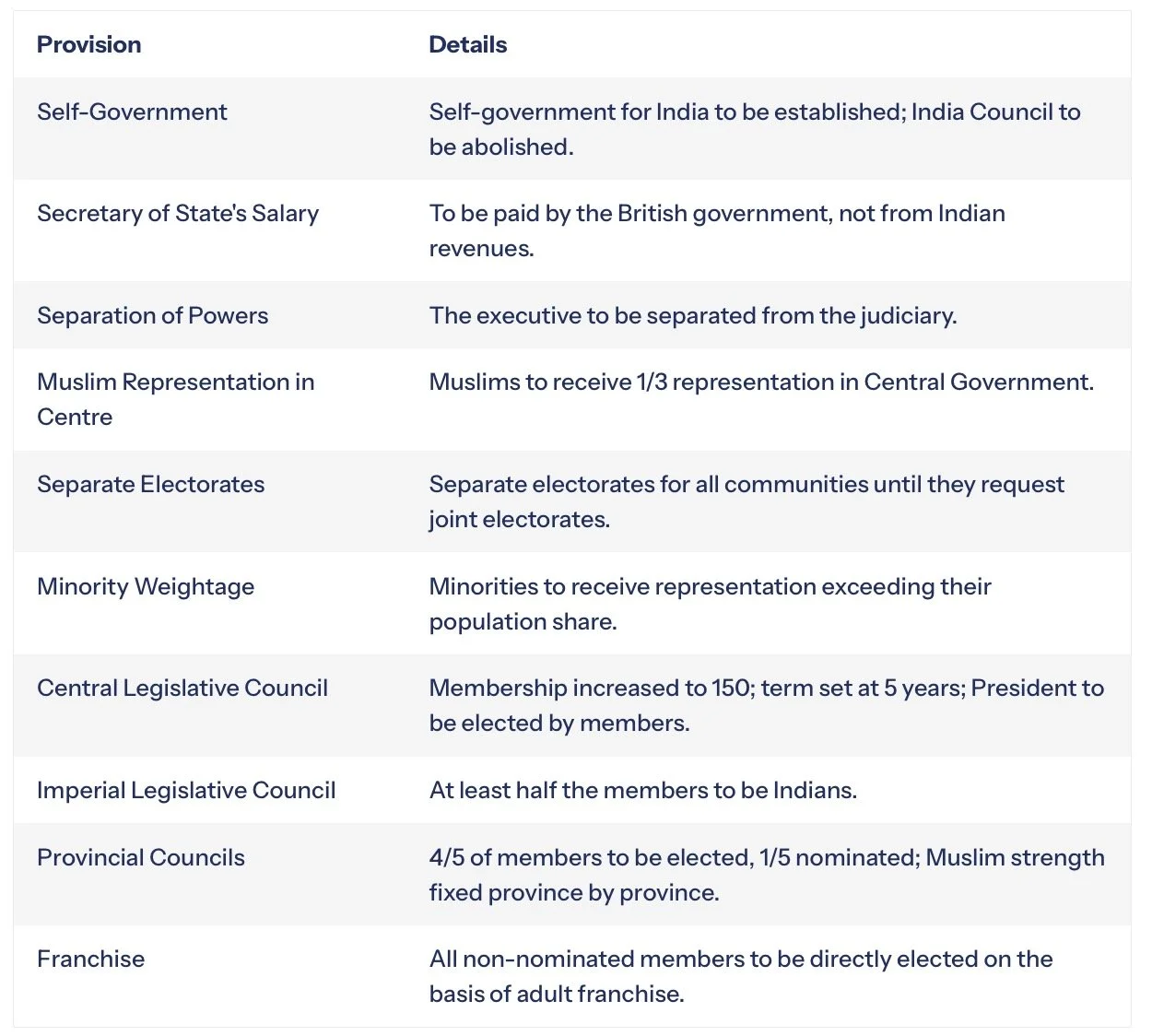
The Lucknow Pact combined broad constitutional demands for self-government with specific provisions for communal representation — particularly for Muslims. The following table summarises its principal provisions.
Main Features of the Lucknow Pact
Assessment of the Lucknow Pact
The Lucknow Pact has been the subject of intense historical debate. In the short term, it was celebrated as a triumph of Hindu-Muslim unity and a masterpiece of nationalist diplomacy. In the longer term, historians and political analysts have pointed to its communal provisions as structural fault lines that contributed to the eventual partition of India in 1947. A balanced assessment requires holding both dimensions simultaneously.
Immediate Achievements
United Congress and Muslim League on a common constitutional platform for the first time in history.
Revived the Congress as an effective instrument by reuniting Extremists and Moderates.
Generated significant pressure on the British government, contributing to the Montagu Declaration of 1917.
Established Jinnah as a national statesman and symbol of Hindu-Muslim cooperation.
Long-Term Problems
Congress formally recognised communal politics and the principle of separate electorates — implicitly accepting that India consisted of communities with irreconcilably separate interests.
Muslim representation at 1/3 in the central legislature far exceeded the Muslim population share, setting a precedent for communal over-representation.
The principle that no legislation could pass if 3/4 of any religious community opposed it effectively introduced a communal veto into legislative practice.
The Congress's "recognition" of the Muslim League as the representative body of Indian Muslims was, in retrospect, a historic error — one whose logical implications (the two-nation theory, partition) INC leaders failed to foresee.
The outbreak of communal riots in Bihar, United Provinces, and Bengal shortly after the Pact revealed the continuing disjunction between elite-level political agreements and the realities of inter-communal relations at the mass level — a warning that the Pact's architects chose to overlook.
The Home Rule Movement and the Lucknow Pact were not parallel but separate events — they were deeply interconnected. Both took shape in the same critical year of 1916, both were animated by the same demand for self-government, and both were shaped by many of the same individuals.
Lucknow Pact (Dec 1916)
Congress-League unity gives the self-government demand a broad Hindu-Muslim front, boosting Home Rule's political legitimacy.
Home Rule Agitation
Mass mobilisation across India creates popular pressure that the Lucknow Pact's elite-level negotiations need to appear credible to the British.
Montagu Declaration (Aug 1917)
British concession to "increasing association of Indians" in government — directly influenced by both the Pact and Home Rule pressure.
Nationalist Generation
Both events produce a trained, committed corps of nationalist leaders who carry the movement into the Gandhian era and beyond.
Jinnah, for example, was both a signatory of the Lucknow Pact and a prominent joiner of the Home Rule agitation. Tilak was the central figure in both. The 1917 decision of the Muslim League to support Besant's Home Rule campaign was directly enabled by the cooperative spirit the Lucknow Pact had established. The two events together constituted the high-water mark of pre-Gandhian nationalist politics — a moment when the Indian political classes, across communal and factional lines, briefly converged on a shared vision of self-governing India within the Empire.
The events of 1915–1916 constitute one of the most consequential chapters in modern Indian history. Here is a concise summary of the most important points to remember.
Home Rule as a New Political Style
The Home Rule Movement marked the shift from Moderate petitioning to aggressive, popular mobilisation. It was the crucial transitional phase between elite Congress politics and the mass-based Gandhian movement — a bridge between two eras.
Tilak and Besant: Complementary but Different
Tilak's League was tightly organised and geographically focused; Besant's was broader but looser. Their eventual divergence — especially Besant's conciliatory drift in 1918 — was a primary cause of the movement's decline. Leadership consistency matters in sustained political mobilisation.
The Lucknow Pact: Achievement and Warning
The Pact united Congress and League on a common platform and pressured the British into constitutional concessions. But its communal provisions — separate electorates, 1/3 Muslim representation, minority weightage — institutionalised communal politics in ways that would have long and dangerous consequences.
The Limits of Elite Mobilisation
Both the Home Rule Movement and the Lucknow Pact ultimately remained elite-level phenomena, unable to bridge the gap between the political classes and the masses. It would take Mahatma Gandhi's Satyagraha to accomplish that — and the Home Rule generation would supply him with many of his most capable lieutenants.
