
The Swarajists and No Changers
A Nation at the Crossroads
In the aftermath of Gandhi's arrest in March 1922, the Indian nationalist movement entered a period of profound uncertainty. The suspension of the Non-Cooperation Movement left a political vacuum, forcing Congress leaders to confront a fundamental question: how should nationalists engage with the colonial system during a period of enforced passivity? The answer to this question divided the Congress into two distinct schools of thought — the Swarajists, who believed in entering legislative councils to fight from within, and the No Changers, who advocated quiet, constructive grassroots work. This document explores the origins, arguments, achievements, and ultimate decline of both factions, offering a comprehensive account of one of the most intellectually rich debates in the history of the Indian independence movement.
The Crisis After Gandhi's Arrest
The arrest of Mahatma Gandhi in March 1922 marked the beginning of a turbulent transitional phase for the Indian National Congress. The sudden withdrawal of the Non-Cooperation Movement, following the Chauri Chaura incident of February 1922, had already shaken the morale of nationalist cadres across the country. Gandhi's imprisonment removed the movement's central unifying force, leading to what historians describe as a period of disintegration, disorganisation, and demoralisation within nationalist ranks.
With no active mass movement to sustain political energy, Congress leaders were faced with a pressing question about the nature and direction of nationalist politics during this passive interlude. Should they continue to stand apart from colonial institutions, maintaining the purity of non-cooperation? Or should they strategically enter the very institutions they had so far rejected, using them as platforms to embarrass and undermine the colonial government?
This dilemma was not merely tactical — it reflected deeper philosophical divisions about the nature of nationalist struggle, the role of constitutional methods, and the relationship between elite politics and mass mobilisation. Two distinct factions soon crystallised within the Congress, each with its own logic and its own vision for sustaining the momentum of the independence movement through the difficult years ahead.
The debate that emerged from this crisis was, in many ways, a microcosm of the larger tensions within the nationalist movement — between constitutionalism and confrontation, between elite legislative politics and mass grassroots organising, and between short-term tactical gains and long-term revolutionary preparation.
The Two Schools of Thought: Swarajists vs. No Changers
The division within the Congress crystallised around the specific question of whether nationalists should contest elections to the legislative councils established under the Montagu-Chelmsford Reforms. The two factions that emerged were distinguished not only by their immediate tactical positions but also by their broader political philosophies.
The Swarajists (Pro-Changers)
Led by C.R. Das, Motilal Nehru, and Ajmal Khan, the Swarajists believed that nationalists should enter the legislative councils to expose their fundamental weaknesses and use them as arenas of political struggle. Their slogan was to "end or mend" the councils — either winning genuine reforms or wrecking the councils from within through obstruction.
Advocated council entry to arouse popular enthusiasm
Sought to deter Government from filling councils with loyalists
Intended to obstruct governance if demands were rejected
Saw council work as opening a "new front" in the struggle
The No Changers
Led by Vallabhbhai Patel, Rajendra Prasad, C. Rajagopalachari, and M.A. Ansari, the No Changers held that participating in colonial councils would corrupt the movement, dilute revolutionary zeal, and distract from the essential task of building organisational strength from the grassroots upward.
Opposed council entry as a betrayal of non-cooperation
Advocated continuation of constructive work programmes
Focused on preparing the masses for the next phase of civil disobedience
Warned of parliamentary work leading to political corruption
The differences between the two factions came to a head at the Gaya session of the Congress in December 1922, where the Swarajists' proposal of "ending or mending" the councils was defeated. In response, C.R. Das and Motilal Nehru resigned from the presidentship and secretaryship of the Congress respectively, and announced the formation of the Congress-Khilafat Swarajya Party — popularly known as the Swarajya Party — with C.R. Das as president and Motilal Nehru as one of its secretaries.
The Swarajist Manifesto and Programme
Released in October 1923, ahead of the November elections to the newly constituted Central Legislative Assembly and provincial assemblies, the Swarajist Manifesto was a bold and forthright document that laid bare the nationalist critique of British rule in India. It pulled no punches in characterising the colonial relationship as fundamentally exploitative and the so-called Montford reforms as a facade designed to perpetuate that exploitation.
On British Motives
The guiding motive of the British in governing India is to secure the selfish interests of their own country. The so-called reforms are only a blind to further those interests under the pretence of granting responsible government, while keeping Indians permanently in a subservient position.
On Council Strategy
The Swarajists would present the nationalist demand for self-government in councils. If this demand was rejected, they would adopt a policy of uniform, continuous, and consistent obstruction within the councils to make governance through them impossible — wrecking them from within by creating deadlocks on every measure.
Programme Goals
The broader Swarajist programme encompassed attainment of dominion status, the right to frame a constitution, control over the bureaucracy, full provincial autonomy, organisation of labour (both industrial and agricultural), federation of Asiatic countries for trade promotion, and the attainment of complete Swarajya.
The Swarajists' central argument was that entering the councils would not negate the non-cooperation programme — rather, it would be carrying on the movement through other means, opening a new front of political struggle. In a time of political vacuum, they contended, council work would serve to enthuse the masses, keep up their morale, and prevent the Government from stuffing the councils with undesirable, loyalist elements who could be used to lend legitimacy to colonial measures. Crucially, the Swarajists were at pains to clarify that they had no intention of using the councils as organs for the gradual transformation of colonial rule — their purpose was purely one of political combat.
The September 1923 Compromise and Electoral Performance
Despite the sharpness of the ideological divide, both the Swarajists and the No Changers were acutely aware of the dangers of a 1907-type split within the Congress — a split that had severely weakened the nationalist movement at a critical juncture. Both sides maintained contact with Gandhi, who was in jail, and both recognised the paramount importance of presenting a united front capable of forcing the Government to introduce meaningful reforms. This shared understanding of political necessity eventually paved the way for compromise.
At a meeting in Delhi in September 1923, a working arrangement was reached: the Swarajists were allowed to contest elections as a group within the Congress. They accepted the broad Congress programme in its entirety, with only one specific departure — that they would join and work within the legislative councils. This compromise preserved the organisational unity of the Congress while giving the Swarajists the space to pursue their distinctive strategy.
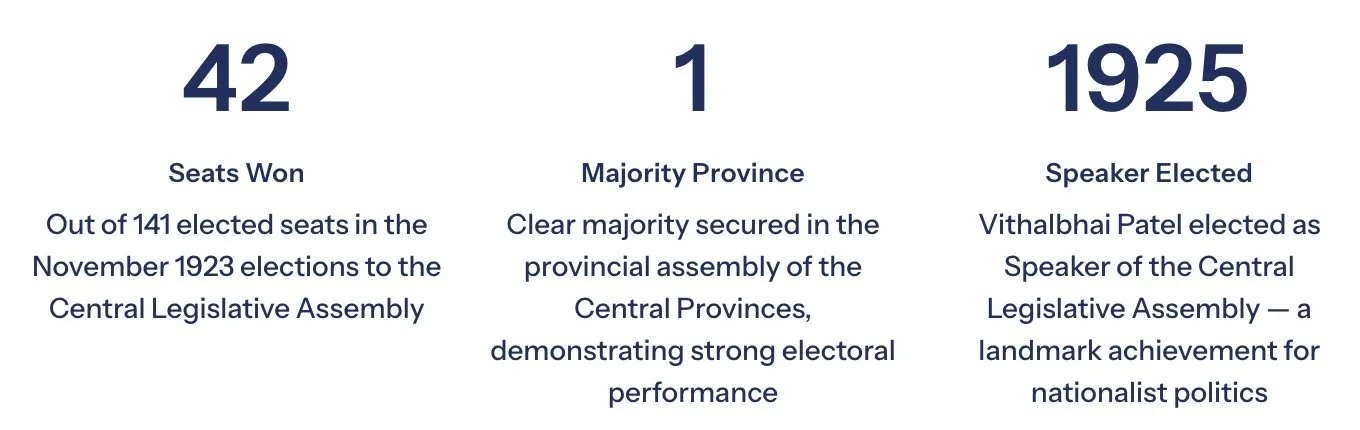
Swarajist Performance
The November 1923 electoral results were a significant vindication for the Swarajist strategy. Their performance demonstrated not only organisational competence but also the genuine popular appeal of the nationalist constitutional programme. In the legislatures, the Swarajists joined hands with Liberals and independents such as Jinnah and Malaviya, forming effective coalitions that allowed them to outvote the Government on several significant matters. This coalition-building proved to be both their greatest strength and, ultimately, a source of their structural vulnerability.
Gandhi's Evolving Attitude Towards the Swarajists
Gandhi's relationship with the Swarajist programme underwent a significant evolution. Initially, he was opposed to the idea of council entry, viewing it as a compromise of the non-cooperation ideal he had championed. However, after his release from prison on health grounds in February 1924, Gandhi gradually moved towards reconciliation with the Swarajists, driven by a combination of practical political calculations and his own assessment of the movement's changing situation.
Avoiding Counterproductive Opposition
Gandhi came to feel that publicly opposing the programme of council entry — which had already been embraced by a significant section of nationalist opinion — would be counterproductive to the larger cause of national unity. The political cost of open confrontation with the Swarajists outweighed any ideological benefit.
Impressed by Swarajist Conduct
The courageous and uncompromising manner in which the Swarajists functioned within the legislatures — outvoting the Government, passing adjournment motions, and refusing to be co-opted — convinced Gandhi that they would not simply become another limb of the colonial administration. Their conduct demonstrated genuine political integrity.
Government Crackdown Expressed Solidarity
Towards the end of 1924, the Government launched a crackdown on both revolutionary terrorists and the Swarajists. This angered Gandhi deeply, and he expressed his solidarity with the Swarajists by surrendering to their wishes — a powerful gesture that signalled the reunification of the Congress under a broad nationalist umbrella.
Gandhi's reconciliation with the Swarajists was more than a tactical manoeuvre — it reflected his deeper understanding that the nationalist movement required multiple modes of engagement, and that the line between constitutional politics and mass mobilisation was not always as sharp as ideological purists insisted. His endorsement lent the Swarajists crucial legitimacy and helped stabilise the Congress during a particularly fragmented period.
Achievements of the Swarajists
Despite their eventual decline, the Swarajists chalked up several noteworthy achievements during their years of active engagement with the legislative councils. Their work within these institutions demonstrated that the councils could be used creatively and confrontationally, even within the constrained framework of the Montford reforms — and this demonstration had lasting significance for the larger nationalist project.
Legislative Obstruction
With coalition partners, the Swarajists outvoted the Government several times, even on matters relating to budgetary grants, and passed adjournment motions that embarrassed the administration and exposed the weakness of the colonial legislative framework.
Powerful Nationalist Advocacy
Through powerful speeches on self-government, civil liberties, and industrialisation, Swarajist legislators kept nationalist demands alive in the public consciousness at a time when mass movement activity was at a low ebb — using the legislature as a platform for political education.
Defeat of the Public Safety Bill (1928)
A landmark achievement was the defeat of the Public Safety Bill in 1928 — legislation aimed at empowering the Government to deport undesirable foreigners, particularly socialist and communist activists. This was a direct blow against the Government's efforts to suppress radical politics.
Exposing Montford Reforms
The Swarajists exposed the hollowness of the Montagu-Chelmsford Reforms, demonstrating to both Indian public opinion and the international community that the so-called constitutional concessions offered by the British were neither genuine nor adequate to meet nationalist aspirations.
Perhaps most significantly, the Swarajists filled the political vacuum at a time when the national movement was recouping its strength following the suspended civil disobedience programme. They kept the flame of political activism burning within the institutional sphere, preventing the total collapse of nationalist morale during what might otherwise have been a period of complete political dormancy. The election of Vithalbhai Patel as Speaker of the Central Legislative Assembly in 1925 was a particular milestone — representing the first time a nationalist had occupied one of the most prestigious offices within the colonial legislative structure.
The Decline of the Swarajists
The Swarajists' trajectory from electoral success to political decline was shaped by a complex interplay of internal contradictions, external pressures, and the shifting landscape of nationalist politics in the mid-to-late 1920s. The very coalition politics that had been their greatest strength proved, in the long run, to be a source of instability — for the ideological ground on which their unity rested was, as historians have noted, weak and shallow.
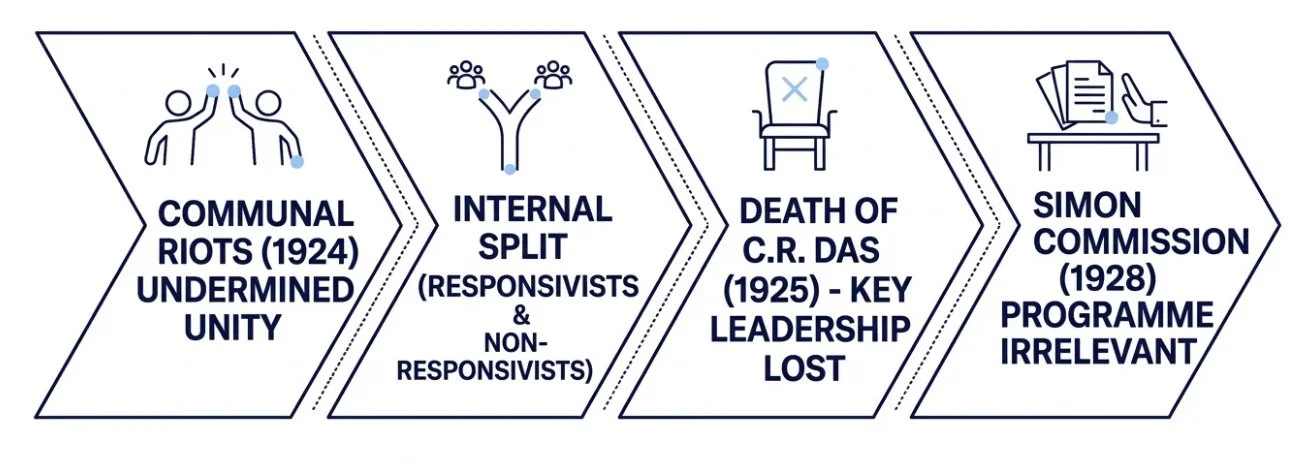
The Decline of the Swarajists
The Responsivist faction — comprising Lala Lajpat Rai, Madan Mohan Malaviya, and N.C. Kelkar — advocated cooperation with the Government and the acceptance of office wherever possible, ostensibly to protect Hindu interests. Their attacks on Non-responsivists like Motilal Nehru, whom they accused of being "anti-Hindu" and a "beef-eater," introduced a poisonous communal dimension into what had previously been a broadly political debate, further fracturing the party's coherence.
By 1926, the main leadership of the Swarajya Party had reiterated its faith in mass civil disobedience and withdrawn from the legislatures, while another section of Swarajists contested the 1926 elections as a party in disarray, faring poorly. The arrival of the Simon Commission in 1928 created a new political situation — one in which all parties joined hands in anti-Simon agitation, rendering the constitutional programme of council entry largely irrelevant. Finally, the Lahore Congress resolution on Purna Swaraj in 1929 and the launch of the Civil Disobedience Movement in 1930 decisively ended the era of Swarajist politics. The party merged with the Congress, its members joining the renewed mass movement.
Drawbacks of the Swarajist Approach
A critical assessment of the Swarajist experiment reveals significant structural weaknesses that limited its effectiveness and hastened its decline. While their achievements within the legislature were real and meaningful, the Swarajists were ultimately unable to translate legislative combativeness into sustained mass political engagement — and this disconnect proved fatal to their long-term viability as a political force.
Lack of Mass Coordination
The Swarajists lacked a coherent policy to coordinate their militancy inside the legislatures with mass struggle outside them. They relied almost entirely on newspaper reporting to communicate with the public, which severely limited their reach beyond the literate urban classes.
Obstructionism's Limits
A strategy of pure obstruction could work only up to a point. Beyond that point, it became a severe constraint — particularly as the Swarajists found themselves unable to obstruct effectively without strong coalition partners whose interests were not always aligned with nationalist goals.
Class Collaboration Contradictions
Both the 'Swarajist Programme' and 'Swarajists at Work' showed marked contradictions. They stood for class collaboration — unity of Zamindar and peasant, capitalists and workers — which rested on irrational ground and could not be sustained in the face of actual economic conflicts between these groups.
Temptation of Power
In the later phase, the tendency towards responsive cooperation appeared at work instead of non-cooperation. The Swarajists failed to resist the perks and privileges of power: Motilal Nehru sat on the Skeen Committee, Vithalbhai Patel became Assembly President, and A. Ramaswamy Iyengar accepted membership of the Public Accounts Committee.
Alienation of Peasant Base
The Swarajists failed to support the peasants' cause in Bengal, thereby losing support among Muslim members who were pro-peasant. This failure to articulate and champion the economic grievances of the rural poor revealed the class limitations of their predominantly elite politics.
The Constructive Work of the No Changers
While the Swarajists fought their battles in the glare of legislative chambers and newspaper headlines, the No Changers engaged in what was, in many respects, a quieter but arguably more transformative enterprise: the patient, unglamorous, grassroots work of building the social and organisational foundations of a future independent nation. Led by figures like Vallabhbhai Patel, Rajendra Prasad, and C. Rajagopalachari, and guided by the Gandhian vision of social regeneration, the No Changers pursued a programme of constructive work that touched dimensions of Indian life that legislative politics could barely reach.
Promotion of Khadi and Spinning
The promotion of khadi and the spinning wheel (charkha) was both an economic programme — encouraging village-based production as an alternative to British manufactured cloth — and a powerful symbol of self-reliance and the rejection of colonial economic dependency. The boycott of foreign cloth was described as "a stroke of genius" demonstrating Indians' determination to be free.
National Education
National schools and colleges trained young men and women in an alternative, non-colonial ideological framework. A large number of young people who had dropped out of official institutions in 1920–21 were channelled into these institutions, and many became full-time cadres of the movement, providing an invaluable trained workforce for future agitations.
Hindu-Muslim Unity and Anti-Untouchability
The constructive programme explicitly included work towards Hindu-Muslim unity — a pressing concern given the communal tensions of the period — as well as the struggle against untouchability, which sought to begin the long process of integrating the lower castes into the broader national movement.
This work was symbolised by hundreds of ashrams that came up all over the country, particularly in the Kheda and Bardoli areas of Gujarat, where political cadres received practical training in khadi work and work among lower castes and tribal communities. These ashrams served as the incubators of a new generation of nationalist activists — people who were not merely intellectually committed to independence but had developed genuine bonds with rural communities and practical organisational skills. The constructive workers were, in Gandhi's vision, to serve as the "steel frame" of the nationalist movement in its active Satyagraha phase, and this vision was largely vindicated when the Civil Disobedience Movement of 1930 drew heavily on the organisational network built through these years of quiet work.
Benefits and Critique of Constructive Work
The constructive work programme of the No Changers generated both significant achievements and notable limitations. A balanced assessment requires engaging seriously with both, recognising that the programme's strengths and weaknesses were often two sides of the same coin — reflecting the broader tensions within Gandhian nationalism between its transformative aspirations and its social conservatism.
Benefits of Constructive Work
Provided much-needed relief to the poor during the passive phase of the movement
Made urban-based, upper-caste cadres familiar with village conditions and the lives of lower castes
Built bonds with sections of the masses hitherto untouched by nationalist politics
Filled rural masses with new hope and increased Congress influence in the countryside
Developed cadres' organising capacity and self-reliance for future struggles
Served as the primary channel for recruitment and training of freedom fighters
Promoted the process of nation-building by forging connections across caste and class lines
National schools created an alternative, non-colonial educational framework
Critique of Constructive Work
National education primarily benefited the urban lower middle classes and rich peasants, not the poorest sections
Enthusiasm for national schools surfaced mainly in the excitement of agitation; in passive periods, the lure of degrees and jobs drew students back to official institutions
Popularisation of khadi was an uphill task since it was costlier than imported cloth for the very poor it sought to help
While campaigning on the social aspect of untouchability, no emphasis was laid on the economic grievances of landless and agricultural labourers — who comprised mostly the untouchables
The programme ultimately reinforced rather than challenged the existing class structure of Indian society
Without the uplift of the lower castes and Adivasis there could be no united struggle against colonialism. The boycott of foreign cloth was a stroke of genius which demonstrated to rulers and the world the Indian people's determination to be free.
Gandhi himself, after his release from jail in 1924, remained aloof from direct politics and concentrated his energies entirely on constructive work. The colonial government, observing his withdrawal from mass agitation, considered him a spent political force — a significant miscalculation that would be dramatically refuted when Gandhi launched the Civil Disobedience Movement in 1930, drawing on the organisational networks and mass consciousness that the constructive work programme had so patiently built.
Legacy and Historical Significance
The debate between the Swarajists and the No Changers represents one of the most intellectually substantive internal debates in the history of the Indian National Congress. Far from being a mere factional squabble, it was a genuine engagement with fundamental questions about political strategy, the nature of colonial institutions, the relationship between elite politics and mass mobilisation, and the appropriate methods of struggle during periods of enforced political passivity.
March 1922
Gandhi arrested; Non-Cooperation Movement suspended; nationalist ranks demoralised
December 1922
Gaya Congress session; Swarajist proposal defeated; C.R. Das and Motilal Nehru form the Swarajya Party
September 1923
Delhi compromise; Swarajists allowed to contest elections within the Congress framework
November 1923
Swarajists win 42 of 141 elected seats; clear majority in Central Provinces assembly
1925
Vithalbhai Patel elected Speaker; C.R. Das dies — a major blow to Swarajist cohesion
1928
Defeat of Public Safety Bill; Simon Commission arrives; constitutional programme loses relevance
1930
Lahore Congress resolution on Purna Swaraj; Swarajists merge with Congress; Civil Disobedience Movement launched
Both the Swarajists and the No Changers made indispensable contributions to the nationalist movement, even as they operated from opposing strategic premises. The Swarajists demonstrated that the councils could be used combatively, kept nationalist politics visible during a period of mass movement dormancy, and scored significant victories against specific colonial legislative measures. The No Changers, meanwhile, built the organisational infrastructure, the mass consciousness, and the trained cadres without which the eventual success of the Civil Disobedience Movement of 1930–34 would have been impossible. Together, they ensured that the nationalist movement survived and deepened during one of its most challenging transitional phases — a legacy that deserves to be remembered and studied with the care and nuance it demands.
Gandhi's post-1924 focus on constructive work — dismissed by the colonial government as a sign of political exhaustion — was in fact the patient preparation for the most powerful mass movement India had yet seen. The Civil Disobedience Movement of 1930 drew directly on the networks, the cadres, and the mass consciousness that the constructive programme had built through years of quiet, determined work.
