
The Senas of Bengal
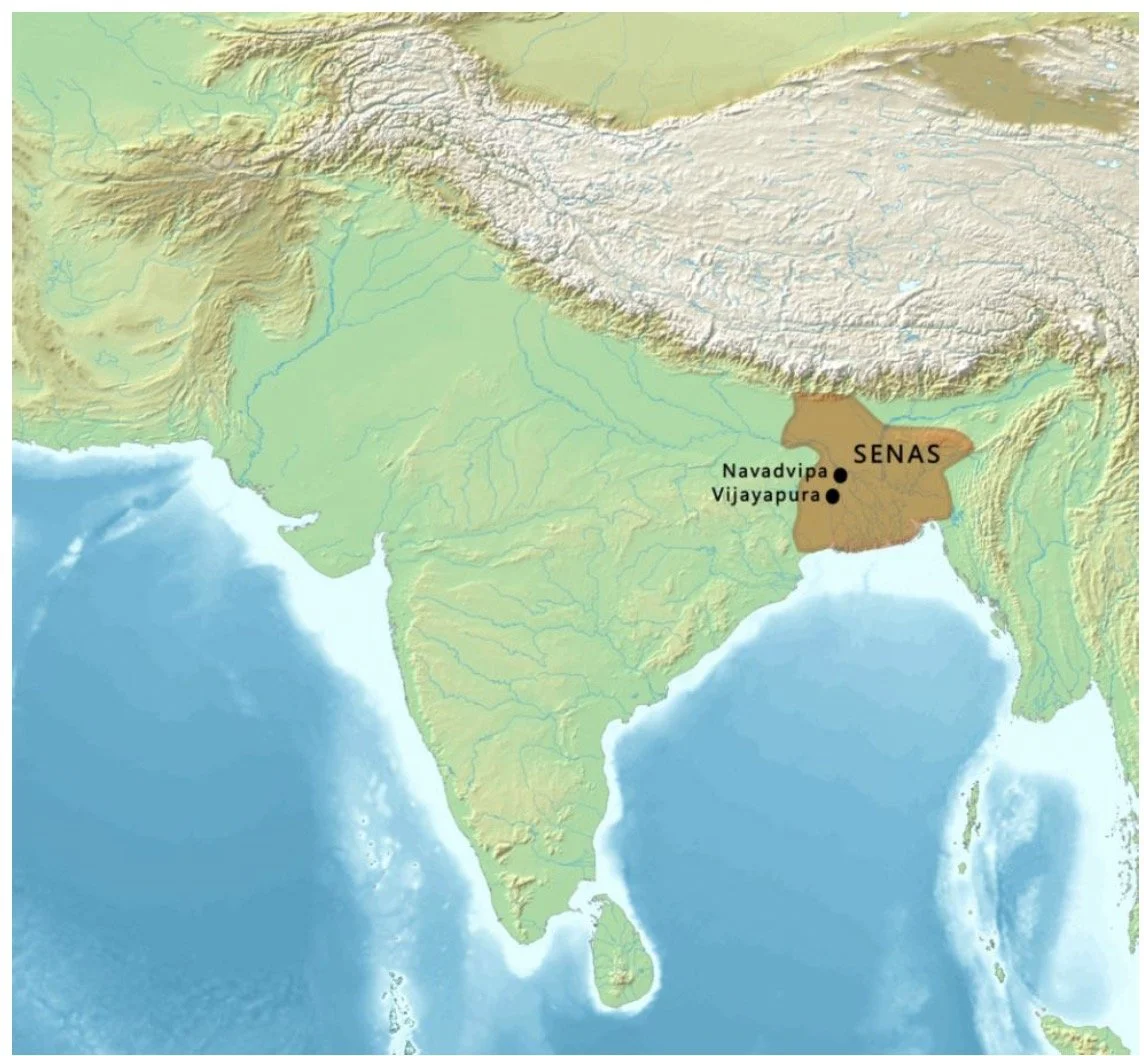
The Sena Dynasty stands as one of the most consequential ruling houses of early medieval India, governing the Bengal region through the 11th and 12th centuries CE. A proud Hindu dynasty of southern Indian origin, the Senas rose from the position of feudatory chiefs under the Palas to become sovereign rulers of a vast empire encompassing much of the northeastern Indian subcontinent.
Dynasty
Hindu ruling house of Karnataka origin, governing Bengal from the late 11th to early 13th century CE
Territory
At its height, encompassed Bengal, Odisha, Bihar, and likely extended to Varanasi in the west
Period
c. 1097–1223 CE, succeeding the Pala Dynasty as the dominant power in northeastern India
Legacy
Pivotal patrons of orthodox Hinduism, Sanskrit literature, and a distinctive sculptural tradition in Bengal
Origins and Early History of the Sena Dynasty
The origins of the Sena Dynasty are illuminated chiefly through epigraphic evidence, most notably the celebrated Deopara Prashasti. According to this inscription, Samanthasena — the progenitor of the dynasty — was a Brahmakshatriya immigrant, a compound designation of significant social meaning. The term "Brahma-Kshatriya" suggests that the Senas of Bengal were originally Brahmins by caste who deliberately assumed the role and identity of Kshatriyas by taking up arms, thereby straddling two of the four varnas of the Hindu social order. Historian P.N. Chopra has further proposed that the Baidyas — a prominent learned caste in Bengal — may also have connections to the Sena royal lineage, adding another layer of complexity to questions of their social origins.
The geographical roots of the dynasty lie firmly in Karnataka, a province in southern India, making the Senas part of a broader pattern of southern dynasties exerting influence over northern and eastern India during the early medieval period. Their southerly marriage alliances, most visibly Ballala Sena's union with Ramadevi of the Western Chalukya Kingdom, reinforced these deep social ties to the Deccan even as the dynasty consolidated power in the far northeast.
The Senas initially entered the political landscape of Bengal as samantas — feudatory chiefs — in the service of the Pala Dynasty in the region of Radha. This subordinate relationship likely began under Samantasena himself. Gradually, through diplomatic acumen and military prowess, they expanded their influence, and by the close of Vijayasena's reign the Senas had extended Pala-administered territory to include Vanga and a portion of Varendra. The transition from vassalage to sovereignty was achieved through a combination of strategic opportunism and political vision across successive generations.
Brahmakshatriya Identity
Samanthasena's dual social identity — Brahmin by birth, Kshatriya by vocation — gave the Sena Dynasty a unique legitimacy rooted in both sacral and martial authority. This synthesis was a powerful ideological tool in asserting royal prerogative.
From Samanta to Sovereign
Beginning as feudatories under the Palas in Radha, the Senas leveraged their military service and matrimonial alliances to build an independent power base, ultimately supplanting the very dynasty they had served.
History of the Sena Dynasty
The Sena Rulers: A Dynasty in Profile
The Sena Dynasty produced a succession of rulers whose individual reigns shaped the political and cultural landscape of medieval Bengal in profoundly different ways. Understanding each ruler's contribution is essential for appreciating the dynasty's overall arc — from its modest feudatory beginnings to its imperial apogee and eventual collapse.
Samantasena
Founder of the dynasty, identified as a Brahmakshatriya from Karnataka. Entered Bengal as a samanta under the Palas in the Radha region, laying the groundwork for an independent Sena principality.
Hemantasena (c. 1095 AD)
Son of Samantasena, Hemantasena usurped the throne and proclaimed himself king in 1095 AD. He established an independent Sena principality and formally marked the dynasty's break from Pala subordination.
Vijayasena
The dynasty's defining figure. Vijayasena reigned for more than sixty years, beginning as a minor ruler and ultimately conquering nearly all of Bengal. His reign earned royal accolades — Paramesvara, Paramabhattaraka, Maharajadhiraja— and two capitals: Vikramapura (Bangladesh) and Vijayapuri (West Bengal). The poet Sriharsha immortalised him in the Vijayaprasasti.
Ballalasena
Son of Vijayasena, Ballalasena maintained his father's territorial inheritance intact during a generally peaceful reign. Renowned more for scholarship than conquest, he authored the Danasagara (a study of portents and omens) and the Adbhutasagara (a work on astronomy). He expelled the Palas from Gaur, consolidated control of the Bengal Delta, and established Nadia as the capital. His marriage to Ramadevi of the Western Chalukya Kingdom underscored enduring ties to southern India.
Lakshmanasena (r. from 1179 AD)
Succeeding Ballalasena at the advanced age of sixty in 1179 AD, Lakshmanasena governed for nearly twenty years. He expanded the Sena Empire to include Odisha, Bihar, and possibly Varanasi. A devoted Vaishnava, his court became a celebrated literary centre. His reign, however, was ultimately undone by internal rebellions and Bakhtiyar Khalji's devastating invasion — events chronicled in the Tabakat-i-Nasiri.
Sena Administration: Governance and Imperial Bureaucracy
In general, the Senas of Bengal preserved and built upon the administrative architecture of their predecessors, the Pala Dynasty. The fundamental framework of governance remained consistent, though the Senas introduced significant elaborations — particularly in the nomenclature and multiplication of administrative offices — that reflect the dynasty's ambitions and its deep engagement with classical Hindu administrative theory.
The territorial divisions maintained under the Senas followed the Pala model: the empire was divided into Bhuktis (large provinces), Vishayas (districts), Mandals (sub-districts), Patakas, and Chaturakas, the latter two terms appearing frequently in Sena-era inscriptions and literature. This multi-tiered administrative geography ensured that royal authority penetrated to the local level, and the frequent use of these subdivisions in official records indicates that the Senas of Bengal gave considerable weight to minor administrative divisions. Officers governing these units bore designations such as Bhuktipati, Vishayapati, and Mandalpati.
At the apex of the administrative hierarchy, the office of the Prime Minister — known as Mahamantri under the Senas — represented an evolution from the Pala precedent. The Palas' Sandhivigrahika (minister of peace and war) was elevated to the status of Mahasandhivigrahika, reflecting both the importance of diplomatic affairs and the Senas' tendency to confer grander titles upon their officers. Similarly, the highest judicial officer was designated Mahadharmadhyakshya. New military titles such as Mahapilupati, Mahaganastha, and Mahabyutpati were introduced, signalling an expanded and more formally structured military establishment.
A remarkable testament to the sophistication of Sena bureaucracy survives in Iswar Ghosh's copper plate, which references no fewer than 29 distinct classes of officers — an unprecedented degree of administrative specialisation in the history of independent Bengal. The Sena administration also appointed Mahamudradhkrita (keeper of the royal seal) and Mahasarbadhkrita (a senior fiscal or revenue officer), reflecting the complexity of the imperial machinery. The Pradeshtris — a class of officers mentioned by Kautilya in the Arthashastra — were also appointed during the Sena era, demonstrating the dynasty's conscious alignment with the ideals of classical Hindu statecraft.
Territorial Divisions
Bhuktis, Vishayas, Mandals, Patakas, and Chaturakas formed the multi-tiered geographic framework of Sena governance, adapted directly from Pala precedent.
Royal Officers
29 classes of officers referenced in Iswar Ghosh's copper plate — the most elaborate bureaucratic hierarchy in Bengal's independent history. Key titles included Mahamantri, Mahadharmadhyakshya, and Mahasandhivigrahika.
Military Structure
New military titles — Mahapilupati, Mahaganastha, Mahabyutpati — signal a formalised and expanded military establishment under the Senas, distinct from Pala-era nomenclature.
Land Grants
Evidence from copper plates shows that Sena monarchs granted land to the Queen (Rajmahishi), Purohitas, and Mahapurohitas, underscoring the elevated ritual and social standing of royal priests.
Literature, Religion, and Cultural Patronage
The Sena Dynasty's contributions to the intellectual and spiritual life of Bengal were as consequential as its political achievements. Lakshmanasena's court, in particular, became one of the most celebrated literary centres of early medieval India. A devout Vaishnava, Lakshmanasena attracted to his court some of the most distinguished poets of the age. Chief among them was Jayadeva, the renowned Bengali Vaishnava poet and author of the Gita Govinda — a lyrical masterpiece celebrating the divine love of Radha and Krishna that would go on to exert an extraordinary influence on Indian devotional literature, music, and dance for centuries to come. Other luminaries of his court included the poet Govardhana and Dhoyi, the author of the Pavanaduta.
Beyond the court of Lakshmanasena, Ballalasena distinguished himself as a scholarly ruler who personally authored works of lasting significance. His Danasagara represents a comprehensive study of portents and omens within the framework of Hindu ritual knowledge, while his Adbhutasagara engages with questions of astronomy. These works place Ballalasena within the tradition of the scholar-king — a ruler whose legitimacy was expressed not only through conquest but through intellectual cultivation.
In the domain of religion, the Sena Dynasty is historically associated with the consolidation and expansion of orthodox Brahmanical Hinduism in Bengal. Their reign is widely regarded as the period during which a systematic revival of Brahmanical orthodoxy was pursued as a matter of state policy. This process had profound and, for some communities, deeply adverse consequences. It is generally accepted that the persecution of Buddhists in Bengal intensified under the Senas, precipitating a mass exodus of Buddhist communities to neighbouring regions such as Myanmar, Tibet, and Southeast Asia. The decline of Buddhism as a significant institutional presence in India is closely correlated with this period. Bhaktiyar Khalji's subsequent plunder of Buddhist universities — including the celebrated Nalanda and Vikramashila — administered the final blow to an already weakened tradition.
Jayadeva and the Gita Govinda
The Gita Govinda, composed at Lakshmanasena's court, remains one of the great lyrical achievements of Sanskrit literature — a devotional poem of profound theological and aesthetic significance that shaped Vaishnavism across the subcontinent.
Orthodox Hinduism and Its Consequences
The Sena patronage of Brahmanical orthodoxy represented a decisive religious realignment in Bengal. While it elevated Sanskrit learning and temple culture, it contributed to the marginalisation of Buddhism, whose institutional infrastructure would not recover from this double blow of Sena policy and Khalji invasion.
Inscriptions, Sculpture, and Coinage
The material culture of the Sena Dynasty — as preserved through copper plate inscriptions, stone sculpture, and numismatic evidence — provides historians with indispensable primary source material for reconstructing the political, social, and economic life of early medieval Bengal.
Inscriptions
In 1838 AD, a copper plate was discovered at Adilpur, inscribed in Sanskrit and Ganda characters. Dating to the third of Jyaistha in 1136 Sambal (equivalent to 1079 AD), it is among the earliest surviving epigraphic records of the dynasty. The copper plate of Keshava Sena records that the goddesses of fortune were wrested from enemies by King Vallala Sena, and further documents the grant of three villages to a Brahman in the third year of Keshava Sena's reign. This grant conferred landlord powers, including authority over the Chandrabhandas — a tribal community of the Sundarbans — and was situated in the village of Leliya within the Kumaratalaka mandala. Another copper plate records a grant to Nitipathaka Isvaradeva Sarman, mentions the construction of pillars of victory and sacrifice posts by Lakshmana Sena, and provides rare descriptions of Bengali dance and music, offering a glimpse into the courtly culture of the era.
Sculpture
The Sena monarchs (c. 1097–1223 AD) were patrons of a vibrant sculptural tradition, primarily dedicated to the depiction of Hindu gods and goddesses. Two dated images serve as style indices for the period: a Sadasiva from Rajibpur, Dinajpur, engraved during the reign of Gopala III; and a Chandi from Dalbazar, Dhaka, inscribed in the third year of Lakshmanasena. The sculptural style of the Sena era is characterised by a profusion of ornamental motifs, though the modelling of the human form retains vitality and passion. Among the most outstanding works are the enormous stone head of Vishnu from Padumshahar Tank and the stone torso of Garuda from Malda. The Ardhanarishvara — a composite image of Shiva and Uma within a circular frame — stands as perhaps the finest sculptural achievement of the age, as does the Apitakucha stone statue from Vikrampur.
Coinage
Sena-era texts reference multiple currency types: Purana, Dharan, and Dramma. The Purana was a silver coin equivalent to a karshapan weighing 32 ratis. The Kapardaka-purana was a fractional medium of exchange comparable in quality to a Purana but calculated by fractional denomination. Significantly, Bengal's traditional arithmetic held 1260 cowries to one silver coin, yielding a Purana-to-Kapardaka ratio of 1:1280. Archaeological excavations at Paharpur and Kalgang have yielded solid evidence of widespread cowrie use, confirming that precious metal coinage was relatively scarce and cowries served as the dominant everyday medium of exchange in early medieval Bengal.
Copper Plates
Primary sources for land grants, administrative offices, territorial boundaries, and royal genealogy — inscribed in Sanskrit, occasionally with Ganda characters
Stone Sculpture
Hindu iconography — Ardhanarishvara, Vishnu, Garuda — executed in a distinctive ornate style that marks the high-water mark of Sena artistic patronage
Cowrie Currency
Archaeological evidence from Paharpur and Kalgang confirms the dominance of cowrie shells over precious metal coinage in everyday Sena-era economic transactions
Decline and Historical Significance
The decline of the Sena Dynasty followed a trajectory common to many great imperial houses: the exhaustion of political vitality following the reign of an exceptionally capable monarch. After Lakshmanasena — the last truly effective ruler of the dynasty — the Sena house showed unmistakable signs of institutional depletion. His heirs demonstrated neither the will nor the capacity to continue the dynasty's expansion, and they appeared largely indifferent to the patronage of arts, culture, and religion that had distinguished their forebears. A preoccupation with personal comfort and courtly enjoyment supplanted the vigour of governance.
This internal weakening created precisely the conditions that Bakhtiyar Khalji of the Ghurid Empire required. His invasion proved swift and devastating: he successfully seized the Sena capital, bringing the dynasty's effective political existence to an abrupt end. The Tabakat-i-Nasiri provides the most detailed surviving account of this invasion, capturing both the military swiftness of Khalji's campaign and the paralysis of Sena resistance. The fall of the Sena capital was not merely the end of a dynasty — it marked the beginning of a transformative new phase in Bengal's history, with the establishment of Muslim political authority in the region.
Nevertheless, the Sena Dynasty's historical significance endures across multiple dimensions. Politically, the Senas demonstrated remarkable administrative sophistication, refining and elaborating upon the Pala bureaucratic system to produce one of the most complex governmental structures in early medieval Bengal. Culturally, their patronage of Sanskrit literature — exemplified above all by Jayadeva's Gita Govinda — left an indelible mark on Indian devotional tradition. Religiously, their championing of Brahmanical orthodoxy fundamentally altered the confessional landscape of Bengal. And materially, their sculptural commissions and epigraphic records continue to furnish historians and archaeologists with irreplaceable evidence of medieval Indian civilisation.
"The Sena era was also one of peace and prosperity in Bengal's history. Society, politics, and religion all saw improvements under the Senas of Bengal."
Administrative Legacy
The Senas elaborated upon Pala governance to produce 29 classes of officers — the most complex bureaucratic hierarchy in independent Bengal's history — whilst preserving the fundamental territorial framework of their predecessors.
Cultural Endowment
Lakshmanasena's court, home to Jayadeva and the Gita Govinda, established Bengal as a pre-eminent centre of Sanskrit Vaishnava literature, a tradition whose influence resonated across centuries and the entire Indian subcontinent.
Religious Transformation
The Sena promotion of orthodox Hinduism decisively altered Bengal's religious demography, marginalising Buddhism and setting the stage for the dramatic changes that would follow Bakhtiyar Khalji's conquest.
