
The Rashtrakutas
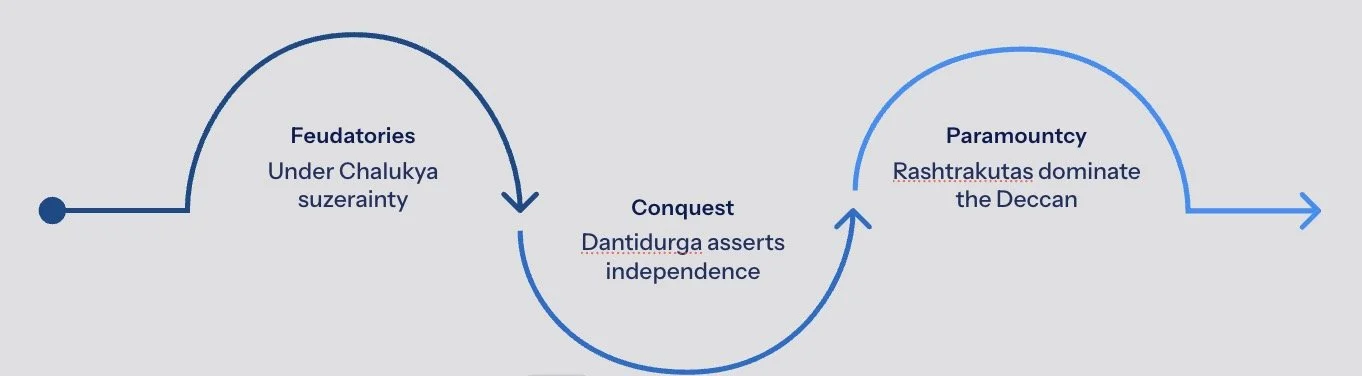
The Rashtrakuta dynasty (755–975 A.D.) stands as one of the most formidable imperial powers of medieval India. Rising from the position of feudatories under the Chalukyas, they ascended to become the paramount rulers of the Deccan Plateau, engaging in constant military, diplomatic, and commercial interactions with kingdoms across the subcontinent.
From their capital at Manyakheta, the Rashtrakutas controlled not only the Deccan heartland but also large stretches of the western coast, enabling them to dominate trade routes connecting India with West Asia. Their story is one of military ambition, cultural patronage, and eventual decline — a narrative that mirrors the complexities of Indian polity in the early medieval period.
The Rashtrakutas: Polity and Administration
Origins
Origins of the Rashtrakuta Dynasty
The question of the Rashtrakutas' ethnic and geographical origin has been a subject of considerable scholarly debate. Several distinct theories have been advanced, each drawing upon epigraphic, literary, and historical evidence. Understanding these competing claims is essential for appreciating how the dynasty constructed its identity and legitimised its rule over a vast and diverse empire.
Yadava Descent
Several inscriptions and literary sources, including the copper grant of 914 C.E. and Kavirahasya by Halayudha, trace the Rashtrakutas to the Yadava lineage — specifically to Satyaki of Epic fame. However, of 75 known inscriptions, only eight make this connection, suggesting it may be a later legitimising claim rather than established historical fact.
Provincial Title Theory
Another influential view holds that "Rashtrakuta" was not an ethnic label but an administrative title conferred by Chalukya kings upon provincial governors, meaning "Head of the Region." The dynasty, in this reading, took its name from the office held by its founding lineage. On consolidating power, they assumed the grander title of Prithvi Vallabha, rendered as "Balharas" in Arab chronicles.
Punjab Tribal Origin
The earliest textual references to the Rashtrakutas appear in the Edicts of Ashoka as "Rashtrika" and "Rathika," suggesting a north-western tribal origin. Historian C.V. Vaidya identifies them with the Arattas of Punjab — mentioned in both the Mahabharata and accounts of Alexander's Gandhara campaign — who gradually migrated southward and assimilated into Maharashtra as Kshatriyas.
Kanarese Origin
Dr. A.S. Altekar argued persuasively that the Rashtrakutas were originally inhabitants of the Karnataka country, with Kanarese as their mother tongue and script. Several inscriptions describe them as "Lord of Lattura," identified with modern Latur in Bidar district, Karnataka — providing a compelling geographical anchor for this theory.
Each of these theories reflects a different strand of evidence and methodology. What is clear, however, is that the Rashtrakutas successfully synthesised diverse cultural and linguistic influences — Sanskrit, Kannada, and later Arabic — into a cosmopolitan imperial identity that was unique in early medieval India.
Political History
Political History: The Great Rashtrakuta Monarchs
The Rashtrakuta dynasty produced a remarkable succession of rulers who combined military genius with cultural patronage. Founded by Dantidurga — who wrested independence from the Chalukyas and defeated the Gurjaras to seize Malwa — the dynasty reached its zenith across nearly two centuries of vigorous expansion, diplomacy, and administration. The following profiles illuminate the dynasty's most consequential monarchs.
Dantidurga (c. 735–756 A.D.)
Founder of the dynasty. Defeated the Gurjaras, captured Malwa, and overthrew Chalukya king Kirtivarman II. Established the capital at Manyakheta and proclaimed the Rashtrakutas as the paramount power in the Deccan.
Krishna I (756–774 A.D.)
Conqueror and builder. Defeated the Gangas and the Eastern Chalukyas of Vengi. Commissioned the magnificent rock-cut monolithic Kailasa temple at Ellora — one of the greatest architectural achievements of ancient India.
Govinda III (793–814 A.D.)
The northern conqueror. Defeated Nagabhatta of Kanauj and annexed Malwa. Terrified the Kerala, Pandya, Chola, and Pallava kings. Brought the king of Lanka and his minister as captives to Halapur, installing two statues of the Lankan lord as victory pillars before a Shiva temple at Manyakhet.
Amoghavarsha (814–878 A.D.)
The philosopher-king. Ruled for 64 years — one of the longest reigns in Indian history. A devoted Jain and patron of letters, he authored Kavirajamarga, the first known Kannada work on poetics. Built the capital city of Manyakhet. Though he lost control of Malwa and Gangavadi, his reign was notable for cultural flourishing.
Indra III (915–927 A.D.)
The restorer. Grandson of Amoghavarsha, Indra III re-established imperial authority. After defeating Mahipala and sacking Kanauj in 915, he was described by the Arab traveller Al-Masudi as the greatest king in India, commanding vast armies and innumerable war elephants, with most Indian rulers acknowledging his suzerainty.
Krishna III (934–963 A.D.)
The last great conqueror. Defeated Chola king Parantaka I (949 A.D.) and annexed the northern Chola territories. Pressed southward to Rameshwaram, erected a pillar of victory, and built the Krishneswara temple there. Held the Tondaimandalam region including Kanchi throughout his reign. After his death, the empire rapidly collapsed, and the capital Malkhed was sacked and burnt in 972 A.D.
Administration
Administrative Structure of the Rashtrakuta Empire
The Rashtrakuta administrative system was a well-organised hierarchy that balanced centralised imperial control with regional autonomy through a layered system of governance. The monarch remained the supreme sovereign — the fountain of all power — while a sophisticated bureaucracy managed the vast empire's day-to-day affairs. Understanding this structure reveals how the Rashtrakutas managed to govern a geographically diverse and politically complex empire for nearly two centuries.
Territorial Hierarchy
Rashtra (Province)
Governed by a Rashtrapati with both civil and military jurisdiction. Responsible for maintaining law and order, collecting taxes, and maintaining revenue records.
Vishaya (District)
Administered by a Vishayapati. Served as the intermediate tier connecting provincial and village governance.
Bhukti (Sub-district)
Comprising 50 to 70 villages under a Bhogapati. Officers at this level were directly appointed by the central government, ensuring imperial oversight.
Village
Administered by hereditary headmen, with village assemblies (councils) playing a significant role. Households were represented in these councils, giving local governance a participatory character.
Key Institutions of Imperial Governance
The King: The monarch wielded supreme authority and adopted high-sounding titles such as Paramesvara, Paramabhattaraka, and Maharajadhiraja. The Rashtrakuta court was marked by elaborate ceremonies and etiquette. Kingship was hereditary, passing ordinarily from father to the eldest son (the Yuvaraja), though younger sons could be selected in special circumstances.
Ministers: The actual work of administration was carried out by ministers appointed on the basis of efficiency. Special inspection officers toured the empire to monitor vassals and report on conditions across the realm.
Vassals: The empire was divided between territories under direct imperial rule and those governed by vassals. Powerful vassals enjoyed considerable internal autonomy — they could make land grants without suzerain consent — but were required to attend the imperial court when summoned and to participate in military campaigns.
Army: The Rashtrakutas maintained a large standing army, permanently stationed at the capital for security. This standing force could be supplemented by the armies of provincial governors and feudatories when required, allowing for rapid large-scale mobilisation.
Revenue System
The financial machinery of the Rashtrakuta empire was sophisticated and multifaceted. The primary source of revenue was tribute paid by vassals, supplemented by income from mines, forests, and wasteland. The principal land tax — known as Udranga or Bhagakara (the King's share) — was normally set at one-quarter of the gross agricultural produce. Notably, even lands granted to Brahmins and temples were not entirely exempt from taxation, though they were taxed at reduced rates. In cases of natural disasters such as drought or famine, tax levies were suspended entirely, reflecting a degree of fiscal humanism.
Currency: Drama
One of five coin types in the Rashtrakuta monetary system.
Currency: Suvarna
Gold coins issued by Rashtrakuta emperors for high-value transactions.
Currency: Godhyanka
Part of the diverse coin system facilitating commerce within the empire.
Currency: Kalanju & Kasu
Smaller denomination coins that facilitated everyday trade across the Deccan.
Society
Society Under the Rashtrakutas
The social landscape of the Rashtrakuta period was rich and complex, shaped by the interplay of traditional varna hierarchies, emergent bhakti movements, royal patronage of multiple religions, and the practical realities of an empire spanning diverse linguistic and cultural regions. The Dharmashastra literature and the accounts of Arab travellers together provide us with a nuanced picture of this society.
Social Hierarchy and Caste
Amongst the four varnas, the Brahmanas continued to enjoy the highest social status, though in practical terms the privileges of the Kshatriyas were nearly comparable. The status of the Vaishyas had declined significantly during this period. By contrast, the condition of the Shudras showed measurable improvement, partly due to the powerful influence of the Bhakti movements led by the Nayanars and Alvars. These saint-poets preached the fundamental spiritual equality of all human beings, thereby narrowing — though not eliminating — the social gulf between high and low castes. The untouchables, however, remained excluded from mainstream social life.
Family Structure and Social Practices
The joint family system was the dominant social unit. Widows and daughters were legally recognised as heirs to property — a relatively progressive feature of Rashtrakuta society compared to some contemporaneous cultures. The sati system was notably unpopular in the Deccan, though child marriage had become increasingly common. The general social fabric was held together by shared religious practices and community institutions.
Education
Formal education was available at centres such as the college at Salatogi in modern Bijapur district. An inscription records that this institution was sustained by endowments from wealthy patrons as well as contributions made by entire village communities on occasions of festivals and celebrations — indicating a broad-based social investment in learning.
Religious Life
Vaishnavism & Shaivism
Both major Hindu sects flourished under Rashtrakuta rule, with royal temple-building activity supporting their spread across the empire.
Jainism
Actively patronised by Rashtrakuta kings and officers. Amoghavarsha was a devoted Jain; his preceptor Jinasena was among the most distinguished Jain scholars of the age.
Buddhism
Prosperous Buddhist settlements existed at Kanheri, Sholapur, and Dharwar. Religious harmony was a distinguishing feature of Rashtrakuta society.
"The Bhakti movements led by the Nayanars and Alvars, which preached the footing equality of man with man, narrowed down the gulf between the high and low castes."
Economy
Economy, Trade, and Commerce
The Rashtrakuta economy was remarkably dynamic, combining an agricultural base with advanced industrial production, organised guild systems, and an active foreign trade network — particularly with the Arab world. The empire's strategic location along the Deccan Plateau, combined with its control of key western coastal ports, made it a natural hub of inter-regional and international commerce.
Agriculture
The foundation of the economy. Government attention ensured stable agricultural output across the Deccan's diverse terrain. Taxation at one-quarter of produce sustained state revenues.
Industry & Mining
The period witnessed considerable progress in mining and industry. The textile industry was particularly advanced — cloth production met internal demand and generated substantial surpluses for export.
Guilds
Trade and industry were organised into guilds that regulated commercial practices, maintained quality standards, and also performed banking functions — an early form of organised financial intermediation.
Foreign Trade
Arab merchants served as key intermediaries in overseas trade. Active commerce flourished between the Deccan and the Arab world, facilitated by Rashtrakuta diplomatic goodwill and coastal port control.
Principal Exports
Muslin and cotton textiles
Hides and leather goods
Mats and matting
Indigo
Incense and sandalwood
Teakwood
Ivory
Tea
Principal Imports
Gold
Wine
Copper
Tin
Lead
Topaz and precious stones
Horses (for resale inland)
Commercial transactions were conducted through both barter and the exchange of gold and silver coins, with the Rashtrakuta monetary system providing five distinct coin types to facilitate transactions at different scales. The Rashtrakuta kings took a proactive approach to international commerce — maintaining cordial relations with the Arabs in Sind and actively promoting Arab trade through diplomatic channels. Arab geographers and travellers such as Suleiman, Ibn Haukal, Al-Masudi, and Al-Istakhri left valuable accounts of this commercial relationship and of the prosperity of the Rashtrakuta realm, testifying to the empire's reputation as a major economic power in the Indian Ocean world.
A Golden Age of Culture, Art & Literature
Few dynasties in Indian history have left behind a legacy as rich, diverse, and enduring as the Rashtrakutas. Ruling over a vast empire that stretched from the river Kaveri in the south to the Narmada in the north, and from the Bay of Bengal to the Arabian Sea, the Rashtrakutas were not merely military and political giants — they were extraordinary patrons of religion, literature, architecture, and the arts. Historian P. B. Desai captured this brilliance eloquently:
The achievements of this epoch in spheres of territorial expanse, political supremacy, military prowess and diplomacy, as well as attainments in the cultural domains of language, literature, religion and art, are shining and substantial, some of them endowed with imperishable merits transcending the barriers of time and space.
Religion & Tolerance: A Dynasty That Honoured All Faiths
The Rashtrakutas were primarily Vaishnavas — their royal emblem was the sacred Garuda, and most of their inscriptions begin with an invocation to Lord Vishnu. Several kings bore the title Veeranarayana, reflecting their deep personal devotion. Yet, in a remarkable departure from sectarian exclusivism, the dynasty became celebrated across Indian history as a symbol of genuine religious pluralism. Their patronage extended generously to Jainism, Shaivism, Buddhism, and even Islam.
Jainism flourished perhaps most spectacularly under Rashtrakuta rule. Historian Altekar estimated that at least 30% of the population of Karnataka during this era followed the Jain faith — a figure that reflects not mere tolerance but active encouragement. This was, by any measure, the golden age of Jainism in peninsular India. The majority of the great literary figures of the period were Jains, and Jain merchants, scholars, and monks enjoyed unparalleled social prestige and royal support.
King Amoghavarsha I, one of the most celebrated rulers of the dynasty, was himself a devoted follower of Jainism and a great devotee of Goddess Mahalaxmi. He is said to have offered his own finger to the goddess as an act of extreme devotion during a time of crisis — a story that speaks volumes about his spiritual temperament. His reign exemplified the coexistence of personal piety with broad-minded patronage across religious communities.
Liberal grants and endowments were bestowed upon temples, mathas, and religious institutions of all denominations. Brahmanas were engaged to perform yagnas and yagas, and kings honoured them with generous gifts. By the 10th century, Jumma Masjids existed within the Rashtrakuta empire, and Muslim communities thrived along the western and eastern coasts. Towns such as Kayalpattanam and Nagore were home to flourishing mosques. Muslim settlers who married local women gave rise to a community known as the Mappilas (Moplahs), who were actively engaged in horse trading and the management of shipping fleets — a vivid testament to the cosmopolitan, multicultural character of Rashtrakuta society.
Vaishnavism
The Garuda emblem and Vishnu invocations defined royal identity. Many kings bore the title Veeranarayana.
Jainism
The golden age of Jainism. Nearly 30% of Karnataka's population followed the Jain faith under Rashtrakuta patronage.
Shaivism & Buddhism
Temples, grants, and endowments were extended to Shaivite and Buddhist institutions across the empire.
Islam
Mosques flourished in coastal towns. Muslim communities integrated into Rashtrakuta society through trade and intermarriage.
Literature: The Dawn of Kannada's Golden Age
The Rashtrakuta period represents one of the most transformative epochs in the history of Indian literature. It was an era of transition and renewal — Sanskrit literature reached its classical zenith, while Kannada literature took its very first confident steps. Education was given considerable weight, and during the reign of Krishna III, centres such as Salotgi (in the Indi taluk of Bijapur district) emerged as significant hubs of learning, attracting scholars from across the subcontinent.
Sanskrit scholarship flourished generously under royal patronage. Among the landmark works of the era were Saktayana's Amoghavriti, a celebrated grammatical treatise; Halayuda's Kavirahasya; Jinasena's Adipurana, a monumental Jain text; Mahaviracharya's Ganitasarasangraha, a foundational work in the history of Indian mathematics; and Trivikrama's Nalacharita. These texts span grammar, poetry, religion, and science — reflecting the breadth of intellectual life under the Rashtrakutas.
Yet it is in Kannada literature that the dynasty made its most historically momentous contribution. Amoghavarsha Iauthored Kavirajamarga, widely regarded as the first work of poetry in the Kannada language. This was not the act of a passive patron but of a scholar-king who personally shaped the literary culture of his time. His contribution to Kannada literature — both as author and as benefactor — is without parallel in South Indian royal history.
The Three Gems of Kannada Literature
The poets Pampa, Ponna, and Ranna — collectively known as the Ratnatraya (Three Gems) — are the towering figures who defined Kannada literary achievement during and immediately after the Rashtrakuta era.
Pampa — the first great Kannada poet, authored Vikramarjuna Vijaya (Pampa Bharata) and Adipurana
Ponna — court poet of Krishna III, wrote Shanti Purana and earned the title Ubhaya Kavichakravarthi
Ranna — court poet of the Chalukya king Tailapa, a feudatory of the Rashtrakutas
Jain Scholars: Pillars of the Literary World
A defining feature of Rashtrakuta-era literature is that the majority of its authors were Jains. These scholars were extraordinary polyglots — masters of Prakrit, Kannada, and Sanskrit — who produced texts of lasting philosophical, religious, and literary significance.
Their contributions ensured that the period marked not merely the end of the classical age of Sanskrit and Prakrit but the glorious beginning of Kannada's golden age — a literary tradition that would continue unbroken all the way to the fall of the Vijayanagara Empire. The Rashtrakutas, in this sense, were the true pioneers of Kannada literary culture.
Architecture & the Arts: Monuments That Defy Time
If the Rashtrakutas were giants of literature and religion, they were nothing less than immortals in the realm of architecture and sculptural art. Their builders and sculptors held a position of pre-eminence in ancient India, leaving behind monuments of extraordinary grace, refinement, and technical audacity. Their work demonstrates a mastery that was at once deeply spiritual and astonishingly innovative — a combination that produced some of the most magnificent structures ever created on Indian soil.
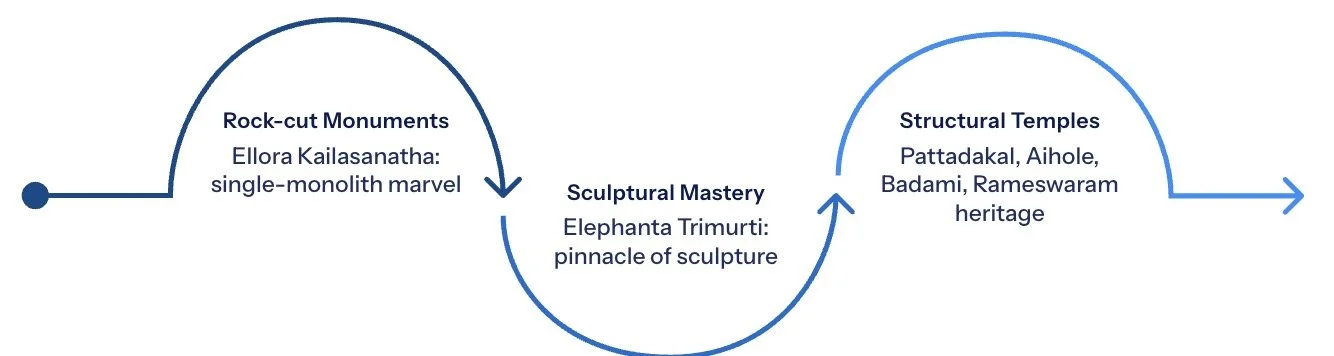
The crown jewel of Rashtrakuta architecture is, without question, the Kailasanatha Temple at Ellora, commissioned during the reign of Krishna I. This colossal temple was not built — it was carved from a single monolithic rock, an achievement without precedent in the entire history of world architecture. Historian V. A. Smith described it memorably: "It is one of the wonders of the world, a work of which any nation might be proud, an honour to the king under whose patronage it was extended." Visiting it even today, one is struck by the sheer impossibility of what was accomplished — millions of tonnes of rock excavated and sculpted with a precision and artistry that staggers the modern imagination.
The Elephanta Caves, located near Bombay (Mumbai), belong to the same era of artistic brilliance. The caves' masterwork is the awe-inspiring Trimurti (also called Mahesh Murthi) — a colossal three-headed sculpture of Lord Shiva that is widely considered the pinnacle of Rashtrakuta sculptural art. Standing over five metres tall, the Trimurti radiates a serene, cosmic authority that continues to captivate visitors from around the world.
The Rashtrakutas: Architecture & the Arts
Beyond these two iconic masterpieces, the Rashtrakutas constructed structural temples across their vast empire — at Manyakheta (their capital), Pattadakal, Mahakuta, Aihole, Badami, Belur, Sannathi, and Rameswaram, among many other locations. At Pattadakal, a UNESCO World Heritage Site, both the Jain Narayana Temple and the Kasivisvesvara Temple were built by the Rashtrakutas. The glorious Trikuteshwara Temple at Gadag was also originally a Rashtrakuta construction, later expanded by the Chalukyas of Kalyani. These temples, spread across the length and breadth of the Deccan, are enduring physical testimonies to a dynasty that regarded the creation of sacred art as both a royal duty and a divine gift to humanity.
Kailasanatha, Ellora
Carved from a single monolith under Krishna I. Called a wonder of the world by historian V. A. Smith. Unparalleled in global art history.
Elephanta Caves
Home to the majestic Trimurti (Mahesh Murthi) — the pinnacle of Rashtrakuta sculpture. A UNESCO World Heritage Site near Mumbai.
Pattadakal Complex
UNESCO World Heritage Site. Rashtrakutas built the Jain Narayana Temple and the Kasivisvesvara Temple within this celebrated complex.
Trikuteshwara, Gadag
Originally built by the Rashtrakutas, later expanded by the Chalukyas of Kalyani. A glorious example of Deccan temple architecture.
An Empire That Shaped Indian Civilisation
The Rashtrakuta dynasty, at the height of its power, commanded the largest empire in the Deccan — a political colossus whose borders were defined by the river Kaveri to the south, the Narmada to the north, the Bay of Bengal to the east, and the Arabian Sea to the west. Various branches of this mighty empire — including those at Vemulavada, Bodhan, and Gujarat — exercised considerable independent authority while remaining bound to the central Rashtrakuta branch, demonstrating an administrative sophistication that served as a model for successor dynasties across the region.
Yet the true greatness of the Rashtrakutas cannot be measured in territorial kilometres or military victories alone. It is measured in the temples that still stand, the poems that are still read, the sculptures that still move, and the traditions of tolerance and scholarship that they helped establish and sustain. They built administrative systems that were reliable and enduring. They patronised Kannada writing, artwork, and construction with a love that — as historian after historian has noted — was unmatched by any other empire in Indian history.
30% Jain Population
Estimated share of Karnataka's population following Jainism during the Rashtrakuta era, per historian Altekar.
3 Gem Poets
Pampa, Ponna, and Ranna — the Ratnatraya who defined the golden age of Kannada literature.
4 UNESCO Sites
Rashtrakuta-associated monuments featured across UNESCO World Heritage Sites including Ellora, Elephanta, and Pattadakal.
1 Monolithic Temple
The Kailasanatha Temple at Ellora — the only temple of its scale carved from a single rock in all of world architectural history.
The Rashtrakutas were, above all, pioneers — pioneers of Kannada literature, pioneers of rock-cut architecture, pioneers of religious pluralism in a monarchical framework. Their age did not merely witness the end of one era and the beginning of another; it was itself the hinge upon which Indian cultural history turned. The golden age of Kannada literature that they inaugurated continued all the way to the fall of the Vijayanagara Empire — a testament to how deeply and lastingly they shaped the civilisational course of the subcontinent. To study the Rashtrakutas is to understand how empires, at their finest, can serve not as instruments of domination, but as engines of human creativity and cultural flowering.
Key Takeaway: The Rashtrakuta dynasty combined military might with extraordinary cultural patronage — founding Kannada literature, producing world-class architectural masterpieces, and championing religious tolerance across faiths including Vaishnavism, Jainism, Shaivism, Buddhism, and Islam. Their legacy endures in the temples, texts, and traditions of India to this day.
Sources & Legacy
Sources of Information and Legacy of the Rashtrakutas
Our knowledge of the Rashtrakuta dynasty rests upon a remarkably diverse body of sources — epigraphic, literary, and foreign — that together allow historians to reconstruct a detailed picture of their polity, culture, and economic life. This multi-source approach also underscores the dynasty's remarkable cosmopolitan reach, attracting the attention of scholars and travellers from across the known world.
Inscriptions and Copper Grants
Numerous inscriptions spread across the Deccan, written in Sanskrit and Kannada, constitute the most direct epigraphic evidence. Of the 75 known inscriptions and copper grants discovered so far, they illuminate dynastic genealogy, land grants, administrative arrangements, and religious endowments. Stone records supplement these findings with detail on local governance and social institutions.
Contemporaneous Kannada Literature
Works such as Kavirajamarga (850 C.E.) — attributed to Amoghavarsha himself — and Vikramarjuna Vijaya (941 C.E.) provide literary evidence of the cultural achievements of the period. These texts also illuminate linguistic history, confirming the importance of Kannada as both a court and literary language under Rashtrakuta patronage.
Sanskrit Literary Sources
Writings by scholars such as Somadeva, Rajashekara, Gunabhadra, and Jinasena — many of them court-connected intellectuals — provide valuable context for understanding the religious, philosophical, and political culture of the Rashtrakuta age. Ancient Pali literature also contributes to our understanding of the period's religious landscape.
Arab Travellers' Accounts
The observations of Arab geographers and merchants — including Suleiman, Ibn Haukal, Al-Masudi, and Al-Istakhri — are invaluable for reconstructing the empire's commercial relationships, its standing in the Indian Ocean world, and the perceptions of foreign observers. Al-Masudi's description of the Rashtrakuta king as "the greatest king in India" remains one of the most striking external assessments of the dynasty's power at its height.
Historical Legacy
The Rashtrakuta dynasty's legacy is multidimensional. Architecturally, the Kailasa temple at Ellora — commissioned by Krishna I — remains one of the supreme achievements of Indian civilisation, a monument carved entirely from a single rock face. Culturally, they were among the earliest and most distinguished patrons of Kannada literature. Administratively, their layered provincial system provided a model of governance that influenced subsequent Deccan polities. Their openness to trade with the Arab world and to religious plurality — supporting Hinduism, Jainism, and Buddhism simultaneously — reflects a sophisticated imperial philosophy that transcended narrow sectarian boundaries. The Rashtrakutas demonstrate, above all, that the early medieval Deccan was not a peripheral backwater but a dynamic centre of Indian civilisation in its own right.
Key Takeaway: The Rashtrakutas are best understood not merely as military conquerors but as sophisticated rulers who integrated administrative efficiency, cultural patronage, economic enterprise, and religious tolerance into a coherent imperial vision — a model that shaped the Deccan for centuries after their fall in 975 A.D.
