
The Palas
Early Medieval India
The Pala Dynasty, which rose to prominence in Bengal around 750 CE, represents one of the most significant political and cultural epochs of early medieval India. Emerging from a period of profound political chaos that followed the death of Emperor Harsha in 647 CE, the Palas forged a vast empire spanning Bengal, Bihar, and beyond — and became legendary patrons of Buddhist learning, art, and trade.
Historical Background
The Age of Anarchy: The World Before the Palas
The death of Emperor Harsha in 647 CE inaugurated one of the most turbulent phases in the political history of the Indian subcontinent. For nearly a century, the Indian subcontinent — particularly the fertile and strategically vital Bengal and Gangetic plains — was subjected to incessant interference, military incursions, and administrative disruption by powerful neighbouring kingdoms. The vacuum left by Harsha's empire created a fierce competition among regional powers, each seeking to claim the coveted mantle of north Indian sovereignty.
Central to this contest was the city of Kanauj, which had long been regarded as the symbolic seat of imperial authority in northern India. Control over Kanauj meant not merely a political title, but effective dominion over the upper Gangetic valley — one of the most agriculturally productive and commercially active regions of the subcontinent. It was a prize that multiple dynasties competed over for generations.
Lalitaditya of Kashmir
The Kashmiri ruler Lalitaditya emerged as a formidable early contender. He brought the Punjab under his control, seized Kanauj, and even launched a military expedition into Bengal (Gaud), where he killed the reigning monarch. His power, however, was not to last.
The Rise That Checked Him
Lalitaditya's dominance began to wane with the concurrent rise of two powerful new dynasties — the Palas in the east and the Gurjara-Pratiharas in the west. These emerging powers fundamentally restructured the political landscape of early medieval India and set the stage for a century-long triangular conflict.
Kanauj as the symbol of north Indian sovereignty
Upper Gangetic valley: rich in trade and agriculture
Bengal (Gaud) exposed to repeated foreign invasions
Lalitaditya's brief dominance eventually eclipsed by new powers
It was against this backdrop of endemic instability, fragmented authority, and political anarchy that the Pala Dynasty was born — not through conquest by an established royal lineage, but through the collective will of the people themselves, in a remarkable act of political institution-building that set the Palas apart from their contemporaries.
Dynasty Founders
Gopala, Dharmapala, and Devapala: The Pala Triumvirate
The Pala Dynasty owes its origins to a singular and historically unusual event: the democratic election of its founder. Gopala, who is believed to have ascended to power around 750 CE, was chosen king by the notable men of Bengal to end the prevailing matsyanyaya — the "law of the fish," wherein the large devour the small — a vivid metaphor for the political anarchy of the era. Gopala was not of royal birth; his father is believed to have been a soldier. Yet, this commoner-turned-king successfully unified Bengal under a single administrative authority and extended his control into Magadha (modern Bihar), thereby laying the foundation of a great eastern empire.
Gopala (c. 750–770 CE)
Elected king to end anarchy. Unified Bengal, extended control into Magadha. Founded the Pala Dynasty.
Dharmapala (770–810 CE)
Expanded the empire's reach across north India. Occupied Kanauj, revived Nalanda, founded Vikramasila University.
Devapala (810–850 CE)
Extended Pala power into Assam, Orissa, and parts of Nepal. Received embassies from the Sailendra dynasty of Southeast Asia.
Dharmapala, who succeeded Gopala in 770 CE and ruled until 810 CE, was perhaps the greatest of the Pala monarchs in terms of territorial ambition and political prestige. His reign was defined by the famous tripartite struggle between the Palas, the Gurjara-Pratiharas, and the Rashtrakutas for dominance over north India and specifically Kanauj. In a dramatic sequence of events, the Pratihara ruler advanced upon Gaud but was decisively defeated by the Rashtrakuta king Dhruva, who then withdrew to the Deccan. This created an opening for Dharmapala, who seized Kanauj and convened a grand darbar attended by vassal rulers from Punjab, eastern Rajasthan, and neighbouring territories — a powerful public demonstration of imperial suzerainty.
Devapala, Dharmapala's son and successor, ruled for approximately 40 years from 810 CE. Recognising that the north had become a contested and exhausting theatre, Devapala redirected Pala energies southward and eastward. He extended Pala authority over Pragjyotishpur (modern Assam), portions of Orissa, and possibly parts of Nepal. It was also during his reign that the powerful Sailendra dynasty of Southeast Asia sent embassies to the Pala court, seeking permission to build a monastery at Nalanda and requesting the endowment of five villages for its maintenance — a request that Devapala graciously granted, signalling the extraordinary international prestige the Palas had by then achieved.
Military & Diplomatic Power
The Tripartite Struggle and the Pala Military Machine
The political history of the Pala Dynasty cannot be fully appreciated without understanding the grand tripartite contest that dominated north Indian politics for well over a century. The three protagonists — the Palas of the east, the Gurjara-Pratiharas of the west, and the Rashtrakutas of the Deccan — were locked in a relentless struggle for control over Madhyadesha, the heartland of north India, and especially the symbolic city of Kanauj. Each dynasty had periods of supremacy, but none could consolidate lasting dominance, and the contest ultimately proved mutually exhaustive.
🐘 Pala Military Strength
Arab merchant Sulaiman (mid-9th century) attested to Pala military power, recording that the Pala king was customarily accompanied by 50,000 elephants. Between 10,000 and 15,000 soldiers in the army were employed in logistical roles such as fulling and washing clothes — indicative of a vast, organised military establishment.
⚔️ The Tripartite Rivalry
Bihar and eastern Uttar Pradesh remained perpetual bones of contention. The Pratiharas revived under Nagabhatta II and defeated Dharmapala near Mongyr. Despite this setback, Bihar and Bengal largely remained under Pala control, while Kanauj oscillated between rival hands.
🤝 Marriage Alliances
The Palas were not solely reliant on warfare. With the Rashtrakutas — though rivals for Kanauj — they entered into useful matrimonial alliances, demonstrating a sophisticated understanding of diplomatic statecraft alongside military power.
An important external source for gauging Pala military and political strength is the account of Sulaiman, an Arab merchant who visited India around the middle of the ninth century. He refers to the Pala kingdom as "Ruhma" — a likely phonetic rendering of "Dharma," short for Dharmapala — and describes the Pala king as being engaged in wars with the Pratiharas and Rashtrakutas, but possessing troops more numerous than either adversary. While these figures may contain elements of exaggeration typical of medieval travel literature, they broadly confirm the scale and organisation of the Pala military apparatus. Whether the Palas maintained a large standing army or relied significantly on feudal levies from their numerous vassals remains a matter of scholarly debate.
"The king of Ruhma is at war with the king of Juzr [Pratihara] and the king of Ballahara [Rashtrakuta], but his troops are more numerous than those of his adversaries." — Sulaiman, Arab Merchant, 9th Century CE
The mutual exhaustion resulting from this prolonged triangular contest had lasting historical consequences. All three dynasties depleted their resources and undermined their own regional stability, opening the door for successor powers in subsequent centuries. The Palas were eventually superseded in Bengal by the Sena dynasty towards the end of the eleventh century, who in turn succumbed to the Turkish Khalji invaders in the thirteenth century.
Culture & Religion
Patronage, Buddhism, and Southeast Asian Connections
Beyond their military and political achievements, the Pala rulers earned an enduring legacy as among the greatest patrons of Buddhist learning, art, and culture in Indian history. Tibetan chronicles — though composed as late as the seventeenth century — provide valuable testimony to the Palas' extraordinary role in sustaining and reviving Buddhist institutions at a time when Buddhism was beginning its long decline in the subcontinent. These accounts describe in detail the monastic universities, the scholarly missions, and the international networks of cultural exchange that the Palas fostered.
Nalanda University Revived
The ancient and celebrated Nalanda University — renowned across the eastern world — was revived under Dharmapala's patronage. Two hundred villages were set apart to meet its expenses, ensuring the institution's financial stability and academic independence.
Vikramasila University Founded
Dharmapala founded the Vikramasila University, situated atop a hill on the banks of the Ganga in Magadha, amid pleasant natural surroundings. It became a major centre of Vajrayana Buddhist scholarship and attracted scholars from across Asia.
Tibet and Southeast Asia
Noted scholars Santarakshita and Dipankara (Atisa) were invited to Tibet, introducing new forms of Buddhist practice. Tibetan monks subsequently studied at Nalanda and Vikramasila, forging deep cross-cultural ties between the Pala empire and Tibet.
Sailendra Dynasty Connections
The powerful Buddhist Sailendra dynasty of Malaya, Java, and Sumatra sent multiple embassies to the Pala court. King Devapala granted their request to build a monastery at Nalanda and endowed five villages for its upkeep — a testament to Pala international prestige.
The Palas' religious outlook was notably pluralistic. Although they were fundamentally Buddhist in orientation and identity, they extended genuine patronage to Saivism and Vaishnavism as well. Large numbers of brahmans from north India were attracted to Bengal through Pala land grants, and their settlements contributed meaningfully to the extension of agricultural cultivation and the transformation of pastoral and food-gathering communities into settled agrarian societies — a significant process of socio-economic development with long-term consequences for Bengal's landscape and demography.
The trade connections with Southeast Asia were not merely cultural but also economically transformative. Trade with Burma, Malaya, Java, Sumatra, and neighbouring regions was highly profitable, contributing substantially to Bengal's growing prosperity and facilitating the inflow of gold and silver into the Pala empire. This commercial prosperity, in turn, enhanced the Palas' capacity for patronage and administration, creating a virtuous cycle of wealth, cultural production, and political prestige that resonated far beyond the borders of the subcontinent.
Governance Structure
The Pala Administrative System: Structure and Hierarchy
The administrative system of the Pala Dynasty represents one of the most sophisticated and systematically documented governance frameworks of early medieval India. While the Palas inherited the broad structural outline of Gupta-era administration, the evidence from their numerous copper plate inscriptions suggests that they refined and elaborated upon this inherited framework with considerable efficiency and institutional detail. At the apex of this system stood the monarch — an absolute sovereign vested with both temporal and sacred authority — who bore grand titles such as Parameshwara, Paramavattaraka, and Maharajadhiraja.
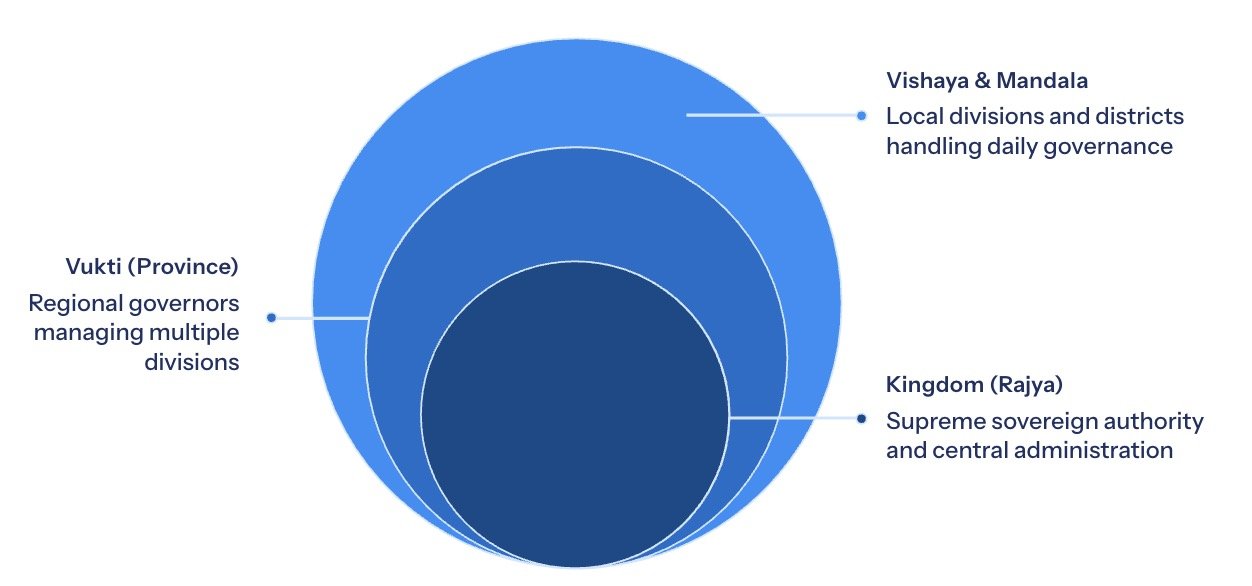
The Pala Administrative System: Structure and Hierarchy
The empire was divided into administrative units of decreasing size and specificity. The largest unit was the Vukti(Province), which was further segmented into Vishaya (Divisions) and then Mandala (Districts). Below these were even smaller administrative entities: the Khandala, Bhaga, Avritti, Chaturaka, and Pattaka. This multi-tiered territorial hierarchy enabled the central administration to maintain oversight over a vast and geographically diverse empire, from Bengal's delta to the highlands of Assam and the plains of Bihar.
Political & Diplomatic Officials
Raja / Mahasamanta — Vassal kings
Mahasandhi-vigrahika — Foreign minister
Duta — Head ambassador
Rajasthaniya — Deputy / Viceroy
Sasthadhikrta — Tax collector
Administrative & Judicial Officials
Mahaksapatalika — Chief accountant
Jyesthakayastha — Head of documentation
Ksetrapa — Head of land use division
Pramatr — Head of land measurements
Mahadandanayaka / Dharmadhikara — Chief justice
Mahapratihara — Head of police forces
Khola — Head of secret service
A particularly noteworthy feature of Pala governance, attested by a grant dated 802 CE, is the mention of a local official in North Bengal called the Dasagramika — an officer responsible for a cluster of ten villages who was given land in accordance with Manu's prescriptions. This suggests the existence of a structured sub-district administrative apparatus that connected the imperial centre to local communities. The Pala administration also featured specialised officials overseeing agriculture and animal husbandry, reflecting the dynasty's active interest in managing the productive base of the empire.
Land & Economy
Land Grants, Feudatories, and Agricultural Administration
Land grants constituted one of the most important instruments of Pala statecraft, serving simultaneously as a mechanism of political consolidation, religious patronage, economic management, and social engineering. The copper plate inscriptions of the Palas — among the most detailed such records from any early medieval Indian dynasty — provide rich evidence of the variety, scope, and conditions under which land was granted to different categories of recipients. These grants were typically permanent in nature and carried with them significant economic privileges as well as specific administrative responsibilities, particularly in the maintenance of law and order and the administration of local justice.
Grants to Religious Establishments
The Pala kings made extensive land grants to brahmans, priests, temples, and Buddhist monasteries (viharas). These grants were permanent and served both to sustain religious institutions and to attract scholarly communities to Bengal. Brahmans from north India who settled on granted lands contributed to the extension of agriculture and the transformation of pastoral communities into settled cultivators.
Grants to Kaivartas and Cultivators
Land grants were also given to Kaivartas — peasant communities — reflecting the Pala administration's recognition of the productive role of agrarian communities. These grants helped incentivise the clearing and cultivation of new lands, contributing to the expansion of the agricultural frontier in Bengal and Bihar.
Feudatory Land Holdings
Pala records mention a range of feudatory titles: Rajas, Rajputras, Ranakas, Rajarajanakas, Mahasamantas, and Mahasamantadhipatis. These individuals were likely military vassals who held land in exchange for military service. Significantly, there is no evidence of sub-infeudation under the Palas — a notable structural characteristic that distinguished their feudal arrangements from some contemporary and later systems.
The agricultural administration of the Palas was remarkably detailed and specialised. Specific officials were appointed to oversee different branches of animal husbandry and agricultural production: the Gavadhyaksha (Head of dairy farms), the Chhagadhyaksha (Head of goat farms), the Meshadhyaksha (Head of sheep farms), the Mahishadhyaksha(Head of buffalo farms), and — in a particularly intriguing entry — the Nakadhyaksha, a term scholars have interpreted as corresponding to an aviation or sky ministry, though its precise function remains a subject of academic discussion.
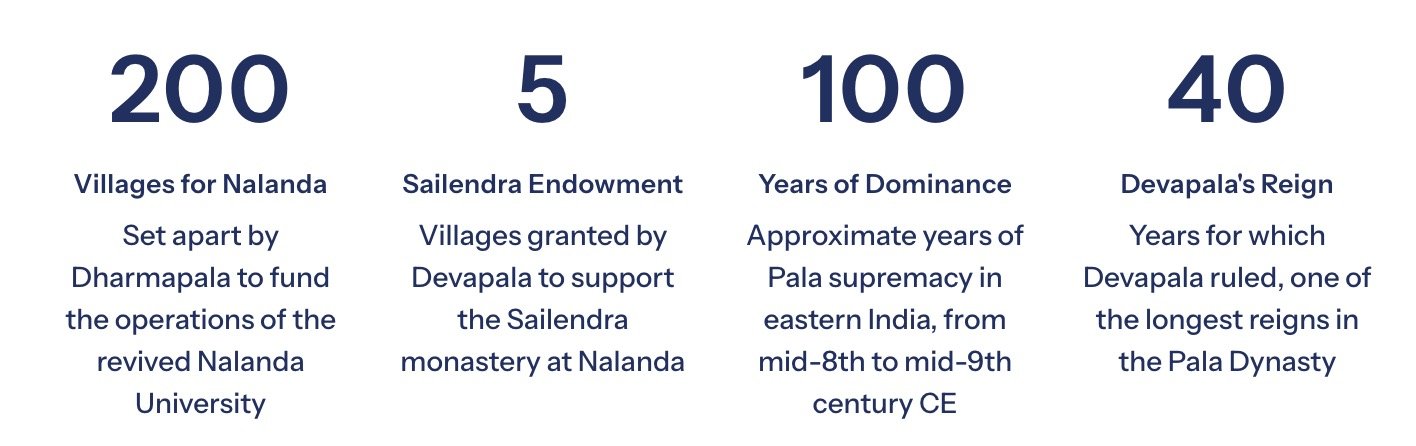
Pala: Land Grants, Feudatories, and Agricultural Administration
The Pala administration also invested significantly in infrastructure. The development of ferry ghats along riverways, the maintenance of land routes, the management of trade and commerce, and the administration of towns and ports were all integral concerns of the Pala state. This infrastructural orientation reflected a sophisticated understanding of the relationship between political power, economic productivity, and territorial control — an understanding that helped sustain the Pala empire's prosperity and prestige for over three centuries.
Pala Dynasty: Cultural Splendour of Eastern India
The Pala dynasty, which held sway over Bihar and Bengal from the 8th to the 12th century CE, occupies a singular place in the annals of Indian civilisation. Beyond their remarkable achievements as military conquerors and astute diplomats, the Pala rulers distinguished themselves as inspired and generous patrons of art, architecture, and learning. Under their aegis, a distinctive aesthetic tradition blossomed — one that would leave an indelible imprint upon the cultural landscape of the Indian subcontinent and extend its influence as far as Nepal, Burma, and Tibet.
The arts that flourished under Pala patronage are collectively designated as Pala Arts — a school of creative expression that synthesised the spiritual fervour of Vajrayana Buddhism with refined aesthetic sensibilities, producing works of extraordinary beauty and theological complexity. This tradition encompassed sculpture in stone and bronze, terracotta figurines, manuscript and mural paintings, and a rich body of monastic and temple architecture.
Cultural History8th–12th Century CEBihar & Bengal
Sculpture
Distinctive stone and bronze works in the Eastern School of Indian art
Terracotta
Charming figurines from Vikramshila and other monastic centres
Paintings
Manuscript miniatures and mural traditions of enduring refinement
Architecture
Viharas, temples, and monasteries of lasting spiritual grandeur
Pala Sculpture: Bronze, Basalt, and Spiritual Vision
The sculptural tradition of the Pala period is widely recognised as a distinct and mature phase of Indian art history. The Bengal sculptors of this era demonstrated an artistic genius that drew upon older Indian traditions whilst forging a new visual language shaped by Vajrayana Buddhist iconography, Brahmanical Tantrism, and an exacting technical sensibility. The principal proponents of this school were Dhiman and Vithpal, master artists who were contemporaries of Dharmapala and Devapala respectively, and whose influence permeated the workshops of Nalanda and Kurkihar.
Bronze Sculpture
Bronze casting during the Pala period employed the sophisticated cire perdue (lost-wax) method, a technique demanding remarkable precision and artistic control. The principal centres of bronze production were the Buddhist establishments at Nalanda and Kurkihar, where bronze casting appears to have been integrated into the monastic curriculum itself — a remarkable confluence of artistic training and religious education.
The thematic range of Pala bronzes is predominantly Buddhist. The Buddha is depicted in characteristic poses — standing with the right hand in the abhaya mudra (gesture of fearlessness) or the varada mudra (gesture of blessing), and seated in bhumisparsha mudra (the earth-touching gesture of enlightenment) or dharmachakra mudra (the gesture of the first sermon). The Bodhisattvas — Avalokiteshvara, Manjushri, Maitreya, and Vajrapani — are rendered with extraordinary ornamental richness, their forms adorned with elaborate jewellery and flowing garments.
A smaller but significant corpus of Brahmanical and Tantric imagery has also been recovered, including images of Ganga, Balarama, Vishnu, and Surya, attesting to the pluralistic religious milieu of the period. Among the finest extant examples is the Standing Buddha from Nalanda — celebrated for its dignity, convincing modelling, and meditative inner poise.
Stone Sculpture
Pala stone sculptures were crafted predominantly from black basalt, a stone abundantly available in the hills of the Santhal Parganas region and Munger district of Bihar. These works exhibit an elegance and technical precision that reveals the strong influence of metalwork traditions — their outlines are sharp, their surfaces smooth, and their ornamentation meticulous.
The iconographic programme of Pala stone sculpture is vast and varied. The majority of images represent Bodhisattvas and Buddhist deities, alongside depictions of important events from the life of the Buddha. Brahmanical deities such as Vishnu and Shiva, as well as Jain figures, are also present, though in comparatively smaller numbers. The frontal composition is consistently privileged — the reverse of most images receiving little to no artistic attention, suggesting these works were designed primarily for frontal veneration within niches or shrines.
The ornamentation of these stone images — their elaborate crowns, jewels, and flowing garments — reflects both the aesthetic values of the period and the influence of Tantric religious culture, wherein divine beauty is understood as an expression of sacred power. However, this very richness of adornment has also drawn criticism from art historians, who note that the heavy ornamentation can, at times, overwhelm the essential form.
Critical Perspective: Pala sculpture has been critiqued for a perceived lack of the spontaneous originality characteristic of Gupta-period works. The heavy ornamentation, while technically accomplished, has been observed to lend the images an artificial quality, and Tantric influences have introduced a heightened sensuality — particularly in the treatment of the female form — that marks a departure from the serene classicism of earlier Indian sculpture.
Standing Buddha, Nalanda
Right hand in abhaya mudra — considered one of the finest bronze pieces of the Eastern School for its dignity and inner poise.
Standing Tara, Nalanda
An iconic bronze image of the compassionate Bodhisattva, demonstrating the ornamental richness of the Pala workshop tradition.
Balarama, Kurkihar
A notable Brahmanical bronze from Kurkihar, illustrating the religious pluralism embedded within Pala artistic production.
Terracotta Figurines & the Art of Painting
Terracotta Figurines
The terracotta art of the Pala period offers a vivid and intimate window into the lived experience of both the sacred and the secular worlds of medieval eastern India. Artistically accomplished and aesthetically charming, these figurines were fashioned to adorn the walls of monastic establishments, with particularly significant examples recovered from the ruins of Vikramshila Mahavihara. Their decorative function notwithstanding, their documentary value for historians is equally remarkable.
The terracotta images depict scenes drawn from religious narrative as well as the everyday life of ordinary people — their dress, occupations, social customs, and domestic arrangements. This dual register of the sacred and the mundane makes them invaluable as primary sources for reconstructing the social history of the Pala period. Alongside representations of the Buddha and Bodhisattvas, images of Hindu deities such as Vishnu, Varaha, Surya, Hanuman, and Ardhanarishvara demonstrate the syncretic religious environment of the age.
Among the most celebrated of these terracotta works is the figure of a seated lady — a masterpiece of intimate portraiture in clay. She is depicted holding a mirror in one hand, absorbed in admiring her own reflection, whilst with the fingers of her other hand she applies vermillion to the parting of her hair. Her artistic beauty is conveyed not through ornament alone but through the innocence of her expression, her slender waist, and the natural dignity of her posture — a profoundly humanist achievement within a predominantly religious artistic tradition.
Paintings: Two Living Traditions
The paintings of the Pala period survive in two distinct forms — manuscript paintings executed on palm leaves, and mural paintings found within monastic complexes. Together, they constitute one of the most important chapters in the history of Indian painting, representing both a continuation of earlier traditions and a confident elaboration of new aesthetic ideals.
Manuscript Paintings: Painted manuscripts of the Pala school were inscribed upon palm leaves and are today among the most treasured artefacts of South Asian artistic heritage, several examples being preserved in the collections of Cambridge University. The principal surviving examples include the Ashtasahasrika Prajnaparamita, the Prajnaparamita, and the Panchraksha, bearing approximately one hundred miniature illustrations.
These paintings deploy both primary colours — red, white, blue, and black — and secondary hues including green, violet, light pink, and grey. The Pala School of painting is characterised by delicate and nervous line work, sensuous elegance, and a strong linear and decorative accent. The influence of Tantric iconography is palpable, and the tradition perpetuates the aesthetic legacy of Ajanta, adapted to the eastern Indian sensibility. Affinities with Nepalese and Burmese artistic traditions are also discernible, speaking to the pan-Asian reach of Pala cultural influence.
Mural Paintings: Mural paintings have been identified at Sarai Sthal, Nalanda, where geometrical floral motifs, animals, human figures, elephants, horses, dancers, and Bodhisattvas remain visible despite the ravages of time. The technical affinity with the cave paintings of Ajanta and Bagh is unmistakable in the manner of execution and the compositional approach.
The trajectory of Pala painting illustrates how a regional school can simultaneously inherit a classical tradition, transform it through local genius and religious innovation, and radiate its influence across international borders — a testament to the cultural vitality of the Pala age.
Pala Architecture: Monasteries, Viharas, and Temples
The architectural achievements of the Pala dynasty represent one of the most ambitious building programmes in the history of medieval India. Motivated principally by their deep commitment to Buddhism — though equally attentive to Brahmanical religious needs — the Pala kings sponsored the construction of great monasteries, viharas, temples, and associated sacred infrastructure across the breadth of their empire. Their building activity employed primarily brick, supplemented in certain contexts by stone, and drew upon both local vernacular traditions and the broader pan-Indian vocabulary of sacred architecture.
The Great Monasteries (Mahaviharas)
Odantpuri Monastery
Built by Devapala. So celebrated was this mahavihara that it served as the model for the first monastery constructed in Tibet, demonstrating the international architectural influence of Pala monastic design.
Vikramashila Monastery
Established by Dharmapala and considered the most distinguished of all Pala monasteries. Ruins of a temple and stupa have been identified here, and it was a great centre of Vajrayana learning.
Sompura Monastery
Located in present-day Bangladesh, attributed to Dharmapala. The largest of the Pala monasteries, its cruciform plan and massive scale made it an architectural landmark of the subcontinent.
Nalanda Mahavihara
Further developed under Pala patronage, Nalanda remained the preeminent centre of Buddhist learning. Remains at Antichak and within the Nalanda complex exhibit the full maturity of Pala architectural achievement.
Temples and Sacred Structures
Beyond the great monasteries, the Pala kings patronised the construction of numerous temples that illustrate the rich regional diversity of their architectural vision. Mahipala commissioned hundreds of temples and buildings at Kashi. The Vishnupada temple at Gaya features a distinctive hemispherical mandapa styled like an umbrella, whilst the Shiva temple at Konch in Gaya district is architecturally notable for its elaborately carved pinnacle and corbelled lattice window. The rock-cut temple at Kahalgaon (Bhagalpur), datable to the 9th century, displays a gabled vaulted roof — a striking borrowing from South Indian architectural vocabulary, attesting to the cosmopolitan awareness of Pala builders.
Siddheshvara Mahadeva Temple, Barakar
A 9th-century example displaying a tall, curving shikhara crowned by a large amalaka — an early and accomplished instance of the Pala temple style blending Nagara vocabulary with local sensibility.
Telkupi Temples, Purulia District
A significant cluster of 9th–12th century temples employing black to grey basalt and chlorite stone pillars and arched niches. Regrettably, many were submerged when dams were constructed in the region, though several survivors remain.
Bengal Vernacular Influence
Local building traditions — particularly the distinctive curving or sloping profile of the bamboo roof of the Bengali hut — shaped the form of temples in the Bengal region, creating a unique regional sub-style within the broader Pala architectural tradition.
Ramavati, the New Town
Ramapala founded the new settlement of Ramavati and commissioned several buildings and temples there, whilst also constructing ponds adjoined with chaityas and viharas — a characteristically Pala integration of the sacred, the civic, and the hydraulic.
The Enduring Legacy of Pala Cultural Achievement
The Pala dynasty's contribution to the cultural history of India extends far beyond the geographical boundaries of Bihar and Bengal, and far beyond the temporal limits of their political dominion. Through their sustained and enlightened patronage, the Pala rulers created an artistic and intellectual tradition of the first order — one that synthesised the deep spiritual energies of Vajrayana Buddhism with the refined aesthetic inheritance of the Gupta classical tradition, and enriched it further with the distinctive genius of the eastern Indian temperament.
Their sculptural workshops at Nalanda and Kurkihar produced bronze and stone images that remain benchmarks of technical and expressive achievement in Indian art. Their terracotta figurines preserve the faces and gestures of ordinary medieval life with remarkable fidelity and warmth. Their palm-leaf manuscript paintings extended the tradition of Ajanta into new iconographic territories, whilst simultaneously radiating their influence into Nepal, Burma, and Tibet. And their monasteries — most especially Vikramashila, Odantpuri, and Sompura — served not only as centres of religious life but as universities, cultural embassies, and architectural models that shaped the sacred landscape of Asia.
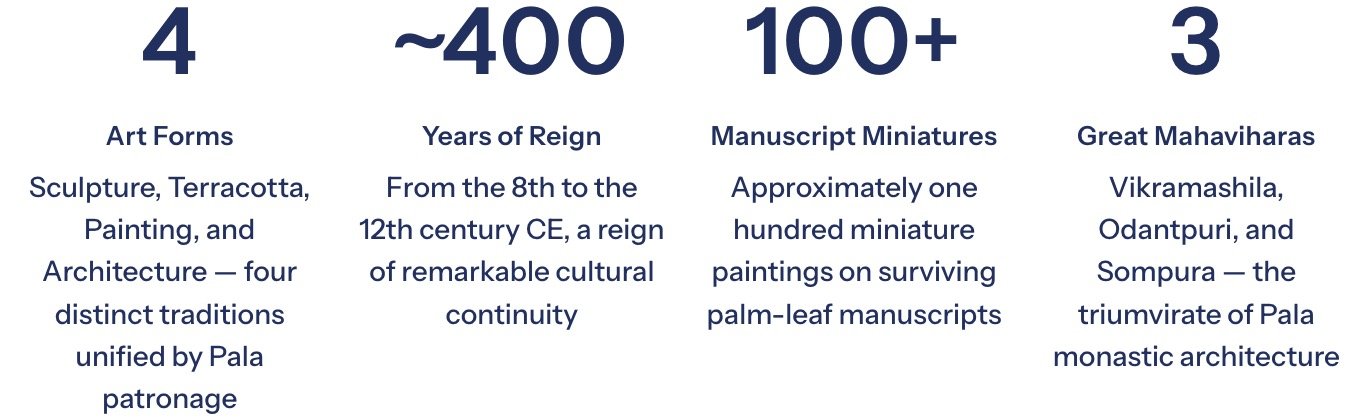
The Enduring Legacy of Pala Cultural Achievement
The Pala era, through its quality sculpture, magnificent architecture, and remarkable painting tradition — especially its manuscript art — provided vital continuity to the growth of art and culture in the eastern region of India, ensuring that the flame of classical Indian aesthetics was carried forward even as political power shifted and imperial configurations changed.
It is this quality of cultural continuity — of preserving, transmitting, and creatively transforming — that constitutes the most enduring dimension of Pala achievement. Scholars and students of South Asian history must engage with the Pala artistic legacy not merely as a repository of beautiful objects, but as a living testimony to the power of enlightened patronage to sustain civilisation through centuries of change. The Pala arts stand today as one of the great chapters of the Indian cultural story — a chapter written in bronze and basalt, in pigment and palm leaf, in brick and carved stone, across the fertile heartland of eastern India.
Legacy and Historical Significance of the Pala Dynasty
The Pala Dynasty occupies a uniquely important place in the history of early medieval India. Born from the collective will of a people seeking deliverance from anarchy, it evolved over three centuries into one of the most powerful, culturally sophisticated, and internationally connected empires of the subcontinent. From the pragmatic statecraft of Gopala to the imperial grandeur of Dharmapala and the expansive diplomacy of Devapala, the Palas demonstrated an impressive capacity for political adaptation, administrative innovation, and cultural vision.
Political Legacy
The Palas demonstrated that power could be institutionalised through consent and administration rather than solely through conquest. Their multi-tiered administrative system, documented in copper plate inscriptions, set benchmarks for governance in eastern India.
Cultural Legacy
As patrons of Nalanda and Vikramasila, the Palas preserved and transmitted Buddhist scholarship to Tibet and Southeast Asia. The Pala school of Buddhist art remains one of the most distinctive and influential artistic traditions of the medieval world.
Economic Legacy
Through trade with Southeast Asia and the expansion of agriculture via land grants, the Palas transformed Bengal into a prosperous hub of commerce, production, and cultural exchange — a legacy that shaped the region's identity for centuries thereafter.
The Palas' eventual decline was the result of a convergence of pressures: the exhaustion wrought by the prolonged tripartite struggle with the Pratiharas and Rashtrakutas, internal administrative challenges, and the rising power of regional successors. By the end of the eleventh century, the Sena dynasty had supplanted them in Bengal. The Senas, in turn, were overwhelmed by the Turkish Khalji invasions of the thirteenth century. Yet, the Pala legacy endured — in the monasteries of Tibet, in the temples of Southeast Asia, in the copper plate records of Bengal's villages, and in the very structure of eastern Indian civilisation as it developed through the medieval and early modern periods. For students of Indian history, the Pala Dynasty offers an indispensable case study in the interplay of political ambition, administrative capacity, religious patronage, and cultural diplomacy.
Key Takeaway: The Pala Dynasty is significant not merely as a political entity but as a civilisational phenomenon. Its administrative records (copper plates), foreign accounts (Sulaiman's narrative, Tibetan chronicles), and archaeological evidence collectively provide one of the most multi-source documented histories of any early medieval Indian dynasty — making it a particularly rich subject for interdisciplinary historical study.
