
Growth of Vaishnava & Śaiva Religions and the Bhakti Movement
From the 6th to the 13th century A.D., South India witnessed one of the most profound religious transformations in human history. The Tamil Bhakti Movement, rooted in intense personal devotion to God, revitalised Hinduism, produced immortal devotional literature, and laid the philosophical foundations that continue to shape Indian religious thought to this day.
The Tamil Bhakti Movement: Origins and Significance
The age between the 6th and 9th century A.D. in Tamil Nadu stands as a period of remarkable religious renaissance. Often described as a Hindu revival, the Bhakti Movement emerged as a powerful response to the spiritual climate of the time, challenging the dominance of Jainism and Buddhism that had flourished during the Kalabhra interregnum. The movement was not a sudden eruption but a gradual awakening, beginning with the earliest saint-poets who are rightly called the "morning stars" of Bhakti.
The foundational principle of the Bhakti doctrine is complete devotion and surrender to God — a direct, personal, mystical relationship with the divine. At the moment of ecstasy, the devotee perceives the vision of God personally. This experience transcended mere ritual and made religion accessible to every human heart. The devotional songs of the saints, sung in temples in the Tamil language, brought the deepest spiritual truths to the common people in a form they could feel, sing, and live by.
Decline of Jainism and Buddhism
Political changes under Pallava rulers, the withdrawal from worldly life, disbelief in a personal God, and active royal patronage of Hinduism by kings like Mahendravarman I and Pandyan Parantaka Neduncheliyan collectively led to the retreat of Jainism and Buddhism from Tamil soil.
Rise of Temple Worship
The Bhakti cult made temple worship the central and most prominent feature of religious life. Siva, Vishnu, and Durga were worshipped through devotional hymns that stirred both individual piety and collective religious identity across the Tamil country.
Saints as Vehicles of Philosophy
Saiva Nayanmars and Vaishnava Alwars composed devotional hymns marked by piety and intense attachment to God. Their works caused profound changes in religion throughout Tamil Nadu, transforming abstract philosophy into lived, sung, and celebrated devotion.
The early Alwars — Pey, Poykai, and Putham — and the early Nayanmars — Karaikkal Ammaiyar and Tirumular — paved the way for subsequent generations of saint-poets. Their compositions were not mere poetry; they were the living testimony of mystical experience translated into song. The Bhakti movement thus stands as one of the most democratic and emotionally powerful religious phenomena in Indian history, cutting across caste, language, and social barriers to reach the human soul directly.
Saivism and the Nayanmars
The Saiva tradition in Tamil Nadu is anchored in the lives and hymns of the sixty-three Nayanmars — saint-poets who dedicated their entire existence to the praise and service of Lord Siva. These saints belonged to different communities and historical periods, yet they were united by an overwhelming love for Siva that expressed itself in song, service, and sometimes extraordinary personal sacrifice. Lord Siva was worshipped both in the human form and as the sacred Linga, and the devotees revered him in varied iconographic forms — Lingotbava Moorthy, Somaskantha Moorthy, and Gangadhara Moorthy.
Thirunavukkarasar (Appar)
Born at Tiruvamur in the Vellala community, Appar first embraced Jainism before returning to Saivism. He composed 3,066 stanzas in the Thevaram. His spiritual path is the Chariya Marga (Dasa Marga) — the devotee as a slave to God the master.
Thirugnana Sambandar
Born at Sirkazhi in a Brahmin family, Sambandar lived only 16 years yet composed 4,158 verses in the Thevaram — celebrated for rare similes and lyrical sweetness. He converted the Pandyan king Kun Pandian to Saivism. His path is Kriya Marga (Sat-Putra Marga) — the devotee as son to God the father.
Sundaramurthy
Born at Navalur, Sundarar is unique for his intimate friendship with God — he was called Tambiran Tholan (Friend of the Lord). His path is Yoga Marga (Sakha Marga) — the devotee as friend to God. He authored the seventh Tirumarai.
Manikavasagar
A minister to a Pandyan king, Manikavasagar received his initiation from Lord Siva himself beneath a Kurundha tree. His approach is Gnana Marga — the path of knowledge. His works, Tiruvasagam and Tiruchirrambalkovai, are among the most sublime expressions of Tamil devotional literature.
The Saiva tradition grew steadily from the Pallava period into the great Chola era. The Chola rulers following Vijayalaya were fervent devotees of Lord Siva and built magnificent temples in his honour. It was the scholar Nambi Andar Nambi who rescued and compiled the devotional hymns into the Tirumarai during the reign of Rajaraja I, ensuring that these precious compositions would endure for all time. The Periapuranam, written by Sekkilar — a minister of the Chola court — in the 12th century A.D., narrates the biographies of all sixty-three Nayanmars and remains one of the greatest literary achievements of Tamil civilisation.
The Twelve Tirumarais: Sacred Canon of Saivism
The devotional literature of Tamil Saivism was not left to scatter across time. Through the dedicated efforts of scholars and poets, it was systematically compiled into a canon of twelve Tirumarais (Divine Literature) — a body of work that forms the spiritual and literary backbone of Tamil Saivism. This compilation represents centuries of inspired composition, from the earliest Nayanmars to the grand narrative of the Chola period.
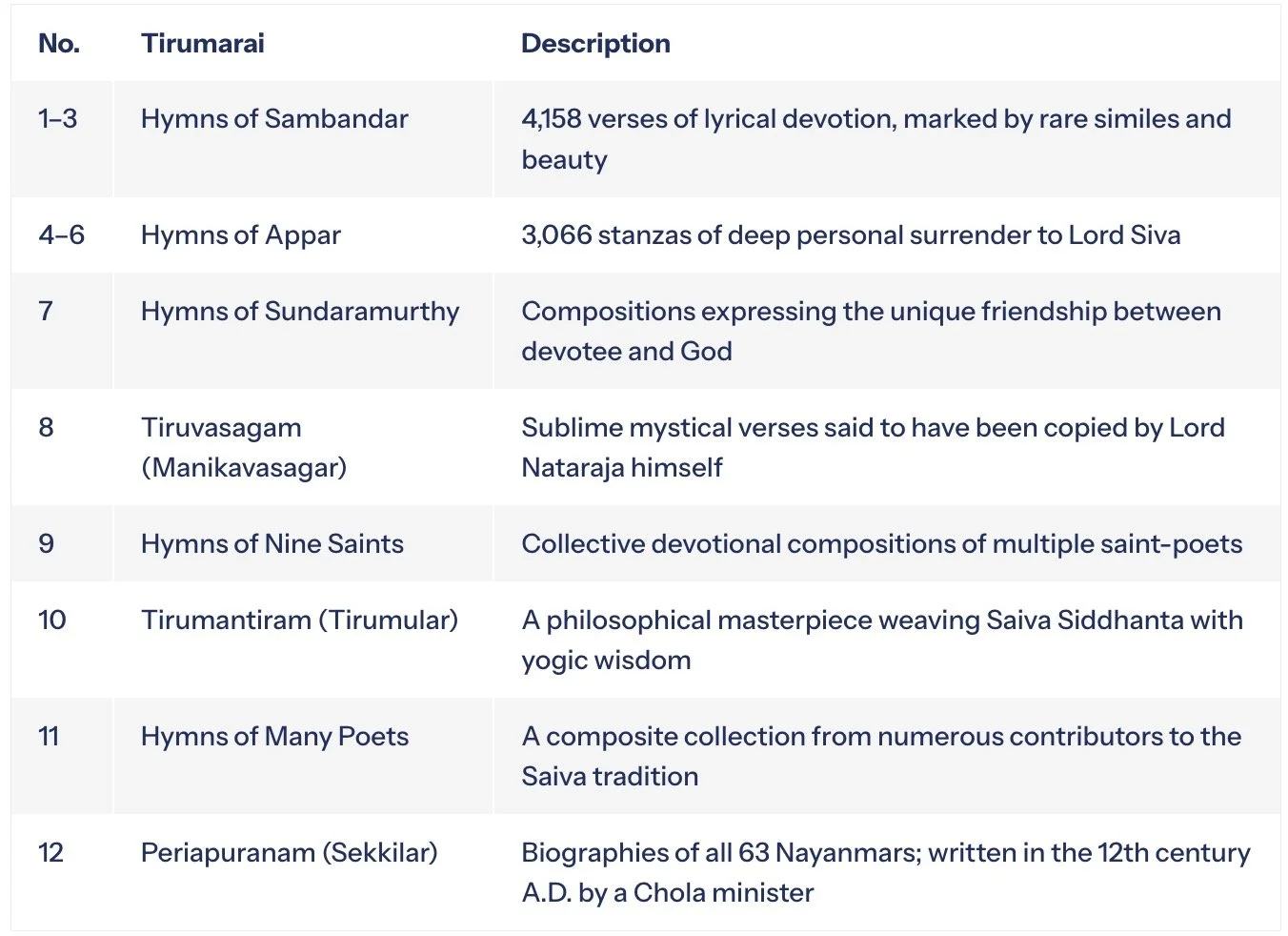
The Twelve Tirumarais: Sacred Canon of Saivism
The first seven Tirumarais are collectively known as the Tevaram. The Siva-Nana-Bodam, written in the first half of the 13th century A.D., is the first systematic statement of the tenets of Tamil Saivism. The philosophical framework of Saivism rests on the doctrine of Pathi, Pasu, and Pasam — God, Soul, and Bondage. Liberation (Mukti) is achieved when the soul frees itself from the bondage of passion and attains union with the divine. As the poet-philosopher Meykandar beautifully expressed: "The Veda is the cow, its milk is true Agama; the Tamil sung by the Four is the ghee extracted from it."
Vaishnavism and the Twelve Alwars
Parallel to the Saiva tradition, the Vaishnava Bhakti movement in Tamil Nadu was led by the twelve Alwars — saint-poets consumed by an overwhelming love for Lord Vishnu. The word "Alwar" itself means "one who is immersed in God." Their compositions, collectively numbering four thousand verses, represent some of the most tender, lyrical, and theologically rich poetry in any Indian language. The Alwars came from diverse social backgrounds — from Brahmins to communities outside the traditional hierarchy — demonstrating that the love of Vishnu recognised no caste boundaries.

Vaishnavism and the Twelve Alwars
An especially memorable episode in Vaishnava tradition is the meeting of the three early Alwars — Poygai, Bhudam, and Pey — at a Vishnu temple at Tirukkovilur on a rainy day. Seeking shelter, they squeezed together in a small space and felt the divine presence of Lord Vishnu pressing among them. In that mystical moment, they were commanded to sing His praise, and the three immediately composed their celebrated verses, known as the Mudhal Tiruvandhadis. Their works are notably free from sectarian bias.
The entire body of Alwar poetry was compiled by the great scholar Nathamuni into the Nalayira Divya Prabandham(The Four Thousand Divine Compositions). Nathamuni's tireless effort preserved these hymns and elevated the Vaishnava tradition to a canonical status comparable to the Vedas themselves. Within the Vaishnava tradition, two important sub-sects later emerged: the Vadakalai, founded by Vedanta Deshikar in the 13th century A.D., and the Thenkalai, founded by Logacharya — distinguished by the 'U' and 'V' symbols respectively worn on their foreheads. Royal patronage from rulers like Simhavishnu, Narasimhavarman, Nandivarman II, and Tirumangai further strengthened the spread of Vaishnavism across the Tamil country and beyond — the hymns of Andal's Tiruppavai even spread to South East Asia.
Shankaracharya and Advaita Vedanta
No survey of this period's religious history is complete without engaging deeply with Adi Shankaracharya (788–820 CE), the towering philosopher from Kerala whose intellectual revolution transformed Indian religious thought. Born in a devout Brahmin family, Shankara showed extraordinary spiritual precocity and went on to become the foremost exponent of Advaita Vedanta — the philosophy of non-dualism. The word "Advaita" literally means "not two," signifying the ultimate unity of the individual soul (Atman) and the supreme reality (Brahman).
The Core Teaching of Advaita
Shankara's philosophy rests on a single, radical claim: Brahma alone is real (Brahma Satyam); the world is illusion (Jagat Mithya); the individual soul is none other than Brahman (Jivo Brahmaiva Na Aparah).
He identified two levels of reality: conventional reality (the experienced world of souls and matter) and absolute reality (Brahman alone). Ignorance (Avidya) causes us to mistake the conventional for the absolute. Liberation (Moksha) is the realisation of oneness — when ignorance vanishes, the soul recognises itself as Brahman.
Shankara's Vedantic Legacy
Brahma-sutra-bhasya: His magnum opus commentary on the Brahma Sutras
Vivekachudamani: A celebrated treatise on discrimination and liberation
Nirvana-shatakam: A lyrical declaration of the non-dual self
Atma-bodha: A concise guide to self-knowledge
Hymns to Siva (Daksinamurti-stotra), Vishnu (Govinda-ashtaka), and Shakti (Saundarya-lahari)
What makes Shankara a figure of extraordinary historical stature is that he was, as scholars note, "not an ivory tower philosopher but a political sage." After the collapse of the Gupta Empire, India was fragmented into warring kingdoms. Shankara's response was to bind the subcontinent not with armies but with philosophy, poetry, and pilgrimage. He connected the twelve Jyotirlingas, eighteen Shakti-peethas, and four Vishnu-dhaams into pilgrim routes that defined India as a single sacred geography. He established the four Mathas at Sringeri, Dwarka, Puri, and Badrinath — centres of Vedantic learning at the four cardinal points of the subcontinent. He communicated through Sanskrit, the intellectual lingua franca of the age, linking the learned across all regions.
His strategy of Jagat Mithya, Brahma Satyam also served a unifying purpose — by declaring that all the diverse forms of God (Siva, Vishnu, Shakti) were ultimately manifestations of the same formless Brahman, Shankara could embrace multiple religious traditions within a single philosophical canopy. Yet his limitations must also be acknowledged: his use of Sanskrit excluded the masses, his philosophy was complex, and several scholars note that his historical fame grew considerably only centuries after his death, particularly during the era of Muslim invasions.
Advaita Vedanta
Shankaracharya (788–820 CE)
Non-dualism. Brahman alone is real. World is Maya. Liberation through knowledge (Jnana Marga).
Vishishtadvaita
Ramanujacharya (1017–1137 CE)
Qualified non-dualism. Soul and matter are real attributes of Brahman. Liberation through Bhakti and divine grace.
Dvaita
Madhvacharya (1238–1317 CE)
Theistic dualism. God and soul are eternally distinct. Strong emphasis on personal devotion to Vishnu.
Other Schools
Nimbarkacharya, Vallabhacharya, Chaitanya Mahaprabhu
Bhedabhed, Shuddhadvait, and Achintya Bhedabhed — further nuanced responses to the question of God, soul, and the world.
Ramanuja and Vishishtadvaita
Ramanujacharya (1077–1157 CE) stands as one of the most important religious thinkers and social reformers in Indian history. A philosopher-saint of the Sri Vaishnava tradition, Ramanuja's genius lay in charting a middle path between the cold abstractions of Advaita and the warm, personal devotionalism of the Alwar tradition he so deeply revered. His philosophy of Vishishtadvaita — "Advaita with qualification" or "Qualified Non-Dualism" — became one of the three most influential Vedantic philosophies of the second millennium, alongside Shankara's Advaita and Madhva's Dvaita.
Ramanuja disagreed with his own guru, Yadava Prakasa, who belonged to the Advaita tradition. Instead, he followed in the footsteps of the Tamil Alwars and the scholars Nathamuni and Yamunacharya. His philosophical departure from Shankara is fundamental: where Shankara declared the world and individual souls to be ultimately illusory (Maya), Ramanuja insisted that both the world and individual souls are real — they are the body of Brahman, real attributes or qualities of the supreme reality. God is not a featureless, attribute-less absolute (Nirguna Brahman) but a Saguna Brahman — a personal God with qualities, full of grace and love.
The individual soul, in Ramanuja's vision, is created by God out of His own essence. It returns to its maker and lives with him forever, yet it is always distinct — "one with God and yet separate." This beautiful paradox is the heart of Vishishtadvaita. Liberation (Moksha) is achieved not through abstract knowledge alone but through Bhakti (devotion)and ultimately through Prapti — an intensely surrendered form of devotion that draws forth the grace of God. It is through this divine grace that the soul attains Moksha.
Ramanuja's social vision was equally significant. He established a careful balance between orthodox Brahmanism and popular Bhakti, making the path of devotion accessible to all — including Sudras and even those outside the caste system. While he did not advocate giving the "lower" castes access to the Vedas, he championed Bhakti as a universal mode of worship. He is remembered for not observing caste distinctions in his spiritual work and for actively attempting to eradicate untouchability — a remarkable stance for his era. His two most important Sanskrit works are the Sri Bhashya (a commentary on the Brahma Sutras) and the Bhagavad Gita Bhashya (a commentary on the Bhagavad Gita), which remain foundational texts of the Sri Vaishnava tradition to this day.
"The individual soul created by God out of his own essence, returns to its maker and lives with him forever, but it is always distinct. It was one with God and yet separate."
— The essence of Ramanuja's Vishishtadvaita philosophy
Legacy and Enduring Significance
The Bhakti Movement and its philosophical tributaries — the Saiva Nayanmar tradition, the Vaishnava Alwar tradition, Shankara's Advaita, and Ramanuja's Vishishtadvaita — together constitute one of the most creative and transformative periods in the history of Indian religion and culture. What began as devotional songs sung in Tamil temples reverberated across centuries and geography, shaping the religious consciousness of an entire subcontinent.
Devotional Literature
The Tevaram, Tiruvasagam, and Nalayira Divya Prabandham created an enduring canon of Tamil devotional literature. These hymns continue to be sung in temples across Tamil Nadu today, preserving a living link with the saint-poets of the Bhakti age.
Temple Culture
The Bhakti movement established temple worship as the central institution of Hindu religious life in South India. The great Chola temples, built by devoted rulers inspired by Saiva Bhakti, remain among the finest achievements of Indian architectural and cultural heritage.
Social Reform
Ramanuja's inclusive Bhakti — open to all castes — planted seeds of social reform that would bear fruit in subsequent centuries. The saint-poets themselves came from diverse communities, challenging the rigidities of caste through the universality of divine love.
Philosophical Synthesis
Shankara's Advaita and Ramanuja's Vishishtadvaita provided India with sophisticated philosophical frameworks for understanding the relationship between God, soul, and the world — frameworks that continue to be debated and lived by millions of Indians today.
The Saiva and Vaishnava saints who flourished during the Pallava and Chola periods, as scholars have noted, "led the powerful forces of Hindu regeneration and established the twin glittering edifices of Saivism and Vaishnavism in the South on firm foundations." Their legacy is not merely historical — it is a living, breathing tradition that continues to animate the religious and cultural life of Tamil Nadu and, through its philosophical reach, of India as a whole. Students of South Indian religious history will find in this period not simply a chapter of the past, but the deep roots of a present that is still, in many ways, shaped by the songs of the Alwars, the hymns of the Nayanmars, and the philosophies of Shankara and Ramanuja.
Key Terms to Remember: Bhakti (devotional surrender) · Nayanmars (63 Saiva saints) · Alwars (12 Vaishnava saints) · Tevaram (first seven Tirumarais) · Nalayira Divya Prabandham (4,000 verses of the Alwars) · Advaita (non-dualism, Shankara) · Vishishtadvaita (qualified non-dualism, Ramanuja) · Pathi-Pasu-Pasam (God-Soul-Bondage, Saiva Siddhanta) · Prapti (supreme devotional surrender, Ramanuja) · Avidya (ignorance, Shankara)
