
Regional States during the Gupta Era: Polity and Administration
Early Medieval India · 300–700 A.D.
Regional States during the Gupta Era: Polity and Administration
Between 300 A.D. and 700 A.D., the Indian subcontinent witnessed a rich tapestry of political formations — from the expansive Gupta empire in the north to the dynamic kingdoms of the Deccan and the far south. This period represents a pivotal transition in Indian political history, marked by evolving administrative structures, the crystallisation of feudal tendencies, and the gradual displacement of tribal republics by hereditary monarchies. Understanding this era is essential for grasping the foundations of medieval Indian statecraft.
The major dynasties that dominated this period included the Guptas and Pushyabhutis in northern India, the Vakatakas, Kadambas, and Chalukyas of Badami in the Deccan, and the Pallavas in southern Andhra and Tamil Nadu. Alongside these major powers, numerous small kingdoms and chieftaincies dotted the political landscape, creating a complex mosaic of sovereign and semi-sovereign entities.
Our understanding of this era rests on a rich and varied body of sources, including epigraphic records (inscriptions), dharmashastra literature, Bana's Harshacharita, and the invaluable accounts of Chinese travellers such as Fa-Hien and Hiuen Tsang. Together, these sources illuminate the structure of governance, the nature of kingship, the organisation of bureaucracy, and the contours of judicial life during one of India's most formative political epochs.
The North
Guptas & Pushyabhutis dominated, with Harsha extending wide sovereign control in the 7th century A.D.
The Deccan
Vakatakas, Kadambas, and Chalukyas of Badami established powerful regional kingdoms across central India.
The South
Pallavas held sway over southern Andhra and Tamil Nadu, including a naval dimension to their power.
Chapter I · Kingship
The King: Divine Right, Hereditary Power, and the Nature of Sovereignty
The most fundamental institution of political life in this period was the monarchy. By the time of Samudragupta's northern campaigns in the early fourth century A.D., the older gana (tribal republic) form of government had been almost entirely swept away. Ancient republics such as those of the Madras and Yaudheyas of the Punjab, and the Abhiras of central India, ceased to figure meaningfully in the political narrative. Many tribal chieftaincies were simultaneously undergoing transformation into hereditary monarchies, reflecting a broad-based shift in the nature of political authority across the subcontinent.
Kings of this period adopted grandiose titles that proclaimed their superiority over subordinate rulers. Titles such as paramamahesvara, rajadhiraja, and paramabhattaraka were not merely honorific; they encoded a carefully constructed hierarchy of political relationships. Crucially, this period also witnessed the firm entrenchment of the divine right theory of kingship. The king was identified with cosmic and divine authority — described as the fifth lokapala, or guardian of the realm, alongside the four cardinal guardians Kubera, Varuna, Indra, and Yama. He bore titles like prithvivallabha, meaning 'the beloved of the Earth Goddess', signifying a sacred covenant between ruler and realm.
Despite this divine elevation, kingship was simultaneously tempered by notions of the king as protector and guardian of his subjects — a dual identity that balanced divine sanction with civic responsibility. Succession was generally governed by the principle of primogeniture (the eldest son inheriting the throne), though exceptions were not uncommon: nobles and councillors at times elected kings, and queens occasionally assumed ruling authority, as in the cases of Prabhavati of the Vakatakas and Didda of Kashmir.
Powers of the King
Supreme judge of the realm
Commander-in-chief of the army
Overseer of all administrative activity
Grantor of lands and charters to feudatories
Final authority in revenue and taxation matters
Key Royal Titles of the Era
Rajadhiraja — King of Kings
Paramamahesvara — Supreme Lord
Paramabhattaraka — Most Venerable Lord
Prithvivallabha — Beloved of the Earth
Lokapala — Guardian of the World
Chapter II · Administration
Bureaucracy: Officials, Cadres, and the Machinery of Governance
Unlike the highly centralised Mauryan bureaucratic model with its well-documented mantriparishad (council of ministers), the Gupta-era state presents a more diffuse administrative picture. While there is no clear evidence for a formal central council of ministers, the period did feature a range of high officials — collectively referred to at times as mantrin — who managed specialised domains of governance.
Among the most important officials was the sandhivigrahika, who handled foreign affairs, war, and diplomacy. Military administration was overseen by the mahabaladhikrita and the mahadandanayaka, both senior positions in the military hierarchy. A notable feature of Gupta administration was that the same individual could hold multiple posts simultaneously — the poet-official Harishena, composer of the celebrated Allahabad Pillar Inscription, served as both sandhivigrahika and mahadandanayaka. The Guptas also maintained a distinct cadre of officials called kumaramatyas, from whom most senior appointments were drawn.
At the provincial and sub-provincial levels, the uparika governed the bhukti (the largest administrative division), while the vishayapati managed the vishaya below it. The ayuktaka served as a critical intermediate link between the bhuktiand the village. Over time, a significant administrative shift occurred: officials who were initially paid in cash came to be assigned revenues from specific territories, earning them the titles of bhogika or bhogapati. This monetisation-to-assignment shift laid the groundwork for increasingly hereditary posts and a consequent dilution of royal authority — a process vividly illustrated in the Harshacharita, which records villagers complaining to Harsha about the misconduct of such revenue-holding officials.
Kumaramatya
Senior cadre from which key officials were selected; served the king, princes, and provincial governors.
Sandhivigrahika
Minister for foreign affairs, war, and peace; a crucial diplomatic post in the Gupta administration.
Uparika
Senior official in charge of the bhukti, the highest territorial administrative unit; sometimes a prince.
Vishayapati
Administrator of the vishaya, the intermediate administrative division below the bhukti.
Chapter III · Territory & Force
Administrative Divisions and the Army
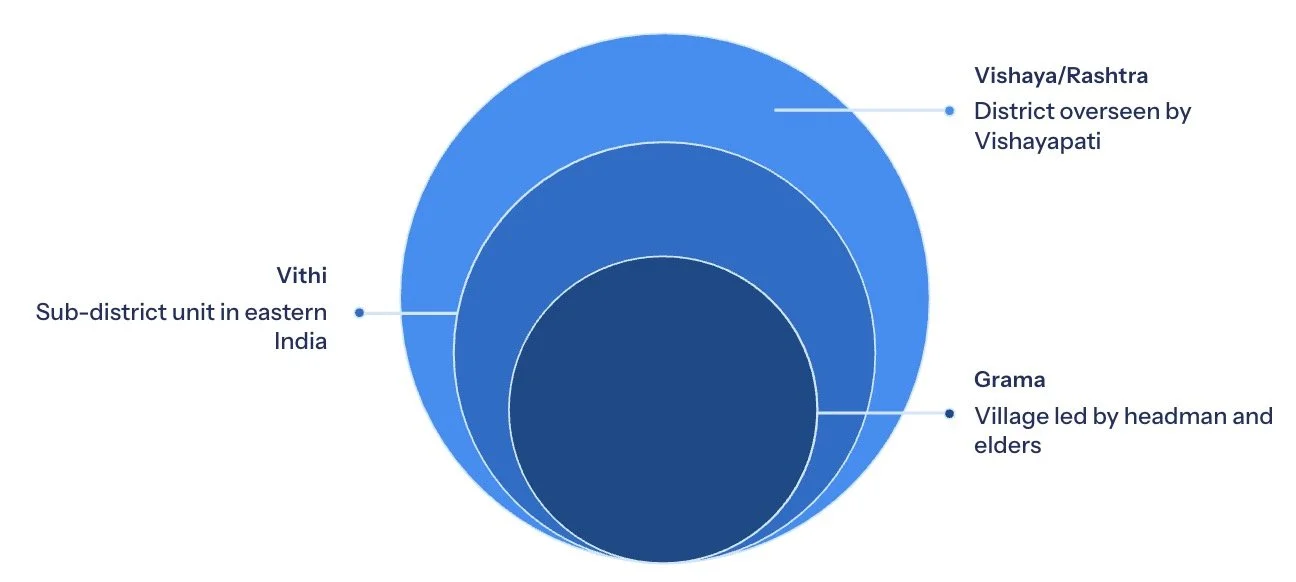
The political geography of Gupta-era India was carefully organised into a hierarchical system of administrative units, each with its own designated official and set of responsibilities. The largest territorial unit was the bhukti, supervised by the uparika. Below it was the vishaya — sometimes also called rashtra in certain regions — which functioned as an intermediate district-level unit under the vishayapati. In eastern India, the vishaya was further subdivided into vithis. The smallest unit remained the village, managed by a headman (gramika) and a council of village elders, who handled local affairs with a degree of autonomy.
Urban settlements and towns had their own administrative character, with craft and merchant guilds playing a vital role in local governance. These guilds were not merely economic bodies; they were quasi-administrative organisations that regulated the commercial and social life of towns, providing a non-governmental layer of administration alongside the royal machinery.
Administrative Divisions and the Army
The maintenance of a standing army was indispensable for both internal order and external defence. Cavalry constituted the most prized arm of the military, while maritime states like the Pallavas maintained navies to project power across the seas. Chariots, once a dominant feature of ancient Indian warfare, declined in prominence during this period. The royal army was not self-sufficient; it was routinely supplemented by the militia of feudatory chiefs (samantas), reflecting the deeply interdependent nature of military power and political loyalty in this era.
This administrative hierarchy ensured that authority flowed from the central royal court outward, though in practice local officials and grantees exercised considerable autonomous power — a tension that would eventually contribute to the feudalisation of the political order.
Chapter IV · Feudalism
The Samanta System: Seeds of Feudal Polity
One of the most historically significant developments of the Gupta period was the emergence and consolidation of the samanta system — a network of semi-independent local chiefs who occupied a critical position between the imperial centre and the local village. Following Samudragupta's extensive military campaigns, many conquered rulers on the fringes of the Gupta empire were not absorbed into a centralised administration but were instead retained as subordinate allies. These rulers, known as samantas, maintained a complex web of obligations toward the imperial overlord.
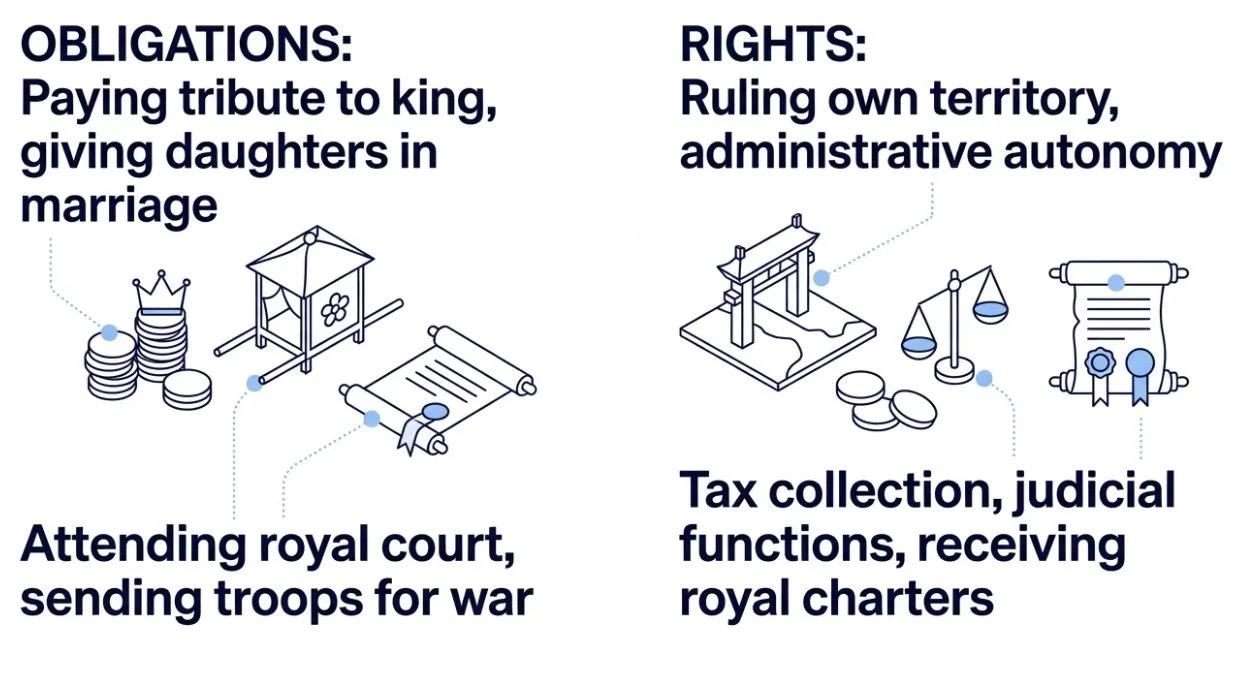
The obligations of a samanta were multi-dimensional: they paid periodic tribute to the Gupta king, offered their daughters in marriage to the royal family, personally attended the king's court to pay homage, and sent troops to fight in the king's army during times of war. In return, the king formally recognised their right to rule their own territories and issued charters to that effect. Within their domains, samantas exercised considerable administrative autonomy, collecting taxes, dispensing justice, and maintaining order — functions that were otherwise reserved for royal officials in the core Gupta territories.
A parallel and reinforcing development was the widespread practice of land grants to priests and officials. When a king granted land, he typically also ceded key administrative rights over that land — including the right to tax, punish criminals, and exclude royal armies. This created a class of grantees who, like samantas, became effectively independent of royal authority. By the 7th century A.D. and beyond, this process had generated officials who adopted grand titles such as mahasamanta and those who claimed panchamahasabda (the privilege of five great ceremonial sounds), publicly proclaiming their autonomy. Historians have identified these features as indicative of an incipient feudal-type political organisation taking root in India from the Gupta period onward.
The Samanta System: Seeds of Feudal Polity
Chapter V · Revenue & Justice
Taxation and the Judicial System
The financial backbone of the Gupta-era state rested overwhelmingly on land taxation. Revenue items such as bhagaand bhoga — different categories of land tax — constituted the primary source of income for the royal treasury. Significantly, the burden of land taxation increased over the centuries, reflecting both the growing administrative needs of the state and the declining importance of trade-based revenues. Commercial taxes, which had been more prominent in earlier periods, receded as trade and long-distance commerce appear to have contracted during this era.
Local populations also bore non-monetary obligations, such as providing hospitality — food and lodging — to travelling officials and dignitaries. Meanwhile, the vast territories assigned to priests and officials through land grants effectively removed significant revenue streams from the royal treasury, further undermining the fiscal capacity of the central state. This fiscal erosion was both a symptom and a cause of the broader decentralisation of political authority during this period.
The judicial system of this period was considerably more developed than in earlier centuries. A profusion of legal codes and dharmashastra treatises codified both criminal and civil law in elaborate detail, with particular attention to property rights and inheritance. Courts operated at multiple levels — including the karana, adhikarana, and dharmasana — creating a layered structure for the dispensation of justice. However, justice was not blind to social hierarchy: the dharmashastra tradition explicitly prescribed differential punishments for the same offence depending on the varna (social class) of the accused, with higher-varna individuals receiving milder penalties. Local usages and the customary practices of guilds and castes were also granted formal recognition and weight in judicial proceedings, creating a pluralistic legal culture that was simultaneously hierarchical and community-sensitive.
Taxation at a Glance
Bhaga and Bhoga: primary land taxes
Land taxes increased progressively over the centuries
Commercial taxes declined with shrinking trade
Local labour and hospitality obligations existed
Revenue lost through land grants to priests and officials
Courts and Justice
Karana, Adhikarana, Dharmasana: different courts
Criminal and civil cases clearly distinguished
Elaborate laws on property and inheritance
Varna-based differential sentencing
Guild and caste customs given formal weight
Key Takeaways: Political Patterns of the Gupta Era
The political history of India between 300 A.D. and 700 A.D. is not merely a chronicle of dynasties and battles; it is a story of profound structural transformation. The period opened with the consolidation of large monarchies at the expense of tribal republics, moved through the elaboration of a complex bureaucratic and administrative apparatus, and closed with the entrenchment of feudal-type political formations rooted in the samanta system and pervasive land grants. Each of these transitions left a lasting imprint on the subsequent character of medieval Indian statecraft.
The divine theory of kingship provided ideological legitimacy to royal authority, while simultaneously the proliferation of samantas and revenue-grantees steadily eroded the practical reach of that authority. The administrative divisions — from bhukti to vishaya to village — represented a thoughtful territorial architecture, but one increasingly hollowed out by the autonomy of local chiefs and grantees. The judicial system, though advanced for its time, remained deeply entangled with social hierarchy. Together, these features define the Gupta era as a watershed moment in the evolution of Indian political organisation.
Consolidation of Monarchy
Tribal republics absorbed; hereditary kingship with divine sanction becomes the dominant political form across the subcontinent.
Administrative Elaboration
Hierarchical bureaucracy built around kumaramatyas, uparika, and vishayapati; territorial divisions systematised from bhukti to village.
Rise of the Samanta System
Feudatory chiefs and land grantees gain autonomy; decentralisation accelerates and feudal-type polity takes shape.
Fiscal and Judicial Evolution
Land revenue becomes dominant; dharmashastra jurisprudence develops elaborate legal codes with varna-based differentiation.
"From the Gupta period onward, the political organisation which developed in India represented a feudal-type of political organisation." — Historiographical consensus on the long-term legacy of Gupta-era statecraft.
