
The Chalukyas of Badami
A dynasty of extraordinary ambition and cultural brilliance, the Chalukyas of Badami ruled large swathes of southern and central India between the 6th and 8th centuries CE. Rising from the ruins of the Kadamba kingdom and carving an empire that stretched from the Narmada to the deep south, they left behind a legacy in stone, literature, and statecraft that continues to shape our understanding of early medieval India.
The Three Chalukya Dynasties: An Overview
The name "Chalukya" encompasses not one but three distinct yet genealogically related dynasties that collectively dominated the Deccan and parts of central India for over six centuries. Understanding how they relate to one another is essential to appreciating the full arc of Chalukya history.
Chalukyas of Badami
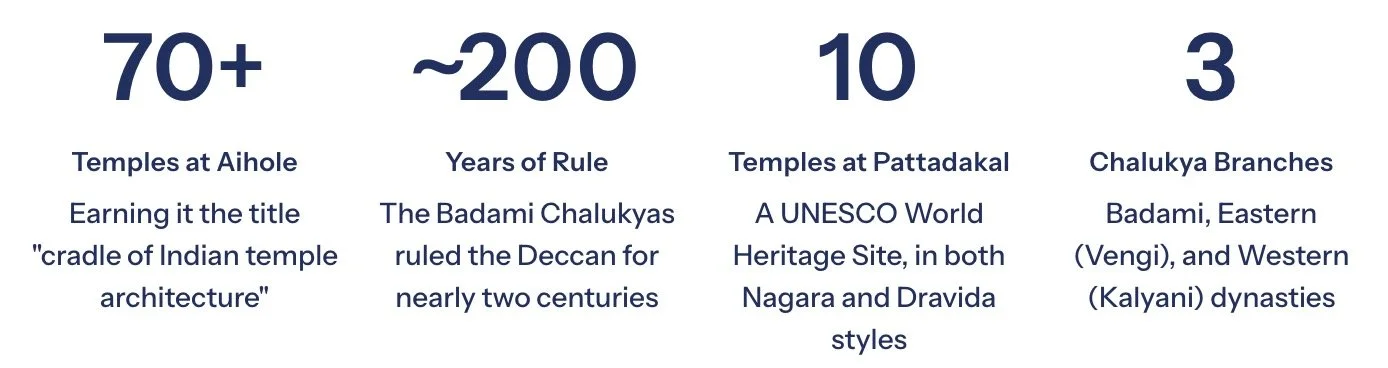
The earliest and foundational branch. Ruled from Vatapi (modern Badami) from the mid-6th century until the rise of the Rashtrakutas in the mid-8th century. Their reign lasted nearly two hundred years and established the template for Chalukya governance and culture.
Eastern Chalukyas of Vengi
A branch established when Pulakeshin II appointed his brother Kubja Vishnuvardhana as governor of the conquered Vengi region in 624 CE. After Pulakeshin II's death, this viceroyalty became an independent kingdom in eastern Deccan, ruling modern Andhra Pradesh until c. 1130 CE and continuing as Chola feudatories until 1189 CE.
Chalukyas of Kalyani (Western Chalukyas)
Descended from the Badami Chalukyas, this line re-emerged in the late 10th century as the Rashtrakuta empire weakened. Under Someshvara I, the capital was moved to Kalyani (modern Basavakalyan), and these Western Chalukyas ruled until the end of the 12th century, continuing the cultural legacy of their ancestors.
The three branches together represent one of the most enduring political traditions in Indian history. While each branch possessed its own identity and territorial sphere, they shared a common ancestry, a common cultural ethos, and a remarkable capacity to revive and reinvent Chalukya power across the centuries.
Origins and Early Identity of the Chalukyas
Few questions in the historiography of the Deccan are as contested as the origin of the Chalukya dynasty. The debate draws upon epigraphy, genealogical records, literary traditions, and comparative history, yet a definitive consensus remains elusive. What emerges is a rich tapestry of competing claims, each reflecting the political and social imperatives of the age in which they were articulated.
Indigenous Kanarese Theory
Dr. D. C. Sircar argued that the Chalukyas represented an indigenous Kanarese family that claimed Kshatriya status. This view is considered more probable by many historians, though direct evidence remains limited. Supporting this interpretation is the proposal by historian S. C. Nandinath that the very word "Chalukya" derived from Salki or Chalki, a Kannada term for an agricultural implement — suggesting deep roots in the local agrarian culture of Karnataka.
The Chalukyas of Badami themselves claimed Brahmanical origin as Haritiputras of the Manavya Gotra in their inscriptions — the same lineage claimed by their early overlords, the Kadambas of Banavasi, thereby positioning themselves as legitimate successors to Kadamba authority.
Northern Origin Theories
Dr. V. A. Smith suggested a connection with the Chapas, a branch of the foreign Gurjara tribe, implying northern or foreign origins. Records of the Eastern Chalukyas reference a ruler of Ayodhya who came south, and later Kalyani Chalukya records link the dynasty to Manu or the Moon, asserting that 59 kings of the Chalukya lineage ruled at Ayodhya before 16 ruled in the Dakshinapatha.
However, historians note that associating South Indian dynasties with northern kingdoms was a common literary convention of the 11th century, lending these claims questionable historical reliability. The Badami Chalukya records themselves are notably silent on the Ayodhya connection. The 12th-century Kashmiri poet Bilhana even suggested a Shudra origin, highlighting the multiplicity and contradictions in the surviving accounts.
The Chalukyas' own inscriptions assert Brahmanical Haritiputra lineage of the Manavya Gotra — the same gotra as the Kadambas — effectively framing their rule as a continuation of Kadamba legitimacy in the Deccan.
Historical Sources for Chalukya History
The reconstruction of Badami Chalukya history rests upon a diverse corpus of epigraphic, numismatic, and literary sources. Taken together, these records offer a remarkably detailed picture of a dynasty deeply invested in documenting its own achievements and legitimacy.
Sanskrit and Kannada Inscriptions
Inscriptions constitute the primary historical source. Key examples include the Aihole inscription of Pulakeshin II — a celebrated Sanskrit prasasti composed by his court poet Ravikirti — and the Mahakuta Pillar inscription of Mangalesha. Both are written in old Kannada script. The Kappe Arabhatta record (c. 700 CE), the Peddavaduguru inscription of Pulakeshin II, and the Kanchi Kailasanatha and Pattadakal Virupaksha temple inscriptions of Vikramaditya II further enrich the epigraphic record.
Numismatic Evidence
Several coins of the Badami Chalukyas bearing Kannada legends have been discovered. These coins are particularly significant as material evidence for the flourishing of the Kannada language during the Chalukya period, corroborating inscriptional references to Kannada as the "natural language" of the region.
Foreign Travelogues
Contemporary foreign accounts provide invaluable external perspectives. The Chinese pilgrim Xuanzang (Hiuen Tsang)visited Pulakeshin II's court around 641 CE and recorded his admiration for the king's efficient administration, noting that the empire was divided into three Maharashtrakas of 99,000 villages each. The diplomatic exchange between Pulakeshin II and the Persian emperor Khosrau II — documented both in the Aihole inscription and represented in an Ajanta fresco — provides further external corroboration.
Political History: The Rulers of Badami
The political history of the Chalukyas of Badami is a narrative of remarkable ascent, imperial consolidation, dramatic reversal, and partial recovery — played out over nearly two centuries across the complex political landscape of the early medieval Deccan.
Pulakesin I (533–566 CE) — The Founder
Pulakesin I is credited with laying the dynastic foundations. In 543–44 CE, he fortified the hill near Badami in the Bijapur district of Karnataka, establishing his capital at the hill-fort of Vatapi. The choice of this site was dictated by strategic considerations — the location was naturally protected by hills and rivers. He adopted the title Vallabheshvaraand performed the ashvamedha (horse sacrifice), signalling sovereign ambition.
Kirtivarman I (566–597 CE) — The Expander
Kirtivarman I extended the Chalukya kingdom significantly by defeating the Mauryas of North-Konkan, the Nalas of Nalavadi (Bellary), and the Kadambas of Banavasi. His conquests firmly established the Chalukyas as the dominant power in the northern Deccan.
Mangalesa (597–609 CE) — The Regent
As Pulakeshin II, Kirtivarman I's son, was a minor upon his father's death, Mangalesa ruled as regent. He extended Chalukya power over the entire region between the two seas and defeated the Kalachuris of Chedi. However, he refused to relinquish power when Pulakeshin II came of age, precipitating a civil war.
Pulakeshin II (609–642 CE) — The Zenith
The most celebrated of all Badami Chalukya rulers, Pulakeshin II transformed the dynasty into the paramount power of the Deccan. After defeating his uncle Mangalesa in civil war and adopting the title Satyashraya, he conducted a series of brilliant campaigns: he checked Harshavardhana's forces on the banks of the Narmada, received the submission of the Latas, Malavas, and Gurjaras in the north, and defeated the Western Gangas and Alupas in the south. He conquered the Vengi region after defeating the Vishnukundinas and appointed his brother Vishnuvardhana as governor — thus laying the seed for the Eastern Chalukya dynasty. His first campaign against the Pallavas under Mahendravarman I was successful. However, a second invasion ended disastrously; Narasimhavarman I of the Pallava line defeated him in several battles, captured Badami, and likely killed Pulakeshin II.
Vikramaditya I to Vikramaditya II (644–745 CE) — Restoration and Glory
Vikramaditya I restored Chalukya power, drove out the Pallavas, and plundered their capital Kanchi, avenging his father's defeat. Vinayaditya (681–693 CE) and Vijayaditya (693–733 CE) presided over peaceful and prosperous reigns marked by significant temple-building activity. Vikramaditya II (733–745 CE) overran Kanchi three times, completely routed the Pallavas in 740 CE, and repelled an Arab invasion of south Gujarat — a reign of remarkable military and cultural achievement.
Kirtivarman II (744–745 CE) — The Fall
The last Chalukya ruler of Badami, Kirtivarman II, was defeated by his own feudatory Dantidurga, who founded the Rashtrakuta dynasty. With this defeat, the Chalukya dynasty of Badami came to an end, though its cultural and architectural legacy endured for centuries.
Religion and Cultural Tolerance Under the Chalukyas
The Chalukyas of Badami were, at their core, adherents of Brahmanical Hinduism. The rulers performed elaborate Vedic rituals including the Ashvamedha (horse sacrifice) and the Vajapeya, and their courts were centres of Sanskrit learning and religious scholarship. Superb temple structures dedicated to Brahma, Vishnu, and Shiva were erected at Vatapi and Pattadakal, reflecting deep royal investment in the Puranic religious tradition. The popularity of the Puranic worldview, in particular the devotional cults of Vishnu and Shiva, gave enormous impetus to the temple-building programmes for which the Chalukyas are so celebrated.
Yet what distinguishes the Chalukyas is not orthodoxy alone, but a genuine and sustained policy of religious tolerance. Their kingdom was a pluralist space in which multiple faiths coexisted and received royal patronage.
🕉️ Brahmanical Hinduism
The dominant faith of the ruling class. Vedic sacrifices were performed and extensive temple complexes dedicated to Vishnu, Shiva, and other deities were constructed at Aihole, Badami, and Pattadakal.
🙏 Jainism
Jainism prospered considerably during Chalukya rule. The celebrated Jain scholar Ravikirti was honoured at the court of Pulakeshin II. Rulers Vijayaditya and Vikramaditya also donated villages to Jain scholars, and Jain cave shrines were constructed at Aihole and Badami.
☸️ Buddhism
Though Buddhism was in decline, the Chalukyas treated it with tolerance. Xuanzang found well-established viharas and monasteries during his visit, reflecting continued Buddhist presence within the empire.
🔥 Zoroastrianism
Even the Parsis were permitted to settle and practise their faith freely in the Thana district of Bombay, demonstrating a remarkable breadth of religious accommodation under Chalukya administration.
This pluralism was not merely passive tolerance but an active acknowledgement of the diversity of religious life in the Deccan. It reflects the sophistication of Chalukya statecraft, which recognised that a stable and prosperous empire required the accommodation of its varied religious communities.
Architecture: The Stone Legacy of the Chalukyas
If there is one domain in which the contribution of the Chalukyas of Badami is most tangible and most enduring, it is architecture. The Chalukyas were great patrons of art and temple construction, and the monuments they left behind at Aihole, Badami, Pattadakal, and Mahakuta constitute one of the most important chapters in the history of Indian temple architecture. Their most significant architectural contribution was the development of the Vesara style — a distinctive synthesis of the northern Nagara and southern Dravida traditions that gave rise to a new architectural identity particular to the Deccan.
The Chalukya temple-building tradition unfolded across two broad phases. The first, spanning the 6th to early 8th centuries, is represented by the temples at Aihole and Badami — experimental, diverse in form, and remarkable for the coexistence of multiple stylistic approaches at a single site. The second phase, represented by the temples at Pattadakal, marks a mature synthesis: grander structures that brought together the best of both northern and southern traditions.
Cave Temples
The Chalukyas were accomplished builders of rock-cut cave shrines. Their cave temples are found at Aihole, Badami, Ajanta, Ellora, and Nasik. These caves generally represent Brahmanical or Hindu shrines, though some, like the Jain cave at Aihole, cater to non-Hindu faiths. Cave temples are characterised by pillars with bases and capitals, typically square in plan, with sanctuaries (garbhagriha) and assembly halls (mandapa). The walls and ceilings of many caves bear exquisite sculptural work.
The Badami Caves, carved into the red sandstone hillside, include three major caves — one Vaishnava, one Shaiva, and one Jaina. Cave 3, the largest and most ornate, contains impressive relief sculptures of Vishnu incarnations including Varaha (boar), Narasimha (lion-man), and Vamana (dwarf). The boar (varaha) was also the dynastic emblem of the Western Chalukyas. The Ravanaphadi cave at Aihole is a Shaiva shrine notable for its sculptures of Shiva as Nataraja and the Sapta-Matrikas.
Structural Temples at Key Sites
Aihole — The "cradle of Indian temple architecture," with over 70 temples including the Ladh Khan temple (flat-roofed, village assembly style), the Durga temple (resembling a Buddhist chaitya), the Huchimalligudi temple, and the Jain temple at Meguti bearing the famous Aihole inscription.
Badami — The Muktheeswara temple and the Melagutti Sivalaya are notable for architectural refinement.
Pattadakal — Ten temples (four northern style, six Dravidian), including the magnificent Virupaksha temple — built by Queen Lokamahadevi, modelled on the Kailasanatha temple at Kanchipuram, and representing the climax of early Chalukya temple architecture.
Mahakuta — Around 20 temples, almost all with northern-style curvilinear shikharas.
The Virupaksha Temple at Pattadakal is unique as the first temple in the Deccan to feature a gopuram (gateway tower). Built by Queen Lokamahadevi to commemorate Vikramaditya II's victory over the Pallavas, it employed sculptors brought from Kanchi — a remarkable cross-regional artistic exchange.
Literature, Language, and the Broader Cultural Legacy
The cultural contributions of the Chalukyas of Badami extend far beyond the architectural domain. Their reign witnessed significant developments in literature, language, painting, and the broader interchange of ideas between the northern and southern cultural zones of India — a legacy with consequences that resonate to this day.
The Aihole Inscription — A Literary Masterpiece
The Aihole inscription of Pulakeshin II, composed in Sanskrit by his court poet Ravikirti and written in old Kannada script, is considered a classical piece of Sanskrit poetry. It is at once a royal prasasti (eulogy), a historical document, and a literary achievement — describing the king's conquests and comparing Ravikirti's poetic gift to that of Kalidasa and Bharavi.
Kannada Language and Literature
The Chalukya period marked the emergence of Kannada as a dominant language of inscriptions alongside Sanskrit. Multiple inscriptions refer to Kannada as the "natural language" of the region. The Karnateshwara Katha, believed to be an eulogy of Pulakeshin II, is among the earliest references to Kannada literary tradition. Several coins with Kannada legends further attest to the vitality of the language during this period.
Sanskrit Scholarship and the Western Chalukya Legacy
From the later Western Chalukya period, two towering works stand out: Vijnaneshvara's Mitakshara — an authoritative commentary on Hindu law that continues to influence Indian jurisprudence — and King Someshvara III's Manasollasa, an encyclopaedia of all arts and sciences. The poet Vijayanaka, who described herself as the "dark Sarasvati," is believed to have been associated with the Chalukya court and represents the participation of women in literary culture.
Painting and the Ajanta Connection
Among the fine arts, painting flourished under Chalukya patronage. Several frescoes at Ajanta were executed during the Chalukya reign, including a celebrated panel depicting the reception of the Persian ambassador at the court of Pulakeshin II — a scene of remarkable cosmopolitan sophistication, documenting the dynasty's diplomatic reach into West Asia.
North–South Cultural Synthesis
Perhaps the most lasting contribution of the Chalukya era was its role as a crucible of cultural fusion. Expanding Sanskritic culture mingled with local Dravidian vernaculars, and the Vesara architectural style itself was an architectural embodiment of this synthesis. The Chalukya era may rightly be seen as the period when the transmission of ideas between northern and southern India was systematised and given monumental form. Today, the Chalukya Utsava — a three-day festival of music and dance organised by the Government of Karnataka at Pattadakal, Badami, and Aihole — annually celebrates this enduring legacy.
Chalukya of Badami: Literature, Language, and the Broader Cultural Legacy
