
The Pallava Dynasty
The Pallava dynasty stands as one of the most consequential political and cultural forces in the history of South India. Rising from the ashes of Sangam-age polities and the interregnum of Kalabhra rule, the Pallavas carved out a remarkable empire centred at Kanchipuram, shaping the political, religious, architectural, and literary landscape of the subcontinent between the 3rd and 9th centuries CE.
Historical Overview
From their early Prakrit charters and Satavahana feudatory status to their eventual overthrow by the imperial Cholas in approximately 893 CE, the Pallavas left an indelible mark on the civilisation of peninsular India. Their capital, Kanchipuram, emerged as one of the seven sacred cities of Hinduism and a pan-Indian centre of learning, attracting scholars from across the subcontinent and beyond. No understanding of early medieval South India is complete without a thorough engagement with the Pallava legacy.
Chapter I
Origins and the Debate Around Homeland
The question of Pallava origins has occupied historians and epigraphers for generations, generating a rich and unresolved scholarly debate. The very name "Pallava" is contested — some scholars have proposed a derivation from "Pahlavas," a Persian or Iranian tribal designation, arguing that the Pallavas were of foreign extraction. This theory rests primarily on a perceived phonological similarity between the two terms. However, critics such as V. A. Smith have roundly rejected this thesis, dismissing it as founded on superficial verbal resemblance with no substantial historical corroboration.
Foreign Origin Theories
Descendants of the Pahlavas, a Persian tribe — based on phonological similarity of names
Naga origin theory — based on the Naga-Chola alliance in the Manimekhalai; Nagas may refer to early Andhra rulers of the lower Krishna valley
Northern Brahmanical origin — based on Pallava claims of Brahman ancestry, Sanskrit patronage, and performance of Asvamedha sacrifices
Branch of the Vakataka Brahmin royal dynasty of the Deccan
Indigenous Origin Theories
V. Smith's view: the Pallavas were indigenous people of the south, connected to the Kurumbas and related to the Kallars
Widely accepted scholarly consensus: Pallavas were natives of Tondaimandalam itself — the land between the north Penner and north Vellar rivers
Identified with the Pulindas mentioned in Ashokan inscriptions
Feudatories of the Satavahanas who became independent after the 3rd century AD
The most widely accepted scholarly position holds that the Pallavas were indigenous to Tondaimandalam itself. This region, defined geographically by the north Penner and north Vellar rivers, formed the heartland of Pallava political identity. They originally served as feudatories of the Satavahanas — a relationship that explains their early use of Prakrit and Sanskrit in inscriptions and their patronage of Brahmanical culture. After the fall of the Satavahanas in the 3rd century CE, the Pallavas transitioned from regional subordinates to independent rulers, setting the stage for their eventual imperial ambitions.
Chapter II
Administrative Achievements
The Pallava state was distinguished not merely by its military conquests but equally by the sophistication of its administrative apparatus. At the apex of this system stood the king, conceived as the fountain of justice and the paramount authority in all matters of state. He was assisted by a council of able ministers known as Rahasyadikadas, whose counsel was integral to the effective functioning of central governance. The king's role was simultaneously executive, judicial, and ceremonial — he adjudicated disputes, directed public works, and performed religious functions that legitimised his authority in the eyes of both Brahmanical elites and the wider populace.
Central Government
King at the apex, assisted by ministers (Rahasyadikadas). Responsible for justice, land grants (Brahmadeya to Brahmans; Devadana to temples), and irrigation infrastructure including tanks at Mahendravadi and Mamandoor.
Provincial Administration
The state was divided into provinces called Rastras or Mandalas, governed by princes of royal blood or scions of noble families. Smaller divisions — Kottams and Nadus — were administered by royally appointed officers.
Local & Village Administration
Village assemblies called Sabhas maintained land records, managed temples, gardens, tanks, and public baths. They exercised judicial functions and acted as trustees of public endowments. Boundaries were carefully demarcated and land surveys conducted for revenue purposes.
Military Administration
The Pallava army comprised foot-soldiers, cavalry, and a small corps of war elephants. Chariots had become obsolete in the hilly terrain of southern campaigns. Army officers occasionally served in civil roles, though a clear distinction between military and civil administration was generally maintained.
Revenue Administration
Land tax was the primary revenue source. The king claimed 18 categories of dues from village communities. Brahmadeya and Devadana lands were tax-exempt. Traders and artisans — carpenters, goldsmiths, washermen, oil-pressers, and weavers — also contributed taxes alongside fees on marriages, market stalls, and brokerage transactions.
An important institutional innovation of the Pallava period was the emergence of the Nadu as a revenue unit and administrative sub-division. Representing a large agricultural settlement, the Nadu formed the economic foundation of the political system. Its crystallisation during this period reflects the increasing sophistication of Pallava statecraft and its enduring influence on subsequent Tamil polities, particularly the imperial Cholas who inherited and elaborated these administrative frameworks.
Chapter II
Military Achievements and Political Conflicts
The Pallavas' political ascendancy was forged through decades of sustained military engagement with neighbouring powers. Their first great ruler, Siva Skandavarman, active in the 3rd century CE, exercised dominion over Kanchi and its surrounding territories. By the mid-4th century, a Pallava king named Vishnugopa of Kanchi was defeated by the northward-thrusting Gupta emperor Samudragupta — a blow that disrupted Pallava consolidation for approximately a century and a half. The dynasty re-emerged as a formidable power only in the last quarter of the 6th century, when a new line of imperial Pallavas was inaugurated by Simhavishnu.
Simhavishnu (Late 6th c.)
Founded the Imperial Pallava line. Defeated Pandyas, Cheras, Cholas, and the ruler of Ceylon. Extended rule to the Kaveri.
Mahendravarman I (600–625)
Began the long Pallava-Chalukya conflict. Defeated by Pulakesin II; lost Vengi province in 610 CE.
Narasimhavarman I (625–668)
Greatest Pallava ruler. Defeated and killed Pulakesin II in 642 CE. Captured Vatapi; took title Vatapikondan. Sent naval expeditions to Ceylon.
Parameshvaravarman I (Late 7th c.)
Defeated by Chalukya Vikramaditya I, who briefly occupied Kanchi. A subsequent lull brought relative peace.
Nandivarman (740 CE)
Suffered disastrous defeat by Vikramaditya II, who again occupied Kanchi. Marked the beginning of Pallava decline.
Aparajita (c. 893)
Last imperial Pallava. Overthrown by Chola king Aditya I. Tondaimandalam passed to the Cholas.
The Pallava-Chalukya conflict constitutes the central axis of early medieval South Indian political history. Initiated under Mahendravarman I and reaching its dramatic climax under Narasimhavarman I — who marched on the Chalukyan heartland and occupied Vatapi — this rivalry ebbed and flowed across more than a century of intermittent warfare. The Pallavas simultaneously engaged the Pandyas to the south and later the Rashtrakutas to the north. The Rashtrakuta Govinda III invaded Kanchi during the reign of Dantivarman in the early 9th century, further sapping Pallava strength. It was, however, the resurgent Cholas who delivered the final blow. Under Aditya I, approximately in 893 CE, the last imperial Pallava Aparajita was overthrown, transferring the overlordship of the Far South permanently into Chola hands, though the Pallavas survived as local chieftains until the 13th century.
Chapter III
Temple Architecture: The Dravidian Legacy
No legacy of the Pallavas is more enduring or more widely celebrated than their monumental contribution to temple architecture. It was under their patronage that the Dravidian style of temple building — characterised by its distinctive pyramidal towers, elaborately carved facades, and complex spatial hierarchies — was systematically developed and codified. The Pallava architectural programme unfolded across three clearly defined phases, each corresponding to a different technique of construction and a different aesthetic sensibility, yet all united by a coherent visual and religious vocabulary.
Phase I: Cave Temples (Mandaps)
600–640 CE — Rock-cut shrines carved into hillsides. Mahendra style: square pillars, plain facades, Dvarapala guardians. Key sites: Mandagappattu, Tiruchirapalli, Mamallapuram.
Phase II: Monolithic Rathas
640–690 CE — Free-standing temples cut from single boulders. Mahamalla/Narasimha style. The famous Panch Rathas at Mamallapuram; lion-based pillars; scenes from the epics and Puranas.
Phase III: Structural Temples
700–900 CE — Built from assembled stone blocks. Rajasimha style (700–800 CE): Shore Temple, Kailasanatha, Vaikuntha Perumal. Nandivarman style (800–900 CE): smaller, less innovative.
The first phase, associated with Mahendravarman I and his successors, produced relatively austere rock-cut shrines that nevertheless display considerable artistic refinement. The caves at Mamallapuram — named for Narasimha I, also known as Mahamalla — represent the more developed manifestation of this phase, featuring slender, multi-faceted columns with cushion-shaped capitals and seated lions at the base. Rich mythological reliefs adorn the walls: Vishnu rescuing the earth, Gaja-Lakshmi, Durga as Mahishasuramardini, and Krishna lifting Mount Govardhana are among the celebrated panels. The cave temples' stylistic vocabulary — cubic pillars, lion-like capitals, peculiar forms of Dvarapalas, and Prabha toranas — established an iconographic grammar that would be elaborated in subsequent phases.
The second phase is most dramatically represented by the Pancha Rathas at Mamallapuram — five monolithic temples named after the Pandava brothers and Draupadi, each differently designed, collectively embodying the architectural diversity of early Dravidian style. The Dharmaraja Ratha, the largest of the group, rises in a three-storey pyramidal shikhara supported by lion-shafted pillars. The diminutive Draupadi Ratha, with its curvilinear roof evoking a thatched hut, stands in instructive contrast to the barrel-vaulted Bhima Ratha. These rathas are understood to reference the celestial vehicles of the deities and provided structural templates for the far grander temples built subsequently across Tamil Nadu.
Chapter III
Key Temples of the Structural Phase
The transition from monolithic rock-cut forms to fully structural temples — built from dressed stone blocks assembled in situ — marks a decisive moment in the history of South Indian architecture. Under Narasimhavarman II Rajasimha, this new technique was deployed to create a series of temples that represent the fullest expression of mature Pallava architectural vision. Six temples are attributed to the Rajasimha phase: three at Mahabalipuram, two at Kanchipuram, and one at Panamalai. Of these, three achieve particular eminence.
Shore Temple, Mamallapuram
Assigned to Rajasimha, this temple complex comprises three shrine areas housing a stone Shiva linga, a Somaskanda relief (Shiva with Uma and Skanda — a favourite Pallava theme), and a reclining Vishnu on the serpent Ananta. Its two slender, terraced shikharas are visible from the sea, making it an iconic landmark. The relief sculptures, unfortunately, are heavily eroded by centuries of sea breeze and sand abrasion. The temple's compositional elegance and coastal setting render it among the most evocative monuments of the Pallava age.
Rajasimheshvara / Kailashanatha Temple, Kanchipuram
Also attributed to Narasimhavarman II Rajasimha, this temple represents the apex of Pallava architectural achievement. Within a large rectangular enclosure stand a main shrine and over fifty subsidiary shrines. The sanctum, enshrining a linga with an enclosed circumambulatory passage, is surrounded by nine smaller shrines. The enclosure walls feature gopuras — gateway towers that would become the defining element of later Dravidian temples. The Kailashanatha temple is the most heavily ornamented of all Pallava structures; Somaskanda representations recur throughout, and lions appear as a persistent motif on the enclosure wall. This temple is widely regarded as a pivotal monument in the evolution of the South Indian temple form.
Vaikuntha Perumal Temple, Kanchipuram
Representing a synthesis of the mature Rajasimha style, this Vaishnava temple at Kanchipuram, along with the Kailasanatha, constitutes the most perfectly integrated example of the Pallava structural tradition. The Nandivarman phase temples that followed — including the Mukteswar and Mangateswar temples at Kanchi and the Parashurameshwar at Gudi Malam — showed greater development of capitals but little architectural novelty, reflecting the dynasty's political decline in their reduced ambition and scale.
Taken as a whole, the Pallava architectural programme represents a sustained and coherent experiment in creating a distinctively southern monumental vocabulary. From the austere rock-cut shrines of Mahendravarman I to the complex, multi-shrine enclosures of Rajasimha, each phase built upon and elaborated the achievements of its predecessor. The Pallava contribution was not merely aesthetic but fundamentally institutional — they established the temple as a complex social, economic, and religious institution that would define South Indian civilisation for centuries to come.
Chapter III
Sculptural Art and the Open-Air Gallery at Mamallapuram
Pallava sculpture constitutes a distinctive and readily identifiable artistic tradition, markedly different in sensibility from the Gupta sculptural vocabulary of northern India. The Pallava idiom is characterised by slender, elegantly proportioned human figures with oval faces, high cheekbones, and tapering limbs. Headdresses and crowns are comparatively plain, and ornamentation is restrained — a quality of aesthetic understatement that lends Pallava images a refined, almost meditative quality. The human form is treated as naturally graceful rather than symbolically volumetric, distinguishing these works from the more corporeal idealism of Gupta art.
Sculptural Categories
Images in Mandaps — Vishnu, Varaha, Durga, Dvarapalas
Images in Rathas — Draupadi Ratha's Durga is a masterpiece
Temple sculptures — Dancing Shiva, Dvarapalas in Kailashanatha and Vaikuntha Perumal
Open-air relief — The great Arjuna's Penance / Descent of the Ganga panel
Stylistic Features
Oval faces, high cheekbones, slender tapering limbs
Plain headdresses and minimal jewellery
Shallower relief than Deccan cave art
Buddhist influence perceptible but subordinated to Hindu iconography
The Great Open-Air Relief: Arjuna's Penance
Among the most celebrated monuments of Indian art, the gigantic open-air relief at Mamallapuram is carved across two large boulders approximately 15 metres high and 30 metres long. A natural cleft separates the boulders, within which a naga and nagini figure are carved; on special ceremonial occasions, water was released from a cistern above to flow through this cleft, creating the illusion of the sacred river's descent.
The panel is densely populated with figures rendered in near life-size dimensions — celestial beings, human devotees, animals including magnificently observed elephants, and the whimsical "ascetic cat" standing erect on its hind legs. The minuteness of observed natural detail — a lice-picking monkey, the musculature of elephants — reveals the extraordinary skill and observational acuity of the Pallava sculptors.
Scholars have interpreted the panel's central narrative in two ways: as the Descent of the Ganga (Bhagiratha's penance to bring the sacred river to earth) or as Arjuna's Penance from the Mahabharata — Arjuna performing austerities to obtain Shiva's celestial weapons, the Pashupatastra, ultimately resulting in a disguised confrontation with the deity himself.
Chapter III
Patronage of Fine Arts: Painting, Music, and Dance
The cultural achievements of the Pallavas extended well beyond architecture and sculpture into the realms of painting, music, and the performing arts, all of which received active royal encouragement. This breadth of patronage reflects a sophisticated understanding of the role of the arts in both legitimising royal authority and creating a coherent civilisational identity for the Pallava realm.
Painting
Pallava painting was primarily a form of religious expression associated with temple architecture, executed on the walls and ceilings of rock-cut and structural temples. The dominant technique was Fresco-Secco — pigments applied to dry plaster — and the iconographic programme encompassed representations of gods and goddesses, lotuses, ducks, geometric designs, and both religious and secular social themes. The finest surviving examples are found in the Kailashanatha temple at Kanchipuram. Mahendravarman I, who bore the distinguished title Chitrakarapuli (tiger among artists), is credited with the remarkable paintings on the ceiling of the rock-cut temple at Sittanvasal, testifying to his personal mastery of the art. The compilation of the commentary Dakshinchitra during his reign further attests to the theoretical engagement with visual art during this period.
Music
Mahendravarman I was equally celebrated as a musical theorist and practitioner. The famous music inscription at Kudumianmalai, ascribed to him, constitutes one of the earliest surviving references to Indian musical notes and instruments. The Mamandur inscription similarly contains notations on vocal music. The Bhakti movement, which flourished within the Pallava realm, was inherently musical in its orientation — the Alvar and Nayanar saints composed devotional hymns in elaborate musical modes, and the movement contributed significantly to the popularisation of instruments such as the flute. This flowering of musical culture within a devotional context established patterns that would define South Indian classical music — Carnatic music — for centuries.
Dance and Drama
Dance and drama flourished under the generous Pallava patronage of the performing arts. The sculptural programme of the Pallava temples — particularly the frequently depicted dancing postures carved in stone — provides compelling evidence of the centrality of dance to Pallava religious and cultural life. The temple context was decisive: the dance form of Bharatanatyam was performed at temples as an act of devotion and ritual offering, and the performing body was integrated into the same sacred economy as the sculpted image and the sung hymn. Mahendravarman I himself contributed to dramatic literature, being attributed the authorship of the Sanskrit burlesque Mattavilasa-prahasana, a witty and satirical composition that reveals his intellectual versatility and cosmopolitan cultural sensibility.
Chapter III
Religious Patronage and the Bhakti Movement
The Pallavas presented themselves as devoted adherents of Brahmanism, claiming descent from the god Brahma through the Bharadvaja gotra. This genealogical claim was buttressed by a comprehensive programme of religious patronage: the performance of Vedic sacrifices including the Asvamedha, the construction of temples to Vishnu, Shiva, and Brahma, land grants to Brahmin communities (Brahmadeya) and temples (Devadana), and the patronage of Sanskrit learning. Kanchipuram evolved into one of the seven sacred cities of Hinduism and a major centre of Vedic scholarship — the Ghatika at Kanchi attracted students from across India and abroad, including the Buddhist dialectician Dignaga and Dharmapala, who later headed Nalanda University.
"The Hindu religious movements which flourished in South India in the eighth century originated within the frontiers of the Pallava empire." — Historical Scholarship on the Pallava Period
Notwithstanding their Brahmanical orientation, the Pallavas demonstrated a noteworthy degree of religious tolerance. They extended protection to Jainism and Buddhism even as they elevated Saivism and Vaishnavism to positions of royal preference. Mahendravarman I began his reign as a Jain and was famously converted to Saivism by the Nayanar saint Appar — an episode that encapsulates the broader transformation of South Indian religious culture during this period. The number of royal land grants to temples increased dramatically from the Pallava to the Chola periods, reflecting a structural shift in the political economy of religion: whereas early Pallava grants were directed primarily toward Brahmin communities, later patronage tilted decisively toward temples as institutional entities.
Nayanars (Shaiva Saints)
Composed devotional hymns in Tamil in praise of Shiva. Their compositions are preserved in the Devarama. They popularised an ardent, emotionally intense devotion to Shiva across all social strata, challenging the Brahmanical monopoly on religious authority.
Alvars (Vaishnava Saints)
Composed devotional Tamil hymns in praise of Vishnu. Their songs were later compiled in the Nalayira Prabandham. Among the most celebrated was Andal, a woman saint whose passionate devotional poetry remains a cornerstone of the Vaishnava literary tradition.
The Bhakti Movement
Distinct from the devotionalism of early north Indian Bhagavatas, the South Indian Bhakti movement was strongly theistic, centred on ardent personal devotion to Shiva or Vishnu. Kanchi served as its nerve centre. The movement democratised religious access and generated an extraordinary body of vernacular devotional literature that reshaped Tamil cultural identity.
Chapter III
Literary Patronage and Sanskrit Learning
The Pallava period was one of exceptional literary productivity, encompassing royal patronage of Sanskrit scholars, the growth of Tamil devotional literature, and the creative activity of ruler-scholars who themselves contributed to the literary heritage. The linguistic history of Pallava inscriptions mirrors the dynasty's broader cultural trajectory: the earliest Pallava charters (250–350 CE) were issued in Prakrit, reflecting Satavahana connections; the second phase (350–550 CE) used exclusively Sanskrit; and the later imperial Pallavas (575 CE onwards) employed both Sanskrit and Tamil, with royal prashastis composed in Sanskrit and administrative content in Tamil.
Sanskrit Literary Figures at the Pallava Court
Bharavi — great Sanskrit poet invited to the court of Simhavishnu
Dandin — celebrated author of the Kavyadarsha (treatise on Sanskrit poetics), believed to have flourished under Narasimhavarman II Rajasimha
Matridatta — contemporary of Dandin at the Pallava court
Dignaga — eminent Buddhist dialectician who came to Kanchi to satisfy his intellectual and spiritual pursuits
Mayurasarman — founder of the Kadamba dynasty, who completed Vedic studies at Kanchi
Dharmapala — later head of Nalanda University; originally from Kanchi
Mahendravarman I as Author
Mahendravarman I holds the rare distinction of being both a royal patron and a literary creator in his own right. He is attributed the authorship of the Mattavilasa-prahasana — a Sanskrit farce noted for its wit, satirical edge, and cosmopolitan intellectual spirit. His multifaceted accomplishments in painting, music, and literature mark him as one of the most intellectually versatile rulers of early medieval India.
Tamil Devotional Literature
Alongside the Sanskrit tradition, the Pallava period witnessed the efflorescence of Tamil Bhakti literature. The Nayanar and Alvar saints composed thousands of hymns in Tamil, creating a body of devotional poetry of extraordinary lyrical beauty and theological depth.
Nalayira Prabandham — collection of Alvar Vaishnava hymns; includes the poetry of Andal
Devarama — collection of Nayanar Shaiva hymns
Bharathavenba — Tamil rendering of the Mahabharata by Perundevanar, patronised by Nandivarman II
Nandikkalambagam — important Tamil work of the period (author unknown)
Kanchipuram's status as a premier centre of learning was not merely a matter of royal proclamation but a lived institutional reality. The Ghatika at Kanchi — an institution generally attached to a temple and devoted to advanced Vedic studies — attracted scholars of the highest calibre from across the subcontinent. Initially open to twice-born Hindus, it gradually became a more exclusively Brahmanical institution. By the 8th century, Mathas (monastic institutions serving as rest houses, educational centres, and feeding centres) had emerged as complementary institutions, further enriching the intellectual ecology of the Pallava capital.
Chapter IV
Society During the Pallava Period: Aryanisation and Social Change
The Pallava period witnessed a profound social transformation in Tamil country, characterised above all by the progressive Aryanisation of the social order — the integration of Brahmanical/Sanskritic cultural norms, institutional forms, and hierarchical values into the fabric of a Dravidian society that possessed its own deeply rooted traditions. This was not a simple process of cultural replacement but a complex and often creative interaction between two distinct civilisational streams, producing outcomes that were genuinely syncretic and original.
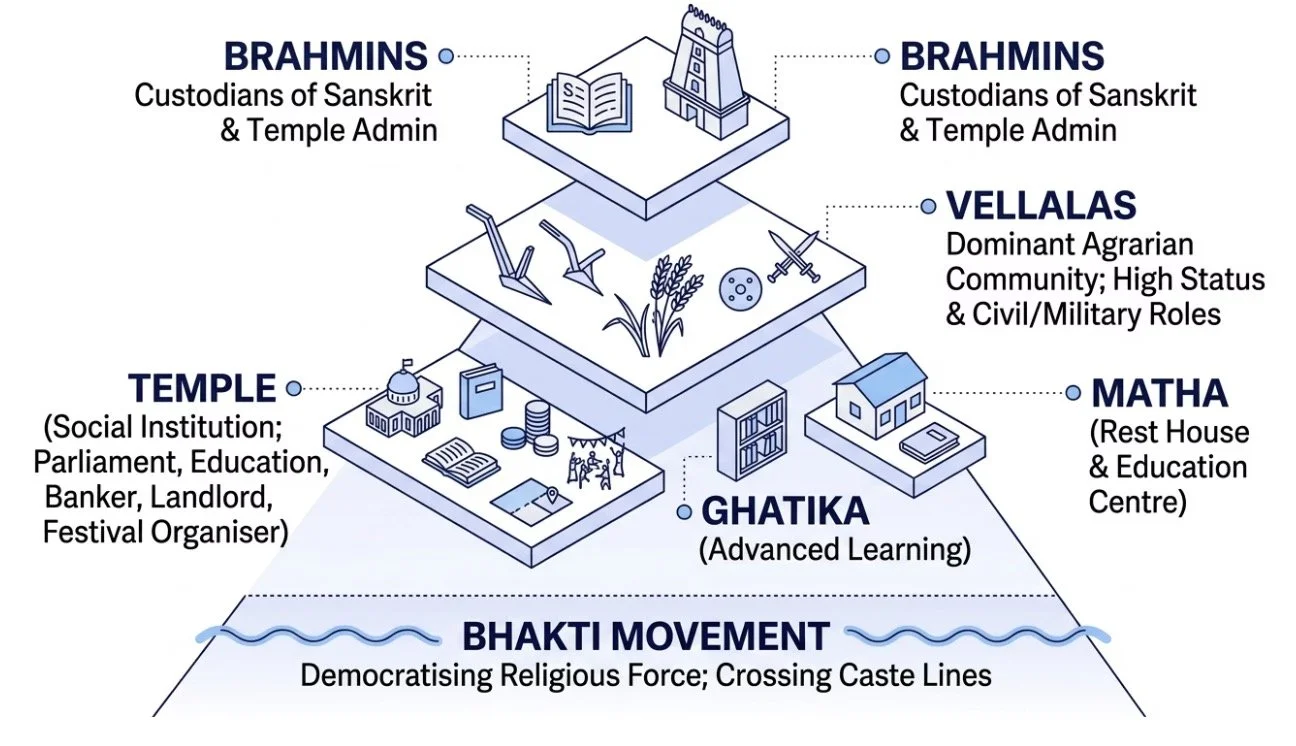
Society During the Pallava Period: Aryanisation and Social Change
The most visible manifestation of Aryanisation was the pre-eminent and privileged position acquired by Brahmins during this period. As custodians of Sanskritic culture and Vedic learning, they served as royal advisers, temple administrators, and beneficiaries of the land grant system. The Brahmadeya — land granted to Brahmin communities — became a foundational institution of the agrarian and social order, concentrating resources and prestige in Brahmin hands while simultaneously extending agricultural cultivation to previously uncultivated territories. The erosion of Buddhist and Jain influence over educational institutions and royal patronage was a direct consequence of this Brahmanical ascendancy, though Jainism retained more vitality than Buddhism throughout this period.
The Bhakti movement, paradoxically, represented a counter-current within the same social formation: its emphasis on direct personal devotion accessible to all, regardless of caste or gender, challenged the Brahmanical monopoly on spiritual authority. The Alvar saint Andal — a woman — and the various Nayanar saints drawn from multiple social backgrounds testify to the movement's genuinely democratising impulse. The tension between Brahmanical hegemony and Bhakti egalitarianism was a defining feature of Pallava social history, and its resolution — or rather its creative non-resolution — would shape Tamil culture for generations.
Chapter V
Agrarian Society and Economic Life
The agrarian economy of the Pallava period was characterised by an active partnership between royal authority, Brahmin donees, village assemblies, and cultivating communities — a complex institutional ecology that sustained one of the most productive agricultural societies of early medieval India. The Pallavas inherited a tradition of settled agriculture from the Sangam age but systematically deepened and broadened the agrarian base through irrigation investment, land reclamation, and institutional innovation. From the reign of Mahendravarman I onward, the expansion of the Pallava empire was accompanied by a concerted effort to organise the economic life of the state, with agriculture as its foundation.
Land Tenure Systems
Three principal categories of land tenure are attested in Pallava inscriptions: Brahmadeya (land granted to Brahmin communities), Devadana (land granted to temples), and Vellan-Vagai (land held by the cultivating Vellala community). Additionally, secular private land transactions are documented, and lands were also granted as remuneration for administrative and military service — a precursor to the later feudal tenure system. Common lands remained under the collective management of village assemblies.
Irrigation Infrastructure
The Pallava kings regarded the provision of irrigation as a fundamental royal duty. Tanks, wells, and channels were constructed across the kingdom, and separate institutional bodies were created for their maintenance: the Tank Supervision Committee (eri-variyam) and the Sluice Supervision Committee (kalingu-variyam). Mahendravarman I cut the celebrated Mamandur tank, called Chithra Mega Tadakam. Private individuals and village assemblies also contributed to irrigation maintenance as an act of religious merit. This dual public-private investment in hydraulic infrastructure was critical to sustaining the agricultural expansion of the period.
Cultivation Methods and Crops
Both wet and dry cultivation were practiced. Transplantation of paddy seedlings was the dominant technique for rice cultivation, and cultivators were familiar with manuring practices and a variety of agricultural implements. Multiple varieties of paddy and other crops were grown. A village-level Field Supervision Committee (kalani-variyam) oversaw agrarian activities within each settlement. Horticulture received specific attention, with flower gardens established across the kingdom. Both men and women participated in cultivation, reflecting the integrated character of rural agricultural life.
The Vellala Community
The Vellalas constituted the primary cultivating community of the Pallava period and occupied a position of considerable social prestige and practical influence. Beyond their agricultural role, Vellalas held significant positions in both civil and military administration, making them a pivotal social force bridging the agrarian and political spheres. The Nadu — the large agricultural settlement unit that emerged as the foundational revenue and administrative division during the Pallava period — was overwhelmingly a Vellala social domain, and it was through the Nadu that the Pallava state articulated its relationship with the agrarian base of its power.
The agrarian tax system of the Pallava period was sophisticated and elaborately differentiated. The primary land dues — Irai, Puravu, and Kanikkadan — were assessed on the basis of land measurement conducted by the land revenue department (Puravu-vari-tinai kalam). Newly reclaimed land received tax concessions as an incentive to agricultural expansion. When tax increases provoked popular discontent, village assemblies had the authority to petition for revision and reduction — a remarkable institutional mechanism for mediating fiscal grievances. The Brahmadeya and Devadana lands remained permanently exempt from taxation. Royal land grants, by bringing forest, waste, and flood-affected lands under cultivation, served simultaneously as instruments of agricultural expansion, religious legitimation, and social patronage — a multi-functional institution central to the Pallava political economy.
Conclusion
The Pallava Legacy: A Civilisational Synthesis
The history of the Pallava dynasty is, at its core, the history of a civilisational synthesis — the creative fusion of northern Sanskritic traditions with the deep-rooted Dravidian cultural inheritance of the Tamil south. This synthesis was never static or complete; it was a dynamic, contested, and continuously evolving process that generated the distinctive cultural forms — architectural, literary, religious, and social — that would define South Indian civilisation for centuries after the dynasty's political extinction.
Architecture
Founded and codified the Dravidian style across three evolutionary phases — cave temples, monolithic rathas, and structural temples. The Kailashanatha temple and Pancha Rathas remain among the greatest monuments of Indian art.
Literature
Created a bilingual literary culture — Sanskrit for elite discourse and Tamil for devotional expression. Patronised great writers including Bharavi and Dandin; fostered the Bhakti literary tradition of the Alvars and Nayanars.
Society
Presided over the Aryanisation of southern social structures while also nurturing counter-currents of Bhakti egalitarianism. Established institutional frameworks — Ghatikas, Mathas, temples as social centres — that endured for centuries.
Agrarian Economy
Systematically expanded agricultural production through irrigation investment, land grants, and institutional innovation. The Nadu as a revenue unit and the village assembly as a local governance institution were Pallava contributions that shaped subsequent Tamil polities.
Political Legacy
Linked the northern and southern political systems through administrative borrowing. Provided the model of legitimation — Brahmanical sacrifices, Sanskrit inscriptions, temple patronage — that later south Indian dynasties would emulate and elaborated.
Religious Legacy
The Bhakti movement, incubated within the Pallava realm, transformed Indian religious culture. The Nayanars and Alvars, the temple as a devotional and social institution, and the vernacular theological tradition they initiated became definitive features of South Asian religious life.
When the Chola king Aditya I overthrew Aparajita, the last imperial Pallava, around 893 CE, he did not dismantle the civilisation his predecessors had built — he inherited it, elaborated it, and carried it to new heights of grandeur. The great Chola temples, the Chola administrative system, the Chola engagement with Sanskrit and Tamil learning, the Chola patronage of Bhakti religion — all were built upon Pallava foundations. In this sense, the end of Pallava political power was not the end of the Pallava achievement but its greatest validation: a civilisational legacy so robust and so deeply embedded that it could survive — indeed, thrive — beyond the dynasty that created it.
Key Takeaway: The Pallava dynasty is best understood not simply as a political entity but as a civilisational project. Its contributions to temple architecture, devotional religion, Sanskrit and Tamil literature, administrative organisation, and agrarian development collectively define the character of early medieval South India and provide the essential foundation for understanding the subsequent imperial Chola period.
