
Paramaras
Medieval Indian History
The Paramara dynasty stands as one of the most significant Rajput ruling houses of medieval India, governing the fertile Malwa plateau and adjacent territories in west-central India from the 9th century through the early 14th century. Emerging from the Agnikula tradition of Rajput lineage, the Paramaras carved out a kingdom of considerable cultural, military, and administrative distinction. From their early capitals at Ujjain and subsequently Dhara (present-day Dhar in Madhya Pradesh), they presided over a realm that at its zenith stretched from Vidisha in the east to the Sabarmati River in the west, and from Chittor in the north to the Konkan coast in the south.
Origins and Founding of the Paramara Dynasty
The origin of the Paramaras is embedded in both mythological tradition and contested historical scholarship. According to the Agnikula legend — one of the foundational origin myths of the Rajput clans — the sage Vashistha performed a grand sacrificial fire (yajna) on Mount Abu after the legendary cow Kamadhenu was stolen by the rival sage Vishwamitra. From the flames of this sacred fire emerged a heroic warrior, the progenitor of the Paramara line, who recaptured the sacred cow. This mythological account places the Paramaras as one of the four Agnikula (fire-born) clans of Rajputs, alongside the Pratiharas, Chahamanas, and Chaulukyas. While modern historians treat this narrative as a legitimising myth rather than historical fact, it remained central to the dynasty's claims of noble and divine origin.
Historically, the Paramara dynasty is believed to have been founded by Upendra, also known as Krishnaraja, who ruled approximately from 800 CE to 818 CE. His domain was situated in the Malwa region, north of the Narmada River. The early Paramaras are widely considered to have been feudatories or vassals of the Rashtrakutas of Manyakheta, one of the dominant powers of the Deccan during that era. It was only in the latter half of the 10th century that the Paramaras successfully asserted their independence. The decisive moment came when Siyaka II sacked Manyakheta, the Rashtrakuta capital, around 972 CE, effectively proclaiming Paramara sovereignty over Malwa.
Mythological Foundation
Emerged from Vashistha's sacred fire on Mount Abu; one of four Agnikula Rajput clans. The Paramara warrior recaptured Kamadhenu, establishing divine legitimacy.
Historical Foundation
Founded by Upendra (Krishnaraja) c. 800 CE in Malwa. Early rulers were likely vassals of the Rashtrakutas of Manyakheta before Siyaka II secured full independence around 972 CE.
Capital initially at Ujjain, later shifted to Dhara (Dhar)
Succeeded the Pratiharas in early 10th century
Multiple regional branches established across Rajputana and Gujarat
Following the collapse of Pratihara dominance in the early 10th century, the Paramaras filled the political vacuum in Malwa, transitioning from regional vassals to sovereign rulers. Their capital was ultimately established at Dhara (modern Dhar, Madhya Pradesh), which became a celebrated centre of culture and learning under successive Paramara monarchs. The dynasty's trajectory from mythological fire-born warrior to independent sovereign power is a compelling illustration of how medieval Indian dynasties constructed and contested their political identities.
Important Rulers of the Paramara Dynasty
The Paramara dynasty produced a remarkable succession of rulers who distinguished themselves in military conquest, diplomatic manoeuvre, literary patronage, and administrative consolidation. The following profiles illuminate the most consequential monarchs whose reigns shaped the character and extent of the Paramara kingdom.
Upendra / Krishnaraja (800–818 CE)
The dynasty's founder established Paramara presence in Malwa, north of the Narmada River. Though the precise details of his reign remain sparse in the historical record, his foundational role is acknowledged across both epigraphic and literary sources as the progenitor of the Paramara royal line.
Siyaka II / Harsha (948–974 CE)
Perhaps the most pivotal early ruler, Siyaka II defeated the Rashtrakuta king Khottiga at Kalighatta on the banks of the Narmada and proceeded to sack Manyakheta, the Rashtrakuta capital, around 972 CE. This audacious act of conquest transformed the Paramaras from vassals into an independent sovereign power, laying the groundwork for the dynasty's golden age.
Munja / Vakpatiraja II (972–990 CE)
Also known by the epithets Amoghavarsha, Prithvi Vallabha, and Sri Vallabha, Munja was a formidable military commander and a celebrated poet. He led successful campaigns against the Kalachuris, the Huns, the Guhilas, and the Nadulas. However, he ultimately met his end at the hands of Tailapa II, the Western Chalukya ruler, resulting in the loss of southern Paramara territories.
Sindhuraja (990–1010 CE)
Brother of Munja, Sindhuraja systematically reclaimed territories lost to Tailapa II. His military campaigns also saw victories against a Huna chief, the Somvanshi of south Kosala, the Shilaharas of Konkana, and the ruler of Lata. His biography, the Nava-Sahasanka-Charita, was composed by his court poet Padma Gupta, offering a rich literary record of his reign.
Bhoja (1010–1055 CE)
Widely regarded as the greatest of all Paramara rulers and frequently compared to the imperial Gupta monarch Samudragupta, Raja Bhoja presided over an empire that stretched from Chittor in the north to upper Konkan in the south, and from the Sabarmati River in the west to Vidisha in the east. A polymath of extraordinary breadth, Bhoja authored or patronised works on cosmology, engineering, poetry, medicine, and architecture. Notable works include the Samarangana Sutradhara (civil engineering), Tattva Prakasha (tantras), Rasaraja Mriganka (chemistry and pharmacology), and Ayurveda Sangraha (commentary on yoga sutras). He constructed the celebrated Bhojeshwar Temple and the Bhojshala, a renowned centre of Sanskrit learning at Dhar. He bore the title Parameshvara-Parama Bhattaraka.
Naravarman (1094–1133 CE)
Succeeding his elder brother Lakshmandeva, Naravarman was noted as a poet and a devotee, composing hymns to various deities including the celebrated Nagpur Prashasti. He also composed a hymn dedicated to the Mahakal deity after restoring the Mahakal temple at Ujjain. Gold, silver, and copper coins bearing his name have been discovered in Indore, attesting to his continued administrative authority.
Mahalakadeva (d. 1305 CE)
The last known king of the Paramara dynasty, Mahalakadeva was defeated and killed by the forces of Ala-ud-din Khalji of the Delhi Sultanate in 1305 CE. His death effectively marked the end of Paramara sovereignty in Malwa and the absorption of their territories into the expanding Sultanate polity.
Administration and Military Organisation
The administrative structure of the Paramara dynasty followed a hierarchical model characteristic of medieval Rajput polities, though it exhibited certain distinctive features shaped by the dynasty's long tenure over a relatively prosperous agricultural and trade region. At the apex of the administrative pyramid stood the king, who exercised sovereign authority over all matters of state, law, revenue, and warfare. The king's position was considered both politically and spiritually supreme, reinforced through elaborate rituals, royal titles, and the patronage of Brahmanical religious institutions.
Beneath the monarch, the most important administrative officer was the Prime Minister (equivalent to a Mahamantri or chief counsellor), who supervised the functioning of state officials and coordinated the day-to-day governance of the realm. The Prime Minister was expected to advise the king on matters of policy, diplomacy, revenue, and justice. However, the king was not constitutionally bound by the Prime Minister's counsel — royal authority remained absolute and unchecked in formal terms, even if practical governance required consultation. This tension between royal prerogative and ministerial advice was a recurring feature of medieval Indian polities.
Administrative Hierarchy
King — supreme sovereign and final authority
Prime Minister — chief counsellor, supervised officials
Court Officials — subordinate to the Prime Minister
Feudatories — regional chiefs holding grants
Local Officers — revenue and justice at district level
Military Composition
Cavalry: 30,000 to 40,000 at the time of the dynasty's fall
War elephants: a celebrated arm of the Paramara forces
Infantry: large numbers, precise figures unrecorded
Principal weapons: swords, bows, and arrows
Forts constructed at Ujjain, Dhar, Bhilsa, Mandu, and Gaupura
The Paramara military was organised along the classical chaturanga model — incorporating war elephants, cavalry, infantry, and chariots — though the relative importance of each arm shifted over time. The dynasty was particularly renowned for its war elephants, which conferred both tactical and psychological advantages on the battlefield. At the time of the dynasty's final dissolution, the Paramara state could field between 30,000 and 40,000 cavalry and an unspecified but large number of infantry, suggesting a polity that retained significant military resources even in its declining years. Principal weapons included swords, bows, and arrows. King Bhoja himself was reputed to practise archery, reflecting the close identification between royal identity and martial virtue in this period.
Fortification was a key dimension of Paramara military strategy. Strongholds were constructed and maintained at strategically important urban centres — notably Ujjain, Dhar, Bhilsa, Mandu (Mandapa-Durga), and Gaupura. These fortified cities served as both administrative and military nodes within the Paramara realm, controlling trade routes, agricultural hinterlands, and potential invasion corridors from rival kingdoms. The later relocation of the capital to Mandu, when Dhara was repeatedly sacked by rival forces, underscores the dynasty's pragmatic approach to the defence of its core territories.
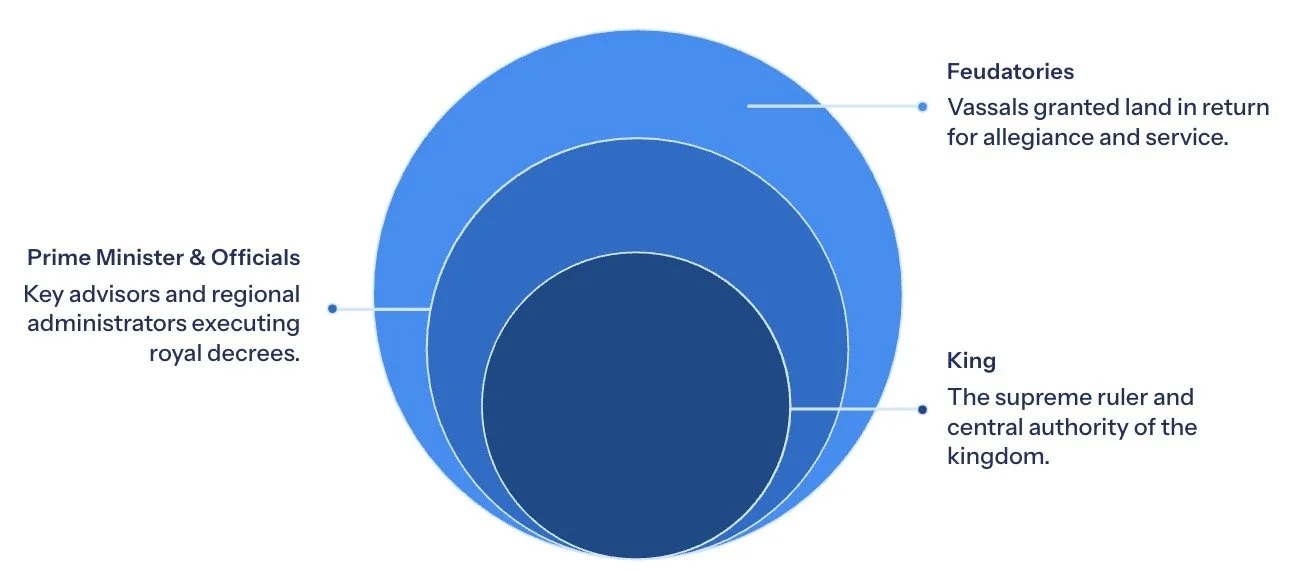
The Paramaras: Administration and Military Organisation
The Paramara administrative framework, while less documented than the empires of the Gupta or Chola periods, nonetheless reflects a sophisticated medieval polity capable of sustaining multi-generational rule over a contested and strategically vital region of the Indian subcontinent.
Regional Branches and Claimed Descendants
One of the most distinctive features of the Paramara dynasty is the proliferation of regional branches that emerged from the imperial line and extended Paramara political presence across a remarkably wide geographic canvas — from the Himalayan foothills of Garhwal and Himachal Pradesh in the north to the plains of Gujarat in the west, and from the Malwa plateau to the Panchmahal districts. Each branch claimed legitimate descent from the imperial Paramaras and adapted its political and cultural identity to local conditions.
Malwa (Imperial Branch)
The principal line, ruling from Dhara. The three sons of Sindhuraja — Bhoja, Udaditya, and Mang — continued the imperial tradition. The Umat Panwars subclan, descended from Udaditya's grandson Umat, founded the Umatwara republic in northern Malwa in the 1400s, later dividing into the states of Rajgarh and Narsinghgarh.
Abu-Chandravati Branch
Founded by Utpalraja, a brother of Bappairaja Parmar of Malwa, between 918–919 CE. Ruling from the base of Mount Abu (Chandravati), this branch lasted from the end of the 10th century to the end of the 13th century. The Jalore Parmars and Bhinmal-Kiradu Parmars were both offshoots of this Abu Paramara line.
Vagad (Arthuna) Branch
The Vagod Parmars governed the Vagad region with their capital at Arthuna (in present-day Banswara-Dungarpur, Rajasthan) from the middle of the 10th century to the 11th century, before the Ahada Guhilots absorbed the territory. Their descendants — the Barads of Panchmahal, Banaskantha, and Sabarkantha — are counted among Gujarat's most widespread Parmar communities, with head families at Danta, Banaskantha.
Garhwal & Himachal Branch
Oral tradition records that Rajaputra Kanakpala Parmar, arriving at Chamoli on pilgrimage in the early 9th century, became the progenitor of the Panwars of Garhwal. By the 14th century, Raja Ajay Pal Panwar (37th generation from Kanakpal) united 52 Garhis to found the Kingdom of Garhwal, moving its capital from Chandpur Garhi to Devalgarh and then Srinagar.
Dod-Parmar & Punjab Branches
The Dod-Parmars migrated to Gujarat and founded Chandanavati (prehistoric Vadodara). Bijaldev Dod founded Gagron in Jhalawar (formerly Dodgarh) in the 12th century. The Varha Panwars of Punjab, descended from Dharnivarah of Lodruva, opposed the Bhatti chief Devraj and dominated Lodruva and Bahawalpur before being pushed further into northern Punjab by the rising power of the Bhattis.
The geographic diffusion of Paramara lineages across such diverse ecological and political zones — from the semi-arid desert of Rajputana to the Himalayan hill-kingdoms of Garhwal, and from the agrarian Malwa plateau to the mercantile littoral of Gujarat — speaks to the dynasty's remarkable adaptive capacity. Each branch synthesised imperial Paramara traditions with local political cultures, creating a mosaic of successor states that long outlasted the fall of the imperial capital at Dhara.
The Decline and Fall of the Paramaras
The decline of the Paramara dynasty was neither sudden nor the result of a single catastrophic event, but rather the cumulative outcome of sustained military pressure from multiple rival powers, recurring successions disputes, and the structural vulnerability of a mid-sized medieval kingdom surrounded by ambitious neighbours. The seeds of decline were sown even during the dynasty's later golden age, and the trajectory from Bhoja's imperial zenith to Mahalakadeva's fatal defeat in 1305 CE spans nearly two and a half centuries of gradual erosion.
The immediate catalyst for decline was the death of the great Bhoja in 1055 CE. His successor, Jaysimha I, faced a devastating joint assault by the Kalachuri and Chalukya powers — an alliance of convenience forged precisely to check Paramara expansion. The Bilhana's writings record these reverses in considerable detail, offering valuable literary evidence for the political turbulence that followed Bhoja's passing. Jaysimha's successor Udayaditya fared somewhat better, but his younger son Narvarman suffered significant defeats at the hands of the Chandelas of Jejakabhukti and the Chaulukya king Jayasimha Siddharaja.
1055 CE
Death of Bhoja; Jaysimha I attacked jointly by Kalachuri-Chalukya coalition
c. 1060–1094 CE
Narvarman defeated by Chandelas and Chaulukya king Jayasimha Siddharaja
c. 1150 CE
Yashovarman surrenders Dhara; Kumarapala defeats usurper Ballala; Malwa becomes Chalukya province
Late 12th Century
Vindhyavarman re-establishes Paramara sovereignty; Malwa repeatedly invaded by Hoysalas and Yadavas of Devagiri
1305 CE
Mahalakadeva defeated and killed by Ala-ud-din Khalji; final end of Paramara dynasty
A particularly destabilising episode occurred around 1150 CE when Yashovarman surrendered control of the Paramara capital Dhara to the Chaulukya king Jayasimha Siddharaja. His heir, Jayavarman I, briefly reclaimed Dhara, but was quickly deposed by a usurper named Ballala. The Chaulukya king Kumarapala, with the assistance of the Naddula Chahamana ruler Alhana and the Abu Paramara chief Yashoda Vala, defeated Ballala around 1150 CE. Malwa was subsequently constituted as a Chalukya province — a humiliating reduction of Paramara status from sovereign kingdom to subordinate dependency.
The recovery engineered by Vindhyavarman — son of Jayavarman, who defeated the Chaulukya king Mularaja II and re-established Paramara sovereignty — represents one of the more remarkable episodes of dynastic resilience in medieval Indian history. Yet even this recovery proved fragile. During his reign and those of his successors, Malwa was repeatedly targeted by the expanding Hoysalas from the south and the Yadavas of Devagiri from the south-east, leaving the kingdom in a state of chronic exhaustion. The repeated sacking of Dhara compelled the later Paramara rulers to relocate their capital to the more defensible hill-fort of Mandapa-Durga (present-day Mandu).
The final blow came in 1305 CE, when the forces of the Delhi Sultanate under Ala-ud-din Khalji defeated and killed Mahalakadeva, the last known Paramara king. With his death, the dynasty's political existence was extinguished, its territories absorbed into the rapidly expanding Sultanate imperium. The Paramaras' centuries-long struggle to maintain sovereignty against the Chalukyas of Gujarat, the Chalukyas of Kalyani, the Kalachuris of Tripuri, and the Chandelas ultimately depleted the dynasty's military and political resources beyond recovery.
Legacy and Historical Significance
The Paramara dynasty occupies a position of considerable importance in the history of medieval India, not merely as one of the prominent Rajput ruling houses but as a dynasty that made enduring contributions to Indian culture, literature, architecture, and statecraft. Their five-century tenure over the Malwa region — one of the most strategically and agriculturally significant zones of the Indian subcontinent — left a deep imprint on the political geography and cultural landscape of west-central India.
Political Legacy
The Paramaras demonstrated remarkable dynastic resilience, repeatedly recovering sovereignty after military reverses. Their administrative model — with its balance of royal authority and ministerial counsel — was characteristic of successful medieval Rajput polities and influenced successor states across Malwa and Rajputana.
Cultural and Literary Contributions
Raja Bhoja's extraordinary intellectual output — spanning civil engineering, medicine, chemistry, poetry, cosmology, and tantric philosophy — represents one of the most remarkable instances of royal scholarship in Indian history. The Bhojshala at Dhar and the Bhojeshwar Temple remain enduring monuments to Paramara cultural ambition.
Geographic Diffusion
Through their many regional branches — from Garhwal's hill-kingdom to Gujarat's mercantile cities, from the Rajputana deserts to the Panchmahal districts — the Paramara lineage seeded political and cultural traditions across an enormous swathe of northern and western India, many of which survived centuries beyond the fall of the imperial centre at Dhara.
For students and researchers of medieval Indian history, the Paramara dynasty offers a rich case study in the dynamics of Rajput polity: the construction of royal legitimacy through mythological narrative, the cyclical pattern of expansion and contraction driven by coalition warfare, the central role of cultural patronage in the exercise of soft power, and the structural vulnerabilities of mid-tier kingdoms caught between larger imperial rivals. The Paramaras' trajectory — from vassal of the Rashtrakutas to independent sovereign power, from the heights of Bhoja's empire to the final defeat at Ala-ud-din Khalji's hands — encapsulates many of the defining patterns of medieval Indian political history.
The Paramara dynasty reminds us that medieval Indian polities were not merely military formations but sophisticated cultural enterprises, in which the patronage of learning, the construction of sacred monuments, and the cultivation of literary traditions were as central to the exercise of power as the command of cavalry and war elephants.
Their legacy endures not only in the historical record but in the landscape of Madhya Pradesh — in the ruins of Bhojpur, the Bhojeshwar Temple, the fort at Mandu, and the scholarly traditions of Dhar — and in the genealogical memories of the many communities across India that trace their lineage to the fire-born warriors of the Paramara line.
