
The Arab Conquest of Sind
In the early eighth century, Arab armies swept across the Indus delta, forever altering the subcontinent's political, cultural, and religious landscape. Led by the young general Muhammad bin Qasim, the campaign of 712–714 CE brought the province of Sind under the Umayyad Caliphate — marking the first sustained Muslim presence in South Asia.
Historical Background and Context
For centuries before the Islamic conquests, Arab merchants had served as the principal intermediaries of Indian Ocean trade, ferrying the fabulous goods of the subcontinent — spices, textiles, ivory, and precious metals — westward to the markets of the Mediterranean world. This longstanding commercial relationship gave the Arabs intimate knowledge of India's wealth and geography. After their conversion to Islam in the seventh century, however, the motivations of Arab expansion acquired a dual character: the pursuit of material gain was now inseparable from the religious imperative to spread the faith.
The death of Emperor Harshavardhan in 647 CE had plunged the Indian subcontinent into a prolonged period of political fragmentation. The great centralising power of the Gupta and Harsha eras gave way to a patchwork of competing regional kingdoms, each jealously guarding its own territory and deeply suspicious of its neighbours. This structural weakness — the absence of any overarching confederacy capable of mounting a coordinated defence — was not lost on ambitious powers beyond India's borders. The Arabs, having successfully implanted their faith in Syria, Palestine, Egypt, and Persia through a series of breathtaking military campaigns, now cast a covetous eye eastward toward Sind.
Sind itself, the lower Indus valley stretching from the river's mouth at Debal northward to Multan, was governed by the Brahman dynasty established by Chach, a former minister who had usurped the throne from the last ruler of the Sudra dynasty, Rai Sahasi II, in the seventh century. Chach's son Dahir ascended the throne around 708 CE and would prove to be the kingdom's last independent ruler. The legitimacy of this dynasty was contested from the outset, sowing the seeds of the internal divisions that would eventually contribute to the region's fall.
The Chachnama — Primary Source
The Chachnama, originally written in Arabic by an anonymous author and later translated into Persian by Ali Kufi in 1216 CE, remains the most authentic primary source on the history of Sind on the eve of the Arab invasion of 711–12 CE. It provides a detailed account of the Sudra and Brahman dynasties, the rise of Chach, the reign of Dahir, and the full course of Muhammad bin Qasim's campaign. Despite its pro-Arab editorial perspective, it preserves invaluable details about court politics, military engagements, and the social fabric of pre-conquest Sind.
Key Figures
Dahir — Last Hindu ruler of Sind, c. 708–712 CE
Hajaj bin Yusuf — Governor of Iraq, architect of the campaign
Muhammad bin Qasim — Commander-in-chief, nephew of Hajaj
Caliph Walid I — Umayyad ruler who authorised the invasion
Queen Ranibai — Dahir's widow, defender of Rawar fort
Factors Behind the Arab Invasion
The Arab conquest of Sind was not the product of a single cause but emerged from the convergence of several powerful motivating forces — religious, economic, and political. Understanding these factors in their full complexity is essential for any serious assessment of the conquest's historical significance.
Propagation of Islam
Following the spectacular expansion of Islam into Egypt and Syria, Caliph Walid I of Damascus formally authorised Arab incursions into India. The followers of Islam regarded the idol-worshipping practices of the Hindus as an affront to monotheism. Destroying idolatry and converting the populace were considered sacred obligations, and the plunder of "infidels" was rationalised as a divinely sanctioned reward for the faithful warrior.
Wealth of India
India's legendary prosperity had tempted conquerors throughout history. The wealth of its temples, trading cities, and royal courts — particularly the gold-laden city of Multan — was well known to the Arabs through centuries of commercial contact. The prospect of enormous booty, tribute, and territorial gain provided powerful material incentives alongside the religious ones.
Political Fragmentation
The collapse of centralised Harsha-era authority had produced chronic mutual rivalry and warfare among India's petty kingdoms. Dahir of Sind was especially unpopular — widely resented as the son of a usurper — and could not count on the loyalty of neighbouring rulers. The Arabs calculated, correctly, that no pan-Indian coalition would arise to oppose them.
The Immediate Cause
The proximate trigger was the piracy at the port of Debal, where Arab ships carrying gifts and treasures — and reportedly some noble women — sent by the king of Ceylon to the Caliph were looted. Governor Hajaj of Iraq demanded compensation from Dahir, who disclaimed responsibility over the pirates. This refusal enraged Hajaj, who obtained the Caliph's blessing to launch a punitive military expedition.
The Course of the Conquest
After two initial Arab expeditions were repulsed by Dahir's forces, Hajaj appointed his nephew and son-in-law, the young and capable Muhammad bin Qasim, to lead a well-equipped army into Sind. The campaign unfolded as a sequence of rapid strikes, each facilitated in no small part by internal betrayal, weak defensive resolve, and Dahir's fatal passivity.
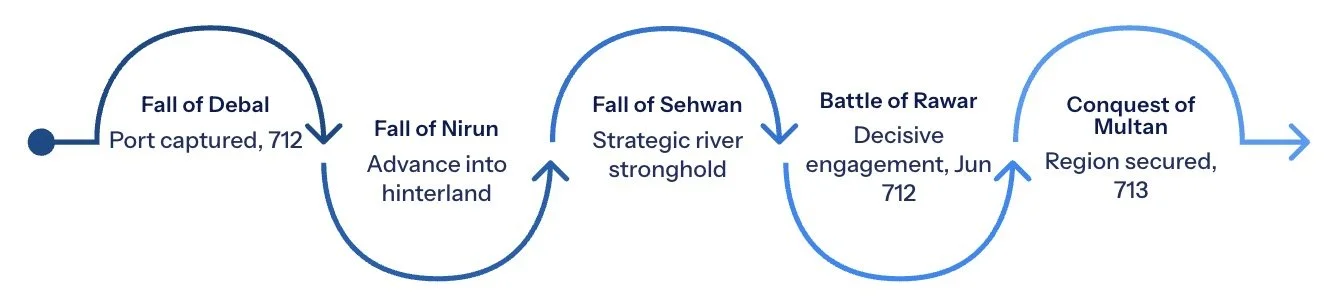
The Course of the Arab Conquest of Sindh
Muhammad bin Qasim landed at Debal near the mouth of the Indus — the very port where Arab ships had been plundered — and used it as his beachhead for the entire campaign. From there, he moved systematically northward, capturing one garrison town after another before delivering the decisive blow at Rawar in June 712 CE, where Dahir himself perished in battle. The final major objective, the wealthy city of Multan, fell in 713 CE, completing Arab control over the Indus valley.
Debal
A treacherous Brahmin exposed the fort's defences. The city fell with massive plunder and the start of forced conversions.
Nirun
Dahir's son Jai Sindh fled, handing the fort to a priest. Buddhist citizens reportedly aided the Arabs. Captured without a real fight.
Sehwan & Sisam
Governor Bajhra fled in panic. Sisam's Jat king Kaka was defeated and Bajhra's followers killed. Dahir remained inexplicably passive.
Battle of Rawar
20 June 712 CE. Dahir fought bravely from elephant-back but fell after two days. Queen Ranibai performed jouhar rather than surrender.
Multan
713 CE. A traitor revealed the city's water supply. After a brave resistance, the city surrendered. Arabs called it the "City of Gold."
The Battle of Rawar — A Closer Look
"Dahir gave a heroic fight and laid down his life after two days of this bloody battle. His widow Queen Ranibai refused to surrender the fort and fought the invader to the bitter end." — Chachnama
The Battle of Rawar, fought on 20 June 712 CE on the banks of the Indus, was the climactic engagement of the entire campaign. Dahir assembled a formidable force of approximately 50,000 soldiers — swordsmen, cavalry, and elephant corps — at Rawar, evidently confident that he could destroy the Arab invader in a single decisive encounter. This confidence proved to be his undoing, as it had led him to remain dangerously passive during all the preceding engagements, allowing Muhammad bin Qasim to consolidate his position unopposed.
Dahir fought with genuine courage. Mounted atop an elephant, he personally led charges against the Arab lines, demonstrating the martial valour of a true warrior-king. The battle raged for two days with extraordinary intensity. Arab sources acknowledge the ferocity of Dahir's resistance. However, Dahir's fundamental strategic error was fighting as a frontline soldier rather than commanding his army as a general. When he was finally struck down, his forces lost cohesion and collapsed.
Dahir's Fatal Errors
Remained passive during the fall of Debal, Nirun, and Sehwan
Did not attack when the Arab army was weakened by scurvy at the Mihran river
Did not prevent the Arabs from crossing the Mihran
Chose to fight as a warrior rather than command as a general at Rawar
Placed excessive faith in a single decisive battle
Queen Ranibai's Last Stand
After Dahir's death, his widow Queen Ranibai took command of the defence of the fort of Rawar and refused all terms of surrender. Recognising that resistance was no longer possible, she performed jouhar — the practice of self-immolation — along with other besieged ladies of the court, choosing death over captivity. Her act of defiance stands as one of the most poignant episodes recorded in the Chachnama.
Causes of Arab Success in Sind
Muhammad bin Qasim's victory was not solely the product of Arab military superiority. A complex matrix of internal weaknesses, social divisions, acts of betrayal, and strategic blunders on Dahir's part combined to make the conquest swift and decisive. Historians must weigh these factors carefully rather than attributing the outcome to any single cause.
Social Fragmentation
Sind's heterogeneous population — Hindus, Buddhists, Jains, Jats, and Meds — lacked social cohesion. Sectarian tensions prevented the formation of a unified resistance. Buddhist communities in particular, perhaps resentful of Brahman dominance under Dahir, actively collaborated with the invaders at Nirun.
Unpopularity of Dahir
As the son of a minister who had murdered his king and married the widowed queen, Dahir's legitimacy was perpetually contested. His semi-independent governors withheld cooperation at critical moments, and his arrogant personal style alienated non-Hindu subjects. Civil strife with his cousin-brothers had further weakened the kingdom before the invasion began.
Betrayal and Treachery
Internal treachery proved decisive at multiple junctures. A Brahmin traitor at Debal revealed the fort's defensive secrets; Buddhist citizens at Nirun opened the gates; a traitor at Multan disclosed the city's water supply. Without these acts of collaboration, the Arab advance would have been far more costly and protracted.
Isolation of Sind
Despite the presence of powerful dynasties like the Pratiharas of Malwa and Kanauj, no Indian power intervened on Dahir's behalf. The parochialism of India's regional rulers — their indifference to a threat on the distant frontier — left Sind to face the Arab onslaught entirely alone. This isolation would later ease the path for subsequent Muslim incursions.
Arab Military Superiority
The Arab army was battle-hardened, ideologically motivated, and well-equipped by the resources of the Umayyad Caliphate. In contrast, Dahir's forces — except at Rawar — were hastily assembled, poorly trained, and lightly armed. The Arabs also benefited from superior siege technology, as demonstrated at Debal and Multan.
Religious Zeal
The Arabs were animated by the conviction that they were instruments of divine will — warriors engaged in a sacred mission against idolatry. This religious enthusiasm produced extraordinary cohesion and fighting spirit. The Sindhis, by contrast, displayed the tolerant, pluralistic indifference characteristic of Indian civilisation, which, while a cultural virtue, offered no comparable rallying force in the heat of battle.
Political Impact of the Arab Conquest
Historians have long debated the precise political significance of the Arab conquest of Sind. The prevailing scholarly consensus, as articulated by Sir Stanley Lane-Poole and Wolseley Haig, is that in purely political terms, the conquest was limited in its immediate consequences — a remarkable victory that nonetheless remained confined to a narrow strip of territory for barely a century and a half.
Stanley Lane-Poole: "The Arab conquest of Sind was only an episode in the history of India and of Islam — a triumph without results."
Wolseley Haig: "It was a mere episode in the history of India and affected only a small portion of the fringe of that vast country."
After the execution of Muhammad bin Qasim by order of the new Caliph — a tragic end that cut short his plans to advance further into the Indian interior — Arab political power in Sind entered a long period of stagnation and gradual contraction. Arab rule lasted barely one and a half centuries and never extended beyond Sind and southern Punjab. The great powers of northern India — the Pratiharas, the Rashtrakutas, the Palas — remained untouched and continued to shape the political landscape of the subcontinent on their own terms.
Administrative Legacy
Some Arab administrative policies in Sind — most notably the imposition of the jizya (poll tax on non-Muslims) — were adopted and elaborated by subsequent medieval Indian rulers, including the Sultanate and Mughal administrations. In this sense, the Arab experiment in Sind provided an early template for the governance of a Muslim state over a predominantly Hindu population.
Precedent for Later Invasions
Some historians argue that the failure of Indian rulers to unite and expel the Arabs from Sind set a dangerous precedent of political indifference that later facilitated the far more consequential raids of Mahmud of Ghazni (997–1030 CE) and the conquests of Muhammad Ghori (1175–1206 CE). The real foundation of Muslim political power in India, however, was laid not by Arab commanders but by the Turko-Afghan warriors who followed two centuries later.
Prof. Habibullah's Assessment
"The Arab was not destined to raise Islam to be a political force in India; politically the Sind affair led to a dead end." This assessment encapsulates the mainstream view: the Arab conquest, for all its dramatic character, was a political cul-de-sac rather than the beginning of enduring Muslim rule. That task fell to the Turks.
Economic and Social Impact
While the political consequences of Arab rule in Sind were limited, the economic and social transformations introduced by the new rulers were considerably more substantial and enduring. Arab administration brought new methods, new commercial networks, and new urban institutions that materially enriched the region even as it altered its demographic composition.
Economic Contributions
Promotion of desert cultivation techniques and camel breeding
Introduction of new forms of currency and expansion of monetary exchange
Development of international trade links with the broader Islamic world
Town planning calibrated to local agricultural produce and trade needs
Importation of horses and camels as beasts of burden, stimulating commerce with Central Asia and the Middle East
Encouragement of leather tanning, manufacturing, and artisan industries
Social and Demographic Changes
Arab rule introduced Islam to a region that had previously been home to Buddhism, Hinduism, and Jainism in roughly equal measure. The spread of Islam brought demographic shifts — conversions, intermarriages, and the gradual emergence of a syncretic Muslim identity in the Indus valley. Scholars have noted, however, that the Arab rulers of Sind generally practised a degree of religious tolerance toward their Hindu and Buddhist subjects, allowing temples and shrines to function under the status of dhimmi protection in exchange for the payment of jizya. This policy of pragmatic accommodation — born partly of necessity — would become a defining feature of Muslim statecraft in the subcontinent for centuries to come.
Cultural Impact — The Enduring Legacy
If the political and even economic consequences of the Arab conquest of Sind were relatively circumscribed, the cultural impact proved to be profound, far-reaching, and ultimately the most historically significant dimension of the entire episode. The encounter between Arab-Islamic civilisation and the Hindu-Buddhist intellectual tradition of the subcontinent generated an extraordinary cross-fertilisation of ideas, texts, and disciplines that shaped the trajectory of medieval learning across Eurasia.
Language and Script
The Arabs enriched the Sindhi language, developed its script, and introduced Arabic loan-words and literary forms into the region's vernacular tradition. The prestige of Arabic as the language of religion, law, and high culture left permanent marks on Sindhi vocabulary, poetry, and scholarship.
Translation of Indian Texts
Arab scholars and patrons commissioned the translation of major Sanskrit works into Arabic. These included the astronomical treatise Surya Siddhanta, the medical encyclopaedias Charaka Samhita and Sushruta Samhita, and the celebrated fable collection Panchatantra. Through these translations, Indian knowledge entered the mainstream of Islamic — and eventually European — intellectual life.
Indian Scholars at Baghdad
The Abbasid court at Baghdad actively recruited Indian intellectual talent. Scholars such as Bhala, Manaka, and Bazigar were invited to the capital. The Indian physician Dhana served as the chief medical officer at Baghdad. Indian architects were commissioned to build mosques and public buildings, bringing subcontinent design traditions to the heart of the Islamic world.
Arab Scholars in India
The traffic of knowledge was not one-directional. Arab astronomer Abu Mashar spent ten years studying astronomy at Varanasi (Benaras), absorbing the sophisticated traditions of Indian mathematical astronomy. This direct immersion in Indian scholarship shaped the development of Islamic astronomical science in fundamental ways.
Sind also proved to be an important conduit for the early spread of Sufism — the mystical dimension of Islam that would eventually become one of the most powerful vehicles of Islamic expansion in South Asia, precisely because of its resonances with Hindu devotional traditions. Cultural contacts, the Chachnama repeatedly suggests, proved far more enduring than political control. Even after the Arabs lost direct political authority over Sind, cultural links were assiduously maintained by the Abbasid Caliphs and later by ruling dynasties such as the Pratiharas of western India. These sustained interactions paved the way for the magnificent synthesis achieved by scholars like Al-Biruni, whose Kitab al-Hind — arguably the greatest work of comparative civilisational study produced in the medieval world — stands as the finest fruit of continued Indo-Arab intellectual exchange.
Key Translated Works: Surya Siddhanta (astronomy) · Charaka Samhita (medicine) · Sushruta Samhita (surgery) · Panchatantra (fables and statecraft) — all rendered from Sanskrit into Arabic, transmitting Indian knowledge to the wider Islamic world.
The Real Significance
The Arab conquest of Sind in 712–714 CE occupies a paradoxical position in Indian history. As a military and political event, it was geographically limited, chronologically brief, and — in the words of its foremost critics — a "triumph without results." Arab political authority never extended beyond the Indus valley, lasted barely a century and a half, and was ultimately superseded by the far more consequential Turkic invasions of the eleventh and twelfth centuries. In this strictly political sense, the consensus of Lane-Poole, Haig, and Habibullah is difficult to challenge.
Yet to assess the conquest solely on political grounds is to fundamentally misunderstand its historical importance. The real and enduring significance of the Arab advent in Sind lay in the cultural sphere. The translation movement that brought the Surya Siddhanta, the Panchatantra, and the great medical treatises of Charaka and Sushruta into Arabic was a civilisational event of the first order. Indian numerals — the so-called "Arabic numerals" — reached the Islamic world partly through the agency of these early intellectual contacts and from there transformed the mathematics of medieval Europe. The Sufi tradition that would convert millions of South Asians over the following centuries drew on spiritual energies first encountered in the syncretic religious atmosphere of the Sind frontier.
Military Conquest
712–714 CE: Muhammad bin Qasim defeats Dahir, establishes Arab rule over Sind and Multan.
Cultural Exchange
Sanskrit texts translated into Arabic; Indian scholars invited to Baghdad; Arab astronomer studies at Varanasi.
Indo-Islamic Synthesis
Foundations laid for a centuries-long civilisational dialogue, culminating in works like Al-Biruni's Kitab al-Hind.
For undergraduate students of history, the conquest of Sind offers a compelling case study in how seemingly minor or geographically peripheral events can carry disproportionate long-term consequences. It demonstrates that the significance of a historical episode cannot always be measured by its immediate political outcomes. The Arab soldiers who marched into Debal in 712 CE did not know that they were inaugurating one of the most fertile cultural dialogues in the history of world civilisation. As Professor Habibullah acknowledged, the Arab was not destined to raise Islam as a political force in India — but in planting the seeds of Indo-Islamic cultural synthesis, the Arab presence in Sind laid the foundation for an intellectual and spiritual heritage whose echoes resound to the present day.
"The real significance of the Arab advent in India was in the cultural sphere, which laid the foundation for Indo-Islamic culture." — Scholarly consensus on the Arab conquest of Sind
