
The Gupta Empire: India's Golden Age
Rising from the ashes of centuries of political fragmentation, the Gupta Empire (c. 319–550 CE) stands as one of the most luminous chapters in ancient Indian civilisation. Under the Gupta monarchs, northern India was united under a single banner, and the subcontinent experienced an extraordinary flowering of science, mathematics, astronomy, philosophy, literature, and the arts.
Origins
Birth of the Gupta Dynasty: Early Kings and Homeland
The Gupta story begins around 240 CE with a founder named Sri Gupta, who carried the modest title of Maharaja — a title typically borne by feudatory chiefs. His successor, Ghatotkacha, continued this lineage. It was Ghatotkacha's son, Chandragupta I, who would elevate the dynasty to imperial heights, taking the grander title of Maharajadhiraja (King of Kings). The Poona copper plate inscription of Prabhavati Gupta describes Sri Gupta as the Adhiraja of the dynasty — a supreme ruler. Chinese traveller I-Tsing's records also confirm the names of the first three Gupta rulers, giving us a clearer picture of the dynasty's early lineage.
Theory 1: Uttar Pradesh Origin
Many scholars argue the Guptas began as landowners in Magadha and eastern Uttar Pradesh. Early coins and inscriptions are largely concentrated in U.P., suggesting it was their operational heartland. With Prayag (Allahabad) as a likely centre, they expanded across the fertile Madhyadesha — exploiting iron ore from central India and south Bihar, and leveraging proximity to the lucrative silk trade with the Byzantine Empire.
Theory 2: Bengal Origin (Most Accepted)
Archaeological and written evidence — including I-Tsing's accounts and the mention of the "Varendra Mrigashihavan Stupa" in Nepal — strongly suggest the Guptas originated from Varendri, in present-day Rangpur, Bangladesh. Sri Gupta is said to have built a temple in Mrigashivana, located in Varendri, indicating early Gupta sway over Bengal. Later, Chandragupta I consolidated Magadha through a strategic marriage with the Lichchhavi clan of Vaishali.
The Guptas are widely regarded by many historians as a Vaishya dynasty, based on ancient Indian legal texts prescribing the name ending in "Gupta" for Vaishya caste members. Some copper plate inscriptions even have Gupta kings identifying themselves as Vaishyas. Their rise was considered one of the most notable departures from the traditional caste hierarchy in ancient Indian history.
Founding Emperor
Chandragupta I: The First Gupta Emperor (319–335 CE)
Though Sri Gupta and Ghatotkacha laid the dynasty's foundations, it is Chandragupta I who is broadly considered the true founder of the Gupta Empire. Distinguishing him from Chandragupta Maurya (the founder of the Mauryan Empire, 322–298 BCE) is important — these are two entirely different historical figures separated by over six centuries. Chandragupta I's genius lay not just in warfare, but in strategic matrimonial alliances.
By marrying Kumaradevi, a princess of the powerful Lichchhavi clan of Vaishali, Chandragupta dramatically elevated his prestige and political influence across the Gangetic region. His rule remained focused on Magadha and parts of eastern Uttar Pradesh — including Saketa and Prayaga. Yet his assumption of the title Maharajadhiraja and the commencement of the Gupta Era in approximately 319–320 CE marked a decisive turning point in Indian history. His face — alongside Queen Kumaradevi — appeared on coins issued by their son Samudragupta, a testament to how significant this royal union was considered.
Title Assumed
Maharajadhiraja — "King of Kings" — signalling supremacy over lesser rulers across the Gangetic basin.
Key Alliance
Marriage to Lichchhavi Princess Kumaradevi forged a powerful political bond with one of India's most prestigious ruling families.
Gupta Era Begins
His accession around 319–320 CE marks the official start of the Gupta Era — a new chronological epoch in Indian history.
Territorial Control
His kingdom encompassed Magadha, Saketa (Ayodhya), and Prayaga — a compact but strategically vital heartland in the Gangetic plains.
The Great Warrior
Samudragupta: Napoleon of India (335–380 CE)
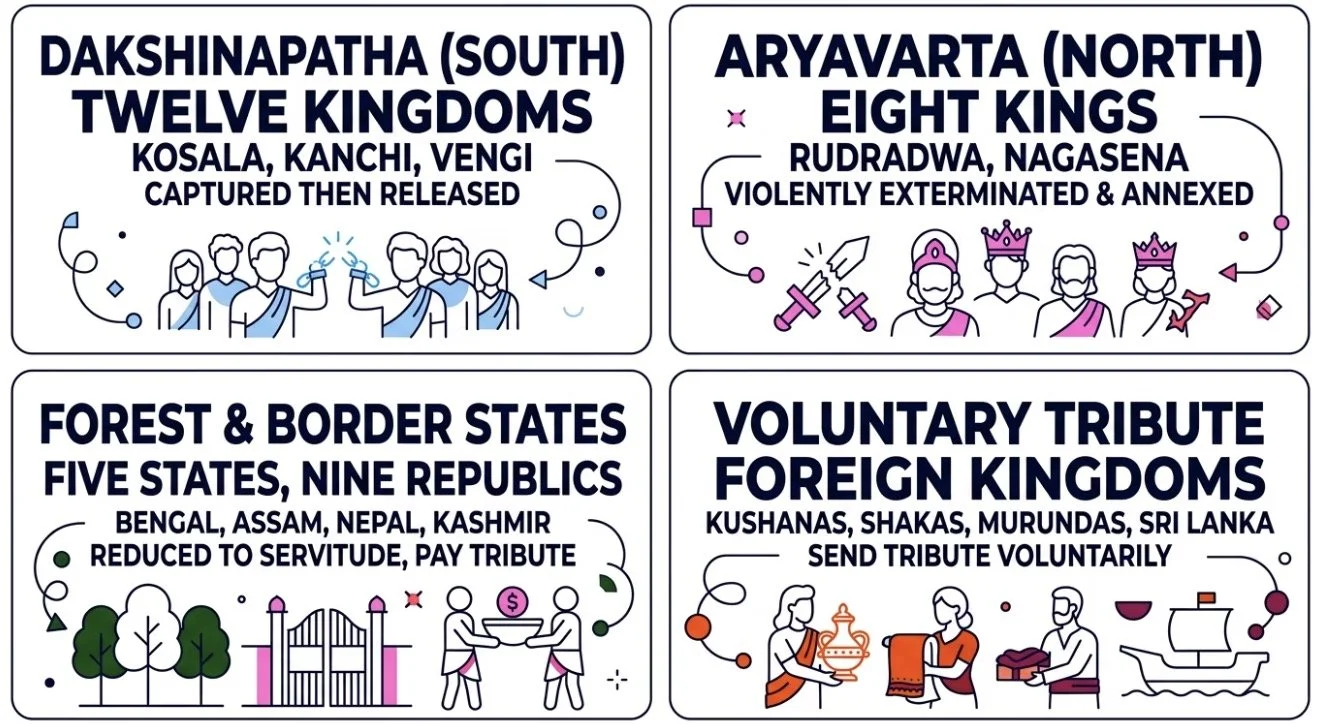
If Chandragupta I built the Gupta foundation, it was Samudragupta who raised the imperial edifice to breathtaking heights. His court poet Harishena rightly described him as the "hero of a hundred battles", and the great historian Vincent Smith famously called him the "Napoleon of India." Samudragupta was no ordinary conqueror — he was simultaneously a warrior, statesman, poet, musician, and philanthropist. His name, derived from samudra (meaning "oceans"), was likely a title earned through the sweeping scale of his conquests.
His conquests are catalogued in the celebrated Allahabad Prasasti — a lengthy Sanskrit eulogy inscribed on an Asokan pillar at Allahabad by poet-minister Harishena. This inscription lists four broad categories of political subjugation, revealing both the geographic reach and the nuanced political strategy of Samudragupta's campaigns.
Samudragupta: Napoleon of India (335–380 CE)
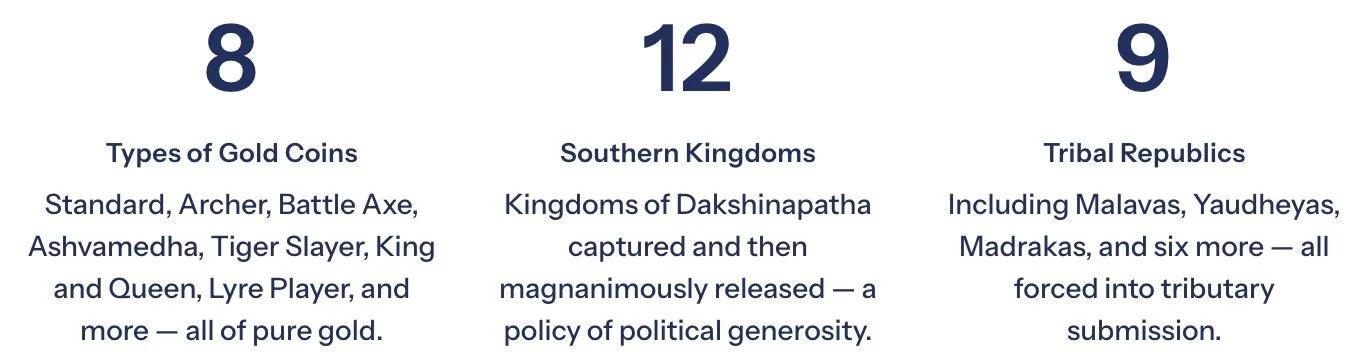
Samudragupta's cultural life was equally remarkable. His gold coins depict him playing the veena (lyre), and he earned the title Kaviraj (King of Poets). His court included luminaries such as philosopher Vasubandhu and poet Asanga. Despite his devotion to Brahmanical religion, he patronised Buddhist scholar Vasubandhu and permitted Sri Lanka's king Meghavarman to construct a Buddhist monastery at Bodh Gaya — demonstrating a spirit of religious tolerance rare for the era.
Samudragupta: Napoleon of India (335–380 CE)
Rulers
Chandragupta II "Vikramaditya": The Zenith of the Empire
Chandragupta II (r. c. 380–412 CE), also known as Vikramaditya (Sun of Power), presided over the absolute peak of Gupta civilisation. During his reign, the empire achieved its greatest territorial extent, its most celebrated cultural achievements, and its most sophisticated administrative organisation. Art, architecture, sculpture, and literature all flourished under his enlightened patronage, and it is his era that is most specifically associated with the phrase Golden Age of India.
Diplomatic Mastery and Military Conquests
Chandragupta II expanded the empire through a deft combination of matrimonial alliances and military campaigns. He married Kuberanaga of the powerful Naga dynasty, and strategically married his daughter Prabhavati to the Vakataka king Rudrasena II. When Rudrasena died early (385 CE), Queen Prabhavatigupta ruled as regent for twenty years — effectively making the Vakataka realm an extension of the Gupta empire, giving Chandragupta II access to the Deccan without direct military conquest.
His greatest military triumph was the defeat of the Western Kshatrapas (Shaka-Kshatrapa dynasty) and the annexation of their territories in western Malwa and Gujarat, defeating their last ruler Rudrasimha III. This gave the empire access to the western sea coast, famous for international trade. He then assumed the title Vikramaditya and the additional epithet sakari (enemy of the Sakas). Ujjain, enriched by trade, became his second capital.
The Iron Pillar of Mehrauli
The famous Iron Pillar at Qutub Minar complex in Delhi bears an inscription identifying "King Chandra" — widely identified as Chandragupta II — recording victories over Valhikas (Bactria) and enemies from Bengal. The pillar was erected as a flagstaff in honour of Vishnu.
Composed of 98% wrought iron, the pillar has stood for over 1,600 years without rusting — a testament to the extraordinary metallurgical capabilities of Gupta-era craftsmen, unmatched for centuries.
The Nine Gems: Navratna of Vikramaditya's Court
Chandragupta II Vikramaditya is celebrated in Indian tradition for assembling the Navratna — nine luminaries of extraordinary intellectual distinction — in his imperial court. This assembly of scholars, poets, physicians, and scientists represents the pinnacle of Gupta-era intellectual life and contributed enormously to what became India's classical heritage.
Kalidasa
Author of Shakuntala and Meghaduta; greatest Sanskrit poet and dramatist
Varahamihira
Author of the Brihatsamhita; master astronomer who reportedly predicted the death of Vikramaditya's son
Dhanvantri
Master physician; expert in diagnosis and multiple treatment approaches for a single ailment
Amarasimha
Author of the Sanskrit Amarakosha, the celebrated Sanskrit lexicon
Vararuchi
Expert linguist and grammarian of exceptional command
Shanku
Expert in Geography; his name remains notable in the field to this day
Ghatakarpara
Expert in sculpture and architecture; embodied the Gupta classical aesthetic
Kshapanika
Prominent astrologer of great mastery and renown
Vetalabhatta
Expert in tantric sciences; authored the sixteen-stanza Niti-pradipa in tribute to Vikramaditya
Foreign Witness
Fa-Hien's Travels: A Chinese Pilgrim's Account of Gupta India
Fa-Hien (Faxian), a Chinese Buddhist monk, is one of the most important external witnesses to the Gupta Empire's conditions. Setting out from China in 399 CE and reaching India in 405 CE, he walked all the way across icy deserts and rugged mountain passes — one of history's most remarkable feats of religious devotion. He visited major pilgrimage sites including Mathura, Kapilavastu, Lumbini, Kushinagar, Vaishali, Pataliputra, Kashi, and Rajgriha before returning to China, where he spent his remaining years translating the Buddhist texts he had collected.
What makes Fa-Hien's account especially valuable to historians is the vivid socio-economic and political portrait he painted of the Gupta world. He was enamoured by the prosperity, orderliness, and humanitarian character of the empire he witnessed.
Law & Order
Fa-Hien noted the peacefulness of India and the rarity of serious crime. One could travel the entire country without molestation or passports. The death penalty was essentially abolished in north India — most crimes were punished by fines alone, with only serious revolt punished by amputation of one hand.
Economy & Governance
Government income was based primarily on revenue taxes of one-sixth of total production. There was no poll tax or land tax. Government officials received fixed salaries. Free hospitals maintained by charitable donations of pious citizens operated across the empire — a remarkable public welfare institution.
Religion & Society
Fa-Hien found Buddhism still flourishing, but theistic Hinduism was very widespread. The old sacrificial Brahminism had given way to a more devotional Hinduism. He noted both Mahayana and Hinayana Buddhist traditions, and observed cordial relations between Hindu and Buddhist communities — a sign of the era's religious tolerance.
Social Conditions
Respectable citizens avoided meat, onions, garlic, and wine. Shudras were kept outside towns and had to announce their presence with a stick. The untouchability system had intensified compared to earlier periods, with Chandalas required to give advance warning before entering city gates or markets.
"The people were rich and prosperous and seemed to emulate each other in the practice of virtue. Charitable institutions were numerous and rest houses for travelers were provided on the highway. The capital possessed an excellent hospital." — Fa-Hien on Gupta India
Later Rulers
Kumaragupta I, Skandagupta, and the Huna Threat (412–467 CE)
Following the death of Chandragupta II around 413 CE, the empire passed to his son Kumaragupta I (also known as Mahendraditya). Kumaragupta maintained the vast empire inherited from his predecessors largely intact, but the final years of his reign were troubled. The Pushyamitra tribe of central India rebelled, and the formidable White Huns (Hephthalites) began pressing on the empire's northern and western frontiers. Kumaragupta managed to defeat both threats and celebrated with an Ashvamedha (horse sacrifice) — the ancient ceremony symbolising supreme imperial authority.
His successor, Skandagupta, proved to be the last truly powerful Gupta monarch. In 455 CE, he decisively crushed a White Huna invasion — an achievement so great that it earned him, like Chandragupta II before him, the title Vikramaditya. The Junagadh inscription records a remarkable public works achievement of his reign: when the ancient Sudarsana Lake — originally built during the Mauryan period — burst due to excessive rains, Skandagupta's governor Parnadatta and his son Chakrapalita had it completely repaired.
412 CE
Kumaragupta I ascends — maintains empire, defeats Pushyamitras and early Huna raiders; performs Ashvamedha.
454 CE
Skandagupta takes the throne amid mounting Hephthalite pressure on the empire's northwestern frontiers.
455 CE
Skandagupta crushes the White Huna invasion — earns title Vikramaditya. The empire's last great military triumph.
467 CE
Death of Skandagupta. Debased gold coinage signals economic strain. The line of succession becomes uncertain.
Yet these wars came at a severe cost. Skandagupta's gold coinage became noticeably debased, reflecting the financial strain of constant military campaigns. He revalued his currency, switching from the old dinar standard (8.4 gm) to a new suvarna standard (9.2 gm) — a sign of fiscal restructuring under pressure. He appears to have been the last Gupta ruler to mint silver coins in western India. After Skandagupta, a succession of weak rulers — Purugupta, Kumaragupta II, Budhagupta, Narasimhagupta, and others — could not arrest the empire's slide.
Invasion
The Huna Invasions: White Huns and the Fall of Northern India
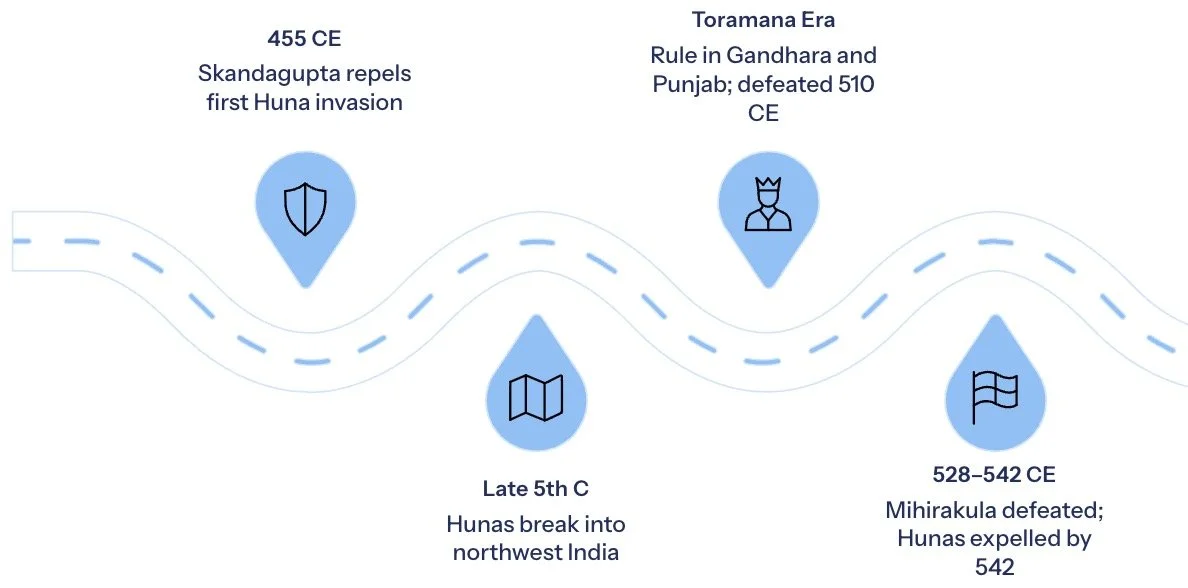
The Hunas — Iranian-speaking Xionite nomads from Central Asia — were among the most devastating external forces to strike northern India. Entering through the Khyber Pass at the end of the 5th and early 6th centuries, they pushed deep into the subcontinent. The Central Asian Xionites comprised four groups: the Black Huns (north), Red Huns (south), Celestial Huns (east), and the White Huns or Hephthalites (west) — the group that invaded India.
Toramana (ruled until ~520 CE)
Toramana established Hephthalite rule over Gandhara and western Punjab, eventually conquering much of northern and central India — including Eran in Madhya Pradesh, Uttar Pradesh, Rajasthan, and Kashmir. He was finally defeated by Gupta Emperor Bhanugupta in 510 CE. He is known from the Rajatarangini (written by Kashmiri scholar Kalhana in the 12th century), coins, and Sanskrit inscriptions including the Gwalior inscription.
Mihirakula (after ~520 CE)
Son of Toramana and one of the most powerful — and feared — Hephthalite emperors. His capital was Sakala (modern Sialkot, Pakistan). He was ultimately defeated in 528 CE by a remarkable coalition: Gupta Emperor Narasimhagupta Baladitya and the Aulikara king Yasodharman of Malwa. By 542 CE, Mihirakula had been driven entirely from the plains of northern India, taking refuge in Kashmir before eventually invading Gandhara and destroying its Buddhist shrines.
The Huna Invasions and the Hephthalite Empire
The victory of Yasodharman of Malwa over the Hunas in 528 CE is commemorated by twin monolithic pillars at Sondani in Mandsaur District. An inscription there reads "Ajay Jarto Hunan" — referring to the defeat of the Huns under Yasodharman's leadership. He also claimed the title Vikramaditya. Remarkably, the second Kalidasa — who wrote Raguvansha and Jyotirvidabharan — was reportedly his court poet.
Collapse
Decline and Fall of the Gupta Empire
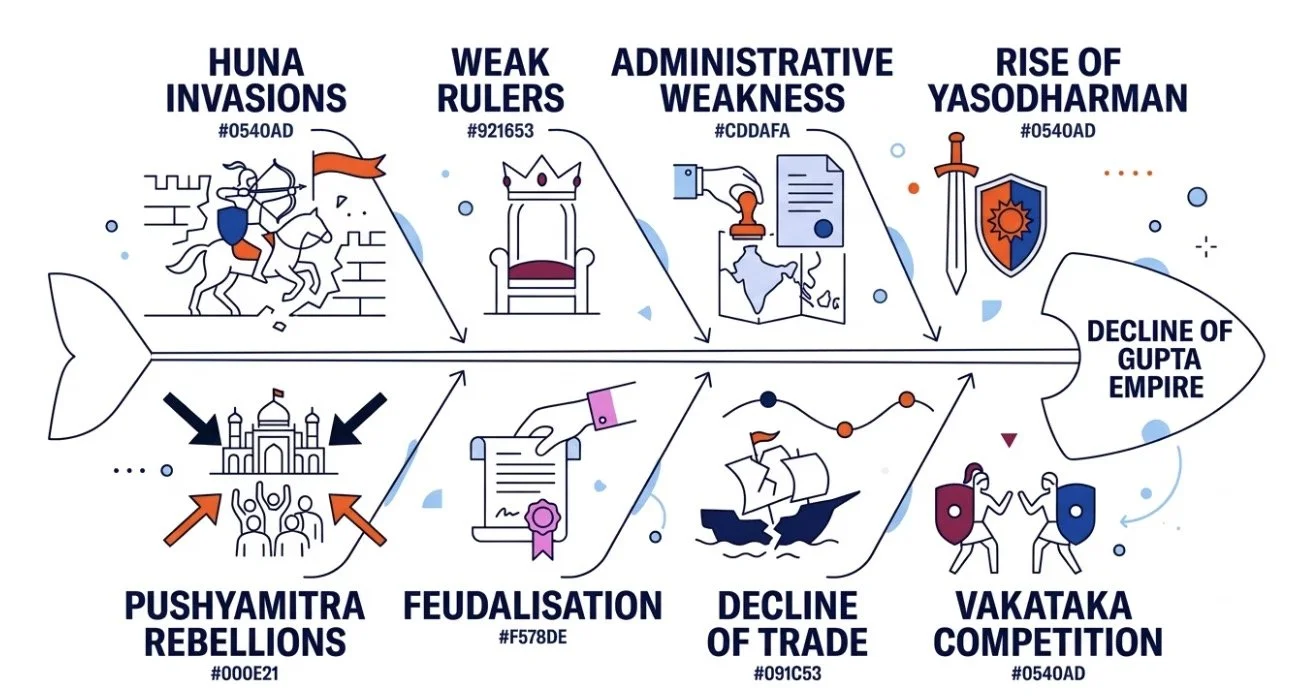
The collapse of the Gupta Empire was not caused by any single catastrophic event. Rather, it was a convergence of internal weaknesses and external pressures that gradually eroded what had once been the most brilliant empire in ancient India. After Skandagupta's death in 467 CE, a rapid succession of weak rulers — Purugupta, Kumaragupta II, Budhagupta, Narasimhagupta, Kumaragupta III, Vishnugupta, Vainyagupta, and Bhanugupta — proved incapable of holding the empire together.
Fall of the Gupta Empire
The process of feudalisation was particularly insidious. By granting land — first to religious beneficiaries (Brahmanas and temples) and later to secular recipients — the Gupta rulers steadily eroded their own tax base and administrative control. Local governors (Samantas) grew increasingly powerful at the expense of central authority. Meanwhile, the disruption of international trade — especially after the fall of the Han dynasty in China broke the Rome-China trade axis — gutted one of the empire's most important revenue streams. By 550 CE, the Gupta name survived, but the empire's power had become, in the words of historians, "very insignificant."
Governance
Gupta Administration: Structure and Organisation
Unlike the Mauryas, who maintained a highly centralised bureaucratic machinery, the Guptas adopted a more decentralised model. They assumed pompous titles like Parameshvara Maharajadhiraja and Paramabhattaraka — titles that implicitly acknowledged the existence of lesser kings with considerable local authority within the empire. The Allahabad Pillar inscription even refers to Samudragupta as a "god dwelling on earth." Kingship was hereditary, but the absence of a firm practice of primogeniture repeatedly created succession crises.
Central Government
Led by the Mantri (chief minister). Key officials included the Mahabaladikarta (commander-in-chief), Mahadandanayaka (general), Mahapratihara (palace guard chief), and the Sandhivigrahika (foreign minister — a new Gupta-era innovation). The Kumaramatyas were high personal staff of the emperor.
Provinces (Bhuktis)
The empire was divided into 26 provinces styled as Bhukti, Pradesha, or Bhoga, governed by Uparikas directly appointed by the king. The empire itself was referred to by names like Rajya, Rashtra, Desha, Mandala, Prithvi, and Avani.
Districts (Vishayas)
Provinces were divided into districts known as Vishayas, ruled by Kumaramatyas, Ayuktas, or Vishayapatis appointed by provincial governors. Urban administration included a Municipal Board (Adhisthanadhikarana) representing guild presidents, chief merchants, chief artisans, and chief scribes.
Villages (Grama)
The lowest unit of administration. In eastern India, vishayas were further divided into vithis and then villages. The Gramapati or Gramadhyaksha served as village headman. A Rural Board (Asthakuladhikarana) comprising village elders (Mahattaras), the headman (Gramika), and householders (Kutumbins) managed local affairs. No land transactions could occur without their consent.
Economy
Gupta Economy: Agriculture, Trade, and Crafts
The Gupta economy rested fundamentally on agriculture, which constituted the primary source of both subsistence and state revenue. Land revenue was the main income of the state, supplemented by fines. The king claimed theoretical ownership of all land, though in practice peasants managed it — a distinction made clear in the Paharpur copper plate inscription of Buddhagupta. Various land types were formally recognised in inscriptions: Kshetra (cultivated land), Khila (uncultivable), Aprahata (forest land), Gopata Sarah (pasture land), and Vasti (habitable land).
Crafts and Industry
Crafts production was diverse and sophisticated. Mining and metallurgy occupied the top position among industries — most eloquently evidenced by the famous Mehrauli Iron Pillar of 98% wrought iron, still rust-free after 1,600 years. The Amarakosha provides a comprehensive list of metals and craftsmen categories. Other flourishing crafts included ivory work, stone cutting and carving, jewellery making, silk weaving, glasswork, and terracotta production. A 5th-century inscription from Mandasor records a guild of silk weavers who migrated from south Gujarat to Malwa — indicating the mobility of specialised labour and a declining western trade.
Trade and Commerce
Two types of merchants operated in Gupta India: the settled Sresthi (guild merchant) and the travelling Sarthavaha(caravan trader). Guilds (nigama, sreni) remained the dominant institutions of manufacture and commerce, nearly autonomous in their internal organisation. Long-distance trade declined compared to earlier periods due to several factors: Byzantine acquisition of silk-worm technology directly from China, Arab expansion disrupting western trade, and the diversion of trade focus to Southeast Asia. The Guptas issued the largest number of gold dinaras in ancient India, yet cowries served as the common daily medium of exchange — suggesting a largely self-sufficient village economy.
Land grants to Brahmanas (Agrahara grants) and secular parties (Devagrahara grants) represented a significant structural shift in the Gupta economy. These grants — perpetual, hereditary, and tax-free — transferred revenue-collection rights from the state to religious and administrative recipients. This process of feudalisation gradually eroded the state's revenue base, reduced peasants to serfs or semi-serfs subject to subinfeudation, and imposed new burdens including forced labour (vishti) and additional levies. The resulting decline of urban centres in the Gangetic plains, which formed the empire's heartland, was both a symptom and an accelerant of Gupta decline.
Society
Social Developments in the Gupta Period
Gupta-era society was complex and stratified, with the varna system undergoing significant transformations. Brahmana supremacy was reinforced by large-scale land grants, and the term dvija was increasingly reserved exclusively for Brahmanas. However, the varna system was simultaneously modified by the proliferation of new sub-castes arising from various social processes — the absorption of Huna and Gurjar peoples into the Kshatriya fold as Rajputs, the transformation of craftsmen's guilds into hereditary castes, and the rise of new scribal groups like the Kayasthas.
Improvements and Continuities
The position of Shudras improved marginally — they were now permitted to listen to the epics and the Puranas and to perform certain domestic rites (which brought fees to priests). Legal texts such as those of Yajnavalkya, Narada, Brihaspati, and Katyayana were composed in this period, taking the Dharmashastra of Manu as their basis. The joint family system was firmly established as an essential feature of Hindu caste society. Chess (chaturanga) is believed to have originated in this period, representing the "four divisions of the military."
Intensification of Untouchability
The practice of untouchability became more intense than in earlier periods. Fa-Hien reported that Chandalas entering a city or marketplace would strike a piece of wood to announce their arrival, allowing others to avoid contact. Penance was prescribed for the sin of merely touching a Chandala. The Shanti Parva of the Mahabharata — assigned to the Gupta period — contains verses stressing the need for Brahmana-Kshatriya combination, possibly indicating some concerted opposition from Vaishyas and Shudras.
Status of Women
Women's status continued its downward trajectory. In a patriarchal framework, women were increasingly treated as property. The practice of sati (self-immolation at a husband's funeral pyre) gained approval from jurists — the first memorial inscription of a sati dated 510 CE is found at Eran in Madhya Pradesh. Lawgivers advocated early (even pre-puberty) marriage. Widows were expected to observe strict celibacy. Women were denied formal education and property rights except for stridhana (jewellery and marriage gifts). Women of lower varnas had more practical freedom through economic participation, unlike those of upper varnas.
Golden Age
The Golden Age: Literature, Science, and Intellectual Achievement
The Gupta period's claim to the title Golden Age rests most securely on its unparalleled intellectual and cultural achievements. The era produced scholars of world-historical importance whose contributions shaped not only Indian civilisation but influenced the entire Asian world.
Mathematics & Astronomy
Aryabhata calculated the value of pi, proposed the heliocentric model, and explained eclipses. Varahamihiraauthored the encyclopaedic Brihatsamhita. The decimal numeral system used worldwide today was developed in this era. The concept of zero as a number was formalised.
Literature & Poetry
Kalidasa's works — Shakuntala, Meghaduta, Raghuvamsha, Kumarasambhava — represent the pinnacle of Sanskrit literature. The earliest available forms of the great Indian epics, the Mahabharata and Ramayana, are thought to have been compiled in this period. The Panchatantra by Vishnu Sharma also dates to this age.
Medicine & Science
Dhanvantari advanced medical science substantially. The Kamasutra of Vatsyayana documented social science and human psychology. The Natyashastra codified dramatic theory. Strong trade ties with the Byzantine Empire and Southeast Asia made the region a major crossroads of knowledge exchange.
Philosophy & Religion
The Bhagavata Purana — articulating fully developed Bhagavata Vaishnavism — emerged in this period, synthesising the Krishna-Vasudeva tradition with cosmic Vishnu. The Gupta period saw Buddhism and Hinduism coexist in productive dialogue. Nalanda University, founded under Kumaragupta I, attracted students from across Asia. The Buddhist scholars Vasubandhu and Asanga graced Samudragupta's court.
Arts
Gupta Architecture: The Birth of the Hindu Temple
The Gupta period marks the decisive beginning of Indian temple architecture. The doctrine of bhakti and the growing importance of image worship led to the construction of the first free-standing temple with a garbha griha (inner sanctum) for the central cult image. While Gupta temples are simple and unassuming compared to later medieval structures, their conceptual innovations — the sanctum, the porch (mandapa), and eventually the tower (shikhara) — laid the foundational grammar for all subsequent Hindu temple traditions.
Type I: Flat-Roofed Temple
Simple flat-roofed square temple with a shallow pillared porch. Examples: Temple XVII at Sanchi, Kankali Devi temple at Tigawa, Vishnu and Varaha temples at Eran.
Type II: Ambulatory Temple
Flat-roofed temple with covered ambulatory around the sanctum. Examples: Parvati temple at Nachna Kuthara, Siva temple at Bhumara (MP), Lad Khan temple at Aihole.
Type III: Shikhara Temple
Square temple crowned with a low, squat shikhara (tower) — forerunner of the Nagara style. Examples: Dasavatara Temple at Deogarh (earliest known Panchayatana temple in North India), brick temple at Bhitargaon (oldest surviving terracotta Hindu shrine with sikhara).
Rock-Cut & Stupa
Rock-cut caves at Ajanta, Ellora, Bagh, Udayagiri, Elephanta, Kanheri and Andhra Pradesh caves (Mogulrajapuram, Undavalli, Akkana Madanna). The Dhamekh Stupa at Sarnath is the finest Gupta stupa. Elephanta's Trimurti is a "masterpiece of Gupta-Chalukyan art."
Arts
Gupta Sculpture and Painting: The Classical Ideal
The Gupta period inaugurated the classical phase of Indian sculpture. Centuries of accumulated technique were synthesised into a unified plastic tradition of supreme importance — drawing upon the sensuous plasticity of Mathura and the elegant refinement of Amravati. Gupta sculpture established definitive types of both Buddhist and Brahmanical divinities that became the models for all subsequent Indian art and served as the template for Buddhist art across Asia — from Siam and Cambodia to Burma, Java, Central Asia, China, and Japan.
Masterworks of Gupta Sculpture
The most celebrated Buddhist sculptures were produced at Sarnath and Mathura. The magnificent red sandstone Buddha from Mathura exemplifies Gupta mastery — Hellenistic elements are still visible in the purity of the statuary and refined drapery, yet these are elevated by an Indian spiritual radiance and the characteristic symbolic shell-like curls of the Buddha's hair.
The Sultanganj Buddha (Bihar) — 7.5 feet high, cast in copper — is the largest substantially complete copper Buddha from this period, dated 500–700 CE. Standing with his right hand in abhayamudra (gesture of protection), it represents the culminating achievement of Gupta metal-casting. Brahmanical sculpture was also produced for the first time at scale: images of Vishnu, Shiva, and other Hindu deities appear at the Deogarh temple. The Great Boar (Varaha) relief at Udayagiri cave entrance is among the most impressive Brahmanical sculptures of any period.
Ajanta Paintings
The wall frescoes of the Ajanta caves represent the apex of Gupta painting. Depicting events from the life of Gautama Buddha and Jataka stories, these paintings are lifelike and natural, their colours undimmed after fourteen centuries. An outstanding feature is the integration of architecture, sculpture, and painting into a marvellous unity.
Cave No. XVI contains the celebrated "Dying Princess" scene. Cave No. XVII has been called a "picture gallery". The Ajanta tradition inspired frescoes at Sigiriya in Ceylon, at Bagh in Gwalior, and at the temple of Sittannavasal in Tamil Nadu. Characteristics of Gupta painting include refinement and restraint, balance and elegance, and the harmonious blending of technique and spiritual subject matter.
Ramagupta: The Disputed Interlude
Between the reigns of Samudragupta and Chandragupta II lies a brief and controversial episode — the reign of Ramagupta, whose very existence was long debated. He was initially known only from literary tradition, principally the Sanskrit play Devichandragupta by Vishakhadatta, which portrayed him as a weak and cowardly king. However, three Durjanpur inscriptions on Jain tirthankara images discovered near Vidisha definitively confirmed his historical reality, identifying him as a Maharajadhiraja. A large number of copper coins from the Eran-Vidisha region, classified into five distinct types (Garuda, Garudadhvaja, lion, and border legend types), are attributed to his reign.
According to the Vishakhadatta narrative, Ramagupta mounted a disastrous campaign against the Sakas of Gujarat. His army was trapped, and the Saka king Rudrasimha III demanded Ramagupta hand over his queen Dhruvswamini in exchange for peace. The weak king was inclined to accept — infuriating his younger brother Chandragupta, who disguised himself as the queen, entered the Saka camp, and killed Rudrasimha III. He then killed Ramagupta and married Dhruvswamini. Though historians cannot be certain how much Vishakhadatta embellished, the Vaishali terracotta seal and the Bilsad Pillar Inscription of their son Kumaragupta I both confirm that Dhruvadevi was indeed Chandragupta II's chief queen (Mahadevi). Official Gupta records do not mention Ramagupta, tracing succession directly from Samudragupta to Chandragupta II.
Military
The Gupta Military Machine
The Gupta military system differed significantly from the massive, state-controlled Mauryan army. Unlike the Mauryas' enormous professional forces, the Gupta army relied heavily on feudatory contingents, with troops supplied by subordinate kings forming a major portion of imperial military strength. The classical Indian military text Siva-Dhanur-veda, composed during this period, provides insight into Gupta military organisation.
Infantry Archers
The bow was the dominant weapon of the Gupta army. The Indian longbow was capable of great range and penetration — an effective counter to invading horse archers. Iron shafts were used against armored elephants; fire arrows were also deployed. Archers were protected by infantry with shields, javelins, and longswords.
Cavalry and Elephants
Chariots receded into the background as armoured cavalry came to the forefront. War elephants remained a key component. Gupta military success likely stemmed from the concerted use of elephants, armoured cavalry, and foot archers in combined-arms tactics. Despite facing Huna horse archers, the Gupta armies were better disciplined.
Steel and Metallurgy
India had a prominent historical reputation for its steel weapons. One distinctive weapon was the steel bow. The Mehrauli Iron Pillar's rust-free longevity attests to the extraordinary quality of Gupta-era metallurgy. Gold coins depicted Gupta kings holding bows — a deliberate martial statement in royal iconography.
Navy and Administration
The Guptas maintained a navy allowing control of regional waters. The commander-in-chief (Mahabaladhikarta) oversaw a staff of subordinate officers. The army was paid in cash, with an officer called Ranabhandagarika in charge of military stores. Land revenue was the primary source of state income, supplemented by fines.
The collapse of the Gupta Empire in the face of the Huna onslaught was not directly due to inherent military defects — after all, Skandagupta had initially defeated these very invaders. More likely, it was internal dissolution that sapped the Guptas' will and capacity to resist sustained foreign invasion. Increasing dependence on feudatories who wielded considerable authority, especially on the fringes of the empire, gradually hollowed out the central military capacity that had made the early empire so formidable.
Legacy
The Enduring Legacy of the Gupta Empire
Though the Gupta Empire dissolved by approximately 550 CE, its legacy proved far more durable than its political existence. The empire's cultural, intellectual, and artistic achievements set a standard of civilisational excellence that became the reference point for all subsequent Indian history. The concept of the "Golden Age" — even if ideologically constructed — captures something real about the Gupta period's extraordinary density of achievement across nearly every field of human endeavour.
c. 240 CE
Sri Gupta founds the Gupta dynasty in Magadha / Bengal
319–320 CE
Chandragupta I assumes Maharajadhiraja title; Gupta Era begins
335–380 CE
Samudragupta — "Napoleon of India" — conquers much of the subcontinent
380–412 CE
Chandragupta II Vikramaditya — empire at its zenith; Golden Age peaks
454–467 CE
Skandagupta defeats the White Huns; empire begins slow dissolution
528 CE
Coalition of Narasimhagupta and Yasodharman defeats the Hunas decisively
c. 550 CE
Gupta power finally extinguished; regional kingdoms inherit the legacy
"But in the best days of the Gupta Empire, Indian culture reached a perfection which it was never to attain again."
— Fa-Hien's travelogues, as interpreted by modern historians
The Gupta Empire's lasting contributions — the decimal numeral system (including zero), classical Sanskrit literature, the canonical forms of Hindu temple architecture, the definitive Buddhist sculptural tradition, the foundational texts of Indian law and philosophy, and the establishment of Nalanda as Asia's greatest university — spread throughout Asia via trade routes, missionary activity, and cultural diffusion. From Southeast Asia to Central Asia, from Ceylon to China and Japan, the fingerprints of the Gupta Golden Age remain visible in architecture, religious iconography, mathematics, and literature to this day. Understanding the Guptas is not merely an exercise in historical recovery — it is an encounter with the foundations of a civilisation that shaped half the world.
