
Sangam Age: Art and Architecture
The Sangam period and its immediate aftermath (roughly 300 BCE to 600 CE) witnessed a remarkable flourishing of art, architecture, music, dance, and painting across the Tamil-speaking lands of ancient South India. Drawing upon the rich literary corpus of Sangam literature — including the celebrated epics Silappadikaram and Manimekalai — as well as epigraphical records, this document explores the diverse forms of artistic and architectural expression that defined this era. From humble thatched dwellings to elaborately decorated temple halls, and from folk music evolving into classical forms to sophisticated theories of dance and painting, the Sangam age laid the enduring foundations of South Indian civilisation.
Architecture
Secular and Religious Architecture
The literary sources of the Sangam period offer a remarkably detailed picture of both secular and religious architecture, revealing a society in which built environment was intimately connected to social hierarchy, religious practice, and urban planning. One of the most striking features of Sangam-age architecture is the extent to which socio-economic status determined the type of dwelling an individual could construct and inhabit.
The poor sections of society lived in simple thatched houses called Kurumbai, constructed from grasses such as kusa, darbai, and ugam. These were modest structures that provided basic shelter but reflected little of the architectural ambition visible in the dwellings of the affluent. Wealthier members of society, by contrast, built more elaborate residences known as Valamanai and Nagar, while palaces with fortifications were constructed for royal families — structures that spoke not only of comfort but of power and political authority. The architects of the period, significantly, were known as Noolari Pulavar, a title that suggests they were learned individuals who consulted written textual traditions on architecture when undertaking construction projects.
The earliest form of religious architecture in this period was strikingly simple: a cell with a wooden plank installed inside, the plank being worshipped as Kantu. This cell was called Podiyil, a term which implies it served as a communal gathering place for religious purposes. Deities were painted on the walls and worshipped. The structure had a brick wall and a wooden roof. As the number of devotees visiting from distant places increased, it became necessary to construct halls in front of the sanctum, some of which were plastered with stucco and occasionally decorated with pearls and precious gems. The stucco figures eventually served as presiding deities in the sanctum, marking an important transition in the nature of image worship.
The development of different religious cults caused a significant increase in the number of temples and alterations in the placement of deities. The contact between temple and society was further strengthened through expanding temple activities — rituals, religious discourses, and festivals — all of which necessitated the enlargement of the temple's physical structure. The period between AD 300 and 600 witnessed a notable increase in the number of buildings, both secular and religious. Town planning also reached new heights during this era: Puhar is described in the Silappadikaram as a well-planned city, representing one of the earliest and most celebrated examples of urban organisation in ancient South India.
Secular Dwellings
Kurumbai — thatched houses of the poor (kusa, darbai, ugam grass)
Valamanai & Nagar — residences of the affluent classes
Palaces with fortifications for royal families
Architects known as Noolari Pulavar
Religious Structures
Podiyil — earliest cell; plank (Kantu) worshipped inside
Deities painted on walls; brick walls, wooden roofs
Halls added in front of sanctum as devotion grew
Stucco decoration with pearls and precious gems
Temples also called Kottam, Niyamam, Koil and Devakulam
Temple Architecture
The Madakkoil Tradition
Among the most significant architectural innovations of the post-Sangam period is the emergence of the Madakkoilstyle of temple construction, a concept that marks a turning point in the history of South Indian religious architecture. The period from AD 300 to 600 is widely regarded as a landmark era in this field, and the Madakkoil represents its most original contribution to structural temple design.
The temple in epigraphical and literary sources of the period is referred to as Devakulam, while other terms such as Kottam, Niyamam, and Koil also appear in the literary tradition. The construction techniques and materials used for both secular and religious architecture were largely the same during this period, reflecting the continuity between domestic and sacred building traditions.
The Madakkoil style was introduced by the Chola king Kochenganan, who is also counted among the sixty-three nayanmars (Shaivite saint-poets). This style was also known as Perunthirukkoil. Its defining architectural feature was the construction of the Vimana (the tower above the sanctum) upon an empty Tala — a raised platform elevated to a considerable height. In some instances, this tala incorporated architectural components such as adhishtana (base moulding), bitti (wall), a roof, and even niches on the wall.
The practical rationale for this elevated design was environmental: the temples were built in the Thanjavur–Kumbakonam belt, a region prone to torrential rains and flooding. Raising the vimana upon an empty tala offered protection against floodwaters. Nearly seventy such temples were constructed by Kochenganan in this region, according to literary sources, and the Madakkoil at Nallur stands as one of the finest surviving examples of this type. These temples were built using brick, mud, and mortar — not granite, which was not yet in common use — making them susceptible to natural calamities. They are popularly known as Yanai Yera Koil (the temple which an elephant can climb), a name derived from a mythology associated with the life of Kochenganan. The proliferation of temples in this age also reflected a broader upsurge in religious consciousness: both Saivism and Vaishnavism received due patronage, despite the strong presence of heterodox religions such as Buddhism and Jainism.
Empty Tala (Raised Platform)
The defining feature — an elevated plinth with adhishtana, bitti, roof, and wall niches. Protected the structure from floods in the delta region.
Vimana Constructed Above
The tower (vimana) of the sanctum was raised atop the empty tala. Built in brick, mud, and mortar — granite was not yet in use.
Perunthirukkoil / Yanai Yera Koil
Also called Perunthirukkoil and Yanai Yera Koil. Kochenganan built nearly seventy such temples; the Madakkoil at Nallur is the finest example.
Performing Arts
Dance: Training, Performance, and the Stage
Dance and music, which had existed primarily as folk arts during the earlier Sangam age, underwent a profound transformation in the period between AD 300 and 600. Dance in particular evolved from a relatively informal communal practice into a sophisticated, codified art form performed on formal stages according to established norms and conventions. This transition is most vividly documented in the Tamil epic Silappadikaram, which is widely regarded as one of the most magnificent treatises on dance and music from the ancient world, retaining its relevance for artists of every subsequent era.
Several sections of the Silappadikaram contain invaluable information on the performing arts: Arrangerru Kathai, Kadaladu Kathai, Vettuvavari, Ayechchiyar Kuravai, and Kunrakkuravai together constitute a rich repository of knowledge about dance, its practice, its performers, and its social context. The description of the dance performance of Madavi in the Silappadikaram provides detailed information about dance teachers, vocal and instrumental musicians, the performance stage, makeup, and numerous other aspects of the art. Manimekalai too contains important references to dance and music.
The training of a dancer was an arduous and long-term commitment. Children began their learning at the age of five, on an auspicious day and at an auspicious time. The training period extended over seven years, during which the teacher — called adalasan — carefully monitored the progress of each disciple before permitting a stage performance. The guiding text for teachers was the Nattiyanannul. The Silappadikaram specifies that teachers were required to be accomplished in all aspects of dance, well versed in texts and treatises on the subject, accomplished in the science of music, knowledgeable about the playing of musical instruments, and themselves accomplished performers. Dance, moreover, was inextricably connected with music — one could not be performed without the other.
During this period, dance had also acquired a professional dimension: dance was performed to entertain the royal household and the affluent sections of society. The stage itself was a carefully designed space. Known in Tamil as arangu, the raised dais measured 48 × 42 feet and stood 6 feet above ground level, with the ceiling rising to a height of 24 feet above the dais. The stage had two openings — one for entrance and one for exit — and was equipped with three curtains.
Age of Commencement
Training began at age five on an auspicious day and time — a formal initiation into the discipline of classical dance.
Duration of Training
Seven years of rigorous instruction under the adalasan (dance teacher), guided by the treatise Nattiyanannul.
The Stage (Arangu)
Platform of 48 × 42 ft, standing 6 ft above ground; ceiling 24 ft high; two openings and three curtains.
Key Sources
Arangerrukadai of Silappadikaram; also Manimekalai. Descriptions of Madavi's debut are the most detailed surviving account.
Performing Arts
Music: Theory, Practice, and Social Life
Music in the Sangam age and the succeeding centuries was an art intimately bound to dance, devotion, and the rhythms of everyday life. Its growth as a formal discipline was as remarkable as that of dance, and it left a profound imprint on the cultural life of ancient Tamilagam. The term Kotti meant tala (rhythmic beat) in music, and a reference in the Tirikadugam — that music set on tala beat alone is worthy of hearing — underscores the sophistication that musical theory had already attained by this period.
Music was transmitted exclusively through oral tradition across generations, a practice that was both its strength and its vulnerability. There were many categories of musicians, including Panar, Porunar, Kodiar, Viraliar, and Koothar. The group that sang and played instruments to accompany dance — known as the nattuvangam — played a crucial role in stage performances, for the impression created by a dancer was held to be deeply dependent upon the musicians and instrumentalists accompanying her.
The Silappadikaram is the single most important source of information on ancient Tamil music. It contains descriptions of several musical scales (pans) and introduces music only when it is directly relevant to the narrative. The most musically rich sections are the Arangerrukadai — dealing with the debut of the danseuse — and the Kanalvariand Aichiyar Kuravai sections. The Arangerrukadai describes the qualifications required of vocal musicians, yaazh players, flutists, and drummers. The technique of playing the Yaazh (a stringed instrument akin to a lyre or harp) is described in detail in the Kanalvari.
Music permeated all aspects of social life. Cultivators sang while ploughing the land, choosing songs suited to the rhythm and mood of agricultural labour. The Mugavai pattu was sung while measuring grain in the field. Tamil Nadu's musical culture was also notably inclusive and cosmopolitan: dancers with their female pairs (viralis) from Kongana and Karnataka performed at the courts of Tamil kings, dressing and performing according to their own regional traditions. Both Kongana Kuttan and Karnataka Kuttan were welcomed at the royal court, demonstrating Tamil Nadu's tradition of encouraging artists from other regions. The commentaries Arumpada Urai and Adiyarkkunallar, though separated from the Silappadikaram by several centuries, continue to shed invaluable light on the musical world of ancient Tamilagam.
Tala and Theory
Kotti = tala (rhythmic beat). Tirikadugam states that music set on tala is alone worthy of hearing — evidence of advanced musical science.
Musicians & Tradition
Panar, Porunar, Kodiar, Viraliar, Koothar. Transmitted orally across generations. The nattuvangam ensemble was central to dance performances.
Silappadikaram as Source
The foremost literary source on music. Describes pans (scales), the Yaazh (stringed instrument), and qualifications for vocal musicians and instrumentalists.
Cosmopolitan Culture
Dancers from Kongana and Karnataka performed at Tamil courts in their own traditions. Tamil Nadu encouraged artists from across regions even in antiquity.
Visual Arts
Painting and Visual Arts
Alongside the performing arts and the built environment, painting occupied an important place in the artistic life of the Sangam age and the centuries that followed. Though little physical evidence survives from this period, literary sources provide a picture of a society in which the visual arts were widely practised and theoretically understood.
In Tamil, the word Oviam signifies picture, and painting as an art was called oviakkalai. The walls and roofs of the houses of the affluent were painted, as were the walls of royal palaces and temples. A painted figure mentioned in Manimekalai is called Kandiipavai. The same text also refers to the existence of a formal treatise on painting called Oviachennool, suggesting that painting had achieved a sufficiently sophisticated status to warrant systematic theoretical treatment. The book on painting was called Oviya Nul, and the brush or kol used for painting was called Vattigai. Suitable painted scenes displayed on or around the stage were called Oviya Elini.
An especially fascinating reference in Manimekalai concerns the Chitra Mandapa — a hall of paintings constructed with the guidance of experts from Yavana (Greece/Rome), Avanti, and Magada. The very name of this structure implies that it was adorned with beautiful paintings, and the involvement of expertise from such geographically distant regions speaks to the cosmopolitan artistic networks of ancient South India. On the ceilings of houses and palaces, painters typically depicted flowers and creepers, though a wider range of objects and scenes was also represented.
Despite this rich literary testimony, it must be acknowledged that no concrete physical evidence of Sangam-age paintings or sculptures has survived. The eminent historian V.A. Smith offered a sobering explanation for this absence, observing that "the statues and pictures apparently were executed in perishable materials and have wholly vanished." The use of wood, clay, brick, and organic pigments — rather than the durable granite and stone that would characterise later temple art — rendered this early artistic heritage acutely vulnerable to the ravages of time, climate, and natural disaster. What remains, therefore, is a literary record of extraordinary richness that must substitute for the physical artefacts that have been lost.
Key Terminology in Tamil Painting
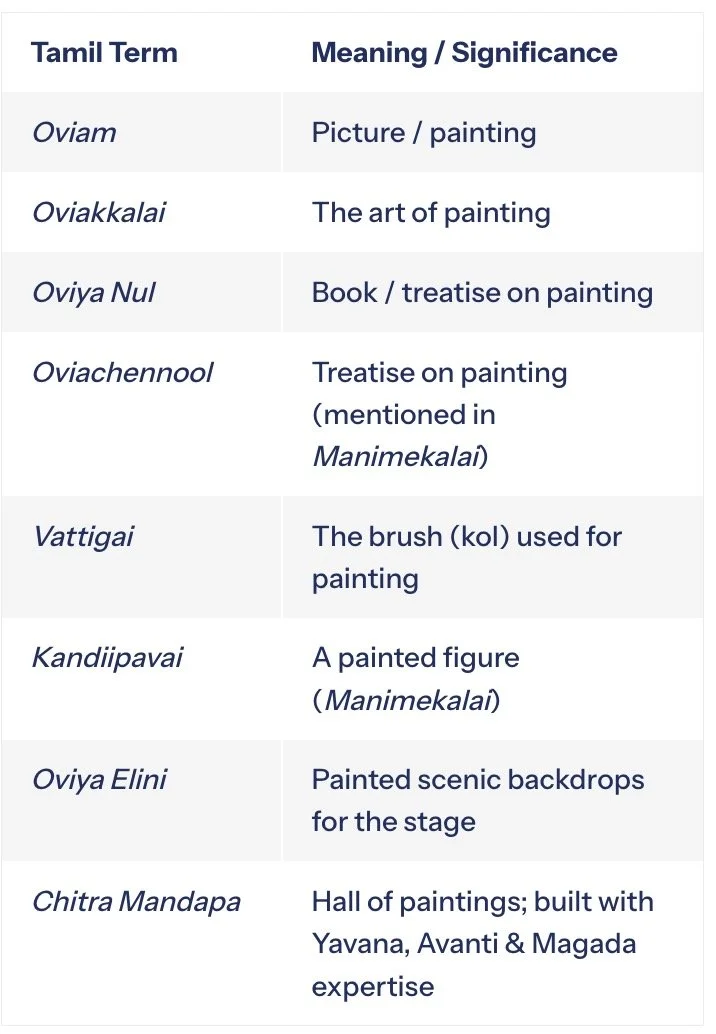
Key Terminology in Tamil Painting
Why No Paintings Survive?
V.A. Smith's assessment remains the most widely accepted explanation for the total absence of surviving Sangam-age visual art:
"The statues and pictures apparently were executed in perishable materials and have wholly vanished."
Materials used — brick, mud, mortar, wood, organic pigments — were not durable. Granite was not yet in common use for construction or sculpture. Natural calamities, floods, and the passage of centuries have erased the physical record.
The Enduring Legacy of Sangam Art
The art and architecture of the Sangam age and the subsequent centuries constitute one of the most vibrant and intellectually rich chapters in the cultural history of South India. Though the physical remains from this era are sparse — largely on account of the perishable nature of the materials employed — the literary sources, above all the Silappadikaram and Manimekalai, provide a detailed and vivid account of a society in which artistic excellence was deeply valued, systematically cultivated, and socially embedded.
Architecture evolved from simple thatched dwellings and wooden-roofed brick cells to elaborate temple complexes with stucco-decorated halls, culminating in the innovative Madakkoil style of Kochenganan — an architectural response to both religious devotion and environmental challenge. Dance and music, once largely folk traditions, were codified into sophisticated disciplines with their own theoretical texts, specialised teachers, professional performers, and formal stages. Painting, too, was recognised as a distinct art form with its own terminology, treatises, and practitioners, even if its physical products have not endured. The period also witnessed a remarkable openness to artistic influences and performers from other regions, reflecting a cosmopolitan cultural sensibility that was characteristic of the age.
For students of South Indian history and archaeology, the Sangam age offers a compelling case study in the relationship between literature and material culture: when physical evidence is absent, it is the literary record that must carry the burden of historical reconstruction. The remarkable richness and specificity of Sangam-age texts on art, architecture, music, dance, and painting make them indispensable sources not only for the historian but for anyone seeking to understand the deep roots of South India's living cultural traditions.
Architecture
From Kurumbai to Madakkoil — a trajectory from simple dwellings to innovative structural temples. Kochenganan's Yanai Yera Koil marks the apex of the period.
Dance
Codified into a seven-year curriculum under the adalasan; guided by Nattiyanannul; performed on a formally designed arangu stage. Silappadikaram is the key source.
Music
Transmitted orally across generations; theorised through tala and pan (scales); central to dance; documented most richly in the Silappadikaram.
Painting
Oviakkalai was practised on temple walls, palace ceilings, and stages. Treatises existed (Oviya Nul). Physical works have perished; literary evidence survives.
Key Note : The near-total absence of surviving physical remains from the Sangam period means that literary texts — particularly the Silappadikaram, Manimekalai, and Tirikadugam — function as primary archaeological sources. Cross-referencing these with epigraphical evidence and later commentaries such as Arumpada Urai and Adiyarkkunallar is essential for rigorous historical analysis. Always bear in mind V.A. Smith's caveat about perishable materials when assessing the archaeological record of this period.
