
Sangam Age: Economy
The Sangam Age refers to the Early Historic period in South India, encompassing the regions of present-day Kerala and Tamil Nadu — territories bounded by seas on three sides and shaped by a distinct ecological and cultural geography. This era is broadly contemporaneous with the Mauryas, Sungas, Indo-Greeks, Kushanas, and Satavahanas, who held sway over other parts of the subcontinent. The developments of the Sangam Age are therefore best understood not in isolation, but as part of a wider network of historical and cultural interactions spanning the Indian subcontinent and the Indian Ocean world.
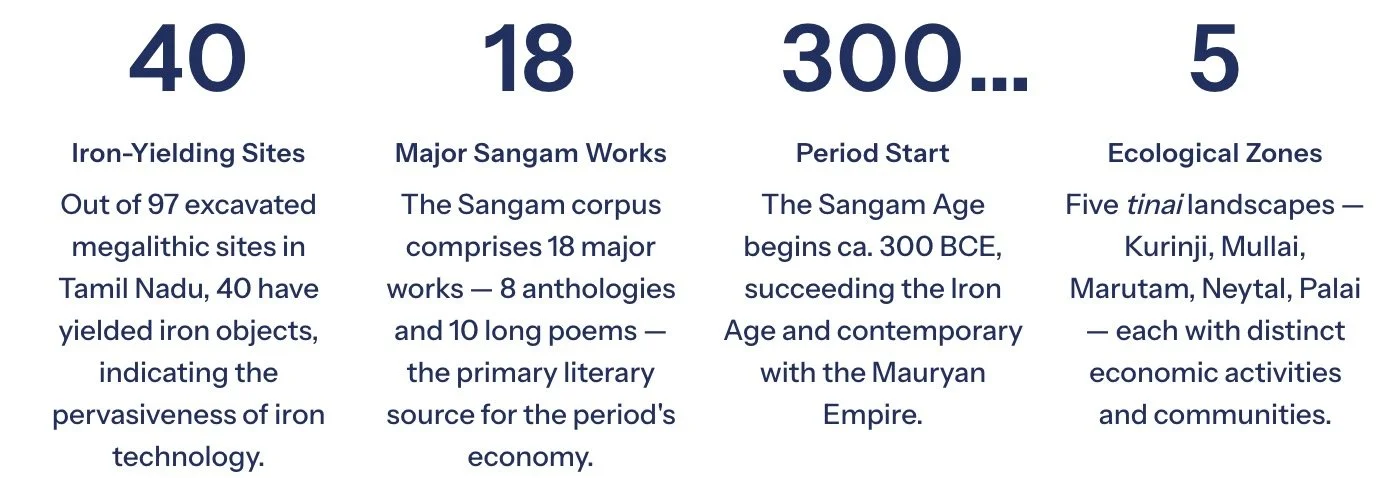
The Iron Age in South India (ca. 1300 BCE – 300 BCE) served as the formative cultural precursor to this period. The Sangam Age itself — named after the literary academy or Sangam that compiled its texts — is broadly placed between 300 BCE and 300 CE, though many of the texts were likely composed earlier than their anthology dates suggest. The polity of the age was dominated by three major Vendars: the Cholas, the Pandiyas, and the Cheras, alongside numerous smaller chiefdoms and political entities.
The economy of the Sangam Age exhibits a striking diversity and relative prosperity when compared to the preceding Iron Age. Coins and script appear for the first time in this region's history, and the material cultural wealth revealed by literature and archaeology together attest to economic vitality across multiple sectors — from highland gathering communities to coastal maritime traders.
Key Polities
Cholas — eastern riverine territories
Pandiyas — far southern regions
Cheras — western coastal zone
Numerous minor chiefdoms
Historical Significance
The Sangam Age marks the beginning of documented literacy, monetisation, and large-scale exchange in South India. References to these polities in Asoka's Rock Edicts, combined with the vast Sangam corpus and Greco-Roman accounts, establish a multi-layered historical record unmatched by any earlier South Indian cultural phase.
Sources for the Study of Sangam Economy
The reconstruction of the Sangam Age economy draws upon a rich and diverse body of evidence. These sources are mutually reinforcing, and their convergence lends considerable confidence to our understanding of this period's economic life.
Sangam Tamil Texts
The eighteen major works of the Sangam corpus — the Ettutogai (eight anthologies) and the Pattupattu (ten long poems) — are the primary indigenous literary sources. They offer detailed references to landscapes, livelihoods, crafts, trade, and social life across all ecozones.
Greco-Roman Accounts
Strabo's geography, the Periplus Maris Erythraei, and Ptolemy's accounts document maritime trade, port towns, and the movement of goods between Tamizhagam and the western world. The Ramayana and other Sanskrit texts also offer supplementary references.
Inscriptions
Asoka's Rock Edict II mentions the Chola, Pandya, and Chera polities. Tamil-Brahmi inscriptions found on rock-shelters along trade routes and on pottery reveal merchant activities, diverse social backgrounds, and the early development of literacy.
Archaeological Evidence
Megalithic burials, habitation sites, and excavated port towns such as Arikamedu, Azhagankulam, Kaveripumpattinam, Korkai, Uraiyur, and Pattanam (Kerala) provide material evidence of trade, craft production, and urban activity.
Roman and punch-marked coins, as well as issues of local rulers — the Chola, Pandya, Chera, and Malayaman dynasties — further illuminate the nature of monetisation and commercial transactions. Together, these sources present a composite picture of an economy that was simultaneously rooted in subsistence activities and integrated into long-distance exchange networks.
The Five Landscapes and Their Economic Roles
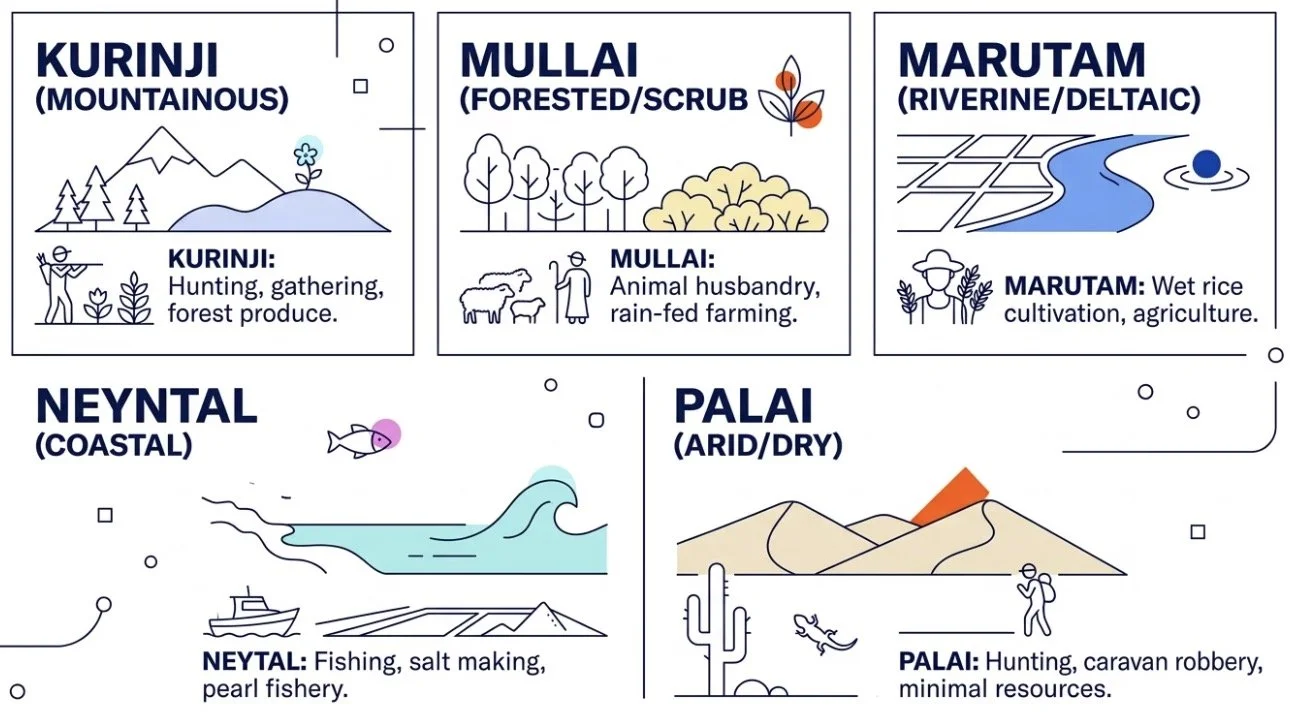
One of the most distinctive features of Sangam literary culture is the classification of Tamil territories into five ecological zones, or tinais, each associated with specific communities, livelihoods, and economic activities. While these categories were idealised literary constructs meant for poetic purposes, they offer a remarkably coherent framework for understanding the economic geography of the region. In reality, there was considerable overlap between zones, and human communities were far more adaptive and complex than any single category suggests.
Sangam Age: Economy The Five Landscapes and Their Economic Roles
Each zone contributed distinct goods and services to the broader regional economy. The highlands supplied forest produce, honey, pepper, and sandalwood; the pastoral zones provided dairy products and cattle; the fertile riverine tracts generated rice surpluses; the coast produced fish, salt, and pearls and served as gateways to maritime commerce. The arid Palai zone, by contrast, was associated with scarcity and the predatory behaviour of those who survived by raiding passing caravans. The economic interaction between these zones was sustained by barter and by the movement of itinerant traders, salt merchants, and wandering bards along well-worn routes.
Agriculture: The Backbone of the Sangam Economy
Agriculture was practised at varying scales across the different ecological regions of Tamizhagam, and it constituted the most fundamental pillar of the Sangam economy. The Sangam literature mentions a remarkable variety of rice cultivars — vennel (white rice), ivananel, torai, sennel (red rice), and putunel (new rice) — suggesting that sophisticated agricultural knowledge had been accumulated over generations. Agricultural fields were described using distinct Tamil terms: vayal, ceru, kalani, and pazhanam.
The Chola king Karikalan is celebrated in the Pattinapalai for having converted forests into cultivable land and for constructing embankments along the River Kaveri — an early instance of state-directed hydraulic intervention to expand the agricultural base. Farmers, known as Uzhavars, ploughed the fields, and the chieftains of agricultural communities were known as Velir. Traditional practices included the selection of quality seed prior to sowing, fertilisation of fields with animal manure and vegetable waste, and the careful management of perennial water bodies and streams that nurtured the fertile Marutam tracts.
In drier upland areas, millet cultivation — particularly ragi and tinai — was practised, while shifting cultivation was undertaken in the hills. The diversity of crops grown across the ecological zones meant that agricultural produce was not merely consumed locally but was actively exchanged and traded across regions, providing one of the fundamental flows of goods in the Sangam economy.
Crops Cultivated
Vennel, sennel, putunel — rice varieties
Tinai and varahu — millets
Wild paddy varieties — hill communities
Jackfruit, honey — forest cultivation
Agricultural Infrastructure
Kaveri embankments — Karikalan's project
Perennial water bodies and streams
Tanks, canals, and step-wells
Segmented field systems (vayal, ceru)
Pastoralism, Hunting-Gathering, and Fishing
Beyond agriculture, the Sangam economy was sustained by a constellation of primary production activities spread across different ecological zones. Pastoralism was a defining feature of the Mullai zone, where communities known as Ayar(men) and Aychiyar (women) tended cattle and produced milk, curd, and butter. These dairy products were exchanged through barter with communities in other zones. The fight for cattle was a recurrent theme in Sangam poetry, and warriors killed in such skirmishes were memorialised by hero stones (nadukal) — a practice that underscores the cultural and economic importance of cattle wealth. Sheep and goat pastoralism was also widespread, evidenced both by textual references and by animal bone assemblages recovered from archaeological excavations.
Hunting and gathering contributed meaningfully to the economy, particularly in the Kurinji and Palai zones. People hunted animals, collected roots, fruits, forest produce, and gathered elephant tusks, gems, and precious stones — all of which entered into barter and trade networks. There is textual evidence for the exchange of ivory for toddy, and animal meat was traded as well. The Kuravars, Kurattiyars, and Vettuvars of the highland zone also collected pepper, sandalwood (aram), and akil (eaglewood), which were highly valued commodities in long-distance trade.
Fishing was the principal occupation of the coastal Neytal zone, with communities known as Paratavar and Valayarengaged in both subsistence fishing and commercial exchange. Fish was traded for paddy in neighbouring inland areas, and fisherwomen played an active role in distribution by bringing catches to village fairs and rural markets. Salt — a vital preservative and dietary necessity — was produced along the coast by these same communities and distributed inland by a specialised group of merchants known as Umanars. Pearl fishery, conducted in the waters around Korkai and Pamban, was another significant coastal activity, producing pearls that entered both regional and long-distance trade circuits.
Craft Specialisation: The Industrial Engine
Craft specialisation is one of the defining hallmarks of the Sangam Age economy, representing a qualitative leap from the subsistence-oriented production of the Iron Age. The Sangam texts name specific craftspeople — blacksmiths (kollans), goldsmiths (pon vanikan), weavers, shell bangle cutters — and describe the existence of specialised settlements or ceris (craft quarters or colonies) associated with particular crafts. This points not merely to individual skill but to an organised, community-level system of production, potentially involving full-time specialisation in urban or semi-urban contexts.
Iron Industry
The backbone of the Sangam economy. Iron objects — swords, daggers, spearheads, axes, arrow heads, knives, and tridents — were produced at smelting sites including Guttur and Kodumanal. Wootz crucible steel was produced at Kodumanal. Iron supported agriculture, warfare, fishing, and hunting across all ecozones.
Stone Bead Industry
Carnelian, quartz, amethyst, garnet, crystal, beryl, and emerald were worked at sites such as Kodumanal, Arikamedu, Alagankulam, and Pattanam. The etched carnelian bead tradition dates to the Iron Age. Raw carnelian was sourced from Gujarat, and finished beads — as well as blanks — were exported overseas.
Shell Bangle Industry
Shells of Turbinella pyrum were harvested from the Pamban sea and cut into bangles at coastal sites. The Sangam literature explicitly mentions the settlements of shell cutters near Korkai. This industry is possibly referenced in the Arthasastra as Pandiya Kavataka.
Glass Bead Industry
A new industry introduced during the Sangam Age. Industrial evidence for glass bead production is attested at Arikamedu and Kudikkadu. Glass beads were traded widely, meeting demand for colourful ornamental objects in both interior and coastal markets.
Gold Working
Gold working became increasingly prominent, likely accelerated by the influx of Roman gold. Goldsmiths and gold merchants are documented in both literary and epigraphic sources. Gold jewellery has been recovered from megalithic burials, and gold working evidence has been found at select excavated sites.
Textile Industry
Weaving was a major industry evidenced by spindle whorls, a fragment of woven cloth from Kodumanal, and a dyeing vat at Uraiyur. Ptolemy mentions Argartic, a fine cloth from Tamizhagam. Kalingam silk and cloth from East Asia, Southeast Asia, and Orissa also reached the Tamil region.
Iron Industry: Technical Achievements
The iron industry was the most consequential craft sector of the Sangam Age economy. It underpinned the political economy of chiefdoms (through the production of weapons), the agrarian economy (through the manufacture of agricultural tools), and the pastoral and fishing economies (through the production of a wide array of implements). Blacksmiths, known as kollans in the Sangam texts, were distributed across the landscapes, and multiple settlements appear to have had at least one kollan workshop, as suggested by the Kuruntogai.
Archaeological evidence reveals a distinction between iron smelting sites (fewer in number) and iron working sites (more numerous). Not all habitation sites contain evidence of smelting, but iron working — the shaping and finishing of iron objects — was far more widespread. In Tamil Nadu, 40 out of 97 excavated megalithic sites have yielded iron objects, underscoring the pervasiveness of iron in daily and ritual life.
Guttur Furnace
Excavated by Madras University. Measured 2.2 m × 0.63 m × 0.45 m in size. Capable of producing cast iron. Iron objects from this site contained 2.5–5% carbon, indicating deliberate control of carbon content.
Kodumanal — Wootz Steel Centre
Excavated by Tamil University. A circular bowl furnace measuring 115 cm × 65 cm was found. The carbon content of a sword's cutting edge was 0.8%, and the edge was harder than the centre — evidence of sophisticated differential heat treatment and skill in iron metallurgy. Magnetite iron ore source identified at nearby Chennimalai.
Other Documented Sites
Furnace evidence from disturbed contexts at Melsiruvallur (documented by Shantha Srinivasan) and Perungalur (documented by Sasisekaran). Iron objects were also traded beyond their production sites, serving communities far from the smelting centres.
Local Trade, Barter, and Salt Commerce
Barter was the most common mode of transaction in the local exchange economy of the Sangam Age. The items exchanged were predominantly articles of immediate consumption — salt, fish, paddy, dairy products, roots, venison, honey, and toddy. The exchange relationships between different ecological zones were regularised through customary practice: salt was bartered for an equal measure of paddy; paddy was exchanged for milk, curd, and ghee; honey was given for fish oil and liquor; rice flakes and sugarcane were exchanged for venison and toddy.
Exchange rates were not generally fixed, and petty bargaining was the primary mechanism for determining the value of goods. The one notable exception was the salt-paddy exchange, for which a set rate of equal measure was conventionally accepted. Loans were also known within the barter system — a practice called Kurietirppai — where a fixed quantity of an article could be borrowed and repaid in kind at a later date.
Salt was among the most strategically important commodities. Produced along the coast, it was distributed inland by a specialised group of merchants known as Umanars, who moved in large caravans (umanchathu) pulled by bullocks or asses. Hawker women of the Umana community carried salt in head loads to coastal villages, bartering it for local produce. These salt caravans served a dual function: as distributors of salt and as collectors of merchandise from different parts of the region, effectively functioning as mobile intermediaries in the exchange network.
"Salt was bartered for equal measure of paddy — the single fixed exchange rate in an otherwise fluid barter economy of the Tamil south."
Land Grants and the Agrarian Order
The Sangam Age and its immediate aftermath witnessed significant transformations in the agrarian order through the institution of land grants. This period saw the deliberate extension of land under cultivation and the establishment of new settlements through grants made primarily to Brahmanas — land that was typically exempt from various taxes and dues. Most of these grants involved virgin forest land, though some grants were also made for regions already under cultivation. The ruling families derived clear economic advantages from such policies: bringing new land under cultivation expanded the resource base, increased agricultural output, and thereby enhanced the revenue available to the chief or king.
Land grants also served important political and ideological functions. By endowing Brahmanas with land, rulers secured religious legitimacy and the support of a literate class capable of performing rituals that endorsed their authority. Religious texts actively sanctioned such grants as a means of ensuring Brahmanical subsistence. Over time, grants were also extended to non-Brahmin religious establishments — Buddhist and Jain monasteries — and to officials, particularly during the Gupta and post-Gupta periods. This expansion of the grant system gave rise to a new class of landowners and contributed to the emergence of a proto-feudal structure in which defeated kings continued to rule their territories as vassals, sharing revenue from the land as tribute to their overlords.
Expansion of Cultivation
Virgin forests were brought under the plough, extending the agricultural frontier and increasing the revenue base of ruling families.
Water Infrastructure
The reach of water resources was central to rural expansion. Tanks (keres), rivers (nadi), wells (araghatta), water channels (srota), and step-wells (vapis) were developed alongside new settlements.
Emergence of Feudalism
Land grants paved the way for a feudal structure. Defeated kings became vassals, ruling their territories while sending tribute to new lords by sharing land revenue.
Coinage and Monetisation
The introduction of coinage — like the Tamil-Brahmi script — was one of the defining innovations of the Sangam Age. The discovery of coin hoards of both local and foreign origin across Tamil Nadu and Kerala attests to the trade relations that existed between the ancient Tamil country and other regions of India and the wider world. However, it would be an overstatement to describe the Sangam economy as a fully monetised one. The use of coins appears to have been limited — concentrated in urban centres and among particular categories of traders and rulers — while barter remained the dominant mode of exchange at the grassroots level.
Monica Smith's work on coin distribution suggests that the varying weight standards found across different regions indicate the use of coins as a standard of value and a medium of exchange, rather than a universally circulating currency. Some scholars argue that Roman coins, in particular, were used primarily for their bullion value — accepted and hoarded for the quality of their metal rather than as tokens of monetary authority. The concentration of Roman coins in the Coimbatore or Kongu region points to the commercial importance of this inland corridor. Later Roman coins are found more commonly in the southern parts of India and Sri Lanka.
Punch-Marked Coins
Among the earliest coins in circulation. Minted in north India from the 6th–5th century BCE onward. Found in large hoards across South India, testifying to north-south commercial contact.
Local Dynastic Coins
Chola, Pandya, Chera, and Malayaman rulers issued coins in copper and other metals. The Sangam literature mentions kasu, pon, and kanam as types of coins — some perhaps used as ornaments rather than in commercial transactions.
Roman Gold Coins
Coins of Augustus Caesar's reign are the most frequently found Roman issues. Likely valued for metal quality. Tamil literature records Yavana ships bringing gold to exchange for pepper. Roman coinage may also have been used as ornament.
The Sangam literature records extraordinary acts of gifting in coins: the chief Kalankaikkanni Narmuticcheral reportedly gave 4,000,000 gold coins to a bard, while Atukotpattu Cherlathan presented 100,000 kanam coins to another. Such references suggest that coins — beyond their commercial utility — served as instruments for the legitimation of chiefly authority and the performance of generosity.
Long-Distance Overland Trade
Commercial and cultural contacts between the northern and southern parts of India can be traced back at least to the fourth century BCE. The resources of the territories south of the Vindhya ranges — their precious stones, spices, pearls, ivory, and fine textiles — were well known to northern traders and political thinkers. Kautilya's Arthasastra explicitly praises the Dakshinapatha (the southern route) as a highway of commerce, noting that the southern territories abounded in conch shells, diamonds, pearls, precious stones, and gold, and that the route passed through regions rich in mines and valuable merchandise.
The Dakshinapatha connected the Ganga valley to the Godavari valley and touched important southern centres, including Pratishthana (later the Satavahana capital). The northern traders brought punch-marked silver coins southward in large quantities — hoards of which have been unearthed across South India — and received in exchange luxury goods such as pearls, precious stones, fine textiles, and spices. A particularly valued textile was Kalingam silk, named after its place of origin in Kalinga (Orissa), which was highly prized by Tamil chieftains and given as a prestigious gift to bards. Northern Black Polished Ware (NBPW) pottery also made its way to the far south, with sherds discovered in the territory of the early Pandiyas.
The overland trade was predominantly in luxury items — pearls, precious stones, gold, fine silk, and spikenard — which meant that its benefits were concentrated among the ruling elites and their immediate circles rather than filtering through to the broader population. Nevertheless, the movement of traders, merchants, bards, dancers, and mendicants along these routes created important cultural and economic linkages between the peoples of peninsular and northern India.
The Indo-Roman Maritime Trade
The direct commercial contact between Rome and peninsular India — evidenced from the close of the first century BCE — represents one of the most consequential economic developments of the Sangam Age. This trade can be understood in two broad phases: an early phase in which Arab merchants served as middlemen, leveraging their knowledge of the monsoon wind systems as a closely guarded commercial secret; and a second phase in which the monsoon winds were "discovered" by the navigator Hippalus, enabling Roman ships to sail directly across the Arabian Sea to the ports of South India.
Roman Imports to South India
Raw materials: copper, tin, lead, coral, topaz, flint, glass
Finished goods: fine wine, quality textiles, ornaments
Gold and silver coins (often used as bullion)
Excellent pottery types
South Indian Exports to Rome
Spices: pepper, spikenard, malabathrum, cinnabar
Precious stones: beryl, agate, carnelian, jasper, onyx; pearls, shells, ivory
Timber: ebony, teak, sandalwood, bamboo
Textiles: coloured cotton, muslin; dyes (indigo, lac)
The Romans paid for Indian goods predominantly in gold. Pliny the Elder, in his Natural History, lamented that enormous quantities of Roman wealth drained annually to India, China, and Arabia in exchange for luxury articles — a complaint echoed by Emperor Tiberius in 22 CE. The large number of Roman gold and silver coins found in hoards across Andhra, Karnataka, Tamil Nadu, and Kerala — mostly dating between the 1st century BCE and the 3rd century CE — provides material corroboration for this vibrant commercial relationship. South India also maintained maritime connections with Sri Lanka and Southeast Asia, where Tamil and Sri Lankan merchants participated in the exchange of spices, camphor, and sandalwood. Tamil-Brahmi inscriptions in Sri Lanka and Sri Lankan merchant references in South Indian epigraphy together attest to this bilateral maritime engagement.
Trade Routes, Transportation, and Commercial Infrastructure
The movement of goods across the diverse ecological zones of Tamizhagam and beyond required a network of routes, transportation means, and supporting infrastructure. Overland routes linked the producing areas of the interior with inland markets and coastal port towns. These routes were traversed by salt caravans (umanchathu), grain merchants, cloth dealers, bards, messengers, mendicants, and sometimes even royally sponsored embassies. The journey was often hazardous: routes passed through dense forests and over hills inhabited by communities who engaged in wayside robbery. In the absence of effective royal policing, merchant caravans employed their own armed guards.
One important route ran from the western hilly region to Kanchipuram on the eastern coast. The main Deccan route descended from Ujjaini to Pratishthana (Paithan) and then traversed the Deccan Plateau to the Krishna Valley, eventually connecting with the famous cities of Kanchi and Madurai. Buddhist cave sites and religious centres along the Deccan routes served travellers in important ways — providing food, shelter, and even loans to merchant caravans. Rulers donated liberally to these establishments, constructed rest houses at port towns, and established watersheds along the routes.
Pack Animals and Carts
Bullocks, asses, and horses were used to transport goods overland. Toll (ulku, derived from the Sanskrit sulka) was levied on merchandise moving by pack animal and cart at major checkpoints and town gates.
River Ferries
Where routes crossed rivers, ferry services were established. A toll was typically charged at such crossings, though some ferries were designated toll-free. River navigation using smaller boats supplemented overland transport.
Coastal and Maritime Shipping
Navigation was predominantly coastal in Tamizhagam. Larger vessels enabled sea-borne trade. At Bharukaccha (Broach), ships were piloted by local boats to separate berths. At Chola port towns, wharves with warehouses, lighthouses, and stamping facilities (tiger emblem) supported administered maritime commerce.
Commercial Organisation: Merchants, Salt Caravans, and Guilds
The organisation of commerce in Tamizhagam ranged from the highly informal — family-based producers who doubled as distributors — to more structured arrangements among specialised merchant communities. In small-scale local transactions, producers were often their own dealers. The fishermen's womenfolk, for instance, carried fish to neighbouring coastal areas and village fairs, while Umana hawker women transported salt in head loads to exchange for paddy. This household-level commercial activity was embedded within kinship and community networks rather than formal institutional structures.
At a slightly higher level of organisation were the specialist merchant groups: dealers in grain (Koolavanikan), cloth (aruvaivanigan), gold (pon vanigan), and sugar (panita vanigan). Some of these merchant groups are attested in cave inscriptions as donors to ascetic communities, indicating that they had accumulated sufficient wealth to engage in acts of patronage. A single epigraphic reference from Tiruvellarai in the deep south mentions a traders' organisation whose members are described as nikamattor — members of a nigama (guild). This suggests that while formal merchant guilds were rare in Tamizhagam, they were not entirely unknown.
The situation in the Deccan under the Satavahanas was markedly different. Merchants' guilds or associations (srenis) were regular and prominent features of commercial life. These guild organisations played a significant role in breaking old kinship ties and establishing new types of relations in craft production and trading ventures. The close relationship between Deccan rulers, commercial guilds, and Buddhist monastic establishments created a transformative dynamic for the economy and society of the Deccan — a dynamic that was far more muted in Tamizhagam.
Key distinction: In Tamizhagam, traders functioned largely within kinship networks of a tribal nature, limiting the downward distribution of trade benefits. In the Deccan, guild structures enabled the advantages of long-distance trade to filter more broadly through society, as reflected in the substantial donations of artisans and traders to Buddhist monasteries.
Revenue from Trade and Weights & Measures
The ability of ruling authorities to systematically collect revenue from trade depended upon the efficiency of governance and the degree of political consolidation in a given region. Political developments across peninsular India during the Sangam Age were far from uniform, and consequently the revenue systems also varied considerably from region to region. In Tamizhagam, the evidence for systematic revenue collection is fragmentary, but it is clear that the ruling chieftains were keenly interested in trade — particularly with the Yavanas (Romans) — with an obvious eye on commercial income.
Revenue in Tamizhagam
Toll (ulku) levied on goods moved by pack animals and carts
Chola agents at Kaveripumpattinam affixed the tiger emblem on merchandise
Artisan tax (karukara) levied on craft products
Royal warehouses and stamping facilities at port towns
Revenue in the Deccan (Satavahanas)
More regular and systematic taxation
Custom duties and tolls at each major town
Ferry duties as a source of income
Revenue received in kind or cash
Ushavdata arranged toll-free ferries on select rivers
A developed system of exchange also required standardised weights and measures. In the Deccan, where trading centres regularly handled diverse goods, precise measurement was well established. Coins were issued in different denominations, and land was measured in nivartanas. In Tamizhagam, ma and veli were measures of land, while grain was measured in ambanam (a large measure used for tribute payments), and smaller measures such as nali, ulakku, and alakku were known for everyday transactions. Weight was determined using a balance, and even minute quantities — such as gold — could be precisely measured. Linear measurement in day-to-day transactions was expressed in terms of the lengths of gingelly grain (el), paddy grain (nel), finger, and hand.
Impact of Trade and Urbanisation on Society
The early trade and urban developments of the Sangam Age did not bring about fundamental transformations in the social life of Tamizhagam to the same degree as they did in the Deccan. Local exchange in the Tamil south was primarily subsistence-oriented: the goods that changed hands were consumed by different groups for their regular needs, and the surplus generated did not accumulate sufficiently to create significant new social formations. Long-distance trade was predominantly in luxury goods — pearls, fine textiles, gold, precious stones — whose circulation was confined to the kinship circles of chieftains and their men, limiting its redistributive effect.
Individual merchants in Tamizhagam, as seen from their gifts to monks and ascetics, achieved modest levels of wealth but were not organised into the kinds of guilds that could collectively challenge or reshape social norms. Craftsmen and traders functioned as members of a family or as close relatives, bound by the norms of kinship rather than by the formal contractual relationships that characterised guild membership. The social impact of trade in the Tamil south thus remained relatively contained, even as the volume and reach of commercial activity were expanding.
Tamizhagam
Trade benefits largely confined to ruling elites. Local exchange subsistence-oriented. No formal guild structures. Craftsmen and traders operated within kinship networks. Limited social transformation from urbanisation.
The Deccan
Guild organisations (srenis) broke old kinship ties. Trade benefits filtered more broadly through society. Artisan and trader wealth visible in donations to Buddhist monasteries. Ruler–guild–monastery nexus drove significant economic and social change.
In the Deccan under the Satavahanas, the picture was markedly different. The participation of local trading groups was essential even for long-distance commerce, so the benefits of trade percolated downward. The wealth and prosperity of artisans, craftsmen, and traders are reflected in their substantial donations to Buddhist monasteries — donations that are visually absent or muted in the Tamizhagam epigraphic record. The triangular relationship between rulers, commercial groups, and Buddhist monastic establishments was responsible for introducing important structural changes in Deccan society and economy that had no real parallel in the far south during this period.
Key Economic Indicators of the Sangam Age
Drawing together the evidence from literature, inscriptions, and archaeology, it is possible to identify several key quantitative and qualitative markers of the Sangam Age economy's scale and sophistication.
Sangam Age
These indicators collectively reflect an economy that was, by the standards of its time and region, remarkably diverse and dynamic. The coexistence of subsistence barter at the grassroots level with sophisticated long-distance maritime commerce, the emergence of specialised craft industries producing goods for regional and overseas markets, the introduction of coinage, and the development of port towns as nodes of administered trade — all of these signal a qualitative advance over the preceding Iron Age cultural formation.
An Economy of Diversity and Integration
The economy of the Sangam Age was characterised above all by diversity — in its ecological foundations, its production systems, its exchange mechanisms, and its connectivity with the wider world. From the highland Kurinji communities gathering pepper and honey and practising shifting cultivation, to the coastal Paratavar fishing and participating in maritime trade, to the urban craftsmen of Arikamedu producing glass beads and stone ornaments for export — the Sangam economy encompassed a remarkable range of human activities, all embedded within a rich cultural and ecological landscape.
What distinguished the Sangam Age from the preceding Iron Age was not merely the expansion of economic activity, but its increasing integration: between ecological zones through barter and the salt trade; between South India and the northern subcontinent through the Dakshinapatha; and between Tamizhagam and the Roman world through the monsoon-driven maritime routes. The introduction of coinage — even if its use was limited — and the development of literacy through the Tamil-Brahmi script created new tools for commercial accounting and legitimation. Land grants expanded the agrarian frontier and laid the groundwork for later feudal structures.
Indo-Roman & Overseas Trade
Long-Distance Overland Trade
Craft Specialisation & Urban Commerce
Agriculture, Pastoralism & Fishing
Hunting-Gathering & Forest Produce
Scholarly understanding of the Sangam Age economy has evolved significantly — from early literary studies to detailed archaeological investigations of megalithic burials, habitation sites, and port towns, and from a focus on the Indo-Roman trade to a more holistic appreciation of local production, regional exchange, and social organisation. The evidence, drawn from indigenous Tamil texts, Greco-Roman accounts, inscriptions, and material culture, collectively reveals a society that was neither "primitive" nor "tribal" in any simple sense, but one that had developed sophisticated, multi-layered economic structures rooted in its diverse landscapes and open to the wider currents of the ancient Indian Ocean world.
