
The Sangam Age: Administration
The Sangam Age stands as one of the most remarkable chapters in the history of South India — a period stretching roughly from the third century B.C. to the third century A.D., during which the Tamil lands flourished under the rule of the Chera, Chola, and Pandya kingdoms. Named after the celebrated academies of Tamil poets and scholars patronised by the Pandyan kings, the Sangam era left behind an extraordinary legacy of literature, governance, and civilisational achievement. This document provides a comprehensive academic overview of Sangam-age administration, the three principal kingdoms, local chieftains, the nature of Sangam polity, and the institutions of governance that shaped early Tamil society.
Drawing primarily from the corpus of Sangam literature — including the Tolkappiyam, the Pattupattu (Ten Poems), the Ettutogai (Eight Anthologies), the Padinenkilkanakku (Eighteen Minor Works), and the five great epics — as well as from inscriptional evidence and northern Indian sources, this document reconstructs the political, social, and administrative fabric of ancient Tamilakam.
Origins & Sources
Sangam Literature: The Primary Window into Ancient Tamil Civilisation
The word Sangam is the Tamil form of the Sanskrit word sangha, meaning a group of persons or an association. The Tamil Sangam was an academy of poets and bards who flourished across three distinct periods, in different places, under the direct patronage of the Pandyan kings. According to tradition, the first Sangam was attended by gods and legendary sages, and its seat was Then Madurai — but all its literary works have perished. The seat of the second Sangam was Kapatapuram, another capital of the Sangam Pandyas; of its vast output, only the Tolkappiyam, the earliest Tamil grammar, has survived. The third Sangam was seated at the present-day Madurai, and it is the surviving fraction of this period's literature that constitutes the extant body of Sangam literature.
What Sangam Literature Covers
Government, war, charity, and diplomacy
Trade, agriculture, and commerce
Worship, social customs, and lifestyle
Historical synchronisms and dynastic records
The natural geography of Tamilakam
Key Literary Works
Tolkappiyam — earliest Tamil grammar
Pattupattu — the Ten Poems
Ettutogai — the Eight Anthologies
Padinenkilkanakku — Eighteen Minor Works
Five Epics — including Silappathikaram & Manimegalai
Prof. K. A. Nilakanta Sastri rightly regarded this literature as constituting the "Augustan Age" of Tamil letters — a body of work that "combines idealism with realism and classic grace with indigenous industry and strength." The Sangam works are distinguished by their absolute devotion to literary standards and their adherence to well-defined literary conventions. Among the outstanding poets and thinkers of this age were Tolkappiyar, Tiruvalluvar, Ilango Adigal, Sittalai Sattanar, Nakkirar, Kapilar, Paranar, Auvvaiyar, Mangudi Marudanar, and several others.
Beyond the literary corpus, our understanding of the Sangam Age is supplemented by important epigraphic and external sources. The Asokan inscriptions are the earliest northern Indian references to the south, mentioning the kingdoms of the Cholas, Pandyas, Satiyaputras, and Keralaputras. The Hathigumpha inscription of Kharavela of Kalinga speaks of defeating the Tamil confederacy of the "three crowned kings" — the Cheras, Cholas, and Pandyas — along with their feudatories. V. Kanakasabhai Pillai's monumental work The Tamils Eighteen Hundred Years Agofurther demonstrates how the Tolkappiyam offers rich accounts of the lifestyle of the people of Tamilakam.
The Three Dynasties
The Three Kingdoms of the Sangam Age
During the Sangam Age, the three great empires — the Cheras, the Cholas, and the Pandyas — ruled over the Tamil country in a state of constant political competition and cultural rivalry. Alongside these major powers, a number of small chieftains, known as Velirs, exercised authority over various parts of Tamilakam. Wars and tribal clashes were frequent, and the king, at this stage essentially a war leader, was primarily concerned with protecting his tribal kingdom. Yet, despite the constant warfare, all three dynasties were notable patrons of literature and classical arts.
🌴 The Cheras
Capital: Vanji
Ports: Tondi & Musiri (Muziris)
Symbol: Bow and Arrow
Region: Parts of modern Kerala and Tamil Nadu — the narrow strip between the sea and the mountains
Known as Vanavar, Villavar, and Malaiyar. Famous for Indo-Roman trade and liberal patronage of Tamil poets.
🐯 The Cholas
Capital: Uraiyur & Puhar (Kaverippumpattinam)
Symbol: Tiger
Region: Modern Thiruchirappalli district to southern Andhra Pradesh, between the Pennar and Vellar rivers
Known as Cholamandalam; rulers bore surnames Killi, Valavan, Senni. Famous for Karikala's military conquests and irrigation works.
🐟 The Pandyas
Capital: Madurai
Port: Korkai & Saliyur
Symbol: Fish
Region: Modern districts of Madurai, Tirunelveli, and Ramanathapuram
Rulers bore surnames Maran, Valudhi, Cheliyan. Famous for patronising the Tamil Sangams and for trade with the Roman Empire.
The Cheras: Rulers of the Western Coast
Among the three kingdoms, the Cheras occupied the western coastal strip, encompassing portions of both modern Kerala and Tamil Nadu. The Pugalur inscription of the first century A.D. refers to three generations of Chera rulers, and the Sangam work Padirruppattu provides detailed accounts of their political achievements. The earliest known Chera king was Udhayan Cheralathan, a great warrior said to have defeated Satakarni II of the Satavahana dynasty. His successor, Nedum Cheralathan, bore the epithet Imayavaramban — "he who had the Himalayas as his boundary" — and is noted for naval victories, the defeat of Yavana forces, and the construction of temples.
The greatest Chera king, according to court poets, was Cheran Senguttuvan — the "Red or Good Chera" — who flourished in the 2nd century A.D. His expedition to the Himalayas was his most celebrated military achievement. Crucially, his younger brother was Ilango Adigal, the author of the epic Silappathikaram. Senguttuvan introduced the Pattini cult — the worship of Kannagi as the ideal wife — in Tamil Nadu. The consecration ceremony was attended by princes from across the subcontinent, including Gajabhagu II from Sri Lanka. After the second century A.D., Chera power declined, and history records little of them until the eighth century. Their lasting fame rests on their liberal patronage of Tamil poets and their flourishing maritime trade with Rome through the port of Muziris.
The Cholas: Masters of the Kaveri Basin
The Chola kingdom of the Sangam period was centred on the fertile Kaveri basin and delta. The first Chola king was Ilamjet Senni, who ruled from Uraiyur. The greatest Chola ruler of this age was Karikala Cholan (2nd century A.D.), son of Ilamjet Senni, whose name means "the man with the charred leg." The Sangam works Pattinappalai and Porunarruppadai portray his life and conquests in vivid detail. Deposed and imprisoned early in life, he made a remarkable return to power. His most celebrated victory was at the Battle of Venni, where he defeated a mighty confederacy of the Cheras, Pandyas, and eleven minor chieftains — a turning point in his career celebrated in many Sangam poems.
Karikala's achievements extended beyond warfare. He reclaimed forest lands for cultivation, founded the city of Puhar, built the Kallanai across the river Kaveri, and constructed 160 km of embankments along the Kaveri — built with the labour of 12,000 Sri Lankan captives. Puhar became a great centre of trade and commerce with a large dock, and the Cholas maintained an efficient navy. After Karikala, the Chola power rapidly declined. According to tradition recorded in the Manimegalai, a good part of the port town of Puhar was engulfed by the sea during the reign of the later Chola king Killivalavan.
The Pandyas: Patrons of the Tamil Sangams
The Pandyas ruled over southern Tamil Nadu from their capital at Madurai. They are rightfully famous for patronising the poets and scholars of the Tamil Sangams. The earliest rulers included Nediyon, Palyagasalai Mudukudumi Peruvaludhi, and Mudathirumaran. Mudukudumi Peruvaludhi was a follower of the Vedic religion and constructed many sacrificial altars. The greatest Pandya king of the Sangam age was Neduncheliyan, of whom there were two notable rulers. The first, Aryappadai Kadantha Neduncheliyan, was responsible for the execution of Kovalan, the incident that prompted Kannagi to burn Madurai in the epic Silappathikaram. The second, Talaiyalanganattu Cheruvendra Neduncheliyan, was the hero of the Maduraikkanchi, praised by Nakkirar and Mangudi Maruthanar.
The Pandyan port of Korkai was a great centre of trade and commerce, and the kings sent diplomatic embassies to the Roman emperor Augustus, profiting handsomely from that trade. Brahmins wielded considerable influence at the Pandyan court, and the kings performed elaborate Vedic sacrifices. Pandyan power began to decline in the 3rd century A.D. with the invasion of the Kalabhras.
Governance
The Nature of Sangam Polity and the Institution of Monarchy
The Sangam polity was fundamentally tribal in character. The Sangam king was both the clan leader and its military commander. Historian M. G. S. Narayanan characterises the Sangam monarch as "a tribal military chieftain in the process of developing into a regular king with an urban court, legal system, and a bureaucratic master." Wars were organised not primarily for territorial conquest but for plunder and the destruction of the enemy's fields and cattle. Cattle raiding was an important dimension of inter-tribal warfare, and the corpus of Sangam poetry is rich with myths, legends, and superstitions surrounding military heroes and martyrdom.
The Muvendar (Three Crowned Kings)
The Chera, Chola, and Pandya rulers alone were accorded the title of muvendar — the three crowned heads. Each controlled a distinct ecological zone:
Cholas — the fully irrigated Kaveri basin (Marudam region)
Pandyas — pastoral Mullai and littoral Neythal tracts
Cheras — the hilly Kurunji region of the West
The Kurunila Mannar (Small Chieftains)
Pegan, Ori, Pari, Kari, Adiyaman and others were called kurunila mannarkal. Though lesser in rank, some were equal in power to the muvendar. They were traditionally organised political actors with recognised rights and duties — not products of monarchical weakness.
Known collectively as Velirs
The "Seven Patrons" (kadaiyelu vallalkal): Pari, Ori, Malayan, Elini, Pegan, Aay, and Nalli
Greatest patron: Pari, who ruled over the Parambu region
Monarchy was the prevailing form of government during the Sangam period. The king was the hereditary head of state, though he was by no means an absolute monarch — his powers were restricted by the existence of five councils or assemblies. The eldest son of the reigning king generally succeeded his father; this right of succession was called tayam or urimai, and the throne was inherited as a matter of right, a system called murai mudal kattil. Younger princes bore titles such as Ilango, Ilanjelian, Ilanjeral, Ilankosar, Ilaveliman, and Ilavichchikkon. The right acquired through conquest was carefully differentiated from the right acquired through birth.
The king had several basic functions: learning, performing sacrifices, giving presents, protecting subjects, and punishing the wicked. According to Nachinarkkiniar, the sacrifices prescribed for kings were the Rajasuyam and the Ashvamedha. The Chola ruler Karikalan is said to have performed many such sacrifices. The king was symbolically equated with divinity — his royal umbrella and garlands represented sovereign dignity, and there was a conscious effort to project the king as a person of extraordinary sacred virtue. The people expected the king to uphold a code of royal behaviour: to look after the welfare of his people, maintain law and order, and demonstrate the strength necessary to secure peace for the land.
Totem Traditions
Each king or chieftain had a totem tree and totem flower, guarded with great care and displayed with pride as markers of dynastic identity.
Patrilineal Succession
Regular patrilineal succession is noted in all three kingdoms, and marriages between royal families are frequently mentioned in Sangam literature.
Tribal Affinities
Territorial sentiment was not strongly expressed, except for cities and villages. Tribal loyalties of the Ayes, Vels, and others are celebrated throughout the Sangam corpus.
State Machinery
The Royal Court, Council, and the Five Great Assemblies
The royal court — called Avai, also known as irukkai, olakkam, vettavai, or arasavai — was the seat of the highest and supreme administration. The king and queen appeared in court in ceremonial attire and costly ornaments; the sceptre, the white umbrella, and the throne distinguished the king and elevated him visually above all others. The members of the council theoretically advised the king but in practice received orders from him. Nevertheless, learned men did not fail to give counsel when needed — the Sangam literature records several instances where wise men warned kings against excessive taxation or prolonged warfare.
The royal court was not a law-making body. Every command of the king was law, but the king respected conventions and usages — he was the guardian of the law rather than its maker. During the post-Sangam period, the king was assisted by two important councils: the Aimperunkulu (Council of Five Great Groups) and the Enperayam (Council of Eight Great Groups), described in detail in the post-Sangam texts Silappathikaram and Manimekalai.
The Five Officials: Roles and Responsibilities
Amaichchar (Ministers)
The ministers were among the most important officials of the state, overseeing various administrative units. Their duties were primarily advisory — they were present in court and counselled the king on matters put to them. Tiruvalluvar in the Thirukkural calls them Amaichchar and Ulai Irundar. There was no fixed requirement that ministers be drawn from any particular community; they were famed for their honesty and their commitment to giving wise counsel.
Purohitar (Chief Priests)
The Purohitar of the king's court were also called Asan, Karuma Vinainar, or Andanars. All rulers of the Sangam period maintained Purohitar at court. The kings held them in high esteem and sought their advice in emergencies. A Chola king who once offended such a Purohitar promptly expressed his regret — demonstrating the significant moral authority these priests wielded.
Senapatiyar (Army Chiefs)
The Senapati controlled and administered the military forces of the state. Under his command, the four traditional arms — infantry, cavalry, elephantry, and chariotry — actively participated in warfare. The Senapati rallied the army around the banner and led the fight personally. Sangam literature celebrates these commanders as paragons of courage who did not flinch even when arrows fell upon them or elephants charged them.
Dutar (Envoys/Ambassadors)
The Dutar were representatives of one king at the court of another. The ideal Dutar was expected to possess pleasing manners, a noble family background, expressiveness, a stately figure, a high standard of education, and courage in the face of certain death. The most famous instance in Sangam literature is Auvvai's role as envoy to Adiyaman Neduman Anji. Ambassadors were not permanently assigned to foreign courts but were chosen when the need arose.
Orrar (Spies)
Espionage — called vevu or orru — was a permanent institution in early Tamil society. Spies were employed in large numbers by the king, especially during wartime, though their service continued through periods of peace as well. Spies who brought valuable intelligence from enemy ranks were liberally rewarded. Nachinarkkiniar notes a subtle distinction between vevu (the intelligence report) and orru (the act of espionage). Occasionally, Dutar also served as Orrar; however, Dutar were officially considered superior in rank to Orrar.
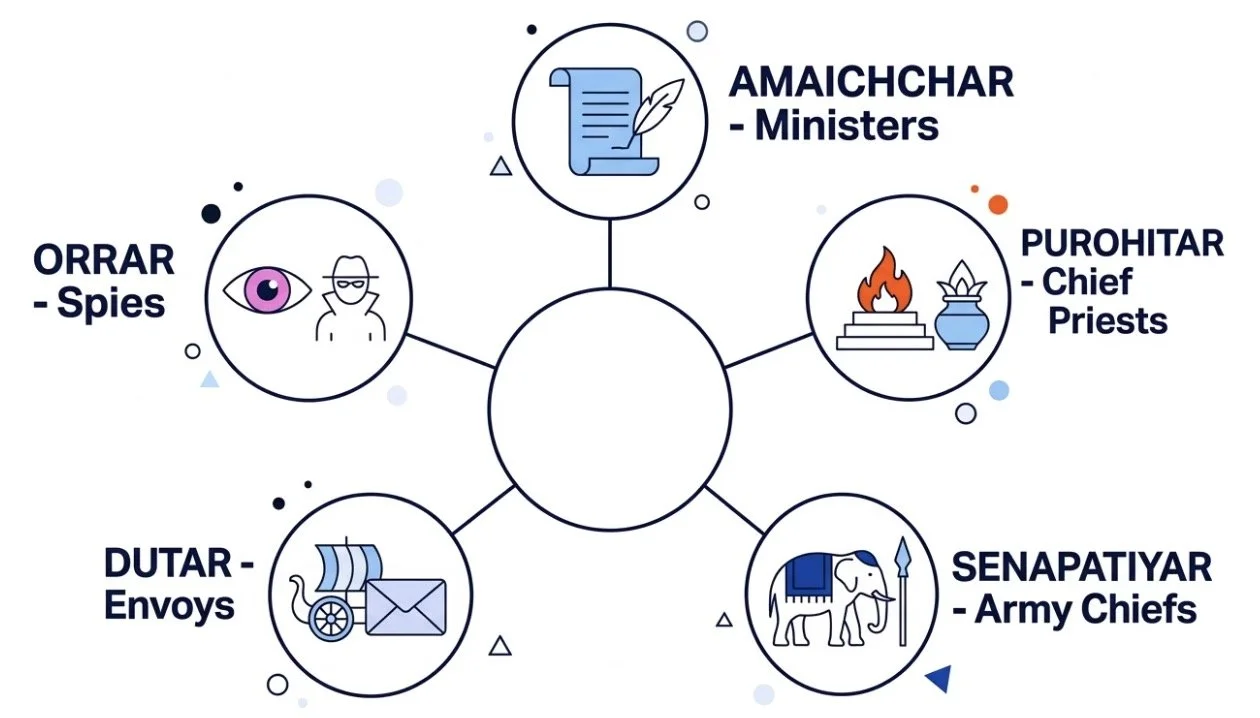
Sangam Age The Five Officials: Roles and Responsibilities
Territorial Organisation
Administrative Divisions and Village Governance
During the Sangam Age, each kingdom was organised into a hierarchy of clearly defined administrative units, from the broadest territorial division down to the individual village. This structure formed the backbone of governance across Tamilakam, enabling the effective administration of a diverse and geographically varied territory.
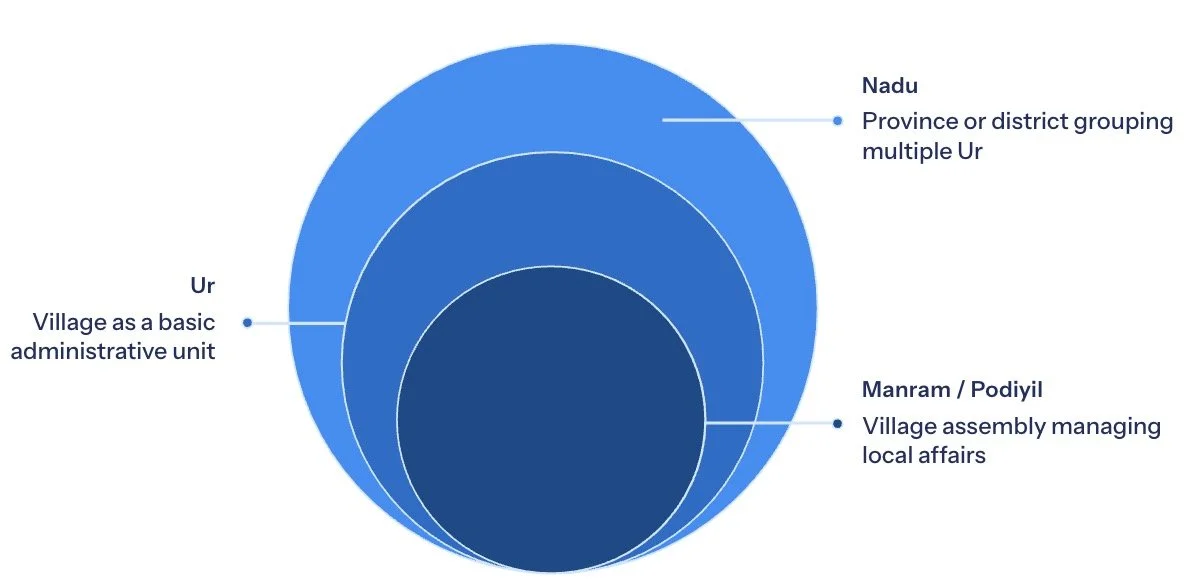
The Sangam Age: Administrative Divisions and Village Governance
Mandalam
The entire kingdom. The major mandalams were the Cholamandalam, Pandyamandalam, and Cheramandalam — geo-political divisions corresponding to the three great dynasties. Nachinarkkiniar also speaks of the Tondai mandalam as a fourth great division of Tamil country.
Nadu (Province)
The major division below the mandalam, equivalent to a province. The administration of nadus was generally carried on by hereditary chiefs, who exercised local authority within the framework of the broader kingdom.
Ur (Village)
The fundamental unit of administration. An ur could be a big village (perur), a small village (sirrur), or an old village (mudur). Pattinam designated a coastal town; Puhar was the harbour area. Key urban centres included Puhar, Uraiyur, Korkai, Madurai, Musiri, Vanji, and Kanchipuram.
Village Administration: The Manram and Podiyil
The village was the fundamental unit of Sangam-age administration, and it managed its own affairs to a considerable degree. Village governance revolved around four key institutions: manram, podiyil, ambalam, and uravai. K. A. Nilakanta Sastri treats the manram as a hall and the podiyil as a common open place. The commentator Nachinarkkiniar describes the manram as the foot of the tree at the centre of the village — a natural gathering place — and equates the podiyil with the ambalam, a small building on a slightly raised platform open to all members of the community.
The term podiyil is derived from podu (common) and il (place), literally meaning "common place." It was a village site, generally outside the settlement and usually under a tree, where people assembled to rest, converse, discuss politics, and constitute the forum for village opinion in politico-judicial matters. The foot of the Margosa tree was a particularly favoured venue, given the tree's well-known medicinal associations. The village institutions of manram and podiyilwere primarily concerned with the arbitration of petty disputes. Village elders exercised ample powers, since there was no hierarchy of officials to whom appeals could be made. These elders were neither selected nor formally elected — they emerged naturally by reason of their age, influence, and wealth, and were rarely challenged by the community.
Fiscal & Legal Systems
Revenue Administration and the Administration of Justice
Sources of Royal Revenue
Land Tax (Irai/Karai) — the chief source; paid in cash or kind. The ma and veli were measures of land; kalamwas the measure of grain.
Water Charges — levied on farmers supplied water from reservoirs or canals for irrigation
Tolls & Customs (Ulgu/Sungam) — collected at sea ports, trunk roads, and kingdom frontiers
Tribute from vassal chiefs and princes
War booty — a major source of income to the royal treasury
Profits from forests, fisheries, and elephants
Revenue Officials and Units
A well-known unit of territory yielding tax was a variyam (vari meaning tax), and the officer in charge of collecting revenue from that territorial unit was called a Variyar. The Pattinappalai explicitly refers to customs officials employed in the seaport of Puhar. Unjust taxation, unusual levies, and forced gifts were disapproved of, and roads and highways were well maintained and guarded day and night to prevent robbery and smuggling.
The Administration of Justice
The king was the repository of all secular power and therefore the ultimate source of justice in the Sangam polity. He dispensed justice with the assistance of ministers and Purohitar. The courtyard of the palace where the king's official court met also served as a court of justice. There was a defined institution for the discharge of justice called arakkalam— the place of justice administration. The king's court (avai) was the highest court of justice, where learned men assisted the king in judicial matters.
The King's Court (Avai)
Highest court of justice; presided over by the king with the assistance of ministers and learned men. Both civil and criminal cases were heard.
Village Court (Manram)
Village-level disputes were settled by elders of the society. Procedure was simple and justice was accessible to the entire population.
Trial by Ordeal
A primitive system of trial by ordeal existed, applied on firm faith in supernatural participation. Though not appealing to modern reasoning, it was an accepted part of the judicial process.
Punishments
Punishments were severe and disciplinary in nature. Exclusion, fines, imprisonment, and even death penalty (even for theft) were practised. The system, though harsh, was effective as a deterrent.
A clear division was maintained between civil and criminal cases. Criminal cases were decided with the aid of witnesses, and the procedure was straightforward. The threat of severe punishment served as a standing warning in a society where voluntary submission to law could not always be assumed. Though this system may appear cruel by modern standards, it was regarded as effective in maintaining social order during a period when the machinery of governance was still developing from tribal into more formal institutions.
Military
Warfare in the Sangam Age
Warfare was a major occupation of the ruling classes of the Sangam period. It permeated the political culture, the poetry, and the social institutions of the age. The art of warfare was fairly advanced, with methods of attack and defence that were well-defined, well-understood, and extensively practised. The army was the mainstay of royal might, and the king was an integral part of the military — spending a substantial portion of state revenue on the maintenance of armed forces.
Composition of the Sangam Army
The army consisted of four traditional arms, maintained out of taxes collected from the peasantry and other sources:
Chariots — drawn by oxen; a prestigious element of the battlefield
Elephants — played an important part in battle; symbols of royal power
Cavalry — horses were imported by sea into the Pandyan kingdom
Infantry — the backbone of the army in most engagements
Wars generally began with the well-known incident of cattle-fighting — both a protest and a justification for broader military engagement. There was no dearth of wars in the Sangam age; the kings maintained armies and the weapons necessary to sustain them.
Military Institutions
Virakkal / Nadukal (Hero Stones)
The practice of erecting stone monuments for fallen soldiers and worshipping them was prevalent. These memorials celebrated the courage of those who died in battle.
Kavalmaram / Kadimaram
Each ruler maintained a great tree in his palace as a symbol of power and sovereignty — a living emblem of royal authority.
"There was no dearth of wars in the Sangam age. The kings maintained armies and weapons necessary for it. The art of warfare was fairly advanced. Methods of attack and defence were many and well-defined, well-understood and well-practised." — From the Sangam historical record
While warfare was constant, it did not preclude the flourishing of peaceful pursuits. As the Sangam literature makes clear, only those specially engaged in military service participated in wars; the broader population continued with agriculture, trade and commerce, art, literature, and other constructive activities. The institution of hero stones demonstrates that martial valour was deeply honoured in Sangam society, and the elaborate rituals surrounding warfare — from the cattle-raid that initiated hostilities to the memorial rites that followed — reveal a highly ritualised and socially embedded understanding of conflict.
The End of the Sangam Age
The political history of ancient Tamilakam, as reconstructed from its extraordinary literary and epigraphic record, presents a civilisation of remarkable sophistication. The three ancient Tamil empires — the Chera, the Chola, and the Pandya — ruled Tamilakam from roughly the third century B.C. to the third century A.D., collectively contributing to the growth of some of the oldest extant literature in the world. Together, they ruled over the Tamil land with a unique cultural identity and a shared language, even as they remained in constant political competition with one another.
3rd Century B.C.
Three kingdoms established; Asokan inscriptions record the Cholas, Pandyas, Satiyaputras, and Keralaputras as kingdoms of the south
1st Century A.D.
Pugalur inscription records Chera rulers; active Indo-Roman trade at Muziris; Karikala Cholan's conquests; Battle of Venni
2nd Century A.D.
Cheran Senguttuvan's Himalayan expedition; introduction of the Pattini cult; composition of Silappathikaram; Neduncheliyan's victories
3rd Century A.D.
Kalabhra invasion disrupts the traditional order; all three kingdoms weakened; beginning of the "dark age" of Tamil history
300–600 A.D.
Almost total lack of historical information about Tamil country; Kalabhras described in later literature as "evil rulers" who overthrew established Tamil kings
The entry of the Kalabhras during the third century A.D. profoundly disrupted the traditional political order by displacing the three ruling kingdoms. From approximately 300 A.D. to 600 A.D., there is an almost total absence of historical information about occurrences in the Tamil land — a period sometimes described as the "dark age" of Tamil history. The Kalabhras are characterised in later literature as "evil rulers" who overthrew the established Tamil kings and consolidated a strong hold over the country. The tradition about their inroads has been interpreted by historians as a profound social crisis, which led to the disappearance of many of the characteristic institutions of the Sangam age.
Key Takeaway: The Sangam Age was not merely a political epoch — it was the foundational period of Tamil civilisation. The administrative systems, literary traditions, and cultural institutions it produced continued to shape South Indian history long after the formal end of the age. The Sangam literature remains, to this day, an irreplaceable primary source for understanding the political, social, and cultural life of the ancient Tamil people.
The fame and enduring legacy of the Sangam Age rest on several foundations: the liberal and sustained patronage of Tamil poetry and scholarship by all three royal dynasties and the local chieftains; the vigorous maritime trade networks connecting Tamilakam with Rome, Sri Lanka, and Southeast Asia; the sophisticated administrative institutions — from the royal court and its five councils to the village manrams — that governed a diverse and dynamic society; and above all, the literature itself, which stands as a monument to the intellectual and artistic achievement of the ancient Tamil people, rightly described as the "Augustan Age" of Tamil letters.
