
Sangam Age: Social Life, Art and Literature
The Sangam Age represents one of the most vibrant and richly documented periods in early South Indian history. Spanning roughly from the third century B.C. to the third century A.D., this era produced an extraordinary corpus of Tamil literature, a sophisticated social order, and a deeply pluralistic religious culture. Through the lens of Sangam poetry, grammar, and epic narratives, we gain an unparalleled window into the lives of ancient Tamil people — their customs, beliefs, art forms, and intellectual pursuits.
Chapter 1
Social Life During the Sangam Age
The Sangam literature offers a remarkably detailed account of the social fabric of ancient Tamilaham. One of its most striking features is the coexistence of tribal arrangements alongside the nascent caste system. The grammarian Tolkappiyar acknowledges four distinct social groups — Andanar (Brahmins), Arasar (warriors/kings), Vaisiyar(merchants), and Velalar (cultivators) — yet tribal identities continued to operate simultaneously, suggesting a society in the midst of gradual social stratification rather than one rigidly bound by caste hierarchy.
The Sangam society was notably not priest-dominated, though Brahmin influence was steadily growing. Tamil Brahmins of the era were a learned and respected community who lived in distinct quarters, performed their ritual duties scrupulously, and served kings as judicial officers, purohits, astrologers, and even ambassadors. They were renowned for their clean surroundings and disciplined domestic lives. Despite being small in number, their contribution to the development of Tamil culture was disproportionately significant.
The Question of Slavery
There is no positive evidence of slavery as a formal institution in Sangam Tamilaham. No references to the sale or purchase of human beings have been found. However, the existence of low-paid servants and labourers whose living conditions were difficult cannot be entirely ruled out.
Education and Learning
Education was a widespread social activity. It encompassed not just reading texts but also listening to learned scholars. Subjects included grammar (as in Tolkappiyam), poetics, mathematics, and astronomy. The fine arts — music, dance, drama, sculpture, architecture — were taught hereditarily. Most learning was oral; students committed vast amounts to memory rather than relying on written records.
The institution of marriage in Sangam society took several forms. At one end were idealistic unions based purely on mutual consent, conducted without parental knowledge or formal ritual — a recognition of individual agency remarkably progressive for the ancient world. At the other end were elaborate ritual marriages, with different prescribed customs for Brahmins, kings, Vaisyas, and Velalar. The Sangam people also held firm beliefs in omens, dreams, ghosts, and spirits, which shaped their everyday behaviour and decision-making.
Chapter 1
The Status of Women in Sangam Society
The position of women in Sangam society was complex and, by modern standards, deeply unequal. Women occupied several distinct social roles: devoted housewives managing the domestic sphere, female ascetics associated with Buddhist and Jain communities (such as the celebrated Kaundi Adigal and Manimekalai), courtesans who sometimes served as bodyguards, and the learned women poets who contributed to Sangam literature itself. Yet despite this diversity, women were generally excluded from public life — they could not serve as soldiers, ministers, ambassadors, or royal advisers, and they did not own property in their own right.
The practice of Sati — a widow immolating herself on her husband's funeral pyre — is documented in Sangam texts, though it appears that the number of women who actually underwent this practice was relatively small. Women who did not commit Sati faced an extremely harsh existence as widows, living lives of penance and social degradation. This dual burden — either death or a diminished life — reflects the patriarchal structures that constrained women's choices even within a culturally vibrant society.
Housewives and Mothers
The largest group, dedicated to the domestic sphere — caring for husbands, children, and households. Faced the grim choice between Sati or widowhood upon a husband's death.
Female Ascetics
Buddhist and Jain women renunciates who found spiritual freedom outside the domestic order. Figures like Manimekalai represent this path in the literary tradition.
Courtesans
A recognised social group who sometimes served in martial roles as bodyguards, suggesting a degree of physical agency not available to other women.
Women Poets
Approximately 50 women poets are identified among the 473 named contributors to Sangam literature — a remarkable, if proportionally small, representation of female intellectual life.
Despite these constraints, the very presence of women poets in the Sangam corpus — contributing to collections like the Ettutogai — suggests that intellectual and creative participation by women was at least partially tolerated within the cultural elite. The tension between social restriction and creative contribution marks one of the most thought-provoking aspects of Sangam gender relations.
Chapter 2
The Sangam: Tradition, Chronology, and the Three Academies
The word Sangam literally means "confluence." In the context of early South Indian history, it refers to an assembly or academy of learned poets, held under the patronage of the Pandyan kings — great lovers of literature and the fine arts. These were not official state institutions but voluntary organisations of poets, functioning somewhat like a Round Table Conference that admitted only those of authentic poetic merit. The Sangam tradition produced literary works of extraordinary quality and lasting historical significance.
The question of chronology has been a source of considerable scholarly debate. K.A.N. Sastri places the Sangam age between A.D. 100–250 on the basis of literary composition. M. Arokiaswami, however, argues that since Tolkappiyar flourished in the 4th or 3rd century B.C., the Tolkappiyam should be assigned to that period. A critical anchor for Sangam chronology is the synchronism between Gajabhagu II of Sri Lanka and Cheran Senguttuvan of the Chera dynasty, confirmed by both Silappathigaram and the Sri Lankan chronicles Dipavamsa and Mahavamsa. The discovery of Roman coins from first-century A.D. emperors across Tamil Nadu further anchors the period. Most scholars now place the Sangam literature between the 3rd century B.C. and the 3rd century A.D.
First Sangam
Held at Then Madurai. Attended by gods and legendary sages. Founded by Sage Agastyar. No literary works survive.
Second Sangam
Held at Kapadapuram. All literary works perished except the Tolkappiyam, which remains the oldest extant Tamil literary work.
Third Sangam
Held at Madurai, founded by Mudathirumaran. Produced voluminous literature; several works survive. Coincides with Indo-Roman trade contacts.
According to Tamil legends, the three Sangams collectively flourished for 9,990 years, were attended by 8,598 scholars, and were patronised by 197 Pandyan kings — figures that belong to the realm of tradition rather than verified history. Nevertheless, the tradition firmly establishes the deep royal patronage of Tamil literary culture and the high prestige accorded to poets and scholars in Pandyan society. In the Third Sangam's later phase, admission was reportedly determined by a miraculous contrivance of Lord Siva, who served as its permanent president — a detail that illuminates the sacred status accorded to this literary institution.
Chapter 3
The Corpus of Sangam Literature
The Sangam literary corpus is one of the most extensive and sophisticated bodies of ancient literature in the world. It includes the Tolkappiyam, the Ettutogai (Eight Anthologies), the Pattuppattu (Ten Idylls), the Pathinenkilkanakku(Eighteen Minor Works), and the five great epics. Together, the collections available to us run to more than 30,000 lines, comprising 2,279 poems of varying lengths — from as few as 3 lines to as many as 800 — composed by 473 named poets, including approximately 50 women, with a further 102 poems attributed to anonymous authors.
The Tolkappiyam, authored by Tolkappiyar and likely composed during the Second Sangam, is the foundational text of Tamil grammar. Far from being a dry linguistic treatise, it also provides invaluable information on the political and socio-economic conditions of the Sangam period. It is in every sense the cornerstone of Tamil literary tradition. All other Sangam poetry is understood to have been produced during the Third Sangam period.
Ettutogai — Eight Anthologies
Aingurunooru
Narrinai
Aganaooru
Purananooru
Kuruntogai
Kalittogai
Paripadal
Padirruppattu
Divided into Aham (love poetry) and Puram (heroic/public poetry). Poems run from 3 to 31 lines.
Pattuppattu — Ten Idylls
Thirumurugarruppadai (devotion to Lord Muruga)
Porunararruppadai (praises Karikala, the Chola king)
Sirupanarruppadai (the generosity of Nalliyakkodan)
Perumpanarruppadai (Kanchipuram and Tondaiman Ilantiraiyan)
Nedunalvadai (the Pandyan king Nedunjeliyan)
Maduraikkanji (also on Nedunjeliyan)
Kurinjippattu (hilly regions and hill life)
Pattinappalai (praises Karikala)
Malaipadukadam (Chieftain Nannan; martial music)
Mullaippattu
Descriptive poems; shortest runs to 103 lines, longest to 782 lines.
The Pathinenkilkanakku (Eighteen Minor Works) is chiefly didactic literature dealing with ethics and morals. Its crown jewel is the Tirukkural, authored by the sage-poet Thiruvalluvar — a work of such universal wisdom that it continues to be revered and translated worldwide. Both the Ettutogai and Pattuppattu are divided thematically into Aham (interior, love) and Puram (exterior, heroic) traditions, reflecting a sophisticated literary taxonomy unique to the Tamil tradition.
Chapter 3
The Five Great Epics and the Twin Narratives
The crowning achievement of the Sangam and post-Sangam literary tradition is the group known as the Aimberikapiyangal — the Five Great Epics. These are Silappadikaram, Manimekalai, Jivakachintamani, Valayapathi, and Kundalakesi. Of these, Valayapathi and Kundalakesi are no longer extant. The three surviving epics — with Silappadikaram and Manimekalai forming the celebrated "twin epics" — are among the most magnificent literary monuments of ancient India.
Silappadikaram
Authored by Ilango Adigal, believed to be the brother of the Chera king Senguttuvan. It narrates the story of Kovalan, the merchant prince of Puhar, his chaste wife Kannagi, and the tragic injustice that leads to Kannagi's divine vengeance. Considered a Jain work by many scholars. Provides rich detail on Sangam society, religion, and the city of Madurai.
Manimekalai
Written by Sittalai Sattanar, it continues the story of Silappadikaram through the character of Manimekalai, daughter of Kovalan and the dancer Madhavi. The work was composed expressly to propagate Buddhist doctrine among the Tamils. It provides valuable information on Sangam polity, society, and the city of Puhar (Kaveripattinam).
Jivakachintamani
A Jain epic of considerable literary merit, assigned to a later date than the twin epics. Along with the others, it represents the philosophical diversity of the post-Sangam literary world, where Buddhist, Jain, and Brahmanical traditions competed and coexisted in creative tension.
Together, Silappadikaram and Manimekalai narrate the continuous story of a single family across two generations: Kovalan the merchant prince, Kannagi his faithful wife, Madhavi the celebrated dancer with whom Kovalan takes up residence, and Manimekalai, the daughter born of that union. This intergenerational arc — moving from tragedy and divine justice in Silappadikaram to spiritual quest and Buddhist enlightenment in Manimekalai — gives the twin epics a remarkable narrative coherence and moral depth. They stand as monuments not only to Tamil literary genius but also to the pluralistic religious world of the Sangam age.
"Modern scholarship uses the term 'Sangam Literature' for only those works in verse... which are comprised in the Ettutogai, Pattupattu, and Patinenkilkanakku, judged to have been produced during the period A.D. 150–250."
Chapter 4
Religious Life in the Sangam Age
The religious landscape of the Sangam age was strikingly plural and layered. Far from following a single uniform faith, the Sangam Tamils wove together three broad strands of religious practice: indigenous regional deities, the exotic Hindu gods imported through Brahmanical contact, and the non-Hindu religious faiths — primarily Buddhism and Jainism. All three coexisted throughout the Sangam period, and no serious open conflict between them is recorded.
The Tolkappiyam provides the foundational framework for understanding Sangam religion through its celebrated Tinai system — the association of specific deities with specific ecological zones and their corresponding occupations. This system reveals how deeply religion was embedded in the everyday life and landscape of the Tamil people.
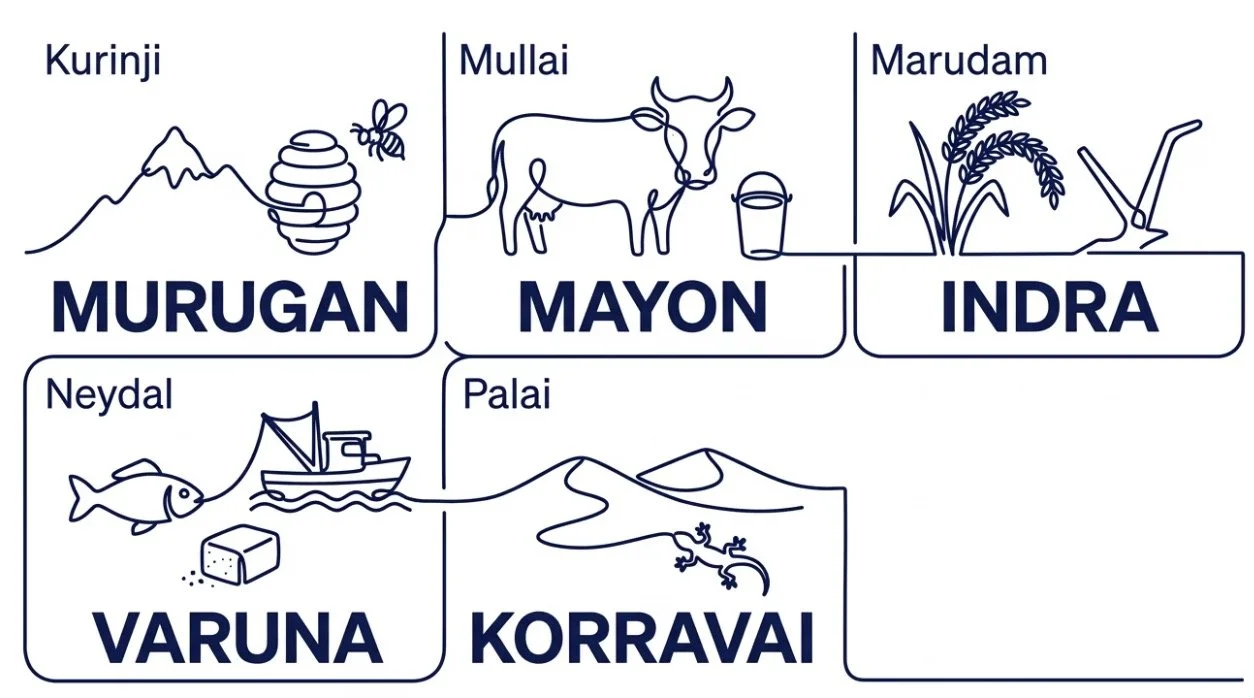
Religious Life in the Sangam Age
Beyond the Tinai system, the Sangam people also revered a wide pantheon of additional deities. Lakshmi, the goddess of prosperity; Baladeva; Kaman, the god of love; the moon-god; and sea-god were all worshipped. Importantly, the Sangam literature does not mention Rama as a deity, and Ganesa is also absent from its pages — suggesting that these later-dominant figures of the Hindu pantheon had not yet entered the Tamil religious consciousness. Sivan (Shiva) and Tirumal (Vishnu) are referenced, but often through attributes rather than by name, indicating that the sectarian identities of Saivism and Vaishnavism were still taking shape during this period.
Chapter 4
Religious Practices: Animism, Temples, and the Advent of Buddhism and Jainism
The religious practices of the Sangam age were rich and diverse, ranging from sophisticated temple worship to deeply rooted animistic beliefs. Animism — the worship of spirits believed to reside in trees, streams, hill-tops, and other natural features — was woven into the fabric of daily life. The Sangam people believed in ghosts and spirits (bhutas), in demons dwelling on battlefields and burning grounds, and in village gods and totemic symbols. Bloody sacrifices were offered to appease fierce deities. The dead — heroes, satis, and other martyrs — were deified, and their memory was honoured through hero-stones and local cult worship.
The burial rituals of the Sangam Tamils reflect beliefs in ritual purity and impurity surrounding birth and death. The dead were disposed of through cremation, burial, or exposure — indicating the simultaneous existence of multiple funerary traditions within the same society. Burning grounds, mentioned in Manimekalai, were believed to be inhabited by spirits of various kinds.
Temple Worship
Temples (called Nagar) dedicated to Siva, Muruga, Baladeva, Vishnu, Kaman, and the moon-god are mentioned in Sangam texts. The method of worship involved dancing, and offering flowers, rice, and meat. Silappadikaram mentions stone images of gods, corroborated by the archaeological discovery of a lingam dating to the centuries B.C. In many cases, deities were set up under sacred trees — a practice that continues in Tamil Nadu to this day.
Buddhism and Jainism
Buddhism and Jainism entered the Tamil region in the first centuries of the Christian era. Tamil-Brahmi inscriptions record the excavation of caves for Jaina monks by kings and chieftains. 2nd-century C.E. inscriptions at Pugalur mention a rock shelter built for a Jaina monk. Pandya king Nedunjeliyan's subordinates made gifts to Jaina monks. The cult of the goddess Pattini (Kannagi deified as the chaste wife) was promoted by the Chera king Senguttuvan — a fascinating intersection of epic narrative and religious cult formation.
The sophisticated interplay between Brahmanical, Buddhist, and Jain influences produced a remarkable religious eclecticism in Sangam Tamil society. Silappadikaram is considered by many scholars to reflect Jain values, while Manimekalai is explicitly Buddhist in doctrine. Yet the great Sangam poets Kapilar and Nakkirar were devoted worshippers of Siva, without any sense of religious antagonism towards other traditions. The Sangam age thus stands as a luminous example of pluralism — not merely as tolerance but as active, creative coexistence.
Chapter 5
Fine Arts in the Sangam Age
The Sangam age was a period of remarkable artistic flourishing. Poetry, music, and dance were not merely entertainment but central to the social and spiritual life of the Tamil people, and they commanded the patronage and respect of kings, chieftains, and nobles alike. The arts were both hereditary professions — passed down through families of specialist artists — and widely appreciated by the broader population.
Music and Dance were highly developed arts. Dancing was performed by Kanigaiyar (courtesans and specialist performers), and Koothu — a form of traditional performance art — was the most popular entertainment of the people. Women enjoyed religious dances, games of dice, the cloth ball game (varippanthu), and swinging on palmyra-fibre swings. Children played with decorated dolls, toy-carts, and sand houses on the seashore — vivid details preserved in Narrinai and Kuruntogai.
Music
Silappadikaram gives minute details about musical traditions. Various instruments — drums, flute, and yal (a kind of harp) — were sold in shops at Puhar and Madurai. Musical forms were integrally linked to the Tinai (ecological zone) system, each zone having its own musical mode.
Dance and Drama
Silappadikaram mentions eleven kinds of dances, divided into seven groups. Drama was mostly religious in character, though performances also commemorated great events and persons. The performing arts occupied a central place in both royal courts and public festivals.
Poetry
With over 30,000 lines of verse surviving, poetry was the supreme art form of the Sangam age. Liberal donations to poets by kings and nobles reflected its central cultural importance. The short ode and the long poem represented two distinct literary modes, each with its own aesthetic tradition.
Architecture and Sculpture
The fine arts of building, architecture, and sculpture were practised by hereditary specialists. Stone images of gods are mentioned in Silappadikaram and corroborated by archaeological discoveries. The construction of temples (Nagar) represented the highest expression of the visual arts.
Chapter 5
The Bardic Tradition: Porunar, Panar, and Viraliyar
One of the most distinctive and socially important institutions of the Sangam age was the tradition of the wandering bard — the Porunar, Panar, and Viraliyar. These were professional performers who travelled from court to court and village to village, carrying their musical instruments and their repertoire of songs celebrating the glory of kings, heroes, and great events. Bardism was not a marginal cultural phenomenon; it was deeply embedded in the social fabric and commanded genuine respect, even from royalty.
The Porunar was the most socially elevated of the bards, originally performing the crucial martial function of rousing the fighting spirit of soldiers on the battlefield and celebrating their victory when battle was won. Over time, the role of the Porunar expanded beyond the battlefield to include carrying messages back to the community at home, serving as a living link between the warrior class and the civilian population. Kings honoured the Porunar with generous gifts and public recognition.
Porunar
Elite court bards who performed for kings and warriors. Originally roused martial spirit on the battlefield; later served as messengers and royal panegyrists. Accorded the highest social honour among performers.
Panar
Bards who performed for the common people, bringing music and storytelling to the broader population. Served the vital social function of disseminating cultural memory and shared values beyond the royal court.
Viraliyar
Female performers who accompanied the bards, expert in folk songs and folk dances. Their presence in the royal court and in public performance underscores the importance of the performing arts as a gendered yet inclusive cultural institution.
The bardic tradition of the Sangam age represents something remarkable: a society in which the artist was also the journalist, the historian, the morale officer, and the cultural ambassador, all in one. The fact that bards "had high respect in society and were even honoured by kings" tells us a great deal about the values of Sangam civilisation — a world where eloquence, memory, and the power of song were considered worthy of the highest social esteem. This tradition would continue to shape South Indian cultural life for centuries after the formal close of the Sangam age.
The Enduring Cultural Legacy of the Sangam Age
The Sangam age stands as one of the most extraordinary chapters in the history of human civilisation. In a period stretching roughly six centuries — from the third century B.C. to the third century A.D. — the Tamil people of ancient Tamilaham created a social order of considerable complexity, a literary tradition of breathtaking richness, a religious landscape of genuine pluralism, and an artistic culture of remarkable sophistication. The roughly 30,000 lines of surviving Sangam poetry represent not merely literary monuments but living historical documents that illuminate the texture of everyday life in ways that official records rarely can.
The social world of the Sangam age was one of paradoxes: a society that celebrated heroic values yet produced deeply tender love poetry; that was slowly stratifying by caste yet retained strong tribal identities; that confined women to domestic roles yet produced 50 named women poets; that honoured Brahmanical learning yet was never priest-dominated. These tensions and coexistences make the Sangam world endlessly fascinating to students and scholars alike.
Literary Heritage
Over 30,000 lines of poetry; 2,279 poems; 473 named poets including ~50 women. The Tolkappiyam remains the oldest extant Tamil grammatical work. The twin epics Silappadikaram and Manimekalai are masterpieces of world literature.
Religious Pluralism
Brahmanical, Buddhist, Jain, and indigenous traditions coexisted without serious conflict. The Tinai system embedded religion in ecology and daily life. Temple worship, animism, and hero cults all flourished simultaneously.
Cultural Achievement
Music, dance, drama, architecture, and sculpture all reached high levels of development. The bardic tradition gave artists a social role of the highest importance. Royal patronage ensured the survival and flourishing of the arts.
Historical Significance
Sangam literature remains the primary source for early South Indian history. Its evidence — literary, archaeological, and numismatic — anchors our understanding of ancient Tamil society, trade, and political organisation in the wider ancient world.
The Sangam age offers an indispensable corrective to any narrative that sees Indian civilisation as monolithic or purely North-centric. It demonstrates, with the full weight of 30,000 lines of poetry behind it, that ancient India was a continent of multiple, parallel civilisations — each with its own genius, its own social forms, and its own contribution to the long story of human culture. The study of the Sangam age is therefore not merely an exercise in regional history; it is an encounter with one of humanity's greatest literary and cultural achievements.
Key Dates to Remember: Sangam Age — approximately 3rd century B.C. to 3rd century A.D. | Tolkappiyam — oldest extant Tamil work, likely 3rd–4th century B.C. | Third Sangam — coincides with Indo-Roman trade, first two centuries C.E. | Buddhism and Jainism entered Tamil region — first centuries C.E.
