
Gupta Empire: Polity and Administration
Polity and Administration of the Gupta Empire
The Gupta Empire (c. 4th–6th century CE) stands as one of the most sophisticated political formations in ancient Indian history. Characterised by a hierarchical monarchical state system, the Guptas constructed an elaborate administrative machinery that extended from the imperial court to the village level. This document provides a comprehensive examination of Gupta governance — spanning central and provincial administration, district-level management, revenue systems, and the remarkable military expansion achieved under Samudragupta.
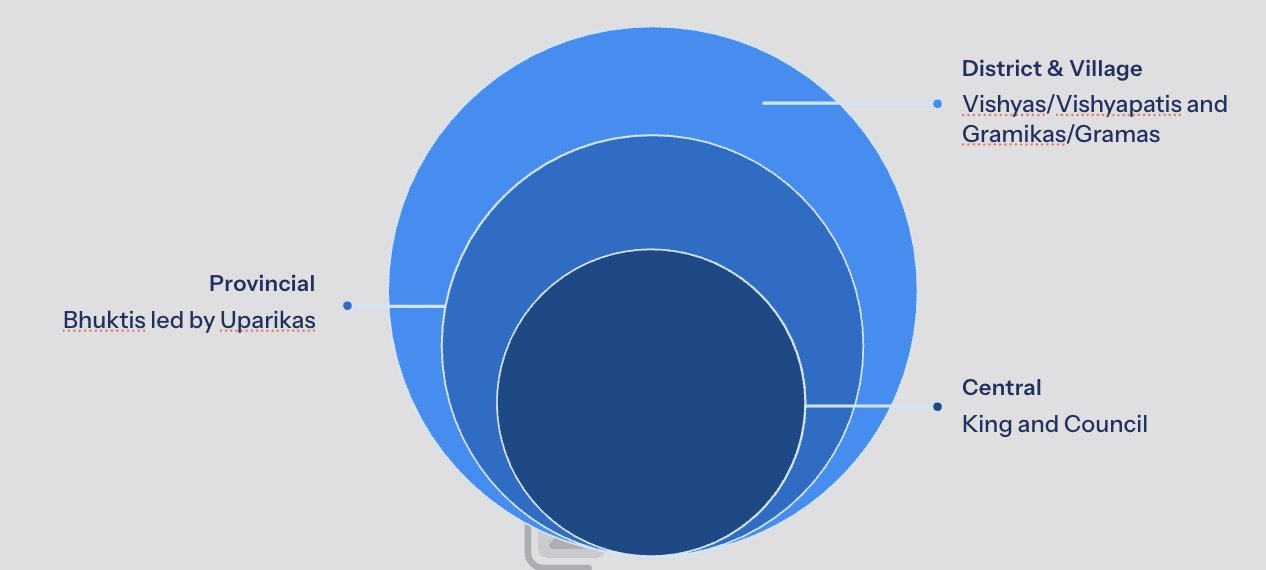
Polity and Administration
At its core, the Gupta polity was not merely a centralised monarchy but a layered network of political relationships — combining direct rule, feudatory obligations, and tributary arrangements — that projected imperial authority across a vast subcontinent.
Central Administration
The Gupta state was fundamentally monarchical, with the king serving as the supreme embodiment of executive, legislative, and judicial authority. Gupta monarchs assumed grandiose imperial titles such as maharajadhiraja (great king of kings), parama-bhattaraka (supreme lord), and parameshvara (supreme ruler). These titles were not merely ceremonial — they communicated the king's dominion over subordinate rulers and vassal chiefs throughout the empire.
The divine character of Gupta kingship is made explicit in the famous Allahabad Prashasti, which describes Samudragupta as "a god dwelling on the earth." This claim to divine status reinforced the political authority of the crown, lending sacral legitimacy to an otherwise human institution. The king was assisted by a council of ministers, whose members bore various designations — mantrin, amatya, and sachiva — and were most probably hereditary in their positions, suggesting that power was concentrated within certain elite lineages.
Sandhivigrahika
Minister for peace and war. Responsible for conducting relations with other states, initiating military campaigns, and concluding alliances and treaties.
Kumaramatya
Pre-eminent among the amatyas, equivalent in status to princes of royal blood. Variously attached to the king, crown prince, revenue department, or a province.
Dandanayaka
High-ranking judicial and military officer, responsible for enforcement of law and military discipline within the empire.
Baladhikrita & Mahashvapati
Commander-in-chief of the army and Commander of cavalry respectively — the empire's foremost military functionaries.
Mahapratihara
Chief of the palace guards, responsible for the personal security of the monarch and the integrity of the royal household.
Khadyatapakita
Superintendent of the royal kitchen — an office reflecting the elaborate ceremonial and domestic administration of the Gupta court.
This elaborate roster of court officials reveals a highly differentiated bureaucratic culture. The hereditary character of many of these offices meant that powerful families could entrench themselves within the administrative structure, a feature that would prove consequential for the empire's long-term cohesion and eventual fragmentation.
Provincial and District Administration
The Gupta Empire was divided into provinces known as deshas or bhuktis. Each bhukti was placed under a governor called an Uparika, who was appointed directly by the king and bore honorific titles such as maharaja, bhattaraka, and rajaputra. The Uparikas carried out general administration, exercised military functions, and crucially, appointed the heads of district administration and district town boards — making them pivotal intermediaries between the central court and local governance.
The importance of the provincial government extended beyond mere revenue collection and law enforcement. A notable example is the repair of the Sudarshana Lake in Saurashtra following the bursting of its embankments — an act of infrastructure maintenance that underscores the province's role in managing public works. Skandagupta's Junagarh inscription refers to Parnadatta as the Goptri of Saurashtra, a term that may represent an alternative designation for the governor.
District Administration (Vishya)
Provinces were sub-divided into districts called vishyas, administered by a Vishyapati appointed by the provincial governor. The Vishyapati was assisted by a board of prominent local figures:
Nagara-sreshthin — Chief merchant or banker
Sarthavaha — Chief caravan trader
Prathama-kulika — Chief artisan
Prathama-Kayastha — Chief scribe or revenue officer
Below District: Vithis and Gramas
Below the vishya level were vithis — clusters of settlements administered by ayuktakas and vithi-mahattaras. At the most local level were individual villages (gramas):
Gramika / Gramadhyaksha — Village administrator
Mahattara — Village elder or head of family/community
Ashtakula-adhikarana — Board of eight members, headed by Mahattaras
Pancha-mandali — Possible corporate village body for collective decision-making
What emerges from this structure is a sophisticated and tiered system of governance in which local elites — merchants, artisans, scribes, and elders — were formally integrated into the administrative apparatus. The participation of trade and craft guild representatives at the district level is particularly notable, suggesting that economic communities had a recognised role in governance, not merely as subjects of taxation but as co-administrators of local affairs.
Revenue Administration
Land revenue constituted the most important source of income for the Gupta state. The Narada Smriti stipulates that one-sixth of agricultural produce should be taken as land revenue — a share termed bhaga. This conventional figure is indirectly corroborated by the Paharpur and Baigram copper plates, which state that one-sixth of the merit accruing from a royal donation would revert to the king. However, the Manu Smriti suggests flexibility, indicating that the king could take one-sixth, one-eighth, or even one-twelfth of the crop yield depending on circumstances — implying that the actual rate may have varied considerably in practice.
"Just as cows have to be tended at certain times and milked at others, and just as a florist takes care of his plants and sprinkles water on them besides cutting them — similarly the king should help his subjects with money and provisions at certain times and tax them at others."
— Kamandaka's Nitisara
Kamandaka's agricultural metaphor captures the Gupta ideal of benevolent and measured taxation. Yet the same text warns sternly that royal officials who enrich themselves through corrupt means should be dealt with like a surgeon lancing a swollen abscess — suggesting that the ideal was not always the reality.
The Tax Taxonomy of the Gupta State
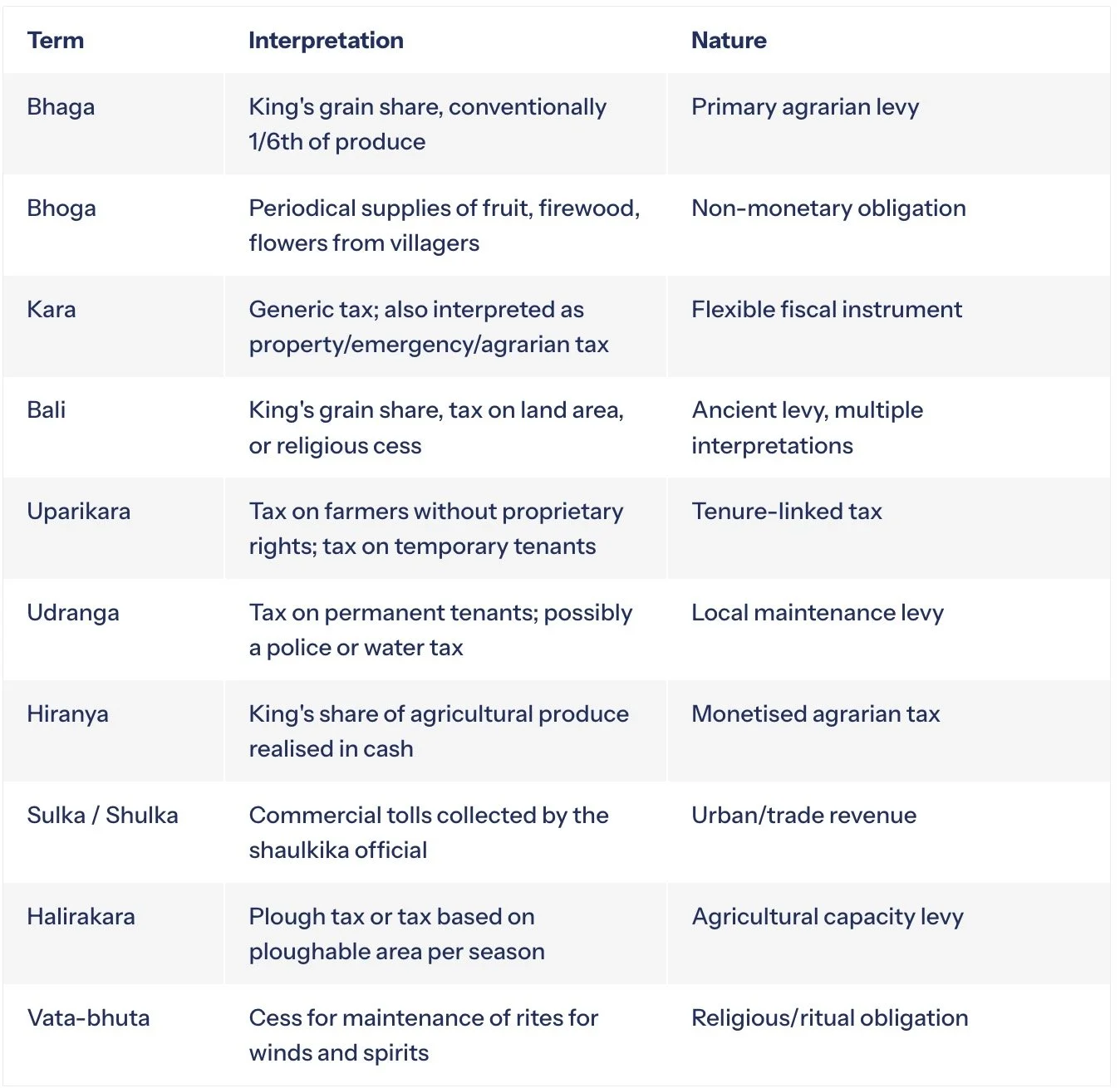
The Tax Taxonomy of the Gupta State
Beyond agrarian levies, the state also derived income from royal monopolies on treasure trove, mineral deposits, mines, and salt reserves. Villagers were obliged to supply royal officers on tour with grass for animals, hides for seats, and charcoal for cooking — a system of non-monetary service obligations. Villages converted into agraharas (Brahmin land grants) were exempted from such duties, revealing how land grants functioned partly as instruments of fiscal relief for privileged recipients.
Revenue Department Officials
Akshapataladhikrita
Keeper of royal records. Gupta inscriptions reference Gopasvamin, the akshapataladhikrita of Samudragupta, as having ordered a copper plate inscription — illustrating the close connection between the revenue department and royal documentation.
Pustapalas
Record-keepers who maintained detailed accounts of land transfers. Their existence points to a sophisticated system of land registry, essential for tracking taxable holdings and resolving ownership disputes.
Shaulkika
Collector of shulka or commercial tolls. The Bihar stone pillar inscription of Skandagupta specifically references this official, confirming a dedicated bureaucracy for urban and trade-related revenue collection.
The revenue system of the Guptas was therefore multi-layered, combining grain-based agrarian levies, cash equivalents, commercial tolls, service obligations, and royal monopolies. The ambitious military campaigns of Samudragupta and subsequent rulers must have been substantially financed through the surpluses generated by this elaborate fiscal apparatus.
Expansion Under Samudragupta
The most authoritative source for Samudragupta's military achievements is the Allahabad Prashasti — an inscription of 33 lines carved on a unique Ashokan pillar and composed by his court poet, Harisena. Written in a combination of prose and verse, the prashasti eulogises the conquests, personality, and statecraft of Samudragupta, portraying him as a restless and brilliant conqueror. Through a careful reading of this inscription, historians have reconstructed the territorial expansion of the Gupta Empire under his reign.
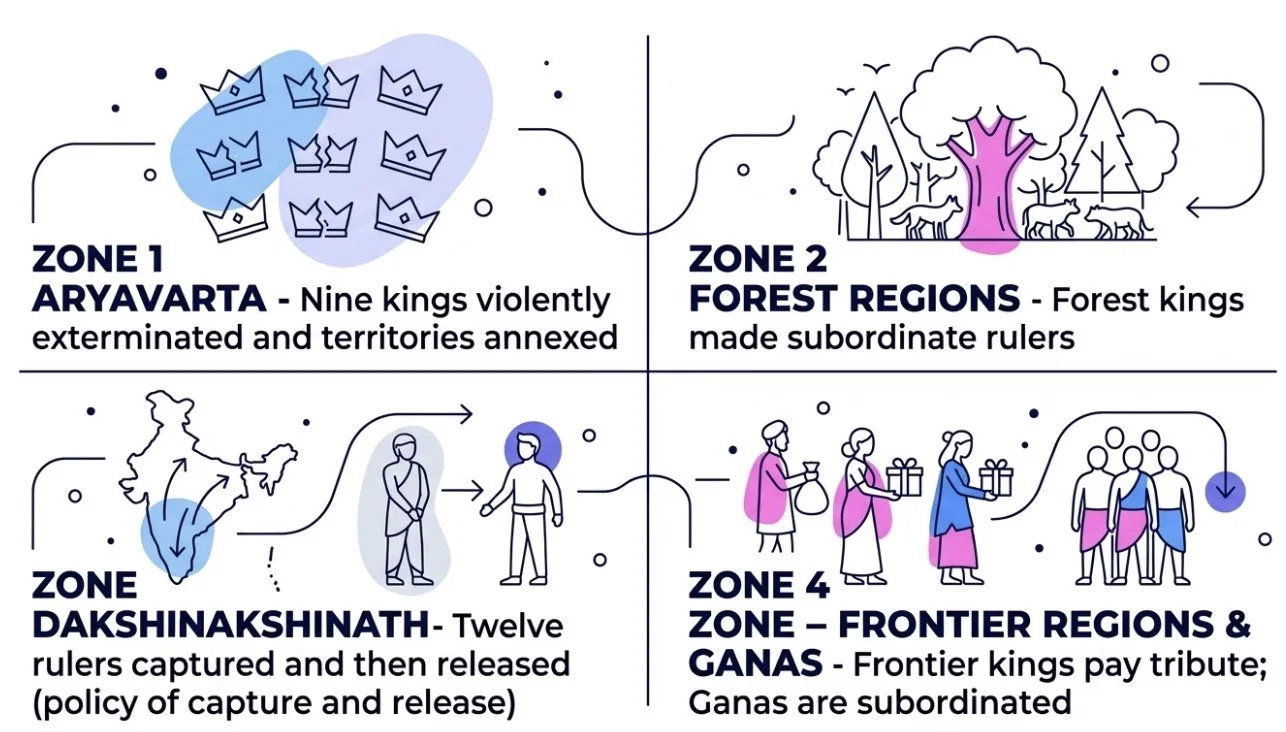
Samudragupta
The Allahabad Prashasti reveals a nuanced and zone-specific military strategy. In the Aryavarta heartland (the Ganga-Yamuna valley), Samudragupta pursued a policy of outright conquest and annexation, violently exterminating nine kings and extending direct Gupta control westward to Mathura and Padmavati. In the forested interior regions, local chieftains were subjugated and made subordinates without formal annexation. In Dakshinapath (the Deccan and South), a striking policy of capture and release was employed — humbling southern rulers without reducing them to feudatory status or incorporating their territories.
Political Relationships and the Nature of Gupta Paramountcy
Line 23 of the Allahabad Prashasti describes certain rulers as voluntarily rendering service to Samudragupta, seeking the use of the prestigious Gupta garuda seal, and entering into matrimonial alliances with the Guptas of their own accord. This voluntary subordination, combined with the tribute-paying arrangements of frontier kings and the semi-autonomous status of the republican ganas (sanghas), reveals the complexity of Gupta imperial authority.
Direct Rule
Aryavarta kingdoms — fully annexed, kings eliminated, territories absorbed into the Gupta core domain.
Feudatory Status
Forest kings and frontier rulers — subordinated, tribute-paying, maintaining local governance under Gupta suzerainty.
Humbled Autonomy
Dakshinapath kingdoms — captured and released, maintaining full autonomy while acknowledging Gupta military supremacy.
Voluntary Alliance
Distant rulers — seeking the Garuda seal, matrimonial ties with the Guptas, projecting loyalty through diplomatic deference.
At the end of Samudragupta's reign, the Gupta Empire comprised much of northern India — with the notable exceptions of Kashmir, western Punjab, Rajasthan, Sindh, and Gujarat. In the north-west, Samudragupta claimed to have impressed his might upon the Shakas and Kushanas. The conclusion that historians draw from all this evidence is significant: the Guptas did not create a monolithic all-India empire under direct central control. Rather, through successive military campaigns, diplomatic manoeuvres, and matrimonial alliances, they established a sophisticated network of paramountcy and subordination that extended Gupta prestige and influence across a vast portion of the Indian subcontinent — a form of imperial authority that was as much political theatre as administrative reality.
