
The Sunga & Kanva Dynasties
After the mighty Mauryan Empire began to fragment following the death of Ashoka, two successor dynasties — the Sungas and the Kanvas — stepped into the power vacuum and shaped the destiny of the Gangetic heartland. This document traces the rise, reign, cultural contributions, and eventual decline of these two crucial post-Mauryan dynasties, helping students understand a pivotal transitional era in ancient Indian history.
Mauryan Decline
Provinces declare independence; northwest India lost to foreign invasions
Sunga Rise (187 BCE)
Pushyamitra Sunga overthrows the last Mauryan king and founds a new dynasty
Sunga Rule (187–73 BCE)
Defence against Greeks, revival of Brahmanism, patronage of art and culture
Kanva Dynasty (75–30 BCE)
Vasudeva Kanva replaces Sungas; short-lived Brahmin rule in Magadha
The Fall of the Mauryas & the Power Vacuum
The Mauryan Empire, one of the largest and most sophisticated political entities in the ancient world, began to unravel rapidly after the death of Emperor Ashoka. His successors lacked both the administrative ability and the political will to hold together an empire that stretched from the Hindu Kush to the Deccan. One by one, the provinces began asserting their independence, and the once-unified subcontinent fractured into a mosaic of regional powers.
The northwest was particularly vulnerable. A series of powerful foreign invasions — most notably by the Bactrian Greeks, who had established a flourishing Indo-Greek kingdom — chipped away at Mauryan authority in that region. Meanwhile, in the east, Kalinga declared its independence, and in the south, the Satavahanas established a formidable independent rule that would endure for centuries. These developments left the Mauryas clinging to control only over the Gangetic valley, the heartland from which their empire had originally sprung.
Regions Lost by the Mauryas
Northwest India — seized by Bactrian Greeks
Kalinga — declared independence
Deccan & South — Satavahanas emerge
Punjab — gradually slipped away
What Remained
By the final decades of Mauryan rule, the empire had been reduced largely to the Gangetic valley — the very core from which it had grown. Even this rump state was unstable, and it was only a matter of time before an internal coup would replace the dynasty entirely.
The stage was set for a new power to emerge — one that would both defend the Gangetic heartland and reimagine its cultural and religious landscape.
Pushyamitra Sunga: Founder of the Sunga Dynasty
Reign: 187–151 BCE
The Sunga dynasty was founded by Pushyamitra Sunga, who served as the commander-in-chief (Senapati) of the Mauryan army. According to the Harshacharita, written by the 7th-century CE scholar Banabhatta, Pushyamitra killed the last Mauryan king Brihadratha while the king was reviewing his troops. This coup d'état in 187 BCE decisively ended Mauryan rule and placed Pushyamitra on the throne of Pataliputra, which remained the capital of the new dynasty.
The origin of the Sunga family has been a subject of scholarly discussion. The Puranas describe Pushyamitra as belonging to the Shunga family, and the name "Sunga" itself is derived from the Sanskrit word for the fig tree — a naming tradition shared with other Indian dynasties such as the Kadambas (named after a tree) and the Pallavas (meaning branch and twig). Panini links the Shungas to the Brahmin Bharadvaja gotra, and Kalidasa's play Malavikagnimitra mentions the Baimbika kula and Kashyapa gotra. All sources broadly agree that the Shungas were Brahmins.
Capital
Pataliputra (primary); later court also held at Besnagar (modern Vidisha)
Gotra & Lineage
Bharadvaja gotra (Brahmin lineage); Baimbika kula per Kalidasa's Malavikagnimitra
Dynasty Name
"Sunga" = fig tree in Sanskrit; follows the Indian tradition of naming dynasties after trees
Rise to Power
Killed Brihadratha while reviewing troops — a coup that ended 137 years of Mauryan rule
Military Campaigns & the Extent of the Sunga Empire
The most pressing challenge that confronted Pushyamitra Sunga upon assuming power was the defence of north India against the Bactrian Greeks — known in Indian texts as the Yavanas. These Greeks, who had established powerful kingdoms in Bactria (modern Afghanistan), pushed eastward with considerable force. According to ancient accounts, the Greeks advanced all the way to Pataliputra and occupied it for a period. However, Pushyamitra ultimately succeeded in regaining the lost territory, a military achievement that established his legitimacy as a protector of the Gangetic heartland.
The grammarian Patanjali, writing in the 2nd century BCE, refers to the Yavanas advancing up to Saketa (near Ayodhya) and Madhyamika (near Chittor in Rajasthan). Kalidasa's Malavikagnimitra narrates a dramatic episode in which Vasumitra — son of Agnimitra and grandson of Pushyamitra — encountered a Yavana army on the banks of the Sindhu River while guarding the horse released for the ashvamedha sacrifice. The Yavanas were defeated and the horse brought safely home, cementing Sunga prestige.
Pushyamitra also fought a campaign against Kharavela of Kalinga, who had invaded north India. His empire, though smaller than the original Mauryan domain, was still substantial: it included Pataliputra, Ayodhya, and Vidisha. According to the Divyavadana and Taranatha's account, it also encompassed Jalandhara and Shakala in the Punjab. Pushyamitra administered his empire through viceroys — his son Agnimitra served as viceroy at Vidisha, as described in Kalidasa's play.
Pataliputra
Primary capital of the Sunga Empire, retained from the Mauryan period
Ayodhya
Important city within the Sunga domain; Patanjali refers to Yavana advances near here
Vidisha (Besnagar)
Seat of viceroy Agnimitra; later became a major cultural and religious centre
Punjab (Jalandhara & Shakala)
Included in the empire per Divyavadana and Taranatha; contested border region
Religious Policy: Brahmanism, Buddhism & the Debate on Persecution
Pushyamitra Sunga was a staunch follower of Brahmanism. He performed two ashvamedha (horse) sacrifices — a potent Vedic ritual that symbolised royal power and legitimacy — as confirmed by the Ayodhya stone inscription of king Dhana. This revival of grand Vedic ritual signalled a deliberate shift in royal patronage away from the Buddhist tradition that had flourished under the Mauryas, particularly under Ashoka.
Buddhist sources, most notably the Sarvastivadin text Divyavadana (2nd century CE) and the Ashokavadana, describe Pushyamitra as a persecutor of Buddhism. The Tibetan Buddhist historian Taranatha also mentions prosecution of Buddhists. Evidence cited by those who accept the persecution narrative includes: damage to Buddhist establishments at Takshashila, the alleged destruction of the Sanchi Stupa (later restored by Agnimitra), the destruction of Ghositarama monastery at Kaushambi, and damage to the Deokothar Stupas.
Arguments FOR Persecution
Divyavadana and Ashokavadana describe anti-Buddhist violence
Taranatha's Tibetan account mentions prosecution
Damage at Takshashila, Sanchi, Kaushambi monastery, and Deokothar Stupas
Bharhut gateway built only by later, more tolerant Sunga rulers
Arguments AGAINST Persecution
Taranatha's account considered historically unreliable by many scholars
Archaeological evidence is ambiguous and does not conclusively prove persecution
Ashokavadana attributes similar cruelty to Ashoka against Ajivikas — likely a literary device
Bharhut inscription mentions Sunga "supremacy" suggesting patronage
Buddhism survived and even flourished in Bengal during Sunga period (terracotta tablet from Tamralipti)
Buddhism later flourished under Kushanas and Shakas — no permanent setback
The most balanced scholarly view is that Pushyamitra likely withdrew royal patronage from Buddhist institutions rather than actively destroying them. With the shift in royal support toward Brahmanism, Buddhists naturally aligned with the Sungas' enemies, the Indo-Greeks. The paradox is that despite the controversy surrounding Pushyamitra, Sunga period monuments at Bharhut and Sanchi stand as some of the finest examples of Buddhist art in all of India.
Cultural Contributions of the Sunga Dynasty
Despite the political controversies surrounding their religious policies, the Sunga dynasty presided over a remarkable efflorescence of art, literature, philosophy, and learning. This period is considered a vital bridge between the Mauryan age and the later classical golden age of the Guptas. In fact, historians have described Sunga rule as "a brilliant anticipation of the golden age of the Guptas."
One of the most significant intellectual contributions of the Sunga period was the composition of Patanjali's Yoga Sutras and the Mahabhasya — the latter being an exhaustive and authoritative commentary on Panini's grammar. These texts remain foundational works in the Indian intellectual tradition. The Sunga period also saw the growth of Vaishnavism and the promotion of the Sanskrit language as a vehicle for high culture and royal patronage.
Sanchi & Bharhut Stupas
The Ashokan stupa at Sanchi was enlarged and faced with dark purple-grey sandstone. Decorated with balustrades, staircases, and a harmika on top, it became one of India's greatest Buddhist monuments. The Bharhut stupa gateway was constructed by later Sunga rulers with exquisite carvings.
Mathura School of Art
The Sunga period witnessed the rise of the Mathura school of art, considered the indigenous counterpart to the Hellenistic Gandhara school. Standing sculptures of Yakshas and Yakshis discovered from Gwalior and Mathura are celebrated examples of this vibrant artistic tradition.
Literature & Philosophy
Patanjali composed the Mahabhasya and Yoga Sutras during this period. Kalidasa's later play Malavikagnimitra romanticised the story of King Agnimitra. The period saw strong promotion of Sanskrit as a literary and administrative language, laying the groundwork for Gupta-era classicism.
Later Sunga Kings: Agnimitra, Vasumitra & Devabhuti
After the death of Pushyamitra Sunga around 151 BCE, his son Agnimitra became the ruler. Agnimitra is perhaps the most famous of the Sunga kings, not because of his political achievements but because he was immortalised as the hero of Kalidasa's celebrated play Malavikagnimitra. This play, composed during the later Gupta period, tells the romantic story of King Agnimitra and the beautiful Malavika, set against a backdrop of court intrigue. According to Kalidasa, Agnimitra belonged to the Baimbika family (Baimbika-kula), while the Puranas mention him as a Sunga.
During Agnimitra's reign, a war broke out between the Sungas and the neighbouring Vidarbha kingdom. Before the rise of the Sungas, Vidarbha (under king Yajnasena) had declared independence from the Mauryan Empire. The conflict ended with the defeat of Yajnasena and the recognition of Sunga suzerainty over Vidarbha. This military success consolidated Sunga authority over central India.
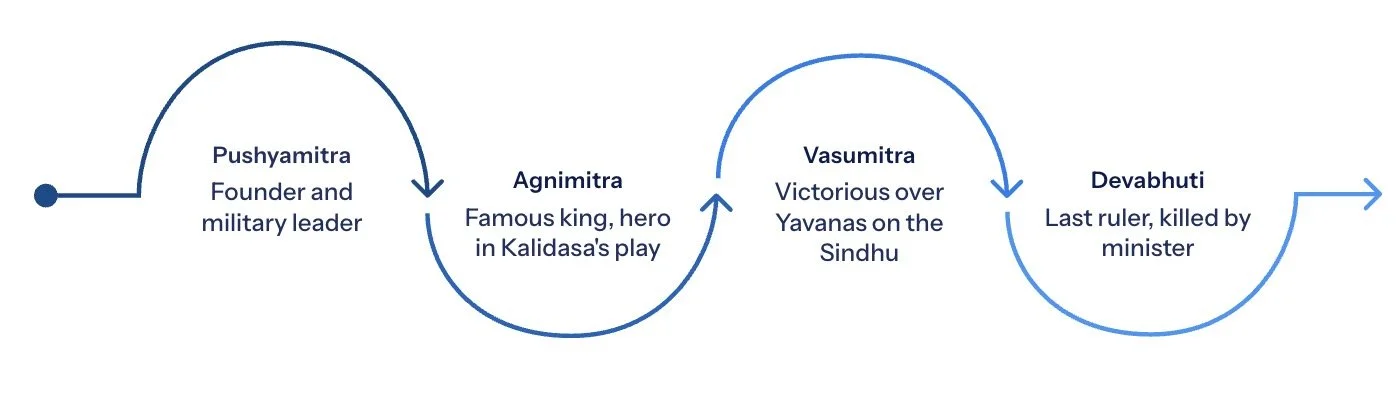
Later Sunga Kings: Agnimitra, Vasumitra & Devabhuti
Vasumitra, grandson of Pushyamitra and son of Agnimitra, is remembered for his dramatic military encounter with Yavana forces on the banks of the Sindhu River during his grandfather's ashvamedha sacrifice. The final ruler of the Sunga line was Devabhuti (83–73 BCE). According to the Harshacharita, he became the victim of a conspiracy masterminded by his Brahmin minister Vasudeva, who went on to found the Kanva dynasty. In total, ten Sunga kings ruled for approximately 112 years.
The Besnagar Pillar Inscription of Heliodorus
Among the most fascinating artefacts of the Sunga period is the inscribed pillar at Besnagar — the site of ancient Vidisha — known as the Heliodorus pillar or Garuda-dhwaj. This inscription is of extraordinary historical significance because it provides rare evidence of cultural and religious interaction between the Hellenistic world and the Indian subcontinent during the post-Mauryan era.
The inscription, written in Prakrit in the Brahmi script, records that this is a garuda-pillar (Garuda being the sacred eagle, vehicle of the god Vishnu) dedicated to the god Vasudeva Krishna. What makes this monument unique is the identity of its dedicant: Heliodorus, a Greek ambassador from the city of Taxila, deputed by the Greek king Antialcidas to the court of the Indian king Kasiputra (a Sunga ruler). Heliodorus describes himself as a Bhagavata — a worshipper of the god Vasudeva Krishna — and a Parambhagavata, meaning a devoted follower of the Bhagavata tradition.
"This Garuda-standard of Vasudeva, the god of gods, was erected here by Heliodorus, a Bhagavata, the son of Diya, and an inhabitant of Taxila, who came as Greek ambassador from the Great King Antialcidas to King Kasiputra..."
— Besnagar Pillar Inscription (c. 100 BCE)
The inscription demonstrates that the Sungas continued the Mauryan tradition of hosting foreign ambassadors and maintaining diplomatic relations with Greek kingdoms. More remarkably, it shows that a Greek envoy had so thoroughly absorbed Indian religious thought that he publicly identified himself as a devotee of Vishnu. The pillar, standing about 20 feet tall and unpolished, has a distinctive shaft divided into four sections of varying geometrical profiles — circular at the top, and below that, octagonal, sixteen-sided, and thirty-two-sided sections, separated by garland ornamentation.
Art of Vidisha & the Sunga Artistic Tradition
Vidisha (ancient Besnagar) served as an important centre of trade, art, and religion during the Sunga period, functioning as a secondary capital where viceroys like Agnimitra held court. The Vidisha art tradition flourished primarily between 200 BCE and 100 BCE during Sunga rule and represents a significant chapter in the history of Indian art.
Free-Standing Stone Pillars
The Heliodorus pillar at Besnagar is the prime example — erected by a Greek ambassador, about 20 feet tall, unpolished, with a shaft divided into four sections of varying geometric profiles. Between the 2nd and 3rd sections is elegant garland ornamentation. The capital features a lower inverted lotus (bell capital) and an upper section originally crowned by a Garuda emblem.
Stone Capitals Without Shafts
A distinctive Sunga artistic form in which elaborate capitals were created independently of any supporting shaft. These capitals displayed sophisticated carving techniques and iconographic programmes that blended Brahmanical and Buddhist motifs.
Sculpture Art
Standing sculptures of Yakshas and Yakshis discovered from Gwalior and Mathura represent the vitality of Sunga sculptural tradition. The Mathura school of art, which grew during this period, became the definitive indigenous style — emphasising naturalistic forms and spiritual expressiveness distinct from the Hellenistic Gandhara style.
The Sunga contribution to Buddhist architecture is particularly notable. At Sanchi, the original Ashokan stupa was enlarged and encased in dark purple-grey sandstone (locally quarried), and embellished with decorated balustrades, staircases, and a harmika. Later Sunga emperors contributed to the iconic gateways (toranas) at Bharhut. A relief from Bharhut from this period, now in the Indian Museum in Kolkata, is among the most celebrated pieces of early Indian art, depicting scenes from the Jataka tales with remarkable narrative skill and visual richness.
The Kanva Dynasty (75–30 BCE)
Post-Sunga45 Years of Rule
The Kanva (or Kanvayana) dynasty replaced the Sungas in Magadha and ruled over the eastern part of India for approximately 45 years. The dynasty was founded by Vasudeva Kanva (75–66 BCE), who had served as an Amatya (minister) under the last Sunga ruler, Devabhuti. According to the Harshacharita, Vasudeva — who was a Brahmin — masterminded a conspiracy, killed Devabhuti, and seized the throne, thus bringing the Sunga line to an end.
The Kanvas considered themselves descendants of the Rishi Kanva, the legendary sage. Like the Sungas before them, they were Brahmins. However, by the time Vasudeva Kanva came to power, the political landscape had changed dramatically. The Punjab was already under the control of the Indo-Greeks, and most of the Gangetic plains had fragmented among different regional rulers. The Kanva domain was therefore limited, and their political reach modest compared to even the reduced Sunga Empire.
Vasudeva Kanva
75–66 BCE. Founder. Former minister of Devabhuti; killed the last Sunga king to seize power.
Three Successors
c. 66–40 BCE. Three more Kanva rulers followed Vasudeva. Details are known mainly through numismatic evidence (coin studies).
Susharman
40–30 BCE. Last ruler of the Kanva dynasty. The dynasty was eventually displaced by the Mitras in Magadha around 30 BCE.
After the Kanvas
c. 30 BCE. The Mitras replaced the Kanvas; the Mitras were in turn dislodged by the Shakas. Magadha's history went blank until the rise of the Guptas.
Much of what we know about the Kanva rulers comes from numismatics — the study of coins — rather than from literary or epigraphic sources. This reflects both the limited geographical extent of their rule and the relatively sparse documentary record of this period. After the fall of the Kanvas around 30 BCE, the history of Magadha remained obscure until the magnificent rise of the Gupta dynasty in the 4th century CE.
Legacy & Historical Significance of the Sungas
The Sunga dynasty, though often overshadowed in popular historical memory by the grander Mauryas before them and the Guptas after them, played a decisive role in shaping ancient India. Their most immediate contribution was military: by successfully repelling the Bactrian Greek invasions and defending the Gangetic valley, they preserved the cultural and political continuity of the Indo-Gangetic heartland during a period of extraordinary external pressure. Without the Sungas, it is plausible that the Greeks might have established a permanent foothold in the Gangetic plains, fundamentally altering the trajectory of Indian civilisation.
In the cultural and religious sphere, the Sungas oversaw a major revival of Brahmanism and Vedic practices — a shift that would define the religious character of the Gupta age and, through it, much of later Hinduism. The performance of ashvamedha sacrifices, the promotion of Sanskrit, and the growth of Vaishnavism under the Sungas laid the groundwork for the classical Hindu renaissance. At the same time, the extraordinary Buddhist monuments at Sanchi and Bharhut — built or expanded during this period — stand as enduring testaments to the richness of artistic production under Sunga patronage.
Military Legacy
Defended north India against Bactrian Greek invasions; preserved the integrity of the Gangetic valley
Religious Revival
Revived Brahmanism, performed ashvamedha sacrifices, promoted Vaishnavism and Sanskrit language
Artistic Patronage
Sanchi and Bharhut expanded; Mathura school of art flourished; Vidisha became an artistic centre
Intellectual Contributions
Patanjali's Yoga Sutras and Mahabhasya; Kalidasa's Malavikagnimitra celebrates this era
Historical Bridge
Transition between Mauryan decline and Gupta brilliance — "a brilliant anticipation of the golden age of the Guptas"
Key Takeaways
For students approaching this topic for examinations or deeper study, a clear understanding of the Sunga and Kanva dynasties requires grasping both the political narrative and the cultural contributions. The following summary captures the most important points across all major themes covered in this document.
The Coup of 187 BCE
Pushyamitra Sunga, commander-in-chief of the Mauryan army, killed King Brihadratha and usurped the throne — ending 137 years of Mauryan rule and founding the Sunga dynasty with Pataliputra as its capital.
Defence Against the Yavanas
The Sungas successfully repelled the Bactrian Greeks (Yavanas) who had advanced as far as Pataliputra. Vasumitra's defeat of the Yavanas on the banks of the Sindhu is a celebrated episode. Patanjali confirms Yavana incursions into Saketa and Madhyamika.
Religion: Complex Legacy
Pushyamitra was a Brahmin who revived Vedic practices, but the question of whether he persecuted Buddhists remains debated. Archaeological evidence is ambiguous; Buddhist art at Sanchi and Bharhut actually flourished under later Sunga rulers.
The Heliodorus Pillar
A Greek ambassador, Heliodorus, erected a Garuda pillar at Vidisha (Besnagar) dedicated to Vasudeva Krishna, calling himself a Bhagavata. This extraordinary inscription shows Greek diplomatic ties and religious conversion to Vaishnavism.
Kanva Dynasty
Vasudeva Kanva killed the last Sunga ruler Devabhuti and founded the Kanva dynasty (75–30 BCE). Four Kanva rulers governed Magadha before being displaced by the Mitras and later the Shakas. Their history is known mainly through coins.
Remember : The Sunga period is notable for three key things — military defence of north India, the religious shift from Buddhism to Brahmanism, and the remarkable Buddhist art at Sanchi and Bharhut. The Heliodorus pillar is a favourite source-based question topic. Always note that the Kanva dynasty lasted only 45 years and is poorly documented outside numismatic evidence.
