
Mauryan Empire: Art, Architecture & Sculpture
Mauryan Empire: Art, Architecture & Sculpture
After an interregnum of more than a thousand years following the demise of the Indus Valley Civilisation — which had achieved extraordinary mastery over stone cutting and sculpting — the revival of sculptural and architectural art in the Indian subcontinent took place during the Mauryan period (c. 322–185 BCE). This era marked a profound transition: from the use of perishable wood to the enduring permanence of stone. Mauryan art flourished primarily under royal patronage, giving rise to a sophisticated court tradition of monumental pillars, rock-cut caves, and stupas. Simultaneously, a vibrant folk art tradition developed independently, shaped by the creative energy of artisans working outside the imperial court. Together, these two streams — Court Art and Folk Art — constitute one of the most remarkable artistic legacies of the ancient world.
Court Art
Palaces, monolithic pillars, stupas, and rock-cut caves produced under royal and imperial patronage.
Folk Art
Yaksha and Yakshini idols, clay sculptures, and pottery created by independent artisans without royal support.
The Mauryan Palace & Pataliputra
The grandeur of Mauryan court architecture is perhaps best glimpsed through the remains discovered at Kumhrar, near modern-day Patna (ancient Pataliputra). The most celebrated of these finds is the 80-Pillared Hall, widely regarded as the site of the Mauryan royal palace. The hall's massive pillars, arranged in neat rows, suggest a ceremonial space of remarkable scale and sophistication — one that astonished archaeologists when first excavated in the 20th century.
The city of Pataliputra itself was an engineering marvel of the ancient world. According to the Greek ambassador Megasthenes, who visited the Mauryan court, the city formed a parallelogram approximately nine miles by one and a half miles, surrounded by a wide ditch 200 yards across. This formidable moat was reinforced by a timber palisade fitted with loop-holes for archers. The palisade was further strengthened by 570 towers and pierced by 64 gateways — a testament to both the military ambitions and the administrative confidence of the Mauryan state.
The palace complex was constructed predominantly of wood — polished teak and other hardwoods — a fact that explains why so little of it survives in its original form. The wooden fortification of the city was itself an extraordinary achievement, representing the height of pre-stone Indian urbanism. The transition from wood to stone, which gathered momentum under the Mauryas, would ultimately define the enduring visual legacy of this dynasty.
Megasthenes on Pataliputra
"…The city formed a Parallelogram, nine miles by one and half miles, surrounded by a ditch 200 yards wide, and protected by a timber palisade with loop-holes for the archers. The palisade was reinforced by 570 towers and had 64 gateways…"
Key Features of the Palace Complex
80-Pillared Hall at Kumhrar (Patna)
Wooden fortification of the city
Surrounded by a 200-yard-wide ditch
570 reinforcing towers along the palisade
64 gateways into the city
Similarities noted with Darius's Hall of 100 Pillars at Persepolis
The Ashokan Pillars: Monuments of Imperial Will
Among the most iconic achievements of Mauryan court art are the great free-standing pillars of Emperor Ashoka — towering monolithic shafts of polished sandstone erected across the breadth of the empire. These pillars were not merely decorative; they were instruments of imperial communication and ideological projection. Their primary objective was to disseminate Buddhist teachings and royal edicts throughout the Mauryan realm, making them among the world's earliest known examples of state-sponsored public messaging.
Mauryan pillars are broadly of two types: those attached to halls (such as the pillars of the 80-Pillared Hall at Kumhrar, which lack any capital) and the independent or free-standing pillars of Ashoka, which are either surmounted by animal capitals or left without any capital. The free-standing pillars in particular are powerful symbols of political authority and imperial reach.
Distribution Across the Subcontinent
Kolhua (Vaishali)
Lion capital, no inscription. Considered the largest of all Mauryan pillars.
Lauriya Areraj
No animal capital, but bears inscription. One of the first six pillar edicts in early Brahmi script.
Lauriya Nandangarh
Features a Lion Capital atop the polished shaft.
Rampurva
Two pillars discovered: one with a Lion Capital and one with a Bull Capital.
Sarnath
The famous Four-Lion Capital — now India's national emblem. Built to mark the Buddha turning the Wheel of Law.
Other Sites
Meerut, Topra (Delhi), Allahabad, Sankisa, Sanchi, Lumbini, Nigalisagar, Basarh, and Kosam.
Anatomy of a Mauryan Pillar
The structural composition of the Mauryan pillar is a marvel of ancient engineering. Each pillar was crafted — most often from buff-grey sandstone quarried from the Chunar region near Varanasi — as a single, seamless piece of stone (a monolith). Some pillars were also fashioned from spotted red and white sandstone from the Mathura region. The pillars are circular in cross-section, taper slightly towards the top, have no base, and bear no surface ornamentation on the shaft — their beauty lying entirely in their austere, high-gloss polish, achieved through the remarkable agate burnishing technology.
The inscriptions on Ashokan pillars were composed primarily in Pali and Prakrit, though a few carry text in Greek or Aramaic — reflecting the cosmopolitan reach of the Mauryan empire and its diplomatic contacts with the Hellenistic world. The capital figures, which include single animals (bull at Rampurva, elephant at Sankissa) and the celebrated four-lion composition at Sarnath and Sanchi, are rendered with extraordinary vitality, their forms simultaneously naturalistic and ceremonially charged.
Mauryan vs. Achaemenian Pillars: A Scholarly Debate
One of the most debated questions in the history of Indian art is whether the Mauryan pillar tradition was an independent indigenous development or whether it owed a significant debt to the Achaemenian (Persian) pillar tradition. Scholars such as D.B. Spooner and Ananda K. Coomaraswamy have argued in favour of Persian influence, pointing out that prior to 300 BCE, there was no such stone-working tradition in India. They note the close cultural contacts between India and Iran — Darius had conquered the north-western regions of India — and draw attention to certain shared features.
However, Niharranjan Ray and other historians have challenged this view, pointing out significant structural and conceptual differences that suggest an independent and distinctly Indian artistic vision. The debate remains one of the most productive scholarly conversations in the study of ancient Indian art.
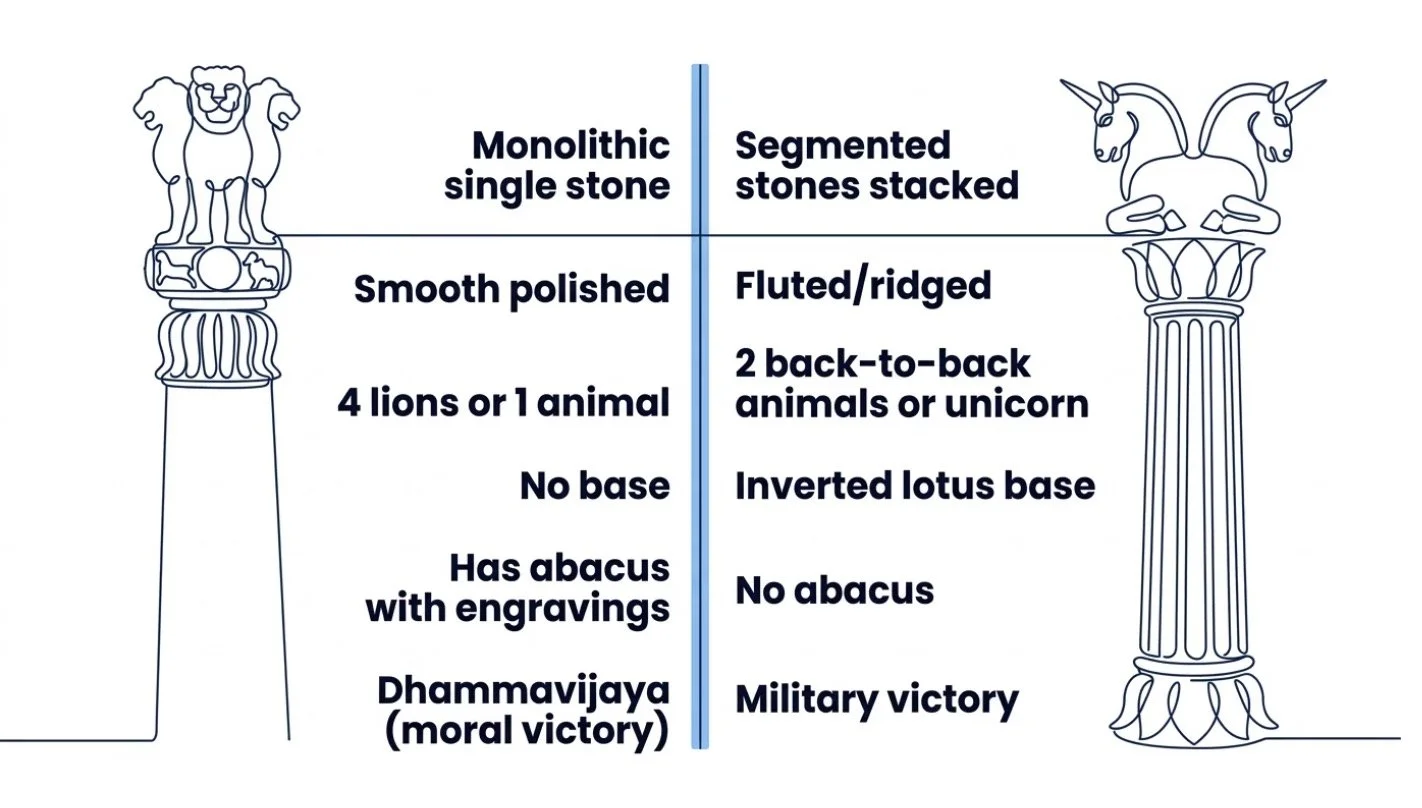
Mauryan vs. Achaemenian Pillars: A Scholarly Debate
The similarities — polished stones, lotus motifs, animal capitals, inscribed proclamations beginning in the third person — are real and cannot be dismissed. Yet the differences are equally compelling. The Mauryan lotus differs in form from its Persian counterpart; the Mauryan shaft is a true monolith unlike the segmented Persian column; the Mauryan pillar stands independently whereas the Achaemenian is always part of a larger architectural complex. Most significantly, the Ashokan pillar is an instrument of Dhamma — of moral and spiritual proclamation — while its Persian counterpart is a monument to military conquest. This fundamental difference in intent reveals a deeply Indian philosophical sensibility at work.
Stupas: Architecture of Sacred Memory
The stupa is one of the most profound architectural innovations of the ancient world — a burial mound covered with a hemispherical structure, built of brick or stone, serving as a sacred monument to the Buddha and his teachings. According to tradition, after the Mahaparinirvana (final passing) of the Lord Buddha, his physical remains were divided into eight parts and distributed among eight kingdoms, each of which built a stupa to enshrine them. Pre-Mauryan stupas were constructed of earthen mounds; the remains of one such structure have been identified at Piparwaha.
It was, however, under the reign of Emperor Ashoka that stupa construction reached its zenith. Tradition credits Ashoka with ordering the construction of as many as 84,000 stupas across the empire — a number that, even if symbolic rather than literal, conveys the extraordinary scale of his religious patronage. The stupa became the primary architectural expression of Buddhism in India and, through the missionary activities of Ashoka's envoys, eventually spread its influence across Asia.
Structural Components of the Stupa
Anda
The hemispherical mound, symbolic of the mound of earth covering the Buddha's remains. In many stupas, actual relics were placed within.
Harmika
A square railing placed on top of the anda, representing the sacred enclosure at the summit of the cosmic mountain.
Chhatra
A central pillar supporting a triple umbrella form, symbolising the three jewels of Buddhism — Buddha, Dharma, and Sangha.
Vedika
A railing encircling the entire structure, built of stone and sparingly polished, with beautiful engravings of folk and Buddhist symbols.
Torana
Ornamental entry gateways placed at the four cardinal directions, richly carved with narrative and symbolic reliefs.
The core of the stupa was made of unburnt brick, while the outer surface used burnt brick covered with a thick layer of plaster. The Vedika and Torana were adorned with exquisite engravings related to Stambha and Ushanisha motifs, combining folk symbols with Buddhist iconography. The most celebrated Mauryan example is the Mahastupa at Sanchi, later expanded during the Shunga period, and the Dharmarajika Stupa at Sarnath.
Rock-Cut Cave Architecture
Cave architecture represents yet another remarkable dimension of Mauryan artistic achievement. During the Mauryan period, the practice of cutting directly into the living rock of hills to create dwelling spaces — viharas — for monks was inaugurated on a significant scale. What makes these caves extraordinary is not simply their antiquity but the astonishing technical accomplishment they represent: though excavated from hard granite rock, their interior walls were polished to a glass-like smoothness — a finish so refined that it has survived largely intact for over two millennia.
The caves were commissioned by Emperor Ashoka and his grandson Dasaratha primarily for the use of the Ajivikas, a heterodox religious community that coexisted with Buddhism and Jainism in the Mauryan period. This act of royal patronage extended beyond the dominant Buddhist tradition, underscoring the pluralistic religious sensibility of the Mauryan court.
The principal surviving examples are found in the Barabar Hills and Nagarjuni Hills near Gaya in Bihar. The Barabar complex includes the Sudama cave, the Karna Chaupar cave, and the celebrated Lomesh Rishi cave — the last of which is renowned for its magnificently ornamented arched entrance, carved in imitation of a wooden façade with remarkable delicacy. Each cave typically consisted of two chambers: one circular and one rectangular, serving different ritual or residential functions. The Nagarjuni Hills yield three additional caves of comparable quality and historical significance.
Sudama Cave
One of the earliest rock-cut caves in India, located at Barabar Hills, commissioned by Ashoka for the Ajivikas.
Karna Chaupar Cave
Another Barabar cave featuring the characteristic mirror-like interior polish that defines Mauryan rock-cut architecture.
Lomesh Rishi Cave
The most famous Mauryan cave, with an ornate arched entrance at Barabar Hills. Features a carved façade imitating a wooden gateway.
Nagarjuni Caves
Three caves on the Nagarjuni Hills, commissioned by Dasaratha for the Ajivikas after Ashoka's death.
Sculpture: Court Art & Folk Art
Court Sculpture
Mauryan court sculpture encompasses stone carvings in three forms: sculptures created by cutting directly into stone(in situ), engraved reliefs, and independently fashioned sculptures mounted on monolithic pillars. The most celebrated examples of in-situ sculpture include the magnificent elephant carved from the living rock at Dhauli in Odisha — a figure of extraordinary naturalism, appearing as though the animal is about to emerge fully from the stone. Similarly, an engraved image of an elephant is found on the rock at Kalsi in Dehradun. Both images exemplify the consummate skill achieved by Mauryan sculptors in rendering animal forms with life-like vitality.
Metal sculpture was also practised during this period. Kautilya's Arthashastra makes specific mention of metal sculptures, indicating that bronze and other metal-casting traditions existed alongside the more celebrated stone tradition, though fewer metal examples survive from this period.
Folk Sculpture
Folk sculpture was produced by independent artisans outside the imperial court, working in grey sandstone and clay. These works display a robust, earthy vitality quite different from the refined polish of court art. Most folk sculptures are independently fashioned figures, not attached to any architectural structure.
Yaksha idol at Parkham (Mathura) — also called Manibhadra, a monumental male figure of great presence
Didarganj Yakshini (Patna) — a polished sandstone female figure of exceptional refinement, exhibited at the Patna Museum
Laughing Boy at Bulandibag — a spirited clay figure radiating joy
Two naked Jaina saint images from Lohanipur (Patna) — among the earliest representations of Jaina asceticism
Tri-mouth Yaksha from Rajghat (Varanasi) — a rare three-faced deity figure
These folk sculptures are made of grey sandstone and still sparkle with the distinctive Mauryan polish. Their bodies are adorned with carefully rendered clothes and ornaments, suggesting that even outside the court tradition, Mauryan artisans brought exceptional technical skill and aesthetic sensibility to their work. Northern Black Polished Ware (NBPW) — characterised by its lustrous black finish — was the hallmark pottery of the Mauryan period, centred primarily at Kosambi and Pataliputra, and was prized as a luxury item.
Decline & Legacy
The Disintegration of the Mauryan Empire
The fall of the Mauryan Empire — one of the largest and most sophisticated political entities the ancient world had yet seen — was not the result of a single catastrophic cause but rather the cumulative consequence of multiple, interrelated pressures. Beginning with the death of Ashoka (c. 232 BCE), the empire entered a prolonged phase of weakening that culminated in the assassination of the last Mauryan king, Brihadratha, by his own army commander Pushyamitra Shunga in approximately 185–186 BCE. Historians have long debated the relative weight of the various causes, and their divergent interpretations reveal as much about modern historical methodology as they do about the ancient world.
Brahmanical Reaction
Ashoka's promotion of Buddhism and discouragement of Vedic sacrifice alienated the Brahmin priestly class. Successor dynasties like the Shungas, Kanvas, and Satavahanas — all Brahmin — performed Vedic rites that Ashoka had suppressed, suggesting a deliberate ideological reversal.
Financial Crisis
The enormous cost of maintaining a vast army, a sprawling bureaucracy, and generous Buddhist endowments strained the imperial treasury. Coins of inferior metal were eventually issued, adversely affecting trade and agriculture.
Oppressive Provincial Rule
Misrule by provincial governors — documented in complaints from Taxila during both Bindusara's and Ashoka's reigns — eroded loyalty at the empire's periphery. Rotations of officers introduced by Ashoka proved insufficient to curb abuses.
Partition of the Empire
After Ashoka's death, the empire was divided between his successors — including Jalauka in Kashmir and Dasaratha in Magadha. This fragmentation invited foreign invasion and enabled provincial independence.
Weak Successor Kings
Only six kings ruled for a mere 52 years after Ashoka. None possessed the administrative genius of Chandragupta Maurya, Bindusara, or Ashoka himself. Highly centralised administration required an exceptionally capable monarch at its centre.
Foreign Invasions, Internal Revolts & Scholarly Interpretations
In addition to internal pressures, the Mauryan Empire faced a renewal of external threats from the northwest — a frontier that Ashoka had largely neglected, unlike China's Emperor Shih Huang Ti (247–210 BCE), who constructed the Great Wall to protect against nomadic incursions. With no comparable defensive infrastructure, the Mauryan northwest lay exposed. The Greeks invaded in 206 BCE, establishing their kingdom in Bactria (northern Afghanistan), followed by successive waves of Indo-Greeks, Shakas, and Kushanas. Meanwhile, the internal revolt of Pushyamitra Shunga — described vividly by the poet Bana in the Harshacharita — brought the dynasty to its abrupt end during an army parade.
Major Scholarly Perspectives on the Decline
Hari Prasad Shastri
Blamed Ashoka's patronage of Buddhism and humiliation of Brahmins for provoking a Brahmanical reaction. Largely rejected — no evidence of a united Brahmin uprising.
H.C. Raychaudhuri
Argued Ashoka's policy of Ahimsa (non-violence) weakened the army, making it incapable of resisting foreign invasion or suppressing provincial revolts. Partially accepted — likely a contributing factor, not the primary cause.
D.D. Kosambi
Identified financial crisis as the primary cause — an over-extended bureaucracy, heavy taxation, and depleted treasury. Largely rejected by modern historians who consider the Mauryan period economically prosperous overall.
R.K. Mookherjee
Took a comparative view: weak successors, provincial revolts, poor communication, palace intrigue, and oppressive local chiefs were universal causes of Indian imperial decline. The Mauryas were no exception.
Romila Thapar
Attributed decline to the failure of a hyper-centralised bureaucracy without representative institutions, and the absence of a sense of national consciousness. Logical from a modern perspective, though national consciousness is itself a modern concept not applicable to ancient polities.
The most widely accepted view among contemporary historians is pluralistic: the fall of the Mauryan Empire resulted from the combined effect of weak successors, provincial independence, financial strain, administrative over-centralisation, foreign invasions, and internal revolt. Ashoka's policies may have contributed partly — but they cannot bear sole or even primary responsibility. The empire's sheer vastness, and the impossibility of sustaining it without a succession of extraordinarily capable rulers, may be the deepest and most unavoidable truth. Thus, the Mauryan Empire's disintegration, even as it dimmed a brilliant chapter, laid the groundwork for the diverse regional cultures and art traditions that would flourish in the centuries that followed.
