
Ashoka
Ashoka
Ancient Indian History272–232 BCE
Emperor Ashoka Maurya — one of the most consequential rulers in world history — covering his rise to power, the pivotal Kalinga War, the philosophy of Dhamma, the celebrated Edicts and Pillars, and ultimately, the decline of the Maurya Empire. Designed for students and general readers, it draws on epigraphic evidence, Buddhist chronicles, and historical scholarship to present a balanced and accurate account.
Ashoka Maurya: Rise to Power
Ashoka Maurya (r. 272–232 BCE) was the third emperor of the Maurya Dynasty, ruling over nearly the entire Indian subcontinent from the capital at Pataliputra. His very name traces to a moment of relief: when his mother bore him, her exclamation "I am now without sorrow" — in Sanskrit, a-shoka — became the child's name. The story captures something of the emotional register that would later define his legacy as a ruler who came to feel profound remorse.
The path to the throne was neither smooth nor bloodless. When Bindusara died in 272 BCE, a war of succession erupted among his sons. The Dipavansa and Mahavansa, two important Buddhist chronicles, record that Ashoka killed 99 of his brothers, sparing only one — named Vitashoka or Tissa. His ascent was secured with the crucial support of the minister Radhagupta. Buddhist legends further describe the young Ashoka as bad-tempered and wicked in nature, and tradition holds that he constructed an elaborate torture chamber known as "Ashoka's Hell" — a striking counterpoint to the humane ruler he would later become.
The Divyavadana, a Buddhist text, describes Ashoka suppressing revolts in Ujjain and Taxila caused by oppressive ministers — events that may date to Bindusara's reign but which Ashoka was dispatched to resolve. These early experiences of governance in turbulent frontier cities appear to have shaped his administrative outlook. Upon ascending the throne, he spent approximately eight years expanding the empire, extending its reach from Assam in the east to Iran in the west, and from the Pamir Knot in the north to the southern peninsula — with the exception of the territories of the three ancient Tamil kingdoms (present-day Tamil Nadu and Kerala).
Dynasty & Capital
Maurya Dynasty, capital at Pataliputra (modern Patna, Bihar)
Reign
272–232 BCE, over 40 years of rule across the subcontinent
Succession
Gained throne after a bloody war of succession with support of minister Radhagupta
Early Character
Buddhist legends describe him as fierce and ambitious before his transformation
The Kalinga War (262–261 BCE)
The Kalinga War stands as the singular most decisive event in Ashoka's life and, arguably, one of the most significant turning points in ancient Indian history. Kalinga was a powerful feudal republic situated along the coast of present-day Odisha and the northern parts of Andhra Pradesh. The war Ashoka waged to conquer it was the only major military conflict he undertook after his formal coronation.
The causes of the invasion were both political and economic. Since the time of Bindusara, the Mauryan Empire had pursued a consistent policy of territorial expansion rooted in the Magadhan tradition of hegemony. Kalinga had been under Magadhan control during the Nanda period but regained its independence with the rise of the Mauryas — a development regarded as a severe loss of political prestige and a reversal of the traditional expansionist agenda. Further complicating matters, Kalinga had aligned itself with the Chola and Pandya kingdoms of the south in opposition to Magadha, transforming it into an ideological as well as strategic adversary.
Beyond politics, Kalinga's formidable military capacity posed a direct security threat to the empire's stability. Its prosperous commercial ties with Malay, Java, and Ceylon had generated considerable material wealth — wealth that may well have attracted Ashoka's ambitions. Rock Edict XIII, inscribed at Dhauli and Tosali, offers Ashoka's own account of the campaign's devastating outcome: "One hundred and fifty thousand were deported, one hundred thousand were killed and many more died from other causes." It was this unprecedented scale of destruction that transformed the conqueror.
Political Causes
Kalinga had broken free from Magadhan control at the start of Mauryan rule
Regarded as a loss of political prestige for the Mauryan empire
Kalinga allied with Chola and Pandya kingdoms against Magadha
Economic & Strategic Causes
Kalinga possessed a vast and powerful army — a security threat
Rich commercial relations with Malay, Java, and Ceylon created great material prosperity
Control of Kalinga would consolidate the empire's eastern seaboard
Aftermath: Transformation of a Conqueror
"Beloved-of-the-Gods feels deep remorse for having conquered the Kalingas. Now Beloved-of-the-Gods strongly desires that all beings should be unharmed, self-controlled, calm in mind, and gentle." — Rock Edict XIII
The aftermath of the Kalinga War is chronicled primarily through Ashoka's own inscriptions, particularly Rock Edict XIII — the longest and most personally revealing of all his edicts. Composed approximately eight years after his coronation, it recounts the enormous human cost of the campaign and documents Ashoka's profound spiritual and moral crisis. The sight of mass death, deportation, and suffering among Brahmins, monks, and common people alike moved him to declare that he would henceforth pursue Dharma-Vijaya — conquest through righteousness — in place of military expansion.
Following the conquest of Kalinga, Ashoka effectively ended all military expansion of the empire. The next four decades of his reign were characterised by relative peace, administrative reform, and welfare initiatives. Approximately two and a half years after the war, he became an enthusiastic supporter of Buddhism — a transformation attributed in tradition to the influence of the young monk Nigrodha (said to be five years old) and, according to some accounts, to the guidance of the elder monk Upagupta. Under Buddhist influence, he replaced the sound of the war drum (Bherighosa) with the sound of Dhamma (Dhammaghosha).
Notably, Ashoka refrained from inscribing his expressions of remorse in Kalinga itself. The Kalinga inscriptions were instead replaced by separate Rock Edicts addressed to his officers, emphasising the imperatives of good governance and compassionate administration. This deliberate decision reflects a sophisticated political awareness — one that balanced personal guilt with the demands of statecraft in a newly conquered territory still raw from war.
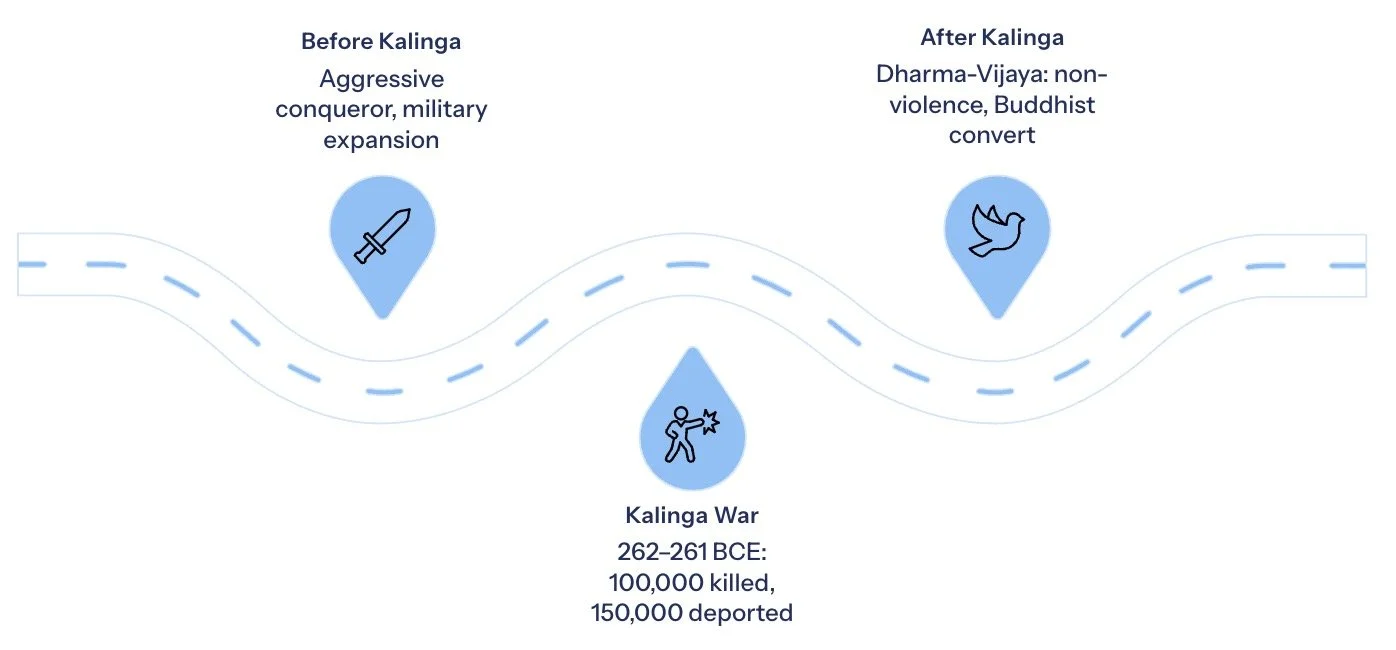
Ashoka and kalinga War
The transformation is rarely understood as total or overnight. Scholarly readings of the inscriptions suggest a gradual process of moral reckoning spread over years, rather than a single dramatic conversion moment. The continuity of administrative structures and the retention of the death penalty (with only a minor grant of a three-day stay of execution) indicates that Ashoka remained a pragmatic ruler even as he embraced a new moral framework.
The Concept of Ashoka's Dhamma
The word Dhamma is the Prakrit equivalent of the Sanskrit term Dharma. Despite numerous scholarly attempts to render it in English — as "piety," "moral life," or "righteousness" — no single translation adequately captures its meaning, because it was coined and deployed in a specific socio-political context unique to Ashoka's empire. The best approach to understanding it remains, as scholars consistently suggest, a careful reading of the edicts themselves.
Dhamma was not a creed, a religious faith, or a sectarian doctrine. Nor was it simply an arbitrary royal policy. At its core, it was an ethic of social conduct — a generalised framework of moral norms governing how people should relate to one another, to different social groups, and to living beings. Ashoka drew upon and synthesised existing social norms prevalent across the empire's many communities, seeking to distil from them a set of principles capable of commanding broad assent.
The need for such a framework was acute. By the sixth and fifth centuries BCE, the Indian subcontinent had witnessed an extraordinary intellectual ferment among competing sects — Charvakas, Jains, Buddhists, Ajivikas, and others — whose doctrines ranged from radical materialism to strict determinism. The Mauryan court itself reflected this diversity: Chandragupta was claimed as a patron by the Jains, and Bindusara reportedly favoured the Ajivikas. Ashoka's empire encompassed peoples at vastly different levels of cultural development, from the Hellenised frontier zones of Afghanistan and Iran to the threshold of the classical Tamil cultural efflorescence in the far south.
In this landscape of bewildering diversity, Dhamma was intended to function as a shared civic morality — a point of convergence and loyalty that could hold together the heterogeneous empire. A centralised monarchy demanded a degree of common feeling among its subjects, and the ethics of Dhamma were designed precisely to generate that feeling. It was also a practical response to social tension: as commercial classes gained economic power and resented the hierarchical restrictions of Brahmanical social order, many gravitated toward Buddhism with its message of social equality. Ashoka's Dhamma offered a broader ethical framework that could attract their loyalty without requiring them to abandon their particular religious affiliations.
Ethical Universalism
Dhamma was directed at all people — Buddhists, Brahmins, Jains, and Ajivikas — as a shared moral code transcending sectarian boundaries.
Social Conduct
Primarily concerned with behaviour towards others: respect for parents and elders, kindness to servants and slaves, and compassion for all living beings.
Religious Tolerance
Ashoka passionately appealed for mutual respect among all religions, warning against denigrating the beliefs of others while promoting one's own.
Practical Statecraft
Dhamma also served the pragmatic purpose of maintaining imperial unity, managing social tensions, and providing a basis for legitimate governance.
Interpretations of Dhamma: Scholarly Debates
The Ashokan policy of Dhamma has been subject to considerable scholarly controversy. One prominent line of interpretation equates Dhamma directly with Buddhism, arguing that Ashoka was in essence a partisan Buddhist propagating the dharma of the Buddha. This reading draws on Buddhist chronicles and the historical narrative of a dramatic conversion following the horror of Kalinga. The Buddhist records do credit Ashoka with the spread of Buddhism both within India and abroad, and his personal devotion to the faith is not in question.
However, a careful reading of the edicts themselves complicates this identification. Ashoka never incorporated the fundamental tenets of Buddhist doctrine — the Four Noble Truths, the chain of causality, the Noble Eightfold Path, or the concept of Nirvana — into his Dhamma. He repeatedly referenced the concept of svarga (heaven), which is a Hindu belief, and continued to style himself as "Beloved of the Gods" (Devanampiyadasi), a title invoking a Hindu theological framework at a time when Buddhism did not recognise personal gods. Had Dhamma been intended as Buddhist doctrine, these omissions and inclusions would be inexplicable.
Other historians have focused on the consequences of Ashoka's policies rather than their religious character. Some argue that his ban on animal sacrifice and his favour of Buddhism provoked a Brahmanical reaction that contributed to the eventual decline of the Maurya Empire. Others contend that his emphasis on non-violence progressively weakened the military capacity of the empire, hastening its collapse after his death. A third, more balanced interpretation holds that Ashoka's Dhamma was a sophisticated political and ethical document — humane in its aspirations, pragmatic in its awareness of state necessity, and genuinely committed to tolerance in an ethnically diverse, religiously varied, and socially stratified society.
Dhamma IS Buddhism
Buddhist chronicles credit Ashoka as the great propagator of Buddhism. His conversion after Kalinga was a dramatic turning point. Missions were sent to Ceylon, Greece, and beyond.
Dhamma TRANSCENDS Buddhism
The edicts omit all core Buddhist doctrines. References to svarga (heaven) and the title Devanampiyadasi indicate a broader, syncretic ethical framework intended for all subjects regardless of faith.
The most defensible scholarly position is that Ashoka's Dhamma was neither anti-Brahmanical nor exclusively Buddhist. Respect for Brahmins and Sramanas is explicitly built into his moral code. His appeal for tolerance was a wise and necessary course of action in a politically unified but culturally plural empire — an empire that encompassed Greek soldiers, Kamboja nomads, Andhra cultivators, Tamil merchants, and hundreds of other communities with distinct traditions, languages, and beliefs.
Ashoka's Major Rock Edicts: A Survey
The fourteen Major Rock Edicts represent Ashoka's most systematic attempt to articulate and disseminate his Dhamma across the empire. Inscribed on prominent rock surfaces at key locations — from Kandahar in Afghanistan to Kalsi in Uttarakhand and Girnar in Gujarat — they were intended to be read aloud to populations, most of whom were illiterate. Together they form a remarkable document of ancient statecraft and moral philosophy.
Edict I
Prohibits animal slaughter and bans festive gatherings involving killing. Ashoka notes that only two peacocks and one deer were still killed in his kitchen, a practice he wished to discontinue entirely.
Edict II
Provides for medical care for humans and animals; mentions construction of roads, wells, and tree planting. References the southern kingdoms of Chola, Pandya, Satyapura, and Keralputra.
Edict III
Declares generosity to Brahmins and Sramanas a virtue. Issued after 12 years of coronation; orders Yuktas, Pradesikas, and Rajukas to tour the kingdom every five years to spread Dhamma.
Edict IV
States that Dhammaghosha (the sound of Dhamma) is the ideal for humanity, not Bherighosa (the sound of war). Describes the positive impact of Dhamma on society and morality.
Edict V
Concerns policy towards slaves and servants. Contains the celebrated declaration: "Every human is my child." Records the first appointment of Dhammamahamatras (officers of Dhamma).
Edicts VI–XIV
Cover administrative welfare, tolerance among sects (VII, XII), the first Dhamma Yatra to Bodhgaya (VIII), condemnation of empty ceremonies (IX), the Kalinga victory and its lessons (XIII), and the rationale for the edict programme (XIV).
Rock Edict XIII holds particular importance: it is the longest and most personally candid of all Ashoka's inscriptions, recording his remorse over Kalinga and articulating the vision of Dharma-Vijaya — the idea that the true conquest is the willing adoption of ethical principles by other peoples and rulers, not the territorial subjugation of their lands. The edict names the Greek rulers of the era, including Antiochus, Ptolemy, Antigonus, Magas, and Alexander, demonstrating Ashoka's sophisticated grasp of the geopolitical world beyond India's frontiers.
The Pillars of Ashoka (Stambhas)
The Pillars of Ashoka are among the most impressive architectural achievements of the ancient world and constitute the first major group of Indian stone sculpture. Originally a far larger number must have been erected, but only nineteen survive with inscriptions, and only six retain their animal capitals. Averaging between 40 and 50 feet in height and weighing up to 50 tons each, these monolithic shafts were quarried, carved, polished, transported across hundreds of miles — often via rivers — and erected at Buddhist monasteries, important sites from the life of the Buddha, and pilgrimage centres.
The stone used came from two principal sources: spotted red-and-white sandstone from the Mathura region, and a fine-grained, buff-coloured hard sandstone with small black spots quarried at Chunar near Varanasi. The uniformity of the carved capitals across geographically dispersed sites strongly suggests that specialist craftsmen from a single workshop tradition were responsible for their production.
Each pillar follows a consistent architectural programme. The monolithic shaft is always plain, smooth, circular in cross-section, and slightly tapered upwards. Above the shaft sits the capital, itself composed of three sections: the bell(a downward-curving lotus petal form), the abacus (either square and plain, or circular and decorated with relief carvings), and the crowning animal sculpture. The three parts of the capital were carved from a single piece of stone, often distinct in material from the shaft itself, and attached by a large metal dowel.
Shaft
Monolithic, plain, smooth, slightly tapering upwards. Circular in cross-section. Made from a single piece of sandstone.
Bell (Lower Capital)
Gently arched bell shape formed of lotus petals, representing the lotus as a Buddhist and Hindu symbol of purity and cosmic order.
Abacus (Upper Capital)
Flat slab providing a broad supporting surface. Either square and plain, or circular and decorated with relief friezes of animals and Dharmachakras.
Crowning Animal
Masterpiece of Mauryan sculpture — lions, bulls, elephants — shown seated or standing, carved in the round as a single piece with the abacus.
The question of cultural influence on the pillar form has been extensively debated. It is possible that Persian artists came to Ashoka's court, bringing with them column traditions from Persepolis, where capitals supporting roof structures bear certain resemblances to the Mauryan form. The Lion Capital at Sarnath in particular displays what scholars describe as "obvious Achaemenid and Sargonid influence" in its rather formal, hieratic style. Yet it is equally plausible that Ashoka chose the pillar because it was already an established Indian art form, and that in both Buddhism and Hinduism the pillar symbolised the axis mundi — the cosmic axis around which the world revolves.
The Sarnath Lion Capital & the National Emblem
Among all the surviving capitals, the Lion Capital from Sarnath — near Varanasi, Uttar Pradesh — is by far the most celebrated, and for good reason. Carved from a single block of polished Chunar sandstone, it features four Asiatic lions standing back to back, their powerful forms rendered with a combination of naturalistic energy and formal grandeur. The lions are mounted on a circular abacus decorated with a high-relief frieze of four animals — an elephant, a galloping horse, a bull, and a lion — separated by four spoked chariot-wheels (Dharmachakras).
Originally, the capital was almost certainly crowned by a large Wheel of Dharma (Dharmachakra), with 24 spokes — fragments of which were recovered from the site. Below the animal frieze is an inverted bell-shaped lotus, forming the lower portion of the capital. The Ashokan pillar itself remains in its original location at Sarnath, but the Lion Capital is now housed in the Sarnath Museum.
The Sarnath capital has a significance far beyond its archaeological importance. The Government of India adopted a version of this capital as the National Emblem of India following independence in 1947. The emblem shows three visible lions (the fourth being hidden from view), with the horse on the left and the bull on the right of the Ashoka Chakra — the 24-spoked wheel — in the circular base. The Ashoka Chakra itself was placed at the centre of the National Flag of India. In this way, a monument of the third century BCE became the visual foundation of modern Indian national identity.
National Significance: The Lion Capital of Ashoka at Sarnath forms the basis of India's National Emblem. The Ashoka Chakra (24-spoked wheel) from its abacus is placed at the centre of the National Flag of India — a remarkable continuity across more than two millennia of history.
Key Pillar & Rock Edict Locations
The Ashokan inscriptions are dispersed across a vast geographical range encompassing modern Bangladesh, India, Nepal, Pakistan, and Afghanistan. This distribution itself testifies to the extraordinary reach of the Mauryan state and to Ashoka's determination to communicate his Dhamma to subjects at every corner of his empire.
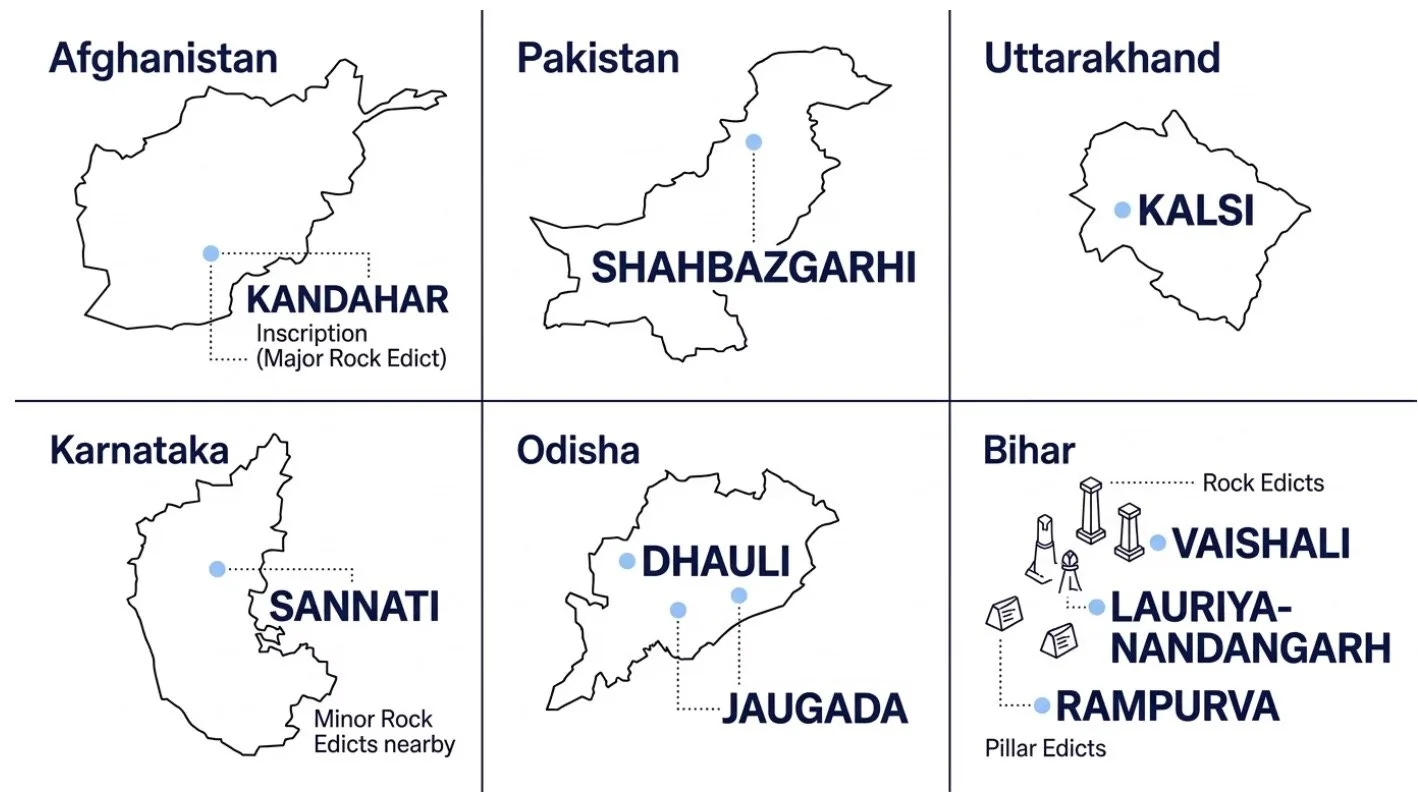
Key Pillar & Rock Edict Locations
The inscriptions in the eastern parts of the empire were composed in the Magadhi language using the Brahmi script. In the western regions, the language is closer to Sanskrit and written in the Kharoshthi script. A bilingual edict in Greek and Aramaic survives at Kandahar, and a fragment of Edict 13 exists in Greek — demonstrating Ashoka's awareness of and outreach toward the Hellenistic world. These inscriptions were deciphered by the British archaeologist and historian James Prinsep in 1837, an achievement that unlocked a largely forgotten chapter of Indian history.
The identification of the inscriptions' author — referred to throughout as Devanampiyadasi ("Beloved of the Gods") — with the historical Ashoka was confirmed only in 1915, when C. Beadon discovered a Minor Rock Edict at Maski in the Raichur district of Karnataka that explicitly names "Ashoka." A further confirmation came from the village of Gujarra in Datia district, Madhya Pradesh, where another minor edict similarly couples the name "Ashoka" with the usual "Devanampiyadasi."
The Pillar Edicts: A Set of Seven
The Pillar Edicts constitute a distinct and more refined body of Ashokan legislation, generally regarded as reflecting a more mature and systematically articulated version of his Dhamma philosophy than the earlier Rock Edicts. They are found inscribed on the major pillars at sites including Lauriya-Nandangarh, Rampurva, Delhi-Meerut, Delhi-Topra, and Allahabad.
Pillar Edict I
Articulates Ashoka's fundamental principle of protection of his people — a ruler's primary obligation.
Pillar Edict II
Defines Dhamma as a minimum of sins, combined with many virtues: compassion, liberality, truthfulness, and purity of mind.
Pillar Edict III
Abolishes sins of harshness, cruelty, anger, and pride — vices that corrupt the moral character of individuals and rulers alike.
Pillar Edict IV
Elaborates the duties of the Rajukas — Ashoka's rural administrative officers — emphasising their role in both rewarding good conduct and punishing wrongdoing.
Pillar Edict V
Lists animals and birds that must not be killed on specific days, and others that must never be killed. Records the release of 25 prisoners by Ashoka.
Pillar Edict VI
Elaborates on the policy of Dhamma and the administrative structures created to implement it throughout the empire.
Pillar Edict VII
Describes the works undertaken by Ashoka in furtherance of Dhamma; states that all sects desire both self-control and purity of mind — affirming the universality of the moral project.
The Delhi-Topra pillar, moved from Topra to Delhi by Firuz Shah Tughluq in the fourteenth century, is the only column that carries all seven Pillar Edicts and is therefore of special textual significance. It also contains a unique reference to matters of taxation, distinguishing it from all other pillar inscriptions. The Allahabad Pillar — bearing Edicts I–VI, the Queen's Edict, and the Schism Edict — additionally carries later inscriptions attributed to the Gupta emperor Samudragupta and to the Mughal emperor Jahangir, making it a palimpsest of Indian historical memory.
Was Ashoka a Complete Pacifist?
Popular historiography, strongly influenced by Buddhist literary sources, has tended to present Ashoka as a ruler who became entirely pacifist after the Kalinga War — abandoning warfare, disbanding armies, and governing through moral persuasion alone. A closer reading of the epigraphic evidence, however, suggests a considerably more nuanced picture. There are good reasons to believe that Ashoka was not as unmilitaristic as the Buddhist tradition asserts.
Evidence for Continued Military Capacity
Ashokan inscriptions confirm the Mauryans maintained a strong army throughout his reign
Inscriptions warn against further revolts, particularly in tribal territories
The class of officers called Rajukas were vested with authority to both reward and punish
Death penalty was retained; Ashoka only granted a three-day stay of execution for condemned men
Limits of the "Pacifist" Narrative
Buddhist literature appears to exaggerate Ashoka's renunciation of all coercive power
There is nothing in the Ashokan inscriptions to suggest actual demobilisation of the military
He explicitly warned forest tribes that force might be used if they continued to cause trouble
Capital punishment continued despite Buddhist tradition claiming its abolition
What the evidence supports is a more accurate characterisation: Ashoka modified his imperial ambitions in accordance with humanistic ethical principles derived from Buddhism, but he did not abandon the instruments of state power. His renunciation of further conquest came at a point when the empire had already reached its natural geographical boundaries — the subcontinent's coasts, mountain frontiers, and the cordial relations established with the southern kingdoms. The plea for non-violence was therefore as much a recognition of strategic reality as it was a moral transformation.
Within his empire, Ashoka continued to exercise coercive authority. He maintained capital punishment, appointed officers with policing and punitive powers, and issued stern warnings to tribal communities on the periphery. The idea that he dismantled the administrative and military apparatus of one of history's largest empires out of Buddhist conviction is not borne out by the inscriptional record. What he demonstrably did was redirect the energies of that apparatus away from external conquest and toward internal welfare, justice, and moral education.
Success and Failure of Dhamma
Ashoka himself claimed in his inscriptions that his Dhamma missions — dispatched to Ceylon, the Greek kingdoms of the west, and various other regions — were universally successful. He states with considerable confidence that rulers as far as the Mediterranean adopted his Dhamma. Historians, however, are generally sceptical of these claims. There is little independent corroborating evidence from the receiving ends of these missions to confirm the wholesale adoption of Ashokan ethics by foreign rulers. The claim of success appears to reflect the rhetorical conventions of royal inscription rather than verifiable diplomatic history.
Within the empire itself, the record is mixed. The Kandahar inscription does speak meaningfully of the success of Ashoka's policy among hunters and fishermen, who reportedly gave up killing animals and took to settled agricultural life — a genuine and significant social transformation in specific communities. Yet social tensions continued to simmer. Taxila, which had revolted in Bindusara's time and again in Ashoka's own, was goaded into further unrest by ministerial oppression, suggesting that the appointment of Dhammamahamatras (special officers of Dhamma) did not eliminate the structural problem of bureaucratic abuse. Over time, the growing power of these officials to interfere in the lives of ordinary people itself became a source of popular resentment.
Partial Successes
Some hunters and fishermen adopted settled agriculture
40+ years of relative peace and stability within the empire
Buddhism spread internationally during this period
Significant welfare infrastructure: roads, wells, hospitals
Notable Failures
None of Ashoka's successors continued propagation of Dhamma
Social tensions and provincial revolts persisted
Dhammamahamatras became resented instruments of interference
Vassals declared independence after Ashoka's death in 232 BCE
The most honest verdict is that Ashoka's Dhamma could not survive him. As a system for binding together a vast and diverse empire through shared moral values, it was ultimately unable to outlast the personal authority and charisma of its author. Yet to call it simply a failure would be to misjudge its nature and purpose. Ashoka was not founding a new religion or establishing a new state religion. He was attempting to impress upon society the enduring necessity of ethical and moral principles — and in doing so, he left behind a body of inscriptions that have continued to speak with remarkable force across more than two millennia.
Disintegration of the Maurya Empire
The Maurya Empire began its terminal decline with the death of Ashoka in 232 BCE. The evidence for the later Mauryas is sparse and inconsistent — the Puranas, alongside Buddhist and Jaina literature, provide the main sources, and these sources frequently contradict one another. The one point on which all the Puranas agree is that the dynasty lasted 137 years in total.
Immediately following Ashoka's death, the empire split into western and eastern halves. The western portion — encompassing the north-western provinces, Gandhara, and Kashmir — came under Kunala (a son of Ashoka) and then briefly under Samprati (regarded by Jaina tradition as a grandson of Ashoka and a patron of Jainism). The eastern portion, with its capital at Pataliputra, passed to Dasaratha (probably a grandson of Ashoka), who is known to have dedicated caves in the Nagarjuni Hills to the Ajivikas. Jaina sources record that Samprati eventually reunited the two halves around 223 BCE by gaining control of Pataliputra, but the empire had by then already begun its structural disintegration.
After Dasaratha and Samprati came Salisuka, described in the astronomical work Gargi Samhita as a wicked and quarrelsome king. His successors — Devavarman, Satamdhanus, and finally Brihadratha — reigned over a progressively weakening state. The dynasty met its end around 185 BCE when Brihadratha was assassinated by his own commander-in-chief, Pushyamitra, who founded the Shunga dynasty. The Puranas record this coup bluntly: "Pushyamitra the Senapati will rule the kingdom by assassinating his own master." The court historian Bana, writing in the seventh century CE, adds the vivid detail that Pushyamitra organised a military parade to which he invited the king — and then killed him in the presence of the assembled army.
232 BCE
Death of Ashoka; empire divides into eastern and western halves
223 BCE
Samprati briefly reunites eastern and western portions under single rule
206 BCE
Bactrian Greeks, first in a series of north-western invaders, enter the subcontinent
185 BCE
General Pushyamitra assassinates Brihadratha; Shunga dynasty established
180 BCE
Western Mauryan territories effectively lost to Bactrian Greek pressure
Causes of the Fall of the Maurya Empire
The collapse of the Maurya Empire has attracted extensive historical analysis, and scholars have advanced several interlocking explanations. No single cause is adequate; the decline was the product of multiple structural vulnerabilities that compounded each other in the generations following Ashoka's death.
Brahmanical Reaction
Ashoka's pro-Buddhist and anti-sacrifice policies alienated the Brahmin priesthood. His edicts were issued in Prakrit rather than Sanskrit, and he introduced uniform civil and criminal law across all social classes — directly challenging Brahmanical prescriptions of varna discrimination. The rise of the Shunga and Kanva dynasties (both Brahmin) and the Satavahanas, all of whom performed Vedic sacrifices Ashoka had suppressed, is cited as evidence of this reaction. However, this interpretation is contested: the Shungas completed the stupas at Sanchi and Barhut, and a Brahmin served as Mauryan commander-in-chief, suggesting a more cooperative relationship than the "reaction" thesis implies.
Financial Crisis
The enormous cost of maintaining the largest army and bureaucracy in the ancient world strained imperial revenues. Ashoka's extensive donations to Buddhist monasteries reportedly depleted the royal treasury to the point where, towards the end, gold images were melted down to meet expenses. Archaeological evidence from Hastinapura and Sisupalgarh, however, shows improvement in material culture during this period, complicating a straightforward narrative of financial exhaustion.
Oppressive Provincial Rule
Bureaucratic abuse in the provinces was a persistent and ultimately fatal weakness. Taxila revolted under Bindusara, again under Ashoka, and sought to break free again after his death. The Kalinga edicts show Ashoka was acutely aware of provincial oppression and rotated officers in Tosali, Ujjain, and Taxila to address it — but these measures proved insufficient to eliminate the structural problem.
Vastness & Centralisation
The sheer geographical extent of the empire, combined with a highly centralised administration entirely dependent on the personal ability of the monarch, was its deepest structural flaw. When the centre weakened after Ashoka's death, the entire administrative machinery of the distant provinces weakened with it. The empire had no intermediary institutions — no representative bodies, no independent judiciary — to absorb the shock of an incompetent king.
Diffusion of Knowledge & North-West Frontier
As the use of iron tools and weapons spread from the Gangetic heartland to central India, the Deccan, and Kalinga through Mauryan expansion itself, the material advantages that had originally powered Magadhan hegemony were eroded. New regional kingdoms — Shungas in central India, Chetis in Kalinga, Satavahanas in the Deccan — could now rise on the foundations the empire had laid. Simultaneously, Ashoka's preoccupation with missionary activity left the north-western passes unguarded against Scythian pressure — a vulnerability the Chinese emperor Shih Huang Ti had addressed by constructing the Great Wall of China around 220 BCE.
The most fundamental analysis locates the causes of decline in the political architecture of the empire itself: an extreme centralisation that made the entire system contingent on the quality of the king; an official class whose loyalty was owed to the person of the monarch rather than to the state; an absence of representative institutions or advisory bodies; a failure to expand or restructure the revenue base; and the persistence of deep economic, cultural, and linguistic disparities among the empire's constituent populations. These structural conditions meant that, however extraordinary the individual reign of Ashoka, the empire he inherited and expanded could not long survive the uneven quality of his successors.
Legacy of Ashoka
Ashoka's legacy is paradoxical in the most illuminating way. An emperor whose military conquests established one of history's largest empires is remembered primarily for the remorse those conquests inspired. A ruler whose Dhamma policy ultimately failed to outlast him nevertheless produced inscriptions that remain among the most morally serious documents of the ancient world. A Buddhist patron whose empire subsequently collapsed partly in a Brahmanical reaction became, two millennia later, the symbolic foundation of a secular democratic republic.
The Ashokan edicts represent the earliest surviving examples of royal proclamations in South Asia and the first tangible evidence of Buddhism as an organised, state-supported faith. They offer historians an unparalleled window into the concerns, aspirations, and self-understanding of a third-century BCE Indian monarch speaking, as it were, directly to posterity. Decoded by James Prinsep in 1837, they were instrumental in reconstructing the chronology of ancient Indian history from a period that had otherwise fallen into obscurity.
The Lion Capital of Sarnath and the Ashoka Chakra are today embedded in the visual identity of the Indian nation-state — not as religious symbols but as emblems of the principle of Dharma understood as law, justice, and righteous governance. This appropriation is itself testimony to the enduring force of Ashoka's moral imagination: that the purpose of political power is the welfare and protection of all beings, that tolerance across religious and cultural difference is not weakness but wisdom, and that the most lasting conquest is not of territory but of hearts and minds.
Epigraphic Legacy
33 inscriptions across the subcontinent form the earliest body of royal proclamations in South Asian history, deciphered in 1837
Buddhist Heritage
First state sponsorship of Buddhism; missions to Ceylon, the Hellenistic world, and Southeast Asia — foundations of a world religion's spread
National Symbols
The Sarnath Lion Capital became India's National Emblem; the Ashoka Chakra is the centrepiece of the National Flag
Moral Philosophy
Dhamma as a model of pluralistic, tolerant governance in a diverse society remains a living reference point in political ethics
