
Maurya Empire
Maurya Empire
The Maurya Empire was a geographically extensive Iron Age historical power in ancient India, ruled by the Maurya dynasty from 322–185 BCE. Originating from the kingdom of Magadha in the Indo-Gangetic Plain (modern Bihar, eastern Uttar Pradesh) in the eastern side of the Indian subcontinent, the empire had its capital city at Pataliputra (Modern Patna). The Empire was founded in 322 BCE by Chandragupta Maurya, who had overthrown the Nanda Dynasty and rapidly expanded his power westwards across central and western India, taking advantage of the disruptions of local powers in the wake of the withdrawal westward by Alexander the Great's Hellenic armies. By 316 BCE the empire had fully occupied Northwestern India, defeating and conquering the satraps left by Alexander. Chandragupta then defeated the invasion led by Seleucus I, a Macedonian general from Alexander's army, gaining additional territory west of the Indus River.
Extent and Significance of the Maurya Empire
The Maurya Empire was one of the world's largest empires in its time, and the largest ever in the Indian subcontinent. At its greatest extent, the empire stretched to the north along the natural boundaries of the Himalayas, to the east into Assam, to the west into Balochistan and the Hindu Kush mountains of Afghanistan. The Empire was expanded into India's central and southern regions by the emperors Chandragupta and Bindusara, but it excluded a small portion of unexplored tribal and forested regions near Kalinga (modern Odisha), until it was conquered by Ashok. It declined for about 50 years after Ashoka's rule ended, and it dissolved in 185 BCE with the foundation of the Sunga Dynasty in Magadha.
The population of the empire has been estimated to be about 50 – 60 million making the Mauryan Empire one of the most populous empires of Antiquity. Archaeologically, the period of Mauryan rule in South Asia falls into the era of Northern Black Polished Ware (NBPW).
Rulers of the Maurya Dynasty
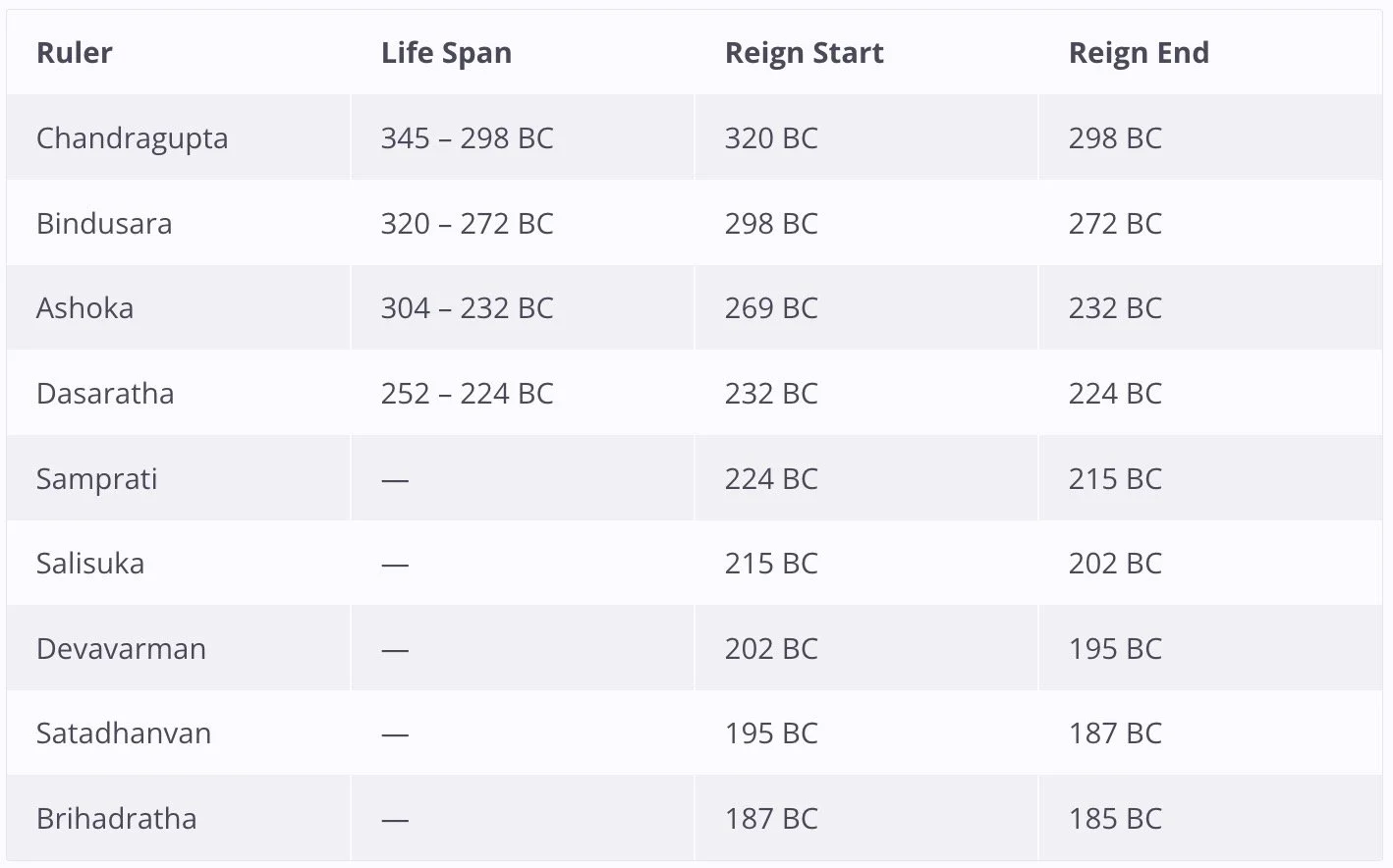
Rulers of the Maurya Dynasty
Expansion of the Mauryan State
The expansion of the Mauryan state occurred in several distinct phases:
Magadha state in the 5th century BCE.
The Nanda Empire at its greatest extent under Dhana Nanda 323 BCE
The Maurya Empire when it was first founded by Chandragupta Maurya 320 BCE, after conquering the Nanda
Chandragupta extended the borders of the Maurya Empire towards Seleucid Persia after defeating Seleucus 305 BCE.
Bindusara extended the borders of the empire southward into the Deccan Plateau 300 BCE
Ashoka extended into Kalinga during the Kalinga War 265 BCE, and established superiority over the southern kingdoms
Chandragupta Maurya: Background and Sources
His Background
Very little is known about Chandragupta's ancestry. What is known is gathered from later classical Sanskrit literature, Buddhist Sources as well as classical Greek and Latin sources.
Classical Greek and Latin Sources
Classical Greek and Latin sources which refer to Chandragupta by the names "Sandracottos" or "Andracottus." Plutarch in his book "Parallel Lives" reports that Androcottus (Chandraupta) met with Alexander around Takshasila in the northwest, and that he viewed the ruling Nanda Empire in a negative light. Chandragupta is also said to have met the Nanda king, angered him, and made a narrow escape. According to this text, the encounter would have happened around 326 BCE, suggesting a birth date for Chandragupta around 340 BCE. Plutarch and other Greco-Roman historians appreciated the gravity of Chandragupta Maurya's conquests. Justin (a 2nd century AD Latin historian who lived under the Roman Empire) describes the humble origins of Chandragupta, and explains how he later led a popular uprising against the Nanda king.
Chandragupta Maurya: Classical Sanskrit and Buddhist Sources
Classical Sanskrit Sources
Chandragupta Maurya's rise to power is shrouded in mystery and controversy. Sanskrit drama Mudrarakshasa ("The Signet of the Minister") by Visakhadatta, describe his royal ancestry and even link him with the Nanda family. Mudrarakshasa calls him a "Nandanvaya" i.e. the descendant of Nanda. Mudrarakshasa uses terms like kula-hina and Vrishala for Chandragupta's lineage. This means that Chandragupta had a humble origin. The Mudrarakshasa ("The Signet of the Minister") is a historical play in Sanskrit by Vishakhadatta that narrates the ascent of the king Chandragupta Maurya (322BC – 298BC) to power in India. Mudrarakshasa is dated variously at the late 4th century. The Mudrarakshasa as well as the Jaina work Parisishtaparvan talk of Chandragupta's alliance with the Himalayan king Parvatka, sometimes identified with Porus.
Buddhist Sources
The Buddhist text the Mahavamsa calls Chandragupta a member of a division of the (Kshatriya) clan called the Moriya i.e. Mor clan or gotra of Jat people. The Mahaparinibbana Sutta states that the Moriyas (Mauryas) belonged to the Kshatriya community. The Mahavamshatika connects him with the Shakya clan of the Buddha. A medieval inscription represents the Maurya clan as belonging to the solar race of Kshatriya.
Rise of Chandragupta Maurya and Foundation of Maurya Dynasty
The Maurya Empire was founded by Chandragupta Maurya, with help from Chanakya, a Brahmin teacher at Takshashila. According to several legends, Chanakya traveled to Magadha, a kingdom that was large and militarily powerful and feared by its neighbors, but was insulted by its king Dhana Nanda, of the Nanda Dynasty. Chanakya swore revenge and vowed to destroy the Nanda Empire.
Chanakya encouraged Chandragupta Maurya and his army to take over the throne of Magadha. Chanakya's original intentions were to train a guerilla army under Chandragupta's command. Using his intelligence network, Chandragupta gathered many young men from across Magadha and other provinces, men upset over the corrupt and oppressive rule of king Dhana Nanda, plus the resources necessary for his army to fight a long series of battles.
Preparing to invade Pataliputra, Maurya came up with a strategy. A battle was announced and the Magadhan army was drawn from the city to a distant battlefield to engage Maurya's forces. Maurya's general and spies meanwhile bribed the corrupt general of Nanda. He also managed to create an atmosphere of civil war in the kingdom, which culminated in the death of the heir to the throne. Chanakya managed to win over popular sentiment. Ultimately Nanda resigned, handing power to Chandragupta, and went into exile.
Chanakya contacted the prime minister, Rakshasas, and made him understand that his loyalty was to Magadha, not to the Nanda dynasty, insisting that he continue in office. Rakshasa accepted Chanakya's reasoning, and Chandragupta Maurya was legitimately installed as the new King of Magadha. Rakshasa became Chandragupta's chief advisor, and Chanakya assumed the position of an elder statesman.
Chandragupta's Conquest of Northwestern India
Meanwhile, the conquering armies of Alexander the Great refused to cross the Beas River and advance further eastward, deterred by the prospect of battling Magadha. Alexander returned to Babylon and re-deployed most of his troops west of the Indus river. Soon after Alexander died in Babylon in 323 BCE, his empire fragmented, and local kings declared their independence, leaving several smaller disunited satraps.
The Roman historian Justin described how Sandrocottus (Greek version of Chandragupta's name) conquered the northwest: After Alexander's death in 323 BCE, Chandragupta turned his attention to Northwestern South Asia (modern Pakistan), where he defeated the satrapies left in place by Alexander, and may have assassinated two of his governors, Nicanor and Philip. The satrapies he fought may have included Eudemus, ruler in western Punjab until his departure in 317 BCE; and Peithon, ruler of the Greek colonies along the Indus until his departure for Babylon in 316 BCE. Chandragupta had defeated Macedonian satrapies in the northwest of the Indian subcontinent by 317 BCE.
Chandragupta's Military Expansion and Conflict with Seleucus
Expansion by Chandragupta Maurya
Megasthenes recorded the size of Chandragupta's army as 400,000 soldiers. According to Strabo: Megasthenes was in the camp of Sandrocottus (Chandragupta), which consisted of 400,000 men. On the other hand, Pliny, who also drew from Megasthenes' work, gives even larger numbers of 600,000 infantry, 30,000 cavalry, and 9,000 war elephants. The Mauryas' military strength was almost three times that of the Nandas, and this was apparently because of a much larger empire and thus far greater resources.
Conquest of Seleucus' eastern territories
Justin, a Greek writer, says that Chandragupta overran the whole of India with an army of 600,000. This may or may not be true, but Chandragupta liberated north-western India from the thraldom of Seleucus. Seleucus I Nicator, a Macedonian satrap of Alexander, reconquered most of Alexander's former empire and put under his own authority the eastern territories as far as Bactria and the Indus (A/C to Appian, History of Rome), until in 305 BCE he entered into conflict with Chandragupta. Seleucus appears to have fared poorly, having ceded large territories west of the Indus to Chandragupta. Due to his defeat, Seleucus surrendered vast territory west of the Indus, including the Hindu Kush, modern day Afghanistan, Arachosia (modern Kandahar), Gedrosia (modern Balochistan), Gandhara. Archaeologically, concrete indications of Maurya rule, such as the inscriptions of the Edicts of Ashoka, are known as far as Kandhahar in southern Afghanistan.
Treaty Between Chandragupta and Seleucus
Classical sources have recorded that following treaty between both (probably first treaty of Ancient India with foreigner), Chandragupta and Seleucus exchanged presents. Chandragupta married Seleucus's daughter to formalize an alliance. In a return gesture, Chandragupta sent 500 war-elephants, a military asset which would play a decisive role at the Battle latter on. In addition to this treaty, Seleucus dispatched an ambassador, Megasthenes, to Chandragupta, and later Deimachus to his son Bindusara, at the Maurya court at Pataliputra. Later Ptolemy II Philadelphus, the ruler of Ptolemaic Egypt and contemporary of Ashoka, is also recorded by Pliny as having sent an ambassador named Dionysius to the Maurya court.
Presents continued to be exchanged between the Mauryan rulers and Greek rulers. Intensity of these contacts is testified by the existence of a dedicated Mauryan state department for Greek (Yavana) and Persian foreigners, or the remains of Hellenistic pottery that can be found throughout northern India. On these occasions, Greek populations apparently remained in the northwest of the Indian subcontinent under Mauryan rule. Ashoka, installed many Edicts, written in Greek. In his edicts, Ashoka mentions that he had sent Buddhist emissaries to Greek rulers as far as the Mediterranean (Edict No. 13), and that he developed herbal medicine in their territories, for the welfare of humans and animals (Edict No. 2).
The Greeks in India even seem to have played an active role in the propagation of Buddhism, as some of the emissaries of Ashoka such as Dharmaraksita, or the teacher Mahadharmaraksita, are described in Pali sources as leading Greek ("Yona", i.e., Ionian) Buddhist monks, active in Buddhist proselytism (mentioned in Mahavamsa). It is also thought that Greeks contributed to the sculptural work of the Pillars of Ashoka, and more generally to the blossoming of Mauryan art.
Chandragupta's Later Life and Jainism
According to Jain tradition, Chandragupta gave up his throne at the beginning of the third century BC when he was forty-two years old and became an ascetic under the last Shrutakevali Bhadrabahu, migrating south with them and ending his days in sallekhana (death by fasting) according to Jain spiritual tradition at Sravaṇa Beḷgoḷa in present day Karnataka, though fifth-century inscriptions in the area support the concept of a larger southern migration around that time.
Chandragupta was first to take title of Devampriya and Priyadarshi.
Mauryan Administration: Megasthenes's Indika
The Mauryas organized a very elaborate system of administration. We know about this from the account of Megasthenes and the Arthashastra of Kautilya.
Megasthenes's Indika
Megasthenes (a Greek ethnographer and explorer in the Hellenistic period) was a Greek ambassador sent by Seleucus to the court of Chandragupta Maurya. He lived in the Maurya capital of Pataliputra and wrote an account not only of the administration of the city of Pataliputra but also of the Maurya empire as a whole. Megasthenes's account does not survive in full, but quotations from it occur in the works of several subsequent Greek writers. These fragments have been collected and published in the form of a book entitled Indika, which throws valuable light on the administration, society, and economy of Maurya times. His Indica served as an important source for many later writers such as Strabo and Arrian.
At the beginning of his Indica, he refers to the older Indians who know about the prehistoric arrival of Dionysus and Hercules (divine Greek Heroes) in India, which was a story very popular amongst the Greeks during the Alexandrian period. Particularly important are his comments on the religions of the Indians. He mentions the devotees of Heracles and Dionysus but he does not mention Buddhists, something that gives support to the theory that the latter religion was not widely known before the reign of Ashoka.
Megasthenes on Pataliputra, the King, and Administration
About Pataliputra
Megasthenes describes such features as the Himalayas and the island of Sri Lanka. He states that numerous cities existed in India, but he considered Pataliputra to be the most important. He calls it Palibothra. This Greek term means a city with gates. According to him, Pataliputra was bounded by a deep ditch and a wooden wall crowned with 570 towers, and had 64 gates which rivaled the splendors of contemporaneous Persian sites such as Susa. The ditch, timber palisades, and also wooden houses have been found in excavations. According to Megasthenes, Pataliputra was 9.33 miles long and 1.75 miles broad. This size tallies with that of Patna even today, because Patna is all length with little breadth. Given this conformity, it is possible to trust Megasthenes's other statements.
About King
Megasthenes gives a detailed description of the personal life of Chandragupta Maurya. He led a very splendid life and his palace was unique in its beauty. The king did not sleep in one room for two continuous days. He did not favor meeting the people too much.
About Administration
Megasthenes has written a lot about the civil administration of Chandragupta Maurya. He writes that the king was an autocrat and he was the master of unlimited powers. He kept himself fully aware of the main events of his empire through his spies. Megasthenes refers to the administration of Pataliputra, the capital of the Mauryas. The city was administered by six committees, each of which consisted of five members. These committees were entrusted with sanitation, care of foreigners, registration of birth and death, regulation of weights and measures, and similar other functions. The administration of the armed forces, according to Megasthenes, was carried on by a board of thirty officers divided into six committees, each committee consisting of five members. It seems that each of the six wings of the armed forces, the army, the cavalry, the elephants, the chariots, the navy, and the transport, was assigned to the care of a separate committee.
Megasthenes on Indian Society and Slavery
About Indian Society
Megasthenes describes a disciplined multitude of people under Chandragupta, who live simply, honestly, and do not know writing: "The Indians all live frugally, especially when in camp. They dislike a great undisciplined multitude, and consequently they observe good order. Theft is of very rare occurrence. People have no written laws, and are ignorant of writing, and must therefore in all the business of life trust to memory. They live, nevertheless, happily enough, being simple in their manners and frugal. They never drink wine except at sacrifices. Their beverage is a liquor composed from rice instead of barley, and their food is principally a rice-pottage."
He found that slavery system was unknown to the Ancient Indian society. He has declared all the Indians are free. Slaves do not exist in India. Megasthenes did not travel whole of India and so his observations may not apply to the whole country. Perhaps, since slavery did not exist in North-Western India, had an impact on Megasthenes and he declared that whole of India was free from the custom of slavery.
Megasthenes' observations about the non-existence of slavery in Ancient India are not supported by available evidences. From the Smritis or Hindu Law Books it is clear that slavery was a recognized institution in India in the Vedic Age. Some scholars have tried to interpret and explain Megasthenes as such. Slavery system in India was very mild and most of the slaves were domestic slaves who were treated as members of the family. Slave trade was prohibited in the Shastras. Different injunctions were laid down in the Shastras for the liberation of the slaves. Megasthenes was impressed by the prevailing intellectual mood of the time. The liberal rules of the Arthasastra for slaves testify the liberal attitude of the society towards slavery.
Megasthenes on the Seven Classes of Indian Society
He describes that Indians are divided into seven classes, a caste system different from the one that exists today, which shows that the caste system may to some extent be fluid and evolving. However, it might be that, being a foreigner, he was not adequately informed about the caste system. Seven classes are:
Philosophers (sophists)
Which in number is inferior to the other classes, but in dignity preeminent over all.
Husbandmen
Who appear to be far more numerous than the others. They devote the whole of their time to tillage; for men of this class, being regarded as public benefactors, are protected from all injury.
Shepherds (herdsmen)
Who neither settle in towns nor in villages, but live in tents. They pay taxes from their animals.
Artisans and shopkeepers
They too perform public duties, and pay tax on the receipts from their work, except for those who make weapons of war and actually receive a wage from the community.
Military
Next to the farmers in number; they enjoy the greatest freedom and most agreeable life. They are devoted solely to military activities. The entire force are maintained at the king's expense.
Overseers
They supervise everything that goes on in the country and cities, and report it to the king, where the Indians are governed by kings, or to the authorities, where they are self governing.
Councillors and Assessors
Who deliberate on public affairs. It is the smallest class, looking to number, but the most respected, on account of the high character and wisdom of its members. From their ranks the advisers of the king, the treasurers, of the state, arbiters who settle disputes, generals of the army, chief magistrates, usually belong to this class, supervisors of agricultural works are taken.
Kautilya and the Arthashastra
The Arthashastra is an ancient Indian treatise on statecraft, public administration, economic policy and military strategy, written in Sanskrit. It identifies its author by the names "Kauṭilya" and "Vishnugupta" both names that are traditionally identified with Chanakya (350–283 BCE), who was a scholar at Takshashila and the teacher and guardian of Emperor Chandragupta Maurya. (Though many authors seems to have contributed to the Arthasastra over the centuries.)
Megasthenes's account can be supplemented by the Arthashastra of Kautilya. Although the Arthashastra was finally compiled a few centuries after Maurya rule. It is divided into 15 adhikarnas or sections and 180 Prakaranas or subdivisions. It has about 6,000 slokas. It was rediscovered in 1904 by R. Shamasastry, who published it in 1909. The first English translation was published in 1915.
Despite the controversy over its date and authorship, its importance lies in the fact that it gives a clear and methodological analysis of economic and political conditions of the Mauryan period. The similarities between the administrative terms used in the Arthashastra and in the Asokan edicts certainly suggests that the Mauryan rulers were acquainted with this work. Arthashastra provides useful and reliable information regarding the social and political conditions as well as the Mauryan administration.
Kautilya on Kingship and Administration
King
Kautilya suggests that the king should be an autocrat and he should concentrate all powers into his own hands. He should enjoy unrestricted authority over his realm. But at the same time, he should give honour to the Brahmanas and seek advice from his ministers. Thus the king though autocrat, should exercise his authority wisely. He should be cultured and wise. He should also be well-read so as to understand all the details of his administration. He says that the chief cause of his fall is that the king is inclined towards evil. He lists six evils that led to a king's decline. They are haughtiness, lust, anger, greed, vanity and love of pleasures. Kautilya says that the king should live in comfort but he should not indulge in pleasures.
Ideals of Kingship
The major ideal of kingship according to Kautilya is that his own well-being lies in the well-being of his people of only the happy subjects ensure the happiness of their sovereign. He also says that the king should be 'Chakravarti' or the conqueror of different realms and should win glory by conquering other lands. He should protect his people from external dangers and ensure internal peace. Kautilya maintained that the soldiers should be imbued with the spirit of a 'holy war' before they march to the battlefield. According to him, all is fair in a war waged in the interest of the country.
About the Ministers
Kautilya maintains that the king should appoint ministers. King without ministers is like a one wheeled chariot. According to Kautilya, king's ministers should be wise and intelligent. But the king should not become a puppet in their hands. He should discard their improper advise. The ministers should work together as a team. They should hold meetings in privacy. He says that the king who cannot keep his secrets cannot last long.
Bindusara (298BCE-272BCE)
Bindusara was the son of the first Mauryan emperor Chandragupta Maurya and his queen Durdhara. According to the Rajavalikatha a Jain work, the original name of this emperor was Simhasena. Bindusara, just 22 year-old, inherited a large empire that consisted of what is now, Northern, Central and Eastern parts of India along with parts of Afghanistan and Baluchistan.
Bindusara's life has not been documented as well as that of his father Chandragupta or of his son Ashoka. Chanakya continued to serve as prime minister during his reign. According to the medieval Tibetan scholar Taranatha who visited India, Chanakya helped Bindusara "to destroy the nobles and kings of the sixteen kingdoms and thus to become absolute master of the territory between the eastern and western oceans."
Bindusara extended this empire to the southern part of India, as far as what is now known as Karnataka. He brought sixteen states under the Mauryan Empire and thus conquered almost all of the Indian peninsula (he is said to have conquered the 'land between the two seas' – the peninsular region between the Bay of Bengal and the Arabian Sea). Bindusara didn't conquer the friendly Tamil regions (Pandya, Chera, Chola and Satyaputra). Apart from these southern states, Kalinga (modern Odisha) was the only kingdom in India that didn't form the part of Bindusara's empire. It was later conquered by his son Ashoka, who served as the viceroy of Ujjaini during his father's reign. The famous Tamil poet Mamulanar of the Sangam literature also described how the Deccan Plateau was invaded by the Maurya army.
He had a Greek ambassador at his court, named Deimachus Strabo. Ambassadors from the Seleucid Empire (such as Deimachus) and Egypt visited his courts. He maintained good relations with the Hellenic World. He was a man of wide interest and taste, since tradition had it that he asked Antiochus I (a king of the Hellenistic Seleucid Empire) to send him some sweet wine, dried figs and a sophist. Antiochus wrote to him in answer, "The dry figs and the sweet wine we will send you; but it is not lawful for a sophist to be sold in Greece". Unlike his father Chandragupta (who at a later stage converted to Jainism), Bindusara believed in the Ajivika sect. Bindusara's guru Pingalavatsa (alias Janasana) was a Brahmin of the Ajivika sect. During his rule, the citizens of Taxila revolted twice. The reason for the first revolt was the maladministration of Suseema, his eldest son. The reason for the second revolt is unknown, but Bindusara could not suppress it in his lifetime. It was crushed by Ashoka after Bindusara's death. Bindusara died in 272 BCE and was succeeded by his son Ashoka the Great.
Ashoka (272-232 BCE): Early Life and Accession
Ashoka Maurya was an Indian emperor of the Maurya Dynasty who ruled almost all of the Indian subcontinent. The empire's capital was Pataliputra. When Bindusara's wife bore a son, it is from her exclamation "I am now without sorrow," that Ashoka got his name.
The Buddhist text "Divyavadana" describes Ashoka putting down a revolt due to activities of wicked ministers in Ujjain and Taxila. This may have been an incident in Bindusara's times. Bindusara's death in 272 BCE led to a war over succession. The Dipavansa and Mahavansa refer to Ashoka's killing 99 of his brothers, sparing only one, named Vitashoka or Tissa. He came into power with the support of minister Radhagupta. Buddhist legends state that Ashoka was bad-tempered and of a wicked nature. He built Ashoka's Hell, an elaborate torture chamber.
Ascending the throne, Ashoka expanded his empire over the next eight years, from the present-day boundaries Assam in the East to Iran in the West; from the Pamir Knot in the north to the peninsula of southern India except for present day Tamil Nadu and Kerala which were ruled by the three ancient Tamil kingdoms. As monarch he was ambitious and aggressive, re-asserting the Empire's superiority in southern and western India. But it was his conquest of Kalinga (262–261 BCE) which proved to be the pivotal event of his life.
The Kalinga War and Its Aftermath
The Kalinga War was fought between Ashoka and the ruler of the state of Kalinga, a feudal republic located on the coast of the present-day Odisha and northern parts of Andhra Pradesh. The Kalinga war, the only major war Ashoka fought after his accession to throne.
Causes of Kalinga war
The main reasons for invading Kalinga were both political and economic. Since the time of Ashoka's father, King Bindusara, the Mauryan Empire based in Magadha was following a policy of territorial expansion. Kalinga was under Magadha control during the Nanda rule, but regained independence with the beginning of the rule of the Mauryas. That was considered a great setback for the traditional policy of territorial expansion of the Magadhan emperors and was considered to be a loss of political prestige for the Mauryas. Moreover since its independence Kalinga became an arch enemy of Magadha and allied itself with Chola and Pandya countries of South against Magadha. Thus, Ashoka invaded Kalinga. Kalinga had a vast army and could be detrimental for the security of the Maurya Empire. It was also true that due to her commercial relation with Malay, Java and Ceylon Kalinga had enormous material prosperity. Possibly this had also provoked Asoka to invade Kalinga.
Aftermath of Kalinga War
Ashoka's response to the Kalinga War is recorded in the Edicts of Ashoka. The Kalinga War prompted Ashoka to devote the rest of his life to Ahinsa (non-violence) and to Dharma-Vijaya (victory through Dharma). Following the conquest of Kalinga, Ashoka ended the military expansion of the empire, and led the empire through more than 40 years of relative peace, harmony and prosperity. Rock Edict No.13 (Dhauli/ Tosali): "Beloved-of-the-Gods, King Priyadarsi, conquered the Kalingas eight years after his coronation. One hundred and fifty thousand were deported, one hundred thousand were killed and many more died (from other causes). After the Kalingas had been conquered, Beloved-of-the-Gods came to feel a strong inclination towards the Dharma, a love for the Dharma and for instruction in Dharma. Now Beloved-of-the-Gods feels deep remorse for having conquered the Kalingas." After 2.5 years of Kalinga war, Asoka became an enthuastic supporter of religion of Buddha. Under its influnce he eventually foreswore conquest y war (Bherighosa) and replaced it with conquest by Dharma (Dhammaghosha). He refrained from engraving his confession of remorse at any location in Kalinga. This was replaced by the separate Rock Edicts, which are instructios to his officers, emphasizing need for good governance. Nigrodha (a 5 years old buddhist monk) was responsible for the change in Ashoka. It is said that he was converte to Buddhism by Upagupta.
