
Magadha Empire
Rise of the Magadha Empire and the Nandas
In the sixth century BCE, the Indian subcontinent witnessed a transformative period marked by political consolidation and imperial ambition. From sixteen major kingdoms known as Mahajanapadas, a pattern of conquest and submission emerged, reshaping the political landscape of ancient India. Through warfare, diplomacy, and strategic expansion, smaller kingdoms either submitted to stronger rulers or were eliminated entirely. By the end of this tumultuous period, only four major kingdoms remained standing: Avanti, Vatsa, Kosala, and Magadha. Among these survivors, one power rose above all others—the Kingdom of Magadha, which would lay the foundation for one of India's first great empires and establish a model of imperial governance that would influence the subcontinent for centuries to come.
The Political Landscape: From Sixteen to Four
The Sixteen Mahajanapadas
Ancient India in the sixth century BCE was fragmented into sixteen great kingdoms and numerous republican states. This political atomisation created chronic instability, with constant warfare between neighbouring states. The Aryan culture had spread across Northern India, but political unity remained elusive. Each kingdom pursued its own interests, making the region vulnerable to both internal conflict and external threats.
The Four Power Struggle
Through decades of conflict, weaker kingdoms fell one by one. Four major powers emerged: Avanti in the west, Vatsa in the centre, Kosala in the north, and Magadha in the east. These kingdoms entered into fierce competition for imperial supremacy. The conflict that ensued would reshape the political map of India and determine which kingdom would lead the subcontinent into a new era of centralised power.
Magadha's Geographical Advantages
Strategic Capital Locations
Rajgriha, Magadha's first capital, was surrounded by five hills and protected by cyclopean stone walls, making it virtually impregnable. The new capital, Pataliputra, was positioned near the confluence of the Ganga, Gandak, Son, and Ghagra rivers—a true Jaladurga or water fortress. These strategic positions provided exceptional defensive capabilities whilst facilitating control over vital trade routes.
River System Mastery
The Magadhan Empire was encircled by three major rivers—the Ganges, Son, and Champa—creating natural barriers against invasion. These rivers served dual purposes: defensive moats during warfare and vital highways for trade and military movement. Control over these waterways allowed Magadha to dominate regional commerce whilst moving troops rapidly to any threatened border.
Elephant Advantage
The eastern regions provided Magadha with abundant access to war elephants, which became a decisive military asset. Magadha pioneered the large-scale use of elephants in warfare, eventually maintaining a force of 6,000 elephants under the Nandas. These massive animals could storm fortresses, traverse difficult terrain, and strike terror into enemy ranks, giving Magadha a significant tactical advantage over its rivals.
Economic Foundations of Magadhan Power
Magadha's rise to imperial supremacy was built upon a foundation of economic prosperity and resource abundance. The kingdom's fertile lands, strategic location, and rich mineral deposits created a wealth-generating system that could fund armies, support administration, and sustain expansion. This economic solvency distinguished Magadha from its rivals and provided the material resources necessary for empire-building.
Agricultural Prosperity
The Magadhan lands between the Ganges and Son rivers yielded multiple crops annually due to exceptional fertility. Deep ploughing with heavy iron implements maximised agricultural output. A vast population could be employed in farming, with surplus production supporting the growing state apparatus and military expansion.
Iron Resources
Abundant iron deposits at Rajgir mines gave Magadha a technological edge. Iron weapons equipped the vast army, whilst surplus could be sold to other states. Iron ploughshares enabled intensive agriculture. This metal wealth positioned Magadha at the forefront of the Iron Age revolution sweeping across Northern India.
Trade Domination
Magadha's location on major land routes connecting Eastern and Western India proved economically decisive. The Ganges served as the principal trade highway of Northern India. Control over river ports like Champa and Kasi allowed Magadha to regulate and tax regional commerce, generating substantial revenue for the state treasury.
The Significance of the Ganges
The Ganges River system became the backbone of Magadhan imperial expansion. By systematically gaining control over key river ports and regions along the Ganges valley, Magadha established commercial and military supremacy across Northern India. Each conquest along this vital waterway strengthened the kingdom's economic position and extended its sphere of influence.
Conquest of Champa
Bimbisara's annexation of Champa port in Anga kingdom provided access to maritime trade with Southeast Asia, Ceylon, and South India. This flourishing port became Magadha's gateway to oceanic commerce.
Acquisition of Kasi
Defeating Kosala and annexing Kasi gave Magadha control over another crucial river port and commercial centre. This victory established Magadhan hegemony over the southern Ganges, enabling economic penetration into Kosala territory.
Northern Expansion
The conquest of Vaisali and Lichchavi countries brought the northern Ganges under Magadhan control. With both banks of the river secured, Magadha achieved supreme mastery over the entire Gangetic valley.
Pan-Indian Vision
Complete control of the Ganges valley provided the strategic base for Magadha's ambitious programme of pan-Indian empire building. The river system became the spine of imperial power.
Cultural and Political Factors
Cultural Synthesis
Magadha represented a unique meeting ground where Aryan culture, having lost some of its original vigour, merged with lingering traces of non-Aryan traditions from Eastern India. This cultural synthesis generated new energy and perspectives that distinguished Magadha from more orthodox regions. The revolutionary philosophies of Mahavira and Buddha emerged from this intellectual ferment, challenging established religious orthodoxy and creating new frameworks for understanding society and governance.
The unorthodox character of Magadhan society, having been only recently brought under Vedic influence, demonstrated greater enthusiasm for expansion than kingdoms with longer histories of Vedic culture. This relative freedom from rigid traditional constraints enabled more pragmatic and ambitious political strategies. In both philosophical and political spheres, Eastern India—with Magadha at its centre—proved willing to break with tradition and forge new paths.
Political Atomisation
The political fragmentation of Northern India in the sixth century BCE created optimal conditions for Magadhan expansion. Mutual jealousies prevented rival kingdoms from forming effective alliances against Magadha. Only the republican Vriji confederation attempted coordinated resistance.
Natural barriers—rivers, mountains, and forests—further prevented unified opposition. This divided political landscape allowed Magadha to pursue a strategy of sequential conquest, dealing with rivals one at a time rather than facing a united front.
Military Innovation and Leadership
Elephant Warfare
Magadha pioneered the large-scale deployment of war elephants, maintaining 6,000 elephants under the Nandas. These massive animals could storm fortifications, traverse marshy terrain where chariots failed, and dominate the battlefield through sheer size and power. This innovation gave Magadha a decisive tactical advantage over neighbours who relied on traditional cavalry and chariots.
Siege Technology
Ajatashatru introduced advanced military engineering, including stone-throwing engines similar to catapults and war chariots with attached maces for mass destruction. These technological innovations demonstrated Magadha's willingness to adopt and develop new military techniques, giving its armies capabilities that rivals could not match.
Exceptional Rulers
An unbroken succession of able monarchs—Bimbisara, Ajatashatru, Shishunaga, Mahapadma Nanda, and Chandragupta Maurya—provided consistent strategic leadership. These rulers employed all means necessary for expansion, supported by brilliant ministers like Vassakara, Kautilya, and Radha Gupta, whose diplomatic and administrative skills proved essential to imperial success.
External Threats and Imperial Necessity
The threat of foreign invasion played a crucial role in creating the conditions for Magadhan imperialism. The Achaemenian invasion in the sixth century BCE and the Macedonian incursion under Alexander in the fourth century BCE exposed the vulnerability of politically fragmented India. These external pressures generated a growing awareness that only a centralised paramount government could effectively defend the subcontinent against foreign powers.
The consciousness that unity was essential for defence against external aggression certainly worked behind the rise of Magadhan imperialism and prepared the country to submit to Magadhan hegemony. The lesson of these invasions was clear: divided kingdoms could not protect India's frontiers, but a unified empire might.
This realisation transformed Magadha's imperial ambitions from merely regional conquest into a project with national significance. The empire-building efforts of Magadhan rulers could be justified not simply as territorial aggrandisement but as necessary for the collective security of the Indian subcontinent. The foreign invasions thus paradoxically strengthened support for Magadhan expansion by demonstrating the practical necessity of political unification under a single powerful state capable of coordinating defence and diplomacy across the entire region.
The Haryanka Dynasty
Foundation of Empire (c. 600–413 BCE)
According to tradition, the Haryanka dynasty established the Magadha Empire around 600 BCE with Rajagriha as its capital, later relocating to Pataliputra. This dynasty pioneered the imperial project that would transform Magadha from a regional kingdom into the dominant power of Northern India. The Haryanka rulers developed the fundamental strategies of territorial expansion, diplomatic alliances, and military innovation that subsequent dynasties would build upon.
Bimbisara (543–491 BCE)
Matrimonial Diplomacy: Married Kosala Devi (sister of Prasenjit of Kosala), bringing Kashi as dowry; wed Chellana, a Lichchhavi princess; and Kshema, daughter of the Madra chief. These alliances secured Magadha's borders and expanded influence.
Territorial Gains: Conquered Anga kingdom, placing it under his son Ajatashatru's viceroyalty. Kashi provided crucial revenue and trade access.
Religious Patronage: Buddhist texts describe him as an important disciple of Buddha, whilst Jain texts name him as a follower of Mahavira, demonstrating his engagement with emerging religious movements.
Ajatashatru (491–460 BCE)
Aggressive Expansion: Fought wars with Kosala and Vaishali, conquering both despite familial ties. Built fortifications at Pataliputra to defend against Avanti and strengthen Magadha's position.
Military Innovation: Employed catapult-like stone-throwing engines and mace-equipped chariots. After sixteen years of warfare, broke the Lichchhavi confederation's power.
Religious Legacy: Patronised the First Buddhist Council at Rajgriha following Buddha's mahaparinirvana, preserving Buddhist teachings for posterity.
The Shishunaga Dynasty
Consolidation and Rivalry's End (413–345 BCE)
The Shishunaga dynasty emerged following a popular rebellion against the last Haryanka ruler. Shishunaga, initially a minister, ascended the throne and achieved what his predecessors could not—the defeat of Avanti, Magadha's most serious rival. This victory ended a century-old rivalry and brought the wealthy kingdom of Malwa under Magadhan control.
Shishunaga's Achievement
The conquest of Avanti represented a watershed moment in Magadhan imperial history. For over a century, these two powerful kingdoms had vied for supremacy over Northern India. Avanti, with its capital at Ujjain and its own rich deposits of iron ore, had proven a formidable competitor. Previous Magadhan rulers had prepared for conflict with Avanti but never achieved decisive victory.
Shishunaga's success in defeating and annexing Avanti eliminated the last major obstacle to Magadhan hegemony. The kingdom that had matched Magadha in military strength and economic resources now became part of the growing empire, its wealth and strategic position strengthening rather than threatening Magadhan power.
Kalashoka's Reign
Kalashoka (also known as Kakavarna), Shishunaga's successor, presided over two significant events. First, the Second Buddhist Council convened at Vaishali in 383 BCE, addressing doctrinal disputes within the Buddhist community. Second, the capital permanently transferred from Vaishali to Pataliputra, cementing that city's role as the imperial centre.
The dynasty concluded with Mahanandin, probably the last Shishunaga ruler. The Nandas, who succeeded the Shishunagas around 345 BCE, would take Magadhan imperialism to unprecedented heights, building upon the territorial foundations and administrative systems established by their predecessors.
The Nanda Dynasty: First Empire Builders
Peak of Pre-Mauryan Power (345–321 BCE)
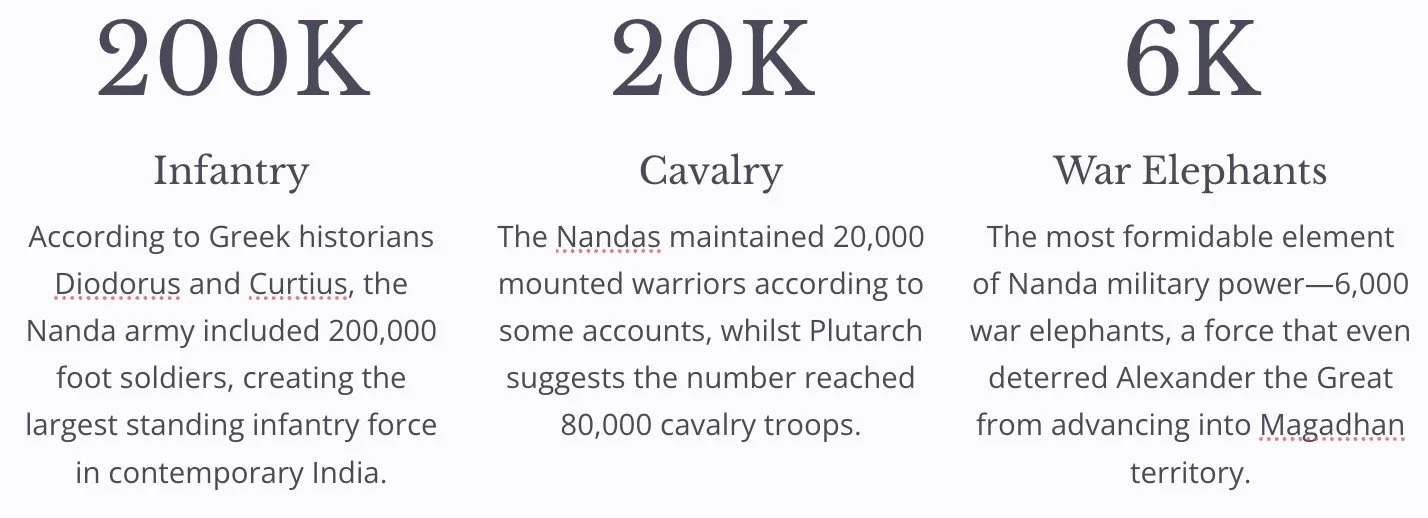
The Nanda dynasty marked a revolutionary moment in Indian political history. Though considered of low origin—with founder Mahapadma Nanda described as son of a Shudra mother—the Nandas built what can be considered India's first true empire. They inherited the substantial Magadhan kingdom and systematically expanded it across the subcontinent, wielding military force on a scale unprecedented in recorded Indian history.
The Nanda Dynasty: First Empire Builders
Mahapadma Nanda: The Sole King
Mahapadma Nanda earned the title Ekrat—the "Sole King"—through his systematic destruction of rival kingdoms. The Puranas describe him as "the destroyer of all the Kshatriyas," indicating the thoroughness with which he eliminated competing royal houses. His conquests extended across Northern India, defeating the Panchalas, Kasis, Haihayas, Kalingas, Asmakas, Kurus, Maithilas, and Surasenas.
The conquest of Kalinga represented a particularly significant achievement. Mahapadma brought the image of Jina from Kalinga to his capital, a fact later referenced in the Hathigumpha inscription of Kharavela. This conquest extended Magadhan power south of the Vindhya range into the Deccan plateau, establishing the Nandas as the first rulers to create a genuinely pan-regional empire in recorded Indian history.
The Nandas' achievement lay not merely in conquest but in creating the administrative and military infrastructure of empire. They standardised weights and measures across their territories, undertook irrigation projects, and governed through an extensive ministerial system. Their immense wealth became legendary—the Tamil poet Mamulanar described Pataliputra's treasures in glowing terms.
Alexander and the Nanda Empire
When Alexander the Great invaded India in 326 BCE, the Nanda Empire under Dhana Nanda represented a military force far exceeding anything the Macedonian conqueror had yet encountered. Greek historians' accounts of the Nanda army's size—particularly the thousands of war elephants—struck fear into Alexander's already exhausted troops. At the Hyphasis River (modern Beas), his forces mutinied, refusing to advance further.
The Deterrent Effect
The Nanda army never actually engaged Alexander in battle, yet its reputation alone achieved what no other kingdom had managed—halting the Macedonian advance. Alexander's soldiers, battle-weary after years of campaign, confronted reports of an empire with military resources dwarfing any they had faced. The prospect of fighting 6,000 war elephants proved decisive in their refusal to march eastward.
Imperial Wealth
The Nandas' financial extortion and accumulated wealth became both their strength and weakness. This treasure funded their massive military establishment but also generated widespread unpopularity. Their "financial extortion" methods alienated subject populations, creating conditions ripe for revolution. Chandragupta Maurya and Kautilya would exploit this unpopularity to overthrow the dynasty.
Bimbisara's Three-Pronged Strategy
Bimbisara, the contemporary of Buddha, laid the foundation of Magadhan imperialism through a sophisticated three-pronged approach that combined diplomacy, friendship, and calculated military action. His policy demonstrated remarkable strategic foresight, avoiding unnecessary conflicts whilst systematically expanding Magadhan power and influence across Northern India.
Matrimonial Alliances
Strategic marriages secured borders and created diplomatic networks. Wedding Kosala Devi brought Kashi territory yielding 100,000 coins annually. Marriages to Lichchhavi and Madra princesses extended influence north and west.
Friendship with Rivals
Maintained cordial relations with Avanti's powerful King Pradyota. When Pradyota fell ill with jaundice, Bimbisara sent royal physician Jivaka to Ujjain, demonstrating diplomatic goodwill and avoiding costly warfare with Magadha's most serious competitor.
Conquest of the Weak
Defeated Brahmadatta and conquered Anga kingdom, annexing its prosperous port of Champa. This victory provided crucial access to maritime trade routes connecting India with Southeast Asia, Ceylon, and coastal regions.
Through these interlocking strategies, Bimbisara transformed Magadha from one kingdom among many into the dominant power of the sixth century BCE. His control over Kashi and Anga provided essential economic resources, whilst matrimonial alliances secured diplomatic support. The friendship with Avanti prevented a two-front war, allowing Magadha to concentrate on expansion elsewhere. This policy of calculated aggression combined with strategic restraint established the template that his successors would follow and expand upon.
Ajatashatru's Wars of Expansion
Ajatashatru pursued an aggressive policy that showed no respect for family relations, fighting wars against both his maternal uncle and grandfather. His ruthless pragmatism and military innovations transformed Magadha into an undisputed regional power, though his reign was marked by the tragic necessity of defeating his own relatives to secure the kingdom's expansion.
Succession and Imprisonment
Ajatashatru imprisoned his father Bimbisara to seize the throne of Magadha, demonstrating the ruthless ambition that would characterise his reign. This patricide set the pattern for subsequent Magadhan rulers—the four kings who followed Ajatashatru all killed their fathers to gain power.
War with Kosala
Fought his maternal uncle Prasenjit, who demanded the return of Kashi given as dowry to Ajatashatru's mother. After fierce battle, Prasenjit conceded Kashi's loss. Ajatashatru retained this crucial territory and its revenues, strengthening Magadha's economic position.
Sixteen-Year War with Vaishali
Battled his maternal grandfather Chetak, chief of the Lichchhavi confederation. Using his minister Vassakara's cunning, Ajatashatru sowed dissension among the Lichchhavis and destroyed their defensive chaityas. After sixteen years of warfare, he broke their independence, adding Vaishali to Magadhan territories.
Preparations Against Avanti
Fortified Pataliputra and strengthened defences against threatened invasion by Pradyota of Avanti. Though the invasion never materialised during Ajatashatru's lifetime, these preparations demonstrated strategic foresight and established Pataliputra as an impregnable fortress capital.
From Nandas to Mauryas: Imperial Succession
The Final Achievement: Shishunaga, Nanda, and Mauryan Contributions
The process of building India's first great empire required the contributions of multiple dynasties, each building upon its predecessor's achievements. The Shishunagas defeated Avanti, ending the century-old rivalry. The Nandas, particularly Mahapadma, extended imperial control to Kalinga and created an unprecedented military establishment. Finally, the Mauryas under Chandragupta consolidated these gains and expanded the empire to its greatest extent.
Shishunaga Dynasty
Defeated Avanti, Magadha's most serious rival, bringing Malwa under imperial control. This victory eliminated the last major obstacle to Magadhan supremacy in Northern India.
Nanda Dynasty
Mahapadma Nanda added Kalinga and extended control into the Deccan. Built the largest army in Indian history, establishing military supremacy across the subcontinent.
Mauryan Dynasty
Chandragupta Maurya overthrew the unpopular Nandas and expanded the empire further, conquering the northwest and establishing control from Afghanistan to Bengal.
The greatness attained during the Mauryan Age would hardly have been possible without the achievements of these predecessors. Each dynasty contributed essential elements: the Haryanka established imperial ambition and basic strategies; the Shishunagas eliminated major rivals; the Nandas created the military infrastructure of empire; and the Mauryas perfected the administrative systems that could govern such vast territories. Together, they transformed the vision of Magadhan imperialism from regional dominance into pan-Indian reality, creating a model of centralised imperial governance that would influence Indian political thought for millennia.
The Iranian Invasions: Achaemenid Rule
Persian Control of Northwest India (550–330 BCE)
The Achaemenid Persian Empire's expansion into India began with Cyrus the Great's campaigns between 558 and 530 BCE, when he captured the Gandhara region. However, it was under Darius I (522–486 BCE) that Persian rule in India became firmly established. In 516 BCE, Darius invaded and occupied territories in the Northwest Frontier Province, Sindh, and Punjab, incorporating these regions into the Achaemenid administrative system. These territories remained under Iranian control until Alexander's invasion disrupted Persian power two centuries later.
Gandhara Province
The Bahistan and Susa Palace inscriptions confirm Gandhara (modern Peshawar and Rawalpindi) as a Persian province. Darius sourced teak from Gandhara for palace construction. According to Herodotus, Gandhara formed the twentieth and most fertile satrapy, paying 360 talents of gold dust annually—probably collected from the upper Indus and Dardistan mines.
Naval Exploration
Herodotus records that Darius sent a naval expedition in 517 BCE to explore the Indus basin, demonstrating Persian interest in understanding and exploiting India's river systems for both trade and strategic purposes. This exploration opened new routes for commerce between Persia and India.
Military Integration
Under Xerxes, large numbers of Indian troops—both infantry and cavalry—were requisitioned for the invasion of Greece. This military integration demonstrated how thoroughly the Indian provinces had been incorporated into the Persian imperial system, contributing resources and manpower to far-distant campaigns.
Impact of Iranian Rule on India
Two centuries of Persian contact (516–326 BCE) with Northwest India produced significant cultural, administrative, and economic influences that shaped the development of Indian civilisation. Whilst the political impact remained limited—the Persians never penetrated beyond the northwest—the exchange of ideas, administrative practices, and artistic traditions left lasting marks on Indian society, particularly visible in the Mauryan period that followed.
Administrative Models
The Persian satrapy system of provincial governance influenced later Indian dynasties, particularly the Sakas and Kushanas. The title "Kshatrapa" (from Persian Satrapy) continued to be used by Indian provincial governors, demonstrating the lasting impact of Achaemenid administrative structures.
Trade Development
Persian promotion of geographical exploration and commerce opened new routes. Scylax's exploration of the Indus and Arabian Sea created waterway connections. Indian ivory and teak became popular in Persian markets, whilst Persian goods flowed into India, stimulating bilateral trade relationships.
Kharoshthi Script
The Aramaic writing system introduced by Persians evolved into Kharoshthi script, written right to left. Ashokan rock inscriptions in Northwest India used Kharoshthi, whilst the practice of inscribing ethical proclamations on stone may have been borrowed from Persian models.
Artistic Influence
Mauryan architecture, particularly Ashokan pillars, showed Persian influence in polish technique and monumental conception. The idea of proclamatory inscriptions on pillars derived from Achaemenid practice. Persian masonry's characteristic high polish appeared in Mauryan stone work.
Coinage Innovation
Persian silver coins circulated in India, influencing Indian coinage with refined minting techniques and elegant designs. Indian rulers adopted Persian models, improving the aesthetic quality and technical precision of their own currency systems.
Alexander's Invasion and Greek Contact
The Macedonian Campaign in India (326 BCE)
Alexander the Great's invasion of India in 326 BCE, whilst militarily impressive, created surprisingly little lasting impression on Indian consciousness. No ancient Indian text references this momentous event, and our knowledge derives entirely from Greek sources corroborated by archaeological evidence. Alexander conquered territories only in the northwest—battling King Porus at the Hydaspes River (Jhelum) and subduing various tribal republics—before his exhausted army refused to advance beyond the Beas River. The formidable Nanda Empire's reputation alone deterred further eastward expansion.
19 Months in India
Alexander's brief nineteen-month stay was consumed by constant warfare, providing little opportunity for meaningful cultural exchange or lasting political impact.
6000 Nanda Elephants
Reports of the Nanda army's 6,000 war elephants and massive infantry terrified Alexander's troops, contributing to their refusal to march beyond the Beas River.
Alexander's Death
Alexander died of fever in Babylon in 323 BCE, ending any possibility of consolidating Greek control over Indian territories or implementing long-term governance plans.
The immediate military consequences proved ephemeral. Chandragupta Maurya swiftly conquered Alexander's Indian territories, obliterating Greek presence in the region. Even Alexander's victory over Porus demonstrated Indian courage rather than Greek superiority—Porus fought so bravely that Alexander, impressed, restored his kingdom and granted additional territories. The Indian political landscape remained fundamentally unchanged; the powerful Magadhan Empire was never threatened, and within years of Alexander's departure, a unified Indian empire under the Mauryas would emerge stronger than before.
Legacy of Foreign Contact: Lasting Influences
Whilst neither the Iranian nor Greek invasions achieved lasting political control over India, their indirect consequences proved significant for Indian civilisation's development. These foreign contacts opened trade routes, introduced new administrative concepts, influenced artistic traditions, and created frameworks for cultural exchange that would continue long after the invaders departed. The legacy of these encounters shaped the Mauryan Empire's administrative practices, artistic expressions, and international relationships.
Historical Records
Greek accounts by Megasthenes, Arrian, and others provided invaluable information about ancient Indian society, helping construct Indian chronology. Alexander's invasion date (326 BCE) became a crucial reference point for dating subsequent events in Indian history.
Commercial Networks
Alexander's campaigns opened five communication routes between India and the West—four overland, one maritime. Indo-Greek trade flourished, with Indian merchants travelling to distant lands whilst Greek traders established settlements in Indian port cities, creating lasting commercial relationships.
Artistic Synthesis
Long after Alexander, the Gandhara School of Art emerged, brilliantly fusing Greek and Indian artistic traditions in Buddha imagery. This Hellenistic influence, particularly evident under Kanishka, created distinctive sculptural styles that enriched Indian artistic vocabulary.
Administrative Concepts
Persian administrative models influenced Mauryan governance. The title "Kshatrapa" (from Persian Satrapy) persisted in Indian administration. Ashokan inscriptions showed stylistic similarities to Achaemenid proclamations, suggesting borrowed practices in governance and communication.
Philosophical Exchange
Indian philosophical and religious ideas reached the Western world through Persian intermediaries even before Alexander. Buddhist and Hindu concepts influenced Greek philosophy, whilst Greek astronomical and mathematical knowledge enriched Indian scientific traditions.
Political Lessons
Foreign invasions demonstrated the necessity of political unity. The ease with which divided northwestern kingdoms fell taught India that only centralised imperial power could defend against external threats. This realisation facilitated acceptance of Mauryan unification and empire-building under Chandragupta.
