
Jainism
Jainism: An Ancient Path of Non-Violence and Liberation
Jainism stands as one of India's most ancient and profound spiritual traditions, teaching that the path to liberation and bliss lies in lives of harmlessness and renunciation. The essence of Jainism is a deep concern for the welfare of every being in the universe and for the health of the universe itself.
The Dawn of Heterodox Movements in Sixth Century B.C.
The sixth century B.C. marked a watershed moment in Indian religious history. During this transformative period, a growing opposition to the ritualistic orthodoxy of the Brahmanas emerged, particularly in the middle Gangetic plains. This intellectual ferment ultimately gave birth to numerous heterodox religious movements—historical sources mention as many as 62 distinct religious sects flourishing during this era.
Among these diverse movements, Buddhism and Jainism evolved into the most popular and well-organized religions, developing sophisticated philosophical systems and institutional structures that would endure for millennia. These new religious ideas did not emerge in a vacuum but were shaped by prevailing social, economic, and religious conditions that created fertile ground for spiritual innovation and reform.
The period was characterized by the parivrajakas or sramanas—renunciants who abandoned household status to wander from place to place, meeting and engaging in philosophical discussions with like-minded seekers. Through this ceaseless movement, they propagated their revolutionary ideas and built devoted followings. What united these diverse sramanas was their shared opposition to the established Brahmanical tradition centered on elaborate sacrificial rituals and their challenge to the Brahmanas' claims of pre-eminence in society. For these reasons, they became known as non-conformist or heterodox sects.
Social Conditions: The Varna System and Its Tensions
Brahmanas
Priests and teachers who claimed the highest status in society, demanding privileges including receiving gifts and exemption from taxation and punishment
Kshatriyas
Warriors and rulers who ranked second in the hierarchy, fighting and governing whilst living on taxes collected from peasants
Vaishyas
Engaged in agriculture, cattle-rearing, and trade, appearing as principal taxpayers whilst being classified as dvija (twice-born)
Shudras
Meant for serving the three higher varnas, barred from Vedic studies along with women, appearing as slaves, craftsmen, and labourers
In post-Vedic times, society was rigidly divided into four varnas, each assigned well-defined functions. Though varna was supposedly based on birth, the two higher varnas enjoyed substantial privileges. The Shudras were characterized pejoratively as cruel, greedy, and thieving, with some treated as untouchables. The higher the varna, the more privileged and "purer" a person was considered, whilst the lower the varna of an offender, the more severe the prescribed punishment.
This varna-divided society generated considerable tensions. The Kshatriyas, functioning as rulers, reacted strongly against the ritualistic domination of the Brahmanas and led a kind of protest movement against the importance attached to birth in the varna system. Significantly, both Vardhamana Mahavira (founder of Jainism) and Gautama Buddha (founder of Buddhism) belonged to the Kshatriya clan and disputed Brahmanical authority.
Economic Transformation: Iron, Agriculture, and Trade
The real catalyst for new religious movements lay in the spread of a new agricultural economy in north-eastern India. The regions of eastern Uttar Pradesh and northern and southern Bihar, with approximately 100 cm of rainfall, were thickly forested before large-scale colonization. These dense jungles could not be easily cleared without iron axes. Around 600 B.C., when iron came into widespread use in the middle Gangetic plains, large-scale habitations became possible. Iron tools enabled forest clearance, agriculture, and substantial settlements.
Agricultural Revolution
The agricultural economy based on iron ploughshares required the use of bullocks, and it could not flourish without animal husbandry. However, the Vedic practice of killing cattle indiscriminately in sacrifices stood in the way of the new agriculture's progress. Cattle wealth slowly decimated because cows and bullocks were killed in numerous Vedic sacrifices. Tribal people living on the southern and eastern fringes of Magadha also killed cattle for food.
Urban and Commercial Growth
The period saw the rise of numerous cities in north-eastern India: Kaushambi near Allahabad, Kushinagar, Banaras, Vaishali, Chirand, and Rajgir. These cities had many artisans and traders who began using coins for the first time. The earliest punch-marked coins belong to the fifth century B.C., circulating first in eastern Uttar Pradesh and Bihar. Coins naturally facilitated trade and commerce, adding to the importance of the Vaishyas.
The newly emerging peasant communities did not approve of killing cattle in sacrifice, as cattle wealth was essential for agricultural operations. The non-killing or Ahimsa preached by heterodox sects appears to have attracted these social groups. The Vaishyas, who ranked third in Brahmanical society behind Brahmanas and Kshatriyas, looked for religions that would improve their position. Merchants (called setthis) made handsome gifts to Gautama Buddha and his disciples, attracted by religions that didn't attach importance to the varna system, preached non-violence (promoting trade), and didn't condemn money-lending as Brahmanical law books did.
Religious and Political Context for Reform
Religious Discontent
Vedic religious practices had become cumbersome and, in the context of new society, often meaningless ceremonies. Sacrifices and rituals became more elaborate and expensive, establishing Brahmanical domination
Political Power Shifts
Kshatriyas, whether in monarchies or gana-samghas, wielded much more political power than before and resisted Brahmanical domination. Constant wars created demand for peaceful, non-violent religions
Philosophical Innovation
Many religious preachers before Buddha and Mahavira—like Kapila, Makkali Gosala, Ajita Kesakambalin—had already highlighted evils of Vedic religion and developed new ideas on life and God
Vedic ritualistic practices had ceased to be relevant to the new social order. With the breakup of communities, participation in these practices became restricted and irrelevant to many sections of society. The growing importance of sacrifices and rituals, combined with the Brahmanas' monopoly on performing sacred rites, allowed them to claim the highest position in a society now rigidly divided into four varnas. However, many people yearned to return to simpler, ascetic ideals that dispensed with new forms of property and lifestyle. Both Jainism and Buddhism preferred simple, puritan ascetic living, with monks asked to forego material advantages and accept only what was sufficient to sustain body and soul.
The Twenty-Four Tirthankaras: Jainism's Ancient Lineage
According to Jaina tradition, the origin of Jainism extends back to very ancient times. Jainas believe in 24 Tirthankaras or great teachers who led their religion. The first Tirthankara is believed to be Rishabhadev, born in Ayodhya. The names of two Jain Tirthankaras—Rishabha and Arishtanemi—are even found in the Rig Veda, whilst the Vishnu Purana and Bhagavat Purana describe Rishabha as an incarnation of Narayana.
The mythology of the Tirthankaras, most of whom were born in the middle Ganga basin and attained nirvana in Bihar, seems to have been created to give antiquity to Jainism. Not much is known about the first twenty-two Tirthankaras except Parsvanatha (the twenty-third and immediate predecessor of Mahavira), who appears to have been a historical figure.
1st: Rishabha
Symbol: Bull
2nd: Ajita
Symbol: Elephant
22nd: Arishtanemi
Symbol: Conchshell
23rd: Parsvanatha
Symbol: Hooded Snake
24th: Mahavira
Symbol: Lion
Parsvanatha, son of King Asvasena of Banaras, enjoined on his disciples four great vows: non-injury (ahimsa), truthfulness (satya), non-stealing (asteya), and non-possession (aparigraha). To these, Mahavira would later add the fifth vow of brahmacharya or continence, marking an evolution in Jaina ethical teachings.
Vardhamana Mahavira: The Great Hero
Vardhamana Mahavira, regarded as the founder of Jainism, was the twenty-fourth and last Tirthankara. Born in 540 B.C. in the village Kundagrama near Vaishali (identified with Basarh in Vaishali district, north Bihar) on the thirteenth day of the rising moon of Chaitra, Mahavira came from a prominent family. His father Siddhartha was head of the Jnatrika clan (a Kshatriya clan), and his mother Trishala was sister of the Lichchhavi chief Chetaka, whose daughter Chellana was wedded to Bimbisara. Thus, Mahavira's family was connected with the royal family of Magadha.
Early Life (540-510 B.C.)
Mahavira was married to Yashoda, by whom he had a daughter, Annoja. He led the life of a householder in his early years
Renunciation (Age 30)
In search of truth, he abandoned his family at age 30 and became an ascetic, beginning twelve years of wandering and penance
Enlightenment (Age 42)
In the 13th year, at age 42, he attained omniscience or 'supreme knowledge' (Kaivalya) under a Sal tree near village Jrimbhikagrama on the northern bank of river Rijupalika in Muzaffarpur district
Teaching Period (30 Years)
For the next 30 years, he moved from place to place preaching his doctrines in Kosala, Magadha, Mithila, Champa, wandering eight months yearly and spending the four rainy months in famous eastern Indian towns
Mahaparinirvana (468 B.C.)
He died by self-starvation (Sallekana) at Pava near Rajagriha at age seventy-two, having become Kevalin (Omniscient), Jina (conqueror), and Mahavira (the great hero)
Core Teachings: Rejection and Reformation
What Mahavira Rejected
Authority of the Vedas and Vedic rituals
Brahmin supremacy in religious matters
Necessity of ritual for acquiring liberation
Extreme asceticism without purpose
What Mahavira Advocated
Right knowledge, right faith, and right conduct
Austere and simple life leading to Kaivalya
Complete renunciation, including clothes
Recognition of human values in all castes
Jainism is essentially an atheistic philosophy that does not accept the authority of the Vedas. Mahavira did not condemn the varna system as Buddhism did; according to him, a person is born in a high or lower varna in consequence of sins or virtues acquired in previous birth. However, Mahavira looked for human values even in a chandala, believing that through pure and meritorious life, members of lower castes could attain liberation.
Mahavira recognized the existence of gods but placed them lower than the Jina. The world, in his view, was not created, maintained, or destroyed by a personal God but by universal law. Significantly, Mahavira regarded all objects—animate or inanimate—as endowed with various degrees of consciousness. They possess life and feel pain upon infliction of injuries, a belief that would profoundly shape Jaina ethics and practice.
The Mechanics of Liberation: Karma and the Soul
Asrav: Influx of Karma
Karma, the result of evil thoughts and actions, creates layers that overshadow the soul, causing it to lose its pure character and leading to the cycle of birth and death
Samvara: Stopping the Flow
By following the five great vows, the flow of Asrav on the soul can be stopped, preventing new karma from accumulating on the soul
Nirjara: Destroying Accumulated Karma
Through self-torment, self-mortification, fasting, study, and meditation, the accumulated karma can be destroyed, removing existing layers
Kaivalya: Liberation Achieved
When the layers of karma over the soul are totally destroyed, the soul is liberated and free, achieving Kaivalya (nirvana or moksha)
Jainism believed that the main goal of human life is the purification of the soul and attainment of nirvana (moksha)—freedom from birth and death. This can be achieved not through rituals and sacrifices but by pursuance of Triratna (three jewels) and Panchamahavrata (five great vows). To attain Nirvana, according to Jaina doctrine, a man must abandon all trammels, including his clothes. Only by a long course of fasting, self-mortification, study, and meditation can he rid himself of karma. Hence, a monastic life is essential for salvation, though householders were expected to observe milder forms of practice called anuvrata (small vows) compared to monks.
The Three Jewels: Triratna
Samyak Darshana: Right Faith/Perception
Seeing, hearing, and feeling things properly, avoiding preconceptions and superstitions. Belief in True Prophets (Jain Tirthankaras), True Scriptures (Jain Shastras), and True Preceptors (Jain saints)
Samyak Jnana: Right Knowledge
Having accurate and sufficient knowledge of the real universe, requiring true knowledge of the five substances and nine truths. Categories include Sensory, Study, Remote, Mind Reading, and Omniscience (Kewalya Gyan)
Samyak Charitra: Right Conduct
Living life according to Jain ethical rules to avoid harming living things and freeing oneself from attachment and impure attitudes. A person with right faith and knowledge will naturally achieve right conduct
The aim of Jain life is to achieve liberation of the soul, accomplished by following the Jain ethical code—living rightly by following these three jewels. If our character is flawed and our conscience is not clear, knowledge alone will not help us achieve composure and happiness. A person who has right knowledge will naturally free themselves from attachment and desire, thus achieving peace of mind. These three jewels work together as an integrated whole, each supporting and reinforcing the others on the path to liberation.
The Five Great Vows: Panchamahavrata
1. Ahimsa (Non-Violence)
Cause no harm to living beings. Minimizing intentional and unintentional harm to other living creatures by actions, speech, or thoughts
2. Satya (Truth)
Always speak the truth. Given that non-violence has priority, in situations where truth could lead to violence, silence may be observed
3. Asteya (Not Stealing)
Take nothing that is not willingly offered. Attempting to extort material wealth from others or exploit the weak is considered theft
4. Brahmacharya (Chastity/Celibacy)
Exercise control over senses to control indulgence in sexual activity. Chastity for laymen, complete celibacy for Jain monks and nuns
5. Aparigraha (Non-Possessiveness)
Non-materialism and non-attachment to objects, places, and people. Jain monks and nuns completely renounce property and social relations
Mahavira added the doctrine of brahmacharya or continence to the four vows prescribed by Parsvanatha. Jainism encourages spiritual development through cultivation of personal wisdom and reliance on self-control through vows. Jains accept different levels of compliance for strict followers (monks and nuns who take mahavrata or great vows) and laymen (who observe anuvrata or small vows). This two-tiered system allows Jainism to accommodate both renunciants seeking ultimate liberation and householders contributing to society whilst progressing spiritually.
Jaina Cosmology and Philosophy
Dualism: Jiva and Ajiva
Jaina philosophy is one of dualism, believing that human personality is formed of two elements: Jiva (soul) and Ajiva (matter). The Jivas are infinite in number, varying in their capacity for knowledge, power, and joy. The essence of Jiva is consciousness, power, and bliss.
Under the category of Ajiva come matter, space, motion (dharma), rest (adharma), and time (kala). Whilst Ajiva is destructible, Jiva is indestructible, and the salvation of an individual is possible through progress of Jiva. Both Jivas and Ajivas have existed eternally.
The Seven Tattvas (Truths)
There is something called the living (Jiva)
There is something called the non-living (Ajiva)
The two come in contact with each other
The contact leads to production of energies
The process of contact could be stopped
The existing energies could be exhausted
Salvation could be achieved
Forms of Existence
Jaina doctrine recognizes four main forms of existence: gods (deva), humans (manushya), hell beings (naraki), and animals and plants (tiryancha). The animal and plant category is further sub-divided based on sense faculties. The lowest category comprises single-sense bodies (ekendriya), including the nigodas—tiny organisms with only the sense of touch whose life lasts a fraction of a second. Above them are single-sense organisms inhabiting various elements (earth bodies, water bodies, fire bodies, air bodies), then plant beings, then animals with two to five senses.
The idea of creation in Jainism holds that the world was never created—it is eternal. Its existence is divided into an infinite number of cycles, each consisting of a period of improvement (utsarpini) and one of decline (avasarpini). We are now in the phase of decline, divided into six periods. In each cycle, there are 63 salak purush (great beings/souls), and in each phase there are 24 Tirthankaras and 12 chakravarti (great kings). Jainas do not believe in the existence of a Creator God.
Distinctive Doctrines: Anekantavada and Extreme Ahimsa
Anekantavada: Multiple Perspectives
One of the most distinguishing features of Jainism is the concept of Anekantavada or Syadavada, meaning that truth can be viewed from aneka or various angles. Reality has an infinite number of aspects and attributes.
The Jaina doctrine of Syadvada asserts that statements must be made with caution, keeping in view that they cannot be absolute and that opposite statements are possible. Seven modes of prediction (Saptabhangi) are possible. This doctrine shows close affinity with Samkhya system of philosophy.
Extreme Non-Violence
The Jainas lay great emphasis on Ahimsa (non-violence), both in theory and practice. Injuring living beings is detrimental from two points of view: it causes the victim to suffer and harms the person who causes injury.
Jainism prohibited war and even agriculture for followers because both involve killing living beings. Eventually, Jainas mainly confined themselves to trade and mercantile activities. Strict vegetarianism is the most important dietary rule, with figs, honey, and alcohol forbidden because nigodas are especially found in sweet and fermented substances.
Monastic Observance of Ahimsa
The renunciant is supposed to take observation of ahimsa to a higher level in daily living. Laypersons are supposed to avoid harming beings with two or more senses, but renunciants must refrain from harming even single-sense beings (ekendriya) and element bodies (sthavara). Monks and nuns must not dig earth (lest they kill earth bodies), avoid bathing or walking in rain (water bodies), not light or extinguish flames (fire bodies), not fan themselves (air bodies), and try not to walk on greenery or touch living plants (vegetable bodies). Even dead flesh cannot be eaten, as it is considered a breeding ground for nigodas.
The Great Schism: Digambaras and Shvetambaras
The cause of Jainism's spread in South India is said to be a great famine in Magadha 200 years after Mahavira's death. The famine lasted twelve years, and many Jaina monks went south under the leadership of Bhadrabahu (Chandragupta Maurya is also said to have accompanied him), whilst others stayed in Magadha under Sthulabahu's leadership. At the famine's end, when the southern group returned to Magadha, they developed differences with local Jainas regarding code of conduct, leading to division into two sects.
Digambaras (Sky-Clad)
The "sky-clad" or naked southern tradition strictly follows Mahavira's practice of moving around naked. According to them, a monk must renounce all possessions, including clothes. The only things a monk can carry are a small broom (rajoharana) for brushing insects away and a water gourd (kamandalu) for toilet hygiene.
Digambaras believe women cannot attain moksha in their lifetime—they must be reborn as men first. They rejected decisions of the First Jaina Council at Pataliputra.
Shvetambaras (White-Clad)
The "white-clad" Magadhan tradition wears white robes, viewing nudity as a practice that had fallen into abeyance and was now unnecessary.
Shvetambaras believe women can attain moksha in their lifetime. They acknowledge the possibility of women attaining jina-hood—their 19th Tirthankara, Malli, was a woman. They accepted the canonical compilations of both Jaina councils.
In later centuries, further splits occurred in both traditions. Samaiyas broke away from Digambaras and Terapantis from Shvetambaras. Both new groups renounced idol worship and worshipped only the scriptures, representing reformist movements within their respective traditions.
Jaina Councils and Canonical Literature
The Two Councils
First Jaina Council (3rd Century B.C.)
Held at Pataliputra under Sthulabahu's leadership, resulting in compilation of 12 Angas (sections) to replace the lost 14 Purvas (old texts). The Digambaras boycotted and refused to accept its decisions.
Second Jaina Council (5th Century A.D.)
Held at Valabhi in Gujarat by Shvetambaras under Devardhi Kshamasramana's leadership, resulting in final compilation of the 12 Angas and 12 Upangas.
Jaina Literature
Jaina literature was written in Ardhamagadhi form of Prakrit, with texts finally compiled in the sixth century A.D. in Gujarat at Valabhi, a great centre of education. The adoption of Prakrit helped growth of this language and its literature. Many regional languages developed from Prakrit languages, particularly Shauraseni, from which Marathi grew. The Jainas composed the earliest important works in Apabhramsha and prepared its first grammar.
12 Angas
Primary canonical texts including Ayaramga-sutta (code of conduct), Sutrakritanga (refutation of heresies), and Bhagavati sutta (comprehensive exposition of Jaina doctrine)
12 Upangas
Minor sections, mostly dogmatic and mythological in character, added at the Second Council at Vallabhi
10 Prakirnas
Texts dealing with various doctrinal matters, written in verse
6 Chhedasutras
Rules for monks and nuns, including the famous Kalpasutra attributed to Bhadrabahu, containing biographies of Tirthankaras and rules for Jaina monks
The Spread of Jainism Across India
To spread Mahavira's teachings, he organized an order admitting both men and women. His teachings became popular among masses and different social sections. Despite not clearly marking itself from Brahmanical religion and thus failing to attract huge masses in the Gangetic plain initially, Jainism gradually spread to south and west India where Brahmanical religion was weak.
6th-4th Century B.C.
Establishment in Magadha region; patronage by Udayin and Nanda rulers. Mahavira's eleven disciples (Ganadharas) spread teachings, with Arya Sudharma becoming first Thera after Mahavira's death
4th Century B.C.
Spread to Kalinga (Orissa). Traditional association with Chandragupta Maurya's migration to Karnataka, though earliest epigraphic evidence dates to 3rd century A.D.
1st Century B.C.
King Kharavela's patronage in Kalinga. Reach to southern districts of Tamil Nadu. Flourished at Mathura in Kushana period
5th Century A.D. Onwards
Numerous basadis (monastic establishments) granted land in Karnataka. Royal patronage by Gangas, Kadambas, Chalukyas, Rashtrakutas in South India
Later Centuries
Penetration into Malwa, Gujarat, Rajasthan. Patronage by Chalukyan Solanki kings Siddharaja and Kumarapala. Mathura (north) and Sravana-Belgola (south) as great centres
The early Jainas discarded Sanskrit language mainly patronized by Brahmanas, adopting Prakrit language of common people to preach their doctrines. Although Jainism did not win as much state patronage as Buddhism and did not spread very fast in early times, it still retains its hold in areas where it spread. Buddhism, on the other hand, practically disappeared from the Indian subcontinent—a striking contrast in the two religions' long-term survival.
Women in Jainism: Debates on Gender and Salvation
Women's Participation
Like Buddhist texts, Jaina texts present women as a danger to monks' celibacy, warning monks of women's wiles and urging them to avoid their friendship and company. At the same time, Jainism established a monastic order for women.
According to the Kalpa Sutra, when Mahavira died, there were 14,000 monks and 36,000 nuns, 159,000 laymen, and 318,000 laywomen—giving prominence to women. A total of 1,400 women as opposed to 700 men are described as having attained salvation during his lifetime. Nuns must have played an important role in spreading Jaina teaching among laywomen.
The Issue of Clothing and Salvation
Digambara Position: Emphasized necessity of nudity for order members. Clothes counted as possessions associated with passion, sexual desire, and shame. However, they shared social disapproval of women moving naked in public. A woman's body was thus the obstacle to attaining salvation. Women mendicants were regarded more like celibate laywomen who had achieved significant spiritual progress.
Shvetambara Position: Wearing or not wearing clothes was optional. Women could attain moksha in their lifetime. Monks and nuns took the same vows and were theoretically on par. In practice, however, inequality existed: nuns had to offer respectful salutation first, could confess to monks and be censured by them, but not vice versa.
Could a Woman Become a Tirthankara?
Digambara tradition holds that a woman must be reborn as a man before attaining salvation. Shvetambaras, however, acknowledge women attaining jina-hood—their 19th Tirthankara, Malli, was a woman (though only one 9th century image with breasts and long braid has been found, and Malli never became a popular worship focus). Both traditions hold that women cannot experience the worst forms of undesirable volitions, so can never be born in the seventh and lowest hell. However, misdeeds and negative propensities such as cheating, greed, unpredictability, and cunning are considered responsible for rebirth as a woman—even the Shvetambara tradition ascribes Malli's birth as a woman to cheating in a previous birth.
Jaina Art, Architecture, and Cultural Contributions
Distinctive Architectural Tradition
Jainism did not create special architecture of its own; wherever Jainas went, they adopted local building traditions. In Northern India, Jainas followed the Vaishnava cult in building, whilst in southern India they adhered to the Dravidian type. Jaina stupas are indistinguishable from Buddhist ones, and a Jaina curvilinear steeple is identical to a Brahmanical temple's. However, Jainas built several cave-temples cut in rocks from early times, though in smaller dimensions than Buddhist ones because Jaina religion gave prominence to individualistic rather than congregational ritual.
Colossal Statues
The gigantic statues of Bahubali (Gomatesvara) at Sravana Belgola and Karkal in Mysore are among the world's wonders. The Sravana Belgola statue—56.5 feet high, carved from granite, standing atop a hill—was erected in 982 A.D. by Chamundaraya, minister of Ganga ruler Rachamalla
Cave Temples
The Hathigumpha caves of Kharavela (2nd century B.C.) and Khandagiri and Udaigiri caves of Orissa contain early relics. Ellora in Maharashtra features Jaina relief works and statues representing excellent architecture and sculpture
Temple Masterpieces
The Jaina temples at Ranakpur and the Dilwara temples at Mount Abu, both in Rajasthan, are products of superb Jaina craftsmanship. Most Jaina temples are gifts of single wealthy individuals, distinguished for elaborate details and exquisite finish
Painting and Manuscript Art
The tradition of Jaina painting is as old as Buddhist painting. Innumerable Jaina paintings of exquisite quality exist on walls, palm-leaves, paper, cloth, and wood. Jainas possess an extensive treasure of manuscript paintings in the early Western Indian Style, sometimes called 'Gujarat Style' or specifically 'Jaina Style'. Numerous manuscripts on palm leaves were written and painted with gold dust, giving rise to a new school of painting known as the "Western Indian School".
Decline of Jainism and Its Lasting Contributions
Causes for Decline
Lack of Royal Patronage: Initial tempo not maintained by later rulers, eclipsed by Buddhism
Severity of Teachings: Unlike Buddhism's 'middle path', Jainism's extreme asceticism proved too severe
Unintelligible Philosophy: Concepts of Jeeva, Ajeeva, Pudgala, Syadbada difficult for masses
Factionalism: Division into Digambara and Shvetambara weakened the religion
Competition: Buddhism's simplicity and Hinduism's revival through Nimbarka, Ramanuja, Sankaracharya
Language and Literature
Enriched Prakrit, Apabhramsha, Kannada, Marathi languages. Created extensive religious literature in multiple languages including Sanskrit. Developed first Apabhramsha grammar
Principle of Non-Violence
Profound influence on Indian civilization through emphasis on Ahimsa. Rejection of Vedic animal sacrifice. Concept of respect for all life forms influenced ethical thinking
Political Influence
Influenced rulers like Chandragupta Maurya and Kharavela. Jaina acharyas aided in creating proper political environment based on ahimsa culture. Active participation in political affairs
Trading Community Development
Fostered brotherhood among traders and merchants. Led to guild system development. Created cooperation between merchants and ruling class, bringing societal stability
Charitable Institutions
Kings and wealthy patrons created caves, distributed food and clothes. Established charitable institutions for social welfare, setting precedent for philanthropy
Art and Architecture
Created magnificent temples, cave art, colossal statues across India. Developed unique sculptural traditions. Patronage of arts by wealthy Jaina community
Jainism and Buddhism: Similarities and Differences
Shared Origins
Both derived ideas from Upanishads with common Aryan culture background. Products of prevailing pessimistic spirit. Revolts against orthodox Brahmanical Hinduism in Eastern India where Aryan culture had less influence
Philosophical Similarities
Both indebted to Sankhya philosophy. Believed world is full of misery, that religion's object is delivering soul from miseries by eliminating rebirth. Rejected Vedic authority and efficacy of Vedic rites
Social Commonalities
Both denied existence of supreme God, upheld ascetic life, moral and ethical codes, non-violence as means of salvation. Both dismissed caste system. Largest followings among mercantile class. Both preached in people's language
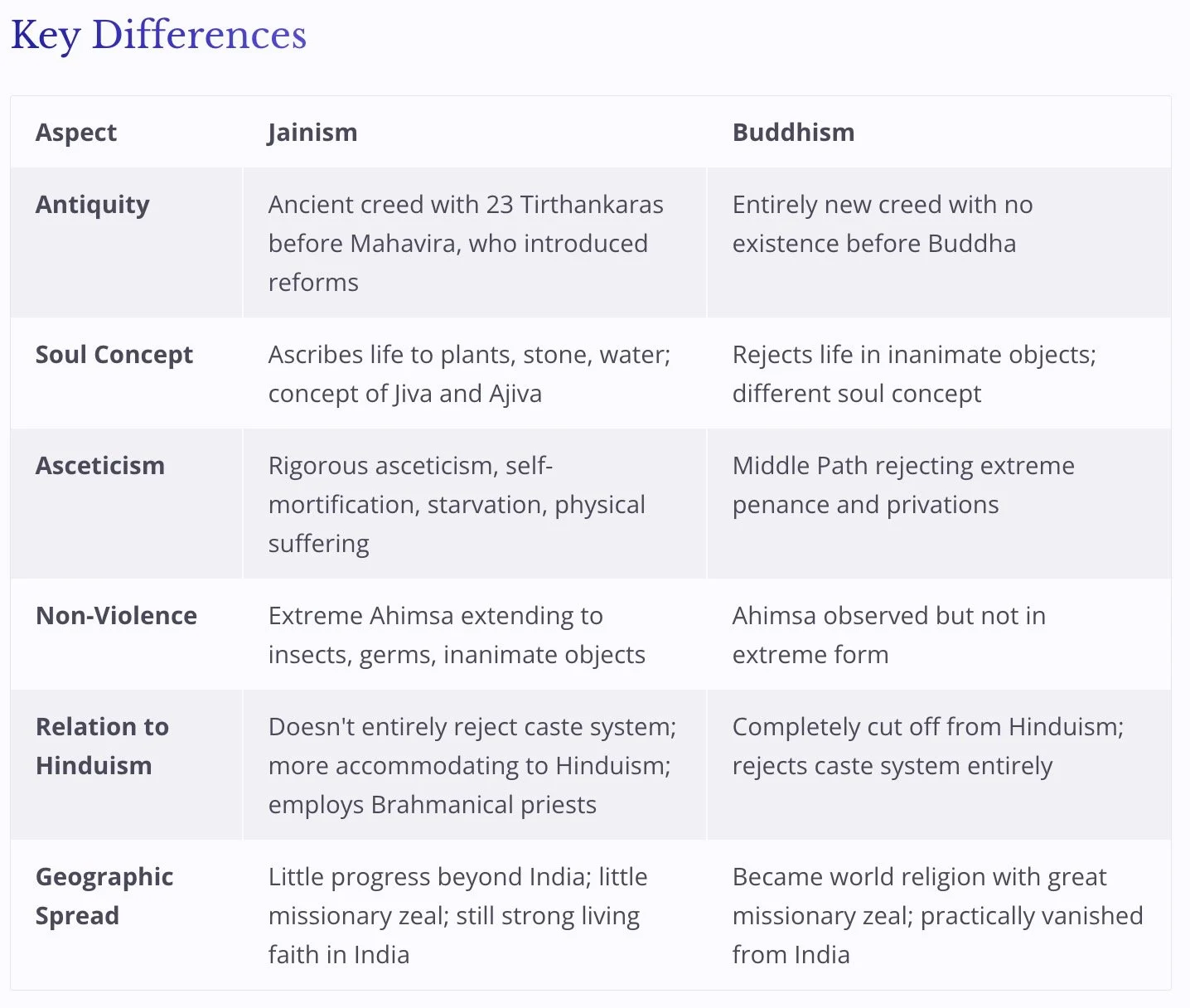
Jainism and Buddhism: Similarities and Differences
In Buddhist literature, there is severe criticism of Jaina doctrines, presupposing great rivalry between both creeds. Whilst Buddhism has practically vanished from India, Jainism remains a strong living faith influencing millions of Indians, demonstrating different trajectories of survival and adaptation for these two great heterodox traditions of ancient India.
