
Buddhism
Buddhism: The Path of Enlightenment
Buddhism emerged in the 6th century BCE as a revolutionary spiritual movement that challenged established religious orthodoxy. Founded by Gautama Buddha, it offered a practical path to liberation from suffering through ethical conduct, mental discipline, and wisdom.
The Life of Siddhartha Gautama
Birth and Early Life
Siddhartha was born in 563 BCE in Lumbini (present-day Nepal) to the Shakya Kshatriya clan. His father Suddhodana was the elected ruler of Kapilavastu, whilst his mother Maya, a Koliya princess, died shortly after childbirth. Raised by his aunt Prajapati Gautami, young Siddhartha displayed a contemplative nature from childhood. At sixteen, he married Bhadda Kachchana (also known as Yasodhara), living a life of royal luxury within palace walls.
The Great Renunciation
The Four Great Signs—an elderly man, a diseased person, a corpse, and an ascetic—profoundly disturbed Siddhartha, revealing the inevitability of suffering. At twenty-nine, upon the birth of his son Rahula, he departed on his spiritual quest. This momentous departure, termed 'Mahabhinshkramana', marked the beginning of his search for ultimate truth, abandoning princely comforts for the uncertainty of the ascetic's path.
The Path to Enlightenment
Seeking Teachers
For six years, Gautama wandered as an ascetic, studying under Alara Kalama at Vaishali and Uddaka Ramaputta at Rajagriha. He learned meditation techniques and Upanishadic teachings, yet these did not lead to final liberation.
Extreme Asceticism
He practised rigid austerities and severe self-mortification, attempting various forms of physical torture. However, these extreme practices proved futile in achieving his spiritual goal.
The Middle Way
Abandoning extremes, he proceeded to Uruvela near Bodh Gaya. After bathing in the Niranjana river, he sat beneath a pipal tree in deep meditation.
Supreme Knowledge
On the 49th day of continuous meditation, at age thirty-five, Gautama attained supreme enlightenment. He became the Buddha—'the enlightened one'—also known as Tathagata and Sakya-Muni.
The Teaching Mission Begins
Following his enlightenment, the Buddha journeyed to the Deer Park at Sarnath near Varanasi. Here, he delivered his first sermon—the Dharmachakra Pravartana (Setting in Motion the Wheel of Dharma)—to five ascetics who became his first disciples: Asvajit, Upali, Mogallana, Sariputta, and Ananda. These five soon attained enlightenment themselves, becoming arhats.
Establishment of the Sangha
The Buddha founded the Buddhist Sangha, the monastic community that would preserve and propagate his teachings. He delivered most of his sermons at Sravasti, where the wealthy merchant Anathapindika became a devoted follower, making generous donations to support the order.
Tireless Wandering
For forty years, the Buddha travelled continuously throughout northern India, visiting Sarnath, Mathura, Rajgir, Gaya, and Pataliputra. He preached, meditated, and debated with rival sects, resting only during the monsoon season each year.
Royal Patronage
Powerful monarchs embraced his doctrines: Bimbisara and Ajatasatru of Magadha, Prasenajita of Kosala, and Udayana of Kausambi. He also converted his foster mother and son Rahula at Kapilavastu, demonstrating Buddhism's universal appeal across social hierarchies.
Mahaparinirvana: The Final Journey
At the age of eighty, in 483 BCE, Gautama Buddha passed away at Kusinagar in the Malla territory, corresponding to modern-day Kasia in Deoria district, Uttar Pradesh. This momentous event, termed Mahaparinirvana, marked the physical departure of one of history's greatest spiritual teachers.
His missionary activities throughout his life demonstrated remarkable egalitarianism, making no distinction between rich and poor, high and low, men and women. This inclusive approach contributed significantly to Buddhism's rapid spread across diverse social groups.
Sources of Buddha's Life: Elements of the Buddha's biography appear in the Sutta and Vinaya Pitakas, whilst more detailed accounts exist in later texts such as the Lalitavistara, Mahavastu, Buddhacharita, and Nidanakatha—all dating to the early centuries CE. These hagiographies blend historical elements with spiritual narratives designed to convey profound meanings to followers.
The Four Noble Truths
At the heart of Buddhist philosophy lie the Four Noble Truths (Chatvari Arya Satyani), which diagnose the human condition and prescribe a cure. These truths represent the Buddha's practical, empirical approach to spiritual liberation, addressing worldly problems rather than engaging in abstract metaphysical speculation.
Dukkha: The Truth of Suffering
The world (samsara) is filled with suffering. This encompasses not merely physical pain but the fundamental unsatisfactoriness inherent in conditioned existence. All experiences, even pleasurable ones, are ultimately impermanent and therefore sources of potential suffering.
Samudaya: The Origin of Suffering
The cause of suffering lies in desire or craving (trishna). This is explained through Pattichcha Samuppada (dependent origination), a causal chain of twelve co-dependent phenomena. Ignorance leads to formations, consciousness, name-and-form, and ultimately to sorrow.
Nirodha: The Cessation of Suffering
The ending of suffering can be attained through the renouncement or letting go of desires. By eliminating craving, attachment, and ignorance, one breaks free from the cycle of birth, death, and rebirth.
Magga: The Path to Liberation
The Noble Eightfold Path (Ashtangika Marga) leads to the cessation of suffering. This middle way (Madhyama Pratipad) avoids the extremes of self-indulgence and self-mortification, offering a practical methodology for spiritual development.
The Noble Eightfold Path
The Eightfold Path represents Buddhism's practical roadmap to liberation, encompassing ethical conduct, mental discipline, and wisdom. These eight principles are interdependent, each supporting and reinforcing the others in the practitioner's spiritual development.
Right View
Understanding reality as it truly is, recognising the Four Noble Truths and the impermanent, unsatisfactory nature of existence
Right Intention
Cultivating intentions of renunciation, benevolence, and harmlessness; avoiding sensory indulgence whilst promoting others' happiness
Right Speech
Speaking truthfully and kindly, avoiding lies, harsh words, gossip, and divisive speech
Right Action
Acting ethically through non-violence, honesty, and respect for others' property and relationships
Right Livelihood
Earning one's living through honest, ethical means that cause no harm to others
Right Effort
Cultivating wholesome mental states whilst preventing and eliminating unwholesome ones through proper mental discipline
Right Mindfulness
Maintaining clear awareness of body, feelings, mind, and mental phenomena; understanding impermanence through meditation
Right Concentration
Developing deep meditative absorption to perceive reality directly and eliminate mental defilements
Core Buddhist Concepts
Impermanence (Anichcha)
All phenomena are in constant flux. Nothing possesses permanent, unchanging essence. What we perceive as the self is actually an ever-changing succession of experiences and consciousness, like a river that appears the same whilst its constituent water continuously changes. This insight challenges the concept of a permanent atman or soul.
Universal Suffering (Sabbam Dukkham)
The Buddha taught that everything is suffering—not merely as pessimism but as realism. Suffering encompasses actual pain and sorrow as well as the potential for experiencing these. Even pleasant states are ultimately unsatisfactory because they depend on impermanent conditions. Human propensities such as desire, attachment, greed, pride, aversion, and ignorance perpetuate this suffering.
No-Self (Anatta)
Buddhism rejects the existence of an unchanging, permanent soul or self. An individual comprises five aggregates (skandhas): form (rupa), name (samjna), sensations (vedana), consciousness (vijnana), and dispositions (samskara). These aggregates are constantly changing, and clinging to the illusion of a permanent 'I' or 'me' results from misperception and ignorance.
Dependent Origination (Pattichcha Samuppada)
This fundamental principle explains all phenomena as interdependent. The twelve nidanas—ignorance, formations, consciousness, mind-body, six senses, contact, feeling, craving, attachment, becoming, birth, and old age-death—form a causal chain. Each link conditions the next, ultimately explaining the origins of rebirth and suffering rooted in ignorance.
Karma and Nirvana
The Law of Karma
Buddhism places great emphasis on karma, though redefining it from the Brahmanical concept of ritual action. In Buddhist teaching, karma refers to intentions that lead to actions of body, speech, or mind. These intentional actions create consequences that determine one's future rebirths within the vast Buddhist universe of many worlds and beings.
Rebirth is governed by the cumulative results of karma from a particular life. Since Buddhism rejects the concept of atman, what transmigrates is not an unchanging soul but rather character, personality, or a life impulse—comparable to transmitting a flame from one candle to another. As the Milindapanha explains: "Just as milk turns into curds, butter, and ghee, a being transmigrates, neither as the same, nor as another."
Nibbana (Nirvana)
The ultimate goal of Buddhist practice is attaining nibbana—not a place but an experience achievable in this life. Nibbana literally means 'blowing out' or 'extinction'—the extinction of desire, attachment, greed, hatred, ignorance, and the sense of I-ness, breaking free from the cycle of birth, death, and rebirth (samsara).
Nibbana does not signify physical death; rather, it represents the complete transformation of consciousness through the elimination of all mental defilements. The term parinibbana refers specifically to the physical death of an enlightened being such as the Buddha. Through systematic elimination of desire and cultivation of wisdom, practitioners can experience this supreme state of liberation whilst still living.
Buddhist Ethics and Social Teachings
Buddhism established a comprehensive ethical framework extending beyond mere ritual observance to practical moral conduct in daily life. The Buddha's teachings emphasised compassion, non-violence, and harmonious social relationships, offering guidance for both monastics and laypeople.
Ahimsa and Compassion
Whilst Buddhism emphasised ahimsa (non-violence), its interpretation differed from Jainism. Buddhist monks could not intentionally kill animals or drink water containing small creatures. However, vegetarianism was not mandatory—monks accepted whatever food was offered, provided animals were not killed specifically for them. The emphasis lay on intention rather than absolute prohibition.
Monastic Code
Monks and nuns observed strict ethical precepts: avoiding destruction of life, theft, sexual activity, lying, intoxicants, eating after midday, entertainment, luxury, and handling money. Laypeople followed the first five rules, with celibacy replaced by marital chastity. These guidelines fostered disciplined communities dedicated to spiritual development.
Social Harmony
The Buddha defined reciprocal duties within society: friends should be generous and supportive; employers should treat servants decently with fair wages; servants should work diligently; husbands should respect wives and provide adequately; wives should maintain households properly. These teachings promoted harmonious social relations across all classes.
The Buddhist Sangha
The Buddha organised his followers into the Sangha, a monastic community that became the institutional foundation for preserving and transmitting Buddhist teachings. This revolutionary organisation operated on democratic principles and welcomed members across social boundaries.
Open Membership
The Sangha welcomed all persons above fifteen years who were free from serious diseases. However, royal servants, debtors, slaves, and convicted criminals were initially excluded. Importantly, there were no caste restrictions—a revolutionary departure from Brahmanical orthodoxy.
Ordination Process
New members underwent two stages: becoming a Sramana (novice) and receiving higher ordination (upasampada) as a Bhikshu. Candidates shaved their heads, donned yellow robes, and took oaths of fidelity to the Triratna (Three Jewels): the Buddha, the Dhamma, and the Sangha.
Democratic Governance
The Sangha operated democratically, holding fortnightly assemblies where monks elected a president (Sanghaparinayaka) and speakers on Dhamma and Vinaya. Decisions were made through formal resolutions and ballot voting using wooden sticks (salaka), requiring a quorum of at least ten monks.
Women in the Sangha
Despite initial reluctance, the Buddha established a bhikkhuni sangha for nuns, following persistent appeals from Ananda and Mahapajapati Gotami. Whilst this represented progressive inclusion for the era, nuns faced additional rules subordinating them to monks, reflecting broader social attitudes towards women.
Buddhism and Social Structure
Whilst Buddhism challenged Brahmanical orthodoxy, its relationship with social hierarchy proved complex. The tradition presented a more inclusive vision than contemporary Brahmanism yet maintained certain hierarchies, even within the supposedly egalitarian Sangha.
Critique of Varna System
Buddhist texts considered varna a human construct rather than divinely ordained. The Buddha famously declared that one does not become a Brahmana by birth but by deed. In the Samyutta Nikaya, he stated: "Do not ask of the origin, ask of the behaviour. Just as fire can be born out of any wood, so can a saint be born in a kula of low status."
The Ambattha Sutta reversed the Brahmanical hierarchy, placing Kshatriyas above Brahmanas in social status. However, it maintained that those who attained nibbana transcended all worldly distinctions. This critique resonated with non-Brahmana groups whilst not completely dismantling existing social structures.
Practice versus Ideal
Despite egalitarian ideals, the Sangha's actual composition reveals significant upper-class participation. Many prominent monks—including Sariputta, Mahamoggallana, and Mahakassapa—were Brahmanas, whilst Kshatriyas like the Buddha, Ananda, and Aniruddha also featured prominently. The distinguished monk Upali, originally a barber, represented an exception rather than the norm.
Buddhist texts distinguished between 'high' occupations (money changing, accounting, writing, farming) and 'low' ones (leather-making, pottery, weaving). This suggests that whilst Buddhism challenged birth-based hierarchy, it maintained occupational distinctions based on social perceptions of the era.
Women and Buddhism
Progressive Elements
Early Buddhism made two revolutionary assertions: women could attain the highest spiritual goal of nibbana, and a bhikkhuni sangha could exist. This represented significant progress by 6th-century BCE standards. The Therigatha preserves 73 poems by enlightened nuns who achieved the status of arhats, demonstrating women's spiritual capabilities. These verses celebrate their liberation from unhappy marriages, family tragedies, and social constraints.
Limitations and Ambivalence
Buddhist texts simultaneously promoted women's spiritual potential whilst perpetuating negative stereotypes. Women appeared as temptresses and creatures of passion—comparisons with poisonous snakes and fire warned monks to maintain distance. The Buddha reportedly predicted that admitting women would reduce the doctrine's lifespan from 1,000 to 500 years. Additional rules subordinated nuns to monks, and direct attainment of Buddhahood without first being reborn as a man was considered impossible for women.
Practical Restrictions
Entry into the bhikkhuni sangha required parental or spousal permission. Pregnant women, nursing mothers, and women associating with young men were excluded. Nuns needed to live relatively close to monks for guidance on ceremonies and discipline. A nun who broke certain rules faced judgment before mixed assemblies of monks and nuns. These restrictions reflected broader social anxieties about female autonomy and sexuality.
Historical Impact
Despite limitations, Buddhism opened significant space for women's spiritual aspirations compared to other contemporary traditions. Women feature prominently in Buddhist texts as both bhikkhunis and lay devotees (upasikas). In subsequent centuries, they appeared frequently as donors at stupa-monastery sites, demonstrating Buddhism's continued appeal to women despite institutional constraints. This visibility suggests Buddhism provided meaningful spiritual opportunities within the context of its historical period.
The Buddhist Councils
Following the Buddha's death, Buddhist communities convened councils to standardise teachings, resolve disputes, and maintain doctrinal purity. These gatherings shaped Buddhism's development, eventually contributing to its division into major schools.
First Council (486 BCE)
Held at Rajagriha under King Ajatasatru's patronage, presided over by Mahakassapa. Approximately 500 monks compiled the Sutta Pitaka (doctrinal sermons) and Vinaya Pitaka (monastic rules), recited by Ananda and Upali respectively. This systematisation proved crucial for Buddhism's survival and spread.
Second Council (386 BCE)
Convened at Vaishali during Kalasoka's reign, probably presided over by Sabakami. Disputes over monastic discipline led to schism: orthodox Sthaviravadins ("Believers in the Teachings of the Elders") versus unorthodox Mahasanghikas ("Great Community"). The Sthaviras eventually spawned several schools, including Theravada.
Third Council (250 BCE)
Held at Pataliputra under Asoka's patronage, presided over by Moggaliputta Tissa. Expelled heretics and established Sthaviravada as orthodox. Added the Abhidhamma Pitaka (philosophical interpretations), creating the Tripitaka ("Three Baskets"). Asoka subsequently dispatched missions to Sri Lanka, Kashmir, Burma, and Afghanistan, significantly expanding Buddhism's reach.
Fourth Council (1st Century CE)
Convened at Kundalabana in Kashmir under Kanishka, with Vasumitra as president and Ashvaghosha as vice-president. Formalised the split between Mahayana ("Greater Vehicle") and Hinayana ("Lesser Vehicle"). Compiled the Mahavibhasha encyclopedia and conducted proceedings in Sanskrit rather than Pali, marking a significant linguistic shift that influenced Buddhism's future development.
Theravada and Mahayana: Two Paths
Theravada: The Way of the Elders
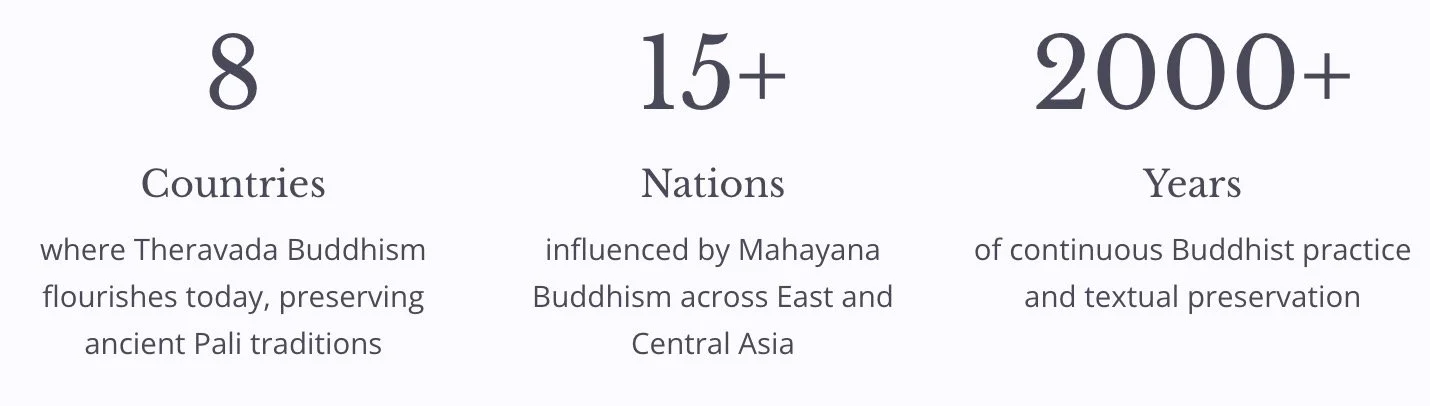
Theravada ("Teaching of the Elders") preserved the teachings established by the Third Council. Following Asoka's missions, it took root in Sri Lanka, where the Tripitaka was eventually written in Pali (circa 35 BCE). Sri Lanka became Theravada's preservation centre, later spreading to Thailand, Burma, Cambodia, and Laos.
Theravada emphasises the Four Noble Truths and meditation practices. The ultimate goal is achieving arhat status—liberation for oneself through individual effort. Buddhahood is considered practically unachievable for most people within this aeon. Whilst helping others is valued, the primary motivation remains personal liberation—attaining Nirvana through disciplined practice and ethical conduct.
Mahayana: The Greater Vehicle
Mahayana developed in North India, spreading to China, Tibet, Korea, Vietnam, and Japan. Nagarjuna developed its philosophy of Sunyata (emptiness), whilst Asanga and Vasubandhu (4th century CE) produced extensive works. Scriptures were primarily written in Sanskrit.
Mahayana teaches that every sentient being can become a Buddha. Practitioners take Bodhisattva vows, pledging to free all beings from suffering across countless lifetimes. This universalist vision contrasts with Theravada's emphasis on individual liberation. The motivation becomes: "The faster I achieve Buddhahood, the sooner I can maximally benefit others." This compassionate ideal inspired diverse practices, art, and philosophical developments throughout Asia.
Buddhism UPSC
Buddhist Scriptures: The Literary Heritage
Buddhist literature represents one of humanity's most extensive religious corpora, preserving teachings, philosophical treatises, monastic codes, and historical accounts across multiple languages and traditions.
Vinaya Pitaka
Contains monastic rules and regulations. The Mahavagga ("Great Section") covers admission procedures, dress codes, and daily routines. The Chullavagga ("Smaller Section") details monks' and nuns' duties, dispute resolution methods, and edifying stories illustrating proper conduct.
Sutta Pitaka
The largest and most important "basket", containing the Buddha's discourses. Divided into five Nikayas: Digha (long sermons), Majjhima (medium sermons), Samyutta (connected teachings), Anguttara (graduated statements), and Khuddaka (miscellaneous works including the famous Dhammapada and Jataka tales).
Abhidhamma Pitaka
Comprises philosophical and psychological treatises. The Dhammasangani provides systematic exposition of Buddhist philosophy, psychology, and ethics. The Kathavatthu, attributed to Moggaliputta Tissa, illuminates the evolution of Buddhist doctrinal debates and schools.
Mahayana Sutras
Sanskrit texts including the Prajna-Paramita (wisdom teachings), Sadharma-Pundarika (Lotus Sutra—"Bible of half Asia"), Avatamsaka (interpenetration doctrine), and Lankavatara. These elaborate Mahayana philosophy, cosmology, and the bodhisattva ideal.
Historical Texts
Works like Milindapanho (dialogues between King Menander and Nagasena), Mahavastu, Lalitavistara (Buddha's biography), and Sri Lankan chronicles Dipavamsa and Mahavamsa preserve historical, biographical, and legendary materials crucial for understanding Buddhism's development.
Factors in Buddhism's Rise
Buddhism's rapid expansion across India resulted from a confluence of social, religious, political, and institutional factors. Its message resonated with diverse audiences, from merchants to monarchs, offering practical spirituality freed from Brahmanical ritual complexity.
Simplicity and Accessibility
Buddhism's straightforward teachings—the Four Noble Truths and Eightfold Path—contrasted sharply with complex Vedic rituals. The Buddha taught in Prakrit, the people's language, rather than Sanskrit's Brahmanical monopoly. This linguistic accessibility enabled ordinary people to understand and embrace Buddhist philosophy without priestly intermediation.
Social Inclusivity
Buddhism opposed caste distinctions, accepting followers from all varnas into the Sangha. Women gained admission to religious life. This egalitarian approach particularly appealed to non-Brahmanas, merchants, and lower castes excluded from Vedic religion. The republican context of Buddha's birth fostered these egalitarian sentiments.
Royal Patronage
Powerful rulers embraced Buddhism: Bimbisara, Ajatasatru, Ashoka, Kanishka, and Harshavardhana provided crucial support. Ashoka dispatched missionaries throughout Asia. Anathapindika and other wealthy merchants made generous donations. This elite backing provided resources for monasteries, universities, and propagation efforts.
Buddha's Personality
The Buddha's charismatic presence, compassionate teaching, and exemplary renunciation inspired deep devotion. His personal example of a prince abandoning worldly pleasures to alleviate human suffering evoked admiration. His calm demeanour, logical arguments, and practical moral solutions attracted followers across social strata.
Educational Institutions
Universities at Nalanda, Taxila, Vikramshila, and Puspagiri became Buddhism's intellectual centres. Scholars like Shilavadra, Dharmapala, and Chandrapala trained students from across Asia. The Chinese pilgrim Hiuen Tsang studied at Nalanda. These institutions systematised Buddhist philosophy whilst attracting international students who spread teachings globally.
Organized Sangha
The Buddhist monastic order provided institutional stability. Dedicated monks like Ananda, Sariputta, and Maudgalayana tirelessly propagated teachings. The Sangha's democratic governance and disciplined lifestyle attracted membership. Monasteries offered shelter for study and meditation, gradually evolving into residential universities that preserved and transmitted knowledge.
The Decline of Buddhism in India
Despite centuries of dominance, Buddhism gradually declined in its Indian homeland, virtually disappearing by the 13th century CE. This decline resulted from multiple interconnected factors—internal corruption, external competition, political upheavals, and ultimately, devastating foreign invasions.
Internal Corruption
Buddhist Sanghas grew wealthy through donations, leading monks towards materialism and indiscipline. The original austerity and spiritual dedication eroded as monasteries accumulated gold, silver, and property. This moral decline alienated laypeople who had supported Buddhism for its ethical rigour.
Hindu Revival
Threatened Hinduism reorganised itself. Reformers like Kumarila Bhatta and Adi Shankaracharya revitalised Brahmanical faith, defeating Buddhist scholars in debates. Later teachers like Ramanuja and Ramananda continued this resurgence. Hinduism absorbed Buddhist principles like ahimsa whilst accepting Buddha as a divine incarnation, effectively neutralising Buddhism's distinctiveness.
Sectarian Divisions
Buddhism fragmented into Hinayana, Mahayana, Vajrayana, Tantrayana, and Sahajayana. Internal disputes over doctrine and practice weakened institutional coherence. Tantric influences introduced complexity, contradicting Buddhism's original simplicity. These divisions prevented unified resistance to external challenges.
Loss of Royal Patronage
After Harshavardhana, no major Indian rulers championed Buddhism. The Sungas actively persecuted Buddhists—Pushyamitra destroyed monasteries and killed monks. Shashanka reportedly destroyed the Bodhi tree. Rising Rajput dynasties preferred martial values over Buddhist non-violence, viewing the tradition with suspicion.
Foreign Invasions
Huna invasions under Toramana and Mihirakula devastated northwestern Buddhism. The decisive blow came from Muslim invasions beginning 712 CE. Invaders destroyed Nalanda, Vikramshila, and countless monasteries. Buddhist monks fled to Nepal, Tibet, and Southeast Asia. By the 13th century, Buddhism had virtually vanished from India.
Buddhism's Cultural Contributions
Despite its eventual decline in India, Buddhism left indelible marks on Indian civilization. Its influence permeated art, architecture, literature, philosophy, and social ethics, creating a rich cultural heritage that continues inspiring humanity.
Architectural Marvels
Buddhism pioneered monumental architecture: stupas like Sanchi with hemispherical domes and ornate gateways; rock-cut chaityas at Karle, Bhaja, and Ajanta featuring apsidal halls and sculptural columns; viharas (monasteries) at Nalanda and Paharpur. These structures demonstrated sophisticated engineering, aesthetic refinement, and religious symbolism, influencing architectural traditions across Asia.
Artistic Innovation
Buddhism introduced anthropomorphic representation in Indian art—the first human images for worship. Stone panels at Sanchi, Bharhut, and Amaravati depicted Buddha's life narratives. Gandhara and Mathura schools developed distinct sculptural styles. Cave paintings at Ajanta showcased narrative art of extraordinary beauty, preserving visual records of ancient life and spirituality.
Literary and Linguistic Legacy
Buddhism promoted Pali and regional languages (Kannada, Gujarati), democratising religious discourse. The Tripitaka preserved extensive philosophical, ethical, and historical materials. Works like Dhammapada became world literature. Buddhist universities fostered scholarship in logic, epistemology, and metaphysics, influencing Indian intellectual traditions profoundly.
Social and Ethical Impact
Buddhism's emphasis on non-violence elevated cattle protection and vegetarianism. Its critique of caste hierarchy challenged social inequalities. The principle of ahimsa influenced Gandhi's non-violent resistance. Buddhist ethics of compassion, mindfulness, and interdependence continue resonating globally, offering solutions to contemporary challenges of violence, inequality, and environmental destruction.
Buddhism UPSC
Buddhism's Enduring Relevance
In our tumultuous contemporary world, Buddhist teachings offer profound wisdom for addressing existential, social, and environmental challenges. The Noble Eightfold Path provides a comprehensive framework for ethical living, mental well-being, and spiritual development that transcends cultural and temporal boundaries.
Mindfulness and Mental Health
Right mindfulness and concentration address modern epidemic of stress, anxiety, and depression. Meditation practices, now scientifically validated, enhance mental health, emotional regulation, and cognitive function. Buddhist psychology offers tools for navigating complexity without requiring religious commitment.
Compassion and Social Justice
Buddhist emphasis on compassion (karuna) and interdependence provides ethical foundations for addressing poverty, inequality, and discrimination. The principle that liberation requires alleviating others' suffering resonates with contemporary social justice movements, offering spiritual grounding for activism.
Non-Violence and Peace
Ahimsa offers alternatives to violence, extremism, and conflict. Gandhi's satyagraha drew heavily on Buddhist non-violence. In our age of terrorism and warfare, Buddhist peace ethics provide moral frameworks for conflict resolution, restorative justice, and reconciliation.
Environmental Ethics
Buddhist teachings on interdependence (dependent origination) and respect for all sentient beings offer philosophical foundations for environmental protection. Recognising that harming nature harms ourselves provides motivation for sustainable living and ecological conservation.
Gender Equality
Despite historical limitations, Buddhism's assertion that women can attain enlightenment challenges patriarchal structures. Modern Buddhist movements increasingly embrace gender equality, whilst feminist scholars recover suppressed voices like those in the Therigatha, inspiring contemporary women's empowerment.
Social Harmony
Buddhist teachings on reciprocal duties between individuals, families, and communities offer frameworks for building cohesive societies. In our fragmented world, emphasis on compassionate relationships and mutual responsibilities addresses loneliness, polarisation, and social breakdown.
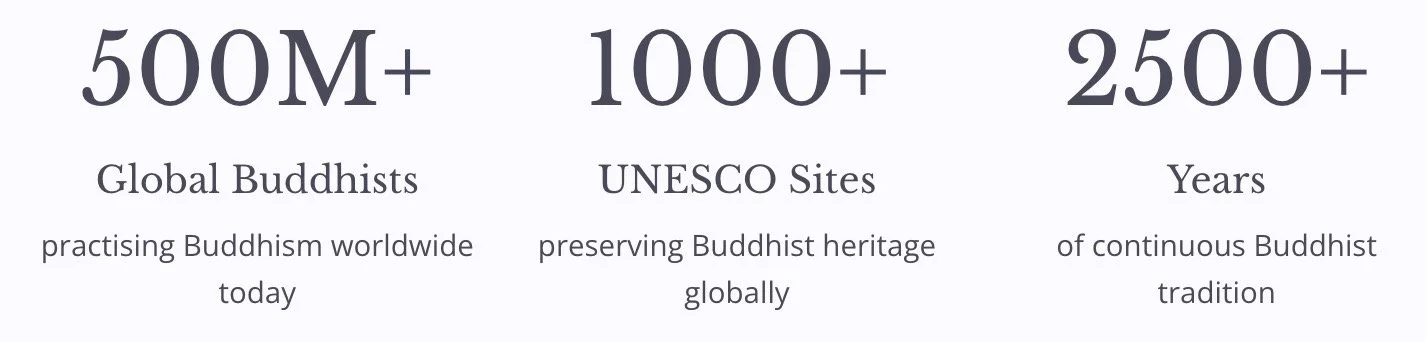
Buddhism's journey—from a revolutionary movement challenging 6th-century BCE orthodoxies to a global tradition influencing millions—demonstrates the enduring power of teachings rooted in compassion, wisdom, and practical ethics. Whilst it declined in India, its philosophical insights, artistic achievements, and ethical principles continue enriching human civilization. As we confront unprecedented challenges, the Buddha's message remains profoundly relevant: suffering exists, but through understanding its causes and cultivating wisdom and compassion, liberation becomes possible—not merely for ourselves, but for all beings.
