
Post-Mauryan Period
Post-Mauryan Period: Contact with the Outside World — Trade and Traders
The period from approximately 300 BCE to 300 CE represents one of the most dynamic and transformative eras in ancient Indian economic history. Under the successor states of the Mauryan Empire — the Indo-Greeks, Sakas, Kushanas, and Western Kshatrapas — trade networks expanded dramatically, connecting the Indian subcontinent to Central Asia, the Mediterranean world, Southeast Asia, and East Asia. This document examines the structural foundations of this trade, the literary and archaeological evidence that illuminates it, and the far-reaching cultural consequences that followed in its wake.
Drawing on a rich array of sources — the Jatakas, Sangam texts, Dharmashastra literature, the Periplus of the Erythraean Sea, Greek and Roman accounts, and a growing body of archaeological evidence — this document reconstructs the vibrant commercial world of post-Mauryan India in structured detail.
The Money Economy: Coins, Currency, and Exchange
Trade in the post-Mauryan period was fundamentally shaped by the expansion of the money economy. The issuance of small denominational coins by the Kushanas and Satavahanas was particularly significant, as it enabled coinage to percolate down to everyday, small-scale transactions rather than remaining restricted to large-scale commerce or state finance. This democratisation of monetary exchange was a crucial structural development in ancient Indian economic life.
Named Coin Types
Dinara — gold coin mentioned in literary works
Purana — silver coin referenced in texts
Karshapana — copper coin for everyday use
Denarii — Roman silver coins found in the far south
Regional Variation in Currency
In the far south, the monetary landscape was particularly diverse. Northern coins circulated alongside locally made punch-marked coins, Roman denarii, and die-struck coins issued by the Chera, Chola, and Pandya kings. This plurality of currency systems reflects the subcontinent's deep integration into both pan-Indian and international trade circuits.
Most coins in ancient India were issued by the state, but a small number of city coins and guild coins also existed, offering a glimpse into the commercial autonomy exercised by urban centres and merchant organisations. Even so, barter and the use of cowrie shells — harvested from the waters off the Maldive Islands — continued alongside monetary transactions, especially in peripheral or rural economies.
Legal Frameworks: Dharmashastra Texts on Trade
The Dharmashastra texts — including the Yajnavalkya Smriti and the Manu Smriti — contain extensive prescriptions concerning taxes, profit, interest rates, and market regulation. However, historians must exercise caution: these normative texts represent the ideals of their authors, not necessarily the reality of how markets functioned on the ground.
Yajnavalkya Smriti on Pricing
The king should fix prices allowing a 5% profit on indigenous goods and a 10% profit on foreign goods. The king is expected to balance the interests of both the consumer and the merchant when setting prices. This graduated margin reflects an awareness of the added costs of sourcing goods from distant lands.
Manu Smriti on Taxation
The Manu Smriti insists that transportation costs, retention costs, and outlay should factor into price calculations. Crucially, it recommends that traders be taxed on their profits, not their capital outlay — a relatively sophisticated distinction — and proposes a 5% tax rate on profits. This suggests an attempt to protect mercantile investment while ensuring state revenue.
Punishments and Interest Rates
The Dharmashastra texts prescribe punishments for adulteration, fraudulent measures, and cheating in trade. Interest rates laid down are notably high, and the Manu Smriti specifies that rates should vary according to the risk factor of the loan and the varna of the borrower — reflecting the intersection of economic and social hierarchy in legal thought.
The Jatakas: Caravans, Ports, and Merchant Life
The Buddhist Jataka stories offer extraordinarily vivid accounts of commercial life in ancient India. Their value for the economic historian lies not in their religious message alone, but in the incidental social detail they preserve about travel, commerce, and merchant organisation. The Jatakas describe long caravan journeys as a regular feature of commercial life, with merchants moving goods overland across great distances.
Travellers in the Jatakas move on foot and by bullock cart; the wealthy travel in chariots and palanquins. The texts mention wells and tanks along roads — evidence of the infrastructure maintained to support overland trade — and rest houses (dharmashalas) where weary traders halted for refreshment. City gates are described as being closed at night, suggesting regulated urban access and concern for security.
The Sarthavaha
Jataka stories celebrate the sarthavaha — the caravan leader — as a figure of wisdom and calm. Bodhisattvas appear in this role, guiding their caravans safely through danger. The sarthavaha was a trusted commercial and moral authority, responsible for the welfare of the entire trading party.
Ports and Hinterlands
Ports were not mere points of embarkation. The Jatakas describe them as important manufacturing centres in their own right, or as nodes closely connected to productive hinterlands. This integration of port and hinterland was a key structural feature of ancient Indian maritime commerce.
Merchant Partnerships
The Jatakas contain references to partnerships among merchants — arrangements for sharing capital, risk, and profit. Sailors were organised in guilds, headed by an officer known as the niyamakjettha. These institutional forms gave commercial activity a degree of stability and collective organisation.
Sangam Texts: Markets and Merchants of Tamilakam
The Sangam corpus of Tamil poetry offers some of the richest literary evidence for commercial life anywhere in the ancient world. Unlike the normative prescriptions of the Dharmashastra texts, the Sangam poems provide literary sketches of lived mercantile experience — the sights, sounds, and social texture of the markets of ancient South India.
The Sangam poems describe the markets of Puhar and Madurai with their sellers of flowers, garlands, aromatic powders, betel leaf, shell bangles, jewellery, cloth, garments, wine, and bronze — a world of urban commercial abundance.
Sangam texts describe caravans (chattu) of itinerant traders who carried goods such as paddy, salt, and pepper into the interior, and returned with goods for the coastal ports. The journeys of salt traders (umanachchattu) are particularly vividly described: their bullock-cart caravans carried both provisions for sustenance and weapons — bows and spears — for protection, highlighting the real dangers of long-distance overland trade.
The Paravatar
The paravatar were coastal inhabitants who began as fishermen and salt and toddy makers, but gradually diversified into pearl diving and long-distance trade. They dealt in pearls, chank bangles, tamarind, fish, precious stones, and horses, becoming prosperous traders in the process. Their trajectory illustrates the economic mobility available to coastal communities in this period.
Tamil–Brahmi Inscriptions
Epigraphic evidence complements the literary picture. Tamil–Brahmi inscriptions record merchants dealing in:
Cloth and salt
Oil and plough shares
Gur (unrefined sugar)
Gold
These inscriptions demonstrate that trade extended well beyond luxury goods to everyday necessities.
Trade Routes: The Arteries of Post-Mauryan Commerce
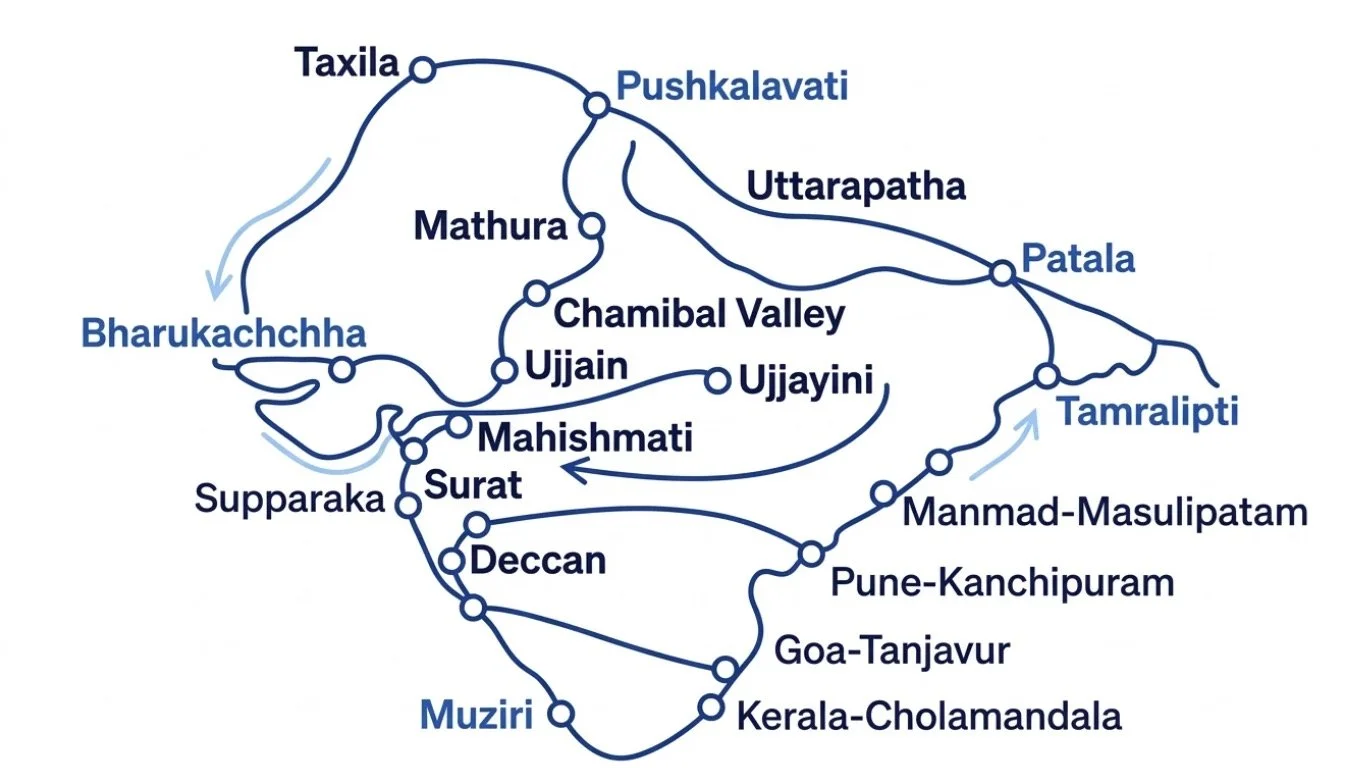
The physical infrastructure of trade in the post-Mauryan period was built upon a network of well-established overland and coastal routes. The two great arterial routes — the Uttarapatha (northern road) and the Dakshinapatha (southern road) — continued to function as the spinal column of long-distance Indian commerce, as they had in Mauryan times. The Uttarapatha connected Taxila in the north-west with Tamralipti in the Ganga delta, traversing the full breadth of northern India.
Trade Routes: The Arteries of Post-Mauryan Commerce
The western route ran along the sea, connecting Sindh and Gujarat. From Rajasthan, another route descended to the Deccan along the western foothills of the Aravalli hills. The Mathura–Chambal–Ujjain–Mahishmati corridor was a crucial interior route linking the Ganga basin to the western coast and the Deccan. The Periplus mentions market towns such as Paithana (Paithan), Tagara (Ter), Suppara (Sopara), and Calliena (Kalyan) along the western Indian coast, and Strabo notes that boats from the sea sailed up the Ganga as far as Pataliputra.
In South India, routes typically followed river valleys. Among the most important connections were those linking Manmad and Masulipatam, Pune and Kanchipuram, Goa and Tanjavur–Nagapattinam, and Kerala with the Cholamandala. These routes ensured that the productive agricultural and craft-producing interiors were linked to the major coastal emporia. The port of Muziris (Muchiri) on the Kerala coast was particularly prominent in western trade, and the ports on the eastern Coromandel coast gradually emerged as a major factor in India–Mediterranean maritime trade by the late 1st or early 2nd century CE.
Commodities and Famous Merchandise Cities
Literary sources provide considerable detail about the specific goods that moved through these networks. The Jatakas, the Arthashastra, and the Sangam texts together allow historians to construct a fairly detailed inventory of commodities in inter-regional trade. The picture that emerges is one of considerable specialisation: different regions of the subcontinent were known for particular products, and merchants built their livelihoods on connecting producers with distant consumers.
Textiles
Silk, fine muslin, and sandalwood of Varanasi
Woollen textiles of the Punjab
Cotton textiles of Kashi
Fine cotton of Kanchi and Madurai
Blankets of Gandhara (red blankets)
Arms and Animals
Steel weapons from Aparanta in the west
Steel weapons from the eastern regions
Horses and camels from the north-west
Elephants from eastern and southern regions
Spices and Luxury Goods
Pepper — a key commodity of long-distance trade
Sandalwood from Varanasi region
Incense (kaleyaka) from Suvarnabhumi
Aloeswood from across the sea
Cinnamon, cloves, camphor from Southeast Asia
Archaeological evidence from excavated sites across the subcontinent supplements and refines this literary picture. Long-distance trade clearly extended well beyond luxury goods to encompass everyday necessities such as salt, paddy, oil, and pottery, meaning that the benefits and disruptions of trade were felt across a broad social spectrum.
Long-Distance Maritime Trade: Ships, Sailors, and the Indian Ocean World
The Indian subcontinent had been part of a broader Indian Ocean world from protohistoric times onwards. Historian H.P. Ray has called for a broader approach to maritime history — one that examines the "social practice of maritime technology." This means attending not only to commodities and routes, but also to boat-building and sailing techniques, the organisation of shipping, and the role of fishing and sailing communities alongside merchants. Maritime activity was deeply embedded in the political, economic, social, religious, and cultural structures of coastal societies.
Ship Crew and Navigation
A large ship's crew included:
Shasaka — the captain
Niryamaka — the pilot
A specialist in cutter and rope management
A bailer of water
Like other ancient mariners, Indian sailors used special birds to identify land — releasing them from the ship and observing which direction they flew. If land was near, the birds flew towards it; if not, they returned to the ship.
The Distinctive Sewn Boat
Ancient Greek observers noted the peculiar construction of Indian boats with some curiosity. Onesicritis, cited by Strabo, criticised Indian boats for their poor seaworthiness on account of their construction and inferior sails. Pliny, however, took a more sympathetic view, noting that Indian boats were well-suited to the seas they sailed on.
The defining feature of the Indian boat was that its planks were not held together with nails but were stitched together with coir rope. These "sewn boats" were probably considered better suited to withstanding the impact of strong waves and the shock of hitting the shore — an adaptation to the specific conditions of Indian Ocean sailing.
Marine archaeology has enriched this picture. Excavations at Dwarka and Bet Dwarka off the Gujarat coast have revealed stone structures, copper, bronze and brass objects, iron anchors, and a wrecked boat from the period c. 200 BCE–200 CE — clear evidence of sites oriented towards maritime trade.
The Silk Routes: India, China, and Central Asia
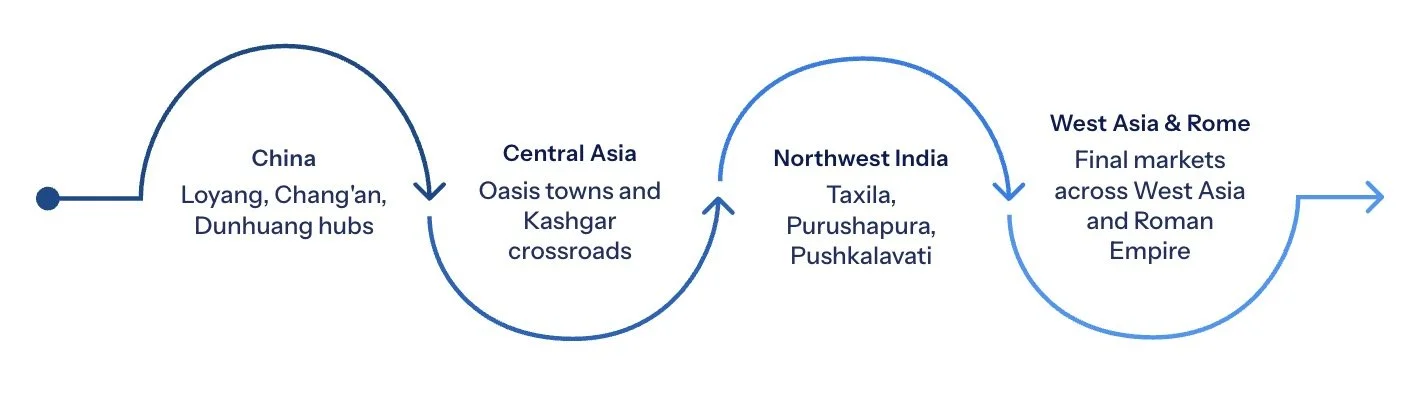
The demand for Chinese silk in the Mediterranean region was the single greatest stimulus to trans-regional and trans-continental trade in this period. The great Chinese Silk Route stretched approximately 4,350 miles from Loyang on the Yellow River in China to Ctesiphon on the Tigris in West Asia — one of the longest sustained commercial arteries in the ancient world. North-west India sat at a critical junction in this system, serving as the point where Chinese exports crossed into the subcontinent and Indian goods moved westward.
The Silk Routes: India, China, and Central Asia
From the junction at Kashgar, the route bifurcated repeatedly. The northern segment passed through the oases between the Takla Makan desert and the Tienshan mountains; the southern segment followed the Kunlun mountains. These routes converged at Kashgar before splitting again — one branch reaching the Caspian Sea and Persia, the other passing through Bactria (northern Afghanistan) to Merv in Turkmenistan. From Afghanistan, a route ran through the Kabul valley to the north-western cities of the subcontinent: Purushapura, Pushkalavati, and Taxila. Another route from Kashgar ran through Gilgit in Kashmir.
Kushana Empire as Middleman
The Kushanas controlled key sections of the Silk Route from China through Central Asia and Afghanistan to Iran. Tolls levied on passing traders were a principal source of Kushana imperial revenue. Their empire also provided relative safety for merchants and reduced the number of tariff posts along the route.
Gold Inflows and Coin Issues
India received substantial gold from the Altai mountains in Central Asia and possibly also through trade with the Roman Empire. Significantly, the Kushanas were the first rulers in India to issue gold coins on a wide scale — a development inseparable from their position at the centre of trans-continental trade.
Disruption in the 3rd–4th Centuries CE
After the fall of the Han dynasty in 220 CE, China remained divided. Simultaneously, the Byzantine Empire broke from Rome, and the Kushana Empire collapsed. Some cities along the Oxus became deserted. Trade between China and the West was disrupted, though India–China trade continued along altered routes.
Trade with Southeast Asia: Suvarnabhumi and Beyond
For a long time, Indian historians tended to view India's relationship with Southeast Asia through the lens of cultural and political colonisation — an "Indianisation" of the region driven by Indian initiative. More recent and sober re-assessments have moved away from this perspective, examining the reciprocal links between the two regions from a more objective and long-term standpoint. The archaeological evidence, in particular, reveals a story of mutual exchange rather than unilateral influence.
Literary Evidence
Ancient Sanskrit and Pali texts refer to Suvarnadvipa or Suvarnabhumi — "the land of gold" — usually identified with Southeast Asia. The Arthashastra mentions incense called kaleyaka from Suvarnabhumi and aloeswood from beyond the sea. The Milindapanha references Suvarnabhumi in the context of shipping ports, and the Jatakas describe sea voyages from Varanasi and Bharukachchha to this land.
Archaeological Evidence
Maritime links between India and Southeast Asia are attested archaeologically from c. 500/400 BCE onwards. Key finds include:
Coloured glass beads and faceted carnelian beads at metal-age sites
Etched carnelian beads at burials in west-central Thailand and Malaysia
Glass beads of South Indian origin at Southeast Asian sites (c. 300 BCE–17th century CE)
Indian artefacts in iron-age burials in the Malay peninsula and south-east Thailand
Finds in urban centres along the Chao Phraya, Irrawaddy, and Mekong rivers
Exports from Southeast Asia to India
Gold, spices (cinnamon and cloves), aromatics, sandalwood, camphor, and possibly tin from the Malay peninsula. Many of these were re-exported from India to Mediterranean markets.
Exports from India to Southeast Asia
Cotton cloth, sugar, beads, and certain kinds of pottery. The trade was clearly not confined to luxury goods — it encompassed a wide range of everyday commodities.
Since coinage was absent in Southeast Asia until the middle of the 1st millennium CE, trade with India in the early period must have been conducted via barter or the use of cowrie shells as a medium of exchange. By the 1st century CE, there was a marked increase in both the quantity and variety of Indian goods reaching Southeast Asia, corresponding to the emergence of new kingdoms, increasingly stratified societies, expanded craft production, and greater inter-regional trade in mainland Southeast Asia.
Indo-Roman Trade: Gold, Pepper, and the Western Connection
The period between the 2nd century BCE and the 2nd century CE saw flourishing trade between India and the Roman Empire — one of the most intensively documented episodes in ancient commercial history. The Kushanas and Satavahanas were especially well-positioned to benefit, given their control over the regions through which goods flowed to and from the west. The balance of trade was generally favourable to India, prompting Roman writers Pliny and Dio Chrysostom to lament the drain of Roman gold into Indian hands.
The term yavana — originally used in Indian texts to denote the Greeks — came in this period to refer broadly to all foreigners from the western regions. Early Tamil literature is particularly rich in yavana references. Sangam poems describe large yavana ships sailing on the Periyar River, bringing gold and wine and departing with cargoes of black pepper. A poem in the Pattuppattu compares the noise of Madurai's weavers to the midnight clamour of workers loading and unloading merchandise from yavana ships. The Roman connection was deeply embedded in the commercial and cultural imagination of ancient South India.
Indo-Roman Trade: Gold, Pepper, and the Western Connection
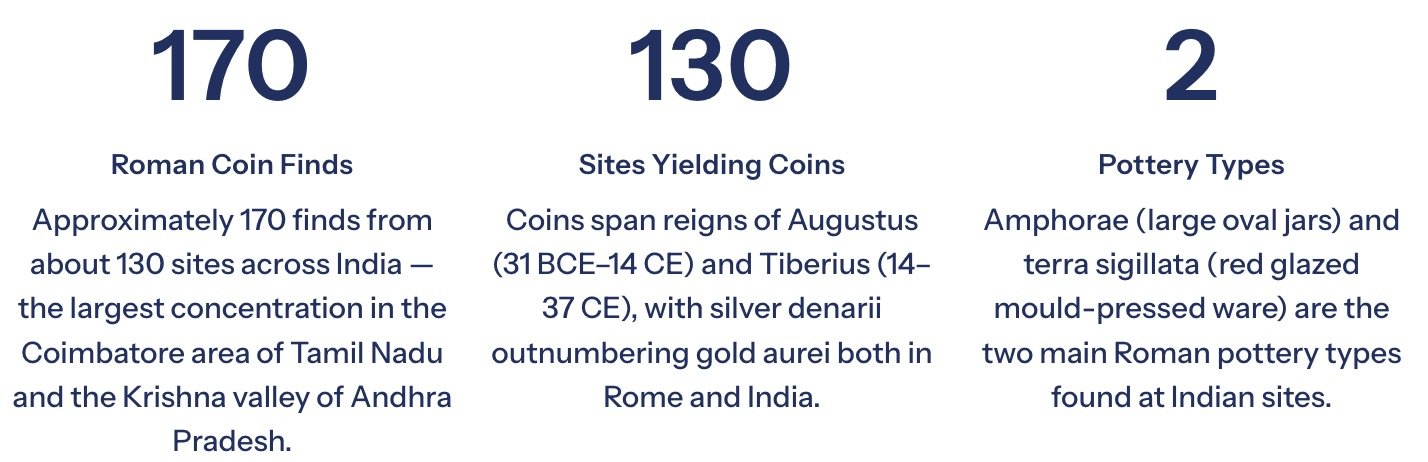
The geographical distribution of Roman coins is highly instructive. The vast majority are concentrated in South India — especially the Coimbatore area and the Krishna valley — while comparatively few have been found in western India and scarcely any in north India. This distribution reflects not simply the geography of trade but also the different monetary systems in place: in regions with well-established coinage systems, such as the Kushana and Satavahana kingdoms, Roman coins were likely melted down for bullion rather than circulated directly. In the eastern Deccan, where indigenous currency systems were weaker, Roman coins may have functioned as currency.
From the time of the Roman emperor Augustus, traders increasingly sought to avoid the turbulent Parthian-controlled sections of the overland Silk Route. A portion of the trade was diverted through India, with goods — including Chinese silk — moving from Indian ports to the Roman Empire by sea. This made India not merely a trading partner of Rome but also an important intermediary in the east–west silk trade. This flourishing trade declined somewhat after the late 2nd century CE due to internal difficulties within the Roman Empire, though it did not cease entirely.
Arikamedu and the Archaeological Evidence for Indo-Roman Links
Among the most important archaeological sites illuminating Indo-Roman trade is Arikamedu, located near Pondicherry on the right bank of the Ariyankuppam River. Excavations revealed occupation from the end of the 1st century BCE through the 1st and 2nd centuries CE. The site has yielded a rich assemblage of both local and Mediterranean artefacts that together paint a detailed picture of a working trading entrepôt.
Structures
A large brick structure was identified as a warehouse. Two walled courtyards with tanks and drains were tentatively identified as dyeing vats where muslin cloth was dyed and prepared for export.
Pottery Finds
Locally produced pottery was found alongside Mediterranean wares — amphorae and arretine ware (terra sigillata) — and a rouletted black ware showing foreign influence.
Small Finds
Over 200 beads of shell, bone, gold, terracotta, and semi-precious stones were recovered. A Graeco-Roman gem bore what may be an intaglio carving of the emperor Augustus. A fragment of a Roman lamp made of fine red ware was also found.
Identification
On the basis of these discoveries, Mortimer Wheeler concluded that Arikamedu was Poduke — one of the yavana emporia (trading stations) mentioned in classical accounts of the Indian Ocean trade.
Beyond Arikamedu, Mediterranean amphorae and terra sigillata have been found at Uraiyur, Kanchipuram, and Vasavasamudram in the south, as well as at Dwarka, Prabhas Patan, Ajabpura, Sathod, Jalat, and Nagara in Gujarat and western India. Other possibly Roman objects include terracotta figures, glassware, metal artefacts, and jewellery, though many appear to be local imitations. Clay bullae imitating Roman coins are found widely across the subcontinent, perforated for wearing around the neck. Brahmapuri in Kolhapur yielded a notable hoard of Roman bronzes, including a statuette of Poseidon. Roman bronze coins found in Tamil Nadu and Sri Lanka in 4th-century contexts clearly signal the southward shift of maritime networks in the later period.
The Periplus of the Erythraean Sea
Among the documentary sources for post-Mauryan Indian Ocean trade, none is more remarkable than the Periplus of the Erythraean Sea. Written in Greek by an unknown Egyptian merchant, probably in the 1st century CE, it was intended as a practical handbook for traders engaged in commerce between Egypt, east Africa, southern Arabia, and India. Ancient Greek and Roman geographers used the term "Erythraean Sea" to encompass the Indian Ocean, the Red Sea, and the Persian Gulf — the interconnected waterways at the heart of this commercial world.
The wealth of detail in the Periplus has enabled historians to draw up a remarkably precise inventory of goods traded at various ports in the Indian Ocean in the early centuries CE — a resource without parallel in the ancient world.
What the Periplus Tells Us
Sailing schedules and seasonal timing
Routes and waypoints along two main directions (Africa and India)
Ports and their merchandise inventories
Local rulers who controlled key ports
Flora and fauna of different regions
Appearance, customs, and way of life of coastal peoples
The Author and His Method
Internal textual evidence strongly suggests that the author wrote from personal experience rather than hearsay. He was evidently a practising merchant who wrote for the benefit of fellow merchants — his observations are practical, precise, and grounded in the realities of commercial navigation. He notes details about market towns on the western Indian coast, including Paithana (Paithan), Tagara (Ter), Suppara (Sopara), and Calliena (Kalyan). Notably, the author is largely silent on the subject of religion — his interests are resolutely commercial and geographical.
The Periplus provides a list of goods exported from Indian ports on the Indus delta and the Gujarat coast to the Roman Empire, and has been used together with the Vienna Papyrus — which records the terms of a shipping deal between merchants of Alexandria and Muchiri covering goods including nard, ivory, and textiles — to reconstruct the detailed mechanics of Indo-Roman trade.
Merchants as Donors: Trade, Religion, and Social Status
The flourishing of trade in the post-Mauryan period had profound consequences for Indian religious and social life. Merchants appear as prominent donors in inscriptions from across the subcontinent during this era. The growing affluence of sections of the merchant community coincided with a period when religious institutions — Buddhist monasteries in particular — were becoming increasingly institutionalised and organised. For successful merchants, patronising these institutions served a dual purpose: it was simultaneously an expression of personal piety and a means of validating and enhancing social status in a competitive world.
Merchants in Sculpture and Art
Seafaring merchants can be identified in sculptures at several religious establishments. A railing medallion from Bharhut depicts a sea monster about to swallow a boat and its crew — identified by inscription as the Jataka story of the merchant Vasugupta, saved by meditation on the Buddha. A Mathura sculpture depicts a bodhisattva in the form of a horse saving shipwrecked sailors from ravenous yakshis. Hero stones on the Konkan coast, sculpted with scenes of sea battles, were set up by survivors in honour of those who had lost their lives at sea.
Buddhist Monasteries and Trade Networks
A close and mutually beneficial relationship developed between Buddhist monasteries, traders, and guilds. As monasteries received more gifts and expanded, they were drawn into various financial activities, forging a reciprocal relationship with the merchant community. Traders provided donations; monasteries provided services. Evidence from Devnimori in Gujarat suggests possible wine or medicine storage in monastic amphorae sherds; a distillation apparatus found at a monastery in Pushkalavati hints at liquor trade. Monks may also have traded in incense and precious stones used for liturgical purposes.
The Cultural Transmission of Buddhism
There are argued connections between long-distance trade, urbanisation, developments in Buddhist theology, and the spread of Buddhism to China and Southeast Asia. Trade networks are said to have been initially dominated by groups owing allegiance to Buddhism, facilitating its geographic spread. However, historians caution that trade was one vehicle among several — the activities of Chinese and Indian monks were equally important. The dominance of Brahmanical ritual practices in Southeast Asian courts further suggests the presence of Brahmanical specialists independent of trade networks.
The Legacy of Post-Mauryan Trade
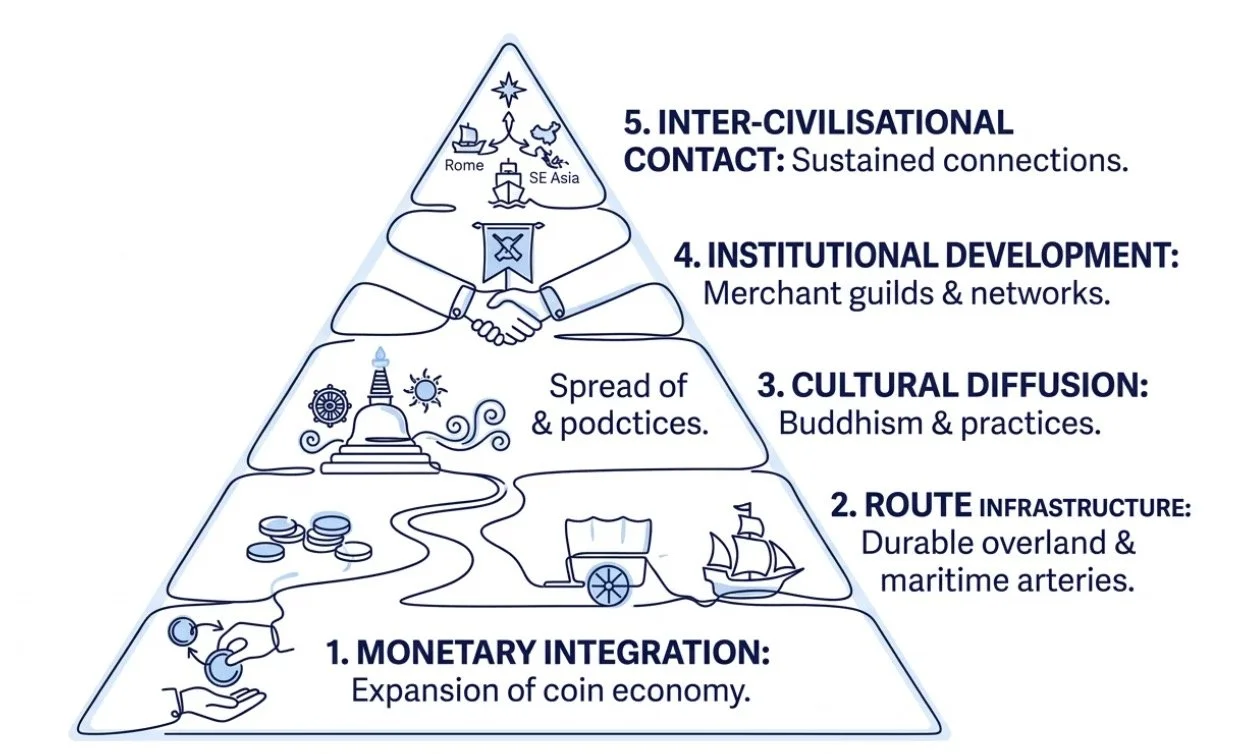
The period c. 300 BCE–300 CE stands as a foundational chapter in the history of ancient Indian economic and cultural engagement with the wider world. The trade networks of this era were of a scope and sophistication that would not be surpassed for many centuries. They connected the markets of Madurai and Kaveripattinam to those of Alexandria, Ctesiphon, and Loyang; they carried not only pepper and silk, but also ideas, artistic motifs, religious practices, and technologies across vast distances.
The Legacy of Post-Mauryan Trade
Several structural features of this commercial world deserve emphasis as final reflections. First, Indo-Roman trade was never a simple bilateral exchange but involved a complex web of middlemen — Arab traders, Greek merchants of Egypt, Parthian intermediaries — underscoring that ancient trade was always a product of multiple interacting communities rather than any single pair of civilisations. Second, the evidence for India's trade with Southeast Asia and East Asia challenges any India-centred or Europe-centred account of ancient commerce: the Indian subcontinent was a pivot point in a genuinely inter-continental economic system. Third, the expansion of the money economy, the development of merchant guilds and partnerships, and the codification of commercial law in Dharmashastra texts all signal the emergence of increasingly sophisticated economic institutions, even if the normative texts did not always reflect market realities.
The post-Mauryan period demonstrates that ancient India was not a closed civilisation but an open, outward-looking world whose merchants, sailors, monks, and artisans actively shaped the economic and cultural contours of a vast inter-connected world spanning three continents.
