
Indo-Greeks, Sakas, Kushanas & Western Kshatrapas
Indo-Greeks, Sakas, Kushanas & Western Kshatrapas
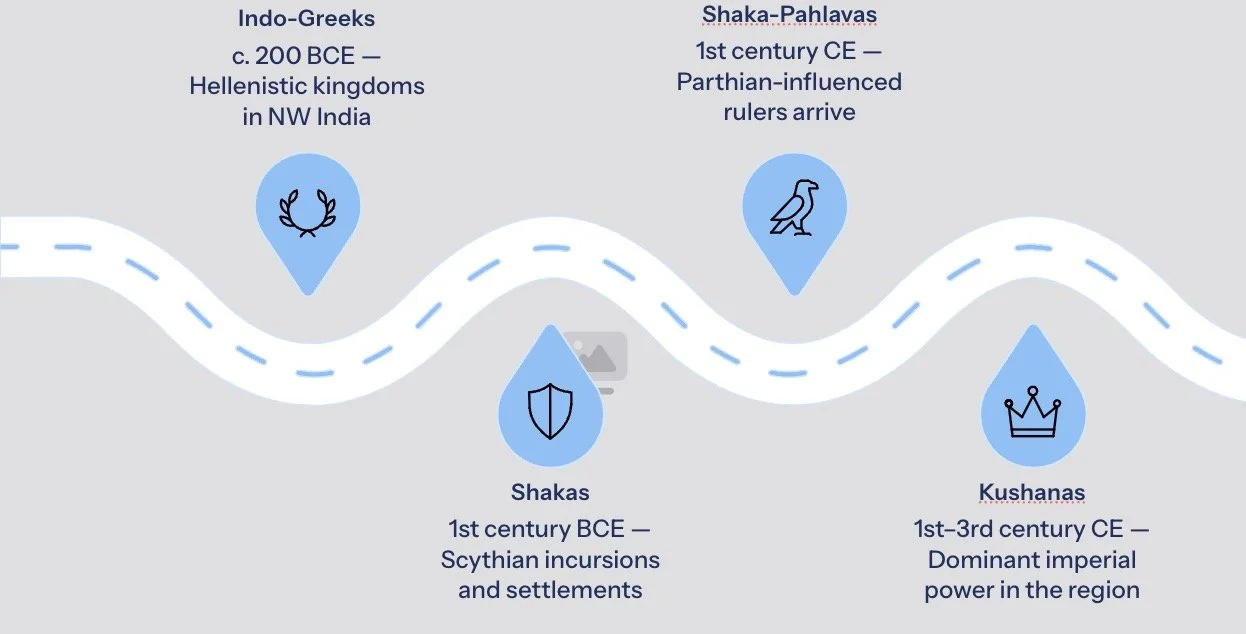
The period beginning around 200 BCE marks one of the most dynamic chapters in ancient South Asian history. Though no single empire matched the scale of the Mauryas, this era was defined by intense cross-cultural contact between Central Asia and the Indian subcontinent. Wave after wave of foreign rulers — Greeks, Scythians, Parthians, and Kushanas — swept through the northwest, leaving behind a rich legacy of art, coinage, religion, and governance that permanently shaped Indian civilisation.
In the eastern and central parts of India, the Mauryas were succeeded by native rulers such as the Shungas, Kanvas, and Satavahanas. But in the northwest, a succession of Central Asian dynasties took hold — each building upon the last, and each leaving a distinctive imprint on the subcontinent's culture and political structure.
Indo-Greeks, Sakas, Kushanas & Western Kshatrapas
Chapter 1
The Indo-Greeks (Indo-Bactrians)
The first wave of Central Asian invaders to enter the Indian subcontinent were the Greeks of Bactria — a region situated south of the Oxus River in what is now northern Afghanistan. Originally satraps (subordinate rulers) of the Seleucid Empire of West Asia, the Bactrian Greeks broke free in the mid-3rd century BCE when Diodotus I revolted against the Seleucids and established an independent Bactrian Greek kingdom.
The primary trigger for their eastward movement into India was the growing pressure from Scythian (Shaka) tribes from the north. The construction of the Great Wall of China had pushed the Scythians away from the Chinese frontier, redirecting their aggression toward neighbouring Greeks and Parthians. Unable to sustain their position in Bactria, the Greeks were effectively pushed into India. The successors of Ashoka were too weak to resist this tide of invasion.
Key Conquests
Demetrius — Greek ruler of Bactria who sent commanders into India from Taxila
Apollodotus — Conquered Sindh, marched to Ujjain
Menander — Extended rule to Mathura, attempted to capture Pataliputra
Indo-Greeks occupied a vast stretch from the northwest to Ayodhya and Pataliputra
Political Fragmentation
The Greeks never established united rule in India. Two Greek dynasties ruled simultaneously in the northwest on parallel lines, issuing overlapping coinage and governing separate territories. This fragmentation ultimately weakened their hold. In approximately 145 BCE, they lost Bactria but continued to rule in the northwestern subcontinent for a few more decades before being displaced by the Shakas and Parthians.
Menander: The Most Important Indo-Greek Ruler
Among all the Indo-Greek rulers, Menander (reigned c. 165–45 BCE), also known as Milinda, stands out as the most significant. He ruled from his capital at Sakala (modern Sialkot) in the Punjab and launched ambitious campaigns into the Ganga–Yamuna doab. His attempt to capture Pataliputra was ultimately stopped by the army of Vasumitra, grandson of Pushyamitra Shunga.
"Menander asked Nagasena many questions relating to Buddhism. These questions and Nagasena's answers were recorded in the form of a Buddhist text in Pali, known as Milinda Panho — the Questions of Milinda."
Menander's conversion to Buddhism by the monk Nagasena (also known as Nagarjuna) is one of the most celebrated episodes of the period. The Milinda Panho remains an important Buddhist philosophical text to this day. A fragmentary Kharoshthi inscription from the North-West Frontier Province of Pakistan also refers to relics of the Buddha being enshrined during the reign of a king named Minedra, identifiable with Menander.
Capital
Sakala (Sialkot) in the Punjab — a major centre of his realm
Religious Legacy
Converted to Buddhism by Nagasena; authored the celebrated Milinda Panho dialogue
Military Reach
Invaded the Ganga–Yamuna doab; extended rule over parts of Bactria and northwestern India
After His Death
Plutarch records a conflict over Menander's ashes — a treatment reminiscent of the Buddha's own relics
Another notable figure of this era is the Greek ambassador Heliodorus, who became a Vaishnavite and erected the famous Garuda Pillar at Besnagar. This act demonstrates the deep cultural assimilation that was occurring — Greeks were not merely conquerors but active participants in Indian religious life. The Greek influence in India lasted for more than a century after Menander's death.
Contributions & Legacy of Indo-Greek Rule
Despite their political fragmentation, the Indo-Greeks left an enduring and multifaceted legacy on the Indian subcontinent. Their contributions span coinage, art, theatre, astronomy, and governance — many of which shaped Indian culture for centuries to come.
Coinage Innovations
The Indo-Greeks were the first rulers in India to issue coins definitively attributed to particular kings. They also introduced gold coins into India — a practice that expanded significantly under the Kushanas. Their bilingual coins (Greek and Kharoshthi/Brahmi) set the standard for subsequent dynasties.
Gandhara Art
Greek rule introduced Hellenistic artistic features in the northwest. Gandhara art was largely Hellenistic at first, growing progressively more Indian over time. Crucially, the idea of representing the Buddha in human form (idol worship) is credited to the Greeks.
Theatre & Astronomy
Greeks contributed to Indian theatre through the use of curtains (Yavanika), the stage manager (Sutradhara), and the backstage area (Nepathya). Indian astrology was also influenced by Greek ideas — the Sanskrit term horasastraderives from the Greek word horoscope.
Military Governorship
The Greeks introduced the practice of strategos — military governorship — to maintain control over conquered peoples. This practice would influence the later Shaka and Kushana administrative systems.
The Coin Types of the Indo-Greeks
North of the Hindu Kush
Made of gold, silver, copper, and nickel
Followed the Attic weight standard
Greek legends on the coins
Royal portrait on obverse; Greek deities (Zeus, Apollo, Athena) on reverse
South of the Hindu Kush
Made of silver and copper; often square in shape
Bilingual: Greek and Kharoshthi (rarely Brahmi)
Followed the Indian weight standard
Indian religious symbols on reverse — not Greek
Notable: King Agathocles issued coins depicting Samkarshana Balarama and Vasudeva Krishna
Chapter 2
The Shakas & Western Kshatrapas
The Shakas, also known as the Scythians, followed the Greeks and proved to be even more formidable conquerors. They destroyed Greek power in both Bactria and India, ultimately controlling a much larger part of India than the Greeks had ever held. The history of Shaka rule is known largely through their inscriptions and coins.
The founder of Shaka rule in India in the 1st century BCE was Maues (also identified as Moga), whose name appears on several copper and silver coins similar in style to those of the Indo-Greeks. An inscription at Taxila mentions Moga and his kshatrapa (governor) Patika. It is likely that Maues conquered the Gandhara region from the Indo-Greeks, though the latter soon recovered some lost territory.
Northern Satraps
Ruled from Taxila. These Shaka rulers were eventually overthrown by the Parthians (Pahlavas).
Western Satraps
Ruled over Maharashtra and western India. They held power for approximately four centuries — far longer than any other Shaka branch.
The Western Satraps benefited enormously from sea-borne trade through Gujarat, issuing numerous silver coins that reflect the commercial vitality of the region. In the early centuries CE, there were two important lines of Kshatrapa rulers: the Kshaharatas and the Kardamakas.
Around 57–58 BCE, a king of Ujjain successfully drove the Shakas out of his region. He adopted the title Vikramaditya, and the era called Vikrama Samvat is reckoned from his victory over the Shakas in 57 BCE. This title became so coveted that as many as fourteen rulers in Indian history adopted it, with Chandragupta II of the Gupta dynasty being the most famous.
The Kshaharata Dynasty: Bhumaka & Nahapana
The Kshaharata dynasty was the first major line of Western Kshatrapa rulers, and included two notable figures: Bhumakaand Nahapana. Bhumaka seems to have originally owed allegiance to Kanishka. His coins, with legends in Brahmi and Kharoshthi, have been found in coastal Gujarat, as well as in Malwa and the Ajmer area, indicating a substantial territorial reach.
Nahapana (c. 119–125 CE) is the better-documented of the two. His inscriptions, dated in the Shaka era of 78 CE, reveal a progression of titles — from kshatrapa in his earlier inscriptions to mahakshatrapa and rajan in later ones. He appears to have ruled largely independently, as none of his inscriptions mention any overlord. His kingdom at its height included Malwa, Gujarat, Saurashtra, northern Maharashtra, and parts of Rajasthan and the lower Indus valley. His son-in-law Ushavadata served as viceroy of the southern portions of the kingdom, and his donative inscriptions have been found at the Nashik and Karle caves.
Conflict with the Satavahanas
The Shaka Kshatrapas were drawn into prolonged conflict with the Satavahanas, a powerful dynasty entrenched in the Deccan. The Nashik and Pune areas seem to have changed hands frequently, as both dynasties contested access to the valuable western seaboard. In approximately 124–125 CE, Nahapana was apparently killed by the Satavahana ruler Gautamiputra Satakarni, who wrested the southern territories of the Kshaharata kingdom. The evidence includes Gautamiputra's inscriptions in the Nashik and Pune districts, his practice of re-striking Nahapana's coins, and an inscription of Gautamiputra's mother, Gautami Balashri.
The Kardamaka Dynasty & Rudradaman I
As the Kshaharata dynasty came to an end, a new line of Shaka Kshatrapas — the Kardamakas — rose to prominence in western India. The dynasty was founded by Chashtana, who may have originally ruled in Sind as a subordinate of the Kushanas. The Kardamakas maintained a distinctive practice of senior and junior co-rulers, holding the titles mahakshatrapa and kshatrapa respectively.
The most famous ruler of this dynasty — and indeed of all the Shaka rulers in India — was Rudradaman I (AD 130–150). He is best known from his Junagarh inscription (dated Shaka year 72, i.e., 150–151 CE), which is remarkable for being the first-ever long inscription in chaste Sanskrit on the subcontinent. All earlier longer inscriptions had been composed in Prakrit, the language made the state standard by Ashoka.
Territorial Extent
Ruled over Sindh, Gujarat, Konkan, the Narmada valley, Malwa, and Kathiawar — a vast swath of western and central India
The Junagarh Rock
A single rock at Junagadh bears inscriptions of three great rulers: Ashoka, Rudradaman, and Skandagupta — spanning over a thousand years of history
Language Innovation
Rudradaman issued the first long Sanskrit inscription in India, signalling the rise of Sanskrit as a language of royal prestige and power
Defeated the Satavahanas
Twice defeated Satakarni (lord of Dakshinapatha) but did not destroy him — likely because Rudradaman's daughter was married to Gautamiputra's son, Vasishthiputra Pulumavi
The Sudarshana Lake: A Story in Stone
The Junagarh inscription of Rudradaman records one of the most remarkable administrative stories of ancient India — the repeated construction, damage, and repair of the Sudarshana lake in the semi-arid Kathiawar region. This reservoir had originally been built under Chandragupta Maurya by the Vaishya Pushyagupta (his provincial governor), and was later completed during Ashoka's reign by the Yavana governor Tushaspha. Its history thus spans centuries of Indian political life.
"So great was the damage that Rudradaman's officers thought the lake was beyond repair. But Rudradaman went right ahead and ordered the job done... The lake was reinforced and made three times as strong in length and breadth on all sides in a very short time, without oppressing the inhabitants of towns and villages by taxes, forced labour, or any other impositions."
During the reign of Rudradaman, a terrible winter storm tore the lake's embankments, draining all its water and leaving it resembling a sandy desert. The lake's very name — Sudarshana, meaning "beautiful to look at" — became mockingly ironic; it had become durdarshana (ugly to look at). The repair work was supervised by the amatya (minister) Suvishakha, governor of Anarta and Surashtra, praised in the inscription as a model official — able, patient, self-controlled, upright, honest, and free from arrogance.
The Eulogy (Prashasti) of Rudradaman
The inscription also contains an eloquent royal eulogy describing the ideal qualities of Rudradaman as a king. He is celebrated as a lover of Sanskrit who was skilled in grammar, music, and logic. He was depicted as generous, compassionate, skilled in warfare, and as one who reinstated deposed kings. The inscription portrays him as universally loved — his towns never troubled by robbers, snakes, wild beasts, or disease. Skandagupta's later inscription on the same rock tells us that the Sudarshana lake burst its banks again in 455–456 CE and was repaired by the Gupta emperor as well.
Chapter 3
The Shaka-Pahlavas (Scytho-Parthians)
Shaka domination in north-western India was followed — and in some regions paralleled — by that of the Parthians, known in ancient Indian Sanskrit texts as the Pahlavas. The two peoples are often mentioned together as Shaka-Pahlavas, reflecting the overlapping and sometimes simultaneous nature of their rule.
Originally based in Iran, the Parthians moved eastward and established control over a relatively small portion of northwestern India in the 1st century CE. In comparison to the Greeks and the Shakas, they held a more limited but strategically significant position. Like the Shakas, they ruled through governors or subordinate rulers known as kshatrapas and mahakshatrapas, who played a critical role in administering and expanding the empire.
Azes I
Extended Scytho-Parthian control into the north-west of the Indian subcontinent. The Vikrama era of 58/57 BCE was once thought to mark his accession. He and Spalirises appear to have been co-rulers for a time, as evidenced by their conjoint coins.
Azilises
Pushed further east into the Mathura region, extending Scytho-Parthian influence deeper into the heart of the subcontinent.
Gondophernes
The most famous Parthian king. According to Christian tradition, St. Thomas the Apostle is said to have visited India to propagate Christianity during his reign — one of the earliest references to Christianity in South Asia.
The successors of Gondophernes were ultimately ousted from north-western India by the advancing Kushanas. In the course of time, the Parthians — like the Shakas before them — became an integral part of Indian polity and society, assimilating into the broader cultural fabric of the subcontinent.
Chapter 4
The Kushanas: Rise of a Central Asian Empire
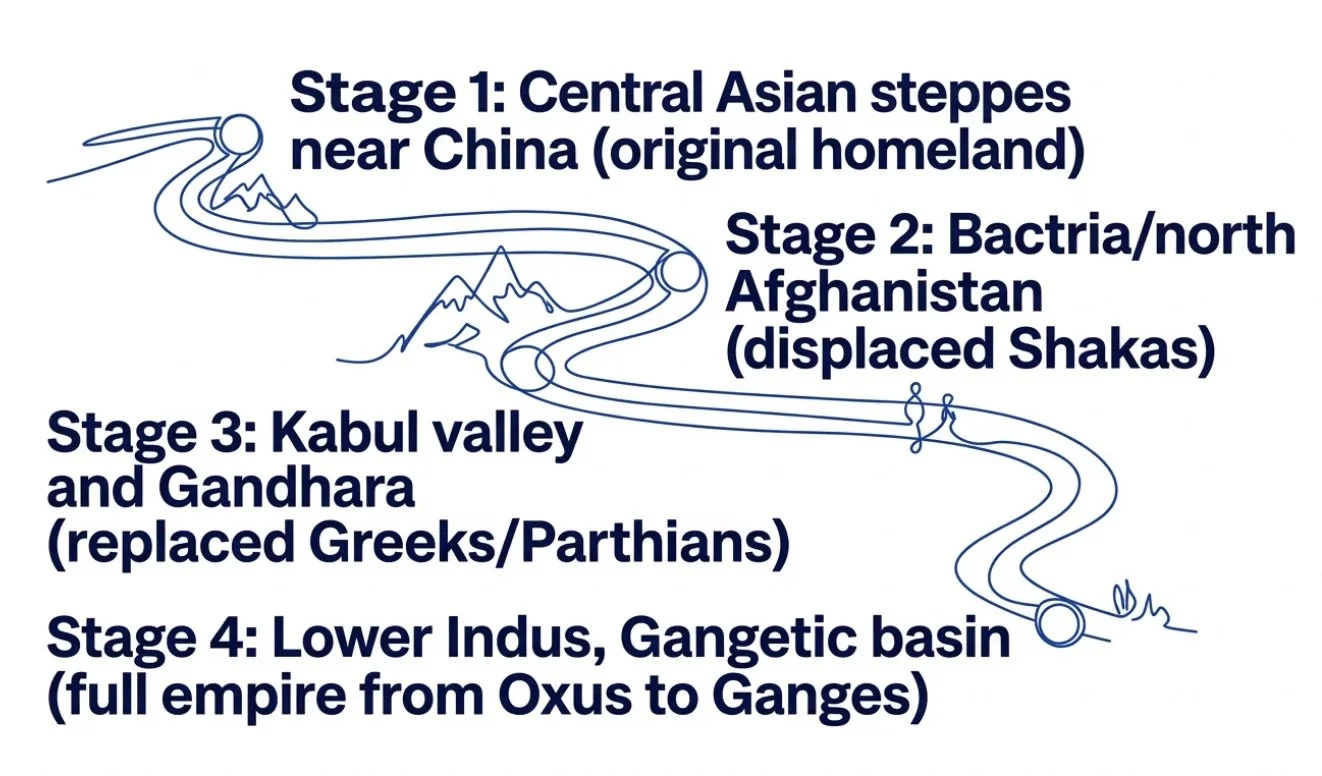
The Kushanas, also called Yuechis, were one of five branches of the Yuchi tribe whose original homeland lay in the steppes of north-central Asia, near China. A series of tribal displacements — triggered by the Hiung-nu (Huns) defeating the Yueh-chi — pushed them westward. From the steppes, they first occupied Bactria (northern Afghanistan), displacing the Shakas; then moved into the Kabul valley; and eventually crossed the Hindu Kush into Gandhara, replacing the Greeks and Parthians.
In time, they established authority over the lower Indus basin and the greater part of the Gangetic basin, creating one of the largest empires of the ancient world. Their empire stretched from the Oxus River to the Ganges, and from Khorasan in Central Asia to Pataliputra in Bihar — encompassing portions of what are now nine modern countries.
The Kushanas: Rise of a Central Asian Empire
There were two successive dynasties of Kushanas — the house of Kadphises and the house of Kanishka. The Kadphises line ruled for approximately twenty-eight years from about 50 CE under two kings: Kujula Kadphises (Kadphises I) and Vima Kadphises. Kujula amalgamated the five Yuchi principalities and laid the foundation of the unified Kushana empire, while Vima expanded it dramatically eastward, issuing gold coins with the title "Lord of the Whole World" and proclaiming himself a devotee of Shiva.
Kanishka: The Zenith of Kushana Power
The Kushana empire reached its peak under the reign of Kanishka, one of the most celebrated rulers of ancient India. His reign is traditionally dated to begin in 78 CE, the year from which the Shaka era — still used by the Government of India — is reckoned. The Rabatak inscription from Afghanistan, written in the Bactrian language and Greek script, provides valuable information about his reign.
Territorial Conquests
At accession: Afghanistan, Gandhara, Sindh, Punjab
Subsequently: Magadha, Pataliputra, Bodh Gaya
Invaded and occupied Kashmir
Conquered regions of the Gangetic plain: Mathura, Shravasti, Kaushambi, Varanasi
Annexed Kashgar, Yarkand, and Khotan from China
Capital Cities
Purushapura (modern Peshawar) — primary capital
Mathura — second most important centre in India
He erected a famous monastery and a massive stupa at Purushapura that astonished foreign travellers
Trade & Wealth
Diamond mines of Akara (eastern Malwa) contributed to expansion
Ports on the Makran coast became critical in Indian Ocean trade networks
Scholars link the decline of this trade to the eventual decline of the Kushana empire
Towards the end of his long reign, Kanishka led an expedition against the Chinese but was defeated and forced to pay tribute to Emperor Ho-ti. This military setback foreshadowed the eventual decline of Kushana power in Central Asia.
Kanishka as Patron of Buddhism & Religious Eclecticism
Kanishka is celebrated in Buddhist texts as one of the greatest patrons of Buddhism in Indian history. He is said to have enshrined the Buddha's relics in a great stupa at Purushapura, and Buddhist chaityas and viharas were built across his empire. Most significantly, he convened the Fourth Buddhist Council at the Kundalavana monastery near Srinagar in Kashmir, presided over by the monk Vasumitra, with approximately 500 monks in attendance. The Council prepared an authoritative commentary on the Tripitakas and gave final shape to the Mahayana form of Buddhism.
"In the age of Kanishka, Mahayana Buddhism came into vogue. The Buddha came to be worshipped with flowers, garments, perfumes, and lamps. Thus image worship and rituals developed in Mahayana Buddhism."
Kanishka patronised leading Buddhist scholars including Ashvaghosha (philosopher, poet, and author of the Buddhacharita), Vasumitra, and Nagarjuna from south India. He also patronised the famous physician Charaka, and sent missionaries to Central Asia and China.
Religious Eclecticism on Coins
Yet Kanishka's religious identity was far from exclusive. His coins depict an extraordinary variety of deities drawn from multiple traditions — a reflection of both personal tolerance and deliberate royal policy acknowledging the religious diversity of his vast, multi-ethnic empire.
Iranian Gods
Atash (fire god), Mithra (sun god) — reflecting the Persian heritage of the Central Asian world
Greek Deities
Helios (sun god), Selene (moon goddess) — echoing the Hellenistic legacy of Bactria
Indian Gods
Oheso (Shiva), Ommo (Uma), Vasudeva (Vishnu) — affirming connections with Brahmanical traditions
Buddhist Imagery
Boddo (Buddha) — reflecting his personal patronage of the Buddhist faith and the Fourth Buddhist Council
Numismatic Evidence: Coins as Historical Documents
One of the most invaluable sources for understanding this entire period is numismatics — the study of coins. Coins from the Indo-Greek, Shaka, Parthian, and Kushana periods are not merely monetary objects; they are windows into the political authority, religious beliefs, trade networks, and administrative structures of their time.
Political History
Over-struck (counter-struck) coins indicate changes in political control — one ruler defeating and replacing another. Conjoint coins reveal co-rulership practices.
Trade Networks
The wide distribution of Kushana coins — as far as Bengal and Orissa — maps the reach of trade. Roman coins found at Taxila and Mathura confirm Indo-Roman trade importance.
Religion & Ideology
Deities on coins signal the religious affiliations and eclectic tolerance of rulers. The variety of pantheons on Kushana coins — Greek, Iranian, Hindu, Buddhist — reflects the empire's diversity.
Economy
Kushanas were the first to mint large quantities of gold coins. Copper coins indicate the spread of a money economy to common transactions. City coins show urban administrative autonomy.
The Kushana coins are particularly notable. John M. Rosenfield, in his study Dynastic Arts of the Kushans, observed that their coinage "functioned as a vehicle of propaganda, directly expressing the ideology of the ruling house" — reflecting concerns with material abundance, military triumph, legitimacy of rule, and divine sanction. The rarity of Buddhist emblems despite Kanishka's patronage, and the total absence of Jain symbols, remain puzzles for historians.
Counter-struck coins offer a fascinating micro-history of political conflict. The silver coins of Nahapana (Western Kshatrapa) were re-struck by Satavahana king Gautamiputra Satakarni — and in some cases also by Shiva Satakarni — indicating back-and-forth changes in regional political control. Counter-striking also sometimes indicated a shortage of a particular metal, rather than purely political defeat.
Kushana Polity & Administrative Innovations
The Central Asian conquerors of this period imposed their rule over numerous petty native princes, which led to the development of a feudatory organisation — a hierarchical system of overlordship that would become a defining feature of Indian polity for centuries. The Kushanas adopted the grandiose title of "King of Kings", indicating that they collected tribute from numerous smaller princes while allowing them to retain local authority.
Divine Kingship
Ashoka had called himself "dear to the gods," but the Kushana kings went further — calling themselves Devaputra(Son of God), a title borrowed from the Chinese concept of the ruler as "Son of Heaven." This idea was used to legitimise royal authority in Brahmanical terms as well.
The Satrap System
The Kushana Empire was divided into smaller administrative units governed by kshatrapas (satraps). Some areas were under direct royal control; others were managed by subordinate rulers who acknowledged Kushana paramountcy, paid tribute, and maintained relative autonomy.
Hereditary Dual Rule
The Kushanas introduced the practice of hereditary dual rule — both father and son ruling the same kingdom simultaneously. The Kardamaka Shakas adopted a similar practice, with mahakshatrapa and kshatrapa titles held concurrently.
Military Governorship
The Greeks had introduced the office of strategos (military governor) to maintain control over conquered territories. The Kushanas and Shakas built upon this system, creating layered governance structures suited to managing large, diverse empires.
The overall result was a political system with less centralisation than the Mauryan model but greater flexibility — allowing diverse ethnic, religious, and cultural communities to coexist under a broad umbrella of Kushana suzerainty. Local dynasties (the Malavas, Yaudheyas, Naga kings) continued to issue their own coins and inscriptions, indicating significant local autonomy.
Decline of the Kushanas & the Indo-Sassanians
The Kushana empire began declining from the time of Vasudeva I, in approximately the mid-3rd century CE. Vasudeva II was the last recognised Kushana emperor. Their decline allowed several polities that had been temporarily subdued — such as the Shaka Kshatrapas of western and central India — to resurface and reassert their independence.
Various inscriptions and coins from this period name local dynasties ruling from Ahichchhatra, Ayodhya, and Kaushambi, as well as tribal republics (ganas) such as the Malavas, Yaudheyas, and Naga kings. The political landscape of northern India became fragmented once again, awaiting the next great unifying force — the Gupta dynasty.
The Indo-Sassanians
By the mid-3rd century CE, the Sassanians had occupied the lower Indus region. They called this region Hindu — not in a religious sense, but referring to the people of the Indus. A Sassanian inscription of 262 CE uses the term Hindustan for this region — the earliest recorded use of this name, which would become the standard designation for India in Mughal and modern times.
The Indo-Sassanians ruled in India for less than a century but contributed to the economy by issuing a significant number of coins.
Why Empires Declined
Tribal pressures from the Central Asian frontier
Over-extension of imperial territories
Decline of Indian Ocean and Central Asian trade routes
Rise of assertive local and regional dynasties
Inability to maintain centralised control over the satrap system
The Enduring Legacy of Central Asian Rule
The period from approximately 200 BCE to 300 CE represents a uniquely transformative era in South Asian history. The successive waves of Indo-Greek, Shaka, Parthian, and Kushana rule did not simply impose foreign governance — they fundamentally reshaped the cultural, artistic, religious, and administrative landscape of the subcontinent in ways that endure to this day.
Coinage & Economy
First kings whose coins are definitively attributed; first gold coins; spread of money economy through copper denominations; bilingual coinage setting lasting precedents
Art & Culture
Gandhara art synthesising Hellenistic and Indian styles; the iconic image of the Buddha in human form; contributions to Indian theatre and astronomical knowledge
Literature & Language
The Milinda Panho as Buddhist philosophy; Rudradaman's Junagarh inscription as the first long Sanskrit record; Ashvaghosha's Buddhacharita; the Mahayana Buddhist canon
Governance
The satrap (kshatrapa) system; military governorship (strategos); divine kingship (Devaputra); feudatory organisation; hereditary dual rule — all becoming lasting elements of Indian statecraft
Religion
The Fourth Buddhist Council and Mahayana Buddhism; religious eclecticism as royal policy; the spread of Buddhism to Central Asia and China via Kushana missionaries
Trade & Connectivity
Indo-Roman trade networks; Silk Road connectivity; port development on the Makran coast; a unique "Central Asian empire" bridging nine modern countries
These dynasties remind us that the history of South Asia has never been isolated. The subcontinent has always been a crossroads — absorbing, transforming, and re-exporting ideas, faiths, art forms, and governance practices to the wider world. The Indo-Greeks, Shakas, Kushanas, and Western Kshatrapas were not merely "foreign invaders" but active participants in the creation of a complex, cosmopolitan Indian civilisation.
