
Post-Mauryan India: Urban Centres, Economy, and Coinage
Post-Mauryan India: Urban Centres, Economy, and Coinage
The period from approximately 200 BCE to 300 CE represents one of the most dynamic phases of economic and urban transformation in the ancient Indian subcontinent. Spanning the reigns of the Satavahanas, Kushans, Indo-Parthians, and Saka rulers, this era witnessed the flourishing of trade networks, the rise of prosperous urban centres, and the sophisticated organisation of craft production through guilds. This document explores the key dimensions of this transformative period — from village life and secondary state formation to the judicial and banking functions of mercantile guilds — drawing on archaeological, epigraphic, and literary sources.
Urban Growth
Brick towns, forts, and trade hubs
Economic Activity
Crafts, guilds, and long‑distance trade
Coinage
Guild coins, nigama seals, monetary economy
Chapter I
Village Life in the Post-Mauryan Period
Despite the relative abundance of information on urban centres for the period c. 200 BCE–300 CE, evidence for village life and agricultural organisation remains comparatively sparse. Nevertheless, a careful reading of literary, epigraphic, and archaeological sources yields important insights into rural social structures, occupational specialisation, and the relationship between villages and their urban neighbours.
The Jatakas — a rich corpus of Buddhist narrative literature — describe villages called gamas that ranged in size from 30 to 1,000 kulas (extended families). Crucially, many of these villages were defined by the occupational identity of their inhabitants. References abound to villages of potters, carpenters, smiths, forest folk, hunters, fowlers, fishermen, reed workers (nalakaras), and salt makers (lonakaras). This occupational character of settlements points to an early and well-entrenched tradition of specialised economic production at the village level, several of which were located in close proximity to larger urban agglomerations.
Among the most illuminating sources for village life in the southern subcontinent are the Early Tamil-Brahmi inscriptions from Tamilakam. These brief epigraphic records offer rare documentary glimpses into the social and economic texture of village communities. A 2nd century BCE inscription at Varichiyur records the gift of 100 kalams of rice — a testament to the agricultural surplus that underpinned village prosperity. A 1st century BCE inscription at Alagarmalai refers to a koluvanikan — a trader in plough shares — where the kolu designates the hard iron tip fixed to a wooden ploughshare, indicating the commercialisation of agricultural implements.
Perhaps most significant for institutional history is a 2nd century BCE inscription at Mudalaikulam, which records the construction of a tank by the ur (assembly) of Vempil village. This is widely regarded as the earliest inscriptional reference to a village assembly in the Indian subcontinent — a striking precursor to the elaborate local governance systems that would emerge in later centuries.
Varichiyur Inscription (2nd c. BCE)
Records the gift of 100 kalams of rice, attesting to agricultural surplus in Tamil village communities.
Alagarmalai Inscription (1st c. BCE)
Refers to a koluvanikan — a trader in iron ploughshare tips — indicating commerce in agricultural tools.
Mudalaikulam Inscription (2nd c. BCE)
Records a tank constructed by the village assembly (ur) of Vempil — arguably the earliest inscriptional evidence of a village assembly in India.
The Kushan rulers additionally promoted large-scale irrigation agriculture, with the earliest archaeological traces of such irrigation in Pakistan, Afghanistan, and western Central Asia dating to the Kushan period. This agricultural expansion was an essential prerequisite for sustaining the dense urban populations and robust trade networks that characterised the era.
Chapter I · Continued
Growth of Urban Centres: Processes and Geography
The period c. 200 BCE–300 CE was marked by urban prosperity across the entire subcontinent. This was not a sudden development but the culmination of long-term processes involving agricultural expansion, the intensification of specialised crafts, and widening trade networks. Archaeologically, the period is distinguished by advances in building technology: the use of burnt bricks for flooring and roofing, the construction of brick kilns, the use of script tiles, and the proliferation of red pottery. Fortifications, though the most visible archaeological remnant of many sites, represent only a fraction of what were evidently prosperous and complex urban landscapes.
A central historiographical question concerns the role of secondary state formation — the emergence of new states modelled on and stimulated by interaction with already-existent states, particularly the Mauryan empire. While Mauryan influence cannot be discounted, scholars have increasingly argued against over-emphasising it. The internal dynamics of agricultural intensification, craft specialisation, and expanding trade were equally if not more decisive in driving urbanisation across different regions.
North India: Key Urban Centres
Vaishali, Pataliputra, Varanasi, Kaushambi, Sravasti, Hastinapur, Mathura, Indraprastha
Kushan kings ensured security of trade routes — a primary driver of northern urban prosperity
Towns of Sonpur, Buxur, Ghazipur (Bihar); Meerut, Muzaffarnagar (UP); Ludhiana, Ropar, Jalandhar (Punjab)
Ujjain: nodal point of two Saka trade routes (from Mathura and Kaushambi)
Mentioned in Chinese texts and records of Chinese pilgrims
Deccan and South: Emerging Urban Nodes
Deccan urbanisation reconstructed primarily from archaeology; textual evidence largely absent
Satavahana-era towns: Paithan, Broach, Sopara, Amaravati, Nagarjunakonda, Arikamedu, Kaveripattanam
South Indian urbanism: first phase c. 300 BCE–300 CE; Graeco-Roman sources term coastal trade towns emporia
Tamil pattinam denotes a port town (e.g., Kaverippumpattinam / Puhar)
Kodumanal: key site for evidence of early literacy and craft production centres in South India
A recurring theme in the historiography of Deccan and South Indian urbanism is the tendency to explain cultural developments in terms of diffusion from the north or through the impact of Indo-Roman trade. Champakalakshmi has argued that far-south urbanism was stimulated primarily by Indo-Roman trade, interregional coastal trade, and later by Southeast Asian commerce — and that its decline in the 3rd century CE tracks the decline of that trade. However, this hypothesis is critiqued on the grounds that trade cannot be treated as an independent variable divorced from deeper social and economic processes. Literary evidence from Sangam poetry — with its descriptions of bustling markets at Puhar and Madurai, wealthy merchants making lavish gifts, specialised crafts in metal, beads, and weaving, and the beginnings of monetary use — collectively point to fundamental socio-economic transformations underway within South Indian society itself.
Chapter II
Crafts: Organisation, Specialisation, and Evidence
The archaeological and literary record for the period c. 200 BCE–300 CE reveals a subcontinent buzzing with specialised craft production. From the Buddhist texts of north India to the Tamil Sangam corpus and the donative inscriptions of the western Deccan, a consistent and remarkably detailed picture emerges of a society in which craft skills were hereditary, geographically concentrated, and deeply embedded in the social fabric.
The site of Kodumanal in Tamil Nadu is of particular importance for understanding the transition to the early historical phase in South India. Inscribed pottery sherds dated from c. 300 BCE to 200 CE — most in Tamil and Tamil-Brahmi script, with a few in Prakrit and Brahmi — bear the names of individuals (both Tamil and Sanskritic) and, significantly, the word nikama or nigama, meaning guild. This single term, appearing on a potsherd, connects the South Indian craft-production landscape to an institutional vocabulary shared across the subcontinent.
North Indian Craft Evidence
Buddhist texts — Angavijja, Lalitavistara, Milindapanha, Mahavastu — reference dozens of professions. The Milindapanha alone mentions 60 types of crafts. Jataka stories describe villages named after craft identities; within towns, craftspersons of the same type concentrated in specific streets and quarters.
South Indian Craft Evidence
Sangam literature identifies specialised crafts including weaving, gem working, shell working, and metal working. Archaeological finds at Kodumanal and inscriptions in Tamil-Brahmi corroborate the literary evidence and point to organised centres of production.
Inscriptional Evidence (Donative)
Donative inscriptions at Sanchi, Bharhut, and Mathura record the pious gifts of potters, weavers, masons, goldsmiths, carpenters, sculptors, and ivory workers. Western Deccan inscriptions specify jewellers (manikara), goldsmiths (suvanakara), blacksmiths (kamara), ironmongers, perfumers, and stone masons.
The hereditary principle in occupations is clearly attested. The Jataka stories systematically attach the suffixes kula(family) and putta (son of) to craft terms. References include kumbhakarakula (potters' family), kammarakula (metal smiths' family), setthikula (family of merchant-bankers), satthavahakula (caravan traders' family), and numerous others. Terms ending in putta — such as vaddhakiputta (son of a carpenter) and nisadaputta (son of a hunter) — reinforce the intergenerational transmission of occupational identity.
A Mathura inscription records the Chhandaka brothers, all stone masons (shailalakas), following explicitly in their father's footsteps. Yet the existence of the hereditary principle does not preclude social mobility: inscriptional and textual evidence together suggest a degree of flexibility was possible, and that the system was less rigidly closed than later caste orthodoxy might imply. The prosperity and social standing of craftspersons — evidenced by their capacity to make substantial donative gifts at major religious centres — further underscores a nuanced picture of artisanal life in Post-Mauryan India.
Chapter III
Guilds: Origins, Structure, and Development
The guild (sreni or nigama) was one of the most distinctive and consequential institutions of ancient Indian economic life. People following the same occupation, residing in proximity, cooperated with one another and organised themselves into guilds — bodies that served simultaneously as professional associations, financial institutions, judicial forums, and agents of social welfare.
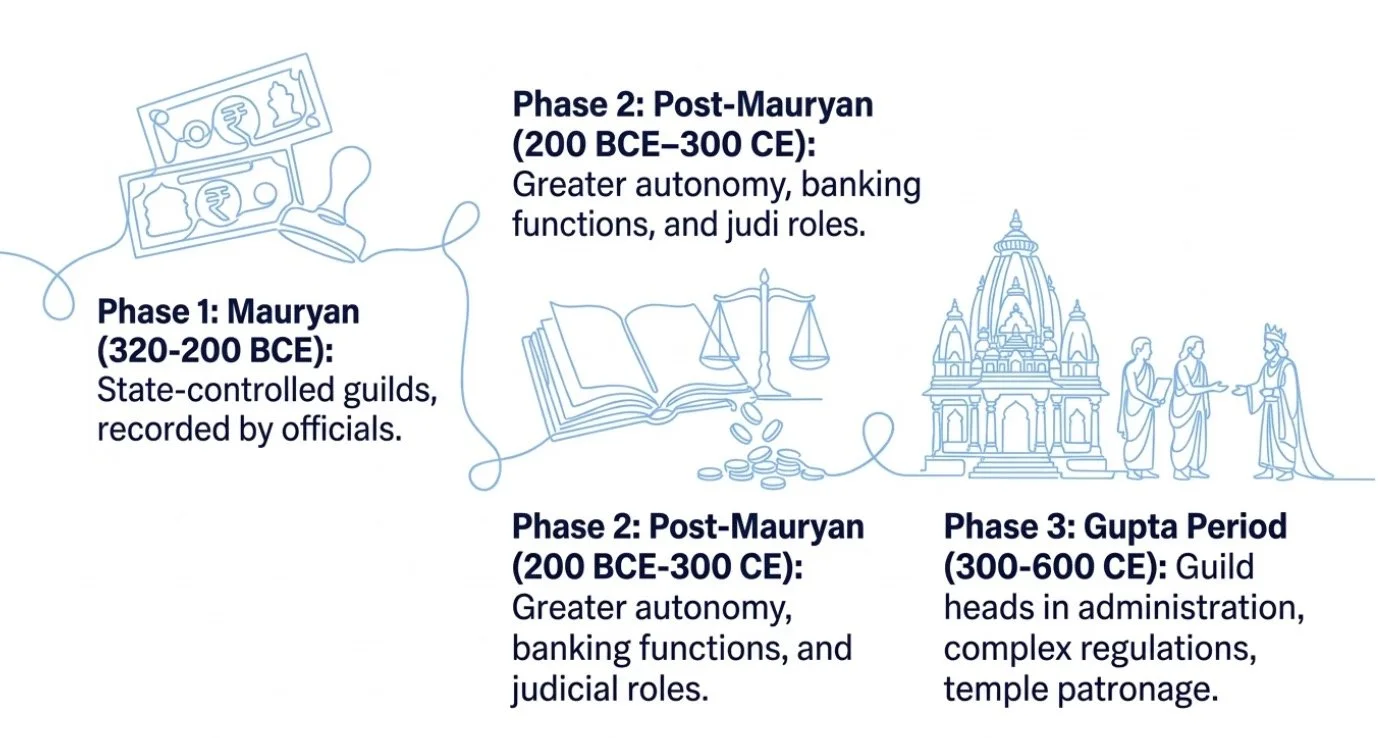
During the Mauryan period (c. 320–200 BCE), guilds operated under significant state oversight. The government kept records of guild transactions and conventions, allotted designated areas in towns to guilds for practising their trades, and Kautilya's Arthashastra explicitly acknowledged the potential of guilds to become independent centres of power — a recognition of their organisational strength. The state's close involvement in guild affairs was both regulatory and supportive.
With the decline of the Mauryan empire (c. 200 BCE), political fragmentation reduced state control over guilds, providing them with considerably greater scope to grow, diversify, and assert institutional autonomy. The period c. 200 BCE–300 CE thus saw a dramatic increase in both the number of guilds and the scale of their activities. This expansion coincided with a broader economic boom: the discovery of the seasonality of the south-west monsoon (c. 46 CE) opened vastly more intensive maritime trade with Rome, Indian merchants earned substantial profits, and the proliferation of coinage stimulated money-economy — all conditions favouring guild growth.
Guilds: Origins, Structure, and Development
The literary evidence is rich. The Jatakas refer to 18 guilds, naming specifically wood workers (vaddhakis), smiths (kammaras), leather workers (chammakaras), and painters (chittakaras). The Mahavastu provides a more extensive catalogue for Kapilavastu, including gold workers, ivory carvers, lapidaries, stone carvers, perfumers, silk and wool weavers, oil pressers, curd sellers, sugar manufacturers, flour makers, and wine makers. The Manusmriti and Yajnavalkya Smriti reflect a more elaborate and complex guild organisation than the Jatakas, with the Yajnavalkya text specifying qualifications and powers of guild officers, rules of apprenticeship, and the judicial role of guilds. Inscriptions from Sanchi, Bharhut, Bodhgaya, Mathura, and the western Deccan further corroborate the picture with records of donations by named guilds of weavers, potters, flour makers, oil millers, bamboo workers, corn dealers, and merchants.
Chapter III · Continued
Guild Leadership and Internal Organisation
The internal organisation of guilds was well-developed and hierarchically structured. At the apex was the guild head, referred to in Pali sources as jetthaka or pamukkha. The Jatakas contain numerous references to heads of specific guilds: malakara-jetthaka (head of garland makers), kammarajetthaka (head of metal workers), vaddhaki-jetthaka(head of carpenters), and vaha-jetthaka (head of caravan traders). The head of a merchant guild specifically bore the title setthi — a term that also carried broader connotations of great wealth and social prestige.
For caravan traders in particular, the guild head was known as the sarthavaha — a figure of considerable importance in long-distance overland trade. The sarthavaha was responsible for organising, provisioning, and protecting commercial caravans that linked distant regions of the subcontinent and beyond.
Jetthaka / Pamukkha
Head of a craftspersons' guild. Specific titles included malakara-jetthaka, kammarajetthaka, and vaddhaki-jetthaka. Often part of the king's official entourage.
Setthi
Head of a merchant guild; also used for wealthy banker-merchants. One of the most prestigious titles in the urban commercial hierarchy.
Sarthavaha
Head of caravan merchant guilds, responsible for organising long-distance overland trade. A key figure in connecting regional markets.
Guild Officers (Smriti Period)
The Yajnavalkya Smriti elaborates on the qualifications, powers, and judicial functions of guild officers, indicating increasing institutional sophistication over time.
The relationship between large merchant guilds and smaller craft guilds was not one of equality. Evidence suggests that large merchant guilds exercised a degree of control over smaller craft guilds, potentially integrating production and distribution functions within a broader commercial network. By the Gupta period, epigraphic evidence confirms that heads of different guilds served as members of advisory boards in district administration — a testament to the deep embeddedness of guild organisation within the governance structures of the time.
The Tamil-Brahmi inscription from Mangulam near Madurai offers a particularly vivid illustration of guild prestige. It records that a member of the merchant guild (nikama) of Vellarai, one Antai Assutan, held the honorific title kaviti — normally bestowed by kings on ministers, nobles, and merchants — and appears to have served as the superintendent of pearls in the Pandya administration. The collective contribution of guild members at Mangulam towards the carving of stone beds for Jaina ascetics demonstrates the strong links between guild activity and religious patronage in the far south.
Chapter III · Continued
Guilds as Banking Institutions
One of the most remarkable aspects of the Post-Mauryan guild system was its function as a proto-banking institution. Guilds accepted deposits, paid interest, managed endowments, and channelled financial resources towards both productive and pious ends. This financial role was not incidental but central to the economic life of the period.
The Arthashastra records that the king's spies borrowed gold — in bar or coin form — from guilds on the pretext of procuring merchandise, confirming that guilds regularly extended credit. More significantly, epigraphic evidence shows that not only members of the public but even royalty deposited money with guilds as trust funds (permanent endowments), with the principal sum remaining intact and only the interest being used for specified pious activities. This anticipates the logic of modern endowment funds by nearly two millennia.
Gadhwa Inscription
Records the investment of 20 dinaras in a guild for the benefit of Brahmanas.
Junnar Inscriptions
One records income from two agricultural fields invested with a guild for planting karanja and banyan trees. Another records money with guilds of bamboo workers and braziers.
Mathura Inscription (2nd c. CE)
Records two endowments of 550 silver coins each with two guilds by Kanasarukamana (Kushana subordinate). Interest provided food for Brahmanas and for distribution to the destitute.
Nashik Inscription (Nahapana's reign)
3,000 karshapanas invested by Ushavadata: 2,000 at 1% per month with one weaver's guild; 1,000 at ¾% per month with another. The only ancient Indian inscription specifying rates of interest clearly.
The Nashik inscriptions of the 2nd century CE are particularly instructive. The investment of 3,000 karshapanas by Ushavadata, son-in-law of the Kshatrapa ruler Nahapana, with two weaver's guilds of Govardhana (Nashik) at different rates of interest — 1% and ¾% per month respectively — constitutes the only ancient Indian inscription to clearly specify rates of interest on monetary investments. Notably, these rates are lower than the standard 1¼% per month prescribed in the Arthashastra and the Smritis, and the fact that two guilds of the same town offered different rates suggests something resembling competitive interest rate setting.
A later Nashik inscription from the time of the Abhira king Ishvarasena records deposits by Vishnudatta with four different guilds — potters, workers fabricating hydraulic engines, oil-millers, and a fourth — for providing medicines to Buddhist monks. The deliberate distribution across four guilds is interpreted as a risk-diversification strategy, acknowledging that any individual guild could suffer a setback or even go bankrupt. It is also noteworthy that guilds providing services outside their primary occupation — such as a weavers' guild arranging meals, or an oil-millers' guild procuring medicine — would likely have sub-contracted those services, functioning as financial intermediaries. The Brihaspati Smriti also records guilds providing shelter to travellers, underscoring their broad charitable mandate.
Chapter III · Continued
Judicial, Administrative, and Charitable Functions of Guilds
Beyond their economic and financial roles, guilds in Post-Mauryan India exercised significant judicial, administrative, and charitable functions — making them genuinely multipurpose civic institutions whose importance extended far beyond the marketplace.
Judicial Functions
Guilds could try their members for offences in accordance with their own customs and usages, which over time acquired quasi-legal status. Guild courts had jurisdiction over civil matters; cases involving heinous crimes remained the exclusive domain of the king's court. Guilds could even arbitrate disputes between members and their wives. The Yajnavalkya Smriti enumerates a hierarchy of courts in descending order: the king's court, the puga (village or neighbourhood assembly), the sreni (guild court), and the kula (family council). Though commentators such as Vijnanesvara and Visvarupa held that disputes should escalate through this hierarchy before reaching the king, in practice this was not always observed.
Judicial Sources
Vasishtha Dharmasutra: guild evidence valid in boundary disputes
Manu Smriti: artisans or merchants of same or other guild may act as witnesses
Brihaspati Smriti: guilds mete out justice to members
Some guild representatives sat in royal courts in an advisory capacity
Guilds also functioned as courts of justice for the general public
Administrative Functions
Guilds exercised administrative control over members (e.g., wife of member joining Buddhist sangha required guild permission)
Some guild heads served as mahamatras and were present in royal courts
Gupta-period epigraphs: guild heads as members of district advisory boards
Arthashastra: state officials to record guild transactions; guilds given designated town areas
Charitable and Religious Functions
Guilds made formal compacts to undertake works of piety and charity. They were expected to use portions of their profits for the preservation and maintenance of assembly halls, watersheds, shrines, tanks, and gardens, as well as for helping widows, the poor, and the destitute in performing religious rites. Epigraphic evidence records gifts of gateways, caves, cisterns, pillars, and seats made by guilds and individual guild members. The Mandasor inscription records the building and renovation of a Surya temple by a guild of silk weavers — a remarkable example of collective guild patronage of religious architecture. The Gwalior inscription from the reign of Mihirakula records the building of another temple. An inscription at Junnar records the gift of a cave with seven cells and a cistern by a guild of corn dealers (dhanika seni) — a tangible contribution to monastic infrastructure.
The significance of guilds as democratic civic institutions should not be underestimated. As scholars have noted, king's courts were often inaccessible to people living far from the capital. By sharing judicial and administrative functions at local levels, guild courts and village assemblies made effective governance of large kingdoms possible even in the absence of rapid communication — a pragmatic solution to the perennial challenges of ancient statecraft.
Chapter III · Continued
Guild Coins, Seals, and Their Relationship with Kings
The relationship between guilds and ruling powers was one of mutual interest and carefully negotiated autonomy. The Arthashastra explicitly recommended that state officials maintain records of guild transactions and assign guilds designated areas in towns — a combination of surveillance and support. The Dharmashastra texts granted kings the right to intervene in guild affairs in specified circumstances: the Manu Smriti stipulated banishment for a guild member who broke an agreement out of greed, while the Yajnavalkya Smriti prescribed that the king enforce accepted usage in cases of internal guild quarrels and impose an eightfold penalty on guilds that cheated the king of his profit share. Yet the same Mandasor inscription that records a silk weavers' guild migrating and building a new temple suggests that guilds did exercise a degree of independent movement without necessarily incurring royal punishment.
Numismatic and Sigillographic Evidence
The importance of guilds is dramatically illustrated by the coins and seals they issued — material evidence of their civic standing and economic significance. Several coins found at Taxila bear the legend negama in Brahmi letters of the 3rd/2nd century BCE, with names of localities on the obverse. The legend pamchanekame — possibly referring to a corporation of five guilds — and hiranasame (possibly meaning an issuer of coined money) also appear. Two copper coins from Kaushambi bearing the legend gadhikanam (c. 2nd century BCE) were likely issued by a guild of perfumers.
3rd–2nd c. BCE
Taxila coins with negama legend; Kaushambi copper coins of perfumers' guild (gadhikanam); early Brahmi sealings at Rajghat, Bhita, Ahichchhatra
2nd–1st c. BCE
Bhita sealing: shulaphalayikanam — possibly guild of arrowhead/spearhead makers. Rajghat sealing: svastika symbol with gavayaka (guild of milkmen)
1st c. CE
Ahichchhatra seal: kumhakara seniya ('of the guild of potters'). City-name coins of Varanasi, Kaushambi, Vidisha, Eran, Ujjayini, Mahishmati — possibly by guilds influential in city administration
2nd–3rd c. CE
Nashik and Mathura inscriptions detail guild banking. Mandasor guild migrates and builds Surya temple. Gupta-era guild heads serve in district administration boards
Seals and sealings with the terms nigama and nigamasya have been discovered at sites including Rajghat, Bhita, Hargaon, Jhusi, and Ahichchhatra, with scripts ranging from the 3rd century BCE to the early centuries CE. Some bear symbols; others carry personal names. A sealing from Rajghat carries a svastika symbol with the legend gavayaka(guild of milkmen) in 1st century BCE Brahmi. A Bhita sealing reads shulaphalayikanam in 2nd century BCE letters — likely a guild of makers of arrowheads or spearheads. Taken together, this numismatic and sigillographic corpus confirms that guilds were not merely private associations but institutions of sufficient civic standing to issue their own currency and official seals — a privilege otherwise associated with royalty and state authority.
Synthesis
The Post-Mauryan Economic World in Perspective
The period c. 200 BCE–300 CE emerges from our survey as one of remarkable economic vitality, institutional creativity, and urban dynamism across the Indian subcontinent. The evidence — drawn from Buddhist narrative literature, Sangam poetry, donative inscriptions, legal digests (Smritis), coins, seals, and archaeological excavations — converges to reveal a world characterised by specialised craft production, organised merchant and artisan guilds, expanding monetary economy, and flourishing urban centres connected through both overland and maritime trade networks.
Agricultural Base
Kushan irrigation innovations; village assemblies managing tanks; occupational villages supplying raw materials to urban centres
Urban Prosperity
Burnt-brick construction; fortified trade hubs; North Indian Kushan towns; Satavahana Deccan emporia; South Indian ports (pattinam)
Guild Institutions
Financial intermediaries, judicial forums, civic patrons, administrative partners — the guild was the foundational economic institution of the age
Coinage & Money
Guild-issued coins and seals; interest-bearing endowments; proliferation of karshapanas, dinaras, and silver coins; risk-diversified banking deposits
Several historiographical debates recur across the scholarship reviewed here. The relative weight of external stimulus(Mauryan legacy, Indo-Roman trade) versus internal processes (agricultural intensification, craft specialisation, indigenous social change) in driving urbanisation — particularly in the Deccan and South India — remains contested. The evidence increasingly supports a more balanced view: while external stimuli were catalytic, they operated upon and through pre-existing processes of social and economic transformation that must be understood on their own terms.
For students of ancient South Asian history, this period offers an unparalleled laboratory for examining how institutions emerge, adapt, and embed themselves in social life. The guild's evolution — from a state-supervised production unit under the Mauryas to a quasi-autonomous civic institution exercising banking, judicial, and administrative functions by the Gupta period — exemplifies how economic organisations can accrete social and political power over time. The inscriptional record, particularly the Nashik and Mathura endowment inscriptions, affords a level of financial and institutional detail that is rare for the ancient world anywhere, and deserves sustained scholarly attention.
The long-term development of urban centres required and involved an expansion in agricultural production, developments in specialised crafts, and wider, more intensive and extensive trade networks. Understanding this period means understanding how these forces interacted — across regions, across communities, and across the many centuries that separate the earliest Jataka references to village guilds from the elaborate Smriti codifications of guild law.
