
Post-Mauryan Period: Development of Religions
Post-Mauryan Period: Development of Religions
The period from approximately 200 BCE to 300 CE stands as one of the most transformative epochs in the religious history of the Indian subcontinent. While many strands of continuity link this era to the centuries preceding it, the post-Mauryan period witnessed a remarkable proliferation of new devotional practices, the crystallisation of early Hinduism, the emergence of Mahayana Buddhism, and the deepening schism within Jainism. Shrines multiplied across the landscape, philosophical schools sharpened their arguments, and royal as well as popular patronage reshaped the sacred geography of South Asia.
Shrines, Texts, and the Limits of Religious History
One of the defining features of the post-Mauryan religious landscape was the proliferation of stone shrines — demarcated sacred spaces that acquired a new permanence and social prominence. A shrine was not merely a site of worship; it functioned simultaneously as a community gathering space, a locus of social interaction, and a stage upon which acts of piety were performed before witnesses. Patronage of a shrine carried dual weight: it was an expression of religious devotion and a very public validation of social, and sometimes political, standing.
However, constructing the history of religions from texts alone is a fraught enterprise. Religious texts are, almost without exception, authored by elites and are normative in character — they prescribe how religion ought to be practised rather than documenting how it actually was. Many such texts are notoriously difficult to date with precision, and the beliefs they record often have considerably older roots than their composition dates suggest. Moreover, dominant religious traditions typically marginalise or overlook competing sects. The Ajivika sect — disparaged in both Buddhist and Jaina sources — is a telling example: despite sustained textual criticism of its ideas, archaeological and inscriptional evidence confirms it enjoyed real influence across the subcontinent for several centuries.
What Texts Tell Us
Doctrinal frameworks and ritual prescriptions
Elite-authored normative narratives
Pan-regional theological debates
Genealogies of sects and teachers
What Texts Miss
Regional and local variations in practice
Popular cults and folk worship
Burial practices and mortuary rituals
The true scale of non-elite patronage
Texts must always be read alongside archaeology, inscriptions, and coins for a complete picture.
Interactions and Interconnections Among Religions
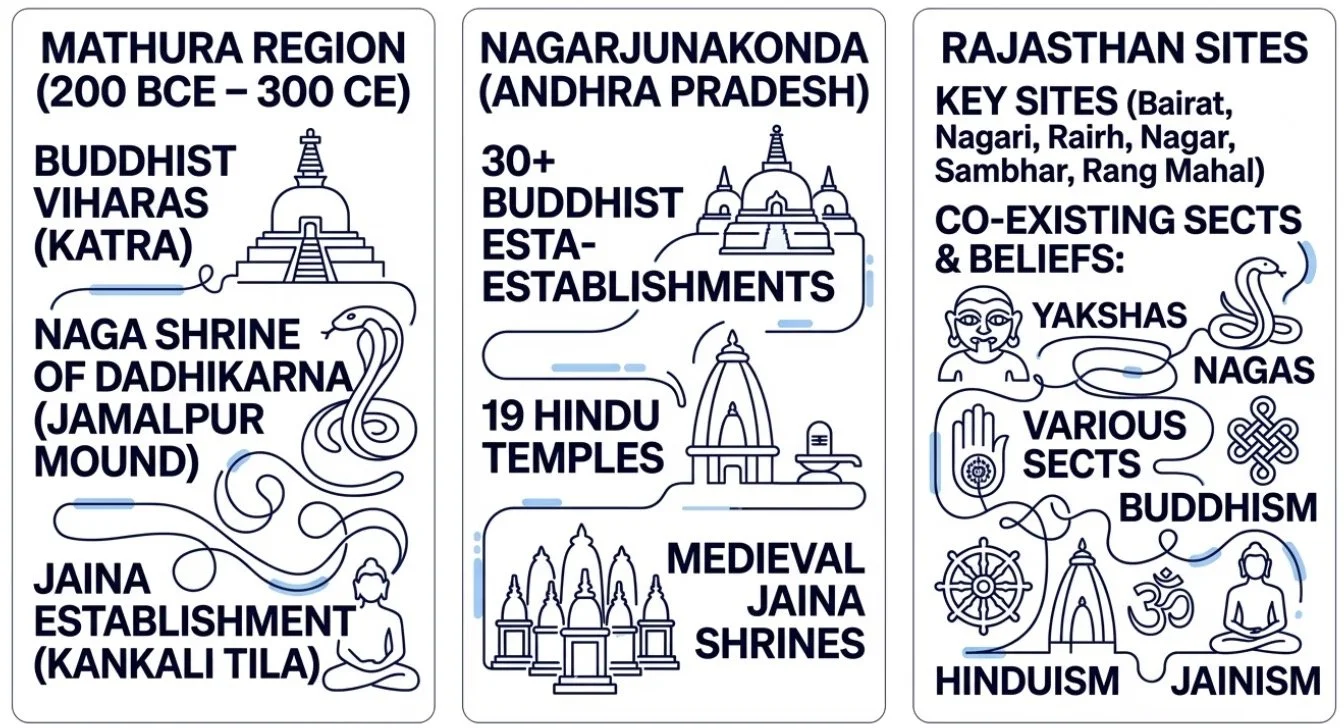
When different religious traditions are studied in isolation, the rich texture of their coexistence and mutual influence is easily lost. The post-Mauryan period was not one of hermetically sealed faiths but of overlapping, sometimes competing, sometimes cooperating traditions that shared sacred spaces, architectural idioms, and auspicious symbols. Pilgrimage sites across the subcontinent offer innumerable examples of places considered sacred by multiple religious communities for different, sometimes contradictory, reasons.
The sculptural evidence is particularly instructive. The motifs adorning shrines of this period reveal a shared pool of auspicious symbols that cut across sectarian lines. Architectural styles too were held in common — the apsidal hall, the pillared gateway, the enclosure rail — regardless of whether the deity enshrined was a Buddha, a Jina, or a Brahmanical god. At the same time, competition and conflict between traditions were real, and the religious landscape was as much a site of contestation as of shared practice.
Interactions and Interconnections Among Religions
These regional snapshots reveal that the religious map of post-Mauryan India was not a mosaic of exclusive territories but a complex, layered palimpsest where multiple traditions overlapped in the same physical spaces, often peacefully, occasionally in rivalry.
The Worship of Yakshas and Yakshis
Among the most ancient and widespread religious cults of the subcontinent was the worship of yakshas and yakshis — deities connected with water, fertility, trees, the forest, and the wilderness. The art historian Ananda K. Coomaraswamy argued persuasively that this worship was the natural source of the devotional (bhakti) elements that later became so pervasive in Indian religions. He further argued that yaksha worship implied temples, puja (devotional worship with offerings), and a fully developed cult — not simply casual village propitiation.
The literary and sculptural evidence together trace a striking metamorphosis. The yaksha began as a benevolent, powerful deity who was the focus of exclusive worship; he was gradually reduced to a terrifying, demonic creature serving as a subsidiary attendant figure associated more with fertility than wealth. Yakshis — the female counterparts — underwent a parallel transformation: originally benign fertility deities, they were recast in Brahmanical, Buddhist, and Jaina texts as demonic and frightening beings. Many of the celebrated shalabhanjikas — sensuous sculptural representations of women grasping the branch of a tree — found across the subcontinent were in origin yakshis.
Urban Scale of Worship
Imposing stone images from Mathura and elsewhere were products of urban workshops for urban clients — not minor rural folk cults. The colossal figure of yaksha Manibhadra at Parkham was a tutelary deity of merchants and travellers, especially venerated at important trading centres.
Public and Private Spheres
Large stone statues indicate community worship in the public domain. Smaller stone and terracotta images found in domestic contexts confirm that yakshas and yakshis were equally worshipped in private, household settings — a dual presence that underlines their cultural ubiquity.
Decline and Absorption
Around the turn of the millennium, colossal public images disappear from the Mathura area, even as small domestic statues remain plentiful. The yaksha cult was gradually absorbed into and marginalised by dominant Brahmanical, Buddhist, and Jaina traditions.
Nagas, Nagis, and the Serpent Cult
The worship of serpents — nagas and nagis — was another widespread religious practice that cut decisively across religious boundaries. Like the yakshas and yakshis, nagas and nagis were associated with water and fertility, and were originally the focus of exclusive, independent worship before being absorbed into the dominant traditions. Their eventual marginalisation was not immediate or uniform; textual, archaeological, and inscriptional evidence confirms that the serpent cult retained real vitality throughout the post-Mauryan centuries.
The archaeological record is particularly rich. A seven-hooded naga image found at Mathura, bearing an inscription placing it in the early 2nd century CE, is among the most impressive examples of the genre. Its technical finesse and colossal scale make it unambiguous that this was no humble village shrine. The Jamalpur mound at Mathura once housed a shrine dedicated to Dadhikarna, lord of the nagas, endowed by a gift recorded in a surviving inscription. An elaborate brick and stone naga temple at Sonkh near Mathura reveals structural phases spanning from the beginning of the 1st century BCE to the 2nd century CE — a longevity of over three hundred years. Naga remains at Maniyar Math near Rajagriha extend the cult's reach into the eastern Gangetic plains.
Geographical Spread
Mathura region: major urban naga shrines
Rajagriha: Maniyar Math naga temple (2nd/1st century BCE)
Central Deccan: Peddabankur and Kotalingala — naga figurines without any Brahmanical temple remains
Iron figurine of a snake at Peddabankur — rare material attestation
Cultural Significance
Many people and villages recorded in inscriptions were named after nagas and yakshas, underscoring how deeply these cults permeated social identity. The story of Krishna subduing the Kaliya naga can be read as an allegorical narrative of the ultimate triumph of Vishnuism over a once-dominant serpent cult — a mythological encoding of historical religious transition.
Goddesses, Votive Tanks, and Shrines
The worship of goddesses during the period c. 200 BCE–300 CE is abundantly attested from archaeological evidence across the subcontinent. The term 'goddess' or 'mother goddess' is a broad label sheltering a range of distinct deities with differing attributes and functions. Not all ancient goddesses were maternal: they were variously invoked for fertility, prosperity, safe childbirth, the protection of children, and defence against disease. The category is diverse and should not be collapsed into a single archetype.
In the Mathura area, goddess figurines first appear in the late 4th–2nd centuries BCE. Those of succeeding centuries display greater stylistic refinement, technical innovation, and considerable variety. They typically bear prominent breasts and broad hips and wear elaborate ornaments including necklaces, bracelets, earrings, and girdles. Some are crowned with a profusion of rosettes, while others sport elaborate headdresses of conical sprouts or grass blades encircled by cactus-like plants — a rich visual vocabulary of fecundity and abundance.
Votive Tanks
Terracotta artefacts interpreted as votive tanks have been reported from sites ranging from Taxila in the north-west to Chirand in the east and Kolhapur in the south, in contexts spanning the 3rd century BCE to the 3rd century CE. Most were evidently filled with water, incorporating lotus plants, snakes, frogs, or fish at the base — all symbols of fertility and abundance.
Miniature Shrines
Terracotta shrines can be interpreted as miniature representations of popular shrines connected with the worship of goddesses and nagas. At Sonkh near Mathura, such objects were found from 3rd century BCE levels right up to medieval layers — a continuous domestic ritual tradition spanning over a thousand years.
Cultic Context
Whether female terracotta images had cultic significance is a matter of contextual judgement. They functioned variously as objects of worship, votive offerings, or paraphernalia of domestic ritual — distinctions that depend heavily on the archaeological context in which they are discovered.
Vedic Rituals in the Post-Mauryan Period
Despite the evident shift in popular religiosity toward image-worship and devotional practice, Vedic sacrificial rituals retained considerable importance throughout the period c. 200 BCE–300 CE. Their significance was not merely ceremonial; Vedic sacrifice functioned as one of several bases of political legitimation for rulers seeking to anchor their authority in ancient Brahmanical tradition. Rulers as varied as Pushyamitra Shunga and certain Satavahana and Ikshvaku kings publicly claimed to have performed prestigious Vedic sacrifices including the ashvamedha (horse sacrifice) and, in at least one striking case, the purushamedha (human sacrifice).
The archaeological evidence corroborates these textual claims in remarkable ways. Stone yupas (sacrificial posts) have been found across Rajasthan from the 3rd century CE onwards. At Isapur in Mathura, two stone yupas were discovered carved with the girdle rope and noose used to bind the sacrificial animal. An inscription on one pillar, dated to the reign of the Kushana king Vasishka, records its erection by a Brahmana named Dronala during the performance of a sacrifice. Excavations at Kaushambi revealed a brick altar shaped as an eagle — the traditional shape of the Vedic fire altar — along with animal and human bones, possibly the remains of a purushamedha.

Vedic Rituals in the Post-Mauryan Period
The evidence from Purola in Uttarkashi, Jagatgrama near Kalsi, and Sanghol in Punjab collectively confirm that Vedic fire rituals were performed in geographically dispersed regions. Yet at the level of popular practice, the period witnessed a marked shift away from sacrifice-centred religion toward devotionalism — a transformation that would reshape the subcontinent's religious character for millennia.
The Emergence of Early Hinduism
The English word 'Hinduism' was first used by Raja Ram Mohun Roy in 1816–17; the word 'Hindu' itself is older, derived from the Sindhu (Indus) river and originally a geographical term in ancient Persian inscriptions. Modern-day Hinduism is distinctive among major world religions in having no founder, no fixed canon, and no organised priesthood — it is marked instead by extraordinary variety in beliefs, practices, sects, and traditions. Some scholars argue it is less a religion than a set of socio-cultural practices; others insist it is inextricably bound up with caste; still others prefer to speak of 'Hindu religions' in the plural.
The period c. 200 BCE–300 CE was a formative phase in the evolution of early Hindu pantheons. Deities known from Vedic literature now emerged as supreme, powerful foci of devotion whose images were installed and worshipped in temples and homes. The beginnings of these theistic trends can be traced to the later Upanishads, but the process is most clearly visible in the Mahabharata and Ramayana. The new religiosity is also reflected in the Bhagavad Gita and the Puranas. Crucially, archaeological sites, sculptures, coins, and inscriptions often indicate even earlier beginnings than the texts suggest.
Textual Sources
Later Upanishads (early theistic trends)
Mahabharata and Ramayana (devotional narratives)
Bhagavad Gita (theology of devotion)
Puranas (mythological elaboration)
Legal and Technical Texts
Baudhayana Grihyasutra (image worship at child's first outing)
Gautama Dharmasutra (images at householder stage)
Patanjali's Mahabhashya (Shiva, Skanda, Vishakha)
Arthashastra (temple placement in cities)
Archaeological Evidence
Besnagar pillar inscription (Vishnu temple, Heliodorus)
Nagari inscription (Samkarshana–Vasudeva temple)
Gudimallam Shaiva temple
Matrika temple at Sonkh; Lakshmi temple at Atranjikhera
The marginalisation of the popular cults of yakshas, yakshis, nagas, and nagis by the gods and goddesses of the Brahmanical tradition is clearly visible in stone and terracotta sculptures from sites such as Mathura. The most influential of the newly emerging cults were those of Shiva, Vishnu, and the goddess Durga. Importantly, even as sectarian cults developed around individual supreme deities, a parallel integrative process visualised the Hindu gods as closely related — giving rise to the celebrated triad of Brahma (creator), Vishnu (preserver), and Shiva (destroyer). The term that best describes this emerging religious formation is not polytheism but monolatory: belief in a supreme god without denying the existence of others.
Shaivism: The Many Faces of Shiva
The roots of Shiva worship may extend as far back as the Harappan civilisation, if the so-called Pashupati seal is accepted as evidence of proto-Shaiva practice. In the Rig Veda, the word shiva (auspicious) appears, but not as a divine name; a fierce god named Rudra bears striking resemblance to the Shiva of later mythology. By the time of the later Vedic literature, the deity is known by a rich array of epithets — Shiva, Rudra, Ishana, Mahadeva, Maheshvara, Bhava, Pashupati, and Sharva — each capturing a different aspect of his complex personality. The Shvetashvatara Upanishad hails him as lord of all gods and the granter of ultimate liberation.
The earliest Shaiva sect appears to have been the Pashupata sect, with its ascetic and mystic associations. Attributed variously to Lakulin (or Nakulin) and Shrikantha, this sect developed a rigorous ascetic discipline that would influence Shaiva practice for centuries. Shiva's many Puranic manifestations — Chandrashekhara, Gangadhara, Vaidyanatha, Kalasamhara, and the remarkable Ardhanarishvara (the deity who is half woman) — reflect the extraordinary breadth of his iconographic and theological range.
Shiva in Linga Form
Shiva's linga (phallic) form represents male procreative energy. Sculptural representations of stone lingas appear from the 2nd century BCE — one of the earliest at Bhuteshwar in Mathura shows a linga on a platform under a pipal tree, being worshipped by two winged creatures. Mukhalingas (lingas with the god's face carved upon them) also gained popularity. Coins of the Kushana king Vima Kadphises bear representations of Shiva, the bull, and the trident.
Shiva in the South
The Sangam literature of Tamilakam attests to Shiva's reach into the south. The Akananuru describes the three-eyed god with konrai flowers and a crescent moon in his matted locks. The poet Nakkirar calls him Kurram, god of death and destruction. The important South Indian god Murugan became part of Shiva's family, identified with his son Skanda-Karttikeya, and one of the temples at Nagarjunakonda was dedicated to Karttikeya.
Formation of the Vaishnava Pantheon
The history of Vishnuism involved a long process of coalescence — the gradual coming together of initially independent cults of various deities including Narayana, Vasudeva Krishna, Shri, and Lakshmi. The Rig Veda addresses five hymns to Vishnu, grouping him with the solar deities and describing him as a mountain deity. The prominence given to Vishnu appears to have been a later development, coinciding with the Brahmanisation of these independent cults.
The cult of Vasudeva Krishna seems to have originated in the Mathura region. The Ashtadhyayi of Panini offers the earliest reference to devotion to Vasudeva. Megasthenes, the Greek ambassador, records that the Sourasenoi of the Mathura region worshipped Herakles — almost certainly Vasudeva Krishna, who most closely resembled the Greek hero. Vasudeva Krishna was one of five heroes (pancha-vira) worshipped by the Vrishnis: Samkarshana, Vasudeva, Pradyumna, Samba, and Aniruddha. The Mora inscription from Mathura records the installation of images of these five heroes during the late 1st century BCE.
Rig Vedic Period
Vishnu grouped with solar deities; five hymns address him as mountain god
c. 400 BCE
Ashtadhyayi of Panini — earliest reference to devotion (bhakti) to Vasudeva
c. 200–100 BCE
Besnagar pillar inscription; Heliodorus described as bhagavata; Nagari temple of Samkarshana and Vasudeva
c. 100 BCE–100 CE
Mora inscription records installation of images of the five Vrishni heroes; Gosundi inscription mentions bhagavata patron
Early Centuries CE
Dramatic increase in Vaishnava images at Mathura; Vishnu, Varaha, and Garuda forms proliferate; avatara concept develops
The goddess Shri Lakshmi was also absorbed into the Vaishnava pantheon by about the 3rd–4th century CE as Vishnu's consort. Originally, Shri (well-being, prosperity) and Lakshmi (sign, mark) appear to have been two distinct goddesses. Her Gaja-Lakshmi form — seated or standing on a lotus, flanked by elephants pouring water over her — became one of the most widely diffused iconographic motifs in this period, appearing on coins of Shunga, Scytho-Parthian, and Ayodhya kings alike.
Shakti Worship and the Goddess Durga
The worship of goddesses associated with fertility is one of the oldest and most enduring features of religious practice on the subcontinent. During the 1st millennium CE, the Puranas attempted to bring diverse goddess traditions together, presenting them as different manifestations of the female principle — shakti. The Taittiriya Aranyaka's Durga-Gayatri is the first text to name some of the goddesses later associated with Shakti worship: Katyayani, Kanyakumari, and Durga. The Mundaka Upanishad mentions Kali and Karali as two of Agni's seven tongues — identified in the Puranas as terrifying forms of Durga.
The Harivamsha (Vishnu Parva) contains the Arya-stava, a hymn in praise of Durga, addressing her by many names — Arya, Narayani, Tribhuvaneshvari, Katyayani, Kaushiki — and connecting her with the Vindhya hills, rivers, caves, forests, and wild animals. She is described as beloved of tribal peoples (Shabaras, Barbaras, Pulindas), as the personification of death, as the mother of mantras, and as the protector of women in both their virginal and married states. She is also a saviour in war, fire, imprisonment, and exile — a goddess of comprehensive refuge.
Textual Tradition
The Devi-Mahatmya, incorporated into the Markandeya Purana by about the 7th century CE, narrates how the goddess emerged from the concentrated energy of all the gods to destroy the buffalo demon Mahishasura — the origin myth of Durga Mahishasuramardini.
Archaeological Evidence
The Mathura area has yielded numerous stone Durga images, including Mahishasuramardini representations, from the period c. 200 BCE–300 CE — predating the textual elaboration of the myth and confirming an early, active goddess cult.
Shrine Evidence at Sonkh
At Sonkh, a stone Matrika plaque may have been the central cult image in Apsidal Temple No. 1. Large numbers of terracotta Mahishasuramardini plaques were found in and around this temple, confirming the goddess's active popular cult well before her Puranic textualisation.
The Emergence of Mahayana Buddhism
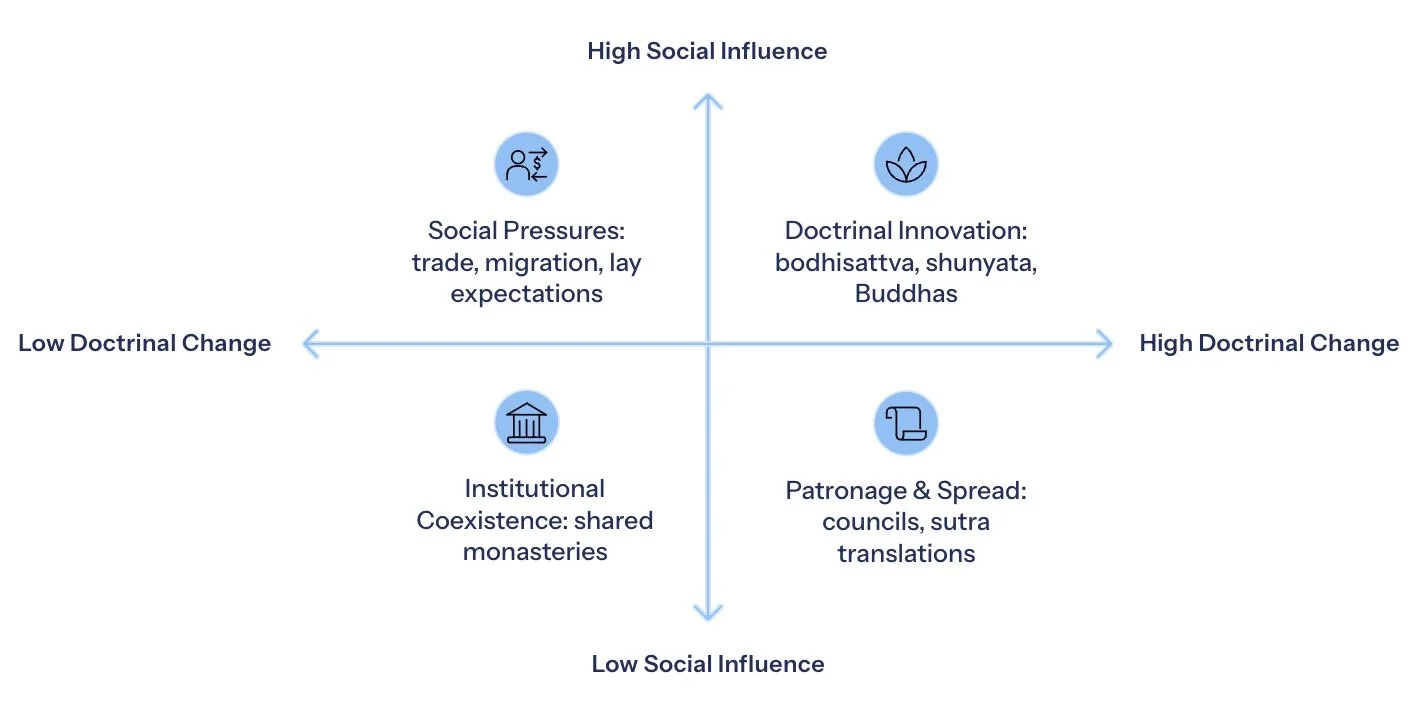
The period c. 200 BCE–300 CE is associated in Buddhist history with the emergence of Mahayana — the 'Great Vehicle'. This development was shaped by a confluence of social and economic forces. The expanding networks of trade and artisanal production brought growing numbers of urban merchants and craftspeople into close contact with Buddhist monasteries, whose monks and nuns could ill afford to alienate this financially significant community. The large influx of Central Asian peoples, many of whom were non-vegetarians, also influenced Buddhist practice. The result was a gradual relaxation of monastic discipline: monks began accepting gold and silver, adopted non-vegetarian food, and wore more elaborate robes. Some even abandoned the sangha and returned to lay life.
The Kushana king Kanishka became Mahayana's great royal patron, convening a council in Kashmir whose members composed extensive commentaries on the three pitakas, subsequently engraved on copper sheets and enshrined beneath a stupa. Yet the origins of Mahayana were not simply a lay revolt against monastic rigour. Recent scholarship has argued persuasively that Mahayana was initially a set of ideas and teachings originating among a group of monks within the existing sangha — not an immediate schism. The Chinese pilgrims Faxian and Xuanzang, visiting India in the 4th–5th and 7th centuries respectively, describe Mahayana and non-Mahayana monks living together in the same monasteries, distinguished mainly by whether they venerated bodhisattva images.
The Emergence of Mahayana Buddhism
The Bodhisattva Ideal and Mahayana Philosophy
The idea of the bodhisattva (wisdom being) existed in earlier Buddhism, but assumed transformative importance in Mahayana. The crucial distinction is between the arhat and the bodhisattva. The arhat strives to attain nibbana for himself, and having achieved this goal, disappears from the cycle of samsara. The bodhisattva, by contrast, has attained great wisdom but deliberately refrains from taking the final step into nibbana — choosing instead to remain engaged with the world for aeons, driven by great compassion (maha-karuna), in order to help all sentient beings achieve liberation. This is the Mahayana ideal: heroic, outward-facing, compassionate.
Mahayana philosophical ideas were represented principally in two major schools: the Madhyamaka and the Yogachara. Nagarjuna (2nd century CE), founder of the Madhyamaka school, developed the concept of shunyata(emptiness) in his Mula-Madhyamaka-Karika. Shunyata does not mean that nothing exists; it means that appearances are misleading, and that permanent selves and substances do not exist. The Yogachara school, associated with thinkers like Asanga and Vasubandhu (4th century CE), developed a detailed philosophy of consciousness, identifying active consciousness, the defiled mind (klishta-manas), and the store consciousness (alaya-vijnana) — the accumulated seeds of past defilements.
The Bodhisattva Path
Six (later ten) perfections (paramitas): generosity, good conduct, patient forbearance, mental strength, meditation, wisdom, skilfulness in means, determination, power, and knowledge
Madhyamaka School
Founded by Nagarjuna. Core concept: shunyata — all dharmas are empty of inherent existence. Later thinkers: Aryadeva, Chandrakirti, Shantideva
Yogachara School
Founded by Maitreyanatha; elaborated by Asanga and Vasubandhu. Core thesis: mundane experience is a construct of consciousness. Three levels: active consciousness, defiled mind, store consciousness
Women in Buddhism and the Bhikkhuni Sangha
Mahayana texts, like their earlier Buddhist counterparts, present contradictory images of women and femininity. Women are variously portrayed as mysterious, sensual, and dangerous to monks' spiritual aspirations, and simultaneously as wise, maternal, gentle, and creative. The path of renunciation was formally open to women, yet the texts consistently display anxiety about women leaving the household to become nuns, and several sutras declare that a woman could not enter the bodhisattva path until reborn as a man. Others narrate miraculous sex changes — the Saddharmapundarika Sutra tells of an 8-year-old bodhisattva girl whose sex changed the moment the prophecy of her Buddhahood was made.
The epigraphic evidence, however, reveals a more nuanced picture of women's actual participation in Buddhist practice. Female donors appear in inscriptions at sites such as Sanchi in roughly equal proportion to male donors — a far higher level of female patronage than the texts might lead one to expect. Nuns appear both as individual donors and as members of collective gift-giving groups. Yet a stark disparity remains: all the great monastic centres known from texts and inscriptions were centres of male monasticism. Not a single inscription from this period records a donation made to the bhikkhuni sangha. Monastic centres of nuns existed but are unknown by name or fame — a silence that reflects a systematic inequality in patronage between male and female monastic orders.
The invisibility of the bhikkhuni sangha in the inscriptional record is itself a form of historical evidence — it confirms the gross disparity in institutional patronage between male and female monasticism, making the eventual decline of the female order unsurprising.
Monastic Practice: Texts versus Inscriptions
One of the most instructive methodological lessons offered by the post-Mauryan period concerns the gap between what Buddhist texts prescribe and what archaeological and epigraphic evidence reveals about actual practice. Scholars who rely exclusively on textual sources risk assuming that these texts were universally known and applied — when in fact they may not have been known to many monks or lay people at all.
Burial Practices
Buddhist texts say almost nothing about the burial practices of monastic communities. Yet stupas — with or without relics — indicate a rich and elaborate stupa cult. Small votive stupas near larger ones contained the funerary remains of devout lay people. This knowledge comes almost entirely from archaeology and inscriptions.
Owning Property
Texts state that monks relinquished all property upon entering the sangha. Yet inscriptions at sites like Sanchi specifically record monks and nuns making donations to stupa-monastery complexes — clear evidence that members of the order retained control over some financial resources.
Handling Money
The texts prohibit monks from handling money. Yet excavations at Sanchi yielded coins and semi-precious stones under the floors of monastic cells. At Nagarjunakonda, lead coins were found in a monastery alongside an earthenware die for making them — monks were evidently minting coins.
Transference of Merit
The idea that meritorious results of one person's actions can be transferred to another is nowhere found in early Buddhist texts. Yet hundreds of donative inscriptions at Sanchi, Bharhut, and elsewhere specifically state that gifts were made for the benefit of parents or all sentient beings — a widespread popular belief unattested in the canonical literature.
The Digambara–Shvetambara Schism in Jainism
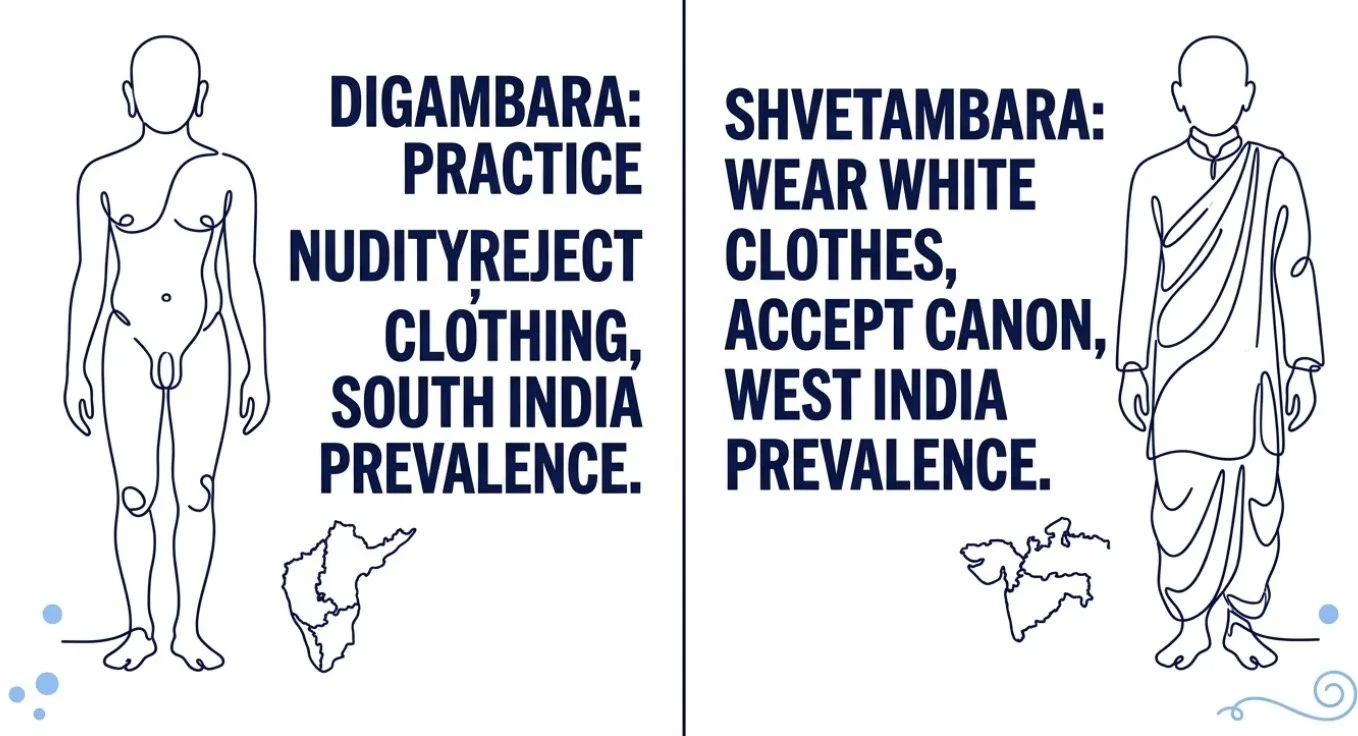
Within the Jaina sangha, the period around 300 CE is associated with the gradual crystallisation of the Digambara–Shvetambara division — one of the most consequential schisms in South Asian religious history. The Digambara tradition explains the split through a narrative of southward migration: when a famine threatened, a group of Jaina monks led by Bhadrabahu moved to the Karnataka region. When they returned to Pataliputra after 12 years, they found that the northern monks, led by Sthulabhadra, had codified the canon and, scandalously, begun wearing clothes. To the returning group, wearing clothes represented the retention of shame and a betrayal of the ascetic requirement to renounce all possessions. The northerners — the Shvetambaras ('white-clad') — naturally offered a different origin story, attributing the Digambara ('sky-clad') sect to a self-initiated monk named Shivabhuti.
Both accounts are late and historically dubious, though a southward migration of monks may indeed have occurred. Crucially, the archaeological and inscriptional evidence suggests a gradual process rather than an abrupt split. All early tirthankara images from Mathura are naked; clothed images appear only from the 5th century CE. The council of Valabhi in the 5th century — an exclusively Shvetambara gathering — may have been the decisive moment in hardening the divide. The early medieval Yapaniya sect appears to represent an intermediate position. Ultimately, the Shvetambaras came to predominate in western India and the Digambaras in the south.
The Digambara–Shvetambara Schism in Jainism
Patronage of Religious Establishments
The increasing architectural elaboration and social visibility of religious establishments in post-Mauryan India rested on a substantial and diverse patronage base. Inscriptions at sites across the subcontinent record the names, social backgrounds, and sometimes the political identities of those who financed shrines, stupas, monasteries, cave excavations, images, tanks, and pillars. Patronage was simultaneously an act of piety, a quest for social legitimacy, and, for rulers, a tool of political communication.
Royal patronage, while significant, was in fact a minority source of funds. The Bharhut inscriptions (c. 125–75 BCE) list 222 records: only four royals appear among a profusion of ordinary individuals whose names reflect the naming conventions of the time — after nakshatras, Brahmanical gods, yakshas, bhutas, and nagas. Donors came from as far as Pataliputra in the east to Nashik in the west. The Sanchi inscriptions (over 800, ranging from Ashoka's schism edict to the 9th century CE) reveal female and male donors in almost equal proportions, a striking contrast to the textual evidence, and include the collective gifts of entire villages and kin groups.
Royal Patrons
Shungas, Satavahanas, Ikshvakus — Brahmanical sacrifices and Hindu temple patronage
Kushanas — religious eclecticism; coins depicting Indian, Graeco-Roman, and Iranian deities
Ikshvaku queens — donations to Buddhist establishments
Mat devakula near Mathura — possible deified royal shrine
Non-Royal Patrons
Monks and nuns — gift-givers in their own right
Merchants (vanija, setthi, gahapati), artisans (kamika), scribes (lekhaka)
Ivory-workers, weavers, cloak sellers, masons
Yavana (Greek) donors at Sanchi, Nashik, Junnar, Karle
Tamil–Brahmi donors: salt merchants, toddy merchants, gold merchants, cloth merchants
The Jaina inscriptions from Mathura reveal significant participation by women donors, with tirthankara images gifted by wives of merchants, householders, jewellers, and bankers — many at the explicit request of Jaina nuns. Early Tamil-Brahmi inscriptions in Tamil Nadu and Kerala record donations by members of the Chera and Pandya royal families alongside specialised craftspeople and traders — a reminder that religious patronage was a practice that crossed all social boundaries.
Philosophical Developments: Astika and Nastika Schools
The post-Mauryan period was not only a time of religious elaboration but of vigorous philosophical activity. Early Indian philosophical schools are conventionally divided into astika (those accepting Vedic authority) and nastika(those rejecting it). The nastika schools — Buddhist, Jaina, and Charvaka — developed sophisticated critiques of Vedic religion, while the astika schools refined their accounts of reality, knowledge, and liberation. The idea of 'six classical systems' of Hindu philosophy is a medieval retrospective construction, but the systems themselves have far older roots.
Mimamsa (Purva)
Founded by Jaimini (2nd century BCE). Dedicated to Vedic exegesis and the centrality of sacrificial ritual. Held the Vedas to be eternal and the supreme authority on dharma. In early Mimamsa, gods were irrelevant — sacrifice alone was central.
Vedanta (Uttara Mimamsa)
Based on the Upanishads and Badarayana's Brahma Sutra. Inquires into brahman as ultimate reality. Emphasises the path of knowledge (jnana) over sacrifice (karma). Ultimate aim: moksha — liberation from samsara.
Vaisheshika and Nyaya
Vaisheshika (Uluka Kanada, 2nd century BCE–1st century CE): pluralistic realism; identifies seven fundamental categories and nine types of atoms. Nyaya: formal logic and epistemology; the classic five-stage argument (thesis, reason, example, application, conclusion).
Samkhya and Yoga
Samkhya: dualist ontology of Purusha (passive spiritual principle) and Prakriti (active matter with three gunas). Liberation is Purusha realising its distinction from Prakriti. Yoga (Patanjali's Yoga Sutras): eight stages of practice leading to cessation of mental activities (chitta vritti-nirodha).
The Charvaka school (Lokayata) stands apart as the most radically materialist tradition. Rejecting the Vedas, the eternal soul, rebirth, and karma, Charvaka accepted only sensory perception as a valid basis of knowledge. Its followers questioned the logic of sacrifice — if food offered to deceased ancestors could reach them, why could it not be transferred to living hungry travellers by the same means? Such pointed critiques indicate a lively philosophical culture in which no tradition was immune from challenge.
Jainism: Temple Cult, Lay Practice, and Geographical Spread
The post-Mauryan period witnessed significant developments in Jaina lay practice, most notably the elaboration of a temple cult and lay rituals that developed largely outside the control of the monastic order — a pattern that contrasts sharply with Buddhism, where monks came to control shrines. The earliest Jaina image found so far is a naked, headless stone torso from Lohanipur (near Patna), tentatively assigned to the Maurya period. From c. 200 BCE onwards, Jaina images appear at numerous sites.
The 1st century BCE Hathigumpha inscription of the Kalinga king Kharavela records his retrieval of an image of a jina — the earliest epigraphic reference to image worship in Jainism. The Udayagiri and Khandagiri caves in Orissa rank among the oldest centres of Jaina monasticism. The Kankali Tila at Mathura has yielded vestiges of a Jaina stupa (the Devanirmita Stupa), demonstrating that stupa veneration was not an exclusively Buddhist practice.
Northern Heartland
Mathura — major centre for Jaina images and inscriptions; Kankali Tila stupa; women donors prominent; nuns actively soliciting donations from laity
Eastern India
Udayagiri and Khandagiri caves in Orissa — among the oldest long-standing centres of Jaina monasticism; Hathigumpha inscription of Kharavela
Sri Lanka and South India
Mahavamsa records houses and temples for Nigantha ascetics at Anuradhapura (4th century BCE); Maduraikkanchi describes a magnificent Nirgrantha temple at Madurai; Tamil–Brahmi inscriptions confirm elite patronage of Jaina monks and nuns in Tamil Nadu and Kerala
The shravakachara literature — tracts on conduct for the Jaina laity — began with the 2nd century CE Charitraprabhrita of Kundakunda and extended to the 17th century. These texts narrated stories illustrating the importance of vows, prescribed expiation for broken vows, and laid down the shravaka-pratima — a graduated path by which a lay person could progressively prepare for complete renunciation. Like the Buddhists, Jainas initially followed Brahmanical samskaras, but the early medieval thinker Jinasena produced the first distinctly Jaina reinterpretation of these rites of passage.
A Transformative Religious Landscape
The period c. 200 BCE–300 CE stands as one of the most consequential eras in the history of South Asian religion. Across every tradition, this was a time of elaboration, innovation, and consolidation. Popular cults of yakshas, yakshis, nagas, and nagis — once commanding independent worship in the urban public domain — were gradually absorbed into and marginalised by the dominant Brahmanical, Buddhist, and Jaina traditions, even as they persisted in the domestic sphere. Vedic sacrificial religion retained its political currency for ruling dynasties even as popular practice shifted decisively toward devotionalism, image worship, and temple-centred religion.
Early Hinduism crystallised around the worship of Shiva, Vishnu, and the goddess Durga; the Vaishnava pantheon absorbed independent cults of Narayana, Vasudeva Krishna, Samkarshana Balarama, and Shri Lakshmi into a coherent theological framework. Buddhism underwent its most far-reaching internal transformation with the emergence of Mahayana — its bodhisattva ideal, its complex philosophy of emptiness and consciousness, and its popular proliferation of image worship. Jainism navigated the Digambara–Shvetambara split and saw its lay culture and temple cult develop in new directions. All six classical systems of Hindu philosophy sharpened their accounts of reality, knowledge, and liberation in dialogue and contestation with each other.
Key Methodological Lesson
Texts are indispensable but insufficient. Archaeology, inscriptions, and coins consistently reveal earlier beginnings, wider geographical spread, and greater popular participation than religious texts alone would suggest.
Religious Plurality
The post-Mauryan landscape was not one of separate, competing faiths in sealed compartments. Shared symbols, shared architecture, and shared sacred spaces coexisted with sectarian competition and theological rivalry.
Patronage as Power
The financing of religious establishments was an act of piety, social legitimation, and political communication. Non-royal donors — merchants, artisans, nuns, monks, entire villages — drove the expansion of religious infrastructure far more than royal patronage alone.
Gender and Religion
Women participated actively as donors and nuns, yet institutional structures systematically privileged male monasticism. The bhikkhuni sangha's near-invisibility in the epigraphic record is a measure of this structural inequality.
The religious history of post-Mauryan India is, at its core, a history of negotiation — between the popular and the elite, the local and the pan-regional, the ancient and the newly emergent, the devotional and the philosophical. Understanding it requires keeping all these tensions simultaneously in view.
