
Gupta & Post-Gupta India: Centres of Learning
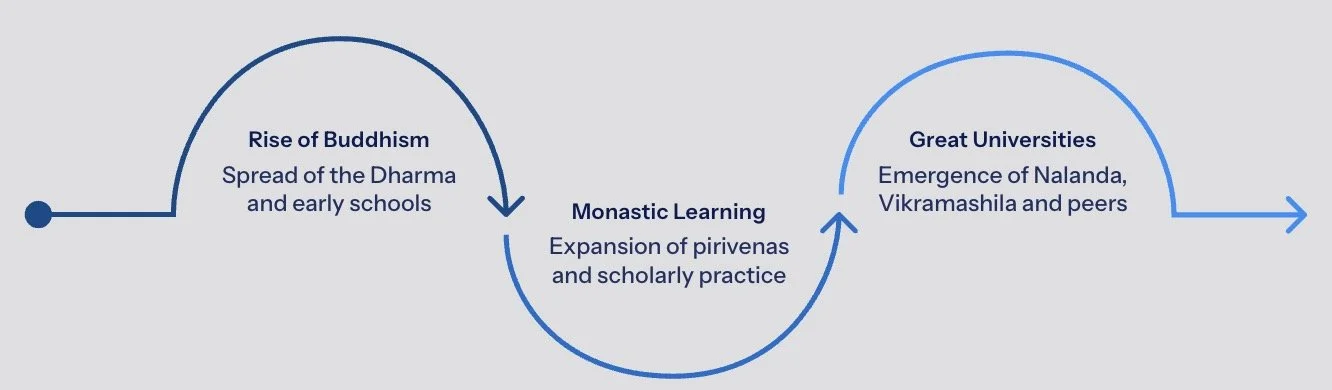
The rise of Buddhism in India gave birth to one of the most extraordinary intellectual traditions in world history. As teaching monks spread the Dharma across the subcontinent, monastic seats of learning — known as pirivenas — gradually evolved into full-fledged universities of international renown. Exploreing the six of the most significant centres of Buddhist learning: Nalanda, Vallabhi, Vikramshila, Odantapuri, Somapura, and Jagaddala — institutions that trained scholars from across Asia and shaped the intellectual heritage of the ancient world.
These universities were not isolated establishments. They functioned as an interconnected network of scholarship, often under royal patronage, and collectively represented the pinnacle of ancient Indian educational achievement. Their destruction at the hands of invaders in the 12th and 13th centuries marked one of history's most devastating losses of knowledge.
Gupta & Post-Gupta India: Centres of Learning
University Profile
Vallabhi University
Vallabhi University stood as one of the most celebrated centres of Buddhist learning in ancient India, rivalling even the great Nalanda in prestige and international recognition. Located in western India, it was established and generously patronised by the Maitraka kings, who constructed a monastery at Vallabhi — their capital city. While Nalanda was renowned as the stronghold of Mahayana Buddhism, Vallabhi carved its own distinct identity as the premier centre for Hinayana (Theravada) Buddhism, and more specifically for the Sammitiya sect.
Xuanzang's (Hieum Tsang) Account
The celebrated Chinese pilgrim Xuanzang visited Vallabhi and recorded his observations in Ta-Tang-Si-Yu-Ki. He described a city of remarkable wealth and vitality — a large population, rich and prosperous countryside, and over a hundred millionaire families. Luxury goods were imported from distant lands, a testament to Vallabhi's thriving commerce and cosmopolitan character.
He noted approximately 100 monasteries housing around 6,000 Buddhist monks. Hindu temples also dotted the landscape, reflecting the religious plurality of the region. He further noted stupas erected by King Ashoka marking spots hallowed by the Buddha's own ministry.
I-Tsing's Record
The Chinese monk I-Tsing confirmed that foreign students travelled from many distant lands to study at Vallabhi, establishing its international reputation. A large library — maintained by a royal endowment and confirmed by an inscription of King Guhasena — served the scholarly community.
I-Tsing also noted that graduates demonstrated their learning before royalty and nobles, reinforcing the institution's elite academic standing.
Curriculum and Academic Life
The course of studies at Vallabhi was remarkably broad for its era, reflecting the university's ambition to produce well-rounded scholars rather than narrow specialists. The curriculum encompassed Comparative Religion, the Six Systems of Hindu Philosophy, various schools of Buddhism, Politics, Law, Agriculture, and Economics. The Sammitiya doctrines held precedence, and the university notably did not accept Abhidharma as the direct teaching of the Buddha, adhering instead to the Antarabhava doctrine.
Founders
The Elders Gunamoti and Sthiramati — alumni of Nalanda — are credited as Vallabhi's founders, explaining why it closely followed the Nalanda pattern.
Flourishing Period
Vallabhi thrived from approximately 475 to 1200 A.C., a span of over seven centuries of continuous scholarship.
End of Vallabhi
Like other great universities, Vallabhi met its end at the hands of Muslim invaders, bringing to a close centuries of unbroken intellectual tradition.
University Profile
Vikramshila University
Vikramashila University — located in the village of Antichak, in the Bhagalpur district of Bihar — was one of the two most important centres of Buddhist learning during the era of the Pala Empire, the other being Nalanda. It was founded by King Dharmapala (783–820 CE) in deliberate response to a perceived decline in scholarly standards at Nalanda, demonstrating the competitive and quality-conscious spirit of the age. It prospered for nearly four centuries before being razed by Bakhtiyar Khilji around 1200 CE.
The Pala Network of Mahaviharas
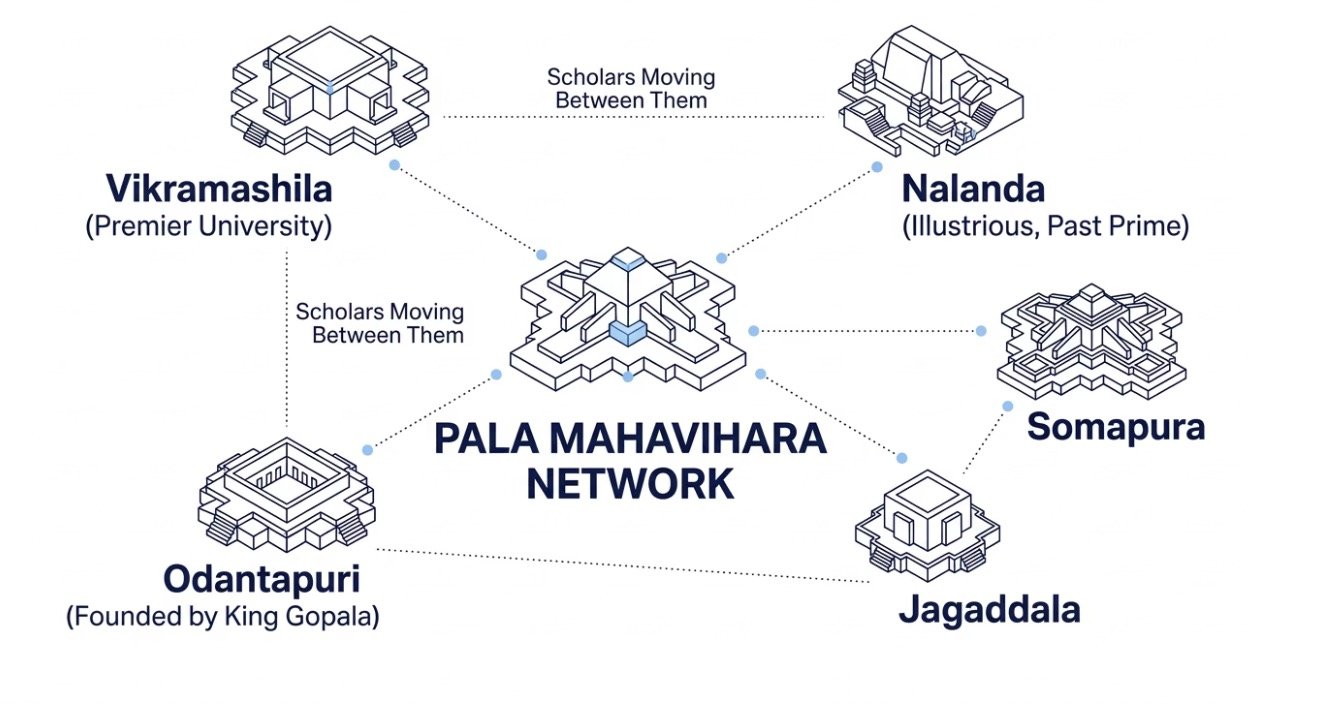
Vikramashila did not operate in isolation. According to Tibetan sources — particularly the writings of the monk-historian Taranatha (16th–17th centuries) — five great Mahaviharas flourished during the Pala period and functioned as an integrated network of institutions under state supervision. Scholars moved freely between them, and the institutions were regarded as a single, interconnected intellectual ecosystem.
The Pala Network of Mahaviharas
Subjects and Tantric Scholarship
Vikramashila offered instruction in philosophy, grammar, metaphysics, and Indian logic, but its most distinguishing feature was its pre-eminence in Tantrism. It was the leading centre for Vajrayana Buddhism and employed a succession of distinguished Tantric preceptors. The first was Buddhajnanapad, followed by Dipankarabhadra and Jayabadhra — the last of whom was the first prominent commentator on the Cakrasamvara Tantra, a foundational Vajrayana text.
Organisational Hierarchy
Vikramashila was notable for its clearly delineated administrative hierarchy — more structured than most other Mahaviharas of the period. This hierarchical clarity likely contributed to its institutional stability and academic reputation.
Abbot (Adhyaksha)
Six Gate Scholars (Dvarapandita)
One for each of the Eastern, Western, Northern, Southern, and two Central Gates
Great Scholars (Mahapandita)
~108 Scholars (Pandit) & ~160 Teachers (Acharya)
~1,000 Resident Monks (Bhikkhu)
The Vikramashila Stupa: Art and Architecture
At the heart of the square monastery stood the Main Stupa — a brick structure laid in mud mortar, serving as the primary site of worship. The walls of both terraces were adorned with intricate mouldings and terracotta plaques, testifying to the remarkable artisanal excellence that flourished in eastern India during the Pala period (8th–12th centuries CE).
The plaques depicted a rich visual world: Buddhist deities including Buddha, Avalokiteshvara, Manjushri, Maitreya, Jambala, Marichi, and Tara; scenes from Buddhist narrative; social and hunting scenes; and Nath deities such as Adinath/Vishnu, Padmavati/Parvati, Ardhanarishvara, and Hanuman. Human figures — ascetics, yogis, preachers, drummers, warriors, archers, and snake charmers — appear alongside a menagerie of animals including elephants, horses, deer, lions, and birds. This rich iconographic programme makes the Vikramashila stupa a priceless record of Pala-era religious and social life.
University Profiles
Odantapuri, Somapura & Jagaddala
Beyond the celebrated triumvirate of Nalanda, Vallabhi, and Vikramashila, three additional universities completed the great Pala-era network of Buddhist scholarship. Odantapuri, Somapura, and Jagaddala each contributed uniquely to the intellectual and religious life of ancient India — and each met the same tragic fate at the hands of invaders.
Odantapuri
Situated in Magadha, ~6 miles from Nalanda (near Biharsharif)
Considered the second oldest university in India
Founded under patronage of King Gopala (660–705 CE)
Tibetan records report approximately 12,000 students
Acharya Sri Ganga of Vikramashila was formerly a student here
Destroyed by Muslim invaders who mistook it for a fortress
Somapura Mahavihara
Located in present-day Bangladesh
King Devapala (810–850 CE) erected the Dharmapala-Vihara here
Ruins cover approximately 1 square mile
Complex included 177 monk cells, shrines, image houses, a refectory and kitchen
Surrounded by high walls with a large gate
Flourished for ~750 years before abandonment after the Muslim invasion
Jagaddala
Founded by King Ramapala (1077–1129 CE)
Largest construction project undertaken by the Pala kings
Specialised in Tantric Buddhism, following Nalanda's methods
Major centre for translation of Buddhist texts into Tibetan
The teacher Sakya Sri Bhadra propagated Tantric Buddhism in Tibet after residing here for seven years
Sacked and destroyed by Muslim invaders in 1027 CE
The Destruction of India's Universities
The fate of all six universities followed a similar and devastating pattern. Muslim invaders — most notably Bakhtiyar Khilji around 1200 CE — systematically destroyed these institutions. Historical accounts record that the invaders mistook the universities, with their high enclosure walls, for military fortresses. The Buddhist monks, with their shaved heads, were misidentified as "shaven-headed Brahmins" and treated as idolaters. Centuries of accumulated manuscripts, scholarship, and institutional knowledge were lost in these raids — a catastrophe whose intellectual consequences reverberated across Asia for generations.
Historical Note: The destruction of India's great Buddhist universities is considered one of the most significant losses of organised knowledge in the ancient world. Thousands of irreplaceable manuscripts were burned, and the monastic scholars who survived were scattered across Tibet, Southeast Asia, and beyond — inadvertently spreading Buddhist scholarship even as the institutions themselves perished.
Summary & Significance
Legacy of India's Ancient Universities
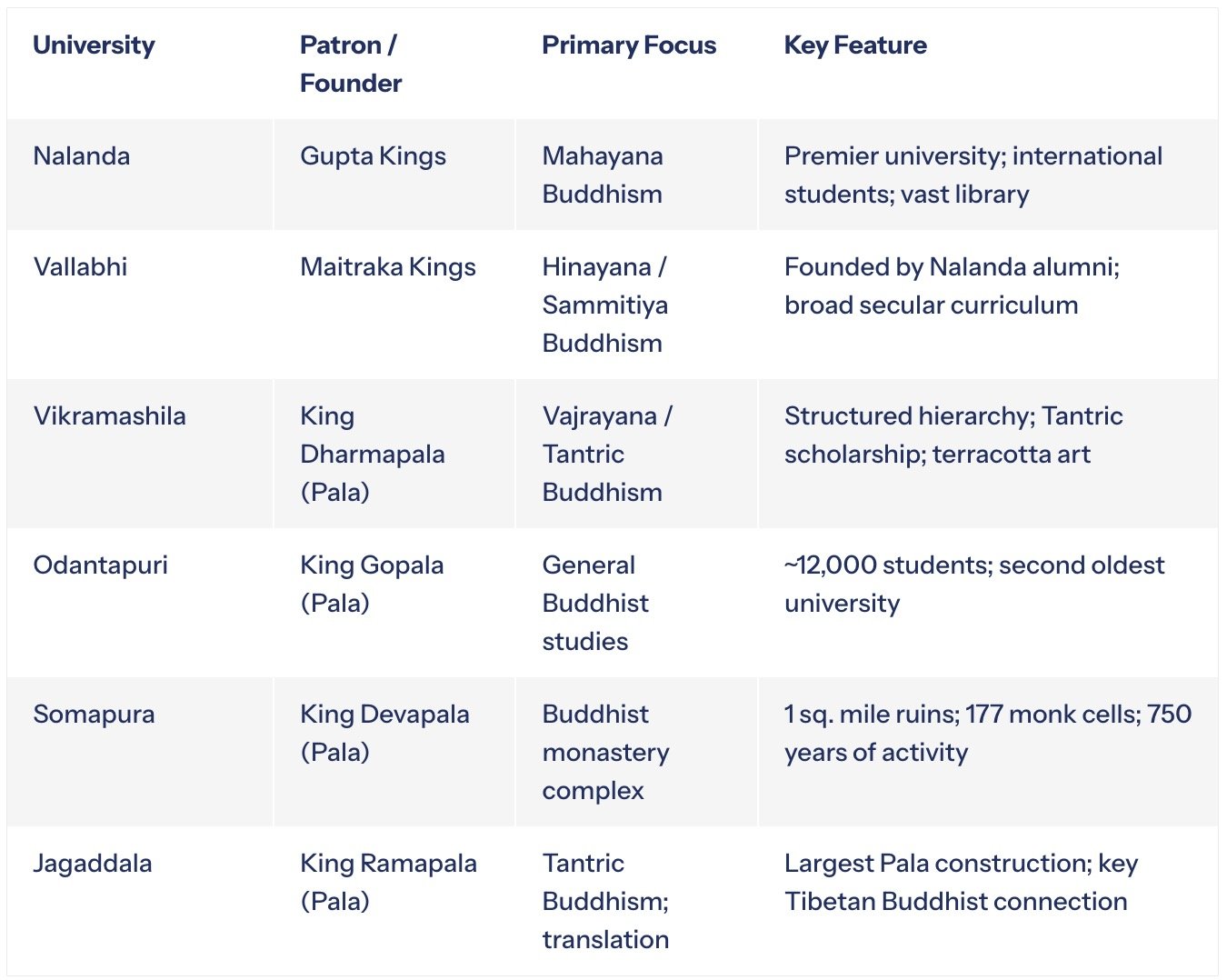
The six great universities of Buddhist India — Nalanda, Vallabhi, Vikramashila, Odantapuri, Somapura, and Jagaddala — represent one of the most remarkable chapters in the history of human education. They were not merely religious establishments but genuine centres of higher learning with diverse, rigorous curricula, sophisticated governance structures, vast libraries, and an international student body. Their legacy endures in the intellectual traditions of Tibet, Southeast Asia, China, and beyond — wherever Buddhist scholarship took root.
Comparative Overview
Legacy of India's Ancient Universities
What Made These Universities Great?
International Character
Students and scholars travelled from China, Tibet, Korea, Central Asia, and Southeast Asia to study at these institutions. Foreign scholars like Xuanzang and I-Tsing documented their visits, giving us our most vivid historical accounts of these universities.
Breadth of Curriculum
Far from being narrowly religious, these universities taught philosophy, logic, grammar, law, politics, economics, agriculture, and comparative religion alongside Buddhist studies — anticipating the ideal of the modern liberal arts university.
Royal Patronage
Sustained royal support from the Guptas, Maitrakas, and Pala dynasties provided the financial stability for libraries, endowments, and infrastructure. This state-university relationship was a model of enlightened governance in the ancient world.
Institutional Networking
The Pala-era universities functioned as a coordinated network — scholars moved between institutions, ideas cross-pollinated, and standards were maintained collectively. This anticipates modern ideas of university consortia and academic exchange.
"The different seats of Buddhist learning that functioned in eastern India under the Pala were regarded together as forming a network, an interlinked group of institutions." — Modern historians, drawing on Tibetan sources
The destruction of these universities in the 12th and 13th centuries was not merely the loss of buildings — it was the erasure of living intellectual communities that had sustained scholarship for half a millennium. Yet the ideas, texts, and traditions they nurtured survived in the libraries of Tibet, the monasteries of Southeast Asia, and the minds of scholars who carried their learning into exile. In that sense, the legacy of India's great ancient universities is truly global and enduring.
