
Gupta-Era: Literature
The Gupta period (c. 4th–6th century CE) represents one of the most luminous chapters in the history of Indian civilisation. Under lavish royal patronage, Sanskrit — the court language of the Guptas — attained its classical excellence, producing poetry, prose, drama, philosophy, and grammar of enduring brilliance.
The Classical Turn in Sanskrit
Sanskrit had been evolving for centuries before the Gupta era, but it was under the patronage of Gupta monarchs that the language achieved what scholars recognise as its "classical form" — both in poetry and in prose. The Gupta period marked a decisive break from the simpler, more functional Sanskrit of earlier ages. The new classical Sanskrit was ornate, aesthetically sophisticated, and deeply self-conscious about style and form. It prized elaborate metaphor, intricate metrical structures, and refined emotional sensibility.
One of the most significant shifts of this era was the greater emphasis on verse over prose. Poetry became the prestige form of literary expression, and even philosophical and technical texts were increasingly composed in verse. The period also saw the beginnings of a commentary tradition, in which earlier canonical texts were subjected to detailed scholarly analysis and interpretation.
The transition from Prakrit to Sanskrit in royal inscriptions was completed during this period, signalling the formal elevation of Sanskrit as the language of power, culture, and prestige. Yet Sanskrit drama preserved a fascinating linguistic hierarchy: high-status characters such as kings and ministers spoke Sanskrit, while women, servants, and other lower-status characters spoke in Prakrit — a convention that reflected social realities even as it was encoded in poetic theory.
Classical Features
Ornate poetic style (as opposed to old simple Sanskrit)
Verse preferred over prose
Commentaries begin to appear
Sanskrit as royal court language
Key Shifts of the Era
Transition from Prakrit to Sanskrit in inscriptions
Rise of secular (non-religious) literature
Codification of poetics and dramaturgy
Compilation of Epics, Puranas, and Smritis into final form
Epics, Puranas, and the Smriti Tradition
The two great Sanskrit epics — the Ramayana, attributed to the sage Valmiki, and the Mahabharata, attributed to Ved Vyasa — were substantially completed by the 4th century CE. Although these monumental texts appear to have been compiled by Brahmanas, their content fundamentally represents the Kshatriya tradition, celebrating martial valour, dynastic glory, and the moral dilemmas of rulership. They are replete with myths, legends, and deliberate exaggerations designed to inspire awe. Historians caution that while the epics may reflect broad social developments, they are not reliable sources for reconstructing political history in any precise sense.
The Puranas, a vast corpus of encyclopaedic texts dealing with cosmology, genealogy, mythology, and dharma, had existed long before the Gupta age in the form of bardic oral literature. It was during the Gupta period that they were finally compiled and given their present form. One of the most remarkable Puranic texts from this perspective is the Vishnudharmottara Purana, a section of which deals extensively with painting — providing detailed technical instructions on surface preparation for fresco paintings and the application of various pigments and colours. This makes it an invaluable source not only for literary history but also for the history of Indian art.
The Gupta period was equally prolific in the production of Smritis — law-books composed in verse that codified dharmic norms for society, family, and governance. Several major Dharmashastra works were compiled during this era, including the Yajnavalkya Smriti, the Narada Smriti, the Katyayana Smriti, and the Brihaspati Smriti. It is significant that the tradition of writing learned commentaries on the Smritis did not begin until after the Gupta period, suggesting that this era was one of primary compilation rather than secondary scholarly elaboration.
Ramayana
By Valmiki. Substantially completed by 4th century CE. Celebrates the heroic journey of Rama.
Mahabharata
By Ved Vyasa. The great epic of the Bharata war; a repository of dharmic teaching and myth.
Puranas
Finally compiled in Gupta age. Vishnudharmottara Purana notably contains instructions on fresco painting.
Smritis
Yajnavalkya, Narada, Katyayana, and Brihaspati Smritis — verse law-books codifying dharmic order.
Secular Literature and the World of Drama
Perhaps the most celebrated achievement of the Gupta period was its remarkable output of secular literature — works not primarily devoted to religious instruction or ritual, but to aesthetic pleasure, worldly wisdom, and the drama of human emotion. Ashvaghosha (1st century CE) is recognised as the first known writer to deploy Sanskrit for non-religious compositions, pioneering a tradition that would flower magnificently under the Guptas. The Allahabad Prashasti by the court poet Harisena, composed in a mixture of prose and verse known as champu kavya, exemplifies the sophistication of Gupta-era literary sensibility.
Alongside the creation of literary works, the Gupta period saw the systematic theorisation of literature itself. Works on poetics (kavyakriyakalpa) and dramaturgy (natyashastra) laid down the principles by which literary and dramatic art should be judged and practised. Bhamaha's Kavyalankara and Dandin's Kavyadarsha are the foundational texts of classical Sanskrit poetics. Both treatises agree that the primary function of kavya is to produce delight and joy in the audience — a position that places aesthetic experience at the very centre of literary value.
Drama occupied a place of special prestige in Gupta cultural life. Plays were performed in royal palaces, at popular festivals, and in courtly gatherings known as goshthis and samajas. The urban elite — the nagarakas — were expected not merely to attend such events but to organise and actively participate in them. Most playwrights (kavis) appear to have been Brahmanas, though their audiences spanned a wide social range. Two features distinguish Gupta-era drama universally: all plays are comedies — there is no tradition of tragedy in Sanskrit drama — and characters of different social classes consistently speak different languages on stage.
Champu Kavya
Mixed prose and verse — exemplified by the Allahabad Prashasti. Celebrates royal achievement with literary sophistication.
Sanskrit Drama
Performed at courts and festivals. Always comedies — no tragedies. High characters speak Sanskrit; low characters speak Prakrit.
Poetics & Theory
Bhamaha's Kavyalankara and Dandin's Kavyadarsha define the aesthetic principles of Sanskrit literary art.
The Natyashastra: India's Ancient Treatise on Drama
The Natyashastra, attributed to the sage Bharata, is the oldest known treatise on dramatic theory and performance in the world. Its origins are composite — it likely began as oral tradition, was later formalised into prose sutras, and was subsequently augmented with verse passages and learned commentary. The text presents itself as a fifth Veda, passed by the god Brahma to Bharata, accessible to all people regardless of caste — unlike the four traditional Vedas. Its purpose, the text declares, is to give pleasure and to divert minds wearied by the conflicts and sufferings of daily life. Natya is described as a kridaniyaka — a plaything, a device for delight.
The scope of the Natyashastra is encyclopaedic. It discusses the construction of the theatre, the types of plays, the structure of plots, the ideal qualities of actors and audiences, and the proper timing of performances. It gives detailed attention to abhinaya — the art by which actors communicate dramatic experience through speech, facial expression, bodily movement, and the use of costumes, ornaments, and props. Notably, the text specifies that elaborate props and drop curtains are absent from Sanskrit dramatic performance, while song and dance are integral elements. There are also references to street plays, suggesting that drama extended well beyond the royal court.
The Natyashastra also prescribes what should not be shown on stage: death, eating, fighting, kissing, and bathing are all to be kept off-stage. The hero is invariably expected to triumph at the play's end. Unlike Greek tragedy, Sanskrit drama does not permit an ending in despair — however much sorrow and suffering may occur in the course of the narrative, the conclusion must be affirmative and uplifting.
The Natyashastra's theory of rasa — aesthetic emotion — remains one of the most influential contributions to world aesthetic philosophy. Eight rasas are enumerated, each corresponding to a fundamental human emotion, whose skillful evocation in the audience produces the highest form of aesthetic pleasure and satisfaction.
Rasa Theory: The Eight Aesthetic Emotions
The concept of rasa is the philosophical centrepiece of the Natyashastra and indeed of classical Sanskrit aesthetics as a whole. Rasa — literally meaning "flavour" or "essence" — refers to the aesthetic experience produced in an audience when the causes and effects of human emotion are skillfully combined in a dramatic performance. It is not merely the representation of emotion, but the transformation of emotional experience into a refined aesthetic pleasure that transcends the personal. The audience does not simply feel the emotion of the character; they savour its essence in a state of artistic detachment and heightened awareness.
The Natyashastra enumerates eight rasas, each paired with a corresponding fundamental emotion (sthayibhava). These eight constitute the full spectrum of emotional life as understood by classical Indian aesthetic theory. The combination of causes (vibhava), effects (anubhava), and transitory emotions (vyabhicharibhava) gives rise to each rasa in the consciousness of the sensitive spectator (sahridaya), producing pleasure and satisfaction. Later theorists, most notably Abhinavagupta, would add a ninth rasa — shanta (tranquility) — and elaborate the theory to extraordinary philosophical depth.
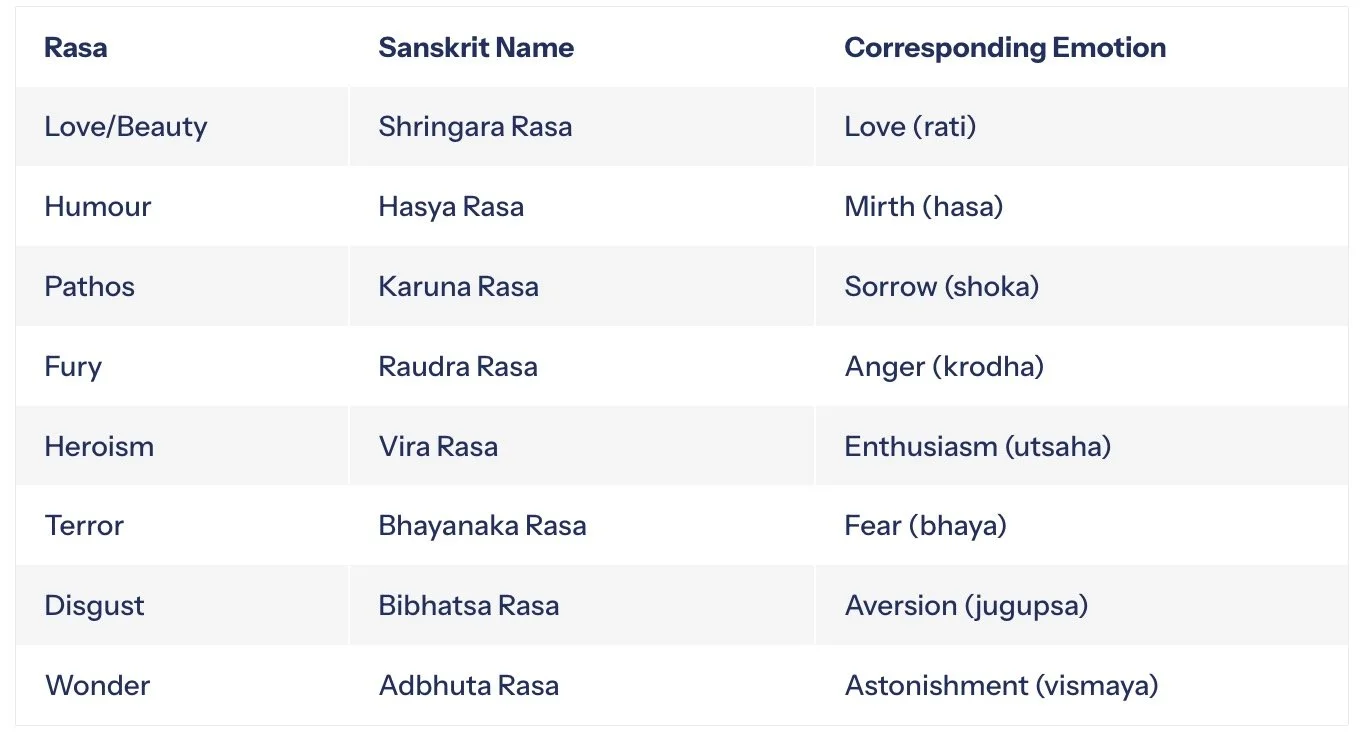
Rasa Theory: The Eight Aesthetic Emotions
Literary Genius
Kalidasa: The Crown Jewel of Sanskrit Poetry
Among all the literary figures of the Gupta age, none stands taller than Kalidasa, widely regarded as the greatest poet and playwright in the Sanskrit language. Tradition places him in the court of Chandragupta II, and his works bear the imprint of an age of political confidence, cultural refinement, and aesthetic ambition. His writing is celebrated for its exquisite descriptions of natural beauty, its tender and psychologically nuanced portrayals of love, and its occasional flashes of gentle humour. His style exemplifies the Vaidarbhi style — the style of the Vidarbha region — characterised by the quality of madhurya (sweetness), praised by later critics such as Banabhatta and Dandin.
Kalidasa's three surviving dramas are among the finest achievements of world dramatic literature. The Abhijnanashakuntalam tells the love story of King Dushyanta and the forest-dwelling Shakuntala, whose son Bharata becomes a famous ruler — the legendary ancestor of the Bharata people. The play is celebrated for its lyricism, its depth of feeling, and the famous episode of the lost ring. Malavikagnimitra is a lighter, more courtly comedy dealing with the love of King Agnimitra for the handmaiden Malavika. Vikramorvashiya dramatises the mythological love between the mortal king Pururavas and the celestial nymph Urvashi.
His major poetic works include Raghuvamsha, an epic poem tracing the lineage of the Raghu dynasty; Kumarasambhava, which narrates the union of Shiva and Parvati and the birth of their son Kartikeya (though certain passages describing their lovemaking attracted criticism from later critics such as Mammata in his Kavyaprakasha); the Meghaduta, a lyric poem in which a lovelorn yaksha sends a cloud as his messenger to his distant beloved; and Ritusamhara, a celebration of the six seasons of the Indian year. Together, these works represent a sustained imaginative achievement of the highest order.
Dramas
Abhijnanashakuntalam — love of Dushyanta and Shakuntala
Malavikagnimitra — courtly comedy
Vikramorvashiya — mortal king and celestial nymph
Major Poems
Raghuvamsha — epic of the Raghu dynasty
Kumarasambhava — birth of Kartikeya
Meghaduta — the cloud messenger
Ritusamhara — celebration of the six seasons
Other Major Playwrights and Prose Writers
While Kalidasa dominates the literary skyline of the Gupta period, he was by no means its only figure of consequence. The era produced a remarkable galaxy of dramatists and prose writers whose works collectively define the range and vitality of classical Sanskrit literature.
Bhasa
An important playwright of the early Gupta phase, Bhasa wrote thirteen plays in Sanskrit, with a substantial admixture of Prakrit. His works include Madhyamavyayoga, DutaGhatotkacha, Dutavakya, Balacharita, and Charudatta. His use of the term yavanika for the curtain is significant evidence of Greek cultural contact. He authored an early version of what became the Mrichchhakatika — Dradiracharudatta — later refashioned by Shudraka.
Shudraka
Author of Mrichchhakatika (The Little Clay Cart), considered one of the finest works of ancient drama. It tells the story of the love between a poor Brahmana trader named Charudatta and Vasantasena, a beautiful courtesan — an unusually democratic subject for classical Sanskrit theatre. The play is celebrated for its realism, social breadth, and dramatic power.
Vishakadatta
Author of Mudrarakshasa, a political drama dealing with the shrewd schemes of Chanakya and the consolidation of the Maurya empire. He also wrote Devichandraguptam, a drama that survives only in fragments, dealing with the early Gupta dynasty.
Dandin
A poet and theorist who lived in Kanchi, Dandin authored both the poetic treatise Kavyadarsha and the celebrated prose narrative Dasakumarcharita (The Tale of the Ten Princes) — a picaresque work depicting the colourful adventures of ten princes, first translated into English in 1927. A master of elegant prose, he praised Kalidasa's sweetness (madhurya).
Bharavi & Mentha
Bharavi is best known for Kiratarjuniya (c. 550 CE), an epic-style kavya in which the god Shiva appears to Arjuna in the form of a mountain-dwelling hunter (kirata). Mentha, author of Hayagrivavadha, was a significant dramatist known primarily through references and quotations in the works of later literary critics.
The Panchatantra and Philosophical Texts
Beyond drama and kavya, the Gupta period produced important works of narrative wisdom literature and systematic philosophy. The Panchatantra is among the most widely travelled books in world literary history. Composed originally to impart instruction in political science and practical conduct to young princes, it belongs to the genre of nidarshana — a work that teaches through illustration, showing what should and should not be done. Its stories are presented as narrated by a sage named Vishnusharman. The three princes he instructs bear names ending in the suffix "shakti," which suggests a possible origin in the Vakataka empire.
The text is divided into five sections, each illustrating a distinct theme of statecraft: splitting a contrary alliance, forming an alliance, waging war, getting the better of a fool, and the consequences of acting without reflection. The stories are mostly satirical, amusing tales in which animals play central roles, and the style elegantly interweaves prose with verse. The Panchatantra has been translated into more languages than almost any other Indian text, and versions of its stories can be found from Persia and Arabia to medieval Europe.
The philosophical literature of the Gupta period reflects intense intellectual debate among competing schools. New sections added to the Brahmasutras, Yogasutras, and Nyayasutras included systematic refutations of Buddhist and Jaina positions, indicating the vigour of inter-school polemic. Key texts include the Samkhya-karika of Ishvarakrishna (4th–5th century), which provides a definitive systematic account of Samkhya philosophy; Vyasa's commentary on Patanjali's Yogasutra; and Vatsyayana's Nyaya Sutra Bhashya, the first great commentary on the Nyaya Sutras, alongside his celebrated Kamasutra. Prashastapada's Padarthadharmasangraha, a commentary on the Vaisheshika Sutra of Kanada, can be assigned to the 5th century.
Panchatantra — Five Sections
Splitting an alliance contrary to one's interest
Forming a beneficial alliance
Waging war strategically
Getting the better of a fool
Consequences of action without reflection
Key Philosophical Works
Samkhya-karika — Ishvarakrishna
Vyasa's commentary on Yogasutra
Nyaya Sutra Bhashya — Vatsyayana
Kamasutra — Vatsyayana
Padarthadharmasangraha — Prashastapada
Sanskrit Grammar, Buddhist & Jaina Literature
The Gupta period was equally distinguished for its contributions to Sanskrit grammar, a discipline with deep roots in the earlier work of Panini (Ashtadhyayi) and Patanjali (Mahabhashya). The grammarian-philosopher Bhartrihari(5th century) wrote a learned commentary on Patanjali's Mahabhashya and composed the Vakyapadiya, a foundational work in the philosophy of language that explores the nature of sentence and word in Sanskrit. His work raised grammar from a technical discipline to a profound philosophical inquiry into the relationship between language, thought, and reality.
Bhatti's Ravanavadha (7th century) represents a remarkable hybrid: an epic poem that simultaneously narrates the story of Rama's life and systematically illustrates the grammatical rules of Panini — a pedagogical tour de force. Amarasimha, one of the luminaries of Chandragupta II's court, compiled the Amarakosha, a comprehensive Sanskrit lexicon that served as an essential learning tool for students of the language. The Buddhist scholar Chandragomia, from Bengal, composed Chandravyakaranam, a grammar that became widely popular in Kashmir, Nepal, Tibet, and Sri Lanka.
Buddhist and Jaina scholars were also active contributors to Sanskrit literature during this period. Buddhist scholars Arya Deva, Arya Asanga, and Vasubandhu were among the most notable writers; the last also wrote the first systematic Buddhist work on logic. His disciple Dignaga extended this logical tradition considerably. On the Jaina side, Vimala produced a Jaina version of the Ramayana, recasting the epic narrative to serve Jaina doctrinal purposes, while Siddhasena Divakara laid the foundations of formal logic within the Jaina intellectual tradition. The Gupta period also saw the evolution of several regional Prakrit forms: Suraseni in the Mathura region, Ardhamagadhi in Oudh and Bundelkhand, Magadhi in Bihar, and Maharashtri in Berar.
Sanskrit Grammar
Bhartrihari — Vakyapadiya
Bhatti — Ravanavadha
Amarasimha — Amarakosha
Chandragomia — Chandravyakaranam
Buddhist Literature
Arya Deva, Arya Asanga, Vasubandhu
Vasubandhu — first Buddhist work on logic
Dignaga — logical treatises
Prose with verse passages in mixed Sanskrit
Jaina Literature
Vimala — Jaina version of Ramayana
Siddhasena Divakara — foundations of Jaina logic
Epics and Puranas recast in Jaina versions
Inscriptions as Literary Art
An important but often overlooked dimension of Gupta-era literary culture is the tradition of literary inscriptions — royal records composed not merely as administrative documents but as self-conscious works of literary art in the Sanskrit kavya tradition. These inscriptions represent the intersection of political power and aesthetic ambition, demonstrating that the Gupta court valued elegant composition even in its official pronouncements.
The most celebrated of these is the Allahabad Pillar inscription of Samudragupta, composed by his court poet Harisena. This prashasti (eulogy) is composed in mixed prose and verse — the champu kavya style — and showcases many of the characteristic features of classical Sanskrit poetry: elaborate metaphor, careful attention to metre, and sophisticated rhetorical ornamentation. The Mandasor inscription by Vatsabhatti similarly displays considerable literary merit and has been studied as an example of the kavya style applied to epigraphic contexts.
Three further inscriptions of literary note deserve mention: the Junagadh inscription, the Mehrauli Iron Pillar inscription, and the Mandasor inscription of Yasovarman by Vasula. All three demonstrate that the standards of classical Sanskrit composition were applied with care and skill even to the practical medium of stone inscription. Together, these epigraphic records testify to the pervasiveness of literary culture in Gupta-era public life — a society in which the aesthetic quality of an inscription on a pillar was considered a matter of serious concern.
Allahabad Prashasti
By Harisena, court poet of Samudragupta. Champu kavya style — mixed prose and verse.
Mandasor Inscription
By Vatsabhatti. Considerable literary merit; example of kavya style in epigraphy.
Junagadh Inscription
Notable for literary quality and historical content.
Mehrauli Iron Pillar
Celebrated both as a metallurgical and literary achievement.
Mandasor of Yasovarman
By Vasula. All three later inscriptions display strong literary skill.
Key Authors and Their Works at a Glance
The following table provides a consolidated reference guide to the most significant authors and literary works of the Gupta period, spanning epics, drama, kavya, grammar, and prose narrative.
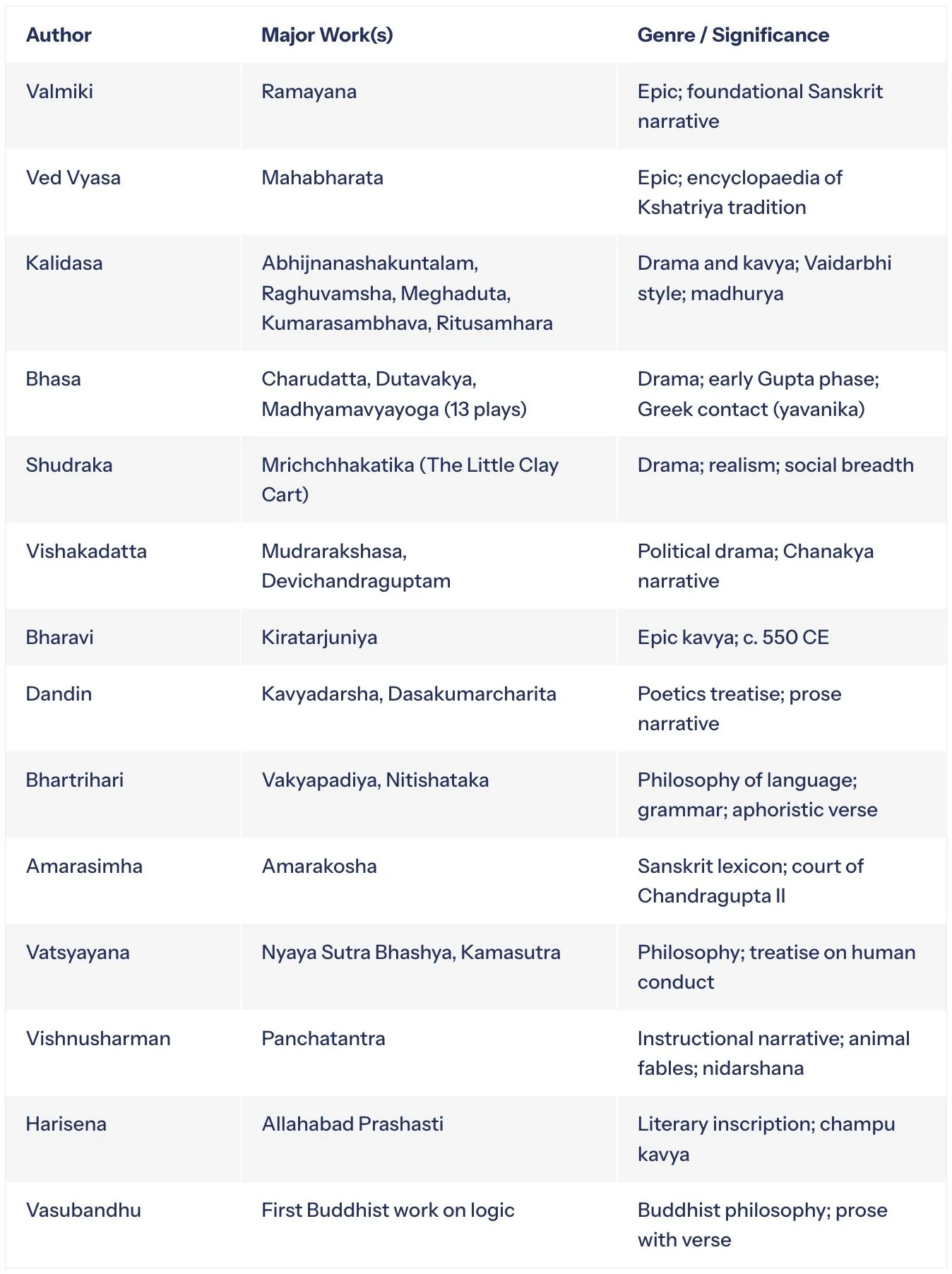
Key Authors and Their Works at a Glance
