
Gupta Period: Art of the Golden Age
The Gupta period (approximately 4th–6th centuries CE) is widely regarded as the Golden Age of North Indian art, representing an era of extraordinary creative achievement across all major religious traditions — Hindu, Buddhist, and Jain. Inspired predominantly by religion, Gupta art synthesised earlier traditions into a refined, classical idiom that set the standard for Indian aesthetics for centuries to come.
Gupta Sculpture: An Overview
The genius of Gupta sculpture lies in its remarkable synthesis — a balance between the sensuous corporeality of Kushan-period figures and the symbolic abstraction characteristic of the early medieval tradition. This equilibrium gave birth to an aesthetic idiom that is simultaneously grounded and transcendent, naturalistic and ideal. An enormous corpus of Hindu, Buddhist, and Jain sculptures has been recovered from numerous sites across the subcontinent, many of which attain a near life-size scale and a fineness of execution that has rarely been surpassed in the history of Indian art.
Both Buddhist and Hindu sculptural traditions during this period concentrate on large, commanding figures of the major deities — the Buddha, Vishnu, and Shiva — rendered with psychological depth and spiritual calm. The expansion of the Buddhist pantheon is a notable feature of Gupta sculpture, with significant importance accorded to Bodhisattvas such as Avalokitesvara, alongside divinities of Brahmanical inspiration. Earlier traditions of illustrating Jataka stories gave way to a more hieratic, devotional idiom centred on the divine figure itself.
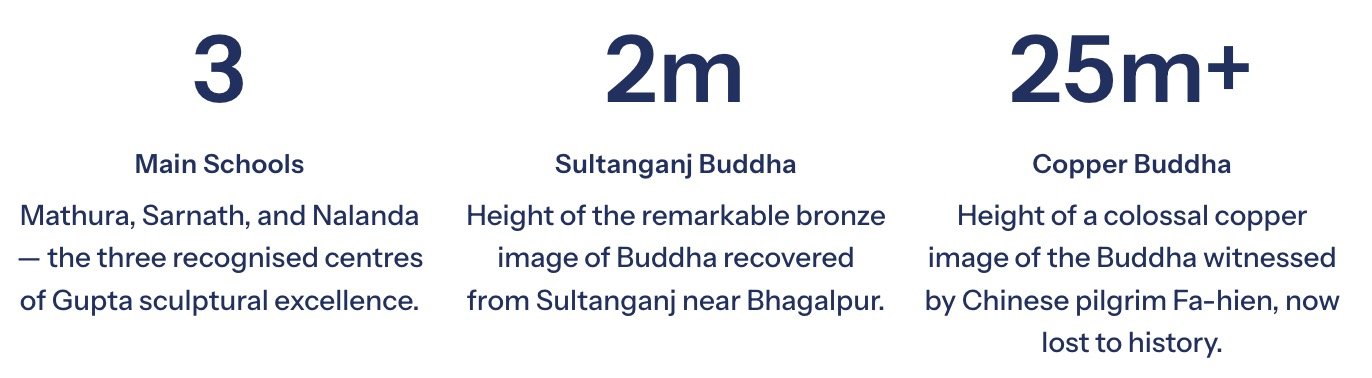
Gupta Sculpture
Chapter 1 · Schools of Sculpture
The Three Schools of Gupta Sculpture
Mathura School
Originating in the post-Mauryan period, the Mathura school emerged as one of the pre-eminent centres of Gupta art. Characterised by its use of mottled red stone and, later, pink sandstone, its sculptures evolved towards extraordinary fineness of execution and delicacy in modelling. Artistic details became increasingly stylised — the Buddha's hair rendered in symbolic shell-like curls, ornamented halos encircling his head — as the school moved away from physical realism towards spiritual idealism. The Mathura idiom is widely regarded as the pinnacle of Indian Buddhist art.
Sarnath School
A new school that emerged in Sarnath during the Gupta period, this tradition is essentially Buddhist in character — depicting the Buddha, Bodhisattvas, and scenes from the life of the Enlightened One. Carved in yellowish sandstonefrom the quarries of Chunar, Sarnath sculptures are distinguished by their refined execution of facial features, richly ornamented halos, and the celebrated transparent drapery — clinging robes with no visible folds that reveal the body beneath, creating the impression of an unclothed figure. Serene, gently smiling facial expressions convey introspection and contemplative calm.
Nalanda School
Representing a third, lesser-recognised school centred on Nalanda and Pataliputra in Bihar, this tradition shows a gradual evolution away from the refinement of the other two schools. By the 6th century, figures became heavier and were increasingly executed in metal rather than stone. The colossal Sultanganj Buddha in bronze — a uniquely large survival from this period — is emblematic of this school's style. Though Gupta sculptural qualities began to deteriorate in this region, the metalwork tradition retained considerable vigour.
Chapter 1 · Regional Sites
Other Sculptural Sites: Udayagiri, Terracotta, and Metal
Beyond the three main schools, the Gupta period witnessed significant sculptural production across a number of other sites, each contributing a distinctive element to the overall artistic legacy of the age. The rock-cut Udayagiri Caves near Vidisha in Madhya Pradesh yield what scholars identify as the "first dated sculptures in a fully-fledged early Gupta style." Though the caves are architecturally modest, the rock relief panels at their entrances — featuring large deities in a relatively heavy, powerful style — are of considerable art-historical significance. Notable among these are a mukhalinga sculpture and the celebrated depiction of Vishnu in the form of Varaha.
Terracotta Sculpture
Gupta terracotta works are of very fine quality and display a remarkable stylistic uniformity across the empire. Some remain in their original settings on the brick temple at Bhitargaon. The river goddesses from Ahichchhatra — an elegant pair standing 1.47 metres high — are among the finest examples. A terracotta Buddha head recovered from Devnimori, Gujarat further attests to the wide geographic spread of this tradition.
Metal Sculpture
Metal sculpture of the Gupta period is rare but of exceptional quality. The over life-size Sultanganj Buddha in copper — made by lost-wax casting — is "the only remaining metal statue of any size" from the Gupta period, stylistically comparable to Sarnath stone Buddhas. The Brahma from Mirpur Khas in Sindh (Pakistan) is a notable bronze image, demonstrating the empire's reach and the diversity of its devotional art.
Chapter 2
Coins and Metalwork of the Gupta Empire
Gupta coinage represents one of the most distinguished chapters in the history of Indian numismatic art. The coins are not mere monetary instruments — they are meticulously crafted works of art that carry aesthetically impressive depictions of royal activities, divine symbols, and Sanskrit inscriptions. Coinage under the Guptas commenced with the reign of Samudragupta (c. 335/350–375 CE), or possibly in the late reign of his father Chandragupta I. The famous Lyrist type gold coins issued by Samudragupta depict the king playing the vina (lute), providing direct evidence of his celebrated musical accomplishments.
Early Gupta gold coins closely resembled the coinage of the later Kushanas — the Guptas adopted Kushan weight standards, techniques, and designs following Samudragupta's conquests in the northwest, even borrowing the Kushan name Dinara for their gold coins. Over time, however, these coins were thoroughly Indianised in both style and subject matter. The Gupta monarchs were most famous for their gold coinage — described by scholars as a veritable "rain of gold" — though silver and (more rarely) copper coins were also produced. Silver coinage imitated the tradition of the Western Satraps, retaining traces of Greek legend while inserting the Gupta peacock symbol on the reverse.
Lyrist Type
Samudragupta playing the vina
Tiger Slayer
Royal prowess in the hunt
Asvamedha
Horse sacrifice ceremony
Archer Type
King shown as warrior-archer
Garuda & Peacock
Kumaragupta and Skandagupta types
The usual layout of a Gupta coin features an obverse with a full-length portrait of the king — standing, seated, or riding a horse — and a reverse depicting a goddess, most often seated on a throne, accompanied by a Sanskrit inscription. The gradual deterioration in design and execution of gold coins in later reigns, along with the disappearance of silver coinage, are taken as evidence of the empire's curtailed territorial reach during its decline.
Chapter 3
Gupta Temple Architecture: The Dawn of the Nagara Style
The Gupta period marks a watershed moment in the history of Indian architecture — it is for the first time that temples in the form of structural buildings (as opposed to rock-cut excavations) were constructed in North India. The Gupta temple tradition laid the foundational principles of the Nagara architectural style, which would go on to define the sacred architecture of northern India for over a millennium. The central image of the chief deity was placed within the garbhagriha (sanctum sanctorum), establishing an architectural grammar of sacred space that persisted long after the empire's decline.
Phase 1: 4th–5th Century
Small, compact structural temples
Garbhagriha (sanctum sanctorum)
Open mandapa (pillared assembly hall)
Bell-shaped pillar capitals
Square plan with flat roof
No ornamentation on walls
Examples: Eran, Sanchi, and Tigwa temples (MP)
One 2-storey example at Nachnakuthar (MP)
Phase 2: 6th Century CE
Cruciform (cross-shaped) square ground plan
Mandapa and garbhagriha fully integrated
Ornamentation on exterior walls
Decorated doorways
Antral (vestibule) connecting mandapa to sanctum
Curvilinear tower (rekha shekhara / shikhara)
Panchayatana style (Deogarh temple)
Full emergence of Nagara style
Notable Phase 2 examples include the celebrated Deogarh Temple in Jhansi and the Bhitargaon Temple in Kanpur, Uttar Pradesh — both of which exhibit the hallmarks of mature Gupta temple design. Significantly, the Gupta period represented a hiatus in rock-cut architecture, with the first wave of cave construction having concluded before the empire's rise, and the second wave beginning only in the late 5th century as the empire declined.
Chapter 3 · Cave Architecture
Cave Architecture: Ajanta, Bagh, and Udayagiri
While the Gupta period saw a relative pause in the tradition of rock-cut architecture, several major cave complexes remain associated with this era, particularly under the patronage of the Vakataka dynasty — contemporaries and allies of the Guptas. The Ajanta Caves represent the most celebrated of these, constructed in two broad phases: an earlier phase under the Satavahanas, and a later, more richly decorated phase under the Vakatakas during the Gupta period. Of the 29 caves at Ajanta, 4 are Chaityas (worship halls) — caves 9, 10, 19, and 26 — while the remainder are Viharas (monasteries).
Ajanta Caves
Buddhist cave complex in Maharashtra. 29 caves carved in two phases. Features include Chandrasala windows, reclining Buddha in Cave 26, and the Maravijaya scene. Paintings survive in Caves 1, 2, 9, 10, 16, and 17.
Bagh Caves
A group of 9 caves. Simple and relatively plain in design, with limited ornamentation. Some caves contain pillars; others preserve remnants of paintings that have largely disappeared over the centuries.
Udayagiri Caves (Vidisha)
20 caves, a mix of rock-cut and stone-built structures. Primarily Brahmanical/Hindu affiliation. Notable for engravings of Vishnu, Durga, and Varaha. Yield some of the earliest dated sculptures in the Gupta style.
In the domain of stupa architecture, the Gupta period saw the construction of the Dhamekh Stupa at Sarnath (128 feet high, constructed on a flat surface) and the Jarasandha's Baitkhak at Rajgriha. The famous Nalanda Buddhist university was also established in the 5th century, constructed primarily in brick, representing the synthesis of religious, educational, and architectural ambitions of the age.
Chapter 4
Gupta Painting: Mastery of the Mural Tradition
Painting was evidently a major and socially valued art form during the Gupta period. It was considered a mark of social accomplishment — Vatsyayana's Kamasutra lists painting as one of 64 art forms practised during the period, indicating its widespread practice even among common people. The refined and sophisticated urban life of the Gupta age included painting as an integral part of its cultural fabric. Literary sources provide rich references: Brihatsamhitamentions "Vajralepa," a method of preparing the ground for murals; Mudrarakshasa references imaginative painting; and Kalidasa's Meghaduta alludes to paintings on rocks.
The Vishnudharmottara, a supplement to the Vishnu Purana (c. 7th century CE), provides the most detailed account of the theory and practice of painting from this era, referring to yet earlier treatises on the subject. The paintings of the Ajanta Caves represent by far the finest surviving examples, revealing a mature and highly developed artistic tradition. The Bagh Caves also contained paintings, though these have largely disappeared. Both sites employed the fresco seccotechnique, in which pigments were applied to a prepared plastered surface rather than wet plaster.
Six Principal Colours
White (lime, kaolin, gypsum) · Red and Yellow (ochre) · Black (soot) · Green (glauconite mineral) · Blue (lapis lazuli). All materials except lapis lazuli were locally available near Ajanta.
Fresco Secco Technique
A thick layer of mud mixed with vegetable material was applied on the rock surface, followed by a thin coat of plaster. Pigments mixed in a glue or gum medium were then painted onto this prepared surface using brushes of animal hair.
Stylistic Features
Multiple perspective, foreshortening, shading and highlighting for luminous glow, absence of scene framing (one scene merging into another), and stylistic variation reflecting different hands at work.
Thematic Range
Buddhist narratives (life of Buddha, Jataka scenes), Bodhisattvas (especially Padmapani), yakshas, gandharvas, apsaras, and vivid scenes of everyday life — women in homes, peasants, workers, animals, birds, and flora.
Chapter 4 · Ajanta Paintings
Ajanta Paintings: Technique, Form, and Vision
The murals of Ajanta represent the apogee of Indian mural painting. Paintings survive in six caves — Caves 1, 2, 9, 10, 16, and 17 — covering walls, ceilings, door-frames, and pillars. Significant differences exist between ceiling paintings (dominated by white and geometric/decorative motifs) and wall paintings (narrative and figurative). There is a striking absence of framing — scenes flow continuously into one another without clear demarcation, creating an immersive visual narrative that envelops the viewer.
The Ajanta painters displayed sophisticated command of several advanced techniques. The use of multiple perspective — objects rendered as if seen simultaneously from eye level, from above, and from below — defies any simple Western categorisation. Foreshortening was employed to create spatial dynamism. The celebrated technique of highlighting and shading — applied particularly to the nose, eyebrows, and other facial features — lent a luminous glow to forms. There is also a profound balance between the material and the spiritual in the depiction of human and divine forms, which is the hallmark of the Gupta aesthetic sensibility.
Human Figure
Slender, well-proportioned, and elegant. Women characterised by narrow waists, full breasts, highly arched eyebrows, and elongated lotus-shaped eyes. Costumes, jewellery, and hairstyles are of great refinement.
Most Famous Image
Bodhisattva Padmapani in Cave 1 — the most celebrated painting at Ajanta. The figure of the compassionate bodhisattva holding a lotus is the supreme expression of Gupta painterly idealism.
Bagh Paintings
Found in Caves 4 and 5. Both religious and secular themes — processions with horses and elephants, princes in grief, divine and princely figures in conversation, flying monks, beautiful birds and animals, and floral decoration.
Chapter 5
Other Art Forms: Music and Drama
The Gupta period's cultural efflorescence extended well beyond the visual arts into the domains of music and dramatic literature. Music held a distinguished place in court culture, as evidenced most directly by the Lyrist type coins of Samudragupta, which depict the emperor himself playing the vina (lyre). This numismatic evidence is remarkable — it is one of the few instances in ancient Indian history where a monarch's personal artistic accomplishment is commemorated on official coinage. The coins thus serve a dual function: as monetary instruments and as artistic declarations of royal identity and cultural refinement.
The Gupta age was equally celebrated for its Sanskrit dramatic literature, producing some of the greatest plays in the Indian canon. The dramatist Kalidasa composed the celebrated Abhijnanashakuntalam and Vikramorvasiyam, works that achieved an unparalleled synthesis of lyrical beauty, emotional depth, and narrative sophistication. Vishakhadatta'sMudrarakshasa offered a masterwork of political drama, while Shudraka's Mricchakatika (The Little Clay Cart) provided a vivid portrait of urban social life. Together, these works testify to the remarkable cultural vitality of the Gupta period across every creative domain.
Music
Samudragupta's Lyrist coins depict the emperor playing the vina, indicating music as a royal and aristocratic accomplishment. Music was listed among 64 arts in Vatsyayana's Kamasutra.
Sanskrit Drama
Abhijnanashakuntalam and Vikramorvasiyam by Kalidasa; Mudrarakshasa by Vishakhadatta; Mricchakatika by Shudraka — masterpieces of the golden age of Sanskrit literature.
Chapter 6
Gupta Art vs. Mauryan Art: Key Distinctions
A comparative analysis of Gupta and Mauryan art reveals not merely stylistic differences but fundamental divergences in patronage, purpose, material, and aesthetic philosophy. Mauryan art was overwhelmingly royal and court-centred — the Ashokan pillars, stupas, and Barabar Caves were products of direct imperial command. No comparable evidence exists for the Gupta period; sculptures, temples, and caves appear to have been produced without direct royal direction, suggesting a broader base of patronage involving merchants, guilds, and religious communities.
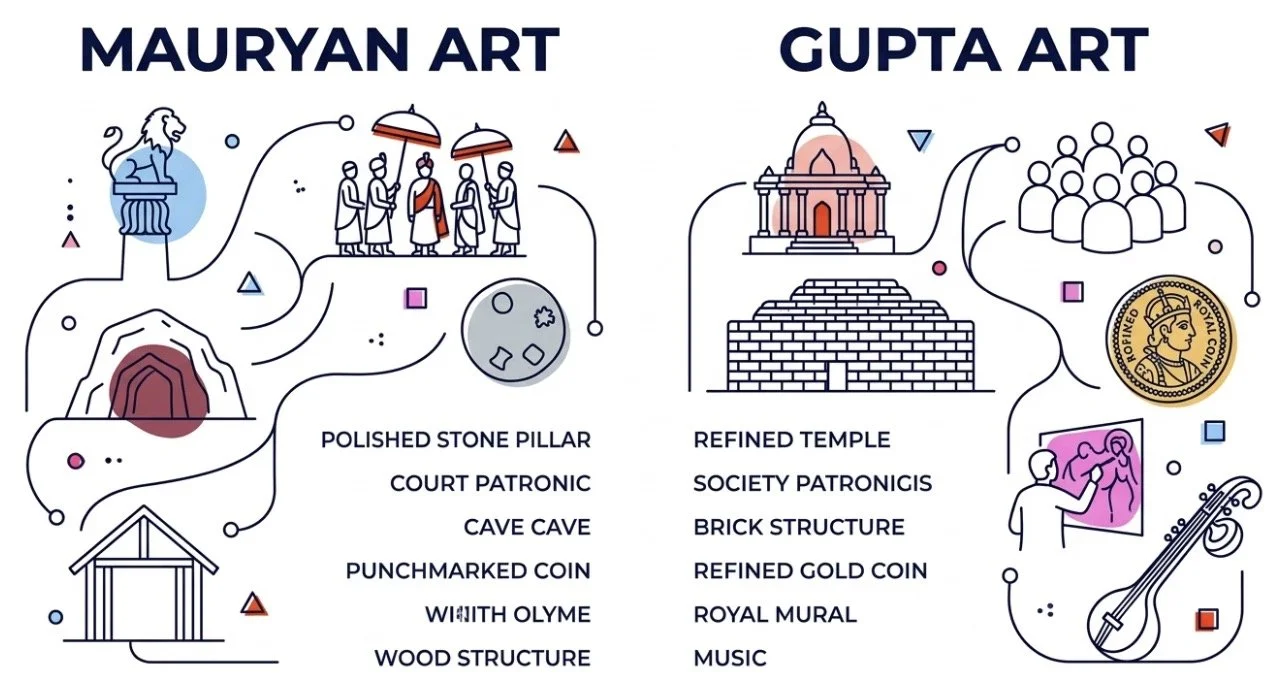
Gupta Art vs. Mauryan Art: Key Distinctions
Perhaps the most visually striking distinction lies in coinage and painting. Mauryan punch-marked coins are entirely devoid of artistic elegance, serving purely economic functions. Gupta coins, by contrast, are sophisticated works of art depicting the ruler in dynamic poses — as lyrist, horseman, lion slayer, or archer. Similarly, painting was absent from the Mauryan artistic vocabulary but reached its absolute perfection during the Gupta period at Ajanta. In material terms, Gupta arts represent a further evolution of forms already present in the Mauryan and post-Mauryan periods — a refinement and elevation rather than a revolution.
Chapter 7
Ajanta: Architecture, Sculpture, and Painting United
Ajanta art refers collectively to all art forms produced at the Ajanta cave complex in Maharashtra — cave architecture, sculpture, and painting — representing arguably the single greatest concentration of artistic achievement in ancient India. The site was created in two principal phases: the first under the Satavahanas (c. 100 BCE – 225 CE), and the second under the Vakatakas (4th–6th century CE, concurrent with the Gupta period). The Buddhist cave monuments at Ajanta date from as early as the 2nd–1st centuries BCE, but the richly decorated second phase represents the true flowering of the site's artistic legacy.
The caves are nestled in a curving section of the Sahyadri hills in the valley of the Waghora river, carved entirely from basalt igneous rock. Workers carved pillars, roofs, and idols directly from the living rock — an extraordinary feat of engineering and artisanship. There are 30 caves in total. Five were excavated in the Satavahana period; the remainder belong to the Vakataka phase. Two Satavahana-period caves (9 and 10) are Chaityas (prayer halls), while three Vakataka-period caves (19, 26, and 29) are also Chaityas — the rest being Viharas (monasteries). Ajanta art represents a beautiful and irreducible blend of architecture, sculpture, and painting — three arts in perpetual dialogue.
The cave complex as a whole represents one of the most significant archaeological and artistic sites in the world, recognised as a UNESCO World Heritage Site, and its influence on subsequent Indian and Asian Buddhist art has been immeasurable.
Chapter 7 · Cave Types
Viharas and Chaitya Grihas at Ajanta
The two primary typologies of cave at Ajanta — the Vihara (monastery) and the Chaitya Griha (worship hall) — represent distinct architectural traditions with different spatial logics and symbolic purposes. Understanding their architecture is essential to comprehending the evolution of Buddhist sacred space from the Hinayana to the Mahayana tradition.
Viharas (Monasteries)
The majority of Ajanta's caves are viharas — symmetrical square halls with colonnaded porches and three entrance doors. The centre is an open square hall, surrounded by rectangular aisles, off which open small monastic cells (dormitories). Most viharas belong to the second phase and reflect the shift from Hinayana to Mahayana Buddhism. A critical innovation of this phase was the addition of a sanctuary at the rear, centred on a large image of the Buddha — a change that transformed the monastery from a residence into a devotional space. Cave 1, the largest vihara, has 20 painted and carved pillars, 14 small chambers, and the celebrated Bodhisattva Padmapani painting. Cave 6 and Cave 27 are notable as two-storey viharas.
Chaitya Grihas (Worship Halls)
Chaitya halls follow a narrower rectangular plan with a high arched/vaulted ceiling. The interior is longitudinally divided into a nave and two side aisles by rows of pillars, with a stupa in the apsidal rear, surrounded by a circumambulatory passage. Many have elaborate carved façades with large windows — the Chandrasala (large semicircular window) is a unique and defining feature of Caves 19 and 26. Cave 19 features a stupa with a spherical dome within which a standing Buddha is carved in high relief, richly carved pillars, and naga, yaksha, and flying couple sculptures. Cave 26 is distinguished by its remarkable 7-metre reclining Buddha (Parinibbana) and the Maravijaya scene — Buddha's victory over the demon Mara, shown in Bhumisparsha Mudra.
Chapter 7 · Murals
Ajanta Mural Paintings: A Detailed Study
The mural paintings of Ajanta are the finest surviving examples of ancient Indian painting and represent the culmination of a long tradition of mural art. Paintings survive today in six caves — Caves 1, 2, 9, 10, 16, and 17 — though originally most caves were decorated. Caves 9 and 10 preserve the earliest paintings (2nd–1st century BCE), while the remaining four belong to the Vakataka/Gupta phase. At Ajanta, it is understood that established teams of painters were brought in when required to decorate a cave — a sophisticated system of artistic production that explains both the high quality and the stylistic variations visible across the paintings.
Ground Preparation
Thick layer of mud mixed with vegetable material applied to rock surface as base coat
Plastering
Thin coat of white plaster applied on top of mud base to create the painting surface
Pigment Application
Pigments mixed in glue or gum medium applied with brushes of animal hair
Highlighting
Shading and highlighting applied to create luminous glow on faces and key compositional elements
The range of scenes depicted at Ajanta is extraordinary in its breadth. Narrative paintings illustrate the life of the Buddha, Jataka stories, and Bodhisattva figures — most famously Padmapani (Avalokitesvara). Mythological figures — yakshas, gandharvas, apsaras — inhabit the painted world alongside vividly observed scenes of everyday life: women in domestic settings, workers bearing loads, peasants tilling fields, birds in trees, and flowers in bloom. The artists' deep sympathy with the natural world is evident throughout. The human figures — slender, elegant, and well-proportioned — and the intricate depictions of costume, jewellery, and hairstyle together constitute a priceless visual record of Gupta-period material culture and aesthetic ideals.
Legacy and Significance of Gupta Art
The art of the Gupta period stands as one of humanity's great creative achievements — a moment in history when artistic ambition, technical mastery, spiritual depth, and royal patronage converged to produce works of enduring beauty and significance. Across every medium — stone sculpture, bronze casting, terracotta, coinage, temple architecture, cave excavation, and mural painting — the Gupta age demonstrated a consistent drive towards refinement, idealism, and the synthesis of the material and the transcendent.
The three schools of Gupta sculpture — Mathura, Sarnath, and Nalanda — collectively established the canonical idiom for the representation of the Buddha and the Hindu deities that would influence Indian and pan-Asian art for centuries. The Gupta temple tradition laid the architectural foundations of the Nagara style, which remains the dominant tradition of Hindu temple building in North India to this day. The paintings of Ajanta, with their extraordinary command of narrative, perspective, and the human figure, represent the pinnacle of the ancient Indian mural tradition — a tradition whose influence extended from Central Asia to South-East Asia and beyond.
Sculpture
Defined the classical idiom for Buddhist and Hindu sacred imagery, balancing sensuousness with spiritual idealism
Architecture
Inaugurated the Nagara temple tradition; Ajanta's cave architecture remains a masterpiece of Buddhist sacred space
Painting
Ajanta murals represent the pinnacle of ancient Indian painting, with enduring influence across Asia
Coinage
Transformed numismatic art into royal portraiture, a "rain of gold" that reflects the empire's cultural confidence
"The cave architecture, sculptures and paintings of Ajanta are considered masterpieces of Buddhist religious art which have had a considerable artistic influence in the later period also."
Gupta art is not merely a period style — it is a civilisational statement. It represents the moment when India's diverse artistic traditions, inherited from the Mauryan and post-Mauryan centuries and shaped by contact with the Kushan world, were fused into a coherent, confident, and supremely refined classical language. That language echoes, unmistakably, in the sacred art and architecture of the entire Asian world.
