
The Vakataka Dynasty
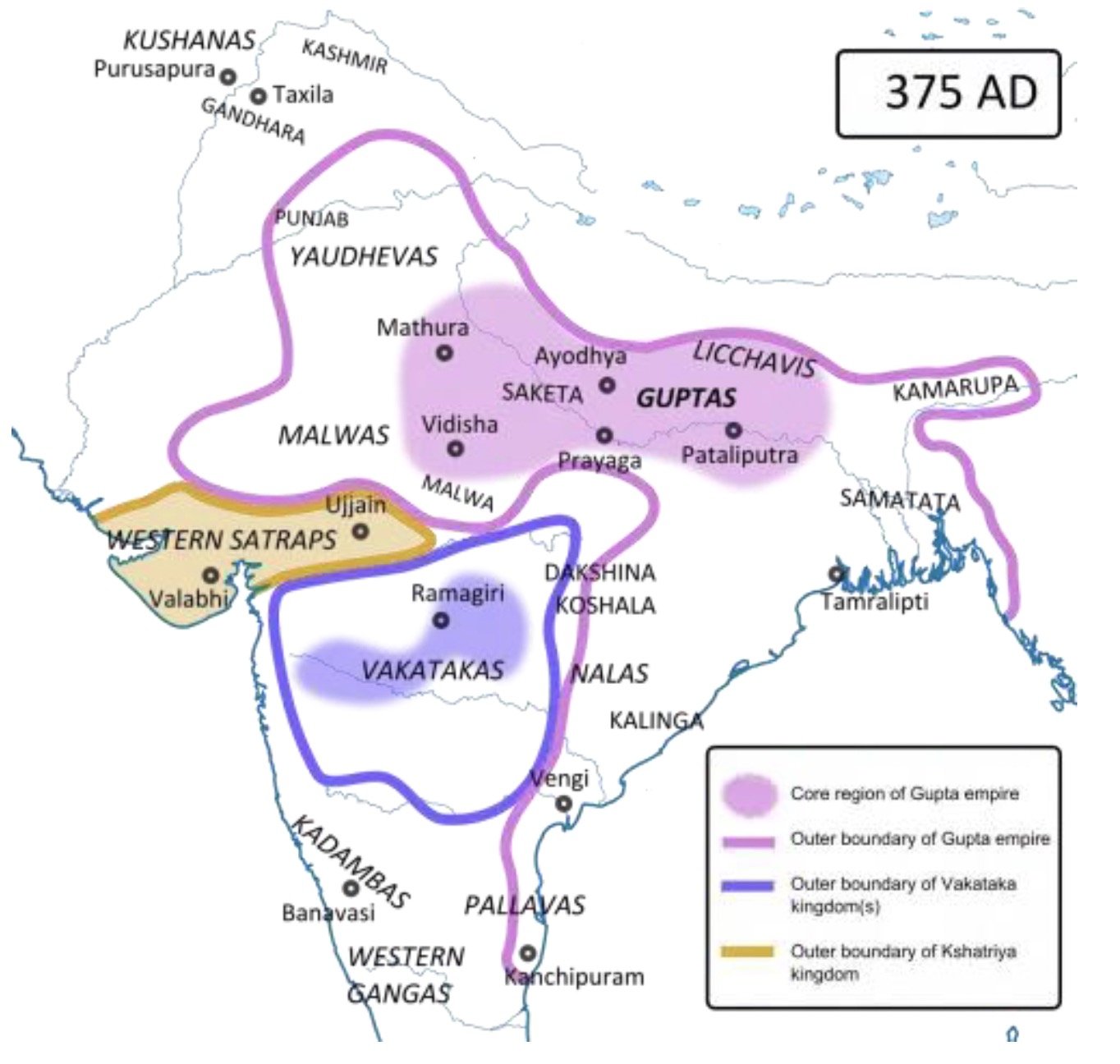
Rising from the Deccan in the mid-third century CE, the Vakataka Empire was one of ancient India's most consequential yet understudied dynasties. Succeeding the Satavahanas in northern Maharashtra and Vidarbha (Berar), the Vakatakas carved out a realm stretching from the southern edges of Malwa and Gujarat in the north to the Tungabhadra River in the south, and from the Arabian Sea in the west to the edges of Chhattisgarh in the east. Contemporaneous with the imperial Guptas of northern India, the Vakatakas served as a vital cultural bridge — transmitting Brahmanical ideas and social institutions southward while forging matrimonial alliances that shaped the political geography of the subcontinent.
Their history is reconstructed primarily from copper plate land grants, royal inscriptions, and references in the Puranas. As staunch champions of Brahmanical religion, the Vakatakas performed numerous Vedic sacrifices and patronised arts, architecture, and literature at a level that produced enduring monuments — most notably the celebrated Ajanta Caves. This document traces the dynasty's origins, royal lineages, administrative architecture, cultural contributions, and ultimate decline.
The Vakataka Dynasty
Origins and Historical Sources
The origins of the Vakataka dynasty remain a subject of scholarly debate, with competing theories placing their ancestral homeland in either South India or the Vindhyan region north of the Narmada. The weight of epigraphic and Puranic evidence, however, tilts decisively toward the Vindhyan hypothesis. The Puranas refer to the dynasty itself as the Vindhyakas, and the town of Kanchanaka — mentioned in connection with the early king Pravarasena I — can be identified with Nachna village in Panna district, Madhya Pradesh, where early Vakataka inscriptions and structural remains have indeed been discovered.
The argument for a South Indian origin rests on the mention of "Vakataka" in a fragmentary inscription at Amaravati in Andhra Pradesh, along with technical similarities between Vakataka inscriptions and the Hirehadagalli and Mayidavolu grants of the Pallava king Shivaskandavarman. The Basim plates of Vindhyashakti II use titles such as Haritiputra and Dharmamaharaja, which also appear in inscriptions of southern dynasties like the Pallavas, Kadambas, and Chalukyas of Badami. Certain inscriptions of Harishena's time describe a minister's family as hailing from Vallura, possibly identifiable with Velur near Hyderabad.
Ultimately, the scholarly consensus favours the Vindhyan region as the dynasty's initial base. From there, the Vakatakas extended their power southwards, gradually becoming the dominant political force in the Deccan. Vindhyashakti I is universally credited as the founder of the dynasty, described in the Cave XVI inscription of Ajanta as the "banner of the Vakataka family" and a Dvija — a twice-born Brahmin. The dynasty belonged to the Vishnuvriddha gotra, and their Brahmanical identity was central to their royal self-representation.
Primary Sources
Copper plate land grants — the most numerous and detailed records
Puranas — dynastic genealogies and early territorial references
Rock-cut cave inscriptions at Ajanta — military and political achievements
Basim plates, Washim plates, Miregaon plates, Chammak plates, and others
What the Sources Tell Us
The Vakatakas are known from a large number of copper plate land grants, which record not only religious donations but also administrative divisions, the names of officials, and the conditions attached to land gifting. The Puranas provide genealogical frameworks, while cave inscriptions offer poetic accounts of military campaigns. Together, these sources allow historians to reconstruct both political history and socio-economic conditions of the Vakataka realm.
The Pravarapura–Nandivardhana Branch: Early Kings
The principal branch of the Vakataka dynasty — the Pravarapura–Nandivardhana line — produced the most politically significant rulers and maintained the closest ties with the imperial Guptas. This branch's history begins with the dynasty's founder and continues through a succession of rulers who expanded Vakataka power across the Deccan.
Vindhyashakti I (c. 250–270 CE)
The dynastic founder and Dvija (twice-born Brahmin). The Cave XVI inscription at Ajanta describes him as the "banner of the Vakataka family" who expanded his power through great battles and commanded a large cavalry. He is associated with the Vishnuvriddha gotra and is credited with establishing the dynasty's identity as champions of Brahmanical religion.
Pravarasena I (c. 270–330 CE)
The most powerful of the early kings, Pravarasena I was the only Vakataka ruler to hold the imperial title Samrat; all others bore the more modest title Maharaja. He extended the empire southwards into Vidarbha and the adjoining Deccan, with his capital at Kanchanaka (modern Nachna, Madhya Pradesh). He waged wars against the Naga kings, cementing a crucial political alliance through the marriage of his son Gautamiputra to the daughter of Naga king Bhavanaga. The Puranas credit him with performing several vajapeya and vajimedha sacrifices, and inscriptions record his four ashvamedhas alongside numerous other Vedic rites.
Rudrasena II and the Gupta Alliance
During the later reign of Prithivishena I, his son Rudrasena II was married to Prabhavatigupta, daughter of the Gupta emperor Chandragupta II. This matrimonial alliance was politically momentous — it allowed Chandragupta II to use Vakataka support to conquer Malwa and Gujarat from the Shaka Kshatrapas in the last quarter of the fourth century CE. When Rudrasena II died after a brief reign in 385 CE, his sons Damodarasena and Pravarasena II were still minors, precipitating one of the most remarkable episodes of female political authority in early Indian history.
Prabhavatigupta: Regent Queen and Political Architect
Few figures in the history of the Vakataka dynasty are as historically consequential as Prabhavatigupta, daughter of the Gupta emperor Chandragupta II and queen of the Vakataka king Rudrasena II. Following her husband's death in 385 CE, she assumed the role of regent on behalf of her two minor sons — Damodarasena and Pravarasena II — and held the reins of government for an extended period, effectively steering the Vakataka kingdom through a critical transitional phase.
Prabhavatigupta's inscriptions are remarkable for their self-assertive character. They give her natal genealogy prominently, emphasising her Gupta connections rather than subsuming her identity into her marital family. Notably, her gotra is recorded as Dharana — that of her natal Gupta family — rather than Vishnuvriddha, the gotra of the Vakataka line into which she had married. This emphasis on natal lineage was an unusual assertion of personal dynastic identity for a royal woman of the period.
Her most significant political inscription is the identification of her father as "Deva Gupta" — whom historians have convincingly equated with Chandragupta II. During her regency, the Vakataka realm was, in practical terms, an extension of the Gupta Empire, leading many historians to characterise this era as the Vakataka-Gupta Age. The capital during this period appears to have shifted to Nandivardhana, identified with Nandardhan near Nagpur.
The Miregaon Seal
The seal of Prabhavatigupta's Miregaon plates describes her as "mother of two kings" — a title that crystallises her dual role as a dynastic matriarch and a political authority in her own right. She continued to issue inscriptions independently even after her sons came of age, and she died during the later part of Pravarasena II's reign.
The Riddhapur Plates
The Riddhapur plates of Prabhavatigupta state that a gifted field was granted along with a farmhouse and four farmers' huts, illustrating the detailed nature of her land grants. The Poona plates further refer to the donees being granted rights over mines and khadira trees, indicating that such grants carried extensive economic privileges.
Legacy and Memory
A fragmentary inscription on the walls of the Kevala-Narasimha temple at Ramtek (Nagpur district) records the construction of a temple named Prabhavatisvamin in memory of the deceased queen — built by her daughter. Her children also constructed a reservoir in her memory, named Sudarshana, echoing the famous Sudarshana lake at Junagadh, a name that had achieved celebrity status across the northern Deccan.
Pravarasena II and the Later Pravarapura–Nandivardhana Rulers
The reign of Pravarasena II represents the administrative and cultural zenith of the main Vakataka branch. He holds the distinction of having left behind the largest number of Vakataka inscriptions, including eighteen copper plate inscriptions that record the gift of twenty villages in all — an extraordinary legacy of royal munificence and documented governance. The earlier inscriptions were issued from Nandivardhana, and the later ones from Pravarapura, a new city he founded and identified with modern Paunar in Wardha district.
Pravarasena II was not merely an administrator but also a man of literary accomplishment. A celebrated Prakrit work called Setubandha (also known as Ravanavaho), woven around Rama's journey to Lanka and his victory over Ravana, is attributed to him. Several verses of the Gaha Sattasai — originally composed by Hala — are also credited to his authorship. He built a temple dedicated to Rama in his new capital, reflecting the synthesis of royal piety and literary patronage that characterised Vakataka rule.
Key Achievements of Pravarasena II
Issued the greatest number of Vakataka copper plate inscriptions
Founded the new capital Pravarapura (modern Paunar, Wardha district)
Built a Rama temple in his new capital
Authored the Prakrit work Setubandha / Ravanavaho
Verses attributed to him in the Gaha Sattasai
Land grants shifted geographically from eastern to western Vakataka territory
The Later Rulers
Following Pravarasena II's death, a succession struggle appears to have ensued. Narendrasena (440–460 CE)ultimately emerged from this contest as king. The last known ruler of the Pravarapura–Nandivardhana line was Prithivishena II, whose death around 480 CE likely concluded the branch's independent existence. A copper coin from Paunar appears to belong to his reign. After his death, his kingdom was in all probability annexed by Harishena of the Vatsagulma branch, who thereby unified the Vakataka realm under a single ruler for the final phase of the dynasty's history.
The Vatsagulma Branch
The Vatsagulma branch of the Vakataka dynasty was founded by Sarvasena, the second son of Pravarasena I, who ruled approximately from 330 to 355 CE. Sarvasena established his own line at Vatsagulma (modern Washim in Maharashtra) and adopted the title Dharmamaharaja — a title also used by southern dynasties — distinguishing his branch's royal nomenclature from the main line. He is also known as Vindhyashakti II in some sources.
Sarvasena was a literary figure of note. He authored the Harivijaya in Prakrit, a work based on the story of Krishna bringing the parijata tree from heaven — a text praised by later writers though now unfortunately lost. He is also credited with many verses of the Prakrit Gaha Sattasai. His administrative record is preserved in the well-known Washim plates, which record the grant of a village in the northern marga of Nandikata (presently Nanded). The genealogical portion of this grant is written in Sanskrit, and the formal portion in Prakrit — making it the first known land grant by any Vakataka ruler.
Sarvasena (330–355 CE)
Founder of the Vatsagulma branch. Authored Harivijaya in Prakrit. Issued the first known Vakataka land grant — the Washim plates. Took the title Dharmamaharaja.
Vindhysena (355–400 CE)
Continued the Vatsagulma line. Maintained the branch's political independence and its distinct administrative traditions, preserving the title conventions established by Sarvasena.
Pravarasena II (400–415 CE)
A great patron of Buddhist architecture, art, and culture. The Cave XVI inscription of Ajanta records his conquests: Avanti (Malwa) in the north, Kosala (Chhattisgarh) and Kalinga and Andhra in the east, Lata (Gujarat) and Trikuta (Nashik) in the west, and Kuntala (southern Maharashtra) in the south.
Harishena (475–500 CE)
The last great Vakataka king. Patron of the Ajanta Caves. The Ajanta inscription alludes in poetic terms to his military achievements. His reign witnessed the excavation of Caves XVI, XVII, and XIX. His death marked the end of Vakataka's golden age.
The most celebrated ruler of the Vatsagulma branch was undoubtedly Harishena (475–500 CE). His minister Varahadeva, son of Hastibhoja, excavated the rock-cut vihara of Cave XVI at Ajanta. Three Buddhist caves at Ajanta — two viharas (Caves XVI and XVII) and a chaitya (Cave XIX) — were excavated and decorated with paintings and sculptures during his reign. Scholar Walter Spink attributes the Ajanta caves of this period to a single intense burst of creative enthusiasm coinciding with Harishena's reign, arguing that his death marked the end of the golden age of Vakataka cultural patronage.
The Fall of the Vakataka Dynasty
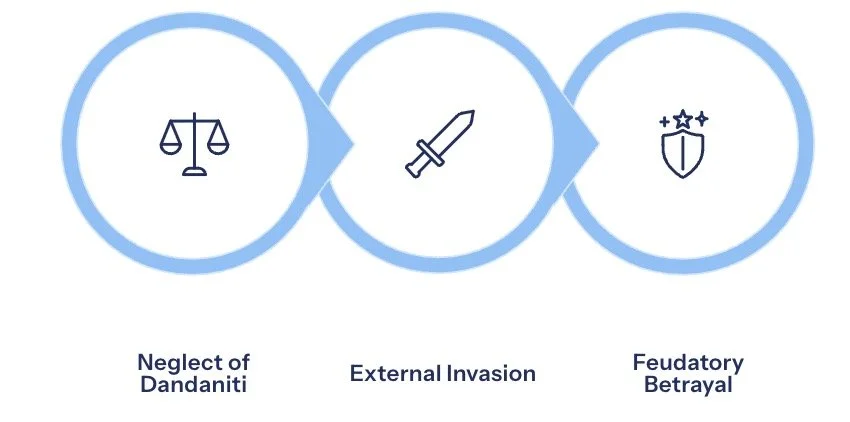
The decline and fall of the Vakataka dynasty is reconstructed largely from the Dasakumaracarita of Dandin, composed approximately 125 years after the dynasty's collapse. According to this literary source, Harishena's son — though described as intelligent and accomplished in all the arts — fatally neglected the study of Dandaniti (the science of political governance and statecraft). Instead, he surrendered himself to pleasure and indulged in what the text characterises as various vices, leaving the kingdom politically vulnerable.
Seizing upon this weakness as a suitable opportunity, the ruler of Ashmaka instigated the king of Vanavasi (in the North Kanara district) to invade Vakataka territory. The Vakataka king, responding to the crisis, summoned his feudatories and resolved to meet the enemy in battle on the banks of the Varada (Wardha) River. The outcome, however, was determined not by the enemy's strength but by internal treachery. While engaged with the opposing forces, the king was attacked from the rear by some of his own feudatories and killed. The Vakataka dynasty ended with his death.
Following the Vakatakas, political power in the Deccan passed to the Chalukyas of Badami, who emerged as the new dominant force in the region. The Vakataka legacy, however, endured — not only in the magnificent Ajanta Caves but also in the administrative frameworks, land grant traditions, and cultural institutions that shaped subsequent Deccan polities.
"Finding this a suitable opportunity, the ruler of Ashmaka instigated the ruler of Vanavasi to invade the Vakataka territory... While fighting with the forces of the enemy, he was treacherously attacked in the rear by some of his own feudatories and killed. The Vakataka dynasty ended with his death."
— Dasakumaracarita of Dandin (paraphrased)
The Fall of the Vakataka Dynasty
The sequential unravelling of Vakataka power — from internal moral decay to external pressure and finally to feudal betrayal — represents a pattern familiar in the fall of many ancient Indian dynasties. The Dasakumaracarita, while a literary work and not a strict historical record, captures the political logic of collapse with remarkable clarity.
Administrative Structure of the Vakataka Kingdom
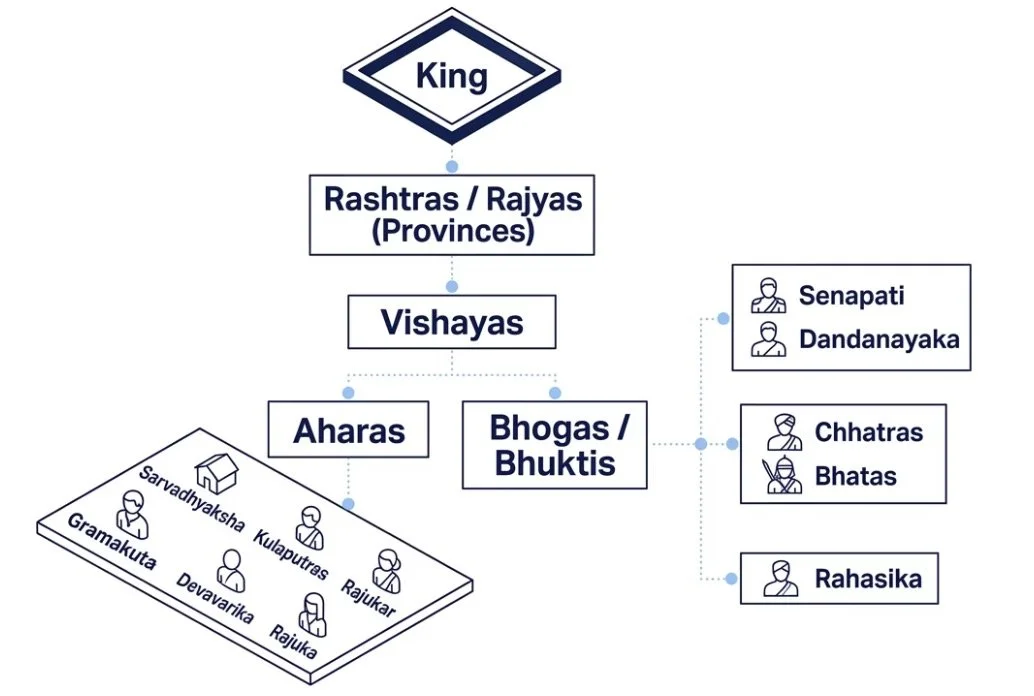
Vakataka inscriptions, while comparatively less forthcoming on administrative matters than those of the Mauryas or Guptas, nonetheless offer a reasonably detailed picture of the kingdom's governance structure. The empire was organised into a hierarchical system of territorial divisions, each administered by officers with specific titles and functions. This administrative apparatus was both efficient in collecting revenue and coercive in maintaining order.
Administrative Structure of the Vakataka Kingdom
The sarvadhyaksha was a supervisory officer who appointed and directed subordinate officers known as kulaputras, whose primary duty was the maintenance of law and order at the local level. The chhatras and bhatas — generally understood as irregular and regular troops respectively — formed the coercive arm of the state, wandering through the countryside to extract taxes due to the king and possibly also maintaining order. The rajuka, known from Mauryan sources as a revenue assessment officer, appears in the Indore plates of Pravarasena II as the writer of a land grant charter — indicating a possibly expanded administrative role in the Vakataka period.
The senapati and dandanayaka were military officers of considerable importance; interestingly, Vakataka charters are described as having been drafted in the senapati's office. The inscriptions of Vakataka feudatories mention additional terms: the rahasika (a confidential royal officer), the gramakuta (village headman), the devavarika (possibly the head of the village police), the gandakas (equivalents of the bhatas), and the dronagrakanayaka (likely in charge of the administrative unit known as the dronagraka or dronamukha).
Land Grants: The Vakataka System of Donative Kingship
Land grants represent the most distinctive and well-documented aspect of Vakataka governance. Unlike the imperial Guptas, who were not prolific donors of land to Brahmanas, the Vakatakas engaged in land gifting with remarkable generosity and consistency. The total tally of gifted villages mentioned in surviving Vakataka inscriptions stands at 35, with a disproportionately large number — twenty villages across eighteen inscriptions — recorded during the reign of Pravarasena II alone.
The grants employed a wide range of technical terms to specify the exemptions, immunities, and privileges accompanying the gifted land and its donees. Thirteen inscriptions record the area of land gifted, ranging from a modest 20 to an extensive 8,000 nivartanas by the royal measure. There are also instances of villages being donated in exchange for previous gifts, and the Yavatmal plates of Pravarasena II record the renewal of an earlier grant — suggesting that the administrative continuity of the grants was actively maintained.
Geographically, from the time of Pravarasena II onwards, there appears to have been a notable shift in the location of gifted villages from the eastern to the western part of the Vakataka kingdom, particularly toward the Tapi valley — possibly reflecting changing settlement patterns or political priorities.
Exemption from State Intrusion
Not to be entered by the district police
Not to be entered by royal soldiers
Exempt from providing sleeping cots, water pots, and slaves to touring officers
Not to provide draught cattle for the transport of officials
Fiscal Exemptions
Exempt from the obligation to gift grain and gold to the king
Exempt from paying taxes
Exempt from providing flowers, milk, and customary cows and bulls to the state
Exempted from providing pastures, hides, and charcoal to touring officials
Economic Rights Granted
Right to hidden treasures and deposits
Right to major and minor taxes collected from the land
Rights over mines and khadira trees (Poona plates of Prabhavatigupta)
Freedom from forced labour (vishti) on several grants
Conditions Attached
Grant to last as long as the moon and sun — i.e., in perpetuity
Donees must not commit treason against the kingdom
Must not be guilty of murder of a Brahmin, theft, adultery, or high treason
Must not wage war or harm other villages
The Basim plates of Vindhyashakti II, which record the grant of Akasapadda village to certain Atharva Veda Brahmanas, provide the most detailed surviving account of the exemptions and privileges attached to a Vakataka land grant. The language of these plates is a mixture of Prakrit and Sanskrit — itself a reflection of the cultural bilingualism characteristic of the Vakataka realm. The Chammak plates of Pravarasena II contain a curious stipulation: the donees, comprising 1,000 Brahmanas, were to enjoy the gifted land collectively — an arrangement that points toward the emergence of communal Brahmin settlements as a significant feature of the Vakataka landscape.
Economy, Trade, and Social Conditions
The economic picture of the Vakataka kingdom, as reconstructed from inscriptions, is one of transition and complexity. Historian Shrimali has argued, with specific reference to the Vakataka context, for a decline in trade, traders, and the urban economy. He characterises the inscriptional evidence as conveying a picture of a non-monetary, small-scale village economy, an expansion of rural settlements, a contraction of urbanism, and an early onset of feudalism. This interpretation, while influential, must be balanced against other epigraphic evidence that points to the continued existence of artisanal specialisation and mercantile activity.
Vakataka inscriptions preserve the terms klipta and upaklipta, which appear to refer to forms of taxation. According to D. C. Sircar, klipta may have denoted a purchase or sale tax, while Maity suggests it may not have been a tax at all but rather a royal right over land. The upaklipta may have referred to additional or minor taxes. Inscriptions also mention vishti — forced labour — as a recognised institution, though some land grants explicitly exempted donees from this obligation.
Artisan Settlements
Several village names in Vakataka copper plates suggest occupational specialisation. Charmanka (Chammak plates) was likely a settlement of leather workers. The Thalner plates mention Kamsakaraka and Suvarnakara — villages of bronze workers and goldsmiths respectively. Ishtakapalli (Mandhal plates) may have specialised in brickmaking. Lavanatailaka was connected with salt manufacture, and Lohanagara with iron working.
Merchants and Trade
The Indore plates of Pravarasena II mention a merchant (vanijaka) named Chandra, who purchased half a village and donated it to certain Brahmanas — an act that reveals the participation of merchants in religious gift-giving. A goldsmith named Ishvaradatta is mentioned as the engraver of the Pattan plates, demonstrating artisanal involvement in the production of official royal documents.
Alcohol and Other Industries
Kallara (Pandhurna plates) and Madhukajjhari (Patna Museum plates) may have been villages associated with alcohol distillers. Hiranyapura appears connected with goldwork, further attesting the geographic clustering of specialised industries across the Vakataka realm. The grant exemption from "the royal prerogative of purchasing fermented liquor" also confirms state interest in the liquor trade.
Cultural Patronage: The Ajanta Caves
No discussion of the Vakataka dynasty is complete without a sustained engagement with the Ajanta Caves — the most spectacular surviving monument of their cultural patronage. Located in the Sahyadri hills of present-day Maharashtra, the Ajanta rock-cut complex represents a synthesis of Buddhist religious architecture, sculpture, and painting that has no parallel in the ancient world. The caves were excavated in two distinct phases: five caves date to the Satavahana period, while 23 belong to the Vakataka period, a fact established by inscriptional evidence.
Walter Spink, the foremost scholar of Ajanta's chronology, attributes the Vakataka-period caves to a single intense burst of creative and devotional enthusiasm concentrated in the reign of Harishena of the Vatsagulma branch (c. 475–500 CE). Spink argues persuasively that it was Harishena's death that brought this golden age of cave excavation and painting to an abrupt end. The scale and magnificence of the Ajanta complex — with its elaborately carved facades, capacious viharas, and vaulted chaitya halls — indicates that it housed a prominent monastic community that attracted lavish patronage from the Vakataka elite.
Three specific caves at Ajanta are directly associated with Harishena's reign: Cave XVI and Cave XVII (both viharas) and Cave XIX (a chaitya). Cave XVI was excavated by Varahadeva, a minister of Harishena and son of Hastibhoja, whose donative inscription within the cave mentions the deities Indra, Vishnu, Rama, Hara, and Kama alongside the Buddhist dedication — a remarkable instance of religious syncretism. The second phase of painting at Ajanta, celebrated worldwide for its extraordinary narrative murals and sensuous figural style, corresponds precisely to this Vakataka period.
Phase 1: Satavahana Period
Five early caves excavated. Establishes Ajanta as a Buddhist pilgrimage and monastic site.
Vakataka Patronage Begins
Harishena's reign triggers an intense burst of cave excavation and artistic activity. Elite ministers and feudatories compete in patronage.
Phase 2: Vakataka Period
23 caves added, including Caves XVI, XVII, and XIX. The second and greatest phase of mural painting executed. Paintings of Padmapani and Vajrapani created.
Death of Harishena
Harishena's death abruptly ends the golden age of Ajanta activity. The dynasty's fall follows shortly thereafter.
Literature, Religion, and the Panchatantra Connection
The Vakatakas were not merely military and administrative actors — they were among the most significant cultural patrons of early medieval India. As Brahmin rulers deeply committed to the Brahmanical religious order, they performed numerous Vedic sacrifices, including the agnishtoma, brihaspatisava, vajapeya, vajimedhya, and no fewer than four ashvamedhas attributed to Pravarasena I. These sacrificial performances were not merely religious acts but also powerful political statements, broadcasting royal authority and largesse across the kingdom.
The literary output associated with the Vakataka court is equally impressive. The Prakrit Setubandha (or Ravanavaho), attributed to Pravarasena II of the main branch, narrates Rama's journey to Lanka and his conquest of Ravana in elegant Prakrit verse. The Harivijaya of Sarvasena (founder of the Vatsagulma branch), based on the story of Krishna bringing the parijata tree from heaven, was praised by later literary critics though the text itself has been lost. Both rulers also contributed verses to the famous Prakrit anthology, the Gaha Sattasai (originally compiled by Hala).
The Panchatantra and Vakataka Authorship
The Panchatantra — one of the world's most celebrated collections of didactic animal fables — may have been composed in the Vakataka empire. The text is classified as a nidarshana, a work that teaches through illustration what should and should not be done. Its stories are presented as narrated by a sage named Vishnusharman, who instructs three princes in niti (statecraft and policy) through engaging animal tales. The crucial evidence: the three princes whose names end in the suffix 'shakti' — a suffix characteristic of Vakataka royal names — strongly suggests a Vakataka context for the work's composition.
The Five Books of the Panchatantra
Book I: Splitting an alliance that is contrary to one's interest
Book II: Forming a strategic alliance
Book III: Waging war effectively
Book IV: Getting the better of a fool
Book V: The results of action without reflection
Most Panchatantra stories are amusing, satirical tales in which animals play central roles. The style employs elegant prose interspersed with verses — a literary form common to Sanskrit and Prakrit literary traditions of the period.
The Vakataka kingdom's cultural significance extends beyond its own literary productions. As a channel for the transmission of Brahmanical ideas and social institutions to the south, the dynasty played a formative role in shaping the cultural landscape of the Deccan. The land grant system itself — with its Brahmin donees, Sanskrit and Prakrit bilingualism, and elaborate ritual exemptions — was a vehicle for spreading the social norms and values of Brahmanical civilisation into regions where they had previously been less firmly established.
The Vakataka Legacy
The Vakataka dynasty ruled the Deccan for approximately two and a half centuries — from the mid-third to the early sixth century CE — and left behind a legacy that is at once political, administrative, cultural, and architectural. Their political history was intimately intertwined with that of the imperial Guptas, and the period of Prabhavatigupta's regency represents one of the most sophisticated examples of dynastic alliance management in ancient Indian history. Their matrimonial connections with the Nagas of Padmavati, the Kadambas of Karnataka, and the Vishnukundins of Andhra further extended their influence across a vast arc of the subcontinent.
Administratively, the Vakataka land grant system was among the most elaborate and well-documented of the early medieval period. The 35 villages recorded as gifts in Vakataka inscriptions, the detailed exemptions attached to each grant, and the geographic evidence of artisanal village settlements all combine to offer historians a remarkably granular picture of the kingdom's socio-economic life. The debate between scholars such as Shrimali (who sees early feudalism and urban contraction) and those who emphasise continuing mercantile activity reflects the genuine complexity of the historical record.
Culturally, the Vakatakas' most enduring gift to posterity is the Ajanta Caves — a UNESCO World Heritage Site and one of humanity's greatest artistic achievements. The paintings of Padmapani, Vajrapani, and the extraordinary narrative murals of the Vakataka period continue to astonish and move viewers more than fifteen hundred years after their creation. The Pravareshvara Shiva temple at Mansar (Nagpur district), built by Pravarasena II, is another surviving monument to Vakataka architectural ambition.
Political Legacy
Strategic matrimonial alliances with the Guptas, Nagas, Kadambas, and Vishnukundins shaped the political geography of the Deccan. The Vakataka-Gupta Age represents a high point of inter-dynastic cooperation in ancient India.
Administrative Legacy
The elaborate land grant system — with its hierarchical territorial divisions, specialist officers, and detailed exemption clauses — provided a template for subsequent Deccan polities, including the Chalukyas of Badami who succeeded them.
Cultural Legacy
The Ajanta Caves, the Pravareshvara Shiva temple, Prakrit literary works, and the possible connection with the Panchatantra constitute a cultural legacy of extraordinary breadth and depth, cementing the Vakatakas' place among ancient India's most significant dynasties.
Geographic Legacy
As a channel for Brahmanical ideas moving southward, the Vakatakas shaped the cultural and religious landscape of the Deccan in ways that endured long after their political disappearance. Their influence on the Chalukyas and other successor states was profound.
Key Takeaway: The Vakataka dynasty represents a pivotal chapter in the history of the Deccan — a dynasty that combined Brahmanical piety with Buddhist patronage, administrative innovation with literary creativity, and political pragmatism with cultural ambition. Their study is indispensable for understanding the transition from the classical to the early medieval period in Indian history.
