
The Vardhana Dynasty
Early Medieval India
The Vardhana Dynasty
Rising from the ruins of the Gupta Empire, the Vardhana dynasty — centred first at Thanesar and later at Kannauj — shaped the political and cultural landscape of northern India in the 7th century CE. From the foundational ambitions of Prabhakarvardhana to the celebrated but contested reign of Harshavardhana, this is the story of a dynasty that stood at a pivotal crossroads in Indian history.
The Fall of the Guptas and the Rise of the Vardhanas
The mid-6th century CE witnessed one of the most consequential transformations in the political geography of the Indian subcontinent — the fragmentation of the once-mighty Gupta Empire. What had been a vast, unified imperial order shattered into a mosaic of small, competing kingdoms scattered across northern India. Into this power vacuum stepped the Huns, who established their supremacy over Punjab and portions of central India, further destabilising the region.
The northern and western regions of India fell into the hands of a dozen or more feudatories, each jostling for dominance. It was in this turbulent environment that the Pushyabhuti family, ruling from Thanesar (modern-day Thanesvara in Kurukshetra, Haryana), began its ascent. Some scholars suggest that in their early days, the Pushyabhutis were likely feudatories of the Maukhari kings of Kannauj — a powerful lineage that controlled the central Gangetic plains.
The dynasty's trajectory changed decisively with the emergence of Prabhakarvardhana, who is credited as the founder of the Vardhana dynasty. He proved himself to be not merely an ambitious regional lord but a formidable statesman and military commander. He defeated the Hunas — the very force that had contributed to the Gupta collapse — and consolidated his hold over Punjab and Haryana.
Political Fragmentation
Post-Gupta collapse left North India divided among a dozen or more feudatory kingdoms, creating a power vacuum that invited both internal rivalry and external invasion.
Hunnic Supremacy
The Huns established dominance over Punjab and parts of central India, disrupting trade and governance structures that had prevailed under the Guptas.
Pushyabhuti Origins
The Pushyabhuti family, initially a feudatory of the Maukharis of Kannauj, was based at Thanesar in Haryana — a strategic location that would anchor early Vardhana power.
Prabhakarvardhana's marriage alliance with the Maukhari dynasty further elevated his political stature. His daughter Rajyashri was wed to Grahavarman, the Maukhari ruler of Kannauj. This matrimonial union transformed a regional feudatory into a significant power broker. He eventually assumed the grand imperial title Parama-bhattaraka Maharajadhiraja — meaning "the one to whom the other kings bow because of his valour and affection" — signalling his emergence as the pre-eminent ruler of northern India.
Rajyavardhana: The Brief and Tragic Reign
Prabhakarvardhana had two sons — Rajyavardhana and Harshavardhana — and one daughter, Rajyashri. Upon the death of the dynasty's founder, it was the elder son, Rajyavardhana, who succeeded to the throne of Thanesar. His reign, however, was defined not by years of administration or conquest, but by a dramatic sequence of events that would prove decisive for the dynasty's future.
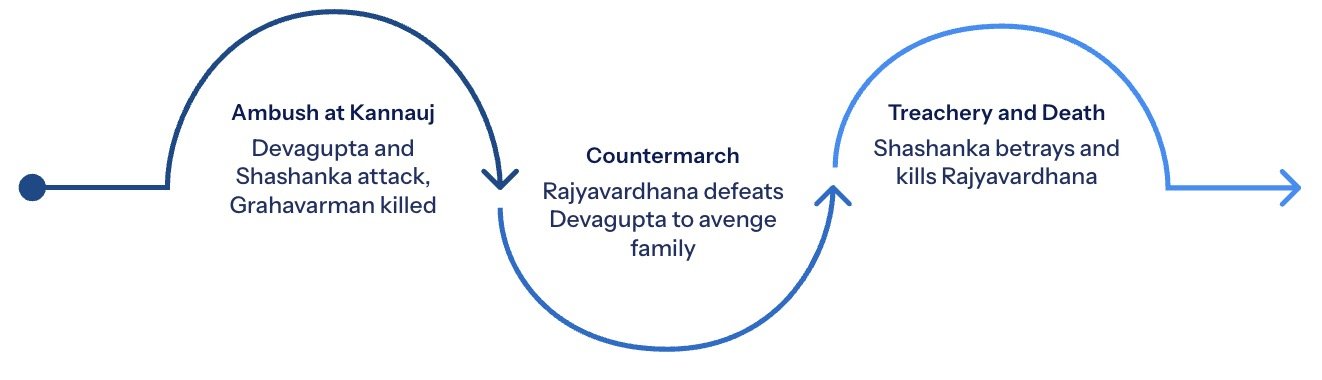
According to the Harshacharita — the celebrated biographical work composed by the court poet Bana — a crisis of the gravest order erupted soon after Prabhakarvardhana's passing. Devagupta, the king of Malava (speculated by historians to have been a ruler of the Later Gupta dynasty), launched a devastating attack on Kannauj. He was supported by Shashanka, the ruler of the Gauda kingdom in Bengal. Devagupta killed Grahavarman, the Maukhari king and Rajyashri's husband, and took Rajyashri captive. The affront to the Vardhana family was profound and personal.
Rajyavardhana: The Brief and Tragic Reign
Unable to accept this insult to his family and kingdom, Rajyavardhana mobilised his forces and marched against Devagupta — whom he defeated in battle. However, in a moment of treachery that would cast a long shadow over subsequent history, Shashanka — ostensibly an ally of Devagupta — murdered Rajyavardhana. His death robbed the Vardhanas of a capable young king and thrust the burden of the dynasty's survival onto his younger brother, Harsha. It was Harshavardhana who would ultimately rescue Rajyashri just as she was about to commit sati, and it was he who would inherit both the grief and the ambition of this tragic moment.
Harshavardhana: The Rise of an Emperor
Following the tragic assassination of his elder brother, Rajyavardhana, and the harrowing circumstances surrounding his sister Rajyashri, a young Harshavardhana ascended the throne of Thanesar in 606 A.D. This marked the beginning of a remarkable 41-year reign that would see him establish a vast empire across northern India. Inheriting a kingdom grappling with external threats and internal instability, Harsha’s immediate challenge was to consolidate power and restore order. He swiftly united the two significant kingdoms of Thanesar (his ancestral seat) and Kannauj (his brother-in-law's former capital, now his sister's domain), subsequently transferring his imperial capital to Kannauj. This strategic move not only legitimised his claim over a broader territory but also provided a more central and fertile base for his future campaigns and administration.
Harsha's reign is exceptionally well-documented, a significant advantage for historians studying early medieval India. Two primary sources provide invaluable insights into his life, administration, and the socio-cultural fabric of his era. The first is the Harshacharita (Deeds of Harsha), an ornate biographical work composed by his court poet, Bana Bhatta. This text offers a detailed, though often eulogistic, account of Harsha's early life, his ascension to power, and his initial military exploits. The second crucial source is the travelogue Si-Yu-Ki (Record of the Western Regions) by the renowned Chinese Buddhist monk, Xuanzang (Hieun Tsang), who spent several years travelling across India, including a considerable period at Harsha's court.
Bana Bhatta's Harshacharita
A court poet's vivid, though often embellished, account of Harsha's early life, ascension, and initial military campaigns, offering a glimpse into courtly affairs and political intrigues.
Xuanzang's Si-Yu-Ki
An extensive travelogue by the Chinese pilgrim, detailing India's geography, society, religious practices, and economy during Harsha's reign from an objective outsider's perspective.
Military Campaigns and the Extent of Harsha's Empire
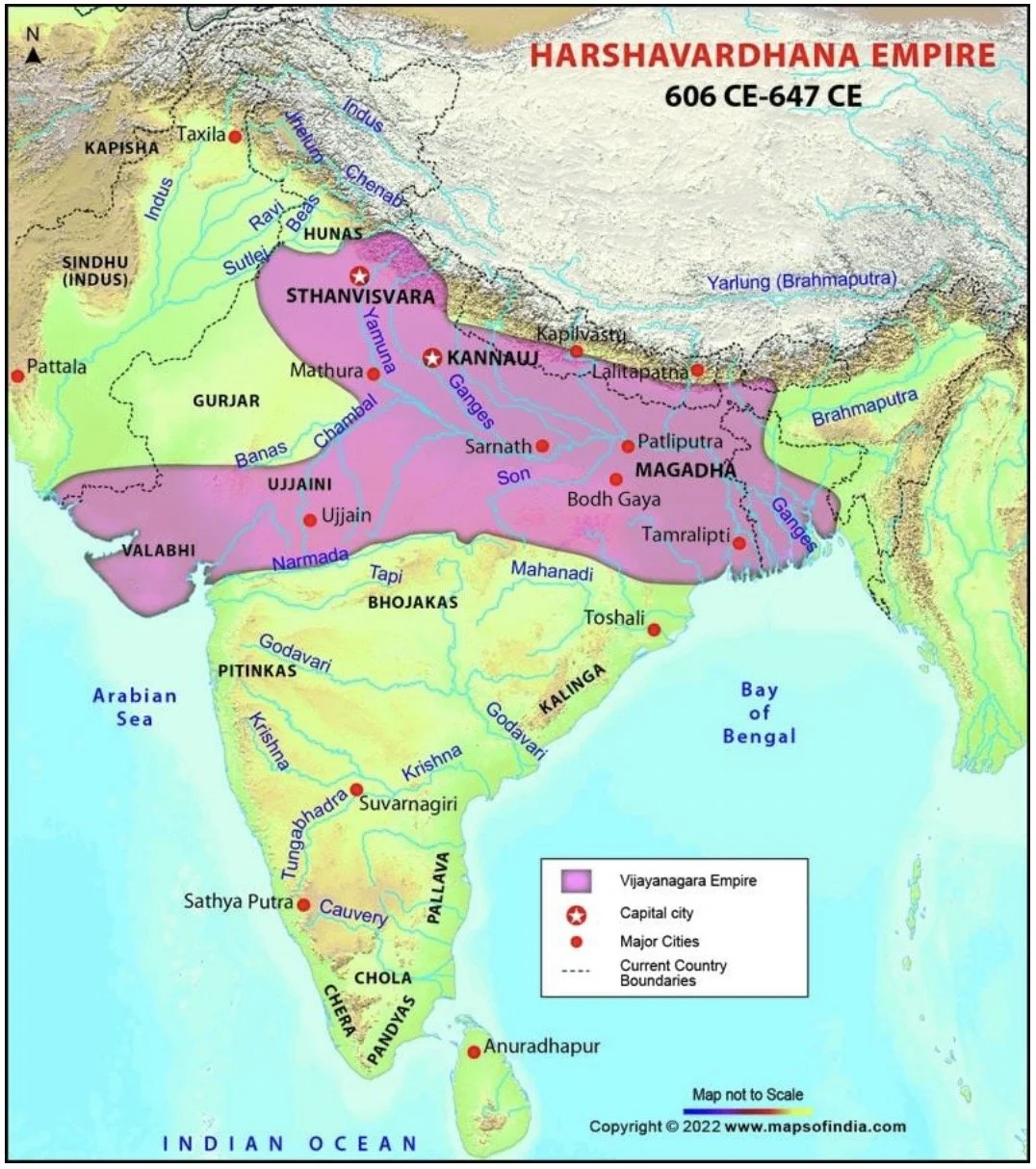
Harsha waged many wars over the course of his reign, pursuing an aggressive policy of territorial expansion that extended the boundaries of the Vardhana kingdom across a vast swathe of the Indian subcontinent. Between 606 and 612 CE, he brought most of northern India — including Punjab, Uttar Pradesh, Bengal, Bihar, and Orissa — under his influence, assuming the title of Siladitya. Hiuen Tsang describes Harsha as the "Lord of Five Indias" — referring to Punjab, Kannauj (in U.P.), Bihar, Bengal, and Orissa.
Eastern Campaign
Harsha successfully conducted an eastern campaign, gaining control over Bihar, Bengal, and Orissa — though Bengal was only secured after the death of Shashanka in c. 637 CE.
Western India
He conquered Vallabhi king Dhruvasena of Gujarat, eventually resolving hostilities through a matrimonial alliance. He also exercised influence over Ganjam in modern Odisha.
North and Northwest
Harsha established control over Kashmir (which paid tribute) and is said to have subdued Nepal. He is also said to have been victorious against the ruler of Sindh, though this remains contested.
Southern Boundary
The Narmada river formed the southern limit of Harsha's dominions. Beyond it, the Chalukya king Pulakesi II held firm — dealing Harsha his most significant military setback.
However, it is crucial to temper the celebratory accounts of Banabhatta and Xuanzang with sober historical scrutiny. Harsha did not conquer even the whole of North India. Kashmir, Western Punjab, Sindh, Gujarat (partially), Rajputana, Nepal, Eastern and Northern Bengal, and Kamrupa or Assam remained essentially independent. His long run of victories was decisively broken when he was defeated by the south Indian emperor Pulakesi II of the Chalukya dynasty. Dr R.C. Majumdar has strongly argued that Harsha's empire included only Eastern Punjab, Uttar Pradesh, Bihar, West Bengal, and Orissa in terms of direct control, with neighbouring states merely recognising his power as suzerain without formal submission.
Dr K.M. Panikkar offers a somewhat more generous assessment, describing the empire's extent as stretching from Kamrupa in the East to Kashmir in the West, and from the Himalayas in the North to the Vindhyas in the South. What is clear is that Harsha built the most powerful empire of his era in northern India — remarkable in scope, even if it fell short of the universality claimed by his admirers.
Harshawardhana Empire
Was Harsha a Great Conqueror?
The question of whether Harshavardhana deserves the title of a "great conqueror" has been one of the most vigorously debated issues in early medieval Indian historiography. Contemporary sources — Banabhatta and Xuanzang — present him as one of the greatest rulers of northern India, and many early modern historians accepted this characterisation, concluding that "Harsha was the last great empire-builder of the Hindu period and his death marked the end of all successful attempts to restore the political unity of India."
The Case For Harsha's Greatness
United the kingdoms of Thanesar and Kannauj in desperate circumstances
Established a vast empire spanning much of the Gangetic plain
Diplomatic genius — alliance with Bhaskaravarman proved decisive
Respected by both friendly and hostile neighbours; none dared attack his kingdom
Patron of learning, religion, and arts at an exceptional scale
The Case Against (Dr R.C. Majumdar's View)
Failed against Shashanka; Bengal secured only after Shashanka's natural death
Probably defeated by Pulakesi II of the Chalukyas
Vallabhi friendship "bargained" through matrimonial alliance, not conquest
His empire was personal — it disintegrated immediately upon his death
Later empires of Pala, Pratihara, and Rashtrakuta were more extensive and durable
Dr Majumdar's nuanced verdict deserves extended quotation: "While, therefore, it would be idle to pretend that Harsha Vardhan's reign constitutes a distinctive age or marks an epoch in Indian history in any way, we cannot withhold our tribute of praise and admiration which is due to him as a great ruler, a brave military leader, a patron of arts and letters, and a man of noble impulses and distinguished personality." This balanced assessment — acknowledging Harsha's genuine qualities while refusing to elevate him beyond his actual achievements — is now widely accepted among historians.
Harsha was a capable commander but certainly no military genius or great conqueror in the mould of Samudragupta. His success was fundamentally personal and proved short-lived. He lacked the institutional genius required to build an enduring state — and thus he cannot be ranked among the truly great emperors of ancient India, even as he rightly occupies a respected place among the rulers of his own era.
Harsha's Relations with Contemporary Rulers
The political world that Harshavardhana navigated was one of competing regional powers, shifting alliances, and frequent conflict. His relationships with contemporary rulers — whether friendly, hostile, or diplomatically ambiguous — fundamentally shaped the trajectory of his reign and the geography of his empire.
Shashanka of Gauda
Shashanka was responsible for the murder of both Grahavarman (Harsha's brother-in-law) and Rajyavardhana (Harsha's brother). Harsha vowed revenge and launched multiple campaigns against Bengal. However, Shashanka ruled Gauda until his death circa 637 CE, and Harsha could not achieve any decisive success against him during Shashanka's lifetime. Shashanka was also notorious for persecuting Buddhists and destroying the sacred Bodhi tree at Gaya.
Bhaskaravarman of Kamrupa
The king of Kamrupa (Assam) was Harsha's most important ally. A detailed account in the Harshacharita describes how Bhaskaravarman's envoy, Hangsavega, met with Harsha and negotiated an offensive-defensive alliance. This alliance was decisive in Harsha's conflict against the Gauda-East Malwa combine. After Shashanka's death, the combined armies of Harsha and Bhaskaravarman attacked Bengal: East Bengal was occupied by Bhaskaravarman, and West Bengal by Harsha.
Dhruvasena II of Valabhi
The Maitraka rulers of Valabhi in Saurashtra were initially in conflict with Harsha. An inscription of the Gurjara kings of Broach claims they protected the Valabhi ruler from Harsha. However, hostilities eventually ended through a matrimonial alliance — Dhruvasena II Baladitya married Harsha's daughter. Whether this reflected Harsha's suzerainty or a negotiated peace remains debated among scholars like Dr R.C. Majumdar and Dr D.C. Sarkar.
Pulakesi II of the Chalukyas
Harsha's most significant military failure was against Pulakesi II, the Chalukya emperor of the Deccan. The Narmada formed the boundary between their domains. The Aihole inscription of Pulakesi claims he acquired the title Parameshvara by defeating Sakalottarapathesvara (a reference to Harsha). Xuanzang's account also suggests that Harsha took the initiative but could not achieve success against Pulakesi.
Harsha also established diplomatic relations with China — a Brahmin envoy sent to Emperor Tai Tsung of the Tang Dynasty in 641 CE returned in 643 CE with a Chinese mission. Historians speculate this diplomatic outreach was partly meant as a counterbalance to Pulakesi II's cultivated friendship with the king of Persia. Meanwhile, kingdoms of Sind, Kashmir, and Nepal remained independent of Harsha's direct control, underscoring the limits of his imperial reach.
Administrative Structure of Harsha's Empire
The administration of Harshavardhana was broadly similar to that of the Gupta Empire but reflected the increasingly feudal character of early medieval India. Theoretically, Harsha ruled as an autocrat — his was a form of oriental despotism in which the sovereign stood at the absolute centre of the state. In practice, however, his rule was one of enlightened despotism: the power of ministers and the autonomy of village communities served as practical checks on royal authority. Hiuen Tsang tells us that people lived in peace and happiness, and that the king made generous charities to the poor.
Bhukti (Province)
The kingdom was divided into large provinces or divisions called Bhukti — the highest tier of territorial administration below the central government.
Visaya (District)
Each Bhukti was further subdivided into Visayas, corresponding roughly to modern districts — the primary unit of revenue collection and local governance.
Pathaka (Sub-district)
A smaller territorial unit, the Pathaka was perhaps equivalent in size to a present-day taluk — bridging district administration and the village level.
Grama (Village)
The Grama or village was the lowest and most fundamental unit of administration — the bedrock upon which the entire imperial structure rested.
The king personally supervised administration, constantly touring the provinces to administer justice and hear grievances directly from the people. During these tours — conducted as state processions with music and drums — Harsha would punish the guilty and make himself accessible to ordinary citizens. He suspended inspection tours during the rainy season on account of travel difficulties, but otherwise remained indefatigable in his administrative duties. According to Hiuen Tsang, there were very few criminals during Harsha's reign, and punishment for offenders was strict — mutilation of limbs, banishment into jungles, or imprisonment. Trial by ordeal was also in practice.
Military and Civil Administration in Detail
The Military Machine
Harsha maintained a well-organised standing army comprising four wings — infantry, cavalry, elephant corps, and camel units. Hiuen Tsang records that Harsha commanded 60,000 elephants and a cavalry of one lakh. Cavalry and elephant corps each had separate commanders; the head of the cavalry was called the Brihadasvavaru. Horses were procured from places as distant as Kamboja, Sindh, and Persia — testament to the imperial reach of Harsha's commercial and diplomatic networks.
Ministers and the Mantri-Parisad
Harsha was assisted by a Mantri-Parisad (council of ministers) that advised him on state affairs and foreign policy. The superior civil service was staffed by Kumaramatyas (Cadet Ministers). The Harshacharita of Banabhatta provides an extensive list of officials.
Key Officials
Mahasandhivigrahika — Supreme minister for peace and war
Mahapratihara — Head of palace-guards
Simhanda — Commander-in-chief
Mahabaladhikrita — Commander of forces
Mahakshapatalike — Chief accounts officer
Nyayakarnika — Judicial officer
Bhandagaradhikrita — Superintendent of stores
Kayastha — Scribe
Most senior officers enjoyed the income of particular tracts of land as remuneration — they were not paid in cash. Lower-grade officers, however, were paid in cash or in land. This arrangement carries the unmistakable trace of a nascent Jaigirdari system of feudalism — a pattern that would become far more pronounced in the centuries following Harsha's death. According to Hiuen Tsang, Harsha was just in administration and meticulous in the discharge of his duties. Society was not burdened by a grinding bureaucracy, and individuals were not subjected to forced labour contributions.
Economy Under Harsha: Feudalism and Decline of Trade
The economy of northern India during Harsha's reign underwent a significant structural transformation — one that would have profound long-term consequences for Indian civilisation. While Harsha's capital at Kannauj initially flourished as a great centre of trade, the broader economic trajectory of his empire moved toward an increasingly self-sufficient and feudal character. Trade and commerce receded, reflected in the decline of urban trade centres, a marked paucity of coins, and the near-complete disappearance of the merchant and trader guilds that had been so characteristic of Gupta-era prosperity.
Decline of Trade
Diminishing commerce affected handicraft industries through want of demand. Agricultural production increasingly turned inward — producing for local consumption rather than external markets.
Rise of Village Self-Sufficiency
As trade vanished, villages became economically self-sufficient units. Dependence on agriculture grew, and the village economy became the structural foundation of economic life.
Feudal Land Grants
Copper plates from 632 CE record land gifts by military officers to Brahmins. Mahasamantas (independent rulers near the core area) paid tribute and provided military service to the overlord king — a pattern analogous to European feudalism.
The main source of state income was land revenue, fixed at one-sixth of agricultural produce. Other taxes were light, and the state's fiscal demands were relatively modest. The income of the state was spent across four categories: expenses of the state and ceremonial worship; advancement of ministers; rewards for the clever, learned, and talented; and charitable spending on religious orders of all persuasions. A gold coin attributed to Harsha bears the legend Harshadeva with the figure of a horseman. About 284 silver coins inscribed with the name Sri Siladitya have also been discovered, providing tangible numismatic evidence of his reign.
Harsha as a Patron of Scholars and Literature
Beyond the battlefield and the council chamber, Harshavardhana distinguished himself as a man of exceptional cultural refinement and literary sensibility. He is credited with the composition of three Sanskrit dramas — Ratnavali, Priyadarsika, and Nagananda — works that continue to be studied and performed. He also authored two significant poems on Buddhist themes: Ashtamahasricaityastotra (Praise to Eight Grand Chaityas) and Suprabhatastotra (Laud to Morning), as well as a grammatical treatise on gender, the Linganusasanam. While his authorship has occasionally been disputed, no decisive contrary arguments have been successfully advanced.
Banabhatta
Author of the Harshacharita (first historical poem in Sanskrit) and the celebrated novel Kadambari. Banabhatta was the most luminous figure in Harsha's literary court.
Mayura
Bana's brother-in-law and a celebrated poet. His works included Surya Sataka, Arya Muktamala, and Mayurastaka — each a testament to the high literary culture of Harsha's court.
Xuanzang
The Chinese Buddhist pilgrim spent eight years at Harsha's court and authored the Si-Yu-Ki — an invaluable record of India's geography, society, religion, and education during this period.
Other Scholars
Haridatta, Jayasena, Divakara, and others were patronised by Harsha. The court also hosted skilled painters who decorated auspicious scenes — though none of their works have survived the iconoclastic destructions of early Muslim invasions.
Hiuen Tsang records that Harsha devoted as much as one-fourth of his revenue to patronising scholars. Every day, rations were provided at the royal lodge for 1,000 Buddhist monks and 500 Brahmanas. Such munificence was not merely the gesture of a wealthy monarch — it reflected a deeply personal commitment to the life of the mind and the welfare of learned communities. Harsha's court was one of the great intellectual centres of the 7th century CE world.
Religion and the Religious Assemblies
The religious life of the Vardhana dynasty was characterised by a remarkable pluralism — each ruler bringing their own personal devotion while remaining broadly tolerant of other faiths. Prabhakarvardhana was a devotee of the Sun, offering daily a bunch of red lotuses in a ruby bowl. Rajyavardhana was a Buddhist. Harshavardhana began his reign as a devotee of Shiva, Surya, and Buddha — an ecumenism that reflected the syncretic religious culture of the age.
Harsha's conversion to a more committed form of Buddhism is attributed by Bana to the influence of the Buddhist ascetic Divakaramitra, who lived in the forests of the Vindhyas. However, it was the Chinese pilgrim Xuanzang who decisively shaped both Harsha's and his sister's faith in Mahayana Buddhism through discourses on its doctrines and a demonstration of the limitations of Hinayana at their very first meeting. Harsha subsequently built numerous stupas, erected a bronze temple 100 feet high at Nalanda, and prohibited animal slaughter — a practice even more rigorously enforced than Ashoka's own prohibitions, according to Xuanzang.
Kanauj Assembly (643 CE)
Harsha summoned 3,000 Mahayana and Hinayana monks, 3,000 Brahmanas, and 1,000 Nalanda scholars. Presided by Xuanzang, focused on establishing Mahayana supremacy. Lasted 23 days.
Prayag Assembly (Quinquennial)
Held at the confluence of the Ganga and Yamuna every five years (the sixth of its kind during Harsha's reign). Tributary kings, scholars, and the poor all attended. Three days honoured Buddha, Aditya, and Shiva respectively.
The Kanauj Assembly was one of the grandest religious-intellectual gatherings of the ancient world. A golden image of Buddha was installed in a tower 100 feet high on the banks of the Ganga. A smaller image, three feet high, was carried in daily procession joined by 20 rajas and 300 elephants. Harsha personally washed the image and led the procession. At the assembly's conclusion, he offered Xuanzang gold, silver, jewels, and garments — all of which the monk declined. The Prayag Assembly, lasting three months, was a celebration of religious pluralism: it honoured Buddha, Aditya, and Shiva on successive days and distributed enormous charity to the poor, orphans, and representatives of all religious sects.
Society and the University of Nalanda
Hiuen Tsang's observations on Indian society during Harsha's reign constitute one of the most vivid and detailed accounts of early medieval Indian life available to historians. According to him, the people were known for their honesty, courage, and love for learning. They were not deceitful or treacherous; they were faithful to their oaths and promises. They maintained personal hygiene scrupulously — cleaning the floors of their houses with cow-dung, bathing daily, and anointing their bodies with scented unguents of sandal and saffron. They washed their hands before meals and did not serve up remnants of food — a practice reflecting a keen sense of propriety and cleanliness.
Society and the University of Nalanda
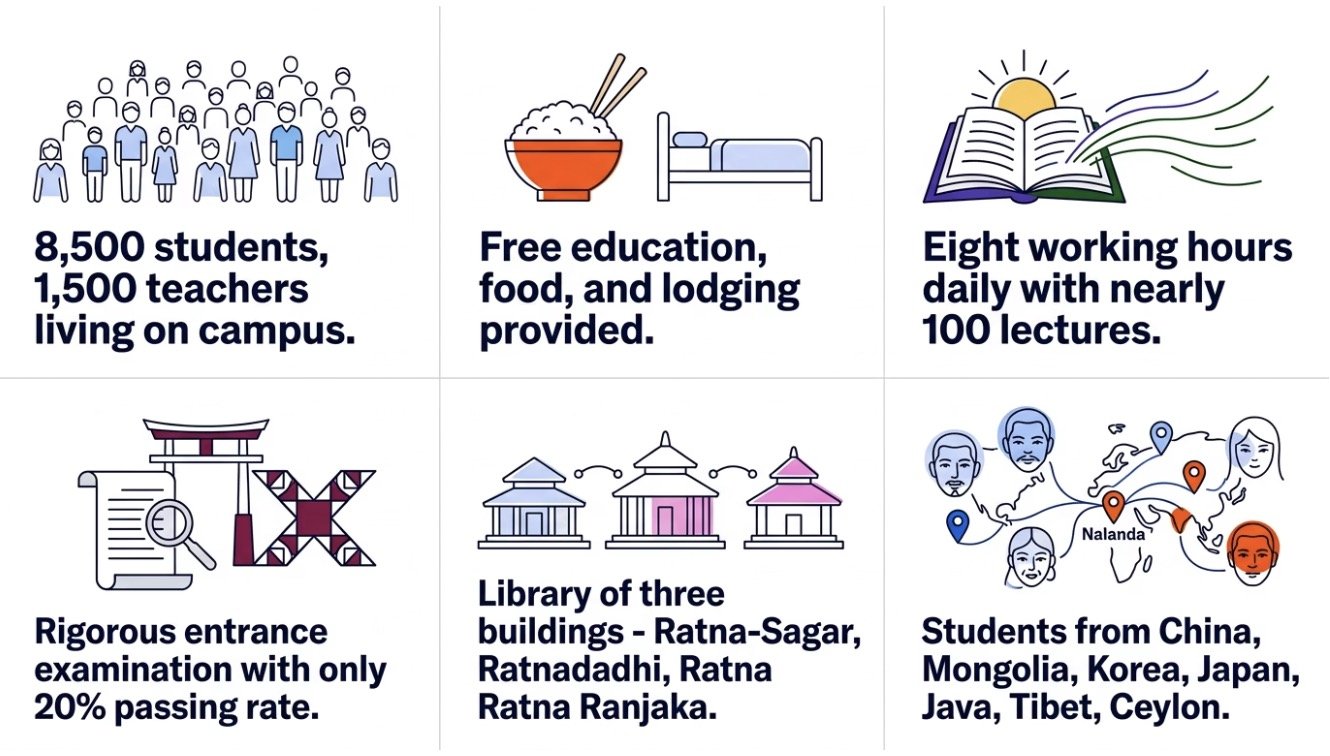
Nalanda was not merely a centre of Buddhist learning — it was an institution of universal higher education. Subjects taught included Hindu and Buddhist literature, logic, grammar, medicine, Sankhya philosophy, and occult sciences. Its famous teachers included Dharmapal (Kulapati during Xuanzang's time), Arya Deva, Chandrakirti, Chandragomin, and others. The university's library comprised three buildings known as Ratna-Sagar, Ratnadadhi, and Ratna Ranjaka. Chinese traveller Yijing notes that by his time, revenues from 200 villages (as opposed to 100 in Xuanzang's day) supported the university. Tragically, this world-renowned institution was destroyed at the end of the 12th century by the Afghan military chief Bakhtiyar Khilji, who set fire to its buildings, burned its library, and killed its monks, teachers, and students.
Harsha's Personality: The Piety of Ashoka and the Valour of Samudragupta?
Few questions in early medieval Indian history have generated as much scholarly discussion as the comparison of Harshavardhana with the two greatest emperors of ancient India — Ashoka and Samudragupta. The historian Dr R.K. Mookerjee declared that as a conqueror, administrator, and patron of his subjects' well-being, Harsha combined in himself the piety of Ashoka and the valour of Samudragupta. This is a bold claim that merits careful examination.
Parallels with Ashoka
Both converted to Buddhism and patronised the faith extensively
Both banned animal slaughter and promoted vegetarianism
Both built stupas, viharas, and rest houses for travellers
Both organised major religious assemblies
Both maintained friendly relations with neighbouring rulers
Both cultivated diplomatic relations with foreign rulers
Both personally toured their empires for administrative oversight
Both were known for extraordinary generosity to all religious orders
Contrasts and Limitations
Harsha remained militarily active throughout his reign; Ashoka renounced war after Kalinga
Ashoka's concept of Dhammavijaya (righteous conquest) is absent in Harsha
Samudragupta achieved military success even in South India; Harsha was checked at the Narmada
Samudragupta's empire lasted 150+ years; Harsha's collapsed immediately after his death
Harsha's victory against Shashanka came only through attrition, not military genius
Dr K.M. Panikkar argues there is "no similarity except of the most superficial kind"
Dr R.C. Majumdar's verdict is the most balanced and widely accepted: while it would be historically inaccurate to claim Harsha as the last great empire-builder of Hindu India — given that subsequent empires like those of the Palas, Pratiharas, Rashtrakutas, and the Chalukyas were more extensive and durable — one cannot withhold admiration for him as a great ruler, a brave military leader, a magnificent patron of arts and letters, and a man of noble impulses and distinguished personality. Harsha remains, in the final analysis, the last in the long line of Hindu rulers who worked earnestly to build and organise a powerful, humane state — even if he lacked the institutional genius to make it endure.
The Aftermath: Collapse of the Empire and Legacy
Harshavardhana died in 647 CE, having ruled for 41 years. His empire, built on his extraordinary personal qualities and diplomatic skill rather than on robust institutional foundations, died with him — disintegrating with remarkable rapidity into a collection of small competing states. The very speed of this collapse is itself a historical verdict on the personal rather than structural nature of his achievement.
Harsha's Death (647 CE)
The emperor dies without a legitimate successor, leaving the throne vulnerable to usurpation.
Usurpation by Arunashwa
Arunashwa, a minister of Harsha, seizes the throne — creating immediate political instability at the centre of the empire.
The Wang Xuance Incident (648 CE)
The Chinese envoy Wang Xuance, sent by Emperor Taizong, finds Harsha dead and is attacked by Arunashwa. He escapes to Tibet, raises a Nepalese-Tibetan army, and defeats the usurper.
Imperial Fragmentation
The Vardhana empire dissolves into small states. The age of great northern Indian empires drawing on Hindu imperial tradition comes to a close for several centuries.
The episode of Wang Xuance is particularly instructive. In 648 CE, the Chinese Emperor Taizong sent Wang Xuance to India in response to Harsha's earlier diplomatic mission. Upon arriving, Wang discovered that Harsha had died and that the new king — Arunashwa, the usurping minister — had attacked Wang and his thirty mounted subordinates. Wang escaped to Tibet, raised a force of Nepalese mounted infantry and Tibetan soldiers, returned, and defeated the Indian state — winning for himself the prestigious title of the "Grand Master for the Closing Court" and securing a Buddhist relic for China. Chinese historical texts tend to overplay Wang's role in ending the Harsha Empire; neither Bana's nor Xuanzang's accounts address this episode at all.
"Harsha was neither the last great empire-builder nor a great emperor of ancient India — but he was, without question, one of the most remarkable rulers of his own times, and his legacy in patronage, culture, and religious catholicity endures long after the political structures he built have crumbled into dust."
The question of whether Harsha was the "last Hindu Emperor" of northern India is itself contested. He was not a follower of Hinduism alone, having given generous patronage to Buddhism and other faiths. And his domain never encompassed all of India. Yet his reign stands as a luminous moment in the early medieval period — a final flourishing of the classical Indian imperial tradition before centuries of fragmentation, followed by the transformative arrival of the Delhi Sultanate. For students of Indian history, Harshavardhana's story offers enduring lessons in the relationship between personal greatness and institutional durability, between cultural achievement and political longevity.
