
Guptas & Indian Feudalism
Foundations of the Indian Feudal Model
The principal theorist of Indian feudalism is Prof. R. S. Sharma, who employs the term to characterise the socio-economic formation of the post-Gupta period. In his framework, feudalism manifests within a predominantly agrarian economy defined by two antagonistic classes: a class of landlords and a class of servile peasantry. The landlords extract surplus not through direct economic compulsion alone but through social, religious, and political mechanisms — what Marxist historiography calls extra-economic coercion. This broadly aligns with the Marxist conception of feudalism, which identifies serfdom, scalar property, and sovereignty as its defining features in the West European context.
The developmental arc of Indian feudalism is traceable to land grants made to Brahmins beginning in the first century AD. These grants were not compensatory payments for civic or military service; rather, they were given in exchange for ritual and spiritual functions. Alongside these spiritual obligations, donees were conferred substantial fiscal and administrative powers — the right to collect revenue, maintain law and order, and levy fines. This combination of religious legitimacy and administrative authority formed the structural backbone of the emerging feudal order.
Land Grants to Brahmins
Initiated in the first century AD, these grants began in peripheral, tribal, and backward territories as a strategy to both generate revenue and cultivate untamed land. They gradually expanded into Madhyadesa, the heartland of Brahmanical civilisation.
Fiscal & Administrative Powers
Donees received not merely usufructuary rights but, from the eighth century onward, full proprietary rights. They could collect taxes, administer justice, and govern their grant villages with minimal state interference.
Transformation of the Sudras
From the Gupta period onward, Sudras — previously regarded as common slaves of the three higher varnas — transitioned into a peasant class. Tribal communities in backward regions were integrated into the Brahmanical system and reclassified as Sudras through the mechanism of land concessions.
The geographic spread of feudal structures was uneven. The practice of forming a landlord class first emerged in Maharashtra around the beginning of the Christian era, later extending northward and eastward. By the time of the Palas, Pratiharas, and Rashtrakutas, land grants had multiplied dramatically in number and undergone a qualitative change in character. The climax of this process came in the 11th and 12th centuries, when northern India fragmented into a mosaic of political and economic divisions, predominantly controlled by secular and religious donees who treated their granted villages as little better than feudal fiefs.
Competing Theoretical Frameworks
The historiography of Indian feudalism is rich with competing interpretations. Two theoretical frameworks have proved particularly influential in shaping scholarly debate: D. D. Kosambi's two-stage model and R. S. Sharma's structural analysis. Both share a commitment to Marxist historical materialism but diverge considerably in their understanding of how feudalism emerged and what forces drove it.
D. D. Kosambi: Two-Stage Feudalism
In his landmark 1956 work An Introduction to the Study of Indian History, Kosambi proposed that Indian feudalism arose through a dual process — simultaneously from above and from below.
Stage One: A primary phase with direct relations between an overlord and tributary or autonomous vassals, without a dominant intermediary class.
Stage Two: A more complex, later phase (4th–17th centuries) in which rural landowners emerged as powerful intermediaries, transforming communal property into feudal property and installing the samantas as feudatories.
This framework generated one of the most enduring debates in Indian historiography, linking feudalism to administrative decentralisation and major social and cultural upheaval across more than a millennium.
R. S. Sharma: Agrarian Decline & Intermediary Class
In Indian Feudalism (1965), Sharma located the origins of the feudal order in the post-Gupta collapse of long-distance trade, which precipitated urban decline and the re-agrarianisation of the economy.
In the absence of a monetised economy, the state began compensating grantees — including Brahmanas — in land rather than coin.
Alongside land, the state progressively transferred control over cultivating peasants to this new intermediary class, reducing peasants to the status of serfs.
The process also stimulated the growth of the scribe caste (later crystallised as Kayasthas), since land grants required documentary recording.
This cycle of feudalisation continued until the 11th century, when the revival of trade reinvigorated urbanisation.
Both Kosambi and Sharma situate the feudal transition within the broad arc of the 4th to 17th centuries, though they assign different weights to political decentralisation, economic contraction, and class formation as causal drivers.
Phases of the Indian Feudal Model
Indian feudalism did not emerge fully formed; it evolved through recognisable phases that can be mapped onto the trajectory of dynastic power and agrarian change across the subcontinent.
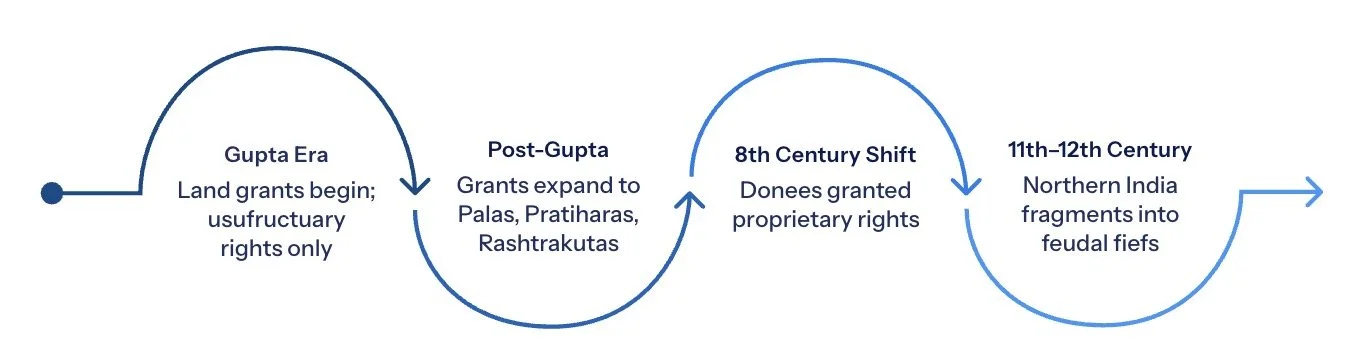
Phases of the Indian Feudal Model
The earliest phase, centred on the Gupta era, saw land endowments to temples and Brahmins begin in earnest. These grants were initially confined to peripheral territories and carried only usufructuary rights — the donee could use the land and draw income from it, but did not own it outright. This arrangement served the dual purpose of generating new revenue from previously uncultivated land and extending Brahmanical cultural influence into tribal and frontier zones.
In the intermediate phase, corresponding to the rise of the Pala, Pratihara, and Rashtrakuta kingdoms, the scale and nature of land grants changed markedly. The number of grants surged, and their geographic spread deepened. Crucially, the eighth century marked a qualitative break: donees began receiving proprietary rights over granted land, not merely the right to its produce. This shift fundamentally altered the relationship between the state, intermediaries, and cultivating peasants, laying the institutional groundwork for a fully articulated feudal order.
Significance of the Indian Feudal Model
Despite the critical scrutiny it has attracted, the Indian feudal model retains considerable explanatory power as a framework for understanding agrarian, administrative, and cultural change during the Gupta and post-Gupta centuries. Its significance operates on several interconnected planes.
Agrarian Expansion
In central India, Orissa, eastern Bengal, and the Deccan, land grants were a primary instrument for bringing virgin and wasteland under cultivation. The era of feudalism was, broadly speaking, an era of significant agrarian growth, as innovative Brahmins introduced improved agricultural techniques into underdeveloped tribal territories.
Administrative Infrastructure
Land grants supplied an administrative framework for maintaining law and order in newly integrated regions. By transferring judicial and fiscal powers to donees, the state extended its reach into areas that would otherwise have remained beyond effective governance.
Cultural Integration
The feudal mechanism was also a vehicle of cultural assimilation. Tribal peoples were Brahmanised through contact with grant-holding priests who introduced writing systems, calendars, literature, and a new hierarchical social order. Religious donees fostered devotion to the established order in both developed and underdeveloped areas.
Military & Political Cohesion
Secular vassals supported their overlords by managing fiefdoms and providing military contingents during conflict. In this respect, the feudal model contributed to a form of political integration, even as it simultaneously produced administrative decentralisation and the fragmentation of sovereign authority.
According to Romila Thapar, the description 'Golden Age' is true in so far as we speak of the upper classes — a reminder that the cultural florescence of the Gupta period was built on a foundation of deepening agrarian inequality.
Criticism of the Feudal Model
The applicability of the feudal model to medieval India has been subjected to rigorous scholarly critique from multiple directions. These objections are both empirical and theoretical, challenging the model's foundational assumptions about peasant subordination, trade decline, and the nature of surplus extraction.
Peasant Agency & Independent Production
Several historians have argued that peasant production in medieval India was largely independent and free. Cultivators retained control over their tools and agricultural procedures, suggesting a degree of autonomy inconsistent with the serfdom model. The social and economic structure was relatively stable, with little dramatic change in agrarian production practices over time.
Nature of Surplus Extraction
Critics contend that disputes in medieval Indian agrarian society were primarily about the distribution and redistribution of surplus, not about control over the means of production. The main instrument of exploitation was state appropriation of agrarian surplus — a pattern closer to the 'tributary mode' than to classical feudalism.
Empirical Challenges to Trade Decline
D. N. Jha criticised R. S. Sharma for over-attributing the genesis of Indian feudalism to the decline of long-distance external trade. Multiple historians have empirically challenged the claim that trade was in significant decline and that there was a generalised coin shortage during the period of Indian feudalism.
The Kaliyuga Evidence Problem
D. N. Jha identified a geographic mismatch in the Kaliyuga evidence used to signal a feudal 'crisis': the textual evidence originated from peninsular India, while the anticipated crisis was located in the Brahmanical north. B. P. Sahu further questioned whether the Kaliyuga trope signalled crisis at all, suggesting it was better understood as a reinterpretation of kingship and a reassertion of Brahmanical ideology rather than evidence of systemic breakdown.
Conclusion: The Legacy of Gupta Agrarianism
The Gupta period stands as a decisive watershed in the agrarian history of the Indian subcontinent. The most striking development of the era was the emergence of priestly landlords — a new class whose power rested on state-sponsored land grants, ritual authority, and the subordination of local peasant communities. The land grant system, originally inaugurated by the Satavahanas, became institutionally entrenched during Gupta rule: Brahmin priests received tax-free land, hereditary ownership rights, and the authority to collect rent and administer justice without state interference.
The social consequences of this transformation were profound and unevenly distributed. In central and western India, peasants were subjected to forced labour. Tribal communities across the subcontinent were integrated into the varna hierarchy through the mechanism of land grants, losing communal autonomy in exchange for a new — if subordinate — place within the Brahmanical order. Many Brahmin beneficiaries became wealthy landlords whose primary relationship with the peasantry was one of extraction and, frequently, oppression.
Scholarly Assessment
The characterisation of the Gupta age as a 'Golden Age' reflects the perspective of the literate, propertied upper classes — those who patronised Sanskrit literature, commissioned temple architecture, and benefited from the redistributive logic of the feudal land grant system. For the vast majority of the population — the cultivating peasantry, the tribal communities, the Sudras — the period was one of increasing subordination and constrained autonomy.
The debate over Indian feudalism remains one of the most generative controversies in South Asian historiography, raising fundamental questions about how we periodise Indian history, how we define exploitation in pre-capitalist economies, and how we assess the relationship between state power, agrarian structure, and cultural transformation.
Key Takeaway
The 'Golden Age' of the Guptas was simultaneously a period of cultural achievement and deepening social stratification — a paradox that any honest appraisal of the era must confront.
Land grants → priestly landlord class
Agrarian expansion at social cost
Feudal model debated, not settled
Peasant subordination alongside cultural florescence
