
Megalithic Cultures of India
The megalithic cultures of South India represent a fascinating chapter in the subcontinent's prehistoric past, marking a transformative period when iron technology revolutionised agriculture, crafts, and social organisation. These cultures, characterised by their distinctive burial monuments constructed from large stones, flourished between 1200 BCE and 100 CE, overlapping with the end of the Neolithic-Chalcolithic period and extending into the Early Historical era. The term 'megalith', derived from the Greek words 'megas' (great) and 'lithos' (stone), refers specifically to monuments built of large stones with sepulchral, commemorative, or ritualistic associations. This foundational phase of peninsular Indian history witnessed the emergence of sedentary agricultural communities, sophisticated craft traditions, and complex social hierarchies that would shape the region's subsequent development.
Understanding the Megalith: Definition and Scope
What Qualifies as a Megalith?
Not all monuments constructed of large stones qualify as megaliths. The term has a restricted usage in archaeological terminology, applying only to structures with specific characteristics. True megaliths are monuments built of large stones that possess sepulchral (grave-like), commemorative, or ritualistic associations, excluding hero stones or simple memorial stones. Most importantly, megaliths typically refer to burials made of large stones in graveyards located away from habitation areas, distinguishing them from domestic or purely architectural structures.
The megalithic tradition in India showcases remarkable diversity in burial practices and monument types, reflecting the complex cultural interactions and regional variations that developed over centuries. These structures serve as windows into the social organisation, religious beliefs, and technological capabilities of prehistoric South Indian communities, providing invaluable insights into a period that bridges prehistory and history.
Chronology: Dating the Megalithic Period
The chronology of megalithic cultures in South India has been established through extensive archaeological investigations, beginning with the pioneering Brahmagiri excavation. Initially, these cultures were placed between the 3rd century BCE and the 1st century CE based on the presence of Black and Red Ware (BRW), a characteristic ceramic type found universally across megalithic sites in South India. However, subsequent research has revealed a much larger chronological span, with significant challenges in establishing precise dates due to the limited availability of radiocarbon dating from megalithic habitation sites.
1200-1000 BCE
Earliest phase in North Karnataka region, with the habitation site at Hallur providing dates around 1000 BCE, correlated with graves at Tadakanahalli
600 BCE
Vidarbha megaliths at Naikund and Takalghat; period of maximum popularity begins
400 BCE
Tamil Nadu sites like Paiyampalli show megalithic occupation
100 CE
Upper limit of megalithic period; overlap with Rouletted Ware of the first millennium CE
The megalithic culture overlapped with the terminal phases of the Neolithic-Chalcolithic culture at the lower end and with Rouletted Ware at the upper end. Based on comprehensive archaeological data, the time bracket for megalithic cultures in South India may be placed between 1000 BCE and 100 CE, with their period of maximum popularity occurring between 600 BCE and 100 CE. This chronological framework positions the megalithic period as a crucial transitional phase in South Indian prehistory.
Origins and Spread: Tracing the Megalithic Migration
The origins of the megalithic culture in India have been the subject of considerable scholarly debate. In the Indian context, the prevailing theory suggests this culture arrived with Dravidian speakers who migrated to South India from West Asia by sea. However, significant differences exist between West Asian and Indian megaliths. The typical West Asian megaliths yielded bronze objects and ended during the last phase of their Bronze Age around 1500 BCE, whereas Indian megaliths belong to the Iron Age, generally dated from 1000 BCE onwards. The precise mechanisms of how iron technology developed and became integral to the megalithic culture remain uncertain, highlighting gaps in our understanding of technological diffusion.
Sea Route
From the Gulf of Oman to the West coast of India, bringing megalithic traditions to coastal regions
Land Route
From Iran through overland passages into northern India
Material and Chronological Differences
The material and chronological differences between northern and southern Indian megalithic cultures suggest the arrival of this culture into the Indian subcontinent occurred via two distinct routes by different groups. The complex pattern of widely different burial practices lumped together under the term 'megaliths' resulted from the mingling of various traditions and developments over an extended period.
Geographic Distribution
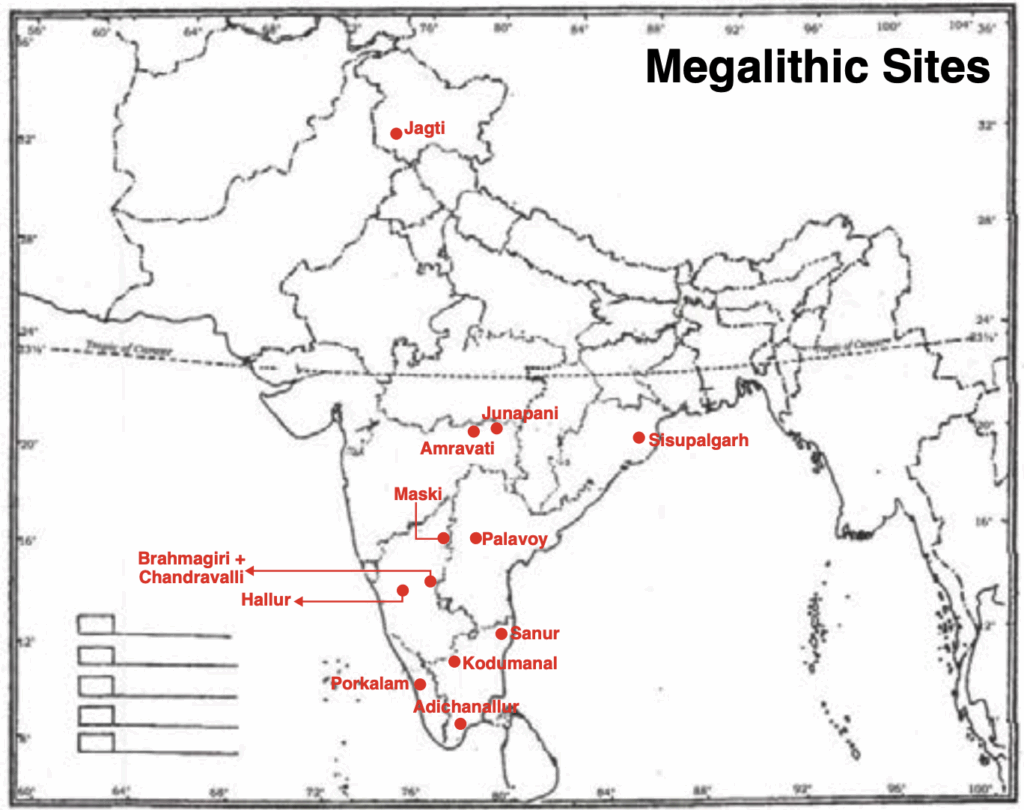
Origins and Spread: Tracing the Megalithic Migration
Megaliths have been found throughout India: from the Punjab plains, the Indo-Gangetic basin, Rajasthan's deserts, northern Gujarat, and especially all regions south of Nagpur in peninsular India. The tradition survives today in north-eastern India and the Nilgiris, demonstrating remarkable cultural continuity.
The main concentration of megalithic cultures was the Deccan, particularly south of the River Godavari. The wide distribution in southern regions suggests it was essentially a South Indian feature that flourished for at least a thousand years, developing distinctive regional characteristics whilst maintaining certain core cultural elements.
Distribution Across the Subcontinent
Southern Heartland
Regions south of River Godavari, especially Karnataka, Tamil Nadu, Kerala, and Andhra Pradesh
Central India
Nagpur, Chanda, and Bhandara districts of Madhya Pradesh
Western India
Deosa near Jaipur in Rajasthan; near Karachi in Pakistan
Northern Sites
Near Leh in the Himalayas; Burzahom in Jammu and Kashmir; Deodhoora in Almora district, Uttar Pradesh
Large-stone structures resembling typical megalith types have been reported from various locations across North, Central, and Western India, including Seraikela in Bihar, Khera near Fatehpur Sikri in Uttar Pradesh, and several sites in Rajasthan. However, the concentration and sophistication of megalithic monuments in southern India, coupled with their continuous development over a millennium, clearly establish this region as the primary centre of megalithic culture. The geographic distribution patterns provide crucial evidence for understanding migration routes, cultural diffusion, and regional adaptations of megalithic traditions across the diverse landscapes of the Indian subcontinent.
Classification of Megalithic Monuments
The megalithic burials of South India exhibit remarkable diversity in disposal methods and architectural styles. Whilst megaliths share certain core characteristics, they differ significantly in external appearance and internal structure. This variety reflects regional preferences, chronological developments, social hierarchies, and the complex evolution of burial practices over centuries. The classification of megaliths presents challenges because monuments can be internally different whilst exhibiting similar external features, or vice versa. Archaeological research has identified eight major categories based on structural characteristics and burial methods, each with multiple sub-types representing local variations and specific cultural preferences.
Rock Cut Caves
Chambers scooped from soft laterite, primarily in Kerala's Cochin and Malabar regions
Hood & Cap Stones
Dome-shaped dressed laterite blocks covering underground circular pits with stairways
Menhirs & Alignments
Monolithic pillars planted vertically, sometimes in parallel rows
Dolmenoid Cists
Box-like graves with orthostats supporting capstones
Cairn Circles
Stone rubble heaps enclosed within boulder circles
Stone Circles
Most common monuments, marking various burial types
Pit Burials
Underground burials without surface megalithic markers
Barrows
Earthen mounds marking underground burials
Each category represents sophisticated architectural planning and considerable labour investment. The diversity of monument types within relatively small geographical areas suggests coexisting communities with distinct cultural traditions, or perhaps the same communities employing different burial structures based on the social status, age, gender, or ritual requirements of the deceased. Understanding this classification system is essential for interpreting the social complexity and cultural richness of megalithic societies.
Rock Cut Caves and Hood Stones
Rock Cut Caves
Rock cut caves represent one of the most architecturally sophisticated megalithic monument types, found primarily in the laterite-rich southern West Coast regions of Kerala, particularly in the Cochin and Malabar areas. These burial chambers were carved out of soft laterite rock formations, demonstrating advanced stone-working capabilities. The Mamallapuram site on the East Coast also features rock cut burial caves.
These tombs typically contain three chambers and are classified into four distinct types: caves with central pillars, caves without central pillars, caves with deep openings, and multi-chambered caves. The architectural sophistication and labour investment required for excavating these chambers suggest they served elite members of society.
Hood Stones (Kudaikallu)
Allied with rock cut caves but simpler in form, hood stones consist of dome-shaped dressed laterite blocks covering underground circular pits cut into natural rock. These structures feature stairways providing access to the burial chamber, demonstrating careful planning and construction.
Cap Stones (Toppikkals)
A variation where the hood stone is replaced by a cap stone—a plano-convex slab resting on three or four quadrilateral boulders. Unlike rock cut caves with separate chambers, cap stones cover open pits containing burial urns with funerary goods. The burial urn is typically covered with a convex or dome-shaped pottery lid or stone slab, containing skeletal remains, small pots, and sometimes ashes.
These monuments commonly occur in the Cochin and Malabar regions, extending along the Western Ghats into the Coimbatore region and up to the Noyyal river valley in Tamil Nadu. Their concentration in laterite-rich areas demonstrates how megalithic communities adapted their burial practices to available geological resources, showcasing remarkable ingenuity in stone-working techniques.
Menhirs, Alignments, and Dolmenoid Cists
Menhirs: Commemorative Pillars
Menhirs are monolithic pillars planted vertically into the ground, ranging from small markers to gigantic monuments. These commemorative stone pillars, mentioned in ancient Tamil literature as nadukal and often called Pandukkal or Pandil, were set up at or near burial spots. Some menhirs rest on the original ground surface, propped up with rubble masses, as seen at Maski. They occur in large numbers in Kerala and in Bellary, Raichur, and Gulbarga regions of Karnataka, and less frequently at other South Indian sites. Mizoram's Kawtchhuah Ropui features 171 menhirs, whilst similar monuments are found in Meghalaya, Nagaland, Manipur, and Andhra Pradesh.
Menhirs
Single standing stones, dressed or undressed, planted vertically as commemorative markers
Alignments
Series of standing stones in rows, sometimes dressed, found at Komalaparathala in Kerala and multiple Karnataka districts
Avenues
Two or more parallel rows of alignments creating pathways, representing organised spatial planning
Dolmenoid Cists
Dolmenoid cists consist of square or rectangular box-like graves built with several orthostats (upright stones or slabs), supporting superincumbent capstones. The orthostats and capstones might be undressed rough blocks or partly dressed stones, with floors often paved with stone slabs. These structures occur in large numbers at Sanur near Chingleput, Tamil Nadu, and many other regional sites.
Tamil Nadu features numerous dolmenoid cist sub-types: structures with multiple orthostats, four orthostats with U-shaped port-holes in the east or west, port-holes on the top corner of eastern orthostats, and variants with slab-circles. The famous Marayur dolmens in Kerala, located in an area also renowned for ancient rock paintings, exemplify the sophistication of these monuments. Slab cists, built of dressed slabs, represent the normal cist type occurring throughout South India and some northern parts, demonstrating the widespread adoption of this burial tradition.
Cairn Circles and Stone Circles
Cairn circles represent one of the most popular megalithic monument types, occurring throughout South India in association with other monument forms. These structures consist of a heap of stone rubble enclosed within a circle of boulders, marking various types of underground burials. The versatility and widespread distribution of cairn circles suggest they served diverse social groups and adapted to multiple burial practices. The excavations at Veeranam in Tiruvannamalai district and Sithannavasal in Pudukkottai district have revealed extensive cairn circle burial grounds dating from 1000 BCE to 300 CE, demonstrating the longevity of this tradition.
Pit Burials Under Cairn Circles
Deep pits dug into soil, roughly circular, square, or oblong in plan, containing skeletal remains and grave furniture on the floor. After placement of burial goods, pits were filled with earth, topped with a cairn heap (sometimes just a thin layer, other times rising 3-4 feet above ground), and bounded by a stone circle. These structures have been found at sites in Chingleput, Tamil Nadu, and Chitradurg and Gulbarga districts of Karnataka.
Sarcophagus Burials
More widespread than simple pit burials, these contain oblong terracotta coffins (legged coffins) holding skeletal remains and grave goods. The sarcophagus typically features a convex terracotta lid, rows of legs at the bottom, and often a capstone at a higher level. Found in South Arcot, Chingleput, North Arcot districts of Tamil Nadu, and Kolar district of Karnataka. The Pallavaram site in Kancheepuram district has yielded well-preserved examples.
Urn Burials Under Cairn Circles
A variant of sarcophagi burials occurring in large numbers across most of South India. Urns containing burials are deposited in pits dug into soil, with pits filled to ground level and frequently provided with capstones. The cairn heap on the surface, marking the burial, is surrounded by a stone circle. Predominant in Kerala, and various districts of Tamil Nadu (Madurai, Tiruchirapalli, Coimbatore, Nilgiris, Salem, Chingleput, South Arcot), Karnataka (Kolar, Bangalore, Hassan, Chitradurg, Bellary, Raichur, Gulbarga), Andhra Pradesh, and the Nagpur region. The Adichanallur site's burial urns, resembling those from Malwa in Madhya Pradesh, suggest extensive inter-regional trade contacts.
Stone Circles
Stone circles represent the most commonly encountered megalithic monuments in India, occurring from the peninsula's southern tip to the Nagpur region and various parts of North India. They reflect features of diverse megalithic forms including Kudaikallu, Toppikkal, pit burials, menhirs, dolmenoid cists, and cairns. The classification focuses on stone circles without considerable cairn filling, containing burial pits with or without urns or sarcophagi. These versatile monuments demonstrate the fundamental role of stone circles as markers in the megalithic burial tradition, serving as recognisable surface indicators for underground burial chambers across varied geographic and cultural contexts.
Pit Burials, Barrows, and Grave Goods
Pit Burials Without Megalithic Appendages
Certain burials in pyriform or fusiform urns—large conical jars containing funerary deposits—are buried in underground pits specially dug into hard natural soil or basal rock, with no surface indication of the burial. These lack stone circles, cairn heaps, hood stones, cap stones, or menhirs. Whilst not strictly megalithic monuments due to the absence of large stones, they exhibit general traits of megalithic culture, particularly the use of Black-and-Red Ware (BRW) and iron objects.
The grave goods found in these pit burials are identical to those in regular megalithic burials, and they occur in areas where typical megalithic burials exist. These urn burials differ from urn burials under stone or cairn circles only in surface features. Found at numerous Tamil Nadu sites including Adichanallur and Gopalasamiparambu, they occur less abundantly in Karnataka and Andhra regions. The Adichanallur excavations revealed urns containing skeletons covered with another urn in a twin-pot system, demonstrating the care accorded to the dead.
Pottery
Large variety including Black-and-Red Ware, burnished black ware, red ware, micaceous red ware, grey ware, and Russet Coated Painted Ware
Weapons & Tools
Mostly iron implements including arrowheads, spearheads, swords, knives, axes, chisels, adzes, sickles, hoes, and ploughshares
Ornaments
Beads of terracotta, semi-precious stones, gold, copper, and shell strung into necklaces; ear and nose ornaments; armlets, bracelets, and diadems
Food Items
Paddy husk and chaff, other cereals, and skeletal remains of animals, sometimes complete specimens
Barrows: Earthen Burial Mounds
Barrows, or earthen mounds marking underground burials, may be circular or oblong in plan, configured as circular barrows or long barrows. They may or may not have surrounding stone circles or ditches. These monuments have not been found in large numbers in India, though they have been observed in Hassan district of Karnataka. The relative rarity of barrows compared to stone monuments may reflect regional geological availability or cultural preferences for more permanent stone markers over earthen constructions, which are more susceptible to erosion and agricultural disturbance over millennia.
Economic Life: Agriculture and Pastoralism
Megalithic sites, initially understood as settlements of nomadic pastoralists, provide clear evidence that early Iron Age communities in the far south lived on a combination of agriculture, hunting, fishing, and animal husbandry, alongside well-developed craft traditions. These features, combined with the megalithic monuments themselves, strongly suggest sedentary living patterns. The economic foundation of megalithic society rested primarily on advanced agricultural methods supported by sophisticated irrigation systems, representing a revolutionary transformation in South Indian subsistence patterns.
Tank Irrigation
Megalith builders introduced tank-irrigation systems, bringing revolutionary changes to agricultural productivity in South India
Rice Cultivation
Rice served as the staple food, with paddy husks and grains found at numerous sites; charred ragi grains also discovered
Agricultural Implements
Iron ploughshares, hoes, sickles, spades, axes; pestles and grinding stones for processing grains
Crop Diversity
Cereals, millets, pulses including horse gram, green gram, and possibly ragi; regional variations in crops grown
Strategic Site Selection
The location of megalithic sites close to irrigation tanks (mostly rain-fed, some fed by streams) was purposeful rather than coincidental. These intelligent communities reserved fertile arable lands for agriculture whilst using unproductive foot-hills, rocky, and gravelly lands for burial grounds. However, they occasionally located massive empty dolmens in the midst of fields, as at Uttaramerur in Tamil Nadu, believing ancestral spirits would guard and bestow prosperity on their crops.
Pastoralism and Animal Husbandry
Frequent occurrence of animal bones—both wild and domesticated species—indicates sophisticated animal husbandry. Domesticated animals included cattle, sheep, goat, dog, pig, horse, buffalo, fowl, and ass. Cattle (including buffalo) were most important, indicating continuation of earlier Neolithic cattle-keeping traditions. Evidence suggests cattle pastoralism, not sheep/goat pastoralism, formed a major economic activity. Domesticated pig and fowl remains suggest small-scale pig rearing and poultry farming.
Hunting, Fishing, and Craft Industries
Hunting Practices
Hunting augmented food supplies, evidenced by arrowheads, spears, and javelins. Slings, attested by large-scale findings of stone balls, were another hunting tool. Wild fauna remains include wild boar, hyena, barking deer, sambar, chital, nilgai, peacock, leopard, tiger, cheetah, sloth bear, wild hog, pea fowl, jungle fowl, and water fowl. Rock paintings at Marayur and Attala in Kerala depict hunting scenes, whilst Hire Benkal in Karnataka shows hunting scenes with peahens, peacocks, stags, antelopes, and dancing groups.
Fishing Activities
Evidence includes terracotta net sinkers from Takalghat, fish-hooks from Khapa and Tangal, and actual fish skeletal remains from Yelleshwaram. Fish-hooks have been found in several Tamil Nadu megalithic graves, confirming fishing as an established subsistence activity supplementing agriculture and pastoralism.
Technology: Industries and Crafts
Megalithic sites provide evidence of well-developed specialised craft traditions, with industrial activities including smithery, carpentry, pottery making, lapidary work, basketry, and stone cutting forming crucial economic activities. The sophistication and diversity of craft production indicate a society with specialised labour divisions and advanced technological knowledge.
Metalworking and Smelting
Archaeological evidence includes crucibles, smelting furnaces, clay tuyeres, iron ore pieces, iron slag, copper slag, and traces of ancient copper and gold mines near sites. Local iron smelting at Paiyampalli demonstrates indigenous technological capability. Efficient metal utilisation depended on fuel availability; charcoal, wood, dung, and paddy husk served as common fuels. Iron objects vastly outnumber other metals—utensils, weapons (arrowheads, spearheads, swords, knives), carpentry tools (axes, chisels, adzes), and agricultural implements (sickles, hoes, coulters).
Ceramics and Pottery
Ceramic fabrics include Black-and-Red Ware (BRW), burnished black ware, red ware, micaceous red ware, grey ware, and Russet Coated Painted Ware (RCPW). BRW, wheel-turned pottery, comprises utilitarian shapes serving as tableware. Prominent shapes include bowls, dishes, lids, vases, basins, legged jars, and channel-spouted vessels. Evidence of pottery kilns at sites like Polakonda and Beltada Banahalli indicates professional potter classes.
Bead Making and Lapidary
Evidence of bead-making industry at Mahurjhari and Kodumanal demonstrates sophisticated lapidary skills. Materials included agate, carnelian, chalcedony, feldspar, coral, crystal, garnet, jasper, tremolite, magnesite, faience, paste, quartz, serpentine, shell, steatite, amethyst, and terracotta. Shapes also worked in precious metals (gold), shell, horn, bone, and glass. Etched carnelian beads found in graves indicate advanced decorative techniques.
Woodcraft and Carpentry
Tool-kit included axes, chisels, wedges, adzes, anvils, borers, and hammer stones. Archaeo-botanical evidence shows knowledge of Acacia, Pinus, Brassica, Stellaria, Teak, and Satinwood. Wooden ploughs used for cultivation; timber constructions for domestic buildings evidenced by postholes at Brahmagiri and Maski. Advanced wooden architecture involved dressing wood and creating different mortice hole types for interlocking or tenons.
Trade Networks and Social Organisation
Trade and Exchange Networks
Several megalithic sites functioned as centres of craft production linked to extensive exchange networks, suggested by their location on trade routes of the early historical period. Excavations have yielded various non-local items among grave goods, reflecting active exchange activities during the megalithic period. Carnelian beads from coastal sites, which were ancient exchange points, indicate circulation of non-local goods through sophisticated trade systems. Bronze availability suggests importation of copper and alloying materials (tin or arsenic) from distant sources. Graeco-Roman writings and Tamil texts confirm that maritime exchange became a major procurement source by slightly later periods.
Archaeological Evidence
Rouletted ware, amphorae, and other ceramic materials found at sites like Arikamedu provide evidence of inter-regional and intra-regional exchange, well established by the 3rd century BCE. Regional variation in commodity production and non-availability of local raw materials/finished goods necessitated long-distance transactions initiated by traders from the Gangetic region and overseas world.
Expanding Networks
The exchange network, initially incipient during the early Iron Age, expanded over centuries through internal dynamics and external impetus involving demand for goods in other subcontinent parts and the Mediterranean region. This created a network across land and seas with long-distance traders intermediating between unevenly developed peoples. Hunter-gatherers and shifting cultivators of the Iron Age actively participated in these exchange systems.
Social Organisation and Settlement Patterns
Variations in burial types' external and internal features reflect that Iron Age megalithic society was not homogeneous. Relatively huge burial types suggest status differentiation and ranking of buried individuals. Differences in types and contents indicate disparity in buried individuals' attributes. Multi-chambered rock-cut tombs, limited in number and containing rare bronze or gold artefacts, contrast sharply with simple urn burials containing few artefacts, indicating clear social stratification.
Elite Chiefs
Warriors & Craftsmen
Agricultural Communities
General Population
Individual treatment at death bears predictable relationships to life status and societal organisation. Megalithic people lived in villages with sizeable populations, evidenced by organised mass labour available for transporting and housing massive stone blocks in cist, dolmen, and other megalith construction, and for erecting large rubble and earthen mounds across water courses for irrigation storage. Extensive burial grounds with numerous graves, occasionally containing remains of 20 or more individuals, further attest to large population sizes. Houses consisted of huts with thatched or reed roofs supported on wooden posts, indicated by postholes at excavated sites.
Religious Beliefs, Polity, and Legacy
Cult of the Dead
Elaborate grave architecture and grave goods indicate great veneration for the dead. Megalithic people believed in afterlife, providing deceased with necessities for the other world. Grave goods represented living's affection and respect for dead, reflecting strong hold of the 'cult of the dead' on these communities.
Animism
Belief in animism reflected through animistic cults evidenced by animal bones (domestic cattle, sheep, goats, and wild wolves) in megaliths. Animals killed for funeral feasts with remains buried in graves, or sacrificed to supply food for dead. Terracotta animal figurines decorated with garlands and ornaments also attest animistic beliefs.
Sangam Literature Evidence
Contemporary Sangam literature reflects religious practices prevalent among megalithic people. Tradition of associating stone with dead survived till late times. Hero stones (Virakal or Mastikal) exemplify this continuity, connecting megalithic traditions to later South Indian cultural practices.
Political Organisation
Monument size differences and grave valuable variations reflecting status and ranking suggest contemporary political power nature. Huge monument construction involving substantial collective labour mobilisation implies buried individuals' power to command it. Given contemporary tribal descent groups, chiefly power (chiefdoms) likely prevailed. Sangam texts refer to tribal chiefs as perumakan (great son), commanding entire personal, material, and cultural resources of clans.
Tribal power distribution patterns were simple without hierarchy, though chiefs, heirs, and warriors held privileged status. However, this differentiation was too flexible to constitute stratification. No plausible evidence shows class-structured society existence anywhere in South India even by mid-first millennium CE (megaliths' upper date). Therefore, tribal descent groups as stratified society with aristocrats seems inconceivable. The period of these huge monuments hardly crosses last two or three centuries before Christ, witnessing numerous small chiefdoms coexisting and contesting, anticipating big chiefdoms' emergence by the Christian era.
Small Chiefdoms
Multiple small chiefdoms coexisting and competing for resources and prestige
Armed Conflicts
Inter-clan and intra-clan raids led by chiefs for predatory control
Subjugation & Consolidation
Successful chiefs subjugating others, leading to larger chiefdom formations
Big Chiefdoms Emerge
Evolution of more powerful chiefdoms by Sangam period
Legacy of Megalithic Culture
Megalithism remains alive amongst different Indian tribes: Maria Gonds of Bastar in Madhya Pradesh, Bondos and Gadabas of Orissa, Oraons and Mundas of Chotanagpur region in Jharkhand, and Khasis and Nagas of Assam. Their memorial monuments include dolmens, stone-circles, and menhirs. North-east Indian megalithic culture appears to have South-east Asian affiliation rather than western influence. In South Indian context, Todas of Nilgiris' megalithism remnants significantly help understand probable customs of now-extinct South Indian megalithic builders. Toda burial practices include many megalithic burial common features with grave goods including food items and stone circle use to mark burial places, demonstrating remarkable cultural continuity across millennia.
Significance and Scholarly Challenges
Megalithic Culture as Foundational Phase
Megalithic culture represents a foundational phase of peninsular India's history through multiple transformative developments. It marked the beginning of sedentary life based on combined agriculture, hunting, fishing, and animal husbandry with evidence of craft traditions suggesting permanent settlements. The widespread use of iron revolutionised tool-making, weaponry, and agricultural implements, fundamentally transforming economic life. Well-developed specialised craft traditions including diverse pottery types, bead making, and sophisticated metallurgy emerged during this period.
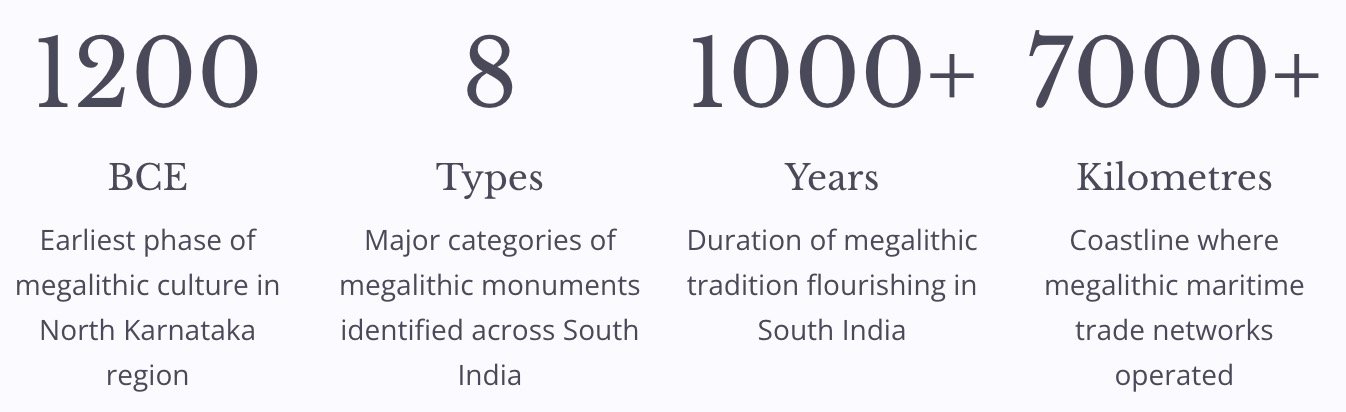
Megalithic Culture in India
Development of sophisticated metallurgy with various techniques including casting in moulds, hammering, and metal alloying demonstrated advanced technological capabilities. Beginning of inter-regional and intra-regional trade networks suggested by non-local items and strategic settlement locations on later trade routes. Rock paintings at megalithic sites depicting fighting scenes, cattle raids, hunting scenes, dancing groups, horse raiders, flora, birds, and sun motifs showcase artistic traditions. Community work evidenced by monument construction must have involved community endeavour, with these monuments serving as ritual sites forming important parts of social and cultural lives.
Limitations of Sources
Major challenges in studying megalithic culture stem from source availability forms. Firstly, nearly all evidence comes from burials, necessarily limiting knowledge about everyday life conditions and methods to evidence supplied by grave furniture and inferences drawn from grave architecture observations. Literary evidences including Graeco-Roman writers' accounts and ancient Tamil texts (Sangam literature) have inherent limitations as their period marks megalithic culture's end phase. Vertical digging in habitation site excavations aimed at unfolding cultural sequences provides scanty and limited evidence.
Critical Research Gap: Lack of settlement remains associated with burials represents a frequently raised issue in peninsular Indian megaliths context. Due to habitation sites' absence in regions like Kerala, settlement pattern analysis has become extremely difficult. Settlement sites could have provided variety of evidence additional to stratigraphic data for separating various culture strands' periods, thus making megalithic people's cultural history reconstruction more illusive. Some scholars have even questioned megaliths' authenticity as burials.
Despite these limitations, megalithic cultures provide invaluable insights into a crucial transitional period in South Indian prehistory. The practice of making megaliths continues among certain tribal communities of India, demonstrating remarkable cultural continuity. Understanding megalithic cultures remains essential for comprehending the evolution of social complexity, technological advancement, and cultural development in peninsular India, forming the foundation for subsequent historical periods including the Sangam age and early South Indian kingdoms. Future archaeological research, incorporating advanced scientific dating techniques and comprehensive settlement excavations, promises to address current knowledge gaps and deepen our understanding of these fascinating prehistoric communities that shaped South India's cultural trajectory.
