
The Vedic Period: Part 1
The Vedic Period: Origins and Early Settlements in Ancient India
The Vedic Period marks a transformative era in Indian history, spanning approximately 1500 BCE to 500 BCE. This epoch witnessed the arrival, settlement and expansion of the Indo-Aryan peoples across the Indian subcontinent, fundamentally shaping the cultural, social, religious and political landscape that would define ancient India. The term "Arya," appearing 36 times in the Rig Veda, represented not a racial classification but a cultural and linguistic community—kinsmen bound by shared language, traditions and worldview. Their journey from the northwestern frontiers to the fertile Gangetic plains represents one of history's most significant migrations, leaving an indelible mark on the civilisational fabric of South Asia.
We need comprehensive analysis to explores the multifaceted dimensions of Vedic civilisation—from the contentious debates surrounding Aryan origins to the sophisticated political structures that emerged, from pastoral economies to settled agriculture, and from simple nature worship to complex philosophical thought. Understanding the Vedic Period is essential for UPSC aspirants, as it forms the foundation for comprehending India's ancient heritage and the evolution of its distinctive social and religious institutions.
The Aryan Question: Linguistic Evidence and Origins
Understanding the Term "Arya"
The composers of the Rig Veda identified themselves as "arya," a term best understood as denoting a cultural or ethnic community rather than a racial category. Etymologically, it may derive from "ar" (to cultivate) or simply mean kinsman or companion. This self-identification appears throughout Vedic literature, representing a shared cultural consciousness among these early peoples.
During the 19th and early 20th centuries, colonial-era scholars misappropriated this term to construct racial hierarchies that justified European imperialism. Figures like Penka concluded that Germany was the Aryan homeland based on flawed racial theories. Today, anthropologists have abandoned such racial classifications entirely, recognising them as pseudoscientific constructs designed to legitimise subjugation.
Linguistic Classification
Indo-European language family includes Sanskrit, Latin, Greek, Persian and Germanic languages
Cultural Identity
Arya denotes linguistic and cultural community, not race or ethnicity
Sir William Jones's groundbreaking 1786 discovery revealed striking similarities between Sanskrit and European languages, establishing the Indo-European language family. Words like Sanskrit "matri" and "pitri" mirror Latin "mater" and "pater," demonstrating common linguistic ancestry. As Max Müller emphatically stated, "Aryan" scientifically refers to language, not race—a distinction crucial for accurate historical understanding.
The Original Homeland: Competing Theories
European Homeland Theory
Many scholars argued that the concentration of Indo-European languages in Europe, stretching eastward to Punjab, suggested a European origin. The linguistic distribution pattern and vocabulary similarities led theorists to propose various European homelands. However, this view was often influenced by colonial-era biases rather than objective archaeological evidence.
Indigenous Origin Theory
Some Indian scholars contended that Sapta-Sindhu (land of seven rivers) was the original homeland. They pointed to the absence of any Rigvedic references to migration from external lands, the largest concentration of Aryan vocabulary in Sanskrit, and the highly developed nature of Vedic literature. However, this perspective struggles to explain the widespread distribution of related languages across Eurasia.
Central Asian Steppe Theory
The most widely accepted view today locates the original homeland somewhere in the steppes stretching from southern Russia to Central Asia. Common words for animals (goats, dogs, horses) and plants (pine, maple) across Indo-European languages indicate Eurasian fauna and flora. This theory is supported by archaeological evidence of horse domestication and chariot technology spreading from this region.
Iran-India Connection: The Indo-Iranian Link
Linguistic and Cultural Parallels
The Rig Veda shares remarkable similarities with the Avesta, the oldest Iranian text. Both texts employ identical names for several deities and social classes, indicating a period of common Indo-Iranian culture before divergence. The linguistic evidence is compelling—words like "Indra" (Vedic) corresponds to "Inar" (Hittite), whilst "Surya" and "Marut" have equivalents in Kassite inscriptions from Mesopotamia as "Suryyas" and "Maruttash."
2200 BCE
Earliest Indo-European language specimen found in Iraqi inscriptions
1900-1700 BCE
Hittite inscriptions in Anatolia (Turkey) showing Indo-European linguistic features
1600 BCE
Aryan names appear in Kassite inscriptions from Iraq
1400 BCE
Mitanni inscriptions from Syria reference Vedic deities
1500 BCE
Rigvedic people appear in Indian subcontinent
These inscriptional evidences trace a pathway of Indo-Aryan movement from West Asia towards the Indian subcontinent, supporting the migration theory whilst demonstrating the chronological spread of Indo-European speaking peoples across vast geographical expanses.
The Aryan "Invasion" Debate: Examining the Evidence
Evidence Supporting Migration
The Aryan migration theory rests on several pillars of evidence. Linguistically, the striking similarities between Rigveda and Avesta cannot be dismissed. Archaeological discoveries include socketed axes, bronze dirks and swords in northwestern India, along with Painted Grey Ware pottery (900-500 BCE) repeatedly connected with Aryan craftsmanship. The presence of horse remains and evidence of horse sacrifice in southern Tajikistan and Pakistan's Swat valley provide material correlates to Vedic descriptions of horse-centric culture.
Linguistic Similarities
Common vocabulary and grammatical structures between Sanskrit, Avestan and other Indo-European languages indicate shared origins and subsequent divergence during migration.
Archaeological Artefacts
Bronze weapons, horse equipment and distinctive pottery styles provide material evidence, though connections remain debatable and not definitive.
Literary References
Rigvedic hymns invoke Indra to destroy fort-dwellers, suggesting conflicts with settled populations, though these may represent inter-Aryan rather than Aryan-Harappan conflicts.
Challenging the Invasion Narrative
Modern scholarship strongly rejects the "invasion" model in favour of gradual migration. Linguistic similarities do not necessarily imply large-scale population movements. The occasional similarities between chalcolithic artefacts of India and Western Asia are insufficient to support massive migration. Crucially, archaeological evidence demonstrates that Harappan civilisation's decline resulted from internal factors—environmental changes, declining trade, urban abandonment—rather than violent conquest. The Rigvedic references to destroying forts may describe inter-tribal warfare among Aryan groups themselves.
The concept of "Aryan" lacks ethnic or racial significance; it remains fundamentally a linguistic classification. Painted Grey Ware's distribution pattern—concentrated in Haryana, upper Ganga basin and eastern Rajasthan rather than along supposed migration routes—contradicts the invasion theory. Recent excavations at Bhagwanpura, Dadheri and Manda reveal Late Harappan and Painted Grey Ware coexisting without cultural breaks, suggesting continuity rather than replacement. What disappeared after 1750 BCE were urban characteristics—towns, cities, seals, standardised weights—whilst rural structures persisted, indicating cultural evolution rather than civilisational destruction.
Early Aryan Settlements: The Land of Seven Rivers
Geographical Horizon of Rigveda
The earliest Aryans settled in eastern Afghanistan, Punjab and western Uttar Pradesh's fringes. Rigvedic hymns reference western Indus tributaries—the Gomati (Gomal), Krumu (Kurram) and Kubha (Kabul). The Suvastu (Swat), meaning "fair dwellings," suggests significant Aryan presence in the Swat valley. However, the cultural epicentre remained the Punjab-Delhi region.
The Sacred Rivers
The Sindhu (Indus) is repeatedly extolled as the paramount river. Other frequently mentioned waterways include the Saraswati (Ghaggar-Hakra channel), Drishadvati (Ghaggar), and Punjab's five streams: Shutudri (Sutlej), Vipas (Beas), Parushni (Ravi), Asikni (Chenab) and Vitasta (Jhelum). These seven rivers gave the region its name: Sapta-Sindhu.
Geographical Knowledge Limits
Early Aryan geographical knowledge extended only to the Yamuna, marking the eastern boundary of their initial settlement. This northwestern focus, covering present-day Afghanistan, Pakistan and northwestern India up to the Yamuna, defined the Rigvedic cultural landscape before subsequent eastward expansion.
Sindhu (Indus)
The supreme river of Rigvedic Aryans
Saraswati
Ghaggar-Hakra channel, sacred river
Shutudri (Sutlej)
One of five Punjab rivers
Vipas (Beas)
Punjab's second major tributary
Parushni (Ravi)
Site of the Battle of Ten Kings
Tribal Conflicts and the Battle of Ten Kings
Rigvedic Aryans engaged in two distinct types of conflicts: struggles with indigenous non-Aryan populations and internecine warfare amongst themselves. Their military superiority derived from technological advantages—horse-driven chariots, superior weaponry including coats of mail (varman), and organised military tactics. Indra's epithet "Purandara" (breaker of forts) suggests conflicts with fortified settlements, though archaeological identification of these structures remains elusive.
Conflicts with Indigenous Inhabitants
The Panis
Wealthy cattle-owners who refused Vedic patronage and rituals, frequently mentioned as adversaries who concealed their cattle wealth in mountains and forests. The term later became associated with merchants.
The Dasas
Mentioned in ancient Iranian literature as Dahaes, suggesting they were an early Aryan branch. The chief Divodasa, who defeated the non-Aryan Sambara, carries "dasa" in his name, indicating complex Aryan-Dasa relationships.
The Dasyus
Described as dark-skinned, full-lipped, snub-nosed phallus-worshippers speaking hostile languages. The term "dasyu-hatya" (slaughter of dasyus) appears repeatedly, indicating intense hostility. Possibly represented indigenous populations with cultural practices diverging from Vedic norms.
The Epic Battle of Ten Kings
The most significant inter-Aryan conflict occurred on the River Parushni (Ravi), known as the Dasarajna—Battle of Ten Kings. King Sudas of the Bharata tribe faced a confederacy of ten kings: five Aryan tribal chiefs and five non-Aryan leaders. The conflict originated when Sudas dismissed his priest Vishvamitra (who had led him to victories on the Vipas and Shutudri) in favour of Vasishtha, who possessed superior priestly knowledge. The slighted Vishvamitra formed the ten-king alliance against Sudas.
Sudas's victory established Bharata supremacy. Subsequently, the Bharatas merged with the defeated Purus, forming the Kuru tribe. The Kurus then allied with the Panchalas, establishing dominance in the upper Gangetic basin—a political formation that would shape Later Vedic civilisation and eventually culminate in the Mahabharata's fratricidal conflict.
Eastward Expansion: The Later Vedic Period (1000-500 BCE)
Initial Base: Punjab-Haryana
Bharata-Puru fusion created Kuru people between Saraswati and Drishadvati rivers, establishing Hastinapur as capital.
Kuru-Panchala Dominance
Kurus occupied Delhi and upper Ganga-Yamuna Doab; alliance with Panchalas extended control across middle Doab.
Eastern Advance: 600 BCE
Vedic people spread to Koshala (eastern UP) and Videha (north Bihar), encountering black-and-red ware users.
The Mahabharata Conflict
Around 950 BCE, the catastrophic fratricidal war between Kauravas and Pandavas—both Kuru clan members—decimated the tribe. Hastinapur excavations (900-500 BCE) reveal settlements and nascent urbanism, though archaeological evidence doesn't match the epic's glorified descriptions, which were composed much later (circa 400 CE) when material culture had significantly advanced.
Expansion Mechanisms
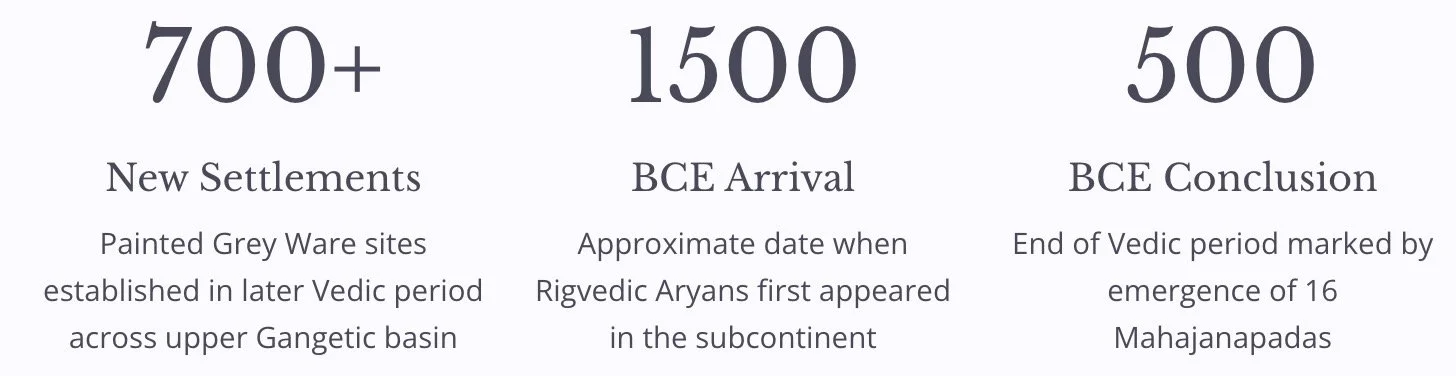
The Shatapatha Brahmana recounts how Agni moved eastward, burning the earth until reaching the Sadanira (Gandak) river. Chieftain Videha Mathava caused the fire god to cross this boundary, Aryanising Videha. This legend describes systematic land clearance through burning, supplemented by iron axes for forest cutting—enabling warrior-peasant migration and new settlement founding.
Archaeological evidence from Atranjikhera and Jakhera in western Uttar Pradesh shows iron (shyama ayas—dark metal) appearing during this period. However, iron agricultural tools remain fewer than weapons, leading some scholars to question iron technology's role in facilitating land clearance. Nevertheless, the combination of fire-clearing and selective iron tool use enabled the transformation of forested Gangetic plains into cultivable land, supporting the Aryan demographic and territorial expansion that characterised the Later Vedic period.
Eastward Expansion: The Later Vedic Period
Political Organisation in Early Vedic Society
Early Vedic political organisation was fundamentally tribal rather than territorial. The basic unit, the kula (family), expanded into grama (village) led by a gramani. Several villages formed a visu (district) under a vishayapati. The largest political entity was the jana (tribe), with tribal kingdoms like Bharatas, Matsyas, Yadus and Purus led by a rajan (king). This represented a mobile, military-oriented system lacking civil administration or territorial governance—reflecting a people in perpetual migration and expansion.
Kula
Family—basic unit
Grama
Village led by gramani
Visu
District under vishayapati
Jana
Tribe ruled by rajan
The Rajan: Tribal Chief
The rajan, appointed through an Abhisheka ceremony, enjoyed pre-eminence but not unlimited power. Though succession became hereditary, it wasn't strictly primogeniture-based—traces of election by the samiti (tribal assembly) exist. The king protected tribal cattle, led wars and offered prayers. His principal duty was maintaining law and order with the Purohita's assistance. He was expected to embody Indra's valour, Mitra's kindness and Varuna's virtue.
Key Officials and Functionaries
Purohita (priest): Most important officer inspiring the chief to action, receiving cows and women slaves as rewards
Senani (commander): Led the non-permanent army of able-bodied tribesmen mobilised during wars, equipped with infantry and chariots
Vrajapati: Authority over pasture grounds, leading kulapas (family heads) and gramanis (village heads) to battle
Spies: Monitored antisocial activities like cattle theft and burglary
Popular Assemblies: Checks on Royal Power
The rajan's authority was balanced by tribal assemblies—sabha, samiti, vidatha, gana and parishad. The sabha (council of elders) and samiti (general assembly) were most significant, discussing wars, spoils distribution, judicial matters and religious activities. Remarkably, women participated in these deliberative bodies. These assemblies effectively limited chiefly power, preventing autocracy and maintaining the tribe's collective voice in governance—a democratic element within the tribal monarchical structure.
Political Evolution in Later Vedic Period
The Later Vedic period witnessed profound political transformation. Chiefship became firmly hereditary, with succession typically favouring the eldest son—though not without conflict, as the Mahabharata's Duryodhana usurpation demonstrates. The divine nature of kingship emerged, with elaborate rituals providing legitimacy. Tribal jana amalgamated into janapadas (territorial states) or rashtras, with dominant tribes lending names to territories. Royal authority expanded significantly as kingdoms grew larger and more complex.
Rajasuya Sacrifice
Ritual conferring supreme power on the king through elaborate ceremonies
Ashwamedha Sacrifice
Horse allowed to roam freely; uninterrupted range signified king's territorial control
Vajapeya Sacrifice
Chariot race where royal chariot won against kinsmen, symbolising supremacy
Declining Popular Participation
The vidatha disappeared entirely. Sabha and samiti continued but transformed fundamentally—dominated by chiefs, nobles and brahmanas rather than common people. Women were excluded from sabha participation. The people's control over the chief diminished substantially, marking a shift from participatory tribal governance towards centralised monarchy legitimised by ritual rather than popular consent.
Emerging State Apparatus
Tax collection and tribute became systematic, deposited with the sangrihitri officer. The king, now kshatriya varna, allied with brahmanas to establish control over people through dharma. Large-scale distributions occurred during major sacrifices, feeding all social sections. Village assemblies, controlled by dominant clan chiefs, handled lower-level administration. Though no standing army existed yet—tribal forces still mustered during wars—the institutional foundations for the territorial state were laid, culminating in the sixth-century BCE emergence of sixteen mahajanapadas.
Early Vedic Social Structure: Kinship and Family
Early Vedic society was fundamentally tribal, with kinship ties forming the primary social bonds. Membership derived from birth into a tribe (jana) rather than territorial residence. The Bharata tribe's members were Bharatas—identity rooted in lineage, not location. This tribal loyalty superseded all other allegiances, as the term jana's 275 Rigvedic occurrences attest, whilst janapada (territory) appears not once. The absence of territorial identity reflects a mobile, pastoral society yet to establish permanent, bounded political units.
The Patriarchal Joint Family
The family, headed by the father, served as the basic social and political unit—the nucleus of Aryan life. Joint families comprised not only parents and children but also nephews, grandsons, cousins and extended kin. The overwhelming desire was for sons to fight wars; Rigvedic hymns never express wishes for daughters, revealing pronounced male preference.
Women's Honoured Position
Early Vedic women enjoyed considerable respect and participation. They attended religious ceremonies with husbands, received education, and could attend assemblies. Learned women like Viswavara, Apala, Lopamudra and Ghosa composed Rigvedic hymns, attaining Rishi status. Girls married after puberty through Swayamvara (self-choice) ceremonies. Neither parda nor sati existed in this period.
Marriage Practices
Monogamy was normative, though chiefs practised polygamy. Evidence suggests levirate (widow remarriage) and even polyandry existed—the Maruts enjoying Rodasi, twin Asvin brothers living with Surya. Matrilineal traces appear in sons named after mothers, like Mamateya. However, women remained legally dependent on fathers, brothers or husbands throughout life.
Emergence of Social Divisions in Vedic Society
Rigvedic society, whilst largely egalitarian, began developing social differentiation. Initial distinctions arose from physical appearance: fair-complexioned Vedic people versus dark-skinned indigenous populations speaking different languages. The concept of varna (colour) provided identity markers, though Western scholars exaggerated its racial significance. Conquest of indigenous dasas and dasyus—treated as slaves and shudras—accelerated social stratification. Unequal war-booty distribution, with chiefs and priests claiming larger shares at common tribespeople's expense, created internal economic inequalities.
Warriors
Priests
Common People (Vis)
Shudras (Late Addition)
Occupational Flexibility
No rigid caste system existed—occupations weren't birth-determined. Family members pursued different professions: "I am a poet, my father is a physician, and my mother is a grinder. Earning livelihood through different means we live together." Occupational groups included weavers, smiths, carpenters, leather workers and chariot-makers (who enjoyed special status). The Panis, wealthy cattle owners, became associated with merchants. No references exist to beggars or wage-earners in the Rigveda.
Limited Social Stratification
The fourth varna (shudra) appeared only in the Rigveda's tenth book—the latest addition—suggesting late emergence. Primarily pastoral rather than food-producing economy limited tribute collection scope. Land and cereal gifts were rare; domestic female slaves existed but not wage labour. Tribal elements remained strong; social divisions based on tax collection or landed property accumulation were absent. The three-fold division into warriors, priests and common people preceded the later four-varna system.
Later Vedic Society: The Varna System Crystallises
The Later Vedic period's transformation from pastoral to agrarian society catalysed profound social reorganisation. The varna system crystallised into four distinct hierarchical groups: brahmanas, rajanyas (kshatriyas), vaishyas and shudras. A Rigvedic hymn describes their origin from Prajapati's body—brahmana from the mouth, kshatriya from arms, vaishya from thighs, shudra from feet. This symbolism presented society as an organic whole with unequal, hierarchically-ordered limbs.
Brahmanas
Powerful priests conducting elaborate sacrifices and agricultural rituals, receiving dana and dakshina
Kshatriyas
Ruling warriors allied with brahmanas, controlling governance and military affairs
Vaishyas
Most numerous varna engaged in agriculture, trade and artisanal work, paying tributes and taxes
Shudras
Lowest hierarchy, serving upper three varnas, denied upanayana (sacred thread ceremony)
Varna Dharma System
The varna system featured status by birth, hierarchical ordering, endogamy rules and ritual purity concepts. Tied with dharma (universal law), varna dharma attempted systematic social organisation. However, it remained incompletely developed—occupation didn't strictly depend on birth, and society retained flexibility. Post-Vedic examples show non-kshatriyas becoming rulers (Nandas, Mauryas) and brahmanas claiming political authority (Shunga kings). Theoretical models never achieved rigid enforcement.
Jati System Emergence
The term jati (extended family) appeared in Later Vedic texts, initially emphasising kinship. Whilst varna determined ritual status, jati assessed actual socio-economic standing. Jati became the gauge for precise group status evaluation, eventually meaning caste—endogamous kinship groups with specialised occupations and service relationships. Each jati developed unique religious observances. Strict marriage rules aimed to maintain tribal purity and preserve kshatriya-brahmana exclusive superior status.
The rudimentary nature of Later Vedic varna distinctions is evident—untouchability was absent, shudras participated in certain rituals, and prestigious artisans like rathakara (chariot-makers) received sacred thread ceremonies. Nevertheless, the conceptual framework for India's enduring social stratification system was established during this transformative period.
Family Structure and Gender Relations in Later Vedic Period
The patriarchal family remained society's basic unit, but its composition and internal dynamics evolved significantly. The grihapati (householder) acquired special economic and ritual status. Increasing paternal authority manifested in fathers' power to disinherit sons. The householder's prominence derived from householding economy's dominance—rights on land based on usage, communal land ownership prevailing. Wealthy grihapatis performed yajnas (sacrifices) as yajamanas (sacrifice-orderers), channelling wealth to brahmanas through ritual obligations whilst retaining economic power through productive labour rather than gifting.
Archaeological Evidence
Rows of hearths discovered at Atranjikhera and Ahichchhatra (western UP) indicate communal feeding or large joint family cooking arrangements
Primogeniture Strengthens
In princely families, eldest son's inheritance rights solidified; male ancestor worship emerged as important religious practice
Gotra System Develops
People sharing common gotra descended from one ancestor; gotra exogamy (marrying outside one's gotra) became mandatory
Deteriorating Women's Status
Marked decline occurred in women's position. Texts counted women alongside dice and wine as vices; daughters were called sources of sorrow. Post-marriage patrilocal residence became standard. Women's samiti (public assembly) participation ceased; property inheritance rights vanished. They became dependents of fathers, husbands or sons—perpetual legal minors excluded from decision-making.
Varnashrama Dharma Institution
The ashrama (life stages) concept emerged, initially comprising three stages: Brahmacharya (student life), Grihastha (householder) and Vanaprastha (hermitage). The fourth stage, Sanyasa (complete worldly retirement), was added later during Upanishadic composition. Combined with varna, this created varna-ashrama dharma—a comprehensive social blueprint governing both social position and life progression, structuring existence from youth through old age within the hierarchical framework of Vedic society.
Early Vedic Economy: Pastoralism and Subsistence
Early Vedic Aryans were fundamentally pastoralists, with cattle-rearing constituting their primary occupation. They raised cattle, sheep, goats and horses for milk, meat and hides. This pastoral subsistence strategy suited regions where large-scale agriculture proved unfeasible due to environmental constraints. Literary evidence overwhelmingly supports this characterisation: numerous Sanskrit words derive from "go" (cow)—wealthy persons called gomat, daughters termed duhitri (one who milks cows). Conflicts were gavishti (search for cows); distance measured in gavyuti; time in godhuli; kinship units labelled gotra. Rigvedic life centred around cattle-rearing.
275 References to Jana
Tribal identity mentioned extensively throughout Rigveda
36 Arya Occurrences
Self-identification term appearing in Rigvedic hymns
0 Janapada References
Territorial state concept absent from Rigvedic vocabulary
Limited Agricultural Practice
Agriculture existed but supplemented rather than dominated subsistence. Evidence appears meagre, mostly in late Rigvedic insertions. The ploughshare mention in earliest portions is disputed as interpolation. They knew sowing, harvesting, threshing and seasons but cultivated only yava (barley)—no other grains mentioned. Ploughed land called urvara or kshetra. Pre-Aryan populations in associated areas also practised agriculture, suggesting knowledge transfer possibilities.
Why Agriculture Remained Secondary
Absence of iron technology relegated copper tools to limited agricultural utility. Stone implements—axes mentioned in Rigveda—facilitated slash-and-burn shifting cultivation rather than settled farming. The region's low rainfall and frequently course-changing rivers (Sutlej, Indus, Ghaggar, Ravi) precluded permanent cultivation without large-scale irrigation infrastructure, which didn't exist. Combined pastoral-shifting agriculture evidence suggests nomadic or semi-nomadic populations moving with herds seasonally.
The term "vis" (settlement) qualified by prefixes Punar (re-entering), Upa (settling near) and Pra (coming back) indicates populations' mobile character. Gift exchange and redistribution played crucial economic roles: victorious chiefs received bali (tribute) from defeated groups; clansmen shared war spoils and booty. Redistribution occurred during sacrifices and rituals. Private property based on land-ownership didn't exist—priests received gifts of cows and women slaves, never land. Artisans included carpenters, chariot-makers, weavers, leather workers and potters. Metal-working knew copper/bronze (ayas). Trade evidence remains meagre; no regular commerce existed. Wooden/bamboo houses with thatched roofs and clay floors characterised settlements, with fortified puras serving as refuges during invasions.
Later Vedic Economy: Agricultural Revolution
The Later Vedic phase witnessed agriculture's ascendancy as the economic mainstay. Vast fertile alluvial tracts in the Ganga-Yamuna Doab and middle Ganga valley—gradually settled throughout the first millennium BCE—enabled this transformation. Later Vedic texts describe ploughing with six, eight, twelve, even twenty-four oxen yoked to ploughs (likely exaggerated, but indicating scale). Wooden ploughshares worked the upper Gangetic plains' light soils. Cattle sacrifice in yajnas limited bullock availability, keeping agriculture somewhat primitive despite widespread prevalence.
Crop Diversity and Rituals
The Satapatha Brahmana classified agricultural operations as ploughing, sowing, reaping and threshing. Manure use was understood for production enhancement. Multiple grain varieties emerged: barley, rice, wheat, beans, sesamum, masura (lentils). Two annual harvests became standard. Even kings and princes engaged in manual labour—Janaka of Videha and Balarama (Haladhar—wielder of the plough) famously participated. Buffalo domestication aided swampy land ploughing. Indra acquired the new epithet "Lord of the Plough."
The Iron Revolution
Iron (krishna ayas—black metal) usage beginning around 1000 BCE proved transformative. Initially appearing in Karnataka's Dharwar district, iron spread to eastern Punjab, western UP, Madhya Pradesh and Rajasthan. By 800 BCE, iron weapons (arrow-heads, spear-heads) became common in western UP. By seventh century BCE, iron reached eastern UP and Videha. Iron tools enabled clearing dense rain forests—particularly thick stumps remaining after burning—more effectively than copper or stone implements. The iron plough turned deeper soil, enhancing fertility.
Debating Iron's Impact
Did iron knowledge advance metal technology? Did new technology transform material society? Scholars debate. Supporters cite the pastoral-to-agrarian transition, arguing socketed iron axes cleared Gangetic forests for permanent cultivation whilst iron-tipped ploughshares increased agricultural efficiency. However, Later Vedic society wasn't purely agrarian nor advanced in iron technology. Bihar's rich ore mines remained unexploited; smelting technology was primitive. Excavations reveal iron primarily made weapons (arrow-heads, spear-heads from Ahichhatra)—agricultural implements (sickles, hoes, axes, one Jakhera ploughshare) are rare. Iron influenced agricultural technology only in the first millennium BCE's second half when middle Gangetic marshlands and monsoon forests were gradually cleared. Upper Doab forest clearance occurred through burning (Mahabharata's Khandavavana burning for Indraprastha). Iron-tipped weapons and horse chariots aided extensively documented military activities, but subsistence activities saw minimal iron technology impact.
Later Vedic Economic and Social Developments
Sedentary Settlements Emerge
Mixed farming (cultivation plus herding) replaced pure pastoralism, fostering sedentary life. Painted Grey Ware deposits 2-3 metres deep indicate prolonged occupation of single locations. Bhagwanpura and Jakhera excavations show circular wattle-and-daub huts replaced by substantial earth-walled houses—durable construction reflecting settled lifestyles. Initially, land was clan (vis) owned; gradual transition to family ownership elevated grihapati (householder) to wealthy status. Vaisyas (producing class from vis) became Kshatriyas' and Brahmanas' wealth and subsistence source through prestations and dana (gifts), enabling non-producers' support.
Ritual Function Transformation
Early Vedic rituals ensured tribal welfare—victory, cattle, sons—and facilitated wealth distribution by chiefs. Later Vedic rituals became complicated, years-long affairs only the wealthy could perform. Collectivity spirit diminished; sacrifices ensured chiefs' control over tribes rather than communal benefit. Complex rituals required expert Brahmans; incorrect incantations brought disaster. Sacrifices conferred superhuman status on chiefs, justifying material and spiritual superiority whilst channelling chiefs' wealth to Brahman priests. Rituals became mechanisms for elite dominance rather than tribal cohesion.
Service Occupations
Fishermen, fire-rangers, ploughers, weavers, dyers, washermen, barbers, butchers, footmen, messengers, basket-makers, rope-makers emerged as specialised groups
Artisan Crafts
Jewel-makers, chariot-makers, bow-makers, smiths, potters, acrobats and musicians developed sophisticated craft industries
Trade and Commerce
Boatmen, helmsmen, oarsmen, money-lenders (Kusidi), merchants (Sreshthis) organised into guilds; sea voyages and commerce emerged
Pottery types included black-and-red ware, black-slipped ware, painted grey ware (most distinctive) and popular red ware (ubiquitous in western UP). Grass hoards, bangles and jewellery served as prestige objects for wealthy sections. Copper working predated iron; copper tools from pre-1000 BCE western UP and Bihar suggest non-Vedic copper-smith existence. Vedic people possibly exploited Khetri (Rajasthan) copper mines. Weaving, leather work, carpentry and pottery advanced considerably. Population increased continuously due to expanding agricultural economy, evidenced by growing Painted Grey Ware settlement numbers and sizes. Better seasonal knowledge, manuring and irrigation enabled substantial settlement enlargement—Hastinapur and Kaushambi acquired proto-urban characteristics towards the Later Vedic period's end. Though nagara (city) appears in texts, only faint urban beginnings existed. These rudimentary towns—inhabited by chiefs, princes, priests and artisans—were supported by peasants sparing produce voluntarily or involuntarily.
Early Vedic Religion: Nature Worship and Sacrifice
Rigvedic religious ideas reflected veneration of natural forces beyond human control—wind, water, rain, thunder, fire. Gods personified these natural phenomena, with attributes mirroring tribal, patriarchal society. Male deities dominated: Indra, Agni, Varuna, Mitra, Dyaus, Pushana, Yama, Soma. Few goddesses existed—Ushas, Sarasvati, Prithvi—occupying secondary positions. Divine functions reflected societal needs.
Indra
Thunder god, rainmaker, strength personified. "Purandara" (fort-breaker) destroying enemies. 250 Rigvedic hymns dedicated. Represented tribal war-lord chief concept.
Agni
Fire god, heaven-earth intermediary. Dominated domestic hearth; marriages solemnised in his presence. Pure destroyer of dirt and germs. Sacrificial oblations carried to gods via smoke. 200 hymns dedicated.
Varuna
Water personification, upholder of cosmic order (rita). Rita reflected tribal organisational importance.
Yama
Death god, important in Early Vedic belief system.
Maruts
Storm gods aiding Indra in wars, mirroring tribesmen aiding chiefs.
Soma
Plant/herb god; intoxicating juice extracted from soma plant, consumed at sacrifices.
Sacrificial Religion
Yajnas (sacrifices) invoked gods to grant boons—battle victory, cattle acquisition, sons. Hymns dedicated sacrificial implements, altars, soma-pressing stones, weapons, drums, mortars. Priests performed yajnas; recited hymns and prayers. Growing sacrifice importance elevated priestly status. Ritual necessity led to mathematics and animal anatomy knowledge development—calculations for sacrificial object positioning, frequent animal sacrifices revealing anatomical understanding. Vedic worldview presented cosmic sacrifice as world's origin, maintained through proper sacrifice performance.
Materialistic Perspective
Worship emphasised direct god communication through sacrifices and hymns rather than magico-ritual formulae. Magical word power wasn't yet paramount (unlike Later Vedic times). Gods weren't invoked for spiritual upliftment, ending existential miseries or abstract philosophy but for material gains—praja (children), pashu (cattle), food, wealth, health. Sacrificial religion suited pastoral societies where economically unviable old animals (no longer producing milk/meat/breeding) were killed, lessening owners' burdens. Animal sacrifice served practical economic functions in pastoral contexts, contrasting with agrarian societies where older animals provided traction, making destruction economically harmful.
Later Vedic Religion: Ritual Complexity and Philosophical Emergence
Agricultural growth and indigenous population interaction catalysed religious transformation. Two traditions emerged: Vedic (Sama/Yajurveda Samhitas, Brahmanas) and non-Vedic/folk tradition (Atharvaveda). Atharvan tradition's inclusion as Vedic suggests cultural assimilation. Sacrifice frequency and animal numbers increased dramatically. Yajurveda Samhita and Brahmanas document elaborate sacrificial religion with public (Rajasuyas, Vajapeya, Ashvamedha) and private character.
Public Sacrifices
Massive community-wide ceremonies—Rajasuya (royal consecration), Vajapeya (chariot race), Ashvamedha (horse sacrifice)—establishing chiefly authority over people and reinforcing territorial polity. Agricultural rituals and fertility cult elements incorporated. Rajasuya and Vajapeya included agricultural rites; Ashvamedha required chief queen lying beside sacrificial horse (queen as earth, ensuring prosperity).
Private Sacrifices
Individuals performed household ceremonies reflecting settled domestic life. Growing Brahmana class maintained supremacy through increasingly complicated yajnas bringing substantial wealth (dana, dakshina)—cows, gold, cloth, horses gifted to priests. Territorial dakshina claimed (Shatapatha Brahmana states all directions should be given), indicating priestly land-grabbing desires, though unrealistic.
Changing Divine Hierarchy
Indra and Agni lost prominence. Prajapati (creator) assumed supreme position. Minor Rigvedic deities Vishnu and Rudra gained importance (though Vishnu's avataras aren't mentioned). Vishnu became universe's preserver and protector. Deity status changes reflected pastoral-to-agriculturist transformation. Early Vedic natural phenomenon gods were slowly discarded; natural element personification became complex, obscuring divine-element connections. Social orders acquired own deities—Pushan, former cattle protector, became Sudra god.
Folk Tradition (Atharvaveda)
Radically different from Vedic sacrificial religion, concerned with magic. Hymns covered disease cures, health prayers, prosperity/children/cattle/field charms, harmony production, love/marriage charms, rivalry/jealousy spells. Documents prevalent superstitions and beliefs. Vedic gods invoked for trivial, individualistic reasons. Godlings and spirits (pisacas, rakshasas) invoked for fortune or foes' destruction. Invocations related to daily household existence: Indra killing house-robbers, body worms, wolf devils; Asvins protecting agriculture, killing rats; Savitri fixing home sites; Pusan ensuring harmony, safe baby delivery; Surya removing demons.
Opposition arose against sacrifices, priestly domination and yajna complexities. Large-scale cattle/animal sacrifice hampered economic growth. This catalysed Upanishadic philosophical doctrine formulation: good conduct and self-sacrifice recommended for happiness. Upanishads contain karma (action) and transmigration (rebirth based on deeds) principles—central Indian philosophical concepts. Real happiness lies in moksha (freedom from birth-rebirth cycle). Religion's materialistic aspect was discarded, elevated to philosophical realm. Upanishads emphasised soul's changelessness and indestructibility, seemingly emphasising stability/integration needs as janapadas and mahajanapadas (republics, monarchies) emerged. Importantly, throughout the entire Vedic phase, no temples were constructed nor statues worshipped—features developing much later in Indian religious evolution.
Vedic Legacy: Foundation of Indian Civilisation
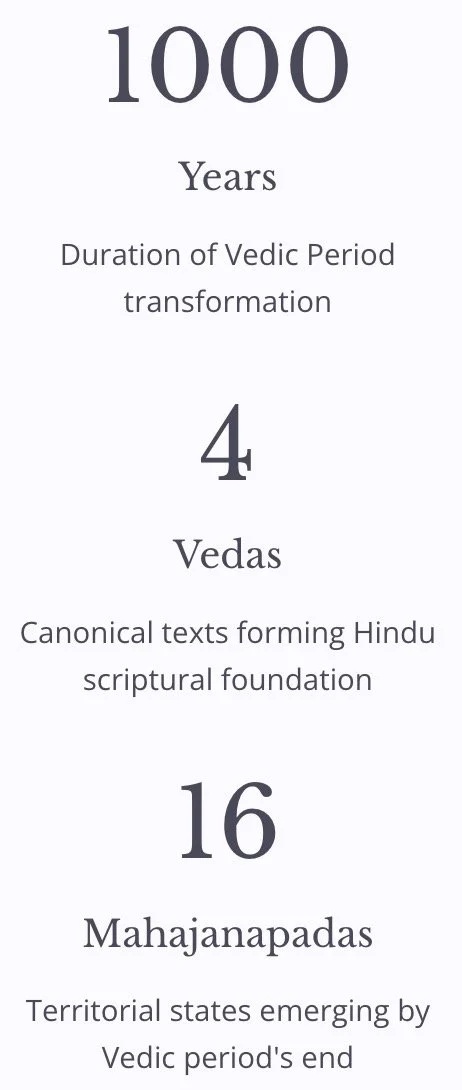
The Vedic Period (1500-500 BCE) represents a foundational epoch that profoundly shaped Indian civilisation's trajectory. From pastoral nomadic communities to settled agrarian societies, from simple tribal governance to complex territorial states, from nature worship to sophisticated philosophical speculation—these transformations established patterns that would persist throughout Indian history. The period witnessed the crystallisation of social stratification through the varna system, the emergence of brahmanical orthodoxy balanced by heterodox philosophical traditions, and the synthesis of Indo-Aryan and indigenous cultures into a distinctive civilisational complex.
Literary Heritage
Rigveda, Yajurveda, Samaveda, Atharvaveda, Brahmanas, Upanishads—foundational texts shaping Indian thought
Social Structure
Varna-jati system establishing hierarchical ordering that influenced caste development
Political Evolution
Tribal chiefdoms to territorial kingdoms laying groundwork for Mahajanapadas
Religious Foundations
Sacrificial religion, philosophical speculation, karma-moksha concepts central to Hinduism
Economic Transformation
Pastoral to agrarian economy enabling population growth, urbanisation, state formation
Linguistic Legacy
Sanskrit as classical language, Indo-Aryan language family dominance in North India
Vedic Period Legacy: Foundation of Indian Civilisation
Enduring Significance
For UPSC aspirants, comprehending the Vedic Period is essential for understanding ancient Indian history's foundational developments. This era established institutional frameworks—political, social, religious, economic—that would evolve but persist in recognisable forms throughout subsequent periods. The synthesis of diverse peoples, the accommodation of variant traditions within brahmanical orthodoxy, the development of sophisticated philosophical speculation alongside ritual practice, and the gradual territorial state emergence—these Vedic developments provided the matrix within which Indian civilisation would continue unfolding.
The debates surrounding Aryan origins, the nature of Vedic society's transformation, and the relationship between material developments and ideological changes remain relevant for contemporary historical understanding. Approaching these questions with nuanced appreciation for archaeological, linguistic and textual evidence—whilst avoiding colonial-era racial theories or nationalist mythologising—enables accurate historical comprehension essential for civil services examination success and informed citizenship alike.
