
Hoysalas
Medieval South India
Hoysalas: Polity, Administration & Culture
The Hoysala dynasty, centred at Dwarasamudra (modern Halebidu), stands as one of the most remarkable polities of medieval South India. Flourishing between the 11th and 14th centuries in the Kannadiga heartland, the Hoysalas rose from feudal obscurity to become a dominant power across the Deccan and the southern peninsula.
Chapter I
Rise of the Hoysala Kingdom
The Hoysalas of Dwarasamudra emerged from the Kannadiga region of present-day Karnataka, with Belur serving as their early centre of power before the capital was relocated to Halebidu. Their ascent to prominence was shaped by the shifting fortunes of several contemporaneous powers: the Western Chalukyas of Kalyani, the Cholas, and rivals such as the Pandyas, Kakatiyas, Kalachuris, and the Yadavas of Devgiri in northern Karnataka. The declining authority of both the Cholas and Pandyas created a political vacuum that the Hoysalas were uniquely positioned to exploit.
Initially, the Hoysalas functioned as feudatories of the Western Gangas, operating under the overlordship of Nripa Kama II. During this period, various local chiefs of Malnad (Karnataka) — including the Kongalvas, Chengalvas, Sandharas, and Kadambas of Humcha, Shimoga, and Bayal-nadu (Wynad) — were brought to heel. While some sources claim that Bayal-nadu formed part of Ballal I's kingdom, this claim is not corroborated by reliable evidence.
The true founder of Hoysala dynastic greatness was Vishnuvardhana, whose name appears in the Ariskere inscription of 1197 CE, which grandly describes him as "a devouring epidemic to Chera." An earlier record from 1190 CE credits him with having broken down the bones of "Cera-Kerala." His conquests included Ananale (a small kingdom in the Western Ghats), Elumale (modern Ezhimala near Kannur, the ancient seat of Mushaka power), and Bayal-nadu (Wynad). By 1185 CE, the borders of the Belur kingdom encompassed Kongu in the south, Kanchi in the east, the Krishna and Venna Rivers in the north, and the Arabian Sea in the west — a remarkable territorial sweep.
Early Period
Hoysalas as feudatories of Western Gangas under Nripa Kama II
Vishnuvardhana
Real founder; conquests of Ananale, Elumale, Bayal-nadu; borders reach Arabian Sea
Narasimha I
Expanded kingdom to Vikramesvaram; Hoysala power overran Kerala region
Narasimha II
Alliance with Cholas via marriage; contained Pandya ambitions
Somesvara
Last powerful king; called "sole protector of the Chola-kula"
Ballala III
Malik Kafur's invasion (1310–11 CE); base shifted to Tiruvannamalai
Narasimha I, son and successor of Vishnuvardhana, extended the kingdom further, adding Vikramesvaram (Ramesvaram) and Kongu (Coimbatore). His reign effectively brought the Kerala region under Hoysala dominance. Under Narasimha II, a diplomatic alliance was forged through the marriage of his daughter to the Chola king Rajaraja II (r. 1216–1256 CE), which helped contain Pandya aggression — as evidenced by the Channarayapatne record of 1223 CE. Somesvara, the last truly powerful Hoysala ruler, is celebrated in inscriptions from Arsirkere (1239 CE) as the "sole protector of the Chola-kula." By 1229 CE, the kingdom had expanded to Kanchi in the east, Belur in the west, and the Krishna River in the north. The eventual disintegration, however, came with Ballala III, when Alauddin Khilji's forces under Malik Kafur overran the territories in 1310–11 CE, compelling the king to relocate his base to Tiruvannamalai.
Chapter II
The King and His Administrative Hierarchy
The Hoysala state was fundamentally a monarchy in which the king stood at the apex of all authority. His primary duty was articulated in unambiguous terms: "to stop the bad and protect the good." He was the supreme judicial authority, the final court of appeal, and personally oversaw the administration of justice. The royal institution was not, however, a one-dimensional autocracy — it was supported by an elaborate hierarchy of queens, princes, nobles, and bureaucrats, each occupying a defined role within a carefully calibrated system of governance.
The Royal Household
Crowned Queens wielded substantial authority — commanding their own ministers, overseeing administration, and at times leading military campaigns.
Uncrowned Queens held no such formal powers and remained outside the administrative apparatus.
Yuvaraja (Crown Prince) served as second in command and sometimes as governor, though his authority did not exceed that of the dannayakas.
Mandaleshvaras were ruling princes — formerly independent or feudal lords under the Chalukyas or Rashtrakutas — who occupied a status comparable to crowned queens.
The Noble and Administrative Tier
Mandalikas were small local rulers positioned below the Mandaleshvaras in the hierarchy.
Samantas were frontier chiefs governing hereditary lands along the kingdom's periphery.
Dannayakas / Dandanayakas held the highest position in the official bureaucracy, doubling as army generals and executing multiple state functions.
Maha-Pradhans were senior ministers consulted by the king. Distinguished officials received prestigious titles such as sarvadhikari, param-visvasi, and bahattara-niyogadhipati (master of 72).
The military administration was particularly well-organised. Nayaks commanded the infantry and cavalry. The king despatched Inspectors (Vicaris) to monitor the conduct of the dannayakas, ensuring checks upon those in positions of power. The portfolio of foreign affairs was managed by the Sandhi-vigrahi — the minister responsible for forging alliances, declaring wars, and negotiating with other rulers. Military campaigns were often directed by generals holding the rank of Senapati (commander) or Samasta-Senadhipati (commander-in-chief), positions typically held by Brahmanas.
Post-campaign, commanders were honoured through symbolic rituals: the granting of betel-leaf as a mark of distinction was one such practice. Families of generals who died in battle received tax-free grants from the state, demonstrating a degree of institutional care for military dependants. At the village level, nad assemblies governed through heggades (sheriffs) and nad-prabhus (deputy sheriffs). Urban centres called pattanas — some of which were grand rajadhani-pattanas (capital cities) — were administered by pattana-svamis (mayors) and were home to nanadesis, the guild merchants who traversed the trading world.
King
Crowned Queens & Yuvaraja
Mandaleshvaras & Mandalikas
Dannayakas & Maha-Pradhans
Samantas, Nayaks & Nad Assemblies
Chapter III
Land Revenue, Taxation & Trade
The fiscal architecture of the Hoysala state rested on two primary pillars: land revenue and trade and commerce. Inscriptions and administrative records furnish us with a remarkably detailed picture of taxation practices, revealing a system that, while efficient, imposed a considerable burden upon the peasantry.
Land Revenue
The principal source of state income was derived from land. The permanent revenue settlement — known as siddhaya — was assessed at between one-sixth and one-seventh of gross agricultural produce, payable in either cash or kind. Land was measured using units called kambas, which varied in dimension from region to region. Beyond this base assessment, an extensive array of additional levies was imposed:
Vira-Sese
War tax levied during military campaigns to fund the state's armed forces
Kudureya-Sese
Separate charges for fodder and horse contribution for the king's cavalry
Aneya-Sese
Tax for the care and maintenance of the royal war elephants
Kataka-Sese
A gift-levy for the royal military camp, paid by the peasantry in paddy
Nallavu-Nallettu
Obligation to supply cattle and bullocks for the king's campaigns
Coronation & Birth Taxes
Levies at the time of coronation (patta-baddha) and for the birth of a royal son (putrotsaha)
Other impositions included maduve tax (marriage tax), loom tax, oil-press tax, dyer tax, and fines collected under the rubric of anyaya (fines for lawbreaking). Some taxes and fines were imposed by nad assemblies with royal sanction. Agrahara villages were granted to Brahmanas and feature in over a hundred Hoysala inscriptions. Significantly, when a gauda (rich landlord)'s land was sought for conversion into an agrahara, the gaudas resisted — occasionally leading to direct confrontations with Brahmanas, from which the latter emerged victorious. Extensive land grants were also made for the upkeep of temples, irrespective of religious sect.
Trade, Merchants and the State
Trade represented another critical source of state revenue, with commercial taxes generally paid in cash. The Hoysala state developed a notably symbiotic relationship with the merchant community, which supplied the royal administration with arms, elephants, horses, and rare commodities. Eminent merchants were elevated to the title of Rajasresthigal (royal merchants) and were regarded as the pura mula stambha (foundational pillars of the towns).
The merchant guild Ayyavole Ainnuruvar, headquartered in Karnataka, maintained commercial contacts spanning Anga, Vanga, Kashmira, Singhala, and Chakragotta — testifying to the geographical reach of Hoysala-era trade networks. Merchants from Gujarat, Kerala, and Andhra settled in Hoysala territory and rose to administrative prominence. Marisetti of Ayyavole, a bangle merchant mentioned in the Kudalaru inscription of 1177–78 CE, relocated to the Hoysala country and eventually rose to the status of mahaprabhu (great officer). His descendant Perumadideva was appointed mahapradhan (great minister) and tantrapala (foreign minister) by Ballala II. Merchants also held the office of pattanasvami/pattanasetti and oversaw the operation of mints (kammata), as recorded in a 1188 CE document naming Kammata Chattisetti. Their contributions to temple construction, land reclamation, well-digging, and tank-building further embedded them into the social and civic life of the kingdom.
Chapter IV
Religion and the Three Philosophers
The religious landscape of the Hoysala period was one of extraordinary dynamism, marked by the interplay of Jainism, Buddhism, and the rising tides of Vaishnavism and Virashaivism. The defeat of the Jain Western Ganga Dynasty by the Cholas in the early eleventh century, combined with the growing followings of Vaishnavism and Virashaivism in the twelfth century, signalled a diminishing — though by no means extinguished — interest in Jainism. Shravanabelagolaand Kambadahalli remained notable centres of Jain worship within Hoysala territory. Buddhism had already been in retreat across South India since the eighth century, following the spread of Adi Shankara's Advaita philosophy; Dambal and Balligavi were among the few remaining Buddhist sacred sites during the Hoysala era.
The tolerance of the Hoysala royal family towards religious plurality is powerfully illustrated by Queen Shantala Devi, consort of Vishnuvardhana, who professed Jainism yet commissioned the Hindu Kappe Chennigaraya temple at Belur. Similarly, King Vishnuvardhana himself built numerous temples after his conversion from Jainism to Vaishnavism, embodying the fluidity of religious identity that characterised the period.
Basavanna & Virashaivism
Twelfth-century reformer who championed a faith without caste distinctions. His Vachanas in simple Kannada proclaimed "Kayakave Kailasa" — work is worship. While five earlier saints (Renuka, Daruka, Ekorama, Panditharadhya, Vishwaradhya) may have founded the sect, Basavanna gave it mass popular momentum.
Madhvacharya & Dvaita
Challenged Shankaracharya's Advaita, asserting the world as real rather than illusion (refuting mayavada). Upheld the supremacy of Lord Vishnu and maintained the distinction between Paramathma (supreme being) and dependent life. Established eight Mathas at Udupi. His teachings inspired Vallabhacharya (Gujarat) and Chaitanya (Bengal).
Ramanujacharya & Bhakti
Head of the Vaishnava monastery at Srirangam, Ramanujacharya preached the way of devotion (bhakti marga) and authored Sribhashya, a critique of Adi Shankara's Advaita. His legacy endured through the Saluva, Tuluva, and Aravidu dynasties of the Vijayanagara Empire, and scholars of the later Mysore Kingdom continued to write Vaishnavite works in his tradition.
These three philosophical and devotional movements had a profound and enduring impact on culture, literature, poetry, and architecture across South India. The later saints of Madhvacharya's order — Jayatirtha, Vyasatirtha, Sripadaraya, Vadirajatirtha — and devotional poets (dasas) such as Vijaya Dasa and Gopaladasa disseminated his teachings far beyond Karnataka. A subsequent wave of bhakti in the seventeenth and eighteenth centuries continued to draw inspiration from these Hoysala-era philosophical foundations. The religious developments of this period were thus not merely theological — they were generative forces in the making of South Indian civilisation.
Chapter V
Society, Women & Urban Life
Hoysala society reflected the emerging religious, political, and cultural currents of the medieval Deccan. The period witnessed growing social sophistication, though the caste system remained as pervasive in Hoysala territory as it was across the rest of the subcontinent. The status of women, however, was characterised by remarkable variability — a tension between institutional participation and literary stereotyping that makes Hoysala-era gender history particularly nuanced.
At the apex of female agency stands Queen Umadevi, who administered Halebidu during the extended northern campaigns of Veera Ballala II, even suppressing armed feudal rebellions in his absence. This stands in striking contrast to the contemporary literary imagination — epitomised by works like the Vikramankadeva Charita of Bilhana — which portrayed women as retiring, overly romantic, and removed from affairs of state. Queen Shantala Devi's mastery of dance and music, and the twelfth-century Virashaiva mystic Akka Mahadevi's pioneering role in the bhakti movement, further illustrate the range of women's engagement with public and spiritual life. Temple dancers (Devadasis), educated and artistically accomplished, enjoyed greater freedoms than other women bound to domestic roles.
Pattanas & Nagaras
Towns called Pattana/Pattanam and marketplaces called Nagara/Nagaram functioned as the nuclei of urban life. Shravanabelagola grew from a seventh-century religious settlement to a major trading hub by the twelfth century.
Temples as Institutions
Large temples served religious, social, judicial, fiscal, and commercial functions, providing employment to hundreds of artisans and guild-members. Royal patronage elevated the king to "God on earth," while Shaiva merchants of Halebidu financed the Hoysaleswara temple to rival Belur's Chennakesava.
Migration & Cosmopolitan Influence
Trade on the west coast brought Arabs, Jews, Persians, Chinese, and Malay peoples to the region. Internal migration driven by imperial expansion introduced new cultures, while royal patronage of forts and outposts caused large-scale population movements.
The urban landscape of the Hoysala kingdom was thus shaped by the interplay of royal patronage, merchant capital, and religious patronage. Belur was transformed into a regal city when Vishnuvardhana constructed the Chennakesava Temple; Halebidu similarly rose to prominence through the construction of the Hoysaleswara temple, financed by Shaiva merchants in competitive emulation. Temples open to all Hindu sects served as anchors of communal life, though the Kesava temple at Somanathapura was a notable exception, adhering strictly to Vaishnava iconographic traditions. In rural areas, temples built by rich landlords fulfilled the fiscal, political, cultural, and religious needs of agrarian communities — mirroring the institutional role of wealthy Buddhist monasteries in an earlier age.
Chapter VI
Kannada & Sanskrit Literature
The Hoysala period was a crucible of literary creativity, witnessing the maturation of Kannada as a refined literary medium alongside the continued prestige of Sanskrit scholarship. While Sanskrit literature retained its élite currency, royal patronage was increasingly extended to Kannada scholars, accelerating the development of distinctive Kannada literary metres and styles. The Champu (mixed prose-verse) style remained popular, but new metres — the Sangatya, Shatpadi (seven-line), Tripadi (three-line), and the lyrical Ragale — gained wide acceptance. Jain works continued their tradition of extolling the virtues of Tirthankaras (Jain ascetics).
Janna — Yashodharacharite (1209 CE)
A Jain scholar patronised by the Hoysala court. His Yashodharacharite narrates the story of a king who, intending to sacrifice two boys to the deity Mariamma, takes pity and renounces human sacrifice. For this masterpiece, Janna was awarded the title "Kavichakravarthi" (Emperor among poets) by King Veera Ballala II.
Rudrabhatta — Jagannatha Vijaya
The earliest well-known Brahminical writer of the Hoysala era — a Smartha Brahmin patronised by Chandramouli, minister of Veera Ballala II. His Jagannatha Vijaya, written in the Champu style and derived from the Vishnu Purana, narrates Lord Krishna's battle with the demon Banasura.
Harihara (Harisvara) — Girijakalyana
A pioneering Virashaiva writer and court poet of King Narasimha I, Harihara wrote the Girijakalyana (marriage of Shiva and Parvati) in the old Jain Champu style. He also composed over a hundred Ragales in praise of Lord Virupaksha at Hampi. He was among the earliest Virashaiva authors independent of the Vachana tradition, hailing from a family of accountants (Karanikas) in Halebidu.
Raghavanka — Harishchandra Kavya
Nephew of Harihara and a Hoysala court poet, Raghavanka is credited with introducing the Shatpadi metre into Kannada literature. His Harishchandra Kavya is considered a classic of the Kannada literary canon, even though it occasionally departs from strict grammatical conventions.
Sanskrit Scholarship
In the domain of Sanskrit, the philosopher Madhvacharya produced a body of work of exceptional intellectual rigour. His most significant contribution was the Rigbhashya on the Brahmasutras — a logical exposition of the Vedas — alongside numerous polemical texts refuting rival schools of Vedantic thought. Notably, Madhvacharya relied more heavily on Puranic literature than on the Vedas themselves as a source of philosophical proof, a methodological choice that distinguished his approach from other commentators. Another celebrated Sanskrit work from the period is Vidyatirtha's Rudraprashnabhashya, which stands as a testament to the vitality of Sanskrit intellectual production under Hoysala patronage.
"Work is worship" — Basavanna's proclamation in his Vachanas (Kayakave Kailasa) encapsulates the egalitarian spirit that animated the literary and devotional movements of the Hoysala age, bridging the spiritual and the social in ways that continue to resonate in Karnataka's cultural memory.
Taken together, the literary achievements of the Hoysala period represent a defining chapter in the evolution of Kannada literature — one in which indigenous metres asserted their independence from Sanskrit models, and in which the devotional, the narrative, and the philosophical converged in works of enduring artistic and intellectual consequence. The patronage extended by the Hoysala court to poets across religious affiliations — Jain, Virashaiva, Brahminical, and Vaishnava — is itself a testament to the pluralistic cultural ethos that distinguished this remarkable medieval dynasty.
Hoysala: Art and Architecture
The Hoysala era (1026 CE – 1343 CE) stands as one of the most illustrious chapters in the history of South Indian art and architecture. Emerging from the Deccan plateau of southern Karnataka, the Hoysala dynasty — with its capital at Dwarasamudra (modern-day Halebid) — gave rise to a temple-building tradition so refined, so intricately detailed, and so visually overwhelming that it remains without parallel in the subcontinent.
Period
1026 CE – 1343 CE
Capital
Dwarasamudra (Halebid)
Key Sites
Halebid, Belur, Somnathpur
Distinctive Medium
Chloritic schist (soapstone)
Architectural Lineage and Origins
The Hoysala temple tradition did not emerge in isolation. It was a deliberate continuation and ultimate refinement of several architectural patterns that had developed under earlier Deccan dynasties — most notably the Chalukyas of Kalyani. The Karnata Dravidian tradition, first nurtured in the 7th century under the Badami Chalukyas, gained considerable sophistication under the Western Chalukyas (Kalyani Chalukya) in the 11th century. It was under Hoysala rule, particularly in the 13th century, that this lineage reached its fullest expression as a confident, independent architectural style.
What sets the Hoysala style apart is its capacity for synthesis. Rather than adhering strictly to either the northern Nagara or southern Dravida traditions, Hoysala architects absorbed elements from both, creating vimanas (superstructures) that are variously described as hybrid forms — some pyramidal, some stellate, some a fusion of both canonical styles. This creative eclecticism, combined with the extraordinary skill of Hoysala craftsmen and the unique properties of their preferred building material — a soft, greenish-black chloritic schist commonly called soapstone — produced an architectural vocabulary of unprecedented intricacy and elegance.
Badami Chalukya (7th century)
Karnata Dravidian tradition established under Chalukya patronage
Western Chalukya (11th century)
Style matures and diversifies under Kalyani Chalukya rule
Hoysala (13th century)
Chalukya tradition perfected as a sovereign, independent architectural style
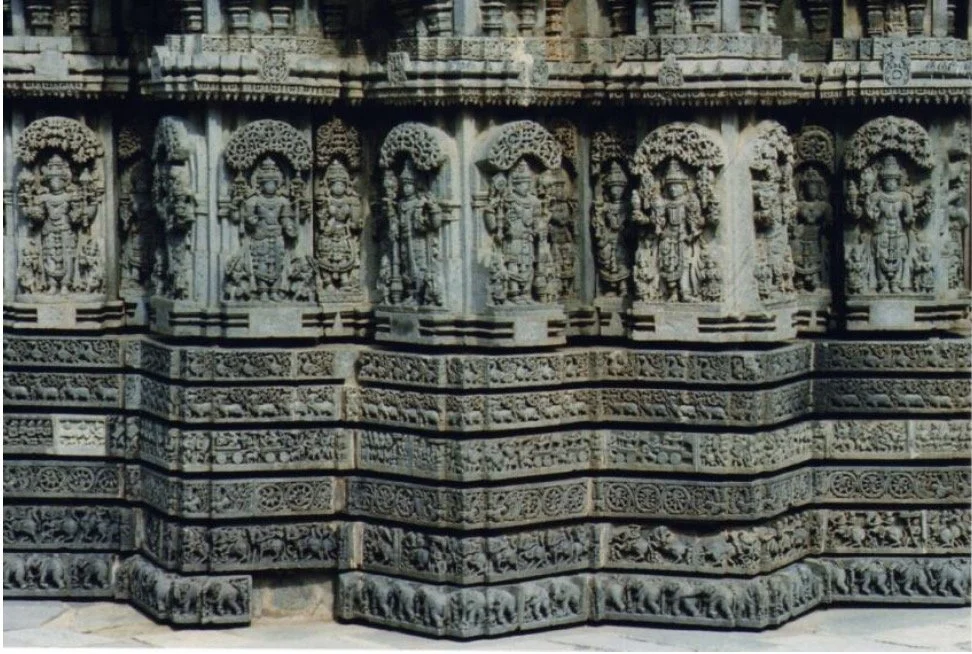
Outer wall panel with six horizontal mouldings at Somanathapura
Defining Features of Hoysala Temple Architecture
Hoysala temples are characterised by an ensemble of distinctive architectural features that together create a visual experience unlike any other in Indian temple art. Perhaps the most immediately striking characteristic is the principle of horizontality — an emphasis on layered, horizontal lines visible in the elaborate mouldings, banded plinths, and tiered friezes that wrap around the temple exterior. This contrasts sharply with the soaring verticality that defines many northern temple traditions, and gives Hoysala shrines a grounded, jewel-box quality that rewards close scrutiny.
The temples are frequently built upon a raised platform or jagati, which serves both a functional and ceremonial purpose: it elevates the shrine above its surroundings and provides a broad, flat surface for pradakshinapatha (ritual circumambulation). The intricately carved banded plinths — a hallmark of the style — comprise a series of horizontal courses running as rectangular strips with narrow recesses between them, each band populated with rows of animals, foliage, and mythological scenes.
Shrine Types (Classification)
Ekakuta
Single shrine
Dvikuta
Twin shrines
Trikuta
Triple shrines (3 garbhagrihas)
Key Structural Elements
Garbhagriha — Cuboid sanctum housing the enshrined deity on a pitha (pedestal)
Shikhara — Superstructure over garbhagriha; not very high; hybrid Nagara-Dravida or pyramidal
Antarala — Vestibule connecting garbhagriha to the mandapa
Mandapa — Pillared hall; both open (outer) and closed (inner) forms present
Amalaka & Kalash — Ribbed stone finial topped by the sacred kalash pot
Gopuram — Ornate entrance towers flanking each doorway
Prakaram — Temple courtyard with minor shrines and outbuildings
The vimanas of Hoysala temples are stellate, semi-stellate, or orthogonal in plan — the stellate (star-shaped) plan being the most celebrated and characteristic. While the interior of the vimana is kept relatively plain, the exterior is profusely elaborated with mouldings, figural sculpture, and decorative panels. The mandapa ceilings are highly ornate, bearing mythological figures and floral designs, while the circular pillars each carry four bracket figures at the top — a feature of immense sculptural importance.
The Miracle of Soapstone: Material and Craft
No discussion of Hoysala architecture is complete without an appreciation of the extraordinary building material that made its sculptural ambitions possible. The temples are constructed primarily of chloritic schist — a soft, greenish or blackish stone popularly known as soapstone — found abundantly throughout the southern districts of Karnataka. This material had a singular advantage: freshly quarried, it is soft enough to be carved with remarkable precision and delicacy. Upon prolonged exposure to sunlight and air, however, it gradually hardens into a durable, weather-resistant stone, ensuring the survival of fine carvings over centuries.
The smooth grain of soapstone allowed Hoysala sculptors to achieve a level of detail that would have been impossible in harder stones such as granite. Every fingernail, every jewel, every strand of hair could be rendered with almost lapidary precision. It is this material that enabled the celebrated abundance of figure sculpture covering almost all Hoysala temple surfaces — a more extensive iconographic programme than anything attempted in later Western Chalukyan architecture.
Interestingly, exceptions to the soapstone tradition do exist. A small number of Hoysala temples — such as those at Tonnur — were built of granite, likely because local stone resources dictated the choice. In the Tamil Nadu region, where Hoysala ambitions extended during their later imperial expansion, local craftsmen trained in the Chola granite-carving tradition were employed, and granite temples were constructed there as well. The adaptability of the Hoysala building programme to local conditions is itself a testament to the dynasty's organisational sophistication.
Soft When Quarried
Freshly cut soapstone is easy to carve into intricate forms, enabling unparalleled sculptural detail
Hardens Over Time
Exposure to sunlight causes the stone to harden, protecting fine carvings from weathering over centuries
Locally Abundant
Found throughout southern Karnataka, ensuring Hoysala builders had a continuous and plentiful supply
The Great Monuments: Halebid, Belur, and Somnathpur
Key Monuments
The three principal sites of Hoysala temple architecture — Halebid, Belur, and Somnathpur — represent successive stages in the development of the style, from its mature early phase to its culminating perfection. Each site presents a distinct architectural personality while sharing the hallmarks of the broader tradition: elaborate moulded plinths, star-shaped vimanas, richly carved mandapas, and surfaces alive with figure sculpture drawn from the great Hindu epics.
Hoysaleshvara Temple, Halebid
The most imposing shrine at Halebid is the 12th-century Hoysaleshvara temple, constructed under the patronage of wealthy local merchants and aristocrats. It consists of two separate shrines (dvikuta) with a cruciform plan, resting on cruciform-shaped (star-shaped) plinths. Built of grey soapstone, the twin shrines are almost identical and joined by a covered passage. The entire base is covered with running friezes of tigers, elephants, horses, birds, and celestial beings. The shikharas are missing, but the mandapa ceilings, pillars, and exterior walls are exquisitely carved. The temple presents what many scholars consider the finest depictions of the Ramayana and Mahabharata in all of Indian temple art.
Chenna Keshava Temple, Belur
Built in the early 12th century by King Vishnuvardhana to commemorate his victory over the Cholas at Talkad, the Keshava temple at Belur is an ekakuta (single shrine) set in a spacious courtyard. The complex stands on a wide, raised star-shaped terrace adorned with elephants in various poses. The pillared mandapa is cruciform in plan. The intricate carvings on outer and inner walls, pillars, screens, and bracket figures are extraordinary — the basement of the vimana is covered with narrative friezes from the Ramayana, Mahabharata, and Bhagavat Purana. Like Halebid, the original shikhara of the main shrine is no longer extant.
Keshava Temple, Somnathpur
The 13th-century Keshava temple at Somnathpur represents the high point of Hoysala temple architecture and sculpture. Its plan is more complex than earlier examples: a triple shrine (trikuta) with star-shaped projections on three sides, housing three forms of Vishnu — Keshava (the main image), Krishna as Venugopala, and Janardhana Vishnu. The shikhara is of moderate height, standing stylistically midway between the Nagara and Dravida tower traditions. The walls and ceilings are richly carved, including a number of erotic themes associated with Shakta practice. It is the most complete surviving Hoysala temple complex.
Other Notable Monuments of the Hoysala Period
Beyond the three great temple complexes, the Hoysala legacy encompasses a range of other remarkable architectural achievements spread across southern Karnataka, each offering its own insight into the dynasty's artistic ambitions and religious pluralism.
Kedareshwara Temple, Halebidu
A Shaiva trikuta temple (three shrines) located near the Hoysaleshwara complex, built under the patronage of King Veer Ballala II and Queen Ketala Devi. Designed following a stellate plan, the central shrine is connected to two laterally positioned shrines by a common mandapa. Its sculptural details include beautifully executed representations of Bhairava, Vishnu as Bharadwaj, and the celebrated Kaliyadamana scene.
Kalyani Tank, Hulikere
Located in the suburb of Halebidu (modern Hulikere), this splendidly decorated stepped tank was built for a Shaiva temple during the reign of Emperor Narasimha I (1152–1173 CE). Ironically, no trace of the original temple survives today, yet the tank itself endures in remarkable condition. This stepped pond is adorned with 27 miniature shrines, several of which still carry a superstructure atop — a testament to the Hoysala propensity for decorating even utilitarian structures.
Jain Temples, Bastihalli
Further south from Kedareshwara, in Bastihalli, lies a group of three Jain temples dedicated to the tirthankars Adinath, Parsvanath, and Shantinatha. The Parsvanath Basti (1133 CE) was built by King Vishnuvardhana to celebrate the birth of his son Narasimha I. The Adinath Basti, built in the late 12th century, is the smallest and carries a beautifully decorated image of Saraswati in its vestibule. Aligned along the north-south axis, all three structures faithfully follow the general architectural pattern of the Hoysalas, demonstrating the dynasty's patronage of Jainism alongside Shaiva and Vaishnava traditions.
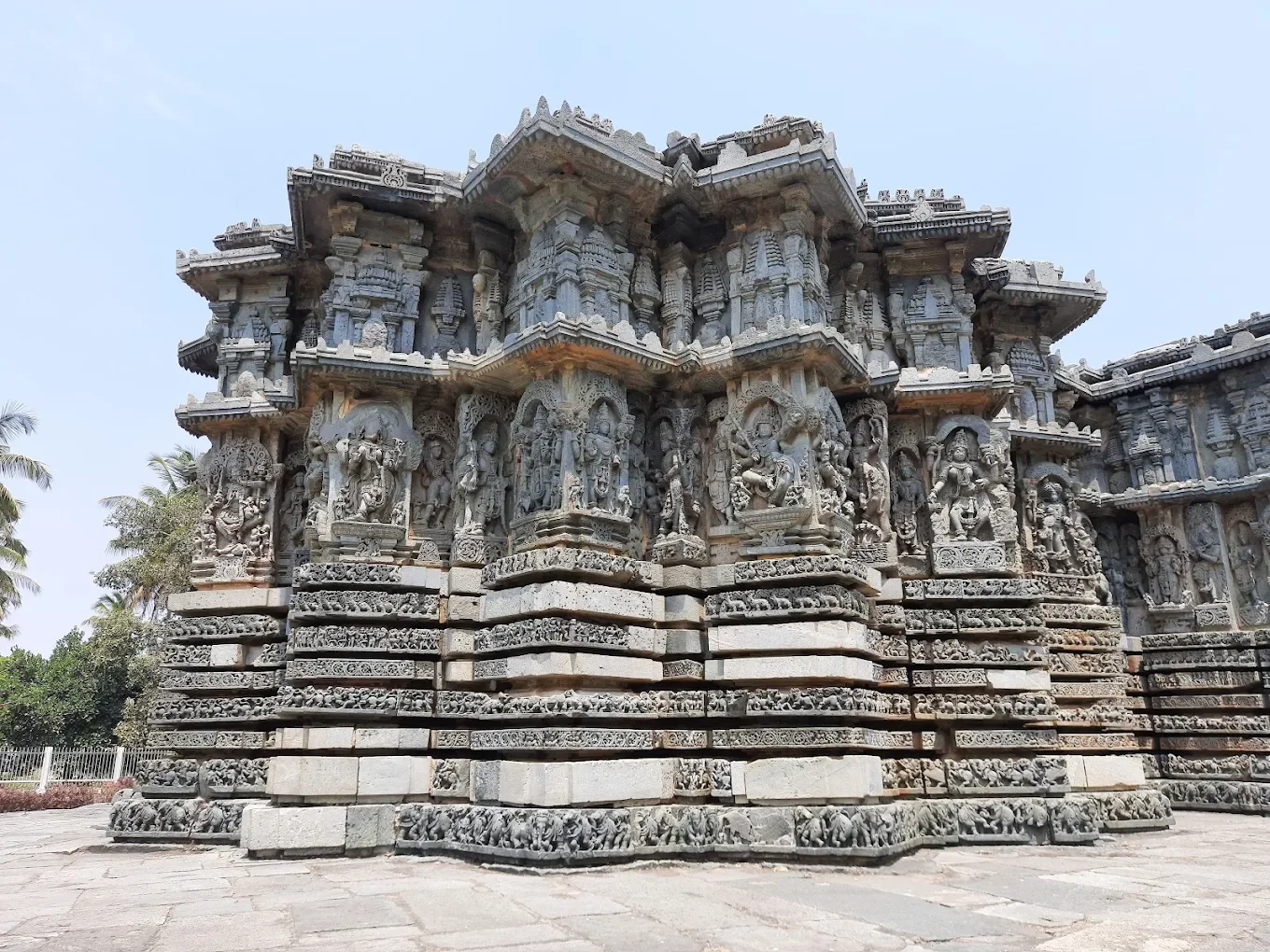
Kedareshwara Temple, Halebidu
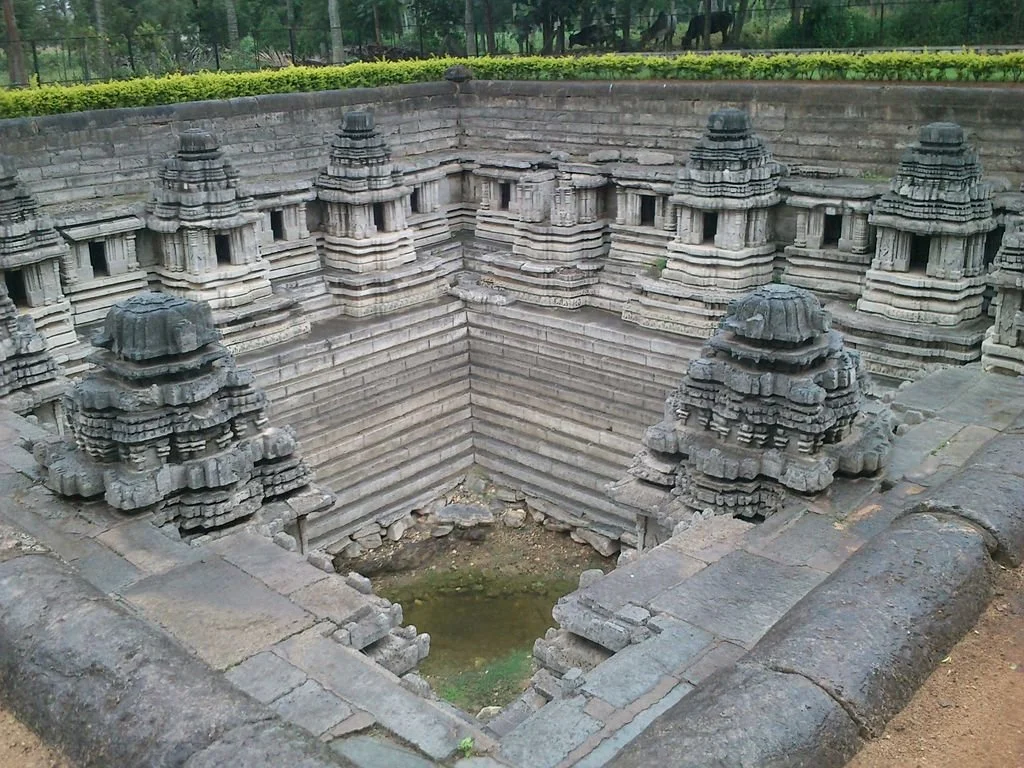
Kalyani Tank, Hulikere
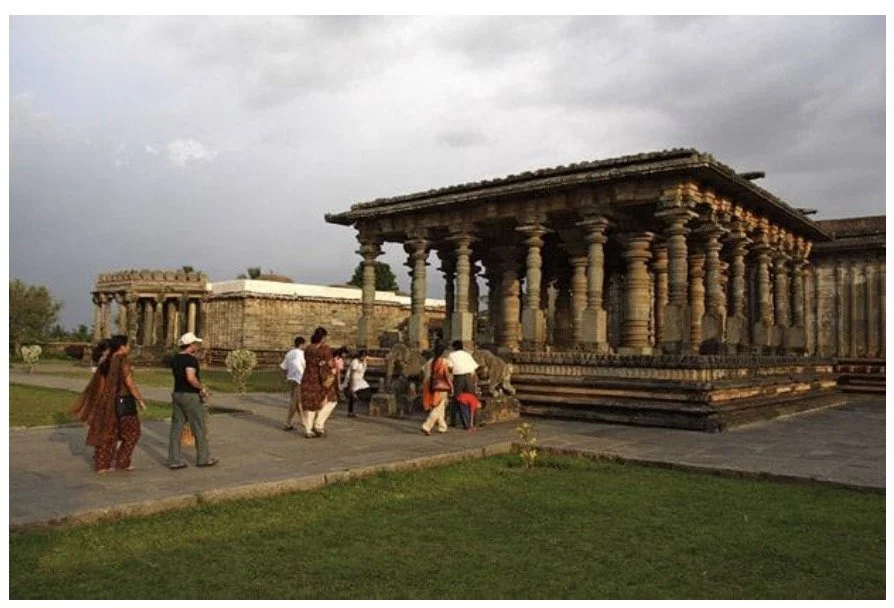
Jain Temples, Bastihalli
Hoysala Sculpture: Virtuosity in Stone
Hoysala artists won enduring fame for the virtuosity of their sculptural craft. Whether depicting scenes from the Hindu epics, mythical creatures such as the Yali, divine deities, the fierce Kirthimukha (gargoyle-like demon faces adorning the towers of the vimana), or intimate aspects of daily life, Hoysala sculptors brought an almost compulsive attention to detail to their work. Their medium — the soft, yielding soapstone — enabled a carving style of extraordinary refinement. Workmanship extended to the finest particulars: every fingernail, every toenail, every strand of jewellery was rendered with precision and care. Occasionally, artists even left behind their personal signatures on the sculptures they created — a rare and touching mark of individual pride in an otherwise anonymous craft tradition.
The walls of Hoysala temples are organised into a programme of rich iconographic narrative. Scenes from the Ramayana, Mahabharata, and Puranas are presented vigorously and extensively, arranged in sequential, clockwise friezes beginning at the main entrance. The Hoysaleshwara temple at Halebidu is perhaps the finest example of this tradition, presenting what many consider the most complete and powerful rendering of the two great epics in Indian temple art. Beyond mythological narrative, the walls are animated with panels of musicians, dancers, horses, elephants, lions, and scenes from everyday life.
Signature Sculptural Motifs
Salabhanjika — The mythical female figure standing near or grasping a tree branch; a motif tracing its origin to Buddhist sculpture, seen on pillar brackets and temple entrances
Jalandhras — Ornately pierced stone window screens admitting light and air, made decorative and sculptural by Hoysala ingenuity; parallels seen at the early Chalukyan Ladkhan temple at Aihole
Kirthimukhas — Demon faces adorning the towers of certain vimanas
Makaratorana — Heavily engraved doorway ornamentation featuring the makara (imaginary beast)
Sthamba Buttalikas — Pillar images showing traces of Chola art blended with Chalukyan touches, reflecting the Hoysala empire's southward expansion into Tamil-speaking territories
Mythological Depictions
Common mythological representations found across Hoysala temple walls include:
Epic hero Arjuna shooting the fish
The elephant-headed god Ganesha
The Sun God Surya
The war and weather god Indra
Brahma with Sarasvati
Durga slaying the water-buffalo demon, holding weapons in multiple arms
Harihara — the composite form of Shiva and Vishnu, holding conch, wheel, and trident
Erotic themes associated with Shakta practice, carved discreetly into recesses and niches
"The Hoysala artist handled erotica with discretion. They avoided exhibitionism, carving erotic themes into recesses and niches, generally miniature in form making them inconspicuous." — Scholarly observation on Hoysala sculptural ethics
Legacy and Enduring Significance
The Hoysala contribution to Indian art and architecture endures as one of the most remarkable achievements in the entire history of the subcontinent's creative tradition. What is extraordinary about the Hoysala achievement is not merely its scale or ambition — though both are impressive — but the sustained quality of its execution across more than two centuries of temple building. From the early 12th-century Keshava temple at Belur to the mature 13th-century Keshava temple at Somnathpur, the tradition maintained and even deepened its commitment to sculptural excellence, iconographic richness, and architectural invention.
The Hoysala temples represent a synthesis that is rare in art history: they absorbed the Karnata Dravidian legacy of the Chalukyas, borrowed selectively from both northern Nagara and southern Dravida canonical traditions, and — through the unique properties of their soapstone medium and the extraordinary skill of local craftsmen — transformed these inherited vocabularies into something genuinely original. The star-shaped stellate plan, the banded horizontal plinths, the profusely carved exterior walls contrasting with plain interiors, the bracket figures and jalandhras, the Makaratorana doorways — all these became the unmistakable signatures of a sovereign artistic vision.
Architectural Innovation
Stellate vimanas, banded plinths, hybrid Nagara-Dravida shikharas, and star-shaped jagatis defined a new temple typology
Sculptural Mastery
Soapstone medium enabled unsurpassed detail; artists signed works; iconographic programmes remain the most complete in South Indian art
Religious Pluralism
Hoysala patronage extended equally to Shaiva, Vaishnava, and Jain traditions, producing an architecturally unified but theologically diverse heritage
UNESCO Recognition
The Sacred Ensembles of the Hoysalas were inscribed as a UNESCO World Heritage Site, affirming their outstanding universal value
Today, the temples at Halebid, Belur, and Somnathpur draw scholars, pilgrims, and visitors from across the world. Their surfaces continue to yield new readings and new details to those who look closely enough — a fitting tribute to craftsmen who worked with such care and love that they carved perfection even into the parts no eye was likely to see.
