Cholas
Cholas: Polity and Administration
The Chola dynasty stands as one of the most magnificent political and administrative edifices in the annals of Indian history. Originating as one of the Three Crowned Kings of Tamilakam — alongside the Cheras and Pandyas — the Cholas rose from the fertile banks of the Kaveri River to command a vast maritime empire that projected power across South Asia, Southeast Asia, and beyond. This document offers a comprehensive examination of Chola governance, tracing the arc from their earliest recorded origins through the heights of imperial administration, local self-government, fiscal policy, and military organisation. It is an essential study for understanding medieval South Indian statecraft in its full complexity.
Origins & Early Period
Sangam literature, Ashokan edicts, and ancient Tamil traditions illuminate the earliest Chola chiefdoms
Imperial Expansion
Vijayalaya to Rajendra Chola I — the consolidation of peninsular India and overseas conquests
Administration
A sophisticated hierarchy from emperor to village assembly, Mandalams, Sabhas, and Variyams
Decline & Legacy
Later Cholas, Pandyan resurgence, and the enduring legacy of Chola statecraft
Chapter I
Sources and Periodisation
The historiography of the Chola dynasty is a multifaceted enterprise, drawing upon a diverse corpus of textual and epigraphic evidence. For the period prior to the 7th century CE, written evidence is sparse, and scholars must rely primarily upon the ancient Tamil literature of the Sangam Period, oral traditions, religious texts, and the invaluable testimony of temple and copperplate inscriptions. These sources, while fragmentary, collectively paint a vivid if incomplete picture of one of ancient India's most enduring dynasties.
Among the most significant external references are the Ashokan Rock Edicts (273–232 BCE), particularly Major Rock Edict No. 13, which mentions the Cholas as neighbours of the Mauryan Empire to the south — friendly but independent of Mauryan suzerainty. The Periplus of the Erythraean Sea and the works of the geographer Ptolemyprovide brief but important references to the Chola country, its towns, ports, and commerce. The Buddhist text Mahavamsa, composed in the 5th century CE, records conflicts between Sri Lanka and the Cholas in the 1st century BCE, further corroborating their antiquity and regional significance.
The Four Periods of Chola History
Historians conventionally divide Chola history into four distinct phases, each marked by different levels of power and territorial extent.
Early Cholas
The Sangam-era chiefdoms, recorded in classical Tamil literature
Interregnum
The obscure transitional period dominated by Kalabhras, Pallavas, and Pandyas
Imperial Cholas
The dynasty of Vijayalaya, the zenith of Chola power (c. 848–1070 CE)
Later Cholas
From Kulothunga Chola I through the dissolution of the dynasty by 1279 CE
Chapter II
Early Cholas and the Interregnum
The Cholas are among the most ancient ruling families known to South Indian history. Their first datable appearance in historical records is alongside the Pandyas and Cheras in Ashoka's II and XIII Rock Edicts, which describe them as a friendly force existing outside the purview of Mauryan suzerainty. The richest source for the early Chola period, however, is Sangam literature, which celebrates the deeds of chieftains and kings in elaborate poetry, offering insights into the political geography, material culture, and values of early Tamil society.
The most celebrated of the early Chola monarchs is Karikala Chola, credited with establishing the port town of Puhar (Kaveripattinam) at the mouth of the Cauvery River and building embankments alongside it. He is also remembered for his keen interest in irrigation infrastructure and land reclamation — activities that underline the agrarian foundations of Chola power. Despite this illustrious heritage, the post-Sangam history of the early Cholas and their precise relationship to the later Imperial Cholas remains a matter of scholarly uncertainty.
The Interregnum: Obscurity and Survival
The three centuries between the close of the Sangam age (c. 300 CE) and the rise of the Imperial Cholas constitute one of the most obscure periods in South Indian history. An enigmatic dynasty known as the Kalabhras invaded the Tamil country, displacing existing kingdoms and plunging the region into an era of political uncertainty. The Kalabhras were eventually displaced by the Pallava dynasty and the Pandyan dynasty in the 6th century.
Chola Retreat to Uraiyur
During this interregnum, the Cholas were reduced to ruling a diminished territory around their old capital of Uraiyur. The Pandyas and Pallavas accepted Chola princesses in marriage, evidencing residual prestige even in political decline.
Mutharaiyar Rule of Thanjavur
Inscriptions from around Thanjavur reveal that the region was governed by the Mutharaiyars (Muthurajas) for roughly three centuries, until Vijayalaya Chola captured Thanjavur from Ilango Mutharaiyar between 848 and 851 CE.
Telugu Cholas
Around the 7th century, a Chola kingdom flourished in present-day Andhra Pradesh. The Chinese pilgrim Xuanzang, who visited Kanchipuram in 639–640 CE, references a "kingdom of Culi-ya," generally identified with these Telugu Cholas who traced their lineage to the Sangam Cholas.
Chapter III
The Imperial Cholas: Rise to Supremacy
Vijayalaya, possibly a feudatory of the Pallava dynasty, seized the opportunity presented by a conflict between the Pandya and Pallava empires around 850 CE to capture Thanjavur from the Muttaraiyars and establish the Imperial line of the medieval Chola dynasty. Thanjavur henceforth served as the glittering capital of one of the most powerful empires medieval India had ever witnessed. The imperial project initiated by Vijayalaya was carried forward with remarkable vigour by his successors.
The second Chola king, Aditya I, caused the demise of the Pallava dynasty and defeated the Pandyan dynasty of Madurai in 885 CE, while establishing marital ties with the Western Ganga dynasty. His son Parantaka I conquered Sri Lanka in 925 CE and defeated the Rashtrakuta dynasty under Krishna II at the Battle of Vallala, demonstrating the empire's ambition to project power well beyond its Tamil heartland.
Rajaraja Chola I
The greatest organiser among Chola rulers, Rajaraja I unified peninsular India south of the Tungabhadra. He conducted a landmark land survey in 1000 CE to rationalise imperial revenues and built the magnificent Brihadeeswarar Temple at Thanjavur in 1010 CE — a monument to Chola power and piety alike.
Rajendra Chola I
Son and successor of Rajaraja I, Rajendra marched north to defeat the Pala dynasty of Bengal, built Gangaikonda Cholapuram to celebrate his victories, invaded the Srivijaya kingdom in Southeast Asia, and sent three diplomatic missions to China in 1016, 1033, and 1077 CE — cementing the Cholas as a true world power.
The Empire at its Zenith
At its greatest extent, the Chola Empire stretched from northern Sri Lanka in the south to the Godavari-Krishna basin in the north, encompassing the Konkan coast, the entire Malabar Coast, Lakshadweep, and the Maldives — a maritime and continental empire without parallel in South Indian history.
Chapter IV
Overseas Conquests and Maritime Power
Perhaps no single achievement of the Chola dynasty captures the historical imagination as powerfully as the range and audacity of their overseas military campaigns. The Chola fleet represented the absolute zenith of ancient Indian maritime capacity. Under Rajaraja Chola I and his successors — Rajendra Chola I, Virarajendra Chola, and Kulothunga Chola I — Chola armies and navies repeatedly demonstrated their capacity to project power across the Indian Ocean world.
Rajaraja Chola I launched several naval campaigns resulting in the capture of Sri Lanka, the Maldives, and the Malabar Coast. These conquests were not mere raids but structured efforts to control the strategic sea lanes that connected the Indian subcontinent with Southeast Asia and China. In 1025 CE, Rajendra Chola I launched a celebrated naval expedition against the ports of the Srivijaya Empire — an entrepôt-based polity centred on the island of Sumatra — as well as against the Burmese kingdom of Pegu. This expedition, targeting cities as far away as modern Malaysia, Indonesia, and southern Thailand, remains one of the most remarkable maritime enterprises in pre-modern Asian history.
"The power and prestige the Cholas had among political powers in South, Southeast, and East Asia at its peak is evident through their expeditions to the Ganges, naval raids on cities of the Srivijaya empire, and their repeated embassies to China."
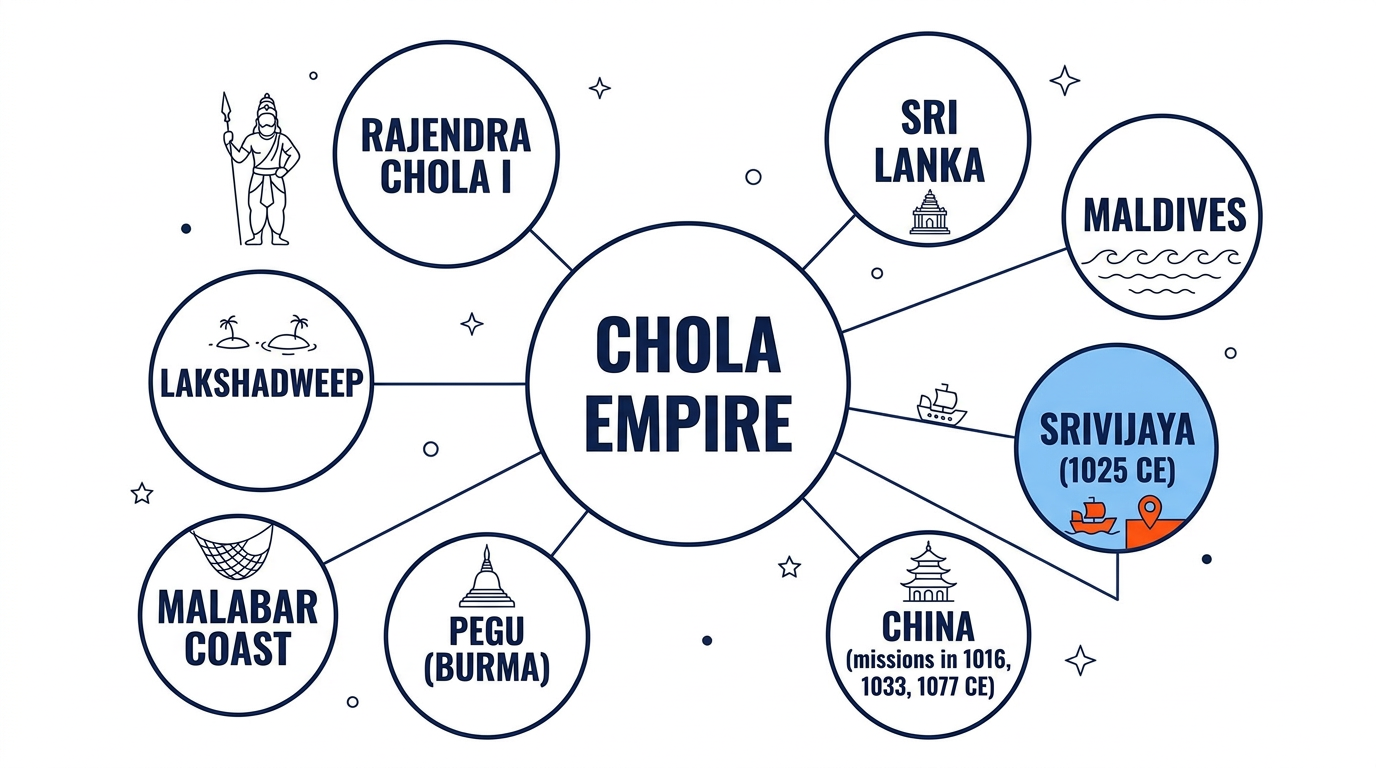
Chola Empire
The significance of these expeditions transcends mere military glory. The Chola naval campaigns dismantled the commercial dominance of the Srivijaya Empire, opening Southeast Asian trade routes to Indian merchants. Diplomatic missions to the Chinese imperial court established the Cholas as recognised members of the medieval Asian state system. The tiger emblem of the Chola dynasty, found on an early silver coin of Uttama Chola discovered in Sri Lanka, is a small but powerful symbol of this vast oceanic reach.
Chapter V
The Later Cholas and Decline (1070–1279 CE)
The period of the Later Cholas (1070–1279 CE) represents a complex and ultimately tragic denouement to one of South India's most glorious dynastic stories. Led initially by capable rulers such as Kulothunga Chola I, Vikrama Chola, Rajaraja Chola II, Rajadhiraja Chola II, and Kulothunga Chola III, the dynasty managed to sustain meaningful territorial authority across much of southern India, even as the geopolitical environment shifted against them.
Around 1118 CE, the Cholas lost control of Vengi to the Western Chalukyas and Gangavadi to the Hoysala Empire. However, these were temporary setbacks, as Vikrama Chola swiftly recovered Vengi by defeating Chalukya Someshvara III and reclaimed Gangavadi from the Hoysalas. The architectural achievement of this period — the magnificent Airavatesvara Temple at Dharasuram, near modern Kumbakonam, built during the reign of Rajaraja Chola II (1146–1175 CE) — testifies to the continued vitality of Chola civilisation even as its political power waned.
1070 CE
Beginning of Later Chola period under Kulothunga Chola I; overseas territories begin to be lost
1118–1126 CE
Brief Chalukya occupation of Vengi; quickly reversed by Vikrama Chola
1185–1190 CE
Kulothunga Chola III and Hoysala Veera Ballala II defeat Western Chalukyas — final dissolution of Chalukya power
1215–1216 CE
Defeat by Maravarman Sundara Pandiyan II marks the decisive beginning of Chola decline
1279 CE
Chola dynasty fully absorbed by the resurgent Pandyan empire; ceases to exist as an independent polity
The final decline was precipitated by the defeat of Kulothunga Chola III by Maravarman Sundara Pandiyan II in 1215–16 CE. The Cholas subsequently lost control of Sri Lanka, driven out by the revival of Sinhala power. A Pandyan civil war — in which the Sinhalas and Cholas became involved — further destabilised the region. Absorbed by the Pandyan empire, the Chola dynasty ceased to exist as an independent political entity by 1279 CE, bringing to a close nearly four centuries of imperial history.
Chapter VI
Central Administration: The King and His Court
The administrative machinery of the Chola Empire was, by the standards of medieval India, a remarkably sophisticated and well-articulated system. At its apex stood the emperor or king, typically referred to in inscriptions as Ko (king) or Perumal Adigal (the great one). The Chola throne was hereditary, governed by the principle that the eldest son of the king should succeed his father. The heir apparent bore the title of Yuvaraja and was groomed for the responsibilities of kingship from an early age.
The ideological construction of Chola kingship was elaborate and multidimensional. Early Chola kings bore unassuming titles, but these were progressively replaced with grandiose appellations that proclaimed the king's supreme status. Titles such as Raja-Rajadhiraja and Ko-Konmai-Kondan — both meaning "king of kings" — articulated a vision of universal sovereignty. Inscriptions describe the king as a great warrior and conqueror, a defender of Varnadharma, a slayer of the Kali Age's evils, a generous patron of the arts, and a figure of divine beauty. Rajaraja I, for instance, is referred to as "Ulakalanda Perumal" (the great one who measured the earth).
Key Royal Institutions
Udankuttam
The council of ministers and army of officers who supported the king in carrying out his duties
Raja Guru
The royal family priest who served as the king's temporal and spiritual advisor — crucial to Chola politics
Royal Tours
Kings undertook tours of their realm, staying in temples, maintaining contact with subjects and monitoring officials
The God-King Cult
The Chola period witnessed the flourishing of the cult of the God-king. Kings were frequently compared to deities — directly or through elaborate poetic double entendres. The worship of images of dead kings and the construction of temples over their graves are powerful material testimonies to this ideology of sacred kingship, which legitimised royal authority through divine association.
The tiger was the royal emblem of the Chola kings, symbolising power, valour, and sovereignty across all their territories and coinage.
The bureaucracy that supported this royal structure was extensive. Officials were ranked into two broad categories: those of Perundanam status (higher officials) and those of Sirudaram status (lower officials). Officers were compensated not only through salaries but also through land assignments and the conferment of honorary titles — a system that integrated personal loyalty with material incentive in the classic fashion of medieval Indian statecraft.
Chapter VII
Provincial Government and Territorial Divisions
The territorial administration of the Chola Empire was organised through a hierarchical system of administrative divisions that translated imperial authority from the capital at Thanjavur down to the individual village. This system was not merely a mechanical apparatus of control but a sophisticated attempt to balance centralised power with local participation — an achievement that historians have rightly regarded as one of the Cholas' most enduring contributions to Indian political thought.
The Chola Empire comprised nine provinces, each known as a Mandalam. Mandalams were typically named after the original names or titles of Chola kings. At the head of each mandalam was a Viceroy, appointed from the close relatives of the king — typically princes of the royal blood. The Viceroys maintained constant contact with the central government, received orders from the king, and reported back regularly. They were assisted in their administrative duties by a large complement of officials.
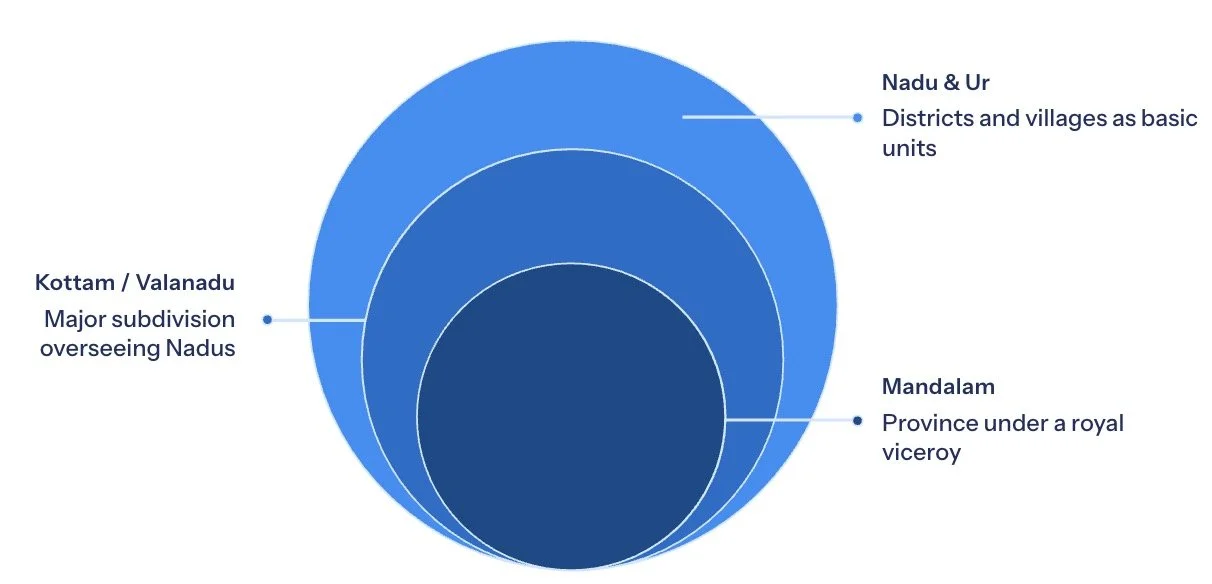
Chola: Provincial Government and Territorial Divisions
Mandalam
Province — governed by a Viceroy (royal prince). The Chola Empire had nine such provinces, named after royal titles.
Kottam / Valanadu
Sub-division — each Mandalam was subdivided into Kottams or Valanadus for more manageable governance.
Nadu
District — every Kottam was further divided into Nadus, with their own local assemblies and administrative structures.
Ur (Village)
Fundamental unit — the village or Ur was the bedrock of the entire administrative edifice, governed by its own assembly.
Towns occupied a special place in this administrative geography. A town was known by the name Nagaram and was governed by a council called the Nagarattar. This town council had its own independent administrative functions, distinct from the village assembly structures. The existence of various assemblies across multiple territorial units — Nadu, Kurram, and Grama — and the occasional convening of the entire provincial population for major decisions, further illustrates the remarkable participatory character of Chola administration.
Chapter VIII
Local Self-Government: Assemblies and Village Administration
Among all the remarkable features of the Chola polity, none has attracted greater admiration from historians than the system of local self-government at the village level. The self-sufficient village and the administrative structures that governed it represented a form of democratic participation strikingly advanced for a medieval polity. The fundamental tenet of this system was that the villagers themselves should govern the village — a principle operationalised through the institution of the village assembly.
The rural administration of the Chola era was overseen by three distinct types of assemblies and their associated committees (Variyams). Each assembly type served a different social constituency and fulfilled different administrative functions, together constituting an interlocking system of local governance.
Ur
A village assembly comprising all socioeconomic groups with stakes in the community — essentially all resident taxpayers. It was the most broadly representative of the three assembly types and is considered the original organ of village governance.
Sabha
An assembly exclusive to Brahmin settlements (agrahara or Chaturvedimangalam villages). Composed solely of learned Brahmins, the Sabha exercised authority in villages that had been granted to Brahmin communities. Where both Ur and Sabha coexisted, it suggests a layering of non-Brahmin landholding communities alongside later Brahmin grantees.
Nagaram
A council of merchants and businesspeople, primarily found in trade centres. The Nagaram served the needs of mercantile interests, overseeing commercial regulation and the welfare of trading communities.
The Uttaramerur Inscriptions: A Window into Village Democracy
The most detailed evidence for village administration in the Chola period comes from the celebrated Uttaramerur inscriptions, discovered in the Vaikunta Perumal temple at Uttaramerur in the Chengalput district of Tamil Nadu. These inscriptions were issued by Chola king Parantaka I between 919 and 921 CE. The first inscription established procedures for the selection of various village committees; the second, issued two years later, amended these procedures to address operational problems — including the infiltration of corrupt elements into the committees.
Eligibility for Committee Membership
Candidates had to fulfil stringent criteria:
Ownership of more than one-fourth Veli (roughly one and a half acres) of land
Residency in a home constructed on one's own site
Age between 35 and 70 years
Understanding of Vedic literature
Disqualifications
The following were ineligible for selection:
Those who had served on any committee in the previous three years
Those who had served but failed to submit financial reports, along with their relatives
Those who had committed adultery or serious sins, along with their relatives
Those who had stolen another person's property
Selection of committee members was conducted by the innovative Kudavolai (pot ticket or lot) system — a form of sortition in which one member was chosen from each of the village's thirty wards. The assembly typically convened in the village temple, occasionally meeting outdoors or by the bank of the village tank. The Uttaramerur inscriptions conclude with the moving statement that the new guidelines were established so that "wicked men might perish while good men might prosper" — a succinct articulation of the moral vision underlying Chola local governance.
In general, neither the royal nor central authority had direct influence over these village assemblies. Central government officers would attend meetings only when important business — such as constitutional changes or land rights affecting royal revenues — was being transacted. Even then, they served in an advisory and supervisory capacity, not as administrators.
Chapter IX
Variyams: The Village Committee System
The day-to-day effectiveness of village self-governance in the Chola period depended not merely on the general assemblies but on a network of specialised committees known as Variyams. These committees, composed of male members of the village community, were the operational arms of the village assemblies, each responsible for a specific domain of communal life. Their composition, the qualifications required for membership, and the duration of membership varied from village to village, reflecting the diversity of local conditions across the Chola realm.
The members of these Variyams were known as Variyaperumakkal — a title suggesting dignified, honourable service. The work performed was honorary in nature; committee members received no salary or regular payment. They were expected to bring to their service the ideals of sacrifice, duty, and the welfare of the village community — ideals that echo the broader Dharmic framework of Chola kingship at the imperial level. Village officials, however, could be compensated in cash or in kind for specific services rendered.
Thottavariyam
Responsible for the management and maintenance of flower gardens — an important resource for temple worship and communal ceremonies
Niyaya Variyam
Administered justice at the village level — resolving local disputes and declaring guilt or innocence, though actual punishments were handed down by royal officials
Dharma Variyam
Oversaw charities and temples — managing endowments, charitable distributions, and the ritual life of the village community
Erivariyam
In charge of water tanks and water supply — critical in an agrarian economy dependent on irrigation for its prosperity
Pon Variyam
The financial committee, overseeing the village's financial affairs — including the power to levy taxes for village purposes and remit taxation in special circumstances
Gramakariya Variyam
The overarching supervisory committee responsible for monitoring the work of all other committees — a coordination and oversight body for the entire Variyam system
The combined authority of the village assembly and its Variyams was substantial. The assembly possessed what can, in modern terms, be described as near-sovereign rights at the local level. It had the power to levy taxes for village purposes, remit taxation under special circumstances, seize land from those who defaulted on their land taxes, resolve local disputes, and manage the village's charitable and religious life. The Gramakariya Variyam — overseeing all committees — ensured institutional coherence and accountability across the entire system. The central government's role was supervisory rather than directive, underlining the genuine autonomy of Chola village governance.
Chapter X
Agricultural Organisation and Fiscal Policy
Like all the great kingdoms of South India, the Chola empire rested fundamentally upon an agricultural base. The fertile valley of the Kaveri River — the heartland of Chola territory — was among the most productive agricultural regions of the subcontinent, and the careful management of this agrarian wealth was central to the entire enterprise of Chola statecraft. Land revenue constituted the principal source of imperial income, and its assessment, collection, and management occupied a significant portion of the administrative apparatus.
Chola kings demonstrated consistent and sustained interest in the advancement of irrigation and agricultural infrastructure. Kings and feudatories frequently engaged in the reclamation of waste land and the clearing of forests for cultivation. The existence of a permanent and systematic method of assessing land tax is evidenced by regular land surveys. Rajaraja I's famous land survey of 1000 CE stands as the most celebrated example of this systematic approach to resource mobilisation. The survey enabled the state to accurately assess the productive capacity of the land and thereby rationalise the demands it placed upon the agrarian population.
Land Revenue
The primary fiscal instrument of the Chola state. Tax could be paid in kind or in cash. According to most estimates, it represented approximately one-third of the total produce — a significant burden upon the peasantry, who were, by the assessments of historians, grossly exploited under this system.
Additional Taxes and Income Sources
Taxes on animals and pasture lands
Levies on roads, oil refineries, and salt
Taxes on forests, different professions, and markets
Judicial fines as a source of state income
A death duty — a notably unusual and historically intriguing fiscal measure
The imposition of a death duty during the Chola period is considered particularly remarkable by historians. It suggests a level of fiscal sophistication — and fiscal ambition — that anticipates practices more commonly associated with much later periods of world history. It stands as a small but telling indicator of the innovative character of Chola state finance.
Chapter XI
Military Organisation and Management
The military power of the Chola Empire was the instrument through which its vast territorial ambitions were realised, and its organisation reflected the same attention to detail and systematic thinking that characterised Chola administration more broadly. The regular Chola army comprised four traditional arms: elephants, cavalry, infantry, and a navy. Inscriptions enumerate up to 70 named regiments, their names frequently derived from royal titles — a practice that bound military identity directly to the dynasty and its glory.
Special attention was given to the instruction and discipline of troops and to the maintenance of "Kadagam" cantonments — permanent military encampments distributed across the empire. The Chola army reportedly included 60,000 war elephants. To strengthen the cavalry, expensive Arabian horses were imported — a significant commercial undertaking that underlines the empire's connections to the broader Indian Ocean trading world. The Cholas also built several palaces and fortifications to protect their cities, using brick as the primary material alongside stone, wood, and mud.
Kaikkolar
Royal standing troops paid on a regular basis from the treasury. The most professional and dependable element of the Chola army, they formed the permanent military establishment of the empire.
Nattuppadai
Militia men raised from the local population and employed only for local defence. They supplemented the standing army without placing a permanent burden on the imperial treasury.
Velaikkarars
The most dependable soldiers within the Kaikkolar — an elite corps prepared to defend the king and his cause with their lives. Their absolute loyalty was central to the security of the imperial person.
The literary tradition surrounding Chola military culture is rich and revealing. The ancient text Silappadikaramdescribes the defensive technology deployed in Chola forts: catapults throwing stones, cauldrons of boiling water or molten lead, and hooks, chains, and traps. A particularly notable aspect of Chola martial culture is the institution of Navakandam — a form of martial suicide representing the ultimate expression of a warrior's loyalty to his commander. This practice is described in detail in the medieval Kalingathu Parani text, which celebrates the victory of Kulothunga Chola I and his general in the battle for Kalinga. The martial art of Silambam was also patronised by Chola rulers, and the Kallar community is noted as serving in Chola armies.
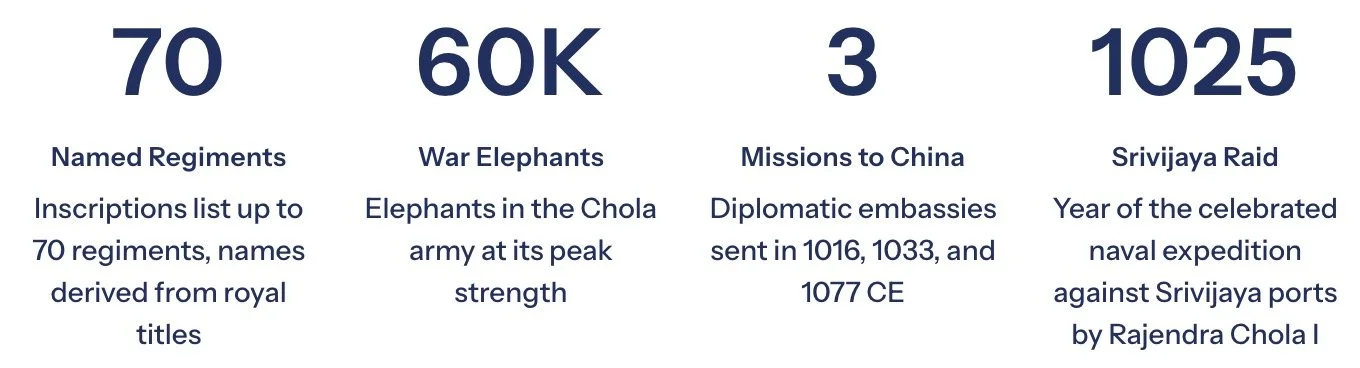
Chola: Military Organisation and Management
Chola: Chola Administration
Local Self-Government under the Cholas
Among the most remarkable achievements of the Chola empire was the development of a sophisticated system of village self-governance that stands as one of the earliest documented experiments in participatory democracy anywhere in the ancient world. The system of village assemblies — the Sabha, the Ur, and the Nagaram — along with their executive committees called Variyams, evolved over centuries and reached its most refined and institutionalised form during the height of Chola rule. What makes this system extraordinary is not merely its existence, but the detailed written evidence that survives in stone, etched into temple walls and assembly halls across Tamil Nadu.
The most celebrated of these records are the two inscriptions discovered at Uttaramerur, belonging to the reign of Parantaka I (907–955 A.D.), dated around 920 A.D. These inscriptions, found in the Kancheepuram district, constitute what scholars have rightly described as a veritable written constitution of a village assembly — a document that guided the election, composition, and functioning of a democratic body over a thousand years ago. Their significance in the history of India cannot be overstated.
The Structure of the Village Assembly: Wards, Qualifications, and Elections
The village of Uttaramerur was divided into thirty wards, with one representative to be elected from each ward. This clear territorial demarcation of constituencies is itself a sign of systematic thinking about representative governance. The assembly, once constituted, was known as the Great Assembly (Mahasabha), and its decisions carried the weight of law within the village.
Qualifications for Candidacy
The inscription prescribes specific qualifications with remarkable precision. A candidate must own more than a quarter veli of tax-paying land and must live in a house built on his own site. His age must be between 35 and 70 years. He must possess knowledge of the Mantrabrahmana, demonstrated by his ability to teach it to others. These criteria ensured that candidates were men of property, maturity, and learning — individuals presumed to have a tangible stake in the welfare of the community.
An important concession was also recorded: even one who owns only one-eighth veli of land could be eligible if he had learnt one Veda and one of the four bhasyas and could explain them to others. This provision demonstrates a degree of flexibility, allowing intellectual merit to partially compensate for lesser property ownership.
Property
Must own at least one-quarter veli of tax-paying land, and reside in a house on his own site.
Age
Must be above 35 years and below 70 years of age at the time of election.
Learning
Must know the Mantrabrahmana, demonstrated by having taught it to others. Alternatively, knowledge of a Veda and a bhasya sufficed.
Character
Must be virtuous, conversant with business affairs, possess honest earnings, and must not have served on any committee during the previous three years.
Disqualifications
Equally detailed were the disqualification norms. Any person who had served on a committee but had not submitted his accounts was barred from standing — and so were his close relatives, including sons, fathers, brothers, sons-in-law, fathers-in-law, uncles, and sisters-in-law. Those guilty of serious moral transgressions — incest, the first four of the five great sins, theft, or the taking of forbidden food — were permanently ineligible. Even those who had undergone expiatory ceremonies for such sins were excluded for life. The inscription is unambiguous: "All these thus specified shall not to the end of their lives have their names written on the pot-ticket."
Governance Mechanism
The Kudav Olai: Mode of Election and Committee Formation
The election procedure described in the Uttaramerur inscription is one of the most detailed accounts of any ancient electoral process anywhere in the world. The method employed was the Kudav Olai, or pot-ticket system — a form of sortition (selection by lot) designed to prevent favouritism, bribery, and factionalism.
The Election Procedure
Names of eligible candidates from each of the thirty wards were inscribed on tickets. These tickets were bundled into thirty separate packets, one for each ward, and placed into a pot. On election day, a full meeting of the Great Assembly was convened — remarkably, the inscription stipulates that the entire village, including infants, had to be present. Only the sick and those who had gone on a pilgrimage were exempt from attendance. Temple priests (Numbimar) present in the village on that day were seated in the inner hall of the assembly mandapa without exception.
The eldest among the temple priests would stand and hold the pot aloft so as to be visible to all. A young boy — chosen precisely because he could not know the contents — would draw one packet, transfer it to an empty pot, and then draw a single ticket from it. This ticket was handed to the arbitrator (madhyastha), who received it on his open palm and read the name aloud. The priests confirmed the reading, and the name was accepted. This process was repeated for all thirty wards.
Formation of Committees
From the thirty elected members, specific committees were constituted. Those previously experienced on committees, more learned, and more senior in age were selected for the prestigious Annual Committee. Of the remaining members, twelve formed the Garden Committee and six formed the Tank Committee. These latter two were also chosen by the pot-ticket method.
Annual Committee
Most senior and learned members. General oversight of village affairs. Supervised the other committees.
Garden Committee
12 members. Responsible for the maintenance and regulation of gardens and horticultural resources of the village.
Tank Committee
6 members. Managed irrigation tanks, water supply, and relief during drought — critical in agrarian Tamil Nadu.
Gold Committee
24 members drawn from a separate round of pot-tickets. Tested and certified gold transactions within the village.
Pancavara Committee
6 members from the separate thirty-ticket draw. Handled specific judicial or administrative functions distinct from the larger committees.
The duration of service for each committee was three hundred and sixty days, after which members retired. Should any member be found guilty of an offence during his tenure, he was to be removed immediately, and a fresh selection by pot-ticket was made for the vacated position. The inscription also carefully specifies the role of the accountant: no accountant could be reappointed until he had submitted his accounts for the previous period and been declared honest by the big committee — a striking anticipation of modern audit principles.
Critical Analysis
Democratic Features and Their Limitations
The Uttaramerur inscription presents a picture of local governance that is, in many respects, genuinely remarkable for its time. The existence of fixed electoral procedures, term limits, disqualification norms, accountability of committee members, and even the right of villagers to recall elected representatives who failed in their duty — all these elements suggest a sophisticated civic culture operating a full millennium before modern democratic institutions took shape in the West. The declaration recorded in the inscription captures the spirit of the enterprise beautifully:
"We, the members of the assembly of Uttaramerur Caturvedimangalam, made this settlement for the prosperity of our village in order that wicked men may perish and the rest may prosper."
Democratic Features
Elected representatives through a systematic process
Fixed term of office (360 days) with mandatory retirement
Right to recall errant representatives
Mandatory public assembly during elections
Separation of different functional committees
Mandatory audit before reappointment of accountants
Written, publicly inscribed constitutional rules
Villagers' declaration of collective purpose
Limitations and Non-Democratic Features
Election by lot rather than direct voting
Restricted eligibility based on property and caste
Relatives of disqualified persons also barred
No reference to quorum or decision by majority vote
Sabhas predominantly Brahmin; non-Brahmin Urs had separate, lesser status
Central royal authority could intervene in emergencies
Assemblies had to account for royal policy directives
Water access determined which villages had autonomy
Scholars have pointed out several significant structural inequalities within this system. The Sabha was the assembly of Brahmin landholders, governed by stringent criteria of property, lineage, learning, and conduct. The Ur, the assembly of non-Brahmin taxpaying landowners, operated on somewhat different and generally less elaborate criteria. The Nagaram, comprising traders of the nadu, was a body focused on regulating commerce, controlling market centres, levying cesses on shops, and organising trade — it functioned partly as an agent of the monarchy in economic regulation. These distinctions reveal that the Chola local government was a system of differentiated governance rather than a uniformly democratic structure.
Furthermore, geography shaped autonomy in a telling way. Villages situated in the central Kaveri river basin, with assured water supply and high agricultural productivity, were placed under direct royal control. It was in the drier, more peripheral regions that village assemblies exercised greater functional independence. This suggests that royal interest in fertile, revenue-rich zones curtailed local autonomy precisely where it might have been most consequential.
Imperial Relations
The Chola Centre and the Village Assembly: A Negotiated Autonomy
The relationship between the imperial Chola state and its village assemblies was not one of simple subordination or unfettered autonomy, but rather a carefully negotiated coexistence. The Chola polity was, at its apex, an absolute monarchy, and the central government retained the right to intervene in village affairs under emergency conditions. Its officers exercised general supervision over local bodies, and village assemblies were expected to operate within the broad policy framework set by the royal court.
The Uttaramerur inscriptions themselves record that the resolution of the Sabha was made in the presence of an official specially deputed by the King — a royal representative who sat with the assembly while the constitution was being drafted and thus caused "this settlement to be made." The inscription closes with a ringing endorsement from the sovereign: "As long as the moon and the sun endure, committees shall always be appointed by pot-tickets alone" — a royal command that simultaneously legitimised and constrained the electoral process.
Tanjavur Inscriptions
Reveal that Raja Raja I issued direct orders to the Sabha of Cholamandalam to perform specific services in the Brihadeshwara temple, illustrating the capacity of the Chola king to direct even autonomous assemblies towards royal religious objectives.
Taniyur Status
Important brahmadeyas (Brahmin land grants) were elevated to taniyur status — meaning "separate village" — granting them considerable functional autonomy and treating them as independent entities within the Chola administrative framework.
Nagaram as Royal Agent
Local assemblies like the Nagaram served as agents of the monarchy in regulating trade and markets. The assessment and collection of revenue were undertaken by assemblies — Ur, Sabha, and Nagaram — who then passed the revenue on to the centre.
Mutual Deliberation
In matters affecting people of more than one assembly, decisions were taken by mutual deliberation between the assemblies concerned, demonstrating a capacity for inter-assembly cooperation within the broader Chola administrative architecture.
Local administration through the assembly units greatly lightened the burden of the central government, enabling a vast empire to be governed without an impossibly large bureaucracy. Crucially, it gave the population a channel through which to air grievances and resolve problems locally, thereby strengthening the state by minimising opposition to central authority — people could not hold the emperor responsible for matters handled by their own assemblies.
Conclusion
Assessment: The Legacy of Chola Local Self-Government
The Chola system of local self-government represents one of the most sophisticated experiments in decentralised civic administration in the ancient world. The Uttaramerur inscriptions, carved into stone over a thousand years ago, preserve for us not merely a historical curiosity but a living testament to the ingenuity of early Tamil political thought. The detail with which electoral procedures, qualification norms, committee functions, accountability mechanisms, and the rights of recall were codified suggests a civic culture of considerable maturity and self-awareness.
Yet a measured scholarly assessment must resist the temptation of anachronistic idealisation. The village assemblies of the Chola period were democratic in some of their practices, but they were not democratic in the modern sense of the term. Participation was restricted by property, learning, caste, and gender. The lot system, while admirably resistant to electioneering and bribery, was not a system of direct popular choice. The relationships between Brahmin Sabhas, non-Brahmin Urs, and trader Nagarams reflected the hierarchical social order of medieval South India. And the overarching authority of the Chola monarchy set the ultimate limits upon local autonomy.
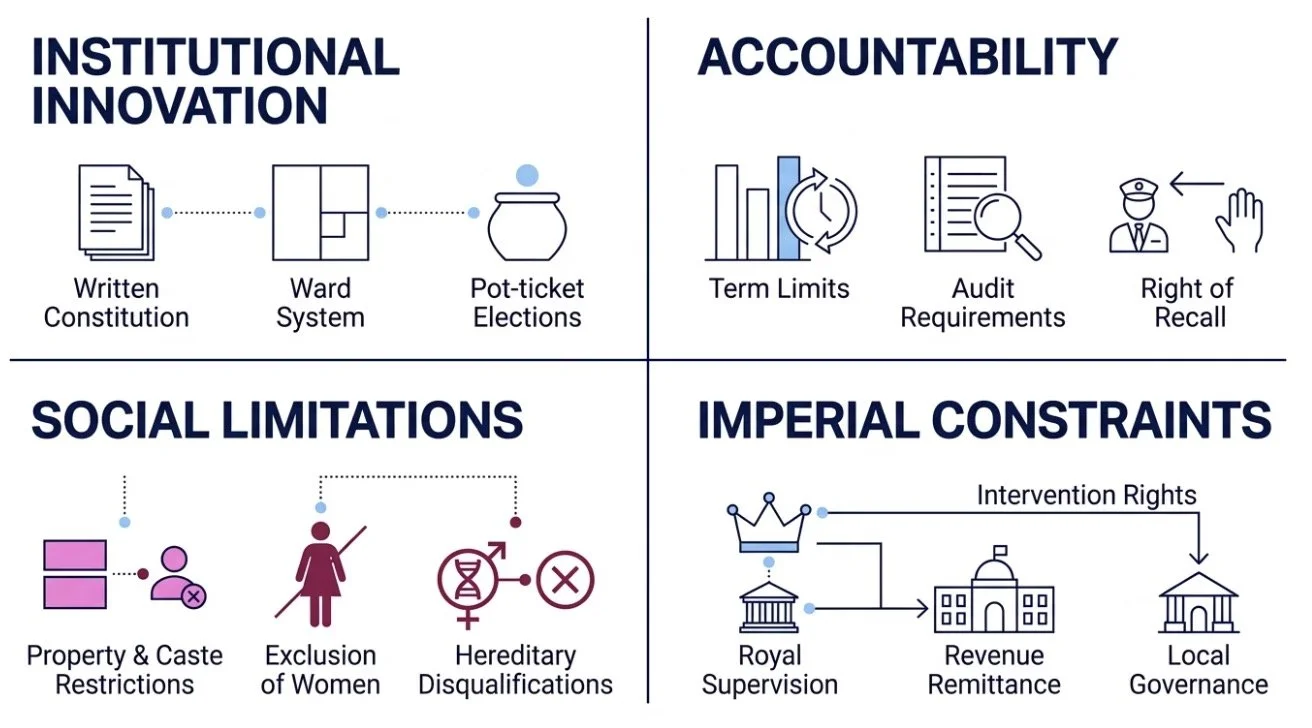
Chola Local Self-Government
What is beyond dispute is that the Chola village assemblies represent a genuine and historically significant form of participatory local governance. The adjustment of the Chola centralised administrative structure with local self-government was a deliberate and largely successful balancing act. By devolving real power to village bodies — power over taxation, irrigation, temple maintenance, roads, commerce, and justice — while retaining ultimate sovereignty at the imperial centre, the Chola state achieved a remarkable equilibrium between central authority and local autonomy.
For students of Indian history and political thought, the Uttaramerur inscriptions offer an invaluable window into this world. They remind us that the ideals of civic participation, accountable governance, and the rule of a written constitution are not exclusively modern or Western inventions — they flourished, in their own form, under the shade of the Chola mandapa, a millennium ago, in the heart of Tamil Nadu.
Key Takeaway: The Chola village assembly system — documented most fully at Uttaramerur — represents a historically significant form of structured local self-governance, combining written constitutional rules, electoral procedures, and committee accountability, while operating within the broader framework of Chola imperial authority and the social hierarchies of medieval South India.
Chola Art and Architecture
The Chola dynasty stands as one of the most magnificent civilisations in the history of South India, leaving behind a legacy of monumental temple architecture, exquisite sculpture, and vibrant performing arts. Rising to dominance after the Pallavas, the Cholas extended their reach from the shores of Tamil Nadu to Bengal, Sri Lanka, Java, and Sumatra, establishing one of the most powerful maritime empires of the medieval world. Their cultural and military achievements found enduring expression in stone and bronze — in temples that still stand tall across the Kaveri delta and beyond.
The Chola Dynasty: Rise and Reach
After the decline of the Pallavas, the Chola dynasty emerged as the dominant power of Southern India, consolidating its authority over rival kingdoms and expanding its influence far beyond the subcontinent. With their capital firmly established at Thanjavur, the Cholas became synonymous with grandeur, military prowess, and cultural sophistication. Their armies advanced as far as Bengal and Sri Lanka, while their naval expeditions carried Chola influence to the distant shores of Java and Sumatra. Trade networks stretched across maritime Southeast Asia, connecting the Kaveri delta with the civilisations of Indonesia, the Srivijaya empire (Sumatra), and Chavakam (Java).
This extraordinary reach — military, commercial, and cultural — found its most permanent expression in architecture. The grand temples built at Thanjavur, Gangaikondacholapuram, Darasuram, and Tribhuvanam were not merely places of worship; they were statements of imperial power, theological vision, and artistic mastery. The Cholas constructed more than two hundred temples, each representing a continuation and transformation of the architectural legacy inherited from the Pallavas.
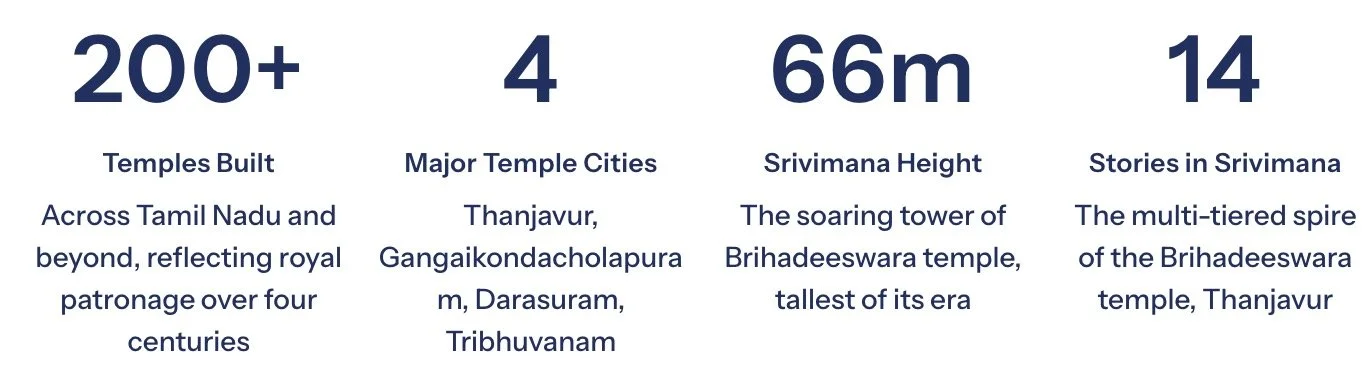
The Chola Dynasty: Rise and Reach
The dynasty's early rulers, such as Vijayalaya Chola, began with brick temples before transitioning to stone construction. Vijayalaya's temple at Narttamalai is considered one of the finest examples of early Chola temple architecture in stone. Subsequent rulers — Aditya I, Parantaka I, Rajaraja I, and Rajendra Chola — each added to this architectural canon, building temples that grew in ambition, scale, and artistic refinement with every generation.
Features of Chola Temple Architecture
Chola temples represent a distinct and evolved phase within the Dravidian architectural tradition. Broadly categorised into two groups — early temples influenced by Pallava architecture, and later temples showing Chalukya influence — they display a coherent visual language that grew increasingly monumental over time. The early examples were modest in scale, while the later ones were defined by vast enclosure walls, soaring vimanas, and elaborate gopuras that commanded the surrounding landscape.
Structural Composition
Garbhagriha (inner sanctum), antarala, and sabhamandapa as core components
Many temples feature arthamandapa, mahamandapa, and nandi mandapa
Panchayatan style but without vimanas on subsidiary shrines
Presence of a water tank within the boundary wall
Sanctums both circular and square in plan
Decorative and Material Features
Spire in the form of a stepped pyramid (Vimana); octagonal shikhara crowning element
Absence of lion motifs at pillar bases (unlike Pallava), but Kudu decoration present
Dome-shaped shikhara and kalasa atop vimanas and gopuras
Walls decorated with sculptures and inscriptions
Raw materials: blocks of gneiss and granite
One of the most distinctive characteristics of Chola temples is the high boundary wall that encircles the entire complex — a feature that sets them apart from the Nagara style of North India. Initially, the gopuram (gateway tower) was the most prominent feature, but in the later stages of Chola architecture, the vimana — the towering spire above the main sanctum — took centre stage. The vimana's Pallava-influenced design, with its tiered pyramidal form and octagonal shikhara, became the defining visual signature of the imperial Chola period.
"A special feature of Chola architecture is the purity of the artistic tradition — sculptures and inscriptions fixed on temple walls reflect an unwavering commitment to canonical form and spiritual expression."
Early Chola Temples: A Survey
The early phase of Chola temple construction spans the 9th to early 10th centuries CE and includes a remarkable range of structures that display the dynasty's growing architectural confidence. While these temples are more modest in scale compared to later Chola masterpieces, they are invaluable for understanding the evolution of the Dravidian style under Chola patronage. Each temple reflects the individual contributions of successive rulers and the specific regional contexts in which they were built.
Vijayalaya Chola — Narttamalai Temple
The first stone temple of the Chola dynasty, located near Trichy in Pudukottai district. West-facing, dedicated to Lord Shiva, with four tiers (three square, one circular) in a pyramidal form. Features an oval-shaped shikhara, kudu decoration, carved dwarpalaka figures, and seven subsidiary shrines surrounding the main temple.
Aditya I — Balasubramaniya & Thirukkatalai Temples
The Balasubramaniya temple at Kannanur in the Pudukottai region and the Thirukkatalai temple were both constructed during the reign of Aditya I, marking a period of expanding temple-building activity across the region.
Nageswarar Temple, Kumbakonam
Celebrated especially for its exceptional sculptural work, the Nageswarar temple at Kumbakonam represents an important milestone in the decorative traditions of early Chola architecture.
Parantaka I — Koranganatha Temple & Muvarkoil
The Koranganatha temple at Srinivasanallur (Trichy District) and the Muvarkoil at Kodumbalur are outstanding examples of later Chola architecture and sculpture, showcasing refined craftsmanship and structural maturity.
Kulothunga I — Sun Temple, Kumbakonam
King Kulothunga I built a temple dedicated to the Sun God at Kumbakonam — the first of its kind in South Indian architecture, representing a unique iconographic departure in the Chola temple-building tradition.
Brihadeeswarar Temple, Thanjavur
The Brihadeeswarar Temple, also known as the Big Temple or Peruvudaiyaar Kovil, stands as the zenith of Chola temple architecture, inaugurated in 1010 CE during the reign of Rajaraja I. This monumental structure marks a significant shift in the Dravidian style, moving towards grander scales and a heightened sense of imperial power. Dedicated to Lord Shiva, it was affectionately called 'Dakhina Meru', mirroring the sacred Mount Kailash, and represents a profound spiritual and architectural achievement.
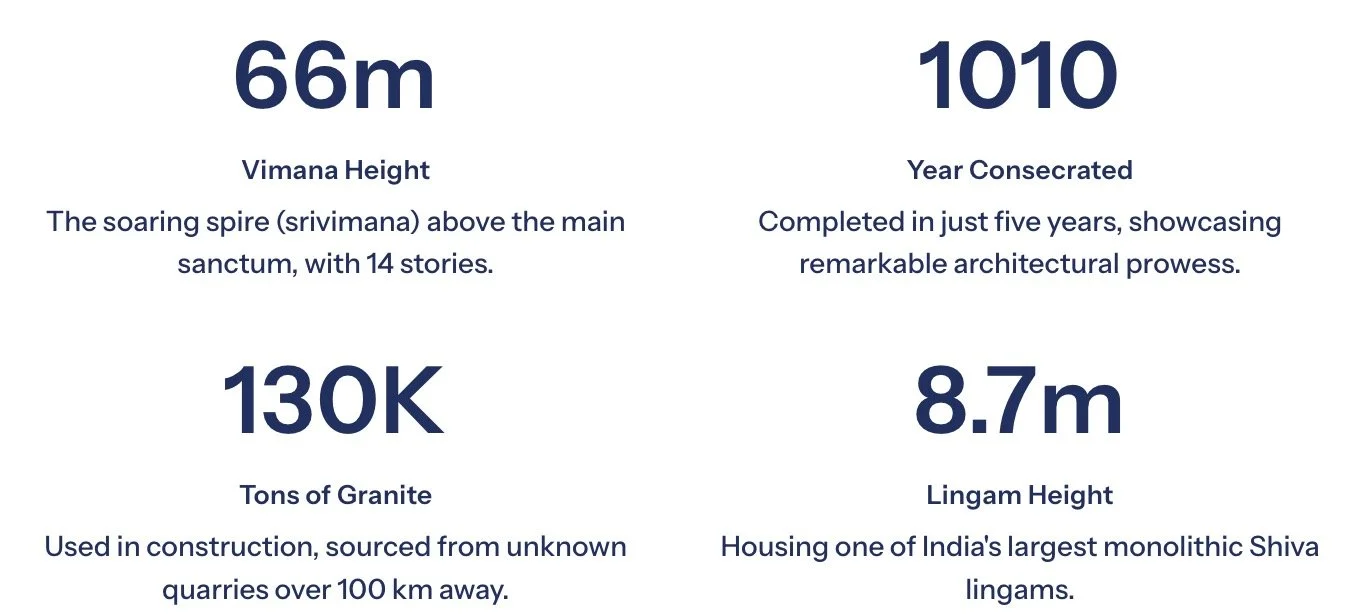
Brihadeeswarar Temple, Thanjavur
A truly unique aspect of the Brihadeeswarar Temple is its exclusive construction using granite, a material not found within a 100 km radius, making it the world's first fully granite temple. The temple complex is enclosed by fortified walls, added in the 16th century, and features three main entrances, including the majestic Keralantakam gopuram, a 30-meter high gateway commemorating Rajaraja I's victory over the Chera king. Inside, the sanctum houses an extraordinary, massive lingam, and the circumambulatory corridor is adorned with exquisite fresco paintings depicting a variety of secular themes, discovered in the early 20th century. This UNESCO World Heritage site is not only a testament to Chola engineering and artistry but also to its enduring strength, having withstood multiple earthquakes.
Airavatesvara Temple, Darasuram
UNESCO World Heritage Site12th Century CE
The Airavatesvara Temple at Darasuram (Kumbakonam, Thanjavur District) was built by Chola emperor Rajaraja II in the 12th century CE. It forms part of the group of Great Living Chola Temples, alongside the Brihadeeswara temples at Thanjavur and Gangaikondacholapuram. Dedicated to Lord Shiva, the temple complex also reverentially displays Vaishnavism and Shaktism traditions, and incorporates legends associated with the Nayanmars — the Bhakti movement saints of Shaivism.
The main temple follows a square plan aligned on an east–west axis, opening to the sunrise. It displays a rich iconographic programme featuring Vishnu, Durga, Surya, Harihara, Ardhanarishvara, and other deities. While considerably smaller than the Brihadeeswara temples — its main tower rises to only 24 metres — the Airavatesvara temple distinguishes itself through its highly ornate and elaborate decorative style. Unlike its predecessors, the inner sanctum is not encircled by a circumambulatory path.
The Chariot Mandapa
The agra mandapa (front pillared hall) is uniquely conceptualised as a horse-drawn chariot, inspired by Pallava architectural traditions. Its columns are richly ornamented with narrative scenes from the epics and Puranas — the burning of Manmatha, Parvati's penance, Shiva's marriage, the birth of Skanda, and battles with asuras. The base of the outer pillars features gaja-yalis with curled trunks and tails.
Nayanmar Friezes & Inscriptions
The base of the main temple features a remarkable stone frieze of panels depicting stories associated with the 63 Nayanmars (Shiva saints). Several panels also depict women in yoga postures and scenes from everyday life. The temple is noted for its numerous inscriptions, though none belong to Rajaraja II himself. Bronze sculptures and artwork on the walls are among its most celebrated features.
Rishaba Kunjaram & Amman Shrine
Carved on a balustrade of a staircase is the celebrated Rishaba Kunjaram — a stone sculpture featuring a conjoined bull and elephant, one of the most iconic images in Chola sculpture. The temple also features a separate Amman shrine, the Periya Nayaki, dedicated to Devi. The perimeter wall has pillared cloisters with cells for deities.
Chola Sculpture and Painting
Stone and metal sculptures are found in abundance in Chola temples, serving both devotional and narrative purposes. They depict the socio-religious ideas of the Chola period with exceptional skill, naturalism, and spiritual depth. Chola sculptors worked within the framework of the Indian Shilpa Shastra and employed the lost wax technique (cire perdue) for casting bronze images — a tradition that produced some of the finest metal sculptures in world art history.
Sculpture Highlights
Nataraja — world-famous for beauty and spiritual meaning; Shiva as the Lord of cosmic dance
Vishnu idols in Vaishnava temples reflect spiritual calmness; Alwar portraits likewise
Narrative panels on temple walls depict scenes from Ramayana, Mahabharata, Puranas, and lives of the 63 Nayanmars
Sculptures decorate walls, pillars, and roofs throughout the temple complex
Best portrait specimens: walls of Koranganatha and Nageswarasamy temples; portraits of Cholamadevi and Kulothunga III at Kalahasti temple
Paintings
The art of painting flourished during the Chola period with a strong emphasis on realism. Figures were painted with lifelike detail and compositional confidence. Key sites include:
The Big Temple at Thanjavur — fresco paintings in the circumambulatory corridor, with secular themes
Kailasanathar temple, Kanchipuram — beautifully depicted scenes from the Periyapuranam
Vishnu temple at Malaiyadipatti — fine specimens of Chola painting
Rajaraja I and Rajendra Chola were the primary royal patrons who contributed most to the development of painting during the Chola period, commissioning works that blended devotional content with accomplished artistic technique.
The sculptures of the Imperial Cholas are widely regarded as the cultural epitome of the period. Realism dominated, and the Cholas surpassed the Pallavas in the art of portrait making — a form that captured both divine and royal subjects with remarkable individuality and psychological presence.
Music, Dance, and Drama Under the Cholas
The Chola kings were not merely builders of temples; they were dedicated patrons of the performing arts. Music, dance, and drama flourished under their rule, institutionalised within temples and courts, and supported through endowments that ensured their continuity across generations. The performing arts were considered inseparable from religious life, and the grandeur of Chola temple culture was as much sonic and kinetic as it was architectural.
🎵 Music
Twenty-three panns (melodic modes) were used in Chola-period music. The seven swaras — sa, ri, ga, ma, pa, da, ni— formed the foundation of the musical system. The hymns of the Alwars and Nayanmars were sung in every temple. Nambiandar Nambi and Nathamuni contributed significantly to the development of music, and formal books were written on musical theory. Several musicians were permanently appointed in the Brihadeeswara temple; Sagadakkottigal formed a professional group of musicians. Endowments were made to promote music, and temples and mutts imparted training in vocal and instrumental music. Key instruments included drums, udukkai, veena, and flute.
💃 Dance
Bharatanatyam and Kathakali were the two principal dance forms performed during the Chola period. Lord Shiva was revered as the exponent of Karana dance, and temples such as the Natarajar temple at Chidambaram and the Sarangapani temple at Kumbakonam prominently feature dancing poses of Lord Nataraja. Rajaraja I appointed 400 devadasis (dancing girls) at the Big Temple at Tanjore, supported by two dance directors. Dance dramas were performed on stages during festival seasons, and Chola kings made formal endowments to sustain the art.
🎭 Drama
The Cholas actively promoted drama as an art form, with music and dance considered integral elements of theatrical performance. Multiple types of theatres and stages were constructed. Rajarajeswara Natakam and Rajarajavijayamwere among the notable dramas enacted during festival times. Koothu was a celebrated form of performance art; inscriptions record various types including Ariyakuthu, Chakki Koothu, and Santhi Koothu. Drama actors received royal honours, and the Chola court's support for theatrical traditions helped sustain a rich performative culture alongside temple worship.
The Chola contribution to the performing arts was structural as well as aesthetic — by institutionalising music, dance, and drama within temple life and funding them through formal endowments, the dynasty ensured that these art forms survived and evolved well beyond the empire's political lifespan.
Legacy and Influence of Chola Art
The Chola dynasty's cultural and architectural legacy extends far beyond the boundaries of Tamil Nadu. Their temple-building traditions, sculptural canons, and performing arts not only shaped subsequent South Indian dynasties but also radiated outward to influence the architecture of Sri Lanka and the temple traditions of Southeast Asian kingdomssuch as Srivijaya (Sumatra) and Chavakam (Java). The temples constructed between the 8th and 12th centuries CEserved as living models for builders across the Bay of Bengal.
The designation of the Brihadeeswara Temple (Thanjavur), the Gangaikondacholisvaram Temple, and the Airavatesvara Temple as UNESCO World Heritage Sites under the collective title "Great Living Chola Temples" is a recognition not just of their architectural grandeur, but of their continued vitality as places of active worship and cultural continuity. These temples remain living institutions, not museum pieces — a testament to the enduring power of the Chola vision.
The Chola period represents a watershed moment in Indian art history. The precision of the Nataraja bronze, the soaring ambition of the Brihadeeswara vimana, the narrative richness of temple frescoes, and the institutional depth of music and dance patronage together constitute a cultural achievement of extraordinary scope. For students of South Indian history, the Chola legacy offers an incomparable window into the intersection of faith, power, aesthetics, and human creativity at their most magnificent.
Architecture
Over 200 temples built; pioneered the fully granite temple; established the Dravidian vimana as a defining form in South Asian religious architecture
Sculpture & Bronze
Lost wax bronzes of unmatched quality; narrative temple friezes; world-renowned Nataraja image; advanced portrait tradition surpassing the Pallavas
Painting
Realistic fresco tradition in temple corridors; scenes from Puranas and Bhakti literature; continued and enriched at Kanchipuram and Malaiyadipatti
Performing Arts
Institutionalised music, dance, and drama within temple life; patronage through endowments; Bharatanatyam and Koothu tradition sustained for centuries
Cholas: Economy, Society, Education and Literature
The Chola dynasty, one of the longest-ruling dynasties in South Indian history, presided over a period of remarkable transformation in social structures, economic dynamism, and literary flourishing. This document provides a comprehensive overview of the social conditions, caste hierarchies, economic systems, trade networks, and the rich literary heritage that defined Chola civilisation. Drawing upon inscriptional evidence and the scholarship of eminent historians such as Prof. K.A.N. Sastri and Nilakanda Sastri, we trace the contours of life under the Imperial Cholas — a civilisation that, as Sastri notes, constitutes "the most creative epoch of South Indian history."
Social Conditions
Caste, gender, marriage, customs and daily life
Economic Conditions
Agriculture, taxation, trade, weights and coins
Literature
Saivite, Vaishnavite, Jain, Buddhist and grammatical works
Social Conditions Under the Cholas
Social life during the Chola period underwent a drastic transformation. The most defining characteristic of Chola society was its rigid caste system. Society was organised on the basis of caste, and distinctions between communities were deeply entrenched. Varnashrama Dharma was strictly observed, and the position of each individual in society was largely determined by birth. Despite this rigidity, several scholars point to a degree of cooperation among various castes and sub-castes in matters of social and religious life — suggesting that the boundaries, while firm, were not entirely impermeable in community participation.
The Brahmins occupied the apex of the social pyramid. They lived in exclusive settlements known as Agraharams and Chaturvedi mangalams, villages reserved solely for Brahmin habitation. These communities were granted tax-free lands by the Chola rulers, a privilege that consolidated Brahmin dominance both economically and intellectually. Brahmins were deeply learned in the Vedas, Upanishads, and Puranas. Their scholarship extended to public narration of the great epics — the Ramayana and the Mahabharata — at public Mandapas, serving as both educators and spiritual guides to the wider population. They also held high governmental positions, including that of Rajaguru, the royal preceptor.
Beyond the Brahmins, the Chetties — the mercantile community — formed an important and influential section of Chola society. Other notable communities included the Vellalas (cultivating landowners), Idayars (pastoral communities), Kaikolars (weavers), Rathakaras (craftsmen), and Paraiyas. Each community occupied its own social niche, bound by occupation, ritual practice, and tradition. Land donations made to Brahmins were categorised under specific tenures such as Irayili–Vedhavirudhi, Pattaviruthi, and Puranaviruthi, all of which are confirmed by inscriptional records.
Brahmins
Lived in Agraharams; held Rajaguru positions; tax-free land grants; proficient in Vedas and Puranas
Chetties
Influential merchant community; engaged in trade and commerce; key figures in economic life
Vellalas & Kaikolars
Vellalas were cultivating landowners; Kaikolars were skilled weavers integral to the textile economy
Paraiyas & Rathakaras
Artisan and labour communities; formed the foundational workforce of Chola agrarian economy
The Idangai and Valangai Division
One of the most distinctive and historically significant social divisions of the Chola period was the bifurcation of society into two broad classes: Idangai (Left-hand caste) and Valangai (Right-hand caste). Each class encompassed 98 sub-castes, making this a remarkably comprehensive social categorisation. The Valangai class comprised the wealthier, more privileged sections of society who enjoyed the patronage and favour of the government. The Idangai, by contrast, consisted largely of working communities and artisans who did not enjoy equivalent governmental privileges. Members of the Idangai were obligated to pay taxes — including land tax and house tax — whilst being denied the social recognition accorded to the Valangai.
A striking aspect of this division was that both Valangai and Idangai maintained separate temples for worship. The Idangai communities worshipped Goddess Parvathi and Kali, whilst the Valangai venerated Lord Siva and Tirumal. This religious segregation mirrored the social separation and deepened communal identities over time. Prof. K.A.N. Sastri makes reference to a later inscription from Aduturai which records the hardships endured by the 98 sub-sects of the Idangai at the hands of Vanniya tenants, Brahmin and Vellala landlords, all backed by government officials — indicating systemic exploitation of the lower-status class.
Nilakanda Sastri notes that the origin of this division remains unknown. Legend attributes it to the design of Karikala Chola, though Sastri suggests with greater plausibility that it arose from a famous occasion when the two sections of the population brought their disputes before a Chola king — one party standing to the right of the monarch, the other to the left. During the reign of Rajaraja I, several regiments of the army were counted as belonging to the Valangai. The tensions between these two groups occasionally erupted into violence: during the rule of Kulottunga I, a clash between Right and Left hand castes resulted in the burning of the village of Rajamahendra Chaturvedi mangalam.
Valangai (Right-Hand)
Wealthy and privileged communities
Enjoyed government favour and patronage
98 sub-castes included army regiments
Worshipped Lord Siva and Tirumal
Had separate temples of higher status
Idangai (Left-Hand)
Workers and artisans; fewer privileges
Paid land tax, house tax and other levies
98 sub-castes including weaving communities
Worshipped Goddess Parvathi and Kali
Faced exploitation by landlords and officials
Position of Women, Marriage, and Social Customs
Women in Chola society occupied a position that was, by the standards of the era, relatively privileged — though nuanced and stratified by class. Inscriptional evidence confirms that women of the upper classes owned property in their own right and had the legal authority to dispose of it as they chose. This suggests a degree of economic autonomy that was not universal but was certainly acknowledged. Women were respected and engaged in various occupations, particularly smaller trades and crafts, though their overall social mobility remained constrained by the prevailing caste and patriarchal norms.
Devadasis — women dedicated to temple service — received grants and donations that provided them economic security. Some Devadasis were married and led domestic lives, contrary to later stereotypes. Social prestige and freedom were notably available to accomplished dancing girls of the higher grade, several of whom became renowned for their philanthropic contributions to public and religious causes. Learned women also existed within Chola society, as evidenced by literary and inscriptional references. Members of the royal family played particularly distinguished roles: Sembian Mahadevi, Vanavanmadevi, and Kundavai were all noted for their religious devotion and patronage of temple construction, leaving indelible marks on the cultural and architectural landscape.
On the subject of marriage, monogamy was the common practice among the general population, while polygamy was found among the wealthy and among kings. Marriages were held only during daylight hours. Dowry was neither customary nor compulsory, though gifts were often given to bridegrooms in the form of land, house, or cash — known as Sridhanam or Seethanam. Social organisation was broadly based on blood relations, professional affiliations, religious belief, and environmental context.
The practice of Sati is mentioned in inscriptions, but the references are few, leading scholars to conclude that it was hardly a common practice in the Tamil country under the Cholas. Many women lived on after the death of their husbands; Sembian Mahadevi is a celebrated example who rendered remarkable service to religion following the death of her husband. Some women conducted religious festivals at Siva temples on behalf of their deceased husbands, reflecting a culture of piety and devotion that transcended widowhood.
Royal Women
Sembian Mahadevi, Vanavanmadevi and Kundavai were patrons of temple construction and deeply religious figures
Property Rights
Women of upper classes owned and disposed of property independently, confirmed by inscriptional records
Devadasis
Temple women received economic grants and donations; some were married; accomplished ones attained social prestige
Marriage Customs
Monogamy was common; dowry (Sridhanam) was optional; marriages conducted only during daylight hours
Daily Life: Food, Dress, Amusements, and Beliefs
Food and Diet
The diet of the Chola-period Tamil people was simple yet varied. Rice was the staple grain, supplemented by millets, pulses, gingili (sesame), and green grams. Common preparations included curd rice, milk rice, and tamarind rice. Ghee was used in cooking. The Jain saints followed a particularly austere diet of rice, roots, and bananas. The culinary culture reflected the agrarian abundance of the Kaveri delta and the diverse community traditions of the region.
Dress and Ornaments
The Tamils of the Chola period wore simple garments fashioned from cotton and silk. Men typically wore two garments — a dhoti and a turban. Women wore upper and lower garments; the upper garment was known as Kachchai. Women folded the saree and inserted the frills on the left side of the hip, a style indicative of tailoring knowledge. Cosmetics were used, mirrors were common household items, and umbrellas were in use. Flowers were worn as adornments, and kumkum was applied to the forehead. Women's jewellery included bangles, necklaces, armlets, waist belts, and anklets.
Amusements and Pastimes
The leisure pursuits of the Chola period were spirited and diverse. Popular pastimes included cock-fighting, horse racing, elephant racing, hunting, wrestling, dance, music, and drama. These activities reflect a society that balanced the rigours of agricultural and craft-based labour with vibrant communal entertainment. Performing arts — dance and music particularly — were deeply intertwined with temple culture and religious festivals, blurring the line between entertainment and devotion.
Beliefs and Superstitions
The people of the Chola period held certain blind beliefs and superstitions alongside their formal religious practices. They believed in the existence of ghosts and held that Margosa (neem) leaves could ward off evil spirits. Augury was practised — people predicted future events based on the sounds made by birds. These popular beliefs coexisted alongside the sophisticated theological frameworks of Saivism, Vaishnavism, and other traditions, reflecting the layered spiritual life of Chola-period Tamil society.
Economic Conditions: Agriculture and Irrigation
Agriculture was the pivot of the Chola economy. It was the primary occupation of the vast majority of the population. The independent peasant proprietor formed, as Sathyanatha Iyer observes, the backbone of social life — then as now. The Chola rulers undertook deliberate and sustained efforts to bring more land under cultivation, transforming the agricultural landscape of the Tamil country. Forests and wasteland were progressively reclaimed and brought under the plough, reflecting an expanding agrarian frontier driven by both royal initiative and community effort.
The proper utilisation of the waters of the Kaveri was central to Chola agricultural policy. This was supplemented by the construction of great tanks, the most notable among them being the Vairamegha Tataka at Uttaramerur. Canals were dug from rivers for irrigation and the maintenance of tanks, forming an elaborate hydraulic infrastructure that sustained the densely settled agricultural communities of the Kaveri delta. Land was possessed both by individuals and by communities, with various tenures including peasant proprietorship. Land was also donated freely by rulers to Brahmins as Ekabhoga villages and as Devadanam land — land dedicated to the support of temples. The care of cattle used for cultivation was also given importance, underscoring the integrated nature of agrarian management under the Cholas.
Rivers Used for Irrigation
Mudikondan River
Vira Chola North River
Madhurantaka North River
Vikraman River
Tanks Constructed by Chola Rulers
Kandaradhitha Big Tank
Viranarayanan Tank
Madhurantaka Big Tank
Sundara Chola Big Tank
Land Tenure Systems
Peasant proprietorship
Ekabhoga villages (Brahmin grants)
Devadanam (temple land donations)
Community-held agricultural lands
Taxation
The Chola state maintained a systematic and comprehensive system of taxation. The primary land tax was known as Purav, later called Irai or Kadamai. Tax-free lands were designated as Iraiyili. A wide variety of taxes were levied on different economic activities. Kudimai was collected from those who cultivated lands; Ankadipattam and Nilanirpattam were levied on those who used water from tanks; Kusakkanam was a tax on potters; Tharigurai was a tax on weavers; and Ilamputchi was a tax on toddy tappers. Tax evaders were punished, and the responsibility for collecting land and other taxes rested with Village Sabhas, which deposited the revenues into the government treasury.
Trade, Commerce, and Coins
The Chola economy was not merely agrarian — it was also characterised by vibrant internal and external trade networks. Craftsmen and artisans formed the productive backbone of commerce: weavers produced cloth, blacksmiths crafted iron implements, and goldsmiths fashioned gold and silver ornaments. There existed well-organised guilds — functioning as chambers of commerce — that protected the interests of merchants and regulated trade practices. Nilakanda Sastri observes that "the metal industries and the jewellers' art had reached a high state of perfection" during the Chola period.
Important centres of salt manufacture existed at Kanyakumari, Variyur, and Ayturai. The road network was maintained by local authorities; the better class of roads were known as Peru Vali (trunk roads), connecting distant parts of the country. Among these were the Andhra road (Vadugapperuvali) and the road to Kongu (Kongupperuvali). The Nanadesis were a powerful autonomous corporation of merchants whose trading activities transcended political boundaries — a remarkable feature of Chola commercial organisation.
The Chola country had brisk foreign trade. Ships from China and Arabia called at the Cholamandalam ports. The Cholas had trading contacts with China, Indo-China, Ceylon, Sumatra, and Java. Exports from the Chola country included pearls, ivory, cardamom, pepper, perfumes, cotton textiles, and coral. Horses were imported from the Arabs; those who purchased and resold horses within India were called Kudirai Chetties. The Chola country also had maritime contact with South East Asian countries and with Arabia and Persia. The barter system remained in practice alongside monetary exchange. Traders were also known as Nagarathar and Manikiramattar, and bonds were used as instruments for obtaining loans. Nilakanda Sastri notes that the extensive trade described by Marco Polo and Wassaf in the early fourteenth century could not have arisen suddenly, and its origins must be traced to Chola times.
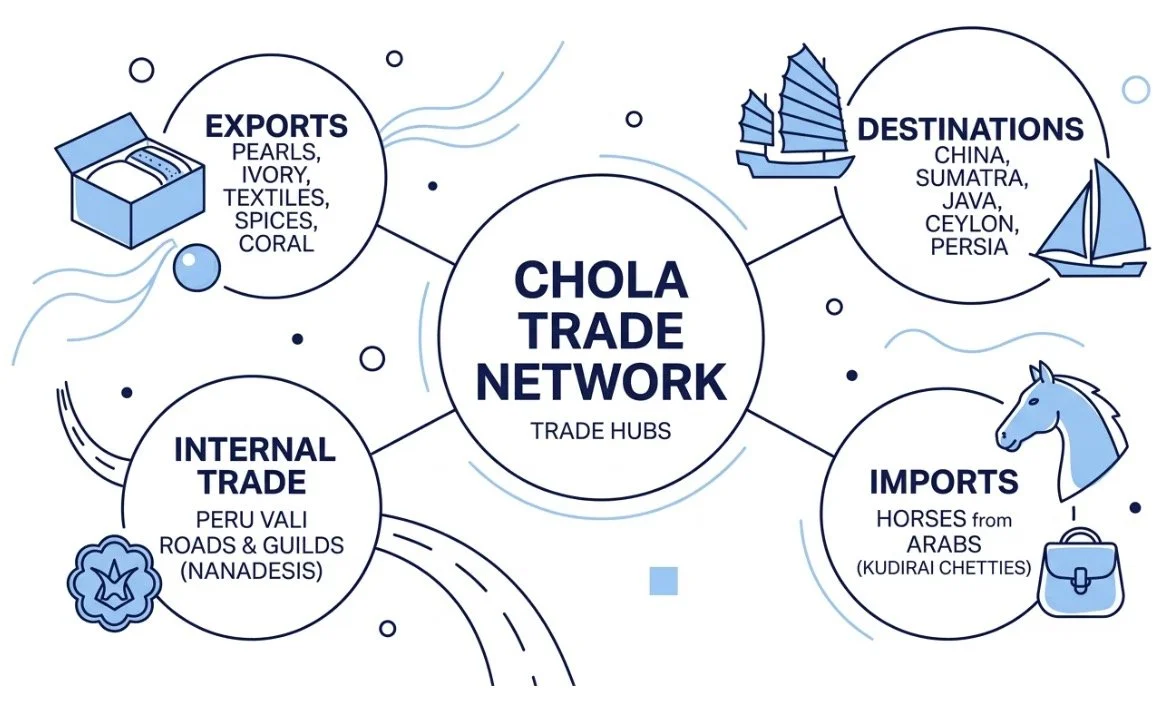
Chola: Trade, Commerce, and Coins
Weights, Measures, and Coins
Weights and Measures
A variety of standardised weights and measures were used for commercial transactions. Grains were measured using pidi, alakku, ulakku, and uri. Cubic measures included Ma, Kuruni, manjadi, and Kalanju. Linear measures were the viral, jan, and mulam. These standardised systems facilitated fair exchange across the diverse markets of the Chola kingdom.
Coins in Circulation
Coins of gold, silver, and copper were all in circulation during the Chola period. Tiger and fish symbols — emblematic of Chola dynastic identity — were inscribed on the coins. Kalanju, Manjadi, and Kachchanam were common denominations. Pon was the name of the gold coin, while Kasu was a copper coin used in everyday transactions.
Literature of the Chola Period
The Chola period was a golden age of Tamil literature. As Prof. K.A.N. Sastri famously asserts: "In literature as in most other spheres, the age of the Imperial Cholas constitutes the most creative epoch of South Indian history." The country produced a remarkable constellation of literary figures during this period — among them Kambar, Sekkilar, Meykandar, Puhalendi, Pattinathar, and Ottakkuttar. The literary output of the Chola period was diverse, spanning devotional, philosophical, epic, grammatical, and narrative traditions. It can be broadly classified into the following categories:
Saivite Works
Tirumarai compilations, Tevaram, Thiruvasakam, Periapuranam
Vaishnavite Works
Nalayira Divya Prabandham, Tiruppavai, Kambar's Ramayana
Jain Works
Jivaga Chintamani, Valayapathi, Neelakesi, Udayanakumara Kaviyam
Buddhist Works
Kundalakesi, Chulamani — depicting Buddha's life and philosophy
Grammatical Works
Virasoliyam, Nannul, Thandialankaram, commentaries on Tolkappiyam
Other Works
Kalingathu Parani, Moovarulavu, Kulothunkan Pillai Tamil and moral works
Saivite and Vaishnavite Literary Works
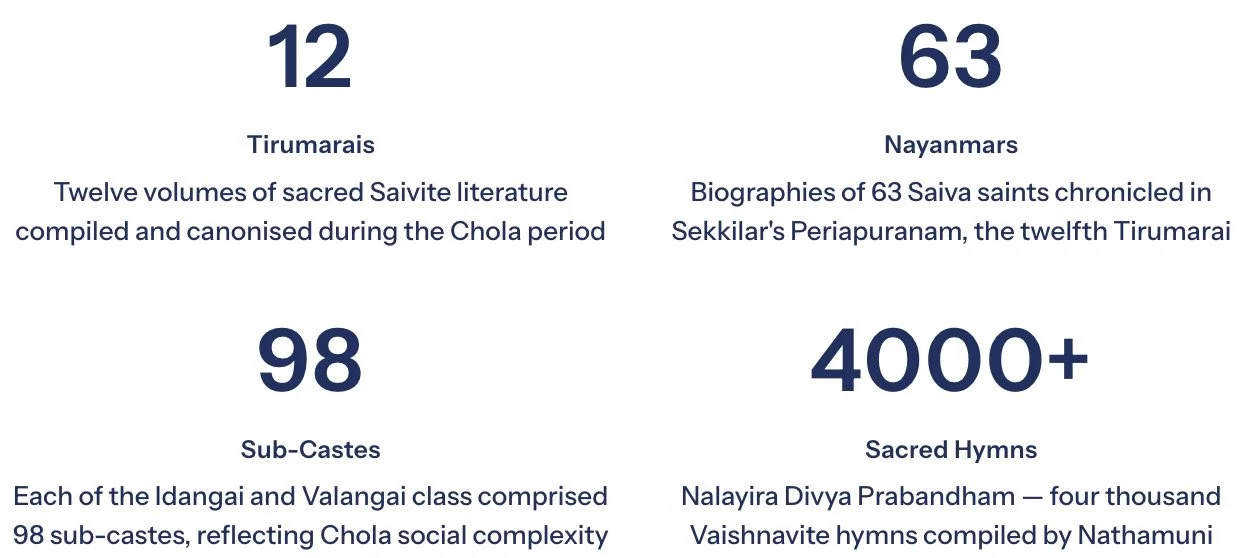
The Saivite literary tradition reached its zenith during the Chola period with the compilation and canonisation of the Tirumarai (Divine Literature). During the reign of Rajaraja I, the scholar Nambi compiled the devotional hymns of the three great Saivite poet-saints — Sambandar, Appar, and Sundarar — into seven volumes: the first three Tirumarais comprising the hymns of Sambandar, the next three those of Appar, and the seventh the hymns of Sundarar. Collectively, these seven compilations are called the Tevaram.
The Thiruvasakam, written by Manikkavasagar, constitutes the eighth Tirumarai. The ninth consists of the hymns of nine saints; the tenth is Tirumular's Tirumantiram. The eleventh Tirumarai comprises the hymns of many poets. The twelfth and most celebrated Tirumarai is the Periapuranam, composed by Sekkilar, a minister in the Chola court. This monumental work contains the biographies of the 63 Nayanmars (Saiva saints) and was written in the 12th century A.D. Nilakanda Sastri remarks that the Periapuranam "worthily commemorates the great age of the Imperial Cholas and their sustained devotion to Saivism." The Kalladum was composed by Kalladanar and refers to the miracles wrought by Siva, believed to belong to the 10th century A.D.
The Vaishnavite tradition was represented by the compilation of the Nalayira Divya Prabandham — the four thousand sacred hymns of the twelve Alvars — by Nathamuni. The early three Alvars (Pei, Poykai, and Pudam) belonged to the pre-Pallava period. The hymns of Andal's Tiruppavai spread beyond Tamil Nadu into South East Asia, demonstrating the pan-Asian reach of Chola cultural influence. Ramanuja, the great Vaishnavite philosopher and expounder of Visistadvaita, wrote commentaries on the Vedas. Kambar, one of the greatest Tamil poets, composed the Tamil Ramayana in the twelfth century A.D., a masterpiece of Tamil literary art that endures as a pinnacle of classical Tamil poetry.
10th Century A.D.
Nambi compiles Tevaram under Rajaraja I; Kalladum composed by Kalladanar
11th Century A.D.
Nalayira Divya Prabandham compiled by Nathamuni; Ramanuja writes Vedic commentaries
12th Century A.D.
Sekkilar's Periapuranam (12th Tirumarai) composed; Kambar's Ramayana completed
Jain, Buddhist, Grammatical and Other Literary Works
Jain Works
The Jivaga Chintamani, an epic poem, was composed by Thiruttakka Thevar. Beyond its religious content, this work is celebrated for its vivid description of nature and its excellent use of simile and ethical instruction, making it one of the gems of Tamil literature. The Valayapathi is another Jain work of the period. The Neelakesi, authored by an unknown writer, emphasises ahimsa (non-violence) and contains ethics; it comprises 894 verses. Another Jain work, Udayanakumara Kaviyam, contains 367 poems. Other contributions include Yashodha Kavyam and Meru Manthara Puranam.
Buddhist Works
The Kundalakesi, a Buddhist literary work, was authored by Nathakuthanar. It describes the life of the Buddha and offers a critique of other religious philosophies. Only 19 poems of the Kundalakesi survive, making it a fragmentary but precious document of Buddhist Tamil literature. The Chulamani, written by Tholamoli Thevar, is another Buddhist work of significance, containing 2,331 verses — a substantial literary achievement.
Grammatical Works
The Chola period also witnessed significant advances in Tamil grammatical scholarship. Iraiyanar Kalaviyal and Nambi Ahapporul were treatises on Akam (interior poetry). Purapporul Venbamalai was a treatise on Puram (exterior poetry). Yapperunkalam and Yapperunkkalakarikai were treatises on prosody. Thandialankaram dealt with poetics. Ilampuranar wrote a commentary on the foundational Tolkappiyam, while Adiyarkku Nallar wrote a commentary on the Silappathikaram — providing valuable historical information. Virasoliyam by Budhamitra and Nannul by Pavanandhi are further important works on Tamil grammar.
Other Notable Works
The Kalingathu Parani, written by Jeyam Kondar, describes in vivid detail the war in the north of Kalinga and the exploits of Kulottunga I. Nilakanda Sastri observes that its complete survival is "perhaps due to its supreme merit." The Moovarulavu was composed by Ottakkuttar, court poet of Vikrama Chola, Kulottunga II, and Rajaraja II. Kulothunkan Pillai Tamil, Nalavenba, Athichoodi, Konrai Vendhan, and Nalvali are other literary works containing moral instruction.
"The survival of the Kalingattupparani in its entirety is perhaps due to its supreme merit; for there are several instances in the history of Indian literature of one good book killing many inferior ones. Jayam Kondar had many imitators but no rival among the poets of later times." — Nilakanda Sastri
The Enduring Legacy of Chola Civilisation
The Chola period stands as one of the most remarkable epochs in the history of the Indian subcontinent. In society, it witnessed the crystallisation of complex caste hierarchies alongside systems of community cooperation and religious patronage. In economics, it demonstrated how agrarian innovation, hydraulic engineering, organised taxation, and dynamic maritime commerce could together sustain a powerful imperial state. In literature, it produced works of extraordinary beauty and philosophical depth — from the devotional hymns of the Tevaram to the epic grandeur of Kambar's Ramayana and the biographies of saints enshrined in Sekkilar's Periapuranam.
The Chola legacy is not confined to the Tamil country alone. Through trade, migration, and cultural influence, Chola civilisation left its imprint across South East Asia, Sri Lanka, and beyond. The hymns of the Alvars spread to Java and Sumatra; Chola merchants and their guilds shaped the commercial landscape of the Indian Ocean world; and Chola temple architecture and bronze sculpture achieved a perfection that continues to inspire wonder. As Prof. K.A.N. Sastri so aptly concludes, the age of the Imperial Cholas remains the most creative epoch of South Indian history — a civilisation that achieved excellence in virtually every domain of human endeavour.