
Chalukyas of Kalyani (Western Chalukyas)
The Chalukyas of Kalyani, also known as the Western Chalukyas, were one of the most formidable dynasties of medieval South India, ruling from their capital at Kalyani (modern Basavakalyan) from AD 973 to approximately AD 1200. Rising from the ashes of the Rashtrakuta empire, this dynasty shaped the political, cultural, literary, and architectural landscape of the Deccan for over two centuries. Their legacy encompasses magnificent temples, a flourishing of Kannada literature, revolutionary social movements, and a complex administrative system that left an indelible mark on the history of Karnataka and South India.
Medieval South IndiaAD 973 – AD 1200Karnataka History
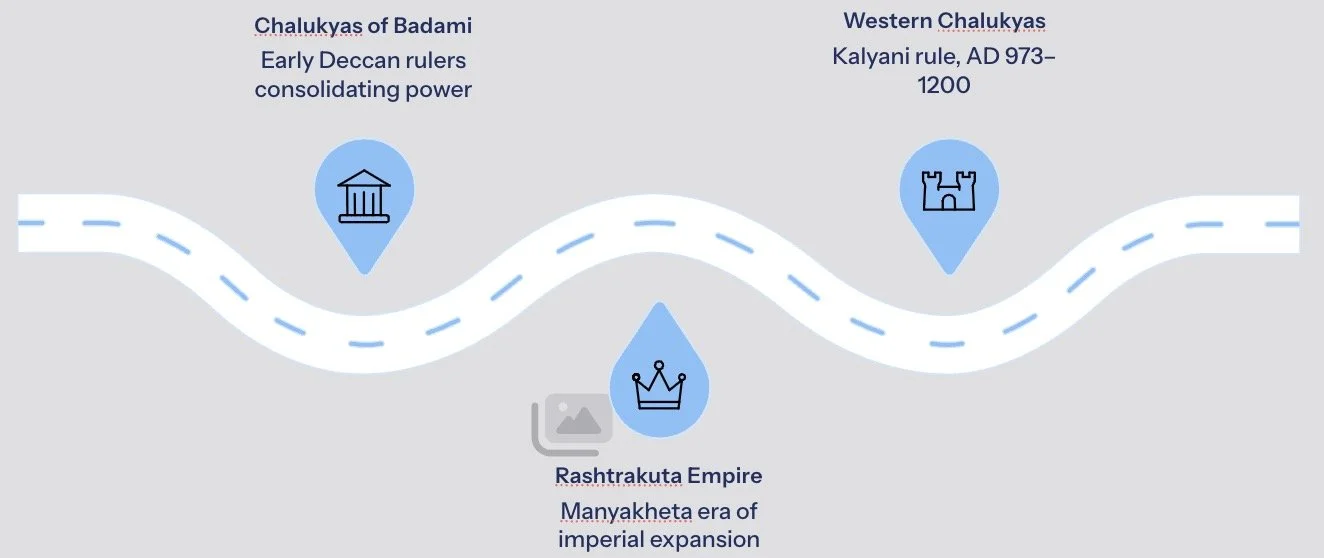
Chalukyas of Kalyani (Western Chalukyas)
Chapter I
Origins and Rise to Power
The Rashtrakutas of Manyakheta had held sway over most of Deccan and Central India for over two centuries, effectively eclipsing the earlier Chalukyas of Badami in the middle of the 8th century. However, by the late 10th century, political confusion and internal strife within the Rashtrakuta empire created an opportunity that the Western Chalukyas seized with remarkable swiftness. Claiming descent from the Chalukyas of Badami — though this genealogical claim remains historically contested — the new dynasty rose to prominence and established an empire that would dominate the Deccan for the next two hundred years.
Tailapa II — The Founder
Tailapa II was originally a feudatory of the Rashtrakuta king Krishna III. Following Krishna's death, he swiftly consolidated his position, overthrew Karka II, and declared himself an independent monarch in AD 973. He ruled for 24 years until AD 997 and is credited with:
Victories over Chedi, Orissa and Kuntala
Slaying Munja, the Paramara ruler of Malwa
Founding the independent Kalyani Chalukya line
Debated Origins
The historian B.R. Gopal, after a close study of available evidence, concluded that the Chalukyas were an indigenous Kannada family with an agricultural and military background, settled in and around the Badami region. Gopal further proposed that the very word Chalukya is an archaic Kannada term — a view that challenges the dynasty's own claim of Badami Chalukya descent and grounds them firmly in local Deccan tradition.
The dynasty's designation as Western Chalukyas serves to differentiate them from their contemporaries, the Eastern Chalukyas of Vengi — a separate dynasty with whom they shared complex, often adversarial relationships.
M.K.L.N. Sastry has observed that the Chalukyas of Kalyani consciously followed the imperial traditions of both the Vatapi Chalukyas and the Rashtrakutas of Manyakheta, and that their period of more than two hundred years constitutes a remarkable epoch of cultural efflorescence in the history of Karnataka. The historical reconstruction of this era draws upon innumerable lithic records, copper plates, and literary texts including the Vikramankadevacharita, Manasollasa, Mitakshara, Prabandhachintamani, Gadayuddha, and the Ajitapurana.
Chapter II
Dynastic History: Rulers and Their Reigns
The Western Chalukya dynasty produced a succession of rulers whose tenures ranged from celebrated military and cultural achievements to political weakness and eventual decline. The following overview traces the key monarchs from the successors of Tailapa II through to the dynasty's final collapse in AD 1190.
Satyasraya (c. AD 997–1008)
Son and successor of Tailapa II, Satyasraya claimed victory over a Chola invader. He was the patron of the great Kannada poet Ranna.
Somesvara I — Ahavamalla (AD 1042–1068)
Moved the capital to Kalyana. Engaged in fierce conflict with contemporary Chola power. Chola epigraphs claim he was defeated at Koppam (AD 1055) and Kudalasangamam (AD 1061), though the Chalukyas disputed this. He also brought Dharavarsha of Chakrakuta and territories of Kosala and Kalinga under his supremacy.
Somesvara II — Bhuvanaikamalla (to AD 1076)
Successor despite Somesvara I's preference for his second son Vikramaditya. A civil war erupted owing to strained brotherly relations and Somesvara II's reputed misconduct. Vikramaditya ultimately prevailed.
Vikramaditya VI — Tribhuvanamalla (AD 1076–1126)
The dynasty's greatest ruler. Started the Chalukya Vikrama Era. Conducted campaigns as far as Bihar and Bengal. Achieved peak territorial control between the Narmada and Kaveri rivers. Patronised Bilhana and Vijnaneshwara. By AD 1118–19, his general Anatapala Dandanayaka gained control over Vengi, effectively ending Chola influence across Andhra.
Somesvara III (AD 1126–1135)
Son of Vikramaditya VI. Authored the encyclopaedic Manasollasa and the biographical Vikramankabhyudaya in Kannada.
Tailapa III and Decline (AD 1151–1163)
A weak and incompetent ruler, under whom the Kalachuri chieftain Bijjala gradually usurped power by AD 1157. Tailapa III died fighting the Kakatiyas.
Somesvara IV and the End (AD 1190)
Failed to restore Chalukyan power. Defeated by Hoysala Ballala II in AD 1190. The Western Chalukyan power of Kalyani came to a permanent end.
The death of Vikramaditya VI marked the beginning of an irreversible decline. His subordinate powers — the Kakatiyas of Warangal, the Yadavas of Devagiri, the Hoysalas of Dwarasamudra, and the Kalachuris — took advantage of the ensuing weakness to assert their independence, gradually dismembering the once-vast Chalukyan empire. The dynasty that had dominated the Deccan for over two centuries disappeared from the arena of political power by AD 1190.
Chapter III
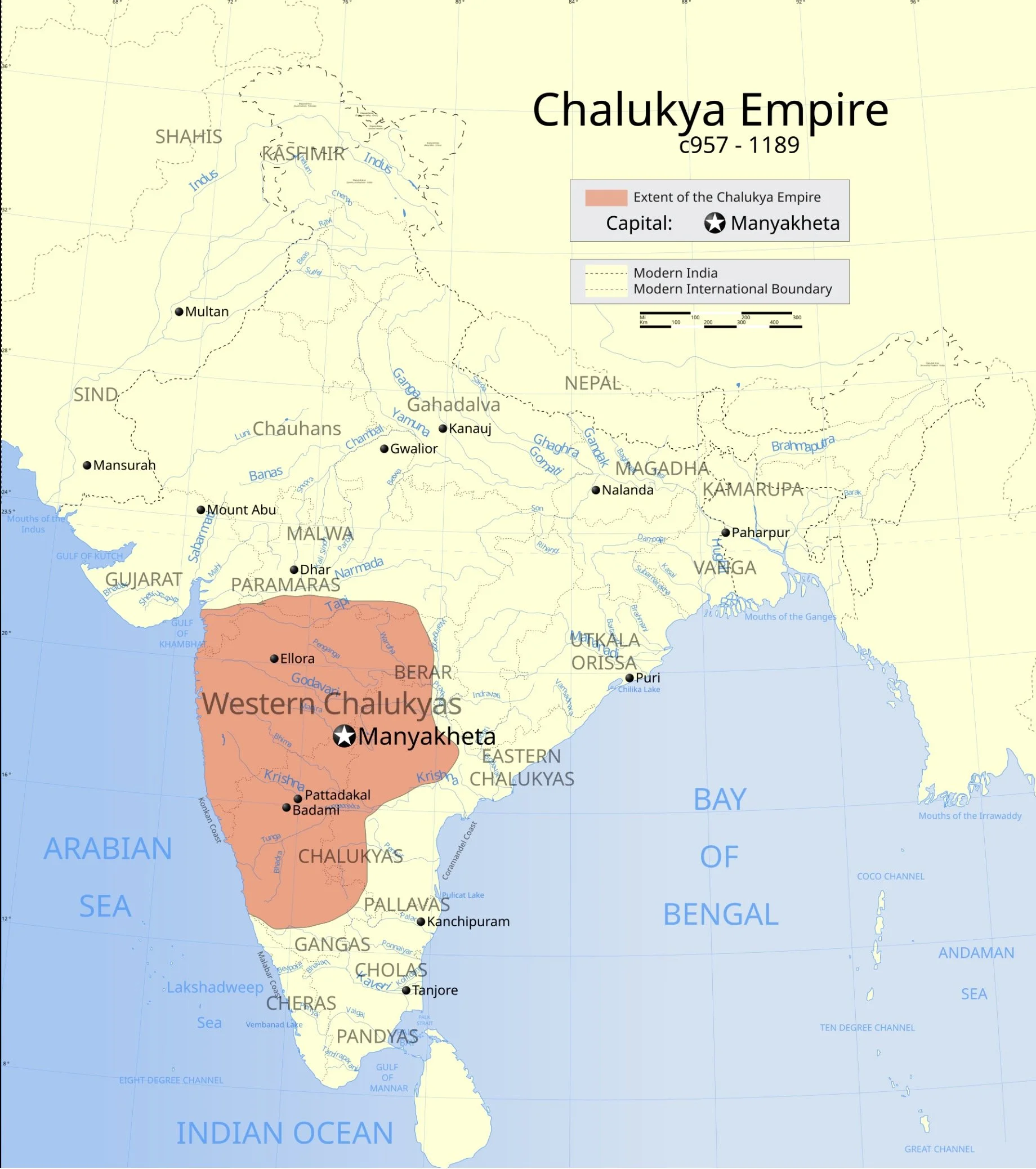
MAp: Chalukyas of Kalyani (Western Chalukyas)
Polity and Administration
The Western Chalukyas maintained a hereditary monarchical system in which the king functioned as the supreme head of state with effective executive authority. The dynasty bore the prestigious titles of Samastabhuvanasraya and Vijayaditya, and their royal insignia was the boar — symbolising the Varahavatara of Lord Vishnu, the divine protector of the earth. Their administrative system blended centralised monarchical authority with a graded feudal structure and active participation by royal women.
Royal Women in Administration
Unusually for the era, Chalukyan queens actively participated in governance. Queen Lakshmidevi, wife of Vikramaditya VI, claimed in an epigraph to be ruling from Kalyana. Lachchala Mahadevi and Ketaladevi, both queens of Somesvara I, also participated in administrative affairs. Princess Akkadevi, sister of Jayasimha II, fought and defeated rebellious feudals.
Feudal Intermediaries
The polity exhibited elements of feudalism through a graded hierarchy of powerful political intermediaries: Samanta, Mahasamanta, Mahasamantadhipati and Mahamandalesvara. The military service likewise had graduated ranks including Senapathi, Dandanayaka, Mahadandanayaka and Meghaprachandadandanayaka.
Territorial Divisions
For administrative convenience, the empire was divided into hierarchical units: Rashtra, Vishaya, Nadu, Kampana and Thana. Vishaya and Nadu were considered smaller units than Rashtra, though no rigid demarcation existed between them. Copper plate charters were addressed collectively to all local officials — Rastrapatis, Vishayapatis, Gramakutakas, Ayuktakas, Niyuktakas, Adhikarikas, Mohattaras — reflecting a broad channel of communication between ruler and ruled.
Ministerial System
The Manasollasa prescribes the qualities befitting ministers and recommends a council of 7 to 8 ministers. Ministerial posts were largely hereditary in practice, ensuring continuity of administrative expertise across generations.
Society and Social Structure
Social life during the Chalukyas of Kalyani was broadly based on the traditional Varnashrama model. Although caste was universal and hereditary, the connection between caste and occupation was not rigid. Women of higher social strata played a remarkably active role in social, administrative, and cultural matters. According to S.L. Shantakumari, epigraphical records of the period reveal names of women not only from royal families but also from lower ranks who distinguished themselves in administration, religion, and the arts.
The rise of Veerashaivaism was socially revolutionary, directly challenging the prevailing Hindu caste hierarchy. Sati, though present, is described in inscriptions as voluntary. Widowhood was publicly accepted. Records describe the participation of women in the fine arts — queen Chandala Devi and Sovala Devi were noted for their skill in dance and music. The 12th-century Virashaiva mystic Akka Mahadevi is among the thirty Vachana women poets whose compositions are recorded from this period. Indoor entertainments included wrestling, cock fights, ram fights, and gambling, while horse racing was a popular outdoor pursuit. Festivals, fairs, and travelling troupes of acrobats, dancers, and musicians were common.
Schools and hospitals were built near temples. Schools of higher learning — called Brahmapuri (or Ghatika or Agrahara) — taught subjects ranging from Veda (Trayi) and Philosophy (Anvikshiki) to Economics (Vartta) and Political Science (Dandaniti).
Chapter V
Religion: A Climate of Spiritual Conciliation
One of the most distinctive features of the Western Chalukya era was its general atmosphere of spiritual conciliation, wherein multiple creeds — Shaivism, Vaishnavism, Jainism, Buddhism, and the emerging Virashaivism — coexisted on a basis of mutual tolerance. There is no mention of religious conflict in the writings and inscriptions of the time, suggesting that religious transitions were smooth and largely peaceful. However, the fall of the Rashtrakuta empire did mark a relative setback for Jainism in the region.
Virashaivism
The most revolutionary development of the era. Growing through its association with Basavanna in the 12th century, Virashaivism (Lingayatism) challenged the caste system and the theory of rebirth, supported widow remarriage, and expressed devotion in simple Kannada Vachanas. Basavanna proclaimed: "Work is worship" (Kayakave Kailasa).
Vaishnavism
Ramanujacharya, head of the Vaishnava monastery in Srirangam, preached the bhakti marga (path of devotion) and authored the Sribhashya, a commentary on Badarayana Brahmasutra. His stay in Melkote resulted in the conversion of Hoysala King Vishnuvardhana to Vaishnavism.
Shaivism and Shakti
Shaivism remained a major branch of Pauranic Dharma. Shakti was worshipped as Kollapura Mahalakshmi. Kartikeya worship centred at Kudidatani in Bellary district. The Advaita philosophy of Adi Shankara had contributed to Buddhism's decline in the region since the 8th century.
Jainism and Buddhism
Though Jainism faced a relative decline following the Rashtrakuta fall, Jain worship continued at Shravanabelagola and Kambadahalli. Buddhism flourished locally at Belagave and Dambal. Successive kingdoms remained religiously tolerant throughout.
"The esteemed scholars in the Hoysala court, Harihara and Raghavanka, were Virashaivas. Akka Mahadevi, Allama Prabhu, Basavanna, Chenna Basava, Prabhudeva, Siddharama, and Kondaguli Kesiraja wrote hundreds of Vachanas in praise of Lord Shiva — devotional poems that continue to resonate through Karnataka's literary and spiritual heritage."
Chapter VI
Literature: A Golden Age of Kannada and Sanskrit
The Western Chalukya era is rightly described as a golden age of Kannada literature. It witnessed substantial literary activity in both Kannada and Sanskrit, covering an extraordinary range of genres — from devotional Vachanas and heroic epics to encyclopaedias, legal treatises, medical manuals, and grammatical works. Jain scholars wrote on the lives of Tirthankaras; Brahmin writers engaged with epics and Vedic literature; Virashaiva poets expressed their devotion in pithy Kannada verses; and royal patrons themselves composed learned works. Nearly three hundred Vachanakaras (Vachana poets), including thirty women poets, have been recorded from this period alone.
Ranna — Emperor Among Poets
Patronised by Tailapa II and Satyashraya, Ranna is one of the "three gems of Kannada literature." He was bestowed the title Kavi Chakravathi (Emperor among Poets) by Tailapa II. His major works include:
Saahasabheema Vijayam (Gadayuddha) — AD 982, in Champu style, narrating the duel of Bhima and Duryodhana
Ajitapurana — AD 993, on the life of Tirthankara Ajitanatha
Kavyavalokana — a work on poetics
Karnataka-Bhashabhushana — on Kannada grammar
Rannakanda / Vastukosa — a lexicon with Kannada equivalents for Sanskrit words
Bilhana and Sanskrit Mahakavya
The Kashmiri poet Bilhana composed the celebrated Sanskrit Mahakavya Vikramankadeva Charita in 18 cantos, recounting the life and achievements of his patron Vikramaditya VI, including the latter's accession after overthrowing Somesvara II. It also contains a graphic description of the geography and people of Karnataka.
Someshvara III — The Scholar King
King Someshvara III authored two significant works:
Manasollasa (Abhilashitartha Chintamani) — an early Sanskrit encyclopaedia of 1129 covering medicine, magic, veterinary science, gems, fortifications, painting, music, and games
Vikramankabhyudaya — a Kannada biography of Vikramaditya VI
Vijnaneshwara and Legal Literature
Sanskrit scholar Vijnaneshwara in the court of Vikramaditya VI composed the Mitakshara — a celebrated legal treatise and commentary on the Yajnavalkya Smriti. Perhaps the most acknowledged work in Hindu legal literature, the Mitakshara has found acceptance across most parts of modern India to this day.
Other Notable Works
Key literary contributions of the era include:
Nagavarma I: Chandombudhi (prosody) and Karnataka Kadambari (romance)
Nagavarma II: Poet laureate (Katakacharya) of Jagadekamalla II
Jagaddala Somanatha: Karnataka Kalyana Karaka (medicine)
Sridharacharya: Jatakatilaka (astrology)
Chavundaraya II: Lokapakara (encyclopedia)
Works on music: Sangita Chudamani, Sangita Samayasara, Sangita Ratnakara
Chapter VII
Architecture and Art: The Gadag Style
The Western Chalukya dynasty made some of the most lasting contributions to Indian art and architecture. They developed a distinctive architectural style known today as a transitional style — an architectural link between the early Chalukya style of Badami and the later Hoysala empire's decorative grandeur. This style is variously called Karnata Dravida or the Gadag style, named after the concentration of ornate temples they built in the Tungabhadra–Krishna river doab region of present-day Gadag district in Karnataka.
Defining Architectural Features
The vimana (tower over the shrine) represents a conscious compromise between the plain stepped style of the early Chalukyas and the highly decorative finish of the Hoysalas. Western Chalukya architects pioneered the use of lathe-turned pillars and soapstone (Chloritic Schist) as the primary building and sculptural material — an idiom that became enormously popular in later Hoysala temples. They also popularised the use of decorative Kirtimukha (demon faces) in sculptures.
Notable Temples
The dynasty's temple-building activity reached maturity in the 12th century, with over a hundred temples constructed across the Deccan. Celebrated examples include:
Kasivisvesvara Temple at Lakkundi
Mallikarjuna Temple at Kuruvatti
Kallesvara Temple at Bagali
Mahadeva Temple at Itagi — called devalaya chakravarti (Emperor of Temples) in an inscription; built by Mahadeva, a commander of Vikramaditya VI
Kedareshvara Temple at Balligavi — an example of transitional Chalukya–Hoysala style
Ornate Stepped Wells (Pushkarni)
Apart from temples, the dynasty is celebrated for its exquisitely designed stepped wells (Pushkarni) that served as ritual bathing places. These stepped well designs were later incorporated by the Hoysalas and the Vijayanagara empire. Several fine specimens are preserved at Lakkundi.
Promotion of Fine Arts
Epigraphic evidence from AD 1045 records the construction of a Natakasala (theatre) in a Jaina temple complex. Grants were given to flutists, songsters, drummers, dancers, and florists. K.A.N. Sastri notes that next to the royal court, the temple was the great promoter of fine arts. An inscription from Nagai (AD 1085) refers to the great sculptor Nagoja, called Kandarana Vidyadhirajam — master of the art of engraving.
Chapter VIII
Language: Kannada and Sanskrit in the Chalukyan World
The Western Chalukyas were ardent champions of the Kannada language, and their inscriptional record reflects this with exceptional clarity. Some historians assert that as many as ninety percent of their inscriptions are in the Kannada language, with the remainder in Sanskrit. More inscriptions in Kannada are attributed to Vikramaditya VI than to any other king prior to the 12th century. Inscriptions were typically recorded either on stone (Shilashasana) or copper plates (Tamarashasana).
Bilingual Inscriptions
When bilingual inscriptions were composed, a clear functional division existed between the two languages. The sections stating the royal title, genealogy, origin myths, and benedictions were generally written in Sanskrit, lending them a pan-Indian legitimacy and classical authority. Kannada, on the other hand, was used to record the practical terms of land grants — land details, boundaries, participation of local authorities, rights and obligations of the grantee, taxes, dues, and witnesses — ensuring unambiguous local comprehension.
In addition to formal inscriptions, chronicles called Vamshavalis were written to provide historical details of dynasties, constituting an important genre of historical documentation.
Kannada as a Literary Language
This period saw the dramatic growth of Kannada as a language of sophisticated literature and poetry. The impetus came from the devotional movement of the Virashaivas (Lingayatism), who expressed their closeness to the divine through lyrical poems called Vachanas. These compositions, written by mystics like Basavanna, Akka Mahadevi, and Allama Prabhu, appealed to the masses through their simplicity and spiritual depth.
In Sanskrit, writings spanned poetry, grammar, lexicon, rhetoric, prose fiction, and drama. In Kannada, secular subjects — romance, medicine, astrology, erotics, encyclopaedias, and prosody — found expression in writing for the first time. Notable examples include Nagavarma I's Chandombudhi and Karnataka Kadambari, Ranna's lexicon Rannakanda, and Chavundaraya II's encyclopaedia Lokapakara.
A Legacy Written in Stone and Verse: The Western Chalukyas of Kalyani left behind a rich and multilayered documentary heritage — in stone inscriptions, copper plates, Vachana poetry, Sanskrit mahakavyas, legal treatises, and encyclopaedias — that continues to inform and enrich our understanding of medieval Deccan history, culture, and society. Their two centuries of rule remain, in the words of M.K.L.N. Sastry, "a period of cultural efflorescence of Karnataka."
