
Pandyas
South Indian History
Pandyas: Polity and Administration
The Pandyan dynasty — one of the most enduring and consequential powers of ancient and medieval South India — governed the southern reaches of the Indian subcontinent for nearly two millennia. Known as one of the three great Muvendar ruling families alongside the Cholas and Cheras, the Pandyas of Madurai shaped the political, cultural, and religious landscape of Tamilakam through sophisticated systems of governance, imperial ambition, and literary patronage.
The Pandya Dynasty: An Overview
Chapter I
The Pandya Dynasty: An Overview
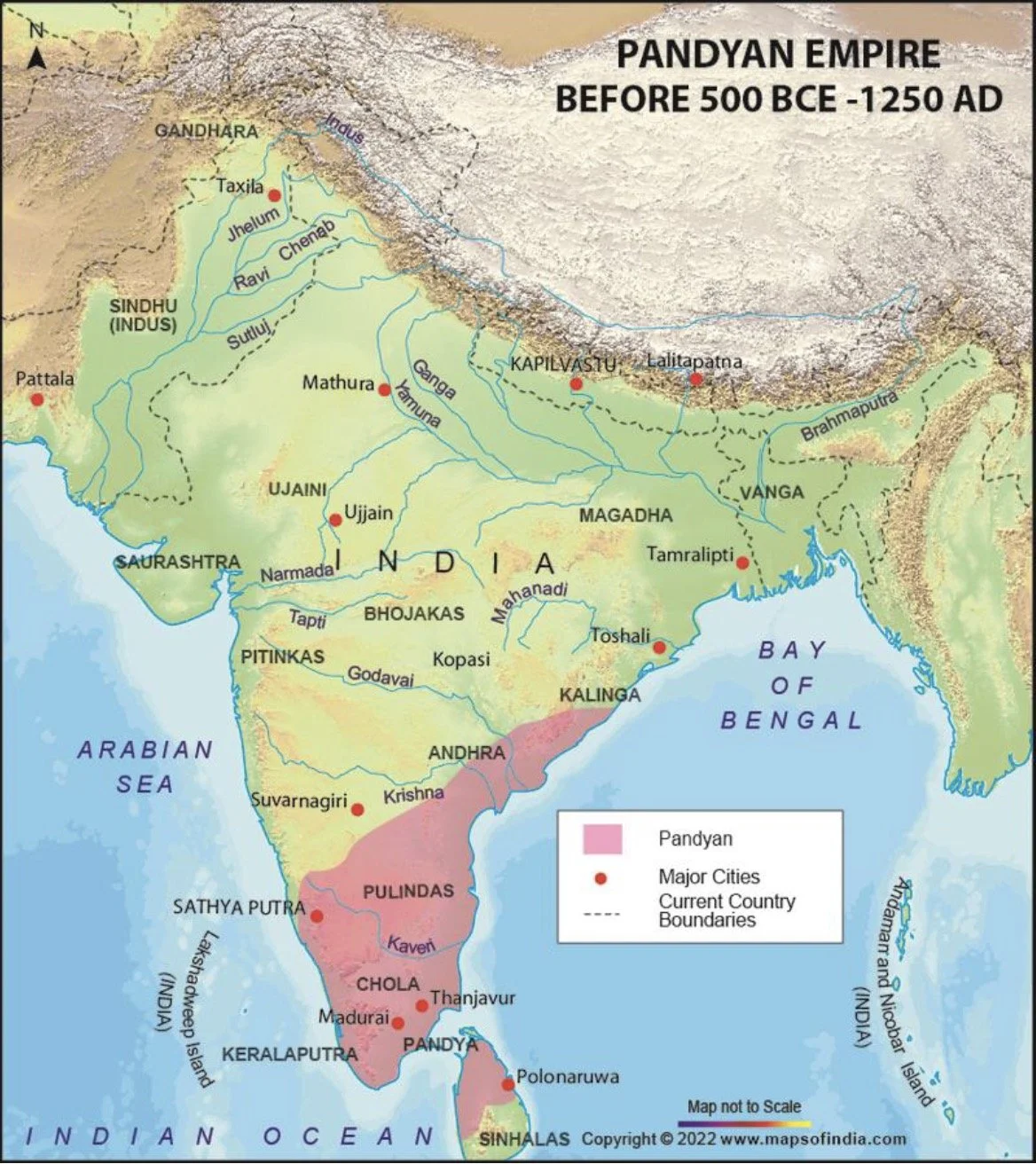
The Pandyan dynasty, also referred to as the Pandyas of Madurai, was an ancient Tamil dynasty of South India and one of the four great kingdoms of Tamilakam — the other three being the Pallavas, the Cholas, and the Cheras. The term Muvendar, derived from the Tamil meaning "three chiefs," was used collectively to refer to the heads of the Chola, Chera, and Pandya ruling families, underlining the tripartite political structure that defined early Tamil polity. Existing since at least the 4th to 3rd centuries BCE, the Pandya dynasty passed through two distinct periods of imperial dominance: the 6th to 10th centuries CE and the era of the Later Pandyas during the 13th to 14th centuries CE.
From the 6th to the 9th centuries CE, the political landscape of South India was shaped by the contest among the Chalukyas of Badami or Rashtrakutas of the Deccan, the Pallavas of Kanchi, and the Pandyas of Madurai. The Pandyas frequently extended their reach into the fertile estuary of the Kaveri (the Chola country), the ancient Chera country of Kongu and central Kerala, Venadu in southern Kerala, the Pallava country, and the island of Sri Lanka. A decline set in with the rise of the Cholas of Thanjavur in the 9th century, pushing the Pandyas into prolonged conflict and eventual subjugation — though they allied themselves with the Sinhalese and Cheras in resistance.
The dynasty entered its celebrated golden age under Maravarman I and Jatavarman Sundara Pandya I in the 13th century. Jatavarman I (c. 1251 CE) successfully expanded the kingdom into the Telugu country as far north as Nellore, subjugated south Kerala, and conquered northern Sri Lanka. The city of Kanchi became a secondary capital. Maravarman Kulasekhara I (1268) defeated an alliance of the Hoysalas and the Cholas (1279), and the venerable Tooth Relic of the Buddha was carried away by the Pandyas as a symbol of their supremacy. This period marked the widest territorial extent of Pandyan power, reaching its zenith around 1290 CE.
However, an internal crisis in the Pandya kingdom coincided with the Khalji invasion of South India in 1310–11. The ensuing political turmoil brought repeated sultanate raids and plunder, the loss of south Kerala (1312) and northern Sri Lanka (1323), and ultimately the establishment of the Madurai Sultanate in 1334. The Pandyas of Ucchangi (9th–13th century) in the Tungabhadra Valley are also understood to have been related to the Pandyas of Madurai, demonstrating the geographic reach of the dynasty's lineage.
6th–10th Century CE
First imperial phase. Rivalry with Chalukyas, Rashtrakutas, and Pallavas defines the political landscape.
13th–14th Century CE
Golden Age under Jatavarman I and Maravarman Kulasekhara I. Widest territorial extent in 1290 CE.
1310–1334 CE
Khalji invasion triggers decline. Loss of Kerala and Sri Lanka; Madurai Sultanate established.
Chapter II
Origin and Sources of Pandyan History
The early Pandya chieftains ruled their country — called Pandya Nadu — from the ancient period, administering from the inland city of Madurai and the southern port of Korkai. Their antiquity is attested through a remarkably diverse range of sources: literary, epigraphic, numismatic, and foreign testimonies. The Pandyas are celebrated in the earliest available Tamil poetry, known as Sangam literature, which references approximately twelve Pandya rulers and presents vivid accounts of their courts, conquests, and patronage of the arts. The epic poem Silappatikaram notes that the emblem of the Pandyas was that of a fish — a symbol that came to define the dynasty's identity.
Graeco-Roman accounts dating as early as the 4th century BCE, the edicts of the Maurya emperor Ashoka, coins with legends in the Tamil-Brahmi script, and Tamil-Brahmi inscriptions all testify to the continuity of the Pandya dynasty from the 3rd century BCE into the early centuries CE. The Greek ambassador to Chandragupta Maurya, Megasthenes, referred to the queens of the Pandyas as "Pandaia" and placed their kingdom in the south of India extending to the ocean. He described their polity as consisting of 365 villages, each of which contributed to the needs of the royal palace on a corresponding day of the year — a striking administrative detail. He also described the ruling queen as a daughter of Heracles (identified by some authors with Shiva or Krishna).
Madurai, the Pandyan capital, is mentioned in Kautilya's Arthashastra (4th century BCE) as "Mathura of the south", affirming its significance in the political geography of ancient India. The Pandyas are further referenced in the inscriptions of Maurya emperor Ashoka — specifically in his 2nd and 13th Major Rock Edicts — alongside the Cholas, Cheras, and Satiyaputras as peoples of the southern periphery known to his empire. The renowned Chinese pilgrim Hiuen Tsang, who travelled to Kanchi in the mid-7th century CE, noted that the Pandyan princes were Pallava feudatories at that time, offering a nuanced picture of the dynasty's political standing during the early medieval period.
Several Tamil literary works, including Iraiyanar Agapporul, contain the legend of three separate Sangams — learned academies held under Pandyan royal patronage in Madurai — and ascribe the cultivation of Tamil literature to successive generations of Pandya rulers. According to tradition, some Pandyan monarchs were themselves accomplished poets, reinforcing the dynasty's self-fashioning as custodians of Tamil cultural and intellectual life.
Sangam Literature
References ~12 Pandya rulers. Silappatikaram records the fish emblem as the royal symbol.
Megasthenes (Indica)
Greek ambassador describes Pandyan queens as "Pandaia," locating the kingdom in India's deep south with 365 tribute villages.
Ashokan Edicts (3rd century BCE)
2nd and 13th Major Rock Edicts mention Pandyas alongside Cholas, Cheras, and Satiyaputras.
Kautilya's Arthashastra
Refers to Madurai as "Mathura of the south," confirming its political importance as early as the 4th century BCE.
Chapter III
The King and the Royal Court
At the apex of Pandyan governance stood the king, who served as the hereditary head of government and ruled with ultimate discretion. Succession to the throne was normally hereditary, though usurpation was not unknown, and on occasion, unusual methods of royal selection were employed — including the celebrated practice of releasing the royal elephant to garland a person of its own choice, thereby designating the next monarch. The king could be crowned at any age and reigned for as long as he chose or lived. He was deeply revered by his subjects and was even equated to God, embodying in his person the divine sanction for political authority.
The king bore onerous duties towards his subjects and was held personally responsible for any misfortune that befell his kingdom. The dynastic emblem of the Pandyas was the double carp, employed for all official purposes of royal authentication. This emblem appeared on coins issued by the kings, on seals affixed to royal letters, and on imported and exported cargo held in port warehouses — a testament to the integration of royal symbolism with economic and administrative practice.
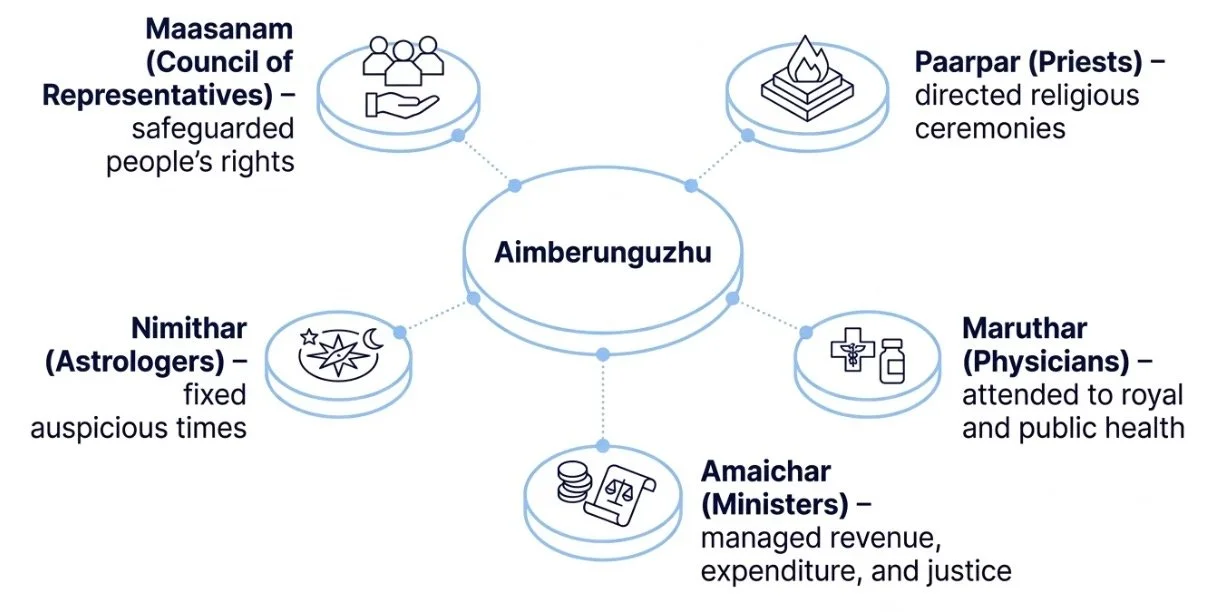
The king's court comprised royal officers including ministers, generals, commanders, and accountants. His personal authority was, however, meaningfully circumscribed by an important institution — the Aimberunguzhu, or the Five Great Assemblies. This body consisted of representatives of the people, priests, physicians, astrologers, and ministers, each of whom held a distinct role. The council of representatives (Maasanam) safeguarded the rights and privileges of the people; the priests (Paarpar) directed religious ceremonies; the physicians (Maruthar) attended to matters of royal and public health; the astrologers (Nimithar) fixed auspicious times and predicted important events; and the ministers (Amaichar) oversaw revenue collection, expenditure, and the administration of justice.
Beyond the Five Assemblies, there existed the Enberaayam, or the Eight Groups of Attendants — another assembly of officials serving the king. Scholars debate its precise composition: some believe it consisted of personal attendants such as perfumers and dressing valets, while others argue it comprised more influential persons such as leaders of the elephant corps, cavalry commanders, and representatives of the capital city. The principal officers of state included the high priest, the chief astrologer, the ministers, and the commanders of the army. The prime minister held the title Uttaramantri, the royal secretariat was known as the Eluttu Mandapam, and military commanders bore distinguished titles such as Palli Velan, Parantakan Pallivelan, Maran Adittan, and Tennavan Tamizhavel.
The Pandya King and the Royal Court
Chapter IV
Administrative Structure and Village Governance
The territory of the Pandyas was designated by several names — Pandymandalam, Thenmandalam, or Pandynadu — encompassing the rocky, hilly regions and mountain ranges of the far south, with the exception of areas irrigated by the rivers Vaigai and Tamiraparni. The Pandyan administrative system was hierarchically layered, descending from the central capital through intermediary units to the most fundamental level of the village.
At the highest level, the king divided his territory into a number of administrative units each called a Koorram. Each Koorram was further divided into provinces called Mandalam, which in turn were subdivided into many Nadus (sub-provinces), with each Nadu consisting of numerous villages. Within settlements, a locality inside a town or village was called an Ur, and each neighbourhood within an Ur was called a Cheri. While the king ruled from the capital at Madurai, he frequently placed one or more principalities (Koorrams) under the near-sovereign governance of a senior royal family member or a feudatory. The Cilappatikaram records, for instance, that while Nedunj Cheliyan I ruled from Madurai, his younger brother was placed in charge of the Korkai principality.
Villages within principalities were governed almost autonomously by their elders, who were not elected but recognised and appointed on the basis of their age and standing in society. There were two institutions for managing village affairs — the Ambalam and the Manram — differing primarily in the locations from which they operated. The Manram (or Podiyil) was a simple structure built around the foot of a tree at the centre of the village, while the Ambalam (or Avai)was a small building on a slightly raised platform.
The functions of these institutions were judicial, administrative, and financial in nature. They managed police duties, settled disputes, dispensed local justice, maintained sanitation, communicated royal orders, conducted land surveys, assessed revenue, and maintained roads and irrigation facilities. The transmission of locally collected taxes to the royal treasury, however, was handled by the king's dedicated revenue officers — marking the precise boundary between village self-governance and central fiscal authority. This arrangement constituted a three-tiered system of governance: a central government under the king, a layer of feudal governments at the level of principalities, and local governmentsoperating at the village level.
Territorial Subdivisions
Koorram — primary administrative unit
Mandalam — province within a Koorram
Nadu — sub-province within a Mandalam
Village — fundamental unit of governance
Ur — locality within a town or village
Cheri — neighbourhood within an Ur
Village Institutions
Manram (Podiyil) — open-air structure at the base of a central tree
Ambalam (Avai) — formal building on a raised platform
Functions: judicial, administrative, financial, sanitation, irrigation
Tax transmission handled separately by royal revenue officers
Chapter V
The Judicial System
Justice under the Pandyas was administered free of charge, by specially appointed judges and magistrates — though the king remained the supreme authority and final arbiter in all civil and criminal matters. The Pandyan monarchs took particular pride in the justness of their governance. The Cilappatikaram preserves the moving legend of a Pandyan king who died of remorse upon realising he had committed an act of injustice — a narrative that powerfully illustrates the moral weight placed upon the office of kingship. Judges were expected to embody a specific set of qualities: they had to be learned, straightforward, experienced, and of advanced age.
Common sources of civil litigation included mortgage, lease, trust property, loans, and breach of contract — with no time bar placed upon civil suits. Criminal offences encompassed theft, adultery, forgery, and treason. In the capital city, justice was organised by the king in his own court, while in the villages, it was the elders who meted out justice locally. The committees of justice in the village assemblies, known as the Nyayattars, convened under ceremonial trees to conduct trials and pronounce judgements. Trials were typically characterised by elaborate judicial procedure, with careful setting down of evidence before a judgement was delivered.
Nonetheless, there existed instances of the trial-by-ordeal system, in which the defendant was subjected to some form of physical test or torture; if he emerged unscathed, he was deemed innocent. Punishments were markedly severe: one caught in the act of burglary, adultery, or espionage was given the death penalty, while one who gave false testimony would have his tongue cut off. The severity of punishments was considered a deterrent — and hence crimes were said to be rare. Prisons were used not only to hold the guilty but also to house captives taken in warfare. Prisoners were kept in chains under the watch of warders. It was common practice to release prisoners on festive occasions, and in some instances, they were directed to engage in pearl-fishing at sea — a distinctive feature of the Pandyan coastal economy.
Capital Punishment
Administered for burglary caught in the act, adultery, and espionage.
Corporal Punishment
False testimony resulted in the severing of the tongue.
Imprisonment
Prisons held both criminals and war captives; prisoners released during festivals or sent for pearl-fishing.
Trial by Ordeal
In some cases, defendants were put through physical tests; survival denoted innocence.
Chapter VI
Military Organisation and Revenue System
The king of the Pandyas was the chief commander of the army and typically led his forces personally in the battlefield. The Pandyan military was described as fourfold in its composition: the infantry, the cavalry, the elephantry, and the chariotry. The military arsenal was formidable and varied, encompassing shields, swords, spears, tridents, maces, bows, and arrows. A successful military campaign could result in the outright annexation of enemy territories or, alternatively, in the formal submission of the defeated ruler, who would then acknowledge the victor's hegemony and commence the payment of tributes.
The principal sources of royal revenue were taxes (Karai or Irai), tributes (Tirai), customs duties, and tolls (Sungam). The levy of taxes and the direction of expenditure lay entirely at the discretion of the king, who determined both the rate and incidence of taxation as well as any remissions. The two primary forms of direct taxation were land tax — paid either in money or in kind — and income tax, fixed at one-sixth of an individual's income. Other revenue streams included tributes from feudal subordinates, war booty, presents from loyal and visiting subjects, treasure troves, land revenue, cess, and forced gifts.
Tolls were levied on trunk roads used by caravans and at the frontiers of the kingdom, while customs duties were collected at seaports on imported goods. The export of locally manufactured goods — particularly textiles and pearls — earned considerable foreign exchange for the royal treasury. The king claimed one-tenth of the total earnings from pearl-diving and pearl sales as his royal prerogative, underscoring the significance of the pearl industry to Pandyan commerce. A scholar named Wassaff further records that the trade in horses was very common during this period, with other goods including spices, precious stones, elephants, and birds. The busiest port under the Pandyas was Kayalpattinam (now in Thoothukudi district).
Expenditure items for the royal treasury encompassed military upkeep and warfare costs, gifts to poets and temples, maintenance of educational and health services, construction of roads and irrigation works, and the considerable expenses of the palace household — including the compensation of merchants, officials, and entertainers residing within the palace complex. Tax remissions, though a mark of royal generosity, also diminished available revenue.
Sources of Revenue
Karai / Irai — direct taxes (land and income)
Tirai — tributes from feudal subordinates
Sungam — customs duties and tolls
War booty and treasure troves
Pearl-diving royalty (one-tenth of earnings)
Seaport customs on imports
Major Expenditures
Military recruitment, maintenance, and warfare
Gifts to poets and temples
Education and healthcare services
Infrastructure: roads and irrigation
Palace household and royal court personnel
Tax remissions granted by the king
Chapter VII
Social and Political Organisation
The social and political landscape of Pandyan rule was characterised by a well-defined system of land grants, occupational designations, and the cultivation of literacy and commerce. Royal palaces were called Tirumaligai and Manaparanan Tirumaligai during the Pandyan reign. The royal couches used by kings were named after local chiefs, a ceremonial practice that served to affirm the legitimacy of the king's overlordship — embedding the symbolic acknowledgement of regional authority into the very furniture of power.
The political division of land reflected the occupational and social hierarchies of the time. Salabogam referred to land assigned to Brahmins; land assigned to ironsmiths was called Tattarkani; land granted to carpenters was known as Taccu-maniyam; and land donated to Brahmin groups for the purpose of imparting education was designated Bhattavriutti. Kings and local chiefs also created Brahmin settlements called Mangalam or Chaturvedimangalam, endowed with irrigation facilities and named after royalty or deities — institutions that served simultaneously as centres of learning and agrarian development.
The promotion of literacy was a conscious policy of Pandyan administrators. Singers were appointed to recite Bhakti hymns in temples as a means of spreading literacy and religious awareness. Theatre productions based on similar moral and cultural themes were also staged. Trade flourished under the Pandyas: the historian Wassaff records the brisk trade in horses, while other commodities exchanged in Pandyan commerce included spices, pearls, precious stones, elephants, and exotic birds. The port of Kayalpattinam in present-day Thoothukudi district served as the most active trading hub of the Pandyan realm, connecting the south Indian coast to distant maritime networks.
Land Classification
Salabogam (Brahmin), Tattarkani (Ironsmiths), Taccu-maniyam (Carpenters), Bhattavriutti (Education donors) — land grants encoded social hierarchy.
Promotion of Literacy
Bhakti hymn recitations in temples and theatrical performances were used as vehicles for popular education and cultural dissemination.
Maritime Trade
Kayalpattinam was the busiest port. Exports included pearls, textiles, and spices; imports enriched the royal treasury through customs duties.
Chapter VIII
Religious Beliefs and Temple Patronage
The religious history of the Pandya dynasty reflects the broad currents of spiritual transformation that swept through South India across the centuries. It is believed that the early Pandyas followed Jainism before subsequently adopting Shaivism — a transition that mirrored wider shifts in Tamil religious culture during the early medieval period. The revival of Pandyan power by Kadungon in the 7th century CE was closely intertwined with the ascendancy of the Shaivite Nayanars and the Vaishnavite Alvars, the two great bhakti saint-poet traditions whose devotional hymns transformed Tamil religious life and whose patronage became a mark of royal legitimacy.
The Pandya rulers followed Vedism, and Shravanism was considered part of Vedic principles as practised under their rule. Medieval and later Pandyas repaired many temples and endowed them richly with gold and land, even though — notably — no new temples were constructed by the medieval and later Pandyas; their contribution lay in the preservation and enrichment of existing sacred structures. Patronage was also extended to Vedic practices, and the impartiality of Pandyan rulers towards both Shaivism and Vaishnavism is made clear in the invocatory portions of their inscriptions, reflecting a spirit of religious accommodation that was politically as well as devotionally motivated.
Pandya Nadu was home to several of the most renowned temples in South India, most famously the Meenakshi Temple in Madurai, which served as the spiritual heart of the Pandyan realm. According to tradition, the legendary Sangams ("the Academies") were held in Madurai under the patronage of the Pandyas, and some Pandyan rulers claimed to be poets themselves — a further illustration of how the political and the cultural were indissolubly linked in the Pandyan worldview. The dynasty thus stands as a testament to the enduring capacity of South Indian civilisation to weave together governance, faith, artistic patronage, and the pursuit of Tamil literary excellence into a coherent and lasting legacy.
Early Pandyas
Initial practice of Jainism; early temple construction; patronage of Sangam literary academies in Madurai.
7th Century CE
Revival under Kadungon coincides with the rise of Shaivite Nayanars and Vaishnavite Alvars; adoption of Shaivism.
Medieval Period
Rulers follow Vedism; patronage extended to both Shaivism and Vaishnavism; existing temples repaired and endowed.
Later Pandyas
No new temples built; focus on preservation of existing sacred structures; Meenakshi Temple at Madurai remains the dynasty's sacred legacy.
"According to tradition, the legendary Sangams ('the Academies') were held in Madurai under the patronage of the Pandyas, and some of the Pandyan rulers claimed to be poets themselves."
Pandyas: Art and Architecture
The Pandya dynasty, one of the oldest and most enduring ruling houses of South India, left behind an extraordinary legacy in stone, paint, and sculpture. From the earliest rock-cut cave shrines hewn directly into granite hillsides to the soaring, elaborately ornamented gopurams that would come to define South Indian temple architecture, Pandya artistic achievement spans centuries of creative ambition and religious devotion. Together, these monuments and artworks reveal a civilisation of profound aesthetic sensibility, technical mastery, and deep spiritual fervour that influenced every subsequent tradition of Dravidian art.
Rock-Cut Temples
Monolithic vimanas carved from living rock at sites like Kalugumalai and Thirupparankundram
Structural Temples
Small stone temples with garbagraha, ardhamandapa, mahamandapa and evolving gopurams
Sculpture
Ornamental single-stone carvings of Somaskandar, Nataraja, Narasimha and more
Mural Painting
Fresco-secco paintings at Thirumalapuram and Sittannavasal linking Ajanta to Chola traditions
Structural Temples: Form, Evolution, and the Gopuram
The structural temples of the Pandya period represent a fascinating evolutionary arc: from modest, simple stone shrines to the towering, richly ornamented temple complexes that would become the defining monuments of Tamil Nadu. The earliest structural temples were relatively small stone constructions, unpretentious in scale yet already complete in their essential spatial organisation. Each temple comprised a garbagraha (the sanctum sanctorum housing the principal deity), an ardhamandapa (the vestibule or antechamber), and a mahamandapa (the great assembly hall for devotees and ritual performance). In Siva temples, a Nandi — the sacred bull and vahana of Siva — was invariably placed in front of the maha mandapa, facing the deity within.
The transformative development of the later Pandya period was the progressive elevation in importance of the gopuram— the monumental gateway tower that marks the entrances to South Indian temple complexes. Originally subordinate to the vimana (the tower directly above the sanctum), the gopuram gradually claimed primacy in terms of height, elaborateness, and visual impact. This shift was not merely aesthetic; it reflected a changing theology of sacred space in which the approach to the divine — the processional axis leading through successive gateways — became as significant as the inner sanctum itself. The rectangular entrance portals that define the gopuram plan gave way above the stone-built lower storeys to a pyramidal superstructure of brick, tapering upward at an inclination of approximately 25 degrees, and crowned by pinnacles known as shikharas, always placed in odd numbers in accordance with Agamic prescription.
The niches of the gopuram walls became canvases for an exuberant sculptural programme: heavily carved Hindu mythological scenes, images of divine guardians, celestial musicians, and narrative reliefs drawn from the great epics and Puranas. Pillars throughout the mandapas were adorned with images of horses and other animals, a tradition that would reach its most spectacular expression in the horse columns of the Nayaka period. The later Pandya rulers invested heavily in constructing lofty gopurams of great proportions with lavish decoration, establishing a template that all succeeding dynasties — Vijayanagara, Nayaka — would inherit, amplify, and carry forward.
Structural Components
Garbagraha — sanctum sanctorum
Ardhamandapa — vestibule antechamber
Mahamandapa — great assembly hall
Nandi — sacred bull in Siva temples
Vimana — tower over sanctum
Gopuram Construction
Rectangular plan at ground level
Ground and first floors: vertical stone construction
Upper floors: pyramidal brick at 25° inclination
Pinnacles (shikharas) in odd numbers
Niches with carved mythological sculptures
Zenith of Pandya Architecture: Madurai, Srirangam, and Srivilliputtur
Meenakshi Temple, Madurai
Considered the absolute zenith of Pandya architectural achievement, the Meenakshi Amman Temple at Madurai is a vast, living monument that has been continuously worshipped for over two millennia. The temple complex contains fourteen gopurams, the tallest rising to approximately 52 metres, encrusted with thousands of stucco figures repainted in vivid polychrome at regular intervals. Structural stone temples associated with Pandya construction are found across the region at Kumbakonam, Thiruvannamalai, Kovilpatty, Thiruppathur, Alagarkoil, Ambasamuthram, and Madurai itself.
Aranganathar Temple, Srirangam
The Aranganathar (Ranganathaswamy) Temple at Srirangam, situated on a river island in the Kaveri, is among the largest functioning Hindu temple complexes in the world, covering an area of approximately 156 acres. The Pandyas contributed significantly to the construction of its mandapas and gopurams, alongside their patronage at the great Siva shrine of Chidambaram. The Vijayanarayana temple at Nanguneri and the Lakshmi Narayana temple at Athur further illustrate the breadth of Pandya structural temple activity.
Srivilliputtur Andal Temple
The Srivilliputtur Andal Temple stands apart as the official symbol of the Government of Tamil Nadu, a recognition of its extraordinary architectural distinction. Its 12-tiered tower structure rises to 59 metres — one of the tallest gopurams in South India. The temple features a sanctum sanctorum with three doorways approached by a flight of stairs, and a large, impressive hall adorned with detailed wooden carvings depicting incidents from the Puranas. Images of Panchamurtis, Thumburu, Narada, Sanatkumara, Kinnara Mithuna, and celestial bodies are represented at the deity's feet.
Pandya Sculpture: Beauty, Ornament, and Mastery
Pandya sculpture is universally acknowledged as among the most beautiful and ornamental in the entire canon of South Indian art. What distinguishes it from its Pallava and early Chola antecedents is a particular quality of refinement — a tendency toward elegant surface articulation, elaborate jewellery and ornamentation on divine figures, and a sensuous but spiritually elevated treatment of the human form. Remarkably, some of the finest Pandya sculptures were engraved on single stones, demonstrating a lapidary confidence and technical mastery that allowed the sculptor to conceive the entire composition within the constraints of a single, undivided block of granite or schist.
The most celebrated sculptural sites of the Pandya period are Kalugumalai, Thirupparankundram, Thirurmalaipuram, and Narthamalai. At these locations, sculptural panels and independent icons survive in conditions that, despite the ravages of time, still convey the original vitality and sophistication of Pandya artistic vision. The iconographic range is extensive, encompassing the full pantheon of Saiva and Vaishnava theology.
Somaskandar
Siva with Uma and Skanda — a quintessential Pandya iconographic grouping of great tenderness and compositional balance
Durgai
The goddess Durga in her fierce aspect, rendered with dynamic posture and layered weaponry symbolic of divine power
Ganapathy
The beloved elephant-headed deity depicted with characteristic pot belly, modaka, and endearing iconographic accessories
Narasimha
The half-man, half-lion avatara of Vishnu, carved with ferocious energy and compositional drama
Nataraja
The cosmic dancer Siva — the Nataraja sculpture at Thirukolakkudi is considered on par with the finest Pallava and Chola renditions
The Vishnu sculpture at Kunnakudi and the Nataraja sculpture at Thirukolakkudi occupy a special position in the history of South Indian sculpture, being assessed by art historians as equal in excellence to comparable works from the great ateliers of the Pallava and Chola periods. This is high praise indeed, given the almost universal critical admiration accorded to Chola bronze casting and Pallava stone carving. That Pandya sculptors achieved comparable heights in a different medium and regional idiom speaks to the depth and vitality of their artistic tradition.
Mural Paintings: Thirumalapuram and Sittannavasal
Among the most precious and understudied achievements of the Pandya period are the mural paintings found in rock-cut cave temples, dating primarily to the middle of the 9th century. These paintings, executed at Thirumalapuram and Sittannavasal, represent a critical link in the genealogy of Indian mural art — connecting the celebrated tradition of the Ajanta Caves (4th–6th centuries AD) with the Chola mural paintings of Thanjavur (11th century AD). They are painted using the fresco-secco technique, in which pigments are applied to a dried plaster surface rather than fresh wet plaster, and employ a palette of mineral-derived colours: white from lime, black from wood charcoal, yellow and red from ochre, blue from ultramarine or lapis lazuli, and green from terre verte.
Thirumalapuram Paintings
Traces of early Pandya painting survive in the Thirumalapuram Rock-Cut Caves, offering a glimpse of the dynasty's earliest pictorial sensibility. On the roof of the cave are representations of small secondary deities — ganas — rendered with lively informality. One gana is depicted riding a mythical lion; others are shown amid lotus foliage in the company of naturalistically treated ducks. The naturalism of these duck figures is particularly striking — their postures and plumage are observed with an attentiveness more characteristic of later manuscript painting traditions. The colour range is deliberately restrained: white, indigo, black, and light blue create a sober, meditative atmosphere entirely appropriate to the cave's sacred function.
On the capital of a column within the cave, a remarkable secular or semi-secular scene survives: a group of bearded characters — possibly hunters — accompanied by girls, a drum player, and several gana dancers, all depicted with considerable dynamism and narrative energy. This openness to genre scenes alongside devotional imagery reflects a cosmopolitan artistic sensibility.
Sittannavasal Paintings
The Sittannavasal cave temple, a Jain shrine, preserves what are arguably the most important surviving examples of Pandya mural painting. Though severely damaged, frescoes remain on the upper parts of columns, ceiling surfaces, and veranda walls. Remarkably, excavation and study revealed two superimposed layers of frescoes, along with an inscription dating to approximately 850 AD, attributing the creation of these paintings to Ilam Gautaman, an acharya of Madura, under the patronage of the Pandya king Srimara Srivallabha.
The iconographic programme includes: a couple with abundantly jewelled busts; two female dancers in graceful motion; and — most celebrated of all — an elaborate composition depicting a stylised lotus tank filled with men gathering flowers, fishes, birds, and quadrupeds including elephants. This lotus tank fresco is directly compared by scholars to the Ajanta paintings in its treatment of attitudes, purity of line, and modelling technique.
Scholarly Note: The Sittannavasal lotus tank fresco depicts the Samava-sarvana — the celestial audience hall where Tirthankaras deliver sermons after achieving kevala-gnana (liberation). Bulls, elephants, apsaras and gods gather to witness this grand occasion. The female dancers and the jewelled couple are stylistically closer to later Chola paintings, suggesting the two layers were executed at different periods.
The Sittannavasal Lotus Tank: A Masterpiece of Indian Mural Art
The lotus tank fresco of Sittannavasal occupies the ceiling of the sanctum and ardha-mandapam of the cave, making it the most central, most sacred, and most visually commanding composition in the entire programme. It is, by consensus, one of the supreme achievements of ancient Indian mural painting. The composition depicts a pond filled with lotuses — those symbols of spiritual purity and enlightened consciousness — inhabited by monks, birds, fishes, swans, and animals, all rendered with a remarkable combination of naturalistic observation and spiritual symbolism. The scene is understood as a pictorial evocation of the Samava-sarvana, the sacred assembly described in Jain scripture where all living beings gather in harmonious contemplation of the Tirthankara's teaching.
The technique employed throughout Sittannavasal is the fresco-secco method, distinguished from the buon fresco of Italian Renaissance painting by the application of pigment onto dried rather than fresh plaster. The mineral palette — lime white, charcoal black, ochre yellows and reds, ultramarine blue, terre verte — was ground and mixed with binding media and applied with considerable skill to achieve tonal gradations and the suggestion of volume. Scholars have noted the use of more sustained colours to indicate modelling, a technique directly comparable to the shading conventions of Ajanta, confirming the continuity of a pan-Indian pictorial tradition even across the considerable chronological gap separating the two sites.
Link to Ajanta (4th–6th c. AD)
Lotus tank fresco shares Ajanta's attitude treatment, purity of line, modelling in sustained colour, and compositional naturalism — confirming direct stylistic inheritance
Pandya Innovation (c. 850 AD)
Minor variations in materials and technique; introduction of Jain theological iconography within a pictorial language inherited from the Buddhist cave tradition
Bridge to Chola (11th c. AD)
Female dancers and jewelled couple compositions at Sittannavasal are stylistically closer to Chola paintings at Thanjavur, demonstrating the forward transmission of this tradition
The decorative paintings of Sittannavasal also include an intricate floral pattern of great delicacy, stylised ducks treated with the same naturalistic flair seen at Thirumalapuram, and figures of men and women in dance — compositions that, in their rhythmic energy and confident draughtsmanship, demonstrate that 9th-century Pandya painters were working not as provincial imitators but as fully accomplished masters of a living, evolving tradition. Together, the murals of Thirumalapuram and Sittannavasal constitute an irreplaceable archive of Pandya visual culture — fragile survivors that illuminate, for those who study them carefully, the full depth and brilliance of one of South India's greatest artistic civilisations.
Pandyas: Economy, Society, Education and Literature
The Second Pandyan Empire, established in the early 13th century A.D., stands as one of the most significant political and cultural chapters in South Indian history. Beginning with the decisive victory of Maravarman Sundara Pandya over the Chola ruler, the Pandyas held sway over much of the Tamil-speaking south until 1312 A.D. This document explores the rich fabric of Pandyan civilisation — its social hierarchies, economic vitality, literary achievements, religious life, and the remarkable observations of foreign travellers such as Marco Polo and Wassaf, whose accounts offer an invaluable external perspective on the empire at its height.
Social Condition
Caste hierarchies, the position of women, and marriage customs in the Pandyan realm
Economy & Trade
Agriculture, industry, internal commerce, and flourishing maritime trade with Arabia and China
Education & Literature
Royal patronage of learning, Saiva and Vaishnava mutts, and a golden age of Tamil letters
Religious Life
The spread of Saivism and Vaishnavism, decline of Jainism and Buddhism, and general religious tolerance
Social Condition of the Pandyan Empire
The social fabric of the Second Pandyan Empire was deeply stratified, shaped by a well-entrenched caste system with numerous castes and sub-castes. A variety of literary, epigraphic, and foreign sources — including the celebrated account of Marco Polo, who visited the Pandya country in 1293 during the reign of Maravarman Kulasekara I (1268–1308) — illuminate the condition of various communities. The Muhammadan historian Wassaf also provides valuable descriptions of the empire's composition and prosperity.
The Brahmins
The Brahmins occupied the highest rung of the social ladder. They were recipients of generous grants, donations, and even entire villages set aside for their settlements by Pandyan rulers. Maravarman Kulasekaran I founded numerous Brahmin settlements known as Sundarapandya Chaturvedi mangalam. Beyond ritual duties, Brahmins were appointed to high offices in the state — serving as ministers and commanders of the army — which made them both spiritually and politically influential.
The Vellalas
The Vellala community held a position of considerable prestige in Pandyan society. Known as Bhoomi Puthirar (sons of the soil) and Nattu Makkal (people of the region), they were prominent traders and landowning agriculturists. Their formal organisation was called Chitirameli Perianattar. The Vellalas also ascended to high governmental positions, though they sometimes came into conflict with Brahmin communities. Historical records note that Vellalas who failed in their social duties towards Brahmins faced punishment from other community groups.
The Nagarathars
The Nagarathar community, also known as Nattukkottai Chetties, is believed to have migrated into the Pandyan country from the Chola region. They were an intensely mercantile and devoutly religious community who consciously set aside a portion of their income for religious purposes. Their settlements in the Pandyan country became well-established, and they played a significant role in the commercial life of the empire.
Other Communities
Beyond these major communities, the Pandyan Empire was home to a diverse range of social groups. The Parayas served important communicative functions — they were responsible for conveying royal messages to the populace. Significantly, untouchability was widely practised in Pandyan society, a social ill that contemporary historians and modern scholars alike have identified as a profound curse upon the social order, denying dignity and opportunity to those placed at the margins of the caste hierarchy.
The Position of Women, Marriage, and Social Customs
The social condition of women in the Second Pandyan Empire presents a picture of contradictions. While certain domains of intellectual and spiritual life were open to women, their overall position in society lagged considerably behind that of men. Women were not granted equal property rights, and the burden of celibacy was expected exclusively of women rather than being a mutual obligation. Yet the period also recorded notable instances of female scholarship and literary achievement, suggesting that a privileged few could transcend the social constraints of their era.
Women in Intellectual Life
Women were permitted to receive higher education, and many became accomplished scholars. Several women composed poems and contributed to the Tamil literary tradition. A notable institution of the period was the Devaradiyar — women who dedicated themselves entirely to temple service. These women occupied a defined social and spiritual role within the religious economy of the Pandyan state.
Marriage Customs
Marriage was regarded as a sacred and socially significant institution. The ceremony included the ritual of the bride and bridegroom circling the sacred fire and placing their step on the Ammi (a grinding stone), both of which remain customary practices in Tamil Hindu weddings to this day. Marriages were arranged by the families of the prospective couple. Among the wealthy, polygamy was practised — most notably by kings who maintained multiple wives — reflecting the deeply hierarchical nature of gender relations in the period.
The Sati System
The practice of Sati — the self-immolation of a widow upon her husband's funeral pyre — was prevalent in Pandyan society. This practice, which Marco Polo also specifically noticed and recorded during his time in South India, represents one of the starkest indicators of the subordinate position of women. Sati was most commonly associated with the upper strata of society and was treated as an act of supreme conjugal fidelity, though it resulted in the loss of countless women's lives.
Marco Polo's Observations on Pandyan Society
Foreign Account
Marco Polo, widely regarded as the prince of medieval travellers, spent several months in South India and left behind one of the most detailed and valuable foreign accounts of the Pandyan Empire. His observations, recorded in the late 13th century, cover the governance, commerce, religion, and daily social habits of the people he encountered, providing historians with an external lens through which to verify and enrich the picture drawn from indigenous sources.
"The king to whom the city (Kayal) belongs possesses vast treasures and wears upon his person a great store of rich jewels. He maintains great state and administers his kingdom with great equity and extends great favour to merchants and foreigners so that they are very glad to visit his city."
Marco Polo's description of the port city of Kayal (Kayalpatinam) is particularly illuminating. He describes it as a major node of international commerce, visited by ships arriving from Hormuz, Kis, Aden, and all of Arabia, laden with horses and merchandise for sale. This convergence of trade brought great concourses of people from the surrounding country, resulting in a thriving commercial metropolis. The city served as the principal gateway for the western trade routes into the Pandyan kingdom.
Pearl Fisheries
Marco Polo recorded the fame of the Pandya country for pearl production, noting the extensive fisheries and the considerable revenue the king derived from them. Pearls from the Pandyan coast were known across the medieval world.
Astrology and Divination
He observed that the people conducted every aspect of their lives — from personal decisions to affairs of state — by consulting astrologers and diviners skilled in sorcery, magic, and geomancy. The diviners commanded great social authority.
Tambulam (Betel)
Polo noticed the widespread use of Tambulam — betel leaves combined with camphor, aromatic spices, and quicklime — a cultural practice deeply embedded in Tamil social and ceremonial life that continues into the present day.
Sacred Domestic Practices
The practice of rubbing the exterior of houses with cow dung — a purification ritual — was observed and recorded by Polo. He also noted the practice of condemned criminals sacrificing themselves to a deity of their choice, a practice he found remarkable.
Education and Literature in the Pandyan Period
The Pandyan rulers were notable patrons of learning and letters, and the Second Pandyan Empire witnessed a remarkable flowering of educational institutions and literary production. Educational centres were known by several names — Ghatiga, Vidhyasthana, and Salai — and received generous donations and grants from the royal court. The mutts, both Saiva and Vaishnava, played a pivotal role as centres of both religious instruction and broader intellectual education.
The Saiva Mutts were particularly active in promoting education at important centres including Madurai, Tirunelveli, Sakkottai, and Aruviyur. The Vaishnava Mutts performed analogous educational services at Alagar Koil and Thirukurungudi. Some temples also housed libraries, suggesting a degree of institutional support for manuscript preservation and scholarly activity. There are even indications of military education, reflecting the practical demands of a kingdom engaged in continuous political and military competition.
Key Literary Works of the Period
Thiruvillayadal Puranam — composed by Nambi, narrating the divine sports of Shiva in Madurai
Kangeyan Pillai Tamil — composed by the poet Adi Devan
Sivagnana Siddhiyar — written by Arunandi Sivachariar, a foundational text of Saiva Siddhanta philosophy
Commentary on Tolkappiam — authored by Senavarayar, a major contribution to Tamil grammatical scholarship
Commentary on Tirukkural — written by Parimel Alagar, the most celebrated commentary on Thiruvalluvar's ethical masterpiece
Thanjai Vanan Kovai — written by Poyyamoli
Unmai-vilakkam — by Manavasa Gangadanadar of Tiruvadi, a concise manual on Agamic doctrine
Saiva Siddhanta Literature
The period was particularly significant for the compilation and elaboration of Saiva Siddhanta philosophical literature. Umapathi Sivacharya was the author of eight of the fourteen Saiva Siddhanta Shastras — a monumental scholarly contribution that systematically critiqued other religious creeds and addressed the subtle doctrinal differences within Saivism itself. These texts remain foundational to the Saiva Siddhanta tradition even today.
Alongside these philosophical works, the period saw flourishing contributions from Vaishnava scholars as well. Eminent authors such as Manavala Perumal, Vedanta Deshikar, and Manavala Mamunigal enriched the Vaishnava literary and philosophical tradition. Both Tamil and Sanskrit were patronised by the Pandyan rulers, ensuring that learning was cultivated in the two great intellectual languages of South India.
Economic Condition: Agriculture, Industry, and Trade
The economic life of the Second Pandyan Empire was robust and multidimensional. The accounts of Marco Polo and Wassaf, particularly their descriptions of Kayalpatinam as a bustling port of import and export, confirm that the Pandyan economy benefited from both a productive agricultural hinterland and a thriving network of internal and maritime trade. The reign of the Pandyas was marked by deliberate royal investment in economic infrastructure — particularly in irrigation, which formed the bedrock of agricultural productivity.
Agriculture
The rivers Vaigai and Tamiraparani fertilised the Pandyan heartland. Dry lands were brought under cultivation through land tenure arrangements. Devadana lands — belonging to temples — were a distinct category of agricultural holding. Land tax was the primary source of state revenue. The government invested in irrigation infrastructure, including canals and tanks:
Vasudeva Grand Canal
Sri Vallabha Canal
Prakrama Pandyan Ground Canal
A body known as Eri Variyam was specifically tasked with the maintenance of these tanks.
Industry
Madurai was renowned for the production of fine cotton cloth. The Kaikola community specialised in weaving, while oil crushing was organised as a hereditary industry. Salt was produced in coastal areas. Pearl fishing was a prominent industry at Korkai and Tuticorin, conducted by the Paradava community. Sugar was extracted from the Palmyra palm, and cotton and sugarcane were cultivated for industrial use. Other established industries included pottery, carpentry, and blacksmithing.
Internal Trade
Internal commerce was flourishing. The Vaishya trading community played a central role. Goods traded included cloth, groceries, salt, oil, and pearls. Both retail and wholesale merchants were active, and a chamber of commerce existed to protect and promote trade interests, reflecting a degree of commercial organisation that was sophisticated for the medieval period.
Foreign Trade & Coins
Maritime trade connected the Pandyas with China, Arabia, Turkey, Persia, and Europe. Arabian horses were a significant import. The Pandyan ruler Kulasekara Pandyan sent embassies to the Chinese emperor in 1280 and 1282, bearing pearls, fine cloth, and ornaments. China reciprocated with its own envoy. Gold coins — Kalanju and Kanam — served as the medium of exchange. Korkai was the principal minting centre of the Pandyas.
Religious Condition: Saivism, Vaishnavism, and Tolerance
Religion permeated every aspect of life in the Second Pandyan Empire. The Pandyan rulers were themselves great patrons of temple building, contributing substantially to what historians recognise as the art and architectural achievement of the period. The religious landscape was dynamic — marked by the vigorous expansion of Saivism and Vaishnavism, the decline of Jainism and Buddhism, the growing presence of Islam and Christianity, and a generally, though not uniformly, tolerant royal stance toward religious diversity.
Saivism
Saivism spread to a considerable extent throughout the Pandyan country. The Nayanmars — the saints of the Saiva tradition — rendered tremendous service both to the growth of the religion and to Tamil literature. Significant Nayanmars of this period include Ninra Seer Nedumaran, Kulachiraiyar, and Mangayarkarasi. The Saiva mutts were the institutional backbone of this movement, functioning simultaneously as centres of worship, education, and social service. Their role in spreading Saivism across the Tamil south was both profound and enduring.
Vaishnavism
Vaishnavism was similarly spreading through the energetic work of Vaishnava saints and the establishment of new mutts. The head of each mutt was called a Jeeyar. Important institutions included the Ahobila Mutt and the Vanamalai Mutt. These mutts promoted not only Vaishnavism but also the Bhakti cult. It is a matter of notable historical pride that celebrated saints such as Mathurakavi, Nammalwar, Periyalwar, and the poetess Andal were born in the Pandyan country.
Jainism and Buddhism
Though both Jainism and Buddhism had earlier established a presence in Tamil country, the Second Pandyan Empire period witnessed a marked decline in their influence. The powerful Bhakti movement — with its emotionally compelling devotional poetry and strong institutional backing — drew popular allegiance away from these faiths. Additionally, rulers such as Koon Pandyan and his descendants took stern measures against Jainism and Buddhism, actively curtailing their institutional and social influence.
Islam, Christianity, and Other Religions
Islam and Christianity both found adherents in the Pandyan Empire. The rigid enforcement of the caste system and the widespread practice of untouchability are identified by historians as factors that led some marginalised communities to convert to Islam and Christianity, seeking social dignity and spiritual equality in these faiths. The port cities, in particular, were cosmopolitan spaces where Muslim merchants and traders from Arabia maintained communities.
Religious Toleration
Sundarapandya II exemplified the broader Pandyan tradition of religious tolerance. Though he endowed the greatest Saiva temple — Chidambaram — and the greatest Vaishnava temple — Srirangam — with great liberality, he is also recorded to have made generous endowments to Jaina Pallis. This spirit of patronising multiple religious traditions, even while personally favouring one, was generally characteristic of the Pandyan dynasty and reflects the complex religious pluralism of medieval South India.
The religious history of the Second Pandyan Empire is thus not one of monolithic devotion but of dynamic interaction between competing traditions — with the Bhakti movement as the dominant force of the age and the Pandyan court as a tolerant, if partial, arbiter of religious patronage.
