
Art and Architecture
Major Stages in the Evolution of Art and Architecture in Ancient India
From the planned cities of the Indus Valley to the magnificent cave temples of the Deccan, India's artistic and architectural heritage spans nearly four millennia of continuous creative expression. This document traces the major evolutionary phases of Indian art and architecture — from proto-historic beginnings through the Mauryan, post-Mauryan, Gupta, and post-Gupta periods — and examines the three great schools of sculpture that defined the classical age: the Mathura, Gandhara, and Amaravati schools. Each phase built upon what came before, producing a rich, layered tradition that would go on to influence civilisations across Asia and the world.
Indus Valley & Vedic Foundations
Proto-historic urban planning and early building traditions
Mauryan Grandeur
Stupas, caves, and the pillared halls of Pataliputra
Post-Mauryan & Gupta Temple Styles
Emergence of Nagara, Dravida, and Vesara traditions
The Three Schools of Sculpture
Mathura, Gandhara, and Amaravati schools compared
The Indus Valley Civilisation: Foundations of Indian Architecture
The earliest remains of the builder's art in the Indian subcontinent are found in the remarkable specimens of architecture from the age of the Indus Valley Civilisation, flourishing roughly between 2600 and 1900 BCE. Towns and buildings of this civilisation were exceptionally well planned, demonstrating sophisticated urban design that few ancient cultures could rival. During excavations at major sites such as Mohenjo-daro, Harappa, and Lothal, ruins of elaborate structures have come to light that testify to a highly organised, technically accomplished society.
Among the most outstanding monuments of this phase, the Great Bath at Mohenjo-daro stands as one of the world's earliest examples of a large-scale public structure. Measuring 11.88 × 7.01 × 2.43 metres, its floor was constructed from burnt bricks set in gypsum, making it remarkably watertight. Alongside the Great Bath, the multi-pillared Assembly Hall and a temple-like structure at Mohenjo-daro testify to the civic and religious ambitions of this civilisation. At Harappa, evidence of six granaries in the citadel reveals sophisticated storage systems, while Lothal contributes evidence of a dockyard — one of the world's earliest known — demonstrating the civilisation's mastery of hydraulic engineering.
A defining characteristic of Indus Valley architecture was the extensive use of burnt bricks for construction — a feature that distinguishes this tradition from almost all other contemporary civilisations. The standardisation of brick sizes across hundreds of kilometres indicates a degree of centralised planning and technological consistency that is truly remarkable. This proto-historic phase of Indian architecture laid the conceptual groundwork for subsequent building traditions, even as a long stretch of time separates it from the early historical period that followed.
Great Bath
Mohenjo-daro — 11.88 × 7.01 × 2.43 m, burnt brick floor set in gypsum
Six Granaries
Harappa citadel — evidence of large-scale food storage systems
Dockyard
Lothal — among the world's earliest known maritime facilities
Assembly Hall
Mohenjo-daro — multi-pillared civic structure of grand proportions
Mauryan Architecture: The High Watermark of Ancient India
A long stretch of time separates the proto-historic phase of architecture from the early historical period. The Vedic Aryans who appeared next lived in houses built of wood, bamboo, and reeds. Since their religion was relatively simple, such structures were adequate for their daily ritualistic needs, and they contributed little to the development of monumental architecture. However, with the second urbanisation in the sixth century BCE and the expansion of economic activity, architecture evolved further. Jatakas and other contemporary works describe beautiful buildings in the cities of this period.
The true high watermark of architectural achievement in ancient India, however, was reached during the Mauryan period(c. 322–185 BCE). The architecture of this period is visible in three main forms: stupas, caves, and residential buildings. The stupas were solid domes of brick or stone masonry erected to commemorate a sacred spot or to deposit the relics of the Buddha. Emperor Ashoka is credited with the construction of an astonishing eighty-four thousand stupas according to tradition, and the Chinese pilgrim Huen Tsang confirmed finding many hundreds of Ashokan stupas during his travels. The Great Stupa at Sanchi is generally believed to have been built by Ashoka himself.
Ashoka and his grandson also excavated cave dwellings for monks, with a notable series in the Barabar Hills. The Sudama Cave was dedicated to the Ajivika sect, while the Karna-Chaupar Cave — excavated in Ashoka's nineteenth regal year — is a rectangular hall with an arched roof. What sets these caves apart is that their interior walls, hewn from hard gneiss, were burnished to a mirror-like finish — a technical feat of extraordinary precision. Though no residential buildings of the Mauryan age survive, Megasthenes' description of the magnificent palaces at Pataliputra and recent excavations revealing ruins of a hundred-pillared hall confirm their grandeur.
Key Mauryan Monuments
Great Stupa, Sanchi
Brick dome commemorating the Buddha's relics
Sudama Cave, Barabar Hills
Dedicated to Ajivika monks, mirror-polished walls
Karna-Chaupar Cave
Rectangular hall with an arched roof, 19th regal year
Hundred-Pillared Hall, Pataliputra
Ruins discovered in recent excavations at the capital
Post-Mauryan Architecture: Shunga, Satavahana, and the Cave Tradition
The next phase in the evolution of Indian architecture opens in the post-Mauryan period, roughly from the second century BCE onwards. During the reign of the Shunga dynasty, a big stupa was constructed at Bharhut, now surviving only in a portion of its railings and one of its gateways. The railing, made of red sandstone, consists of uprights, crossbars, and coping stones, and its sculptural panels are among the earliest examples of narrative relief art in Indian history. Another specimen from this age comes from Bodh-Gaya, where the railing around the stupa also belongs to the post-Mauryan period.
Sanchi contains three big stupas, all well preserved, and represents one of the finest ensembles of Buddhist architecture anywhere in the world. The great stupa — originally constructed by Ashoka — was significantly enlarged during the post-Mauryan period, and four gateways of elaborate construction, known as toranas, were added, one at each cardinal direction. These gateways are covered with dense narrative carvings depicting scenes from the life of the Buddha and Jataka stories, representing a pinnacle of early Indian sculptural craft.
This period also saw the excavation of many large rock-cut caves, including those at Bedsa, Bhaja, Kondane, Junnar, Nasik, Ajanta, and Ellora. These cave complexes served either as chaityas (prayer halls) or viharas (monastic residences). The chaitya caves typically feature a horseshoe-shaped facade with a large window, an apsidal interior hall with a central stupa, and rows of pillars dividing the space. The viharas, in contrast, are rectangular chambers with cells for monks arranged around a central hall. The tradition of cave architecture, initiated in the Mauryan period, reached extraordinary levels of ambition and refinement in these post-Mauryan excavations.
Sanchi Stupas
Three well-preserved stupas with four elaborately carved toranas in cardinal directions
Bharhut Stupa
Shunga-period monument with red sandstone railings bearing early narrative reliefs
Rock-Cut Caves
Chaityas and viharas at Ajanta, Ellora, Bhaja, Nasik — masterpieces of cave architecture
The Gupta Period: Birth of Indian Temple Architecture
The next important landmark in the development of Indian architecture took place during the Gupta period (c. 320–550 CE). The Gupta age marks the true beginning of the Indian temple as an architectural form, and it was a formative era in which experimentation across numerous forms and designs gave birth to the two canonical temple styles — the Nagaraand the Dravida — that would dominate Indian sacred architecture for over a millennium.
Gupta temples are, in themselves, relatively simple and unpretentious structures compared to the elaborately towered temples of later centuries. Yet within this apparent simplicity lies the seed of everything that followed. A flat-roofed square temple with a shallow pillared porch represents the most basic type. A second type features a covered ambulatory around the sanctum, preceded by a pillared porch and sometimes topped by a second storey — this type crystallised into the Nagara style. The third type, a square temple with a low, squat shikhara (tower) above, evolved into the Dravida style. A fourth type features a rectangular plan with an apsidal back and barrel-vaulted roof, while a fifth is circular with shallow rectangular projections at the cardinal faces.
The significance of the Gupta period cannot be overstated in the history of Indian architecture. The experimentation of this age established the vocabulary — the shikhara, the ambulatory passage, the sanctum cella, the pillared porch — that would be refined and elaborated upon by every regional tradition that followed. The Gupta achievement was not so much in grand monuments as in the codification of a design grammar that gave Indian architecture its distinctive identity.
Post-Gupta Architecture: Nagara, Dravida, and Vesara Styles
The post-Gupta period constituted another significant landmark in the evolution of ancient Indian architecture, witnessing the full emergence and crystallisation of the three main regional styles — the Nagara in North India, the Dravida in South India, and the Vesara in the Deccan. Each style developed its own distinctive vocabulary of forms, proportions, and ornamental schemes, reflecting both regional aesthetic preferences and the theological priorities of the communities that built them.
Nagara Style — North India
Square plan with graduated projections (rathakas) on each face, creating a cruciform exterior. In elevation, features a tower (shikhara) gradually curving inward and capped by a ribbed spheroid disc (amalaka). Notable examples: Dasavatara Temple at Deogarh; brick temple at Bhitargaon.
Dravida Style — South India
Sanctum cella situated within an ambulatory, rising in storey after storey of receding dimensions. The tower (vimana) is pyramidal. Examples include the Kailashnath Temple at Kanchi, the Vaikunta-Perumal Temple, and temples at Nachnakuthar and Bhumara.
Vesara Style — The Deccan
An admixture of Nagara and Dravida elements. Found at Aihole and Vatapi. Notable examples: the Lad Khan Temple, the Hucchimalli Gudi, and the Papanath Temple — each blending northern and southern design principles.
The post-Gupta phase also includes the celebrated seven Ratha temples at Mahabalipuram, each carved as a monolith from a single rock outcrop, representing the diverse styles of temple architecture in miniature. These shore temples, along with the cave-style temples of the Pallavas, demonstrate the remarkable vitality of Pallava patronage in pushing the boundaries of both structural and rock-cut temple design. The architecture of ancient India thus evolved through distinctive phases, each building on the last, laying the strong foundations upon which medieval Indian architecture would rise to even greater heights.
Schools of Sculpture
The Mathura School of Arts: India's Indigenous Sculptural Tradition
The Mathura School of art represents one of the most important and distinctive traditions in the history of Indian sculpture. It is a purely indigenous style, developing without direct foreign influence in its early phase — a contrast to the contemporary Gandhara School. Mathura art began to flourish in the post-Mauryan period, principally during the Shunga phase, and reached its peak during the Gupta period (AD 325–600). The traditional centre of production was the city of Mathura in modern Uttar Pradesh, with Sarnath and Kosambi emerging as important secondary centres. The distinctive material of the school is spotted red sandstone, which gives its sculptures a warm, vibrant quality.
The Mathura School is notable for its assimilative and vitalistic character. Its thematic range is exceptionally wide, encompassing Buddhist, Brahmanical (Hindu), and Jain imagery — a reflection of the religious diversity of the region and the democratic character of its artistic patronage. Several Brahmanical deities were first given sculptural form at Mathura. Buddhist images are found in the largest numbers, but the school also produced important images of Vishnu, Shiva, Saraswati, Surya, Durga, Karttikeya, and a host of Yaksha and Yakshini figures. The Sarvatobhadrika image of four Jain Tirthankaras standing back-to-back is among the most distinctive creations of the school.
An important characteristic of Mathura Buddha images is that they were modelled on the lines of earlier Yaksha images rather than foreign prototypes. The early Buddha of the Mathura school is a happy, fleshy figure, physically robust, with a shaven head except for one lock. The right hand is raised in the abhaya posture, the dharma chakra and tri-ratna are chiselled on the palms and soles, and the halo around the head is profusely decorated — a feature that sharply distinguishes the school from Gandhara. More stress is given to inner beauty and facial emotion rather than bodily gesture. The famous headless erect statue of the Kushan emperor Kanishka, with his name inscribed at its lower end, is one of the most celebrated royal portraits from Mathura.
Mathura Sculpture: Types, Features, and Evolution
Brahmanical Images
The earliest Brahmanical representations from Mathura include Siva (in the form of the Chaturmukha linga), Lakshmi, Surya, and Sankarshana. During the Kushan period, Karttikeya, Vishnu, Sarasvati, Kubera, and Naga images were added. The Surya in the Kushan age rides a chariot drawn by two horses, dressed in a heavy coat, salwar-like garment, and boots. Saraswati is seated with a harp and manuscript, simply dressed and unadorned. Durga appears in her Mahisha-mardini form as the slayer of the buffalo demon.
Jain Sculptures
Mathura was a sacred Jain centre and the Kankali Tila site yielded a large number of Jain sculptures — including ayagapatas (stone slabs with Jain figures and auspicious marks), architectural fragments, pillars, and railing posts. Parsvanatha is recognisable by his canopy of snake hoods; Rishabhanatha by the locks of hair on his shoulders. Regular Tirthankara images became common from the Kushan period onward.
Buddhist Images — General Features
Made of white spotted red stone
Images fashioned in the round, viewable from every side
Head and face shaven; right hand in abhaya posture
No mark on the forehead
Dress tight on the body; left hand holds the frill
Halo profusely decorated with geometric and floral patterns
Two attendants holding chowries on either side of Buddha
Sitting Buddha in padmasana with Tri-ratna and Dharmachakra on soles
Evolution of Style
Early images are fleshy and robust with little spirituality. By the second century AD, images became more sensual. By the third century, extreme fleshiness was reduced and surface features refined. By the fourth century, massiveness was further reduced and the flesh became tighter, with increasingly decorated halos — culminating in the sublime refinement of the Gupta period.
Mathura vs. Gandhara: A Comparative Analysis
The Mathura and Gandhara schools represent the two dominant sculptural traditions of the early centuries of the Common Era, and understanding their differences — and mutual influences — is central to appreciating the development of Indian art. Though both schools produced images of the Buddha and flourished under Kushan patronage, they differ fundamentally in their origins, materials, aesthetics, and spirit.
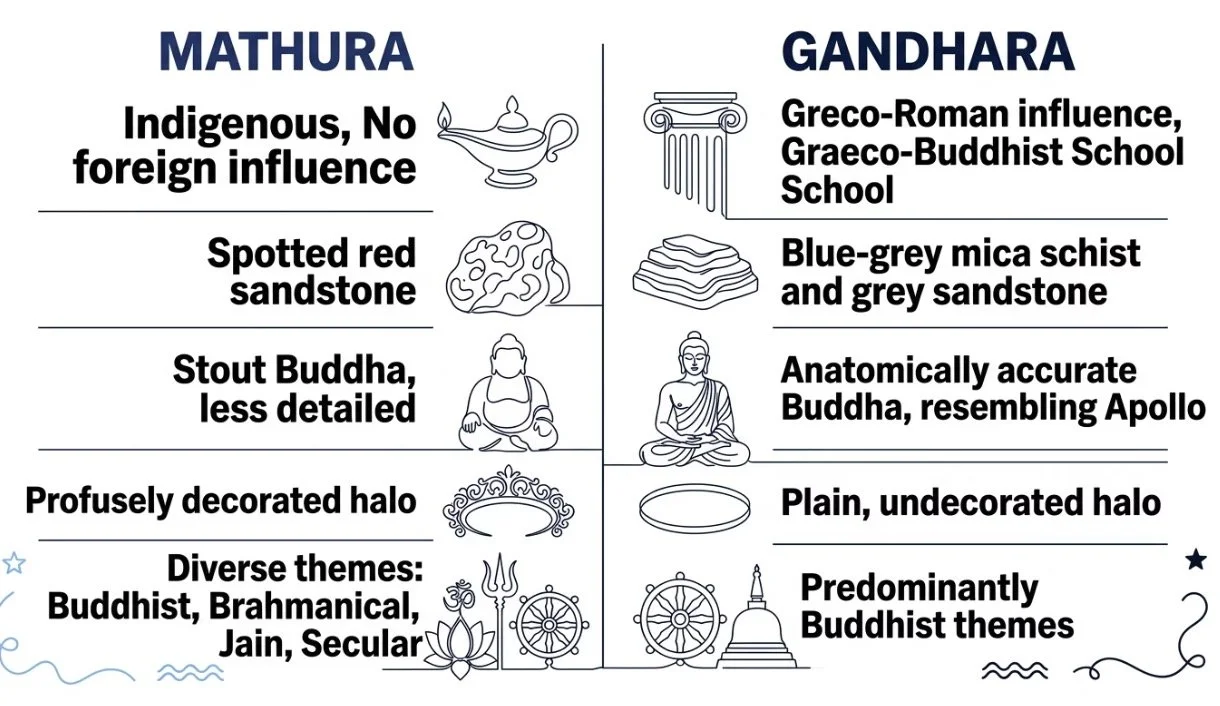
Mathura vs. Gandhara: A Comparative Analysis
Despite these differences, the two schools influenced each other deeply. Many Mathura sculptures incorporate Hellenistic elements such as idealised realism, curly hair, and folded garments. Conversely, the Gandhara school was enriched by Indian spiritual sensibilities. The result of this synthesis was the refined, spiritually luminous Buddha image of the Gupta period — which became the template for Buddhist art across South and South-East Asia for centuries to come.
Schools of Sculpture
The Gandhara School of Arts: Greco-Buddhist Synthesis
The Gandhara School of art represents one of the most fascinating cultural syntheses in world history — a fusion of Classical Greek aesthetics with Buddhist religious imagery, born of the extraordinary contact between Indian and Hellenistic civilisations in the north-western frontiers of the Indian subcontinent. Indian craftsmen came into contact with Central Asians, Greeks, and Romans in the region of Gandhara — centred in and around modern Peshawar in Pakistan — giving rise to a new form of art in which the Buddha was portrayed in the Greco-Roman style, his hair fashioned in flowing curls reminiscent of the Greek god Apollo.
The origins of Greco-Buddhist art lie in the Hellenistic Greco-Bactrian kingdom (250–130 BCE), located in today's Afghanistan, from which Hellenistic culture radiated into the Indian subcontinent with the establishment of the Indo-Greek kingdom (180–10 BCE). The best Gandhara sculpture was produced during the first and second centuries AD, and while the school originated under Indo-Greek rulers, its real patrons were the Shakas and Kushanas, particularly the great emperor Kanishka. Specimens of Gandhara sculpture have been found at Taxila, Peshawar, and numerous sites across north-western India and Afghanistan, including the colossal Bamiyan Buddhas of Afghanistan.
The influence of Gandhara art spread far beyond its place of origin. Under the Kushans, who were at the heart of the Silk Road, it radiated northward into Central Asia, strongly affecting the art of the Tarim Basin, and ultimately influencing the Buddhist art of China, Korea, and Japan. Within India, it influenced the Mathura school and, through the Gupta synthesis, shaped the Buddha image that became canonical across South-East Asia. Few artistic traditions in history have had so wide a geographical reach.
Greek Influence
Buddha's mother resembles an Athenian matron; early Buddhas have Apollonian faces; Greek gods pay obeisance to Buddha; curly or wavy hair; broad forehead and long earlobes.
Roman Influence
Dresses arranged in the style of Roman toga; deeply delineated folds of robes; Roman artistic motifs including triton; anthropomorphic tradition and naturalistic portraiture.
Buddhist Themes
Four canonical mudras — Abhaya, Dhyana, Dharmachakra, Bhumisparsha; reliefs depicting Buddha's birth, renunciation, and preaching; Mahayana Bodhisattva imagery.
Sculptural Features
Anatomical accuracy; spatial depth and foreshortening; rich carving and elaborate ornamentation; grey sandstone and stucco as primary materials; realistic muscle depiction.
Gandhara Art: Salient Features, Materials, and Legacy
Materials Used
Blue-grey mica schist and grey sandstone — primary materials
Mud, lime, and stucco — stucco provided great plasticity for expressive modelling
Marble was not used in Gandhara art
Terracotta was used rarely
The Four Mudras in Gandhara Art
Abhayamudra — gesture of fearlessness
Dhyanamudra — gesture of meditation
Dharmachakramudra — the preaching gesture
Bhumisparshamudra — touching the earth
Centres of Production
Taxila, Peshawar, Rawalpindi region; ruins of approximately fifteen monasteries found in and around Peshawar; the Begram hoard in Afghanistan.
The Gupta Synthesis and Legacy
The Mathura and Gandhara schools cross-fertilised over time, with the bulky Mathura Buddha gradually giving way to the slender elegance of the Gandharan image. The result of this synthesis — achieved during the Gupta period — ennobled, refined, and purified the Buddha image into one of the greatest artistic achievements in world history. The Gupta style became the canonical model for South-East Asian Buddhist art, carrying with it traces of the Hellenistic tradition that had, centuries earlier, arrived in India with the armies of Alexander the Great.
The influence of Gandhara art can be traced beyond Mathura as far as Amaravati on the east coast of India, as evidenced by Greek scrolls used in combination with Indian deities. Greek chariots pulled by four horses appear as motifs in the same area. The art of the Gupta period, considered the pinnacle of Indian Buddhist art, retains Hellenistic elements — purity of statuary, folds of clothing — but improves upon them with delicate draping, while tending away from strict realism toward a sublime spiritual idealisation that is wholly Indian in spirit.
Gandhara's Impact on Other Traditions
On Mathura
Curly hair, idealised realism, folded garments; Mathura adapted these with warmer, more fluid draping covering one shoulder
On Amaravati
Greek scrolls alongside Indian deities; motifs of Greek chariots found on east coast sculptures
On Gupta Art
The ultimate synthesis — spiritual Indian sensibility refined by Hellenistic clarity, becoming the template for Buddhist Asia
Schools of Sculpture
The Amaravati School of Arts: The Eastern Deccan Tradition
In the eastern Deccan, in the lower valleys of the Krishna and Godavari rivers, the Amaravati School of art developed over nearly six centuries, commencing from approximately 200–100 BCE. Patronised first by the Satavahanas and later by the Ikshvakus, and also by political dignitaries, merchants, and other groups, this school occupies a pre-eminent position in the history of Indian art. Its principal centres were Nagarjunakonda, Amaravati, Goli, Ghantasala, and Jaggayyapeta, all inspired by Buddhist themes drawn from the life of the Buddha and the Jataka stories.
The sculptural forms of this school come to us from the railings, plinths, and other parts of several stupas — above all, the great Mahachaitya at Amaravati. The reliefs represent a mature and sophisticated narrative art of the highest order. A celebrated example depicts the story of the taming of an infuriated elephant by the Buddha: the elephant approaches on a street, men throw up their hands in fear, women cling to their companions, the Buddha moves forward in a spirit of adoration and humility, the elephant kneels in submission, and the entire episode is watched by townspeople from balconies and windows. The entire scene is rendered with a naturalism and dramatic intensity that is astonishing in its compositional intelligence.
The general features of Amaravati art are distinctive: figures are carved in white marble and are well modelled with long legs and slender frames; physical beauty and sensual expression dominate; the central characters are human beings, with kings, princes, and palaces figuring prominently. The lotus and the purnakumbha (full vase) motifs are typical of Amaravati art, expressing auspiciousness and abundance. The curly hair of the Buddha in this school shows influence from the Greek artistic tradition mediated through Gandhara and Mathura.
Amaravati School: Four Periods of Stylistic Evolution
The Amaravati School shows a distinct and traceable evolution toward stylistic maturity over its five hundred years of development. Through successive stages, one can observe steady advances in technique, compositional complexity, and refinement of form.
First Period (200–100 BCE)
Evidenced at Jaggayyapeta. Slabs at the stupa base depict pilasters with animals above bell-shaped capitals. Figures are isolated units, not interrelated in composition. First signs of the tall, slender human frame characteristic of the Krishna Valley tradition.
Second Period (100 BCE – AD 100)
Casing slabs above the platform depict the Buddha in preaching form. Figures are more graceful and natural. The Buddha is almost always represented by a symbol, with a few early examples of his personalisation — among the earliest in Indian art.
Third Period (AD 150)
The railing around the stupa is carved. Sculptures represent the high watermark of the entire school. A new feature: delineation of different planes — figures of the first plane in deep relief, with depth reducing through successive planes. Extraordinary skill in depicting scenes of action. Nagarjunakonda sculptures on green limestone begin here.
Fourth Period (AD 200 onwards)
Casing slabs show richer and more elaborate carvings. Figures grow taller and slimmer. Finest miniature sculptures appear on small circular bosses and friezes. Third-century Buddha statues are magnificent and powerful — features full, expression aristocratic and benign, head crowned with short curly hair.
"One can see here the beginning of that tall and slender human frame which is so characteristic an ethnic form in the narrative reliefs of the Krishna valley, and later, of Pallava sculpture." — on the first period of Amaravati art at Jaggayyapeta
The Three Schools Compared: Mathura, Gandhara, and Amaravati
The three great schools of ancient Indian sculpture — Mathura, Gandhara, and Amaravati — each represent a distinct regional tradition shaped by different patronage networks, cultural contacts, and aesthetic priorities. Together, they constitute the bedrock of the classical Indian sculptural tradition and provide a comprehensive picture of the extraordinary artistic vitality of the early centuries of the Common Era.
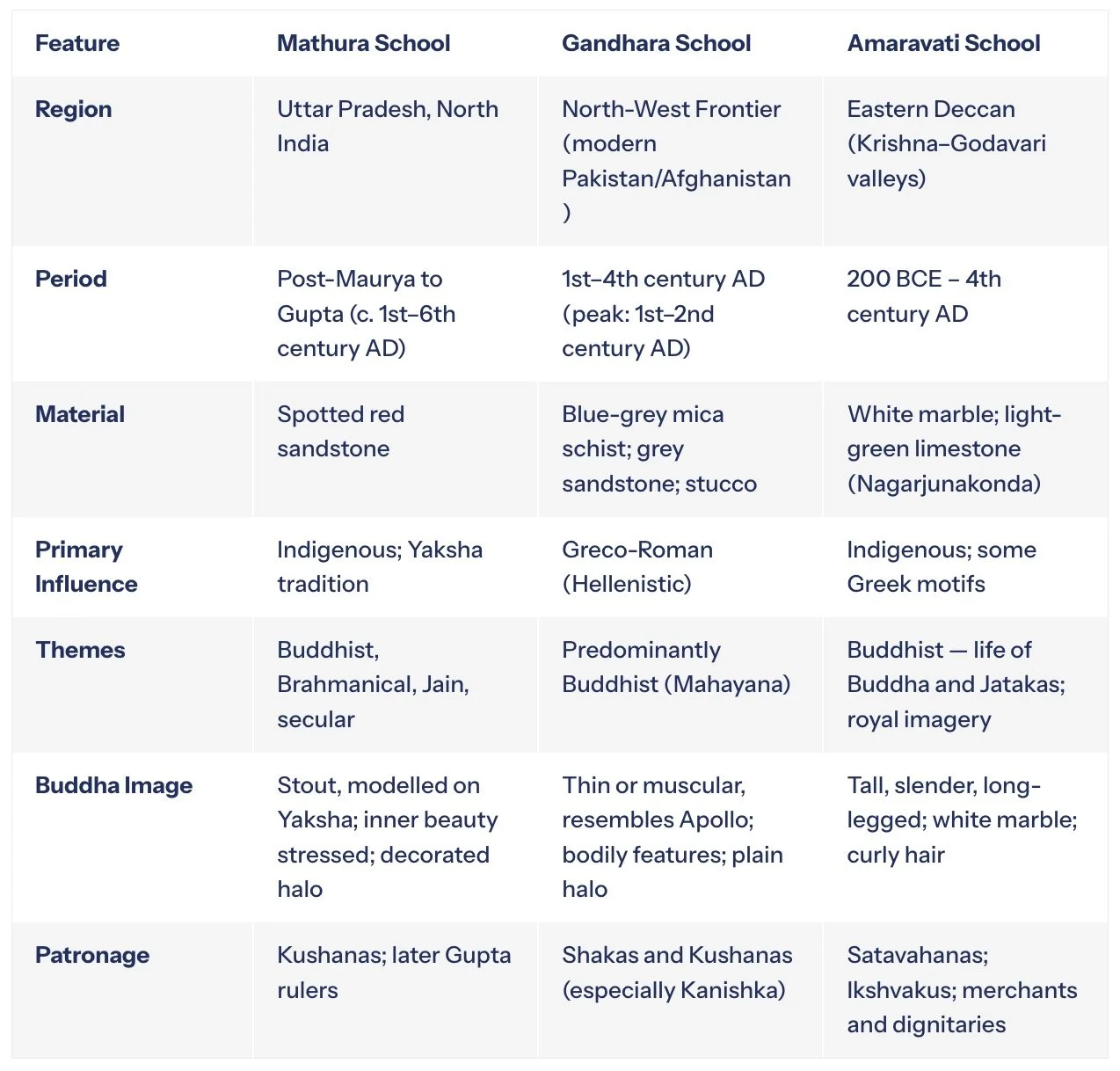
The Three Schools Compared: Mathura, Gandhara, and Amaravati
A Living Legacy
The architecture and art of ancient India evolved through distinctive and recognisable phases, each building upon the innovations of what came before while responding to new religious, political, and cultural circumstances. From the meticulously planned cities of the Indus Valley civilisation to the towering shikharas of the post-Gupta temples; from the burnished cave walls of Ashoka to the narrative reliefs of Sanchi, Bharhut, and Amaravati; from the indigenous vigour of the Mathura school to the Greco-Buddhist elegance of Gandhara — the cumulative achievement is one of the most remarkable in world cultural history.
What makes this tradition particularly extraordinary is its capacity for synthesis. The Gandhara school absorbed Greek and Roman forms and transformed them into something wholly its own. The Mathura school drew on the Yaksha tradition and gradually incorporated Hellenistic refinements. The Amaravati school developed a narrative art of storytelling in stone that is unsurpassed in its compositional sophistication. And the Gupta period achieved a synthesis of all these streams into a classical ideal that radiated outward across Asia, shaping the Buddhist art of China, Japan, Korea, Thailand, and Cambodia.
For students and enthusiasts of art history, the study of this tradition is not merely an exercise in cataloguing monuments and styles. It is an encounter with the creative intelligence of a civilisation that gave visual form to some of humanity's deepest spiritual aspirations — and in doing so, produced an artistic legacy of enduring beauty and universal significance. This rich Indian tradition of architecture and sculpture received further infusions and transformations in the medieval period and beyond, but the foundations laid in ancient times remain the bedrock upon which all subsequent Indian artistic achievement rests.
~4,000 Years of Architecture
From Indus Valley to post-Gupta — a continuous, evolving tradition
Three Great Sculptural Schools
Mathura, Gandhara, and Amaravati — each unique, each influential
Pan-Asian Legacy
Indian art shaped Buddhist traditions across China, Japan, Korea, and South-East Asia
Power of Synthesis
India's genius lay in absorbing foreign influences and transforming them into something distinctively its own
