
Indian Philosophy
Systems of Indian Philosophy
Orthodox & Unorthodox Schools
Indian philosophy represents one of the most ancient and richly layered intellectual traditions in the world. Rooted in the sacred authority of the Vedas — considered the oldest scriptures in human history — Indian philosophical thought has evolved over millennia into a vast, interconnected web of schools, doctrines, and debates. At the heart of this tradition lies a fundamental classification: systems that accept the authority of the Vedas (the āstika, or orthodox schools) and those that reject it (the nāstika, or unorthodox schools). This document offers a comprehensive, structured overview of both categories — from the six classical orthodox systems and their principal founders, to the heterodox challenges of Charvaka and Ajivika, to the spiritual dimensions of Tantricism and Shaktism. Together, these traditions form the intellectual and spiritual bedrock of what is broadly known today as Indian civilisation.
The Two Great Divisions: Orthodox & Unorthodox Systems
The classification of Indian philosophical systems rests on a single, decisive criterion: acceptance or rejection of the Vedas as the ultimate source of authoritative knowledge. The Vedas are commonly regarded by their adherents as having originally emanated from the divine, making them the supreme arbiter of spiritual truth. Any system of thought that does not ground itself in Vedic authority — even if it believes in God or gods — is considered nāstika (atheistic in the Indian sense). Conversely, systems that recognise Vedic authority are called āstika (theistic or orthodox).
Orthodox (Āstika) Schools
Also called Sanatana Dharma, collectively known today as Hinduism. These six schools accept Vedic authority.
Nyāya
Vaisheshika
Sāmkhya
Yoga
Pūrva-Mimāmsā
Uttara-Mimāmsā (Vedānta)
Unorthodox (Nāstika) Schools
These systems reject the authority of the Vedas, representing heterodox intellectual and spiritual movements in ancient India.
Charvākism (Lokāyata)
Ājīvika
Jainism
Buddhism
Note: Vaisheshika, Nyāya, Sāmkhya and Yoga, when originally formulated, neither explicitly accepted nor rejected the Vedas — making their classification nuanced.
The orthodox schools are further organised into three complementary pairs: Nyāya–Vaisheshika (logic and atomism), Yoga–Sāmkhya (practice and theory of liberation), and Mimāmsā–Vedānta (ritual and philosophical interpretation of the Vedas). In each pair, the first system is concerned with practice and the second with theoretical underpinnings.
Common Characteristics of Indian Philosophy
Despite their doctrinal differences, nearly all Indian philosophical systems — with the notable exceptions of Ājīvika and Charvākism — share a set of fundamental orientations toward human life, knowledge, and liberation. These common threads reveal the remarkably unified spirit of the Indian philosophical enterprise, even amid its great diversity of methods and metaphysical commitments.
Philosophy Must Improve Life
All schools insist that philosophical inquiry must have a positive and practical impact on human life. Abstract speculation divorced from lived experience is considered insufficient or even harmful.
The Four Purushārthas
There is broad agreement on the four principal goals of human life — artha (wealth), kāma (desire), dharma(righteousness), and moksha (liberation) — as the framework for ethical and spiritual life.
From Darkness to Light
All systems reflect the conviction that philosophy should guide a person from ignorance (avidyā) toward knowledge and enlightenment. This journey from darkness to light is the essential metaphor of the Indian tradition.
Verifiable Truth
Truth and reality must be substantiated through reasoning and experience — whether sensory, conceptual, or intuitional. Indian philosophy is not dogmatic in the Western sense; it demands epistemic justification.
Ignorance as the Root of Suffering
Human suffering arises from ignorance (avidyā). All schools hold that man can overcome ignorance and attain total freedom — moksha — even within this bodily existence.
Essential Spirituality of Man
There is general agreement that the human being is fundamentally spiritual in nature. The material world is not the ultimate reality, and man's deepest identity transcends the physical.
The Six Orthodox Schools: Founders & Texts
By the beginning of the Common Era, six formal schools of philosophy — collectively called the Shad-darshanas (six viewpoints) — had crystallised within the Vedic intellectual tradition. Each school is organised around a foundational text of aphorisms called sūtras, which encapsulate its essential teachings. These schools were associated with sages and rishis who systematised earlier teachings into coherent philosophical frameworks. While the precise historicity of these founders is sometimes debated, the following attributions are widely acknowledged.
Sāmkhya — Kapila Muni
The oldest of the six systems. Its foundational text is the Sāmkhya Kārikā. Explores the dualism of Purusha (consciousness) and Prakriti (matter).
Yoga — Patañjali
Systematised by Patañjali in the Yoga Sūtras. Provides the practical methodology for realising the distinction between Purusha and Prakriti through the eight-limbed path (Ashtānga Yoga).
Nyāya — Gautama Muni
Founded around the 2nd century BCE. The Nyāya Sūtras form its basis. A rigorous system of logic and epistemology grounded in four means of valid knowledge.
Vaisheshika — Kaṇāda
Founded in the 6th century BCE. Kaṇāda's Vaisheshika Sūtras propound an early atomic theory. Concerned with classifying all of reality into seven ontological categories.
Pūrva-Mimāmsā — Jaimini
Propagated by sage Jaimini, a disciple of Veda Vyāsa. Focuses on the interpretation of the earlier Vedic texts (Samhitās and Brāhmaṇas) and the performance of ritual duty.
Vedānta — Ādi Shankara
The Uttara-Mimāmsā, or "end of the Vedas," is based on the Upanishads. Systematised most famously by Ādi Shankara in the 8th century CE into the Advaita (non-dual) school.
Sāmkhya & Yoga: Matter, Spirit, and Liberation
The Sāmkhya and Yoga schools are paired as the theoretical and practical halves of the same philosophical enterprise. Sāmkhya (literally meaning "to count" or "to enumerate") provides the metaphysical framework — a systematic enumeration of the principles (tattvas) that constitute reality — while Yoga provides the methodological path for actualising the liberation that Sāmkhya describes.
Sāmkhya: The Dualist Framework
At its core, Sāmkhya posits two fundamental and irreducible realities:
Prakriti — primordial matter, creative energy, inert and ever-changing
Purusha — pure consciousness, eternal, immutable, and non-active
The visible universe arises from the interaction of Purusha and Prakriti. A jīva (living being) is the state in which Purusha is bonded to Prakriti. Liberation comes from the clear recognition — through perception (pratyaksha), inference (anumāna), and testimony (shabda) — that Purusha is entirely distinct from Prakriti. Early Sāmkhya was materialistic; it did not require a divine creator. Around the 4th century CE, the concept of God was introduced, giving the school a more theistic character. The existence of a Supreme Being is not directly asserted and is considered largely irrelevant to the soteriological project.
Yoga: The Eight-Limbed Path (Ashtānga)
Yoga accepts all twenty-five Sāmkhya principles and adds Īshvara (God) as a twenty-sixth, making it more theistic. Patañjali defines yoga as the cessation of all mental modifications (chitta-vritti-nirodha). Salvation is achieved through disciplined practice:
Yama — ethical restraints
Niyama — personal observances
Āsana — physical postures
Prāṇāyāma — breath regulation
Pratyāhāra — withdrawal of senses
Dhāraṇā — concentration
Dhyāna — meditation
Samādhi — absorption
The ultimate goal is kaivalya — complete solitariness or detachment of Purusha from Prakriti. This path bears a structural resemblance to Buddhism's Noble Eightfold Path, reflecting a shared intellectual climate.
Nyāya & Vaisheshika: Logic, Atoms, and Analysis
The Nyāya and Vaisheshika schools form another complementary pair — the first providing the logical and epistemological tools of inquiry, the second offering an atomistic and ontological analysis of the material world. Though originally independent, their closely related metaphysical commitments led them to eventually merge into a unified system.
Nyāya: The School of Logic
Founded by Gautama Muni in the 2nd century BCE, the Nyāya school (nyāya = analysis) is concerned primarily with the methodology of valid knowledge and its role in attaining salvation. It identifies four sources of valid knowledge (pramāṇas): perception (pratyaksha), inference (anumāna), comparison (upamāna), and testimony (shabda). Human suffering arises from wrong knowledge and ignorance; correct knowledge, arrived at through rigorous logical method, leads to liberation. A classic Nyāya syllogism runs: "There is fire on the mountain, because it emits smoke; wherever there is smoke, there is fire, as in a hearth." The school acknowledges the soul and self, distinguishing it from Buddhism, which denies both.
Vaisheshika: Atoms and Ontology
Founded by Kaṇāda in the 6th century BCE, the Vaisheshika school is atomist and pluralist. It holds that all material objects are reducible to indivisible atoms (paramāṇu), and that Brahman is the fundamental force that causes consciousness within these atoms. The school classifies all of reality into seven ontological categories (padārthas):
Dravya (substance)
Guṇa (quality)
Karma (movement)
Sāmānya (generality)
Vishesha (speciality)
Samavāya (inherence)
Abhāva (non-existence)
The Vaisheshika thus laid the foundations for an early Indian physics, though its scientific vision was tempered by theological commitments. It accepts only perception and inference as valid epistemic sources.
Pūrva-Mimāmsā & Vedānta: The Vedic Pair
The final orthodox pair — Mimāmsā and Vedānta — is uniquely distinguished from the other four schools in that both derive their philosophical principles directly from the statements of the Vedas. Where the first four schools were founded on the teachings of individual sages, Mimāmsā and Vedānta ground their entire doctrinal edifice in Vedic revelation. The two schools differ sharply, however, in which part of the Vedas they foreground.
Pūrva-Mimāmsā (Jaimini)
Focus: The earlier (pūrva) portions of the Vedas — the Samhitās and Brāhmaṇas — which are primarily ritualistic.
Mimāmsā (literally "the art of reasoning and interpretation") uses logical argument to justify and uphold Vedic ritual authority. It holds that the Vedas contain eternal truth and that the performance of prescribed fire sacrifices (yajñas) sustains the activity of the universe. The essence of the Vedas, according to this school, is dharma. Righteous action earns merit, leading one to heaven. However, accumulated virtue is finite; one eventually returns to earthly existence unless moksha — complete freedom from the cycle of birth and death — is attained through absolute ritual performance. Mimāmsā strongly legitimised Brahminic authority and the varna-based social hierarchy.
Uttara-Mimāmsā / Vedānta (Shankara / Rāmānuja)
Focus: The later (uttara) portions of the Vedas — the Āraṇyakas and especially the Upanishads — which are philosophical and meditative.
Vedānta (literally "the end of the Vedas") holds that the supreme teaching of the Vedas is not ritual performance but the realisation of Brahman — the Absolute Truth. Its foundational text is the Brahmasūtra of Bādarāyaṇa (2nd century BCE). Shankara (9th century CE) interpreted Brahman as attributeless and the phenomenal world as māyā (illusion); the self (ātma) is identical with Brahman, and liberation comes through jñāna (knowledge). Rāmānuja (12th century CE), in contrast, held that Brahman possesses attributes, the world is real, and the path of devotion (bhakti) is the route to salvation. Vedānta is widely regarded as the apex of all six systems.
Sub-Schools of Vedānta: Six Interpretive Traditions
Due to the cryptic and poetic nature of the Vedānta sūtras, the school diverged into six distinct sub-schools, each offering a different interpretation of the relationship between the individual self (jīva), the material world (jagat), and the Absolute (Brahman). These sub-schools can broadly be divided into personal (devotion to a personal God) and impersonal(realisation of a formless Absolute) approaches.
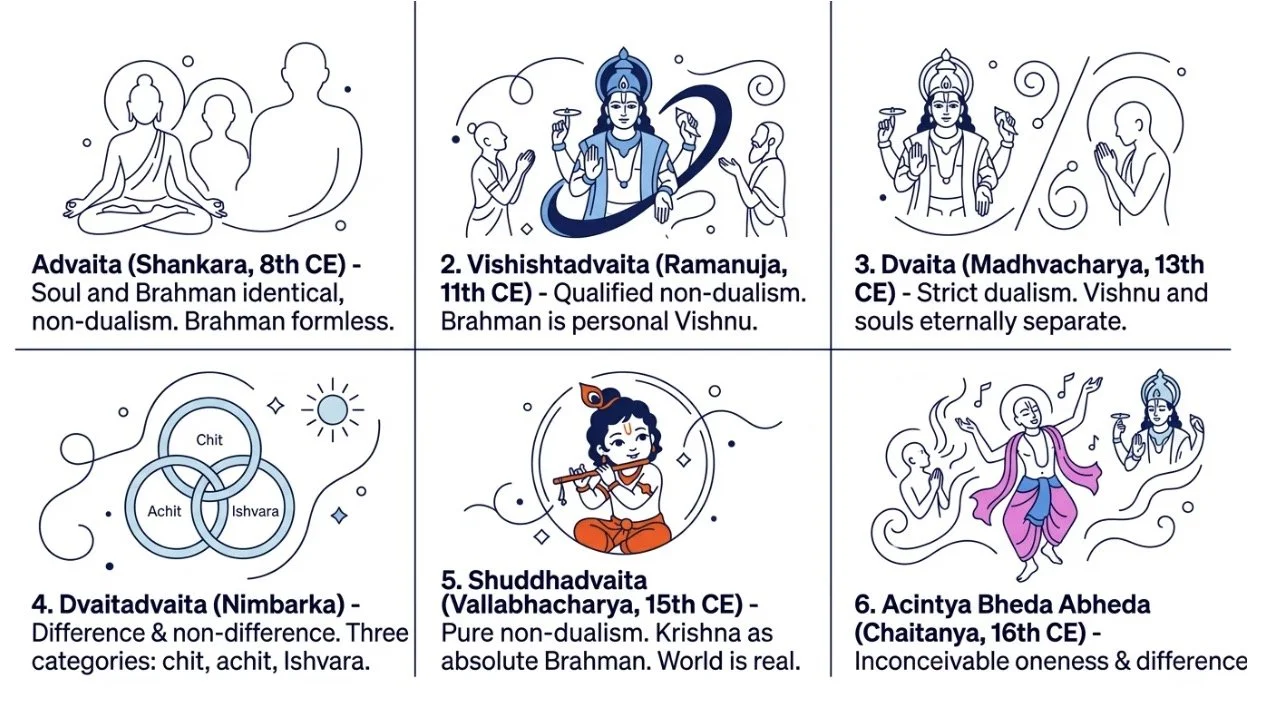
Sub-Schools of Vedānta: Six Interpretive Traditions
The most widely known sub-school is Advaita, systematised by Ādi Shankara in the 8th century CE. Advaita holds that Brahman is the only reality; the phenomenal world is an illusion (māyā) arising from ignorance, and individual beings are non-different from Brahman. In contrast, the personal schools — Vishishtadvaita, Dvaita, Dvaitadvaita, Shuddhadvaita, and Acintya Bheda Abheda — affirm the reality of the world, the personality of God, and the distinct existence of individual souls, with devotion as the primary path.
Advaita, Vishishtadvaita & Dvaita: A Closer Look
Three of the six Vedānta sub-schools deserve particular attention for their historical influence and philosophical depth: Advaita, Vishishtadvaita, and Dvaita. Together they represent the full spectrum of possible positions on the metaphysical relationship between God, soul, and world — from radical monism to strict dualism.
Advaita Vedānta — Ādi Shankara (8th century CE)
Advaita literally means "not-two." The true Self (Ātman) is identical with the highest Reality (Brahman). The phenomenal world is covered by māyā — the veil of illusion arising from ignorance. Knowledge of Brahman destroys māyā and leads to liberation. Shankara's masterpiece was the Brahmasūtrabhāshya; he also wrote commentaries on ten principal Upanishads and the Bhagavad Gītā. He organised Hindu monks under four Mathas at Dvārakā (West), Jagannātha Puri (East), Sringeri (South), and Badrikāshrama (North). Brahman is formless, attributeless, eternal, and conscious. Individual beings are non-different from Brahman.
Vishishtādvaita — Rāmānuja (1017–1137 CE)
Rāmānuja's "Advaita with uniqueness" (qualified non-dualism) holds that Brahman alone exists but is characterised by internal multiplicity — souls and matter are real and form the "body" of Brahman. The three key principles are: Tattva(knowledge of three real entities: jīva, ajīva, and Īshvara), Hita (the means of realisation through bhakti and prapatti/self-surrender), and Purushārtha (the goal of moksha). Unlike Shankara's impersonal Brahman, Rāmānuja's Brahman is a Personal God — specifically identified as Vishnu-Nārāyaṇa. Rāmānuja was born in Tamil Nadu and drew from the devotional Āḷvār tradition.
Dvaita Vedānta — Madhvāchārya (1238–1317 CE)
Madhva's "Dvaita" (dualism), also known as Tattvavāda, posits a strict and eternal distinction between God (Brahman/Vishnu/Paramātman) and individual souls (jīvātman). Five fundamental and irreducible differences are maintained: between God and soul, God and matter, soul and matter, soul and soul, and matter and matter. Individual souls are not created by God but depend on Him for their existence. Madhva, like Rāmānuja, embraced Vaishnavism. He established the famous Krishna temple at Udupi, Karnataka, which remains an important centre of pilgrimage.
The Unorthodox Schools: Ājīvika & Charvāka
While the six orthodox schools promoted idealistic or spiritually-oriented philosophies, a powerful counter-tradition of heterodox materialism also developed in ancient India. Two schools in particular — the Ājīvika sect and the Charvāka school — represent the most radical departures from the Vedic mainstream. Both rejected supernatural authority and privileged material and sensory reality; both found their greatest following among the warrior, merchant, and artisan classes of society.
Ājīvika: The School of Fate (Niyati)
The Ājīvika sect, whose most prominent leader was Makkhali Gosāla (5th century BCE), built its philosophy on the concept of niyati (cosmic determinism). Nothing in the universe — not karma, not effort, not devotion — can alter the predetermined path of a soul. All events, past, present, and future, are entirely ordained by cosmic forces. Human effort is of no consequence whatsoever. Though karma and transmigration exist in Ājīvika doctrine, they operate on a rigid, preordained schedule lasting thousands of years. The Ājīvikas rejected the Vedas but believed in the ātman. They practised severe asceticism, including complete nudity, and their communities were open to all castes, including women. The school reached its peak under the Mauryan emperor Bindusāra (4th century BCE), received royal patronage from Ashoka and Dasharatha, and survived for nearly 2,000 years — as late as the 14th century CE — in Karnataka and Tamil Nadu.
Charvāka (Lokāyata): Pure Materialism
The Charvāka school, also known as Lokāyata ("worldly"), is the most thoroughgoing materialist philosophy in Indian history. It rejected the authority of the Vedas, denied the existence of God, soul, karma, rebirth, and heaven or hell. Sensory perception is the only valid source of knowledge. Only what can be directly perceived by the senses is real. Consciousness is not a separate substance but a property of the physical body — like the redness produced when areca nut, lime, and betel are combined. When the body dies, consciousness simply ceases. The school promoted egoistic hedonism: the proper goal of life is to maximise pleasure (kāma) and wealth (artha); dharma and moksha are irrelevant inventions. Religion, priests, and rituals are frauds devised by the clever to exploit others. The Charvāka school developed from around the 7th century BCE, with early texts attributed to Ajita Kesakambalī.
Historical Context: The materialist schools flourished between 500 BCE and 300 CE, a period of expanding economy, iron-based agriculture, and growing urban trade. By the 5th century CE, idealistic philosophy had largely eclipsed them — though their legacy endured as a persistent counter-current in Indian thought.
Charvāka Philosophy: Principles in Detail
The Charvāka school offers one of the most systematically developed materialist philosophies in the ancient world. Though its original texts have been lost, later works — including Buddhist, Jaina, and Brahminic polemical literature — preserve enough of its doctrine to reconstruct its essential positions. Charvāka stands as the most radical intellectual challenge to the spiritual consensus of Indian philosophy.
Theory of Knowledge (Epistemology)
Sensory perception is the only valid source of knowledge. Inference, verbal testimony, comparison, and all other epistemic sources are rejected as unreliable. Only what can be directly experienced by the human sense organs is real. This principle eliminates belief in Brahman, God, soul, and any transcendent reality.
Metaphysics: Four Elements
The universe is composed entirely of the four basic material elements — earth, water, fire, and air. There is no fifth spiritual substance. The world exists and operates purely mechanically. God is rejected because He cannot be perceived by the senses. If God exists, who made Him? The universe requires no supernatural creator.
Rejection of the Soul
The soul does not exist as a separate entity. Consciousness is a property of the body that arises from the correct combination of the four material elements — just as fermentation produces intoxication from inert ingredients. When the body dies, consciousness disappears entirely. There is no transmigration, no rebirth, no afterlife.
Ethics: Pleasure as the Highest Good
Of the four purushārthas, Charvāka accepts only kāma (pleasure) and artha (wealth). Since there is no soul, there is no case for liberation (moksha). The dictum is to live fully in the present. Right and wrong are human conventions; the cosmos is indifferent to moral categories. The only rational goal is to enjoy pleasures and avoid pain.
Tantricism: The Path of Mantra and Sacred Power
Tantricism represents one of the most distinctive and complex spiritual currents in Indian religious history. It is best understood not as a single unified system but as a broad family of traditions united by certain characteristic features: the use of sacred syllables and phrases (mantras), symbolic diagrams (maṇḍalas), ritual practices, and the quest for spiritual power and ultimate liberation through means not sanctioned by mainstream Vedic orthodoxy. The texts of this tradition are known as Tantras — a word literally meaning "looms" — and they form the scriptural basis for a wide range of Hindu and Buddhist practices. Tantricism is therefore an umbrella term for a heterogeneous body of theology, philosophy, ritual, and spiritual practice.
A defining characteristic of Tantric traditions across all their forms is the centrality of mantra — hence they are commonly referred to as Mantramārga ("Path of Mantra") in Hinduism, and Mantrayāna ("Mantra Vehicle") or Guhyamantra ("Secret Mantra") in Buddhism. Tantricism drew heavily from its parent traditions of Hinduism and Buddhism while simultaneously transforming them from within. It was radically egalitarian in social orientation: Tantric practice was open to all castes as well as to women — a stark contrast to Brahminic orthodoxy. The guru occupied the highest place in Tantric tradition; no practitioner was to attempt the path without the guidance of a competent teacher.
Belief in Magical Powers
Attainment of supernatural powers (siddhis) through disciplined practice is a central aspiration. Rituals, mantras, and meditative techniques are all oriented toward this end.
Realisation of Self as Deity
The practitioner identifies the self with a chosen deity (ishtadevatā), collapsing the boundary between worshipper and worshipped in an act of radical spiritual identification.
Predominance of Female Deities
The Mother Goddess in her many forms — Shakti, Kālī, Durgā — occupies a central position. The female principle is accorded great reverence as the source of all creation and power.
Centrality of Guru and Dīkshā
The relationship between Guru and disciple is considered indispensable. Initiation (dīkshā) by a qualified Guru is necessary before undertaking Tantric practices. Without it, the path is considered spiritually dangerous.
Centrality of the Body
The human body is regarded as the earliest and most immediate medium through which truth can be realised. Bodily faculties are employed in sādhana (spiritual practice) rather than renounced.
Union of Polarities
Liberation is conceived as the union of opposing cosmic principles — most characteristically, the union of Shiva (pure consciousness) and Shakti (dynamic power). Reality is fundamentally bipolar.
Tantricism in Hinduism and Buddhism
Tantricism did not develop in isolation from the major Indian religious traditions. Rather, it penetrated and transformed both Hinduism and Buddhism from within, generating new scriptures, new lineages, and new forms of practice that became enormously influential across South Asia and beyond. The relationship between Tantra and its parent traditions is one of mutual influence — Tantra borrowed from Hinduism and Buddhism while also reshaping their theology, ritual, and cosmology in profound ways.
Tantra in Hinduism
According to Hindu Tantrism, the entire universe is conceived as the divine stage upon which Shiva and Shakti enact the drama of creation, preservation, and dissolution. Tantric practice aims at attaining the grace of Shakti, leading to liberation from ignorance and the attainment of immortality. Hindu Tantric lineages today exist in several major traditions:
Shaiva Siddhānta
Shakta Shrī Vidyā tradition
Kaula tradition
Kashmir Shaivism
Tantric practice is classified into two broad paths: the dakshiṇa-bhāva (right-hand path), involving conventional ritual observance, and the vāma-bhāva (left-hand path), which includes practices involving the ritual use of alcohol, meat, and sexual rites. Active centres of traditional Tantric practice persist in Assam (near the Kāmākhyā temple), parts of West Bengal, South Indian Siddhānta temples, and Kashmiri Shaiva temples. Tantra is extolled by some as a shortcut to self-realisation, while most orthodox Hindus view its left-hand practices with suspicion or condemnation.
Tantra in Buddhism (Vajrayāna)
Buddhist Tantrism — known as Vajrayāna ("Diamond Vehicle") — is an ancient and highly complex system of Buddhist philosophy and practice that distinguishes itself from other Buddhist schools through its elaborate ritual methods (upāya, or skilful means) for attaining liberation. Rather than relying solely on meditation and ethical conduct, Vajrayāna employs mantra recitation, mudrā (ritual gesture), maṇḍala visualisation, and the guidance of a Tantric Guru. The major Vajrayāna traditions include:
Indo-Tibetan Buddhism (Gelug, Kagyu, Nyingma, Sakya)
Chinese Esoteric Buddhism (Mìzōng)
Japanese Shingon Buddhism
Nepalese Newar Buddhism
Tibetan Buddhism has a particularly strong Tantric foundation. Tantric traditions were especially influential in north-eastern India and Tibet, and some of their ritual elements derived from indigenous Tibetan practices. Though Buddhist Tantra claims to be exclusively a right-hand path, it shares many structural features with its Hindu counterpart. Tantric Hindu and Buddhist traditions together influenced Jainism, Islam, and Sikhism across South Asia.
Shaktism: The Tradition of the Divine Feminine
Shaktism is one of the major denominations of Hinduism, centred on the worship of Shakti or Devī — the Divine Feminine — as the supreme reality and the dynamic power underlying all of existence. The tradition traces its roots back more than 20,000 years to the earliest known female figurines found in Indian Palaeolithic settlements. It developed further in the Indus Valley Civilisation, experienced a partial subordination during the Vedic period when the great male gods dominated, and re-emerged with increasing force in the Epic and Purāṇic periods. Shaktism as it exists today found its full flower during the Gupta Age (300–700 CE) and has continued to expand ever since.
Palaeolithic & Indus Valley
Female figurines and goddess worship appear in settlements over 20,000 years old. The goddess cult was refined during the Indus Valley Civilisation.
Vedic Period
Goddesses such as Ushās, Aditi, Prithvī, Sarasvatī, Vāc, and Shrī (Lakshmi) appear in the Rig Veda, though in a generally subordinate role as consorts to the great gods.
Epic Period
The Mahābhārata reveals the goddess residing in the Vindhyas and introduces the Durgā Stotras — the first revelation of Devī in her true, all-encompassing character.
Gupta Age (300–700 CE)
Shaktism reaches its full flower. Key Purāṇic texts are compiled, including the Devī-Māhātmya. Goddess temples and sculptural traditions proliferate across the subcontinent.
Medieval Period
The Kalika Purāṇa, Lalitā Sahasranāma, and Tantric texts systematise Shakta theology. The sacred geography of Shakta pithas expands dramatically across India.
The foundational conviction of Shaktism is that the Divine Feminine — however she may be named (Durgā, Kālī, Lakshmi, Sarasvatī, Pārvatī, Bhagavatī) — is not merely one deity among many but the singular, all-encompassing power that animates and sustains the universe. The Kena Upanishad offers an early account of the Devī appearing as the shakti(essential power) of the Supreme Brahman itself, establishing the philosophical basis for her supreme status long before the Purāṇic era.
Sacred Texts of Shaktism
The theological and devotional richness of Shaktism is encoded in a vast body of literature spanning the Upanishads, the great Epics, the Purāṇas, and the Tantras. These texts progressively elaborate the mythology, philosophy, ritual practices, and sacred geography of the goddess tradition. Several texts are of particular importance for understanding the tradition's intellectual depth and its historical development.
Devī-Māhātmya
Inserted into the Mārkaṇḍeya Purāṇa by approximately the 7th century CE, this is perhaps the single most important Shakta text. For the first time, diverse mythic, cultic, and theological elements relating to various female divinities were brought together into a unified narrative. The text narrates the Devī's exploits — most famously her slaying of the buffalo-demon Mahishāsura — accompanied by hymns in which the gods praise her in countless forms. The Devī is here revealed as the supreme Shakti who sustains the entire universe.
Lalitā Sahasranāma
Part of the Brahmānda Purāṇa, this text contains the thousand names of the Hindu mother goddess Lalitā. It is a sacred text for worshippers of the goddess in all her forms — Durgā, Pārvatī, Kālī, Lakshmi, Sarasvatī — and operates on multiple levels simultaneously: the names describe the Devī's physical qualities and mythic exploits while also encoding an esoteric guide to kundalinī yoga and the Srīvidyā tradition of Shaktism.
Kālikā Purāṇa
Composed in Assam or adjacent Bengal during the early medieval period, this text reflects the richly syncretic and locally rooted worship of the Devī in her both benign (shānta) and terrifying (raudra) aspects. It describes two methods of worship: the dakshiṇa-bhāva (right method, including animal and human sacrifice) and the vāma-bhāva (left method, involving alcohol, meat, and sexual rites). The text also documents the performance of the popular festival of Durgā Pūjāand provides an early enumeration of the Shakta pīthas — sacred sites where pieces of the goddess Satī's dismembered body fell to earth.
The Shakta Pīthas: The Devī Bhāgavata and Kālikā Purāṇa enumerate sacred sites (pīthas) associated with the goddess — locations where the dismembered body of Satī is said to have fallen. The Kālikā Purāṇa lists seven principal pīthas, including Kāmarūpa (Assam), Jālandhar, and Pūrṇagiri. This sacred geography expanded dramatically in the medieval period, creating a pan-Indian network of goddess pilgrimage sites that unified diverse local traditions under the overarching symbol of the one great Devī.
Shaktism: Architecture, Sculpture & Local Goddesses
The lived reality of Shakta worship is expressed not only in texts but in the rich material culture of temples, sculpture, and sacred landscape that spread across the Indian subcontinent in the early medieval period. Architectural and sculptural remains from multiple regions bear witness to the widespread worship of Durgā and her associated forms — the Mātr̥kās (divine mothers), the Yoginīs, and the countless local goddesses who were gradually assimilated into the expanding Shakta tradition.
The Saptamātr̥kās and Yoginīs
The seven (or eight) divine mothers — the Saptamātr̥kās — appear frequently in early medieval temple iconography. Their worship was especially popular in eastern India. In Orissa, Mātr̥kā images have been found in and near Jajpur. The Yoginīs — sixty-four attendants or manifestations of Durgā — are described in texts as participants in the goddess's battles against the demons Shumbha and Nishumbha. Roofless Yoginī temples of remarkable architectural character occur at Rāṇīpur-Jhariāl and Hirāpur in Orissa, representing a unique form of open-sky sacred space aligned with Tantric cosmology.
Multi-Armed Durgā and Local Goddess Cults
Multi-armed images of Durgā proliferate in large numbers across early medieval India, particularly in the eastern regions. In Tamil Nadu, an iconographic peculiarity associates the goddess with a stag. Representations of the goddess as Nishumbhamardini (slayer of the demon Nishumbha) appear prominently among the reliefs of Chola-period temples. The inscriptions of early medieval India record many local goddesses: Virājā and Stambheshvarī in Orissa, and Kāmākhyā in Assam — a site that remains one of the most venerated Shakta shrines in India to this day. The Purāṇic tradition performed a crucial integrative function by developing the theological framework that all local goddesses were manifestations of the single, universal great Devī — thus weaving together an enormously diverse range of regional goddess cults into a coherent pan-Indian tradition.
The Legacy of Indian Philosophical Systems
The systems of Indian philosophy — orthodox and unorthodox, idealist and materialist, ritualist and mystical — together constitute one of humanity's most sustained, diverse, and intellectually rigorous engagements with the fundamental questions of existence. Spanning more than two and a half millennia, from the Vedic sages of the second millennium BCE to the medieval commentators of the 14th century CE, this tradition addressed with equal seriousness the nature of matter, the structure of knowledge, the path to liberation, the organisation of society, and the metaphysics of the Absolute.
Philosophical Pluralism as a Strength
Indian philosophy never converged on a single orthodox system in the manner of some Western traditions. The competition and dialogue between schools — between Advaita and Dvaita, between Nyāya logic and Sāmkhya metaphysics, between Charvāka materialism and Vedāntic idealism — generated an extraordinarily rich intellectual ecosystem in which every major position was articulated, defended, and contested with rigour.
The Social Dimension of Philosophy
Indian philosophy was never merely academic. The Mimāmsā school legitimised Brahminic ritual authority and the varna hierarchy. The Charvāka and Ājīvika schools challenged that hierarchy from below. The Tantric and Shakta traditions democratised spiritual access, opening the path of liberation to all castes and women. Every philosophical position had profound social consequences and was embedded in the political economy of its time.
The Enduring Question of Liberation
Across all systems — whether through jñāna (knowledge), bhakti (devotion), karma (action), yoga (discipline), or mantra (sacred sound) — the central preoccupation of Indian philosophy remains the liberation of the individual from suffering and the cycle of birth and death. This shared soteriological concern gives the tradition its remarkable unity beneath its surface diversity and ensures its continuing relevance for students, scholars, and seekers the world over.
"All the schools agree that the philosophy should help man in realising the main ends of human life — the purushārthas — and lead a person from darkness and ignorance to light and knowledge."
