
The Kharavela Dynasty
The Kharavela Dynasty: Power, Conquest, and Legacy in Ancient Kaḷinga
The Mahameghavahana dynasty of Kaḷinga, with Kharavela at its zenith, represents one of the most remarkable political resurgences in post-Mauryan India. Rising from the ashes of Ashoka's devastating conquest, Kaḷinga under Kharavela transformed itself into a formidable imperial power — its military reach extending from the Gangetic plains to the southernmost kingdoms of the Tamil country, and its maritime networks spanning the breadth of Southeast Asia.
Chapter I
Kharavela and the Mahameghavahana Dynasty
Kharavela (193 BCE–170 BCE) stands as the most celebrated ruler of the Mahameghavahana dynasty, the ancient ruling house that reasserted Kaḷinga's sovereignty in the turbulent aftermath of Mauryan decline. The Mauryan emperor Ashoka had famously shattered Kaḷinga in 261 BCE, an act of violence so profound that it precipitated the emperor's own conversion to Buddhism. Yet, from precisely this crucible of defeat, the Chedi clan of Kaḷinga — to which Kharavela belonged — fashioned a political renaissance of extraordinary vigour. The Mahameghavahana dynasty filled the power vacuum left by the crumbling Mauryan administrative apparatus and rapidly consolidated authority over the eastern Deccan and coastal Orissa.
Within a remarkably compressed span of ten regnal years — from his second to his twelfth year — Kharavela orchestrated a series of brilliant military campaigns that extended Kaḷinga's suzerainty from the north-western reaches of the subcontinent to the far south. His armies confronted Magadha, Anga, and the Satavahanas; broke the Tamil confederacy in the Pandyan south; uprooted western powers; and very likely defeated an Indo-Greek (Yavana) king. The political consequences were sweeping: Pushyamitra Sunga, the founder of the Sunga dynasty in Magadha, accepted the suzerainty of Kharavela and became his vassal — a remarkable reversal of the historical balance of power between the two regions.
Political Context
Dynasty: Mahameghavahana (Chedi clan)
Region: Kaḷinga (modern Odisha)
Period: Post-Mauryan, c. 193–170 BCE
Preceded by Mauryan decline after Ashoka's Kalinga War (261 BCE)
Rapidly filled political vacuum in eastern India
Key Military Achievements
Defeated Magadha, Anga, and Satavahanas
Broke the Tamil confederacy in the far south (Pandyan country)
Probably defeated an Indo-Greek (Yavana) king
Pushyamitra Sunga became vassal of Kaḷinga
Jina statue of Mahaveera restored to Kaḷinga
Beyond conquest, Kharavela demonstrated a cultural and religious breadth unusual among ancient Indian monarchs. Although personally inclined towards Jainism — which he patronised generously — he is described in his own inscription as "the worshiper of all religious orders, the restorer of shrines of all gods," suggesting a deliberate policy of religious pluralism designed to consolidate loyalty across a diverse populace. His maritime ambitions were equally striking: Kaḷinga under his leadership maintained active trade and diplomatic connections with Simhala (Sri Lanka), Burma, Siam, Vietnam, Kamboja, Malaysia, Borneo, Bali, Sumatra, and Java — testifying to a sophisticated, outward-looking commercial vision. Kharavela appears to have abdicated in his thirteenth regnal year, and was succeeded by his son Kudepasiri, who is attested in only a few minor inscriptions.
Military Supremacy
Campaigns spanning from north-western India to the Pandyan south within ten years; forced Pushyamitra Sunga into vassalage and recovered the sacred Jina statue from Magadha.
Maritime Reach
Kaḷinga's trade routes linked it to Sri Lanka, Burma, Siam, Vietnam, Cambodia, Malaysia, Borneo, Bali, Sumatra, and Java — a testament to a thriving oceanic commercial network.
Religious Tolerance
A devout Jain patron who nonetheless honoured all faiths, restored temples of various traditions, and styled himself "restorer of shrines of all gods."
Chapter II
The Hathigumpha Inscription: Source, Form, and Context
The single most important primary source for the history of Kharavela is the celebrated Hathigumpha Inscription — the "Elephant Cave" inscription — carved upon a natural cavern on the southern face of the Udayagiri hill near Bhubaneswar, Odisha. Consisting of seventeen lines incised in deep-cut Brahmi letters in the Prakrit language, this epigraph represents one of the most extensive and historically consequential inscriptions of the post-Mauryan period. Its physical placement is itself laden with political symbolism: the Hathigumpha cave faces directly towards the Rock Edicts of Ashoka at Dhauli, situated approximately six miles away. In Dhauli, Ashoka had proclaimed his remorse and his dharma after the conquest of Kaḷinga; in Hathigumpha, Kharavela proclaimed the triumphant reconstitution of Kaḷinga's power. The two monuments together constitute a remarkable dialogue in stone across centuries.
"The inscription of the victory of Magadha at Dhauli; the inscription of the victory of Kaḷinga at Hathigumpha — a dialogue in stone between conqueror and reconstituted power."
The inscription opens in the unmistakable idiom of Jain religious invocation, saluting the Arhats and the Siddhas — a declaration of Kharavela's personal religious allegiance. It then proceeds, year by year, to record the principal events of his reign: military campaigns, civic constructions, religious benefactions, and administrative measures. The inscription is dated to the 165th year of the era of the Maurya kings and the 13th year of Kharavela's own reign. Taking the coronation of Chandragupta Maurya in 321 BCE as the probable starting point of the Maurya era, scholars have arrived at an approximate date of 157 BCE for the inscription itself, and 170 BCE for Kharavela's accession to the throne — a chronological framework that, while subject to scholarly debate, provides a workable foundation for historical analysis.
Location
Natural cavern, southern face of Udayagiri Hill, near Bhubaneswar — facing Ashoka's Dhauli Rock Edicts, ~6 miles distant.
Script & Language
Seventeen lines in deep-cut Brahmi script, Prakrit language — the standard epigraphic medium of the period.
Dating
165th year of the Maurya era; 13th regnal year of Kharavela — yielding c. 157 BCE for the inscription and 170 BCE for accession.
Opening
Begins with a Jain invocation of the Arthatas and the Riddhas — establishing Kharavela's personal religious orientation from the outset.
It must, however, be emphasised with scholarly caution that the Hathigumpha Inscription is an eulogistic composition — a prasasti — and not a dispassionate historical chronicle. Many of its claims, particularly those relating to the scale of military victories and the extent of territorial suzerainty, require corroboration from other sources. Independent archaeological and numismatic evidence for several of the events described remains limited. Scholars have long noted that while Kharavela was evidently a formidable conqueror and an energetic administrator, the inscription's framing as a panegyric means that its testimony must be weighed critically rather than accepted wholesale.
Chapter III
Military Campaigns as Recorded in the Hathigumpha Inscription
The Hathigumpha Inscription provides a year-by-year chronicle of Kharavela's military activities, presenting a portrait of relentless and strategically calculated expansion. The inscription's account of the military campaigns is among the most detailed royal campaign narratives to survive from ancient India outside the Asokan corpus, and it allows historians to reconstruct, with appropriate caution, the broad contours of Kaḷinga's imperial overreach under this remarkable ruler.
2nd Regnal Year
Without deference to the Satavahana king Satakarni, Kharavela dispatched a large army to the west comprising horse, elephant, infantry, and chariot. He also destroyed the capital of the Mushikas to aid the Kaspa (Kasyapa) Kshatriyas.
4th Regnal Year
Conquest of the Rathika and Bhojaka chiefs, who were compelled to cast off their crowns, surrender their royal umbrellas and insignia, and prostrate themselves at Kharavela's feet. Their jewellery and wealth were confiscated.
8th Regnal Year
Invasion of Magadha, advancing as far as Barabar Hills (Gorathagiri). A ruler described as "Yavana-raja" — an Indo-Greek king — was forced to retreat to Mathura. This is one of the most debated episodes in the inscription.
12th Regnal Year
Attack upon the king of Uttarapatha. Kharavela caused fear among the people of Magadha and compelled their king to pay homage at his feet. The Tamil confederacy in the south was also broken during these campaigns.
Among the most symbolically resonant of all Kharavela's military achievements was the recovery of the sacred Jain idols — the blessed Tirthankaras — that earlier Magadhan rulers had carried away following the original Kalinga War. The Nanda king had reportedly looted these divine images along with the treasures of Anga and Magadha. Kharavela's restoration of these idols, complete with their crowns and endowments, was not merely a political act but a profound statement of religious restitution and dynastic legitimacy. It linked him directly to a pre-Mauryan Kaḷinga and presented him as the righteous restorer of a violated sacred order — a narrative device as powerful as any military victory in the inscription's overall rhetoric.
Scholarly Note: The identification of the "Yavana-raja" forced to retreat to Mathura in the 8th regnal year remains contested. Some historians identify him with the Indo-Greek king Demetrius or Menander; others remain sceptical. The episode cannot be independently corroborated and must be treated with the caution due to all eulogistic sources.
Chapter IV
Civic Administration, Cultural Patronage, and Religious Policy
The reign of Kharavela was emphatically not confined to military conquest. The Hathigumpha Inscription reveals a ruler of remarkable administrative energy, civic consciousness, and cultural breadth — one who invested as heavily in the welfare of his subjects as in the extension of his empire. This dimension of Kharavela's kingship is frequently overshadowed by the dramatic narrative of his campaigns, yet it is arguably equally significant for understanding the nature and legitimacy of Mahameghavahana rule.
Year 1 — Infrastructure
Repaired gates, ramparts, and structures of the Kaḷinga Nagari fort damaged by storm. Built steps for cool tanks and laid gardens at a cost of 3,500,000 coins — winning the affection of his subjects from the very outset of his reign.
Year 3 — Cultural Life
Being versed in the Gandhavara-Veda (the science of music), Kharavela organised theatrical performances, dances, and public entertainments — demonstrating a conception of kingship that embraced cultural flourishing alongside statecraft.
Year 5 — Water Management
Extended the great canal excavated by King Nanda three hundred years earlier into the capital Kaḷinga Nagari through Tanasuli — a major hydraulic engineering achievement linking his reign to a deeper historical continuum.
Year 6 — Corporate Rights
Granted special privileges to the Paura (urban) and Janapada (rural) corporations — indicating a sophisticated awareness of civic organisation and the importance of co-opting mercantile and agrarian communities into the political structure.
Year 9 — Royal Munificence
Gave lavish gifts to Brahmins and constructed the grand Palace of Victory on both banks of the Prachi river at a cost of 36 lakh silver coins. Gifted a golden Kalpa tree along with elephants, horses, and chariots.
Year 13 — Religious Devotion
Having satisfied himself with imperial expansion, Kharavela turned entirely to religious activities at Kumari Hill (Udayagiri) — constructing the Arhat temple, erecting a four-pillared pavilion, and carving the Hathigumpha cave itself.
The inscription's language in describing Kharavela's civic and religious roles is particularly revealing. He is styled "the king of peace and prosperity," the "Bhikshu king," and the "King of Dharma" — epithets that consciously echo the Asokan idiom of righteous kingship while reinterpreting it through a Jain lens. His self-description as "worshiper of all religious orders, restorer of shrines of all gods" reflects a pluralist religious policy typical of successful ancient Indian monarchs who governed populations of varied sectarian affiliation. The maintenance of nine hundred bulls by the royal household, the construction of stone edifices near the Arhat temple, and the carving of the Hathigumpha cave itself all speak to a deep personal investment in the material culture of Jainism.
The inscription concludes with the observation that the personality of Kharavela reveals the confluence of both Raj Rishi (the royal sage) and Dharma Rishi (the sage of righteousness) — a formulation that positions him simultaneously in the Kshatriya tradition of royal heroism and the renunciatory tradition of spiritual wisdom. This ideological synthesis, however carefully constructed by his court poets, resonated with a political culture that valued both martial prowess and dharmic authority. Nevertheless, scholars are unanimous in noting that despite his magnificent achievements as a conqueror and builder, Kharavela ultimately remained a regional power rather than a pan-Indian empire builder in the tradition of the Mauryas.
Chapter V
The Minor Inscriptions of Udayagiri and Khandagiri
Beyond the magnificent Hathigumpha Inscription, the twin hills of Udayagiri and Khandagiri near Bhubaneswar preserve a collection of minor Brahmi inscriptions that supplement and contextualise our understanding of the Kharavela period. These shorter epigraphs, also composed in Prakrit language and engraved in Brahmi script, are scattered across the cave complexes of both hills and represent a diverse body of evidence — royal, monastic, and administrative — that enriches the historical picture considerably.
Key Features of the Minor Inscriptions
Script: Brahmi; Language: Prakrit
Location: Twin hills of Udayagiri and Khandagiri
Mention of Kharavela's son and successor, Kudepasiri
Illuminate the reign, kingdom, and administrative structures of Kaḷinga
Complement and contextualise the Hathigumpha testimony
Royal, monastic, and administrative perspectives represented
Historical Significance
The minor inscriptions are invaluable precisely because they provide perspectives beyond the controlled royal narrative of the Hathigumpha prasasti. References to Kudepasiri — Kharavela's son — in these shorter texts confirm the dynastic succession, even as the paucity of evidence about his reign underscores how personalised Mahameghavahana power was under Kharavela himself. The caves of Udayagiri and Khandagiri served as important Jain monastic centres, and several inscriptions record donations to monastic communities, the excavation of cave residences for ascetics, and the patronage of Jain religious activities — providing a ground-level view of how Jainism was institutionally embedded in Kaḷinga society during this period.
The concentration of epigraphic evidence at Udayagiri and Khandagiri reflects the deliberate choice of these hills as a royal and sacred landscape. The elaborate system of rock-cut caves — many of which bear decorative carvings, gateways, and relief sculptures — suggests a sustained programme of royal patronage that transformed the hills into a monumental statement of Mahameghavahana power and Jain piety. The Rani Gumpha (Queen's Cave) and the Ganesh Gumpha, among others, are architecturally sophisticated examples of this tradition.
Limitation of the Epigraphic Record
Despite their collective value, the inscriptions of Kharavela's period suffer from significant limitations. The Hathigumpha text itself is damaged and several passages are illegible or disputed. The minor inscriptions are brief and fragmentary. No external corroboration — Chinese, Greek, or Roman — for most of the events described in Hathigumpha has been found. Numismatic and archaeological evidence for the Mahameghavahana period remains relatively sparse. These lacunae mean that any reconstruction of Kharavela's reign must proceed with scholarly humility.
Enduring Historical Importance
Notwithstanding these limitations, Kharavela and the Hathigumpha Inscription occupy a position of extraordinary importance in the historiography of ancient India. They document the recovery of a regional polity from near-annihilation; they preserve evidence of maritime trade networks that connected eastern India to the whole of Southeast Asia; and they offer a rare, detailed account of royal ideology and administrative practice in the post-Mauryan centuries — a period for which evidence remains frustratingly fragmentary across much of the subcontinent.
The Kharavela Dynasty: Power, Conquest, and Legacy in Ancient Kaḷinga
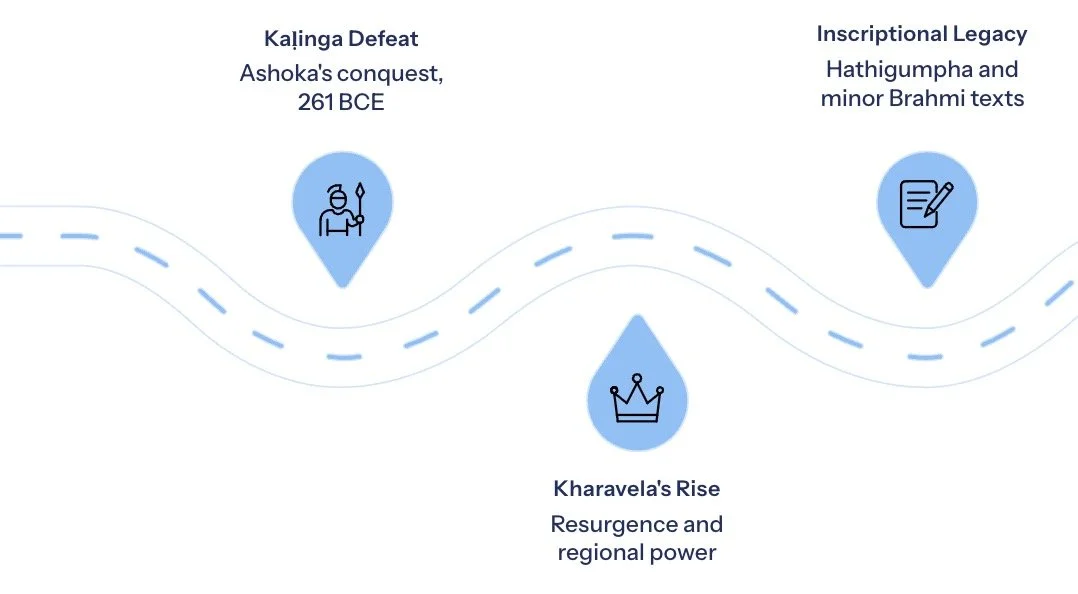
The arc from Kaḷinga's traumatic defeat under Ashoka to its glorious reconstitution under Kharavela, preserved for posterity through the rock-cut testimony of Hathigumpha and the minor cave inscriptions, encapsulates one of the most compelling narratives of resilience, statecraft, and sacred legitimacy in the entire corpus of ancient Indian history. Kharavela may not have been an empire-builder in the Mauryan mould, but as a regional sovereign who transformed conquest into culture and military power into monumental memory, he stands among the most remarkable figures of early historic India.
