
Post-Mauryan Period: Literature, Science & Art
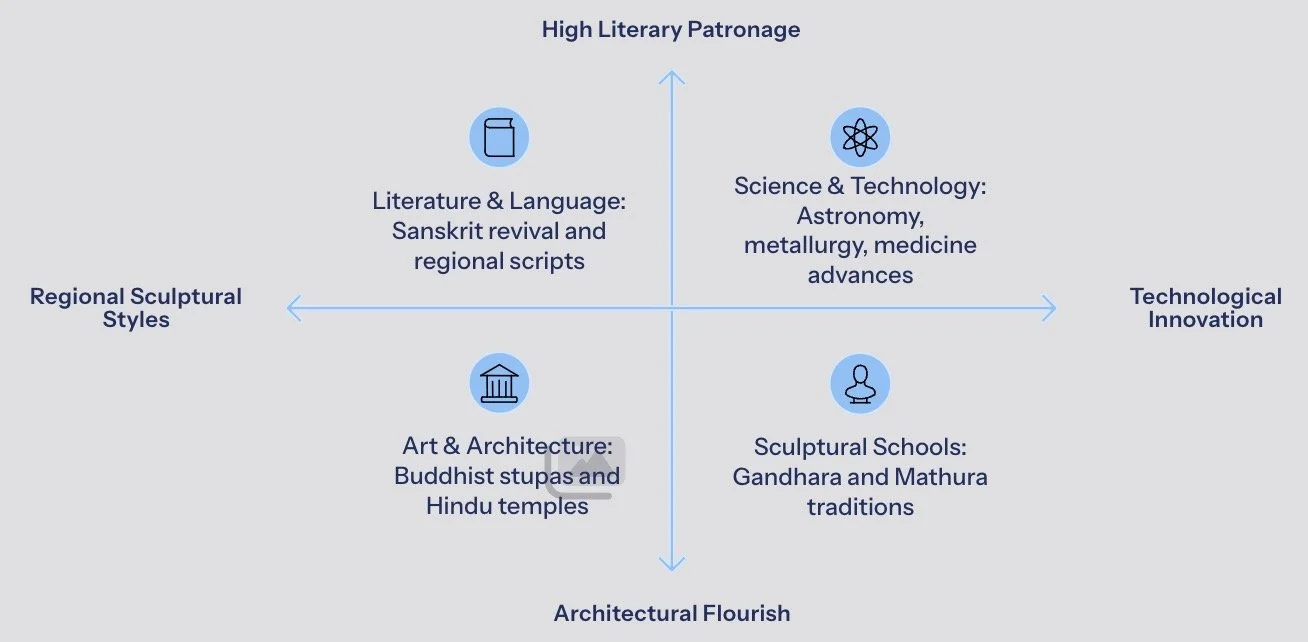
The centuries following the decline of the Mauryan Empire — roughly spanning 200 BC to AD 300 — witnessed one of the most dynamic and cosmopolitan phases in ancient Indian history. Under the patronage of the Kushans, Shakas, Satavahanas, and Tamil kingdoms, India experienced a remarkable efflorescence of literary creativity, scientific exchange, artistic innovation, and architectural achievement.
Post-Mauryan Period: Literature, Science & Art
Chapter 1
Language and Literature: A Multilingual Civilisation
The Kushan rulers were acutely aware of the linguistic and scriptural diversity within their vast dominions. Their coins and inscriptions were issued in the Greek, Kharoshthi, and Brahmi scripts, while the languages employed ranged from Greek and Prakrit to Sanskrit-influenced Prakrit, and ultimately, towards the end of their rule, pure Sanskrit. This official recognition of three scripts and four languages reflects not merely political pragmatism but a genuine commitment to communicating across cultural boundaries — and serves as evidence of widespread literacy during Kushan times.
While the Mauryas and Satavahanas had long patronised Prakrit, it was certain Central Asian princes who elevated Sanskrit to literary prominence. The earliest specimen of the refined kavya style appears in the Junagadh Rock Inscription of Rudradaman (c. AD 150), which also records the repairs he commissioned to the Sudershana Lake. From this point onwards, chaste Sanskrit increasingly replaced Prakrit in formal inscriptions, though Prakrit continued in use well into the fourth century AD.
Ashvaghosha
Enjoyed Kushan patronage. Authored the Buddhcharita — the first Buddhist biography of the Buddha in Sanskrit Mahakavya form. Also composed Saundarananda, Vajrasuchi, and Sahputra.
Vasumitra & Nagarjuna
Vasumitra produced Prajnaparmita, Sutra Shastra, and the encyclopaedic Mahavibhasha. Nagarjuna was a towering philosopher of the Mahayana tradition whose influence extended far beyond India.
The rise of Mahayana Buddhism stimulated the composition of numerous avadanas — narratives recounting the life histories and teachings of the Buddha and bodhisattvas. These texts were composed in Buddhist Hybrid Sanskrit, a deliberately accessible register designed to communicate Mahayana teachings to the widest possible audience. Notable examples include the Mahavastu and the Divyavadana.
The Milindapanho (Questions of Milinda), composed by Nagasena, records the philosophical dialogue between the Greek king Menander (Milinda) and the Buddhist monk Nagasena. It stands as a remarkable testimony to the intellectual encounter between Hellenistic and Indian thought.
Theatre, Secular Literature & the Greek Influence
Indian theatre in this period owed a significant, if debated, debt to Greek influence. Both outdoor and indoor theatres appear in the caves of Ramgarh hill, approximately 160 miles south of Banaras, where a rest house for an actress has also been identified. The architectural plan of these theatres is considered to be of Greek origin. Most strikingly, the theatrical curtain — a device borrowed from the Greeks — entered Indian drama as the yavanika, a term derived from yavana, the Sanskritised form of "Ionian," by which the ancient Indians knew the Greeks. The character of the court clown (Vidushaka) is similarly believed to have entered Indian dramatic tradition on the Greek model.
Yet India's indigenous contribution to dramatic art was equally profound. Around 150 BC, Patanjali references the staging of scenes such as the binding of Bali or the killing of Kansa, indicating an already established tradition of theatrical performance. The formal codification of this tradition came with Bharata's Natyasastra, an authoritative treatise on rhetoric and dramaturgy that marked the full institutionalisation of theatre in India.
Kamasutra of Vatsyayana
Attributed to the third century AD, this is the earliest surviving work on erotics in the Sanskrit tradition. Beyond its explicit subject matter, it provides a richly detailed portrait of the life of the nagaraka — the cultivated, city-bred individual — set against a backdrop of thriving urbanism and refined social culture.
Sangam Literature (South India)
The Tamil literary tradition produced a remarkable body of work, including the Thirukkural by Thiruvalluvar, Agattiyam by Agathiyar, and Tolkappiyam by Tolkappiyar. Outside the Sangam corpus, five great Tamil epics are recognised: Silappatikaram, Manimekalai, Cīvaka Cintāmaṇi, Valayapathi, and Kundalakeci.
Medical Literature
The Charaka-Samhita extended the Ayurvedic tradition, articulating the concept of the balance of three doshas — Vata, Pitta, and Kapha. The Sushruta-Samhita, attributed to Sushruta (the "Father of Surgery"), catalogues more than 120 surgical instruments, demonstrating the extraordinary sophistication of ancient Indian medical knowledge.
Chapter 2
Science, Astronomy & Indo-Greek Exchange
In the post-Mauryan period, Indian astronomy and astrology were profoundly enriched through sustained contact with the Greeks. Numerous Greek astronomical terms relating to planetary movement found their way into Sanskrit texts. Indian astrology absorbed Greek conceptual frameworks, and from the Greek word horoscope was derived the Sanskrit term horashastra, which continues to denote astrology in the classical tradition. The renowned Indian astronomical treatise Gargi Samhita offers a candid acknowledgement of this intellectual debt, asserting that although "the Yavanas are barbarians, yet the science of astronomy originated with them, and for this they must be reverenced like Gods."
Greek coinage, which was properly shaped and standardised, represented a considerable advance over the earlier Indian punch-marked coins. The Greek term drachma was Indianised as drama. In exchange, Greek rulers adopted the Brahmi script and incorporated Indian motifs on their coins, reflecting the reciprocal nature of this cultural encounter.
Astronomy
Greek planetary terminology entered Sanskrit. The Gargi Samhita acknowledged Greek astronomical expertise. Indian scholars built upon Hellenistic foundations to develop a sophisticated indigenous tradition.
Medicine & Botany
In medicine, botany, and chemistry, India owed little to the Greeks. The Charakasamhita catalogues hundreds of medicinal plants (oshadhi) and describes processes of pounding and mixing that reveal advanced chemical knowledge.
Technology & Dress
Central Asian contact introduced the stirrup (attributed to the Kushans), leather shoes, trousers, long boots, and riding gear. Kushan copper and gold coins were imitated from Roman originals, and diplomatic embassies were exchanged with Rome in AD 27–28 and AD 110–120.
The field of glass-working was especially transformed through foreign contact. In no other period of ancient Indian history did glass-making advance as dramatically as it did during the post-Mauryan era. Indian artisans, already accomplished in many crafts, absorbed and adapted foreign techniques to create a flourishing industry that served both domestic consumption and export markets.
Crafts, Mining & Metallurgy
The reign of the Shakas, Kushans, Satavahanas, and Tamil kings (c. 200 BC – c. AD 300) witnessed remarkable strides across all major craft traditions. The Mahavastu catalogues 36 kinds of crafts practised in the town of Raggu, while the Milinda Panha enumerates 75 distinct craft specialisations. Great advances were achieved in metallurgy, glass manufacture, architecture, sculpture, weaving, carpentry, ironsmithery, arms manufacture, dyeing, and fishing.
Textiles
Mathura was a premier centre of cloth-making. Silk weaving and cloth production saw remarkable progress. Fine textiles were traded across the known world.
Ivory & Gems
Ivory craftsmanship reached its zenith. Ivory articles have been recovered from as far afield as Rome and Afghanistan. Rich patrons wore necklaces of diamond beads cut by highly skilled artisans.
Metallurgy
Eight craft specialisations in gold, silver, lead, tin, copper, brass, iron, and precious stones are referenced in contemporary literature. Steel was manufactured and Indian cutlery was in such demand that Pliny records Romans willing to pay any price for it.
Coinage
Coin-minting became a major craft. Gold, silver, copper, bronze, lead, and potin coins were produced in various shapes. Coin-moulds capable of producing half a dozen coins simultaneously have been found across North India and the Deccan.
Indian iron and steel goods, including cutlery, were in exceptional demand in western Asia and the Roman Empire. The Indian craftsmen and jewellers produced unique specimens in gold and silver that were eagerly sought in foreign markets. In the sphere of military technology, the Shakas and Kushans introduced improved cavalry techniques — popularising the use of reins, saddles, and a form of toe stirrup — which fundamentally transformed warfare. Their turbans, tunics, trousers, and long coats left a lasting imprint on the sartorial traditions of the subcontinent, visible even today in the attire of Afghans and Punjabis.
Chapter 3
Art & Architecture: An Overview
The post-Mauryan period marked a decisive transformation in the character, patronage, and social base of Indian art. Whereas Mauryan art was essentially palace art — spectacular but state-sponsored and exclusive — the art of the Sunga, Kanva, Kushan, and Satavahana periods drew on a vastly wider social base. Merchants, guilds, local rulers, and religious communities all contributed to the flourishing of artistic activity across the subcontinent and beyond its frontiers.
A crucial material shift accompanied this change in patronage: from the Mauryan period onwards, artists increasingly moved away from perishable wood towards non-perishable stone as the medium of creative expression. This transition ensured the survival of a rich archaeological legacy. The period also witnessed constant and productive interaction with art forms from beyond the frontiers of the Indian subcontinent — from Central Asia, the Hellenistic world, and Rome — giving rise to distinct regional schools.
Art & Architecture: The post-Mauryan period
Most artistic production of this period was inspired by Buddhism and Jainism, with very few surviving Brahmanical monuments from the early centuries. Sacred sites such as Sanchi, Sarnath, Taxila, and Bharhut — where stupas may have been originally built under Mauryan patronage — received significant additions and embellishments in the post-Mauryan centuries. Importantly, the symbolic vocabulary of this art was not confined to any single religion: the Bharhut and Sanchi stupas depict not only scenes from the life of the Buddha but also Yakshas, Yakshinis, Nagas, and other popular divinities, alongside richly observed scenes from everyday life and nature.
Residential Architecture & Early Temple Structures
The architecture of the post-Mauryan period may be broadly divided into two categories: residential structures and religious monuments. The former have largely disappeared, as they were constructed primarily of perishable materials such as wood. Nevertheless, literary sources offer vivid descriptions. The Milinda Panha describes a prosperous city furnished with moats, ramparts, gatehouses, towers, well-laid streets, markets, parks, lakes, and temples. Buildings of several storeys with wagon-vaulted roofs and verandas are mentioned — mostly constructed of wood. Archaeological evidence partially corroborates this picture, though little structural evidence survives in situ.
The Shaka–Kushan phase saw a distinct advance in building activities. Excavations at various sites in north India have revealed several superimposed layers of construction — sometimes more than half a dozen — evidencing sustained urban habitation and rebuilding. Burnt bricks were used for flooring and tiles for both flooring and roofing, though the adoption of tiles may have been an indigenous development rather than a foreign borrowing. The characteristic pottery of the period is red ware, both plain and polished, with medium to fine fabric; the distinctive forms include sprinklers and spouted channels.
Jhandial Temple, Taxila
One of the earliest known temple structures of the period. Exhibits a plan suggestive of Hellenistic architectural influence in the northwest.
Sankarshana Temple, Nagari (Rajasthan)
An early Brahmanical temple dedicated to Sankarshana (Balarama), representing the nascent tradition of deity-image worship in a formal temple setting.
Temple at Besnagar, Madhya Pradesh
Associated with the Heliorodorus pillar and the Bhagavata tradition. A significant early example of Brahmanical religious architecture.
Apsidal Temple, Nagarjunakonda (Andhra Pradesh)
A notable example from the south, with an apsidal plan reflecting Buddhist architectural influence adapted for other religious purposes.
The Chinese pilgrim Fa-hien's account references a grand tower at Purushapura (modern Peshawar) attributed to Kanishka I — a structure of thirteen storeys surmounted by an iron column bearing imposing ceremonial umbrellas. The construction of permanent temples housing images of deities became common only later; in this period, Buddhist stupas and associated structures constituted the dominant form of religious architecture.
Stupas: Architecture, Symbolism & Major Sites
The stupa — a hemispherical mound built over the preserved remains of a revered personality — occupies the central place in Buddhist religious architecture. According to Buddhist sources, the remains of the Buddha's body were divided into eight portions and enshrined beneath eight stupas. Ashoka later redistributed these relics, which led to the construction of many more stupas across the subcontinent. The worship of stupas drove their progressive ornamentation and the development of a distinctive architectural vocabulary.
Structurally, a stupa resembles an inverted bowl. At its slightly flattened top stood the harmika — the symbolic abode of the gods — within which the relic casket (of gold or silver) was placed. A wooden rod (yashti) was fixed at the centre, rising through the harmika, and topped by three small umbrella-shaped discs (chatras) symbolising reverence, veneration, and magnanimity.
Bodh Gaya (Bihar)
Site of the Buddha's enlightenment. Ashoka commissioned a Bodhi Manda here. Stone pillars from the Sunga period survive, decorated with Jataka reliefs.
Sanchi Stupa (Madhya Pradesh)
Originally built in brick by Ashoka (c. 250 BC), nearly doubled in circumference during the Sunga period (c. 150 BC). Four ornate gateways (toranas) depict scenes from the Buddha's life and Jataka stories in exquisite relief.
Bharhut Stupa (Madhya Pradesh)
Near Satna. The main stupa has not survived, but its stone railings and gateways — imitations in stone of wooden originals — preserve remarkable carvings of Yakshas, Yakshinis, and Buddhist narrative scenes.
Amaravati (Andhra Pradesh)
Built of white marble, 42 metres in diameter and 29 metres tall. Though the structure itself has vanished, its sculptured panels — now in museums — represent the high point of Andhra Buddhist art.
Nagarjunakonda (Andhra Pradesh)
Built in a distinctive southern style with concentric circular walls joined by spoke-like partitions. Its richly carved marble drum slabs depict episodes from the life of the Buddha with great narrative fluency.
Taxila (Northwest)
Multiple stupas excavated, including the Chira-Tope Stupa (excavated by Sir John Marshall) and the stupa erected by Kanishka near Peshawar. Objects here display the characteristic Gandhara style.
The shared architectural features across stupas from different regions are particularly instructive: they suggest the mobility and interaction of artisans and craftsmen across vast distances, and the existence of a pan-Indian artistic community capable of synthesising diverse regional traditions into a coherent aesthetic whole.
Rock-Cut Architecture: Chaityas and Viharas
Alongside the free-standing stupa, the rock-cut tradition produced some of the most impressive monuments of the post-Mauryan period. Both Buddhists and Jains carved chaityas (shrine halls with a votive stupa at the apse) and viharas(monastic cells for the residence of monks) directly out of living rock. This technique, which required no fired brick or quarried stone, produced spaces of extraordinary spatial power — their scale and precision a testament to the sophisticated engineering and organisational capacity of ancient Indian builders.
Chaitya Halls: Key Features
Long rectangular hall ending in a semicircular apse
Internally divided into a nave, an apse, and two side aisles
Aisles separated from the nave by rows of pillars
Pillars encircling the votive stupa in the apsidal section
Barrel-vaulted ceiling
Doorway facing the votive stupa
Characteristic horse-shoe shaped chaitya window on the facade
Vihara Monasteries: Key Features
Square or oblong central hall
Pillared veranda at the front
Multiple small square cells for monks
Raised stone benches within cells and halls
Among the earliest: Bhaja, Bedsa, Ajanta, Pitalkora, Nasik, Karle
Notable Jain examples: Udayagiri and Khandagiri (Orissa), patronised by Kharavela
Double-storeyed Ranigumpha at Udayagiri — the largest of the Jain cave monuments
Major western Indian sites include Bhaja, Karle, Kondane, Nasik, Chitaldo, Ajanta, and Kanheri; in eastern India, the primary examples are concentrated at Udayagiri in Orissa. The Jain cave complex at Udayagiri and Khandagiri comprises approximately 35 excavations laid out in two groups — some single-celled, others multi-celled with open courtyards and inner facades decorated with doorways surmounted by semi-circular arches. The double-storeyed Ranigumpha on the Udayagiri hills is the most impressive of the group, its walls carved with narrative reliefs of considerable vitality and detail.
Sculptural Art: Schools, Styles & Iconography
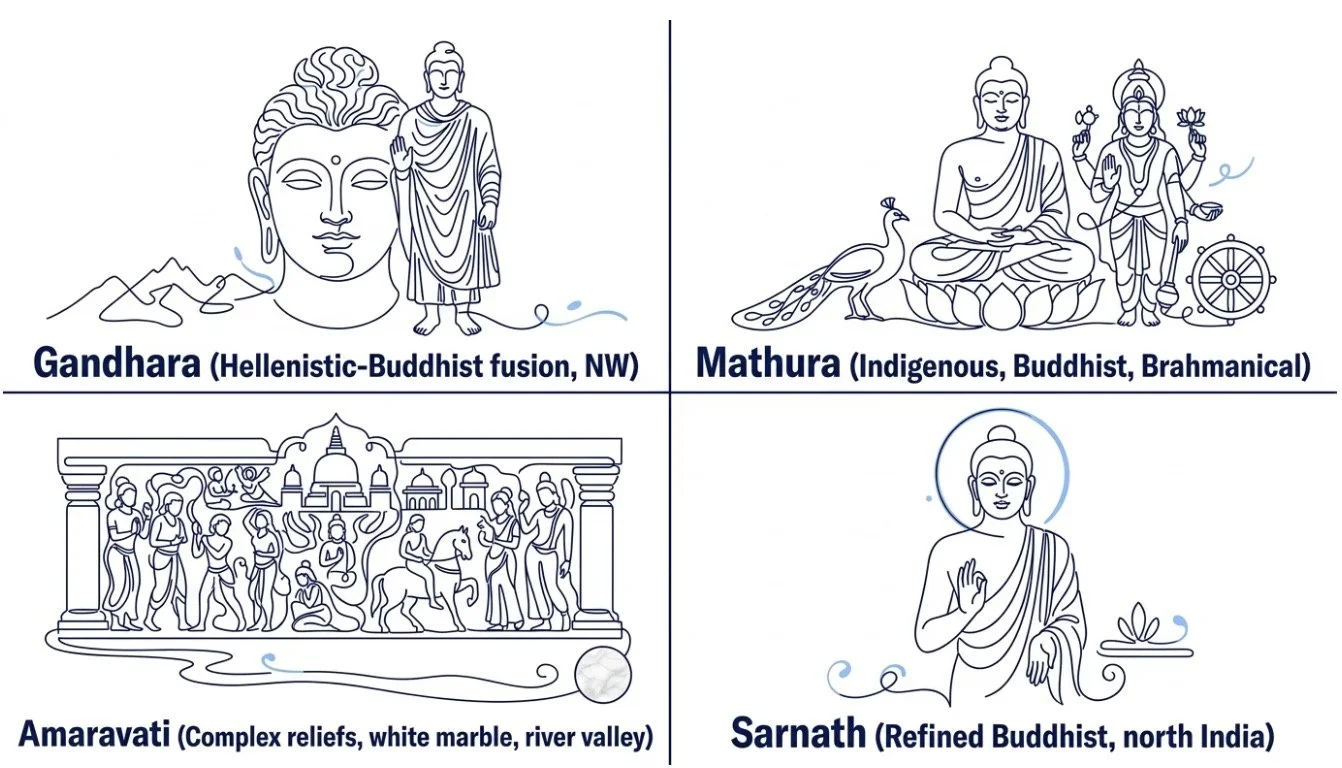
Sculptural art in the post-Mauryan period cannot be properly understood in isolation from its architectural context: sculptures functioned as integral components of larger ensembles — stupas, chaityas, and viharas — and only later began to be produced as independent devotional images. The period witnessed the crystallisation of distinct regional schools, each with its own aesthetic vocabulary, materials, and iconographic conventions.
Gandhara School
Located in the northwest frontier region. Characterised by the synthesis of Hellenistic and Buddhist traditions. The Buddha image here displays classically draped robes, wavy hair, and a serene, almost Apolline physiognomy. Chief centres: Gandhara, Taxila, and Peshawar.
Mathura School
Rooted in the indigenous Indian tradition, using the spotted red sandstone of the Sikri quarries. Produced both Buddhist and Brahmanical images. The Mathura Buddha is robust, sensuous, and spiritually energetic — quite distinct from the Gandhara type.
Amaravati School
Centred in the lower Krishna-Godavari valley. Used white marble. Known for its narrative dynamism and fluid, crowded compositions. The figures are slender, with a characteristic twist and emotional expressiveness unmatched in the north.
The bas reliefs of Sanchi, Bharhut, and Bodh Gaya represent an early phase of narrative relief carving. Carved on medallions and rectangular panels on the railings surrounding stupas, these reliefs depict scenes from the Buddha's life and Jataka stories in a mode of continuous narration — multiple moments of a single episode shown simultaneously within one compositional field. At Sanchi in particular, the four great events of the Buddha's life (birth, enlightenment, the first sermon, and the Mahaparinirvana) are depicted with extraordinary skill alongside representations of lions, elephants, camels, and oxen, and beautifully carved lotus vines and wishing-creepers.
An important iconographic development of this period was the transition from the aniconic to the iconic representation of the Buddha. Earlier art had represented the Buddha through symbols — the Bodhi tree, the stupa, footprints, or an empty throne. From the first century AD onwards, at both Mathura and Gandhara, seated and standing images of the Buddha began to be produced. The Mahayana sect was the primary driver of this shift, which subsequently influenced Brahmanical and Jain traditions as well: Brahmanical images of gods and goddesses multiplied in this period, and Jain icon worship, traceable perhaps to pre-Mauryan times, became firmly established by the first century AD, as evidenced by votive tablets with ashtamangalas (eight auspicious marks) from Mathura.
A Civilisation at the Crossroads
The post-Mauryan period — spanning roughly five centuries from 200 BC to AD 300 — stands as one of the most creatively fertile and culturally open epochs in the history of ancient India. It was a time of vigorous cross-cultural exchange: Indian scholars absorbed Greek astronomical knowledge, Indian artisans adapted Roman coinage techniques and Central Asian military technologies, and Indian dramatists incorporated Hellenistic theatrical conventions. Yet throughout this process, India retained and deepened its own distinctive intellectual and artistic traditions, producing literary masterworks, surgical encyclopaedias, profound philosophical texts, and architectural achievements of enduring magnificence.
Literary Achievement
Sanskrit emerged as the premier literary language. Ashvaghosha, Vasumitra, and Nagarjuna produced foundational texts. Buddhist Hybrid Sanskrit democratised religious literature. Sangam poetry flourished in the south. The Kamasutra and Natyasastra codified secular and dramatic traditions.
Scientific & Technological Progress
Astronomy advanced through Indo-Greek contact. Medicine reached new heights with Charaka and Sushruta. Metallurgy produced world-class iron, steel, and jewellery. Glass-making, coin-minting, and military technology were transformed through foreign contact and indigenous innovation.
Artistic & Architectural Legacy
The stupa tradition evolved into regionally distinct architectural schools. Rock-cut chaityas and viharas demonstrated extraordinary technical mastery. Three great sculptural schools — Gandhara, Mathura, and Amaravati — produced the canonical image of the Buddha. Art shifted from exclusive state patronage to broad social participation.
What emerges most powerfully from a survey of this period is the image of a civilisation confident enough in its own identity to absorb foreign influences without being overwhelmed by them — transforming what it received, adapting it to its own needs and aesthetic sensibilities, and in the process creating something wholly original. The cultural achievements of the post-Mauryan centuries formed the bedrock upon which the classical Gupta age would subsequently build.
"The Yavanas are barbarians, yet the science of astronomy originated with them, and for this they must be reverenced like Gods." — Gargi Samhita
