
The Paleolithic Period
The Paleolithic Period: India's Ancient Stone Age
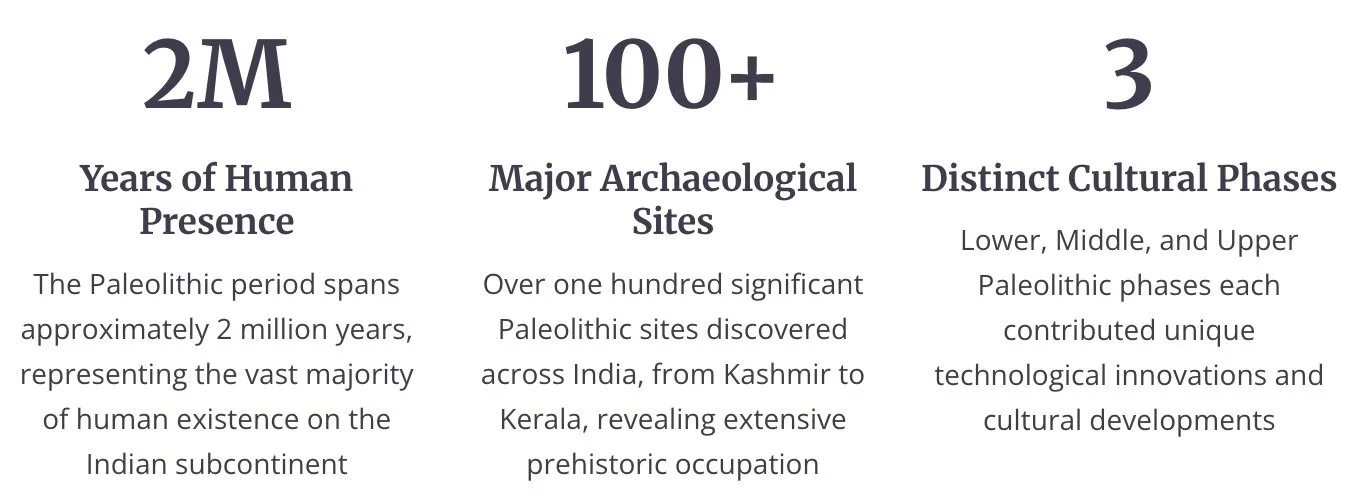
The Indian Stone Age represents humanity's earliest chapters, spanning millions of years of technological and cultural evolution. This remarkable period is divided into three distinct phases—Paleolithic, Mesolithic, and Neolithic—each characterized by unique geological contexts, stone tool technologies, and subsistence strategies. The Paleolithic era, meaning "Old Stone Age," witnessed the first human colonization of the Indian subcontinent during the Pleistocene geological period, approximately 2 million years ago when ice covered vast portions of Earth's surface.
This was fundamentally a hunting and gathering culture, where early humans adapted to diverse environmental conditions across the subcontinent. The term "Paleolithic" was coined by archaeologist John Lubbock in 1865, derived from Greek words meaning "old stone." A watershed moment in Indian archaeology occurred in 1863 when Robert Bruce Foot discovered the first Paleolithic stone tool, opening a window into India's prehistoric past. These ancient peoples, often called "Quartzite Men" due to their preference for hard quartzite rock, developed sophisticated tool-making techniques that enabled survival in challenging Ice Age conditions.
Understanding this period requires recognizing that stone age cultures did not evolve uniformly across the subcontinent. Regional variations in tool types, dates, and cultural features reflect the diverse ecological niches and adaptive strategies of early human populations. The Paleolithic cultures belong to the Pleistocene era, while subsequent Mesolithic and Neolithic cultures emerged during the Holocene epoch, marking fundamental shifts in human society and technology.
Chronological Framework and Divisions
Lower Paleolithic
2 million - 100,000 years ago
Dominated by handaxes, cleavers, choppers, and chopping tools. The Acheulian and Soanian cultures flourished during this extensive period, representing humanity's first effective colonization of India.
Middle Paleolithic
100,000 - 40,000 years ago
Characterized by smaller, lighter flake tools and blades with finely trimmed edges. Stone tool assemblages showed increased sophistication and adaptation to changing environmental conditions during the Upper Pleistocene.
Upper Paleolithic
40,000 - 10,000 years ago
Marked by the appearance of Homo sapiens, burins, scrapers, and parallel-sided blades. This period witnessed the emergence of art, figurines, and bone tools, reflecting growing cognitive and cultural complexity.
The Paleolithic period unfolded during the Pleistocene geological era, also known as the Great Ice Age. However, dating these phases involves considerable variation across different sites, reflecting the complex interplay between local geological conditions, climatic fluctuations, and human adaptations. Tools considered characteristic of one phase may occasionally appear in another, demonstrating technological continuity alongside innovation. For instance, celts associated with the Neolithic period have been found in historical contexts in eastern India, illustrating the persistence of certain tool-making traditions.
It's crucial to understand that the transition between these phases was neither uniform nor linear across the subcontinent. Regional ecological diversity meant that communities in different areas faced distinct challenges and opportunities, leading to varied developmental trajectories. This chronological framework provides a general structure for understanding prehistoric India, but local contexts reveal fascinating complexity and diversity in human adaptation strategies.
Lower Paleolithic: The Foundation Period
Tools and Technology
The Lower Paleolithic period, spanning roughly 50,000 to 100,000 BC, witnessed the creation of humanity's earliest stone tool assemblages in India. This phase covered the greater part of the Ice Age and saw the development of sophisticated core tool technology. The primary implements included handaxes, cleavers, choppers, and chopping tools, all crafted by systematically removing flakes from stone blocks or cores until achieving the desired size and shape.
Tool makers demonstrated remarkable ingenuity in their manufacturing techniques. Beyond directly breaking pieces from large boulders—requiring considerable strength—they possibly lit fires against rocks and threw water over them, causing thermal shock that made large fragments break off more easily. These implements served multiple functions: hunting, butchering and skinning animals, breaking bones for marrow extraction, digging roots and tubers, processing plant foods, and making wooden tools and weapons.
The choice of raw materials reveals deep environmental knowledge. Early Paleolithic peoples primarily used hard, durable quartzite, though regional variations existed. At Hunsgi in Karnataka, limestone was the main material; at Lalitpur in Central India, artisans preferred pink granite; while in parts of Maharashtra and Central India, basalt dominated. This selective use of stone types demonstrates sophisticated understanding of material properties and local geological resources.
Key Tool Types
Handaxe: Core tool worked on both sides (biface), triangular shape, broad at one end and pointed at the other
Cleaver: Flattish tool with broad rectangular cutting edge, used for clearing and splitting
Chopper: Large unifacial tool worked on one side only
Chopping Tool: Core tool flaked alternately on both sides creating a wavy cutting edge
Two Distinct Cultural Traditions
Soanian Culture
Named after the Sohan River (tributary of Indus), this tradition developed in the Siwalik Hills of Northwest India and Pakistan. Sites in the Soan valley, Kashmir, and the Thar Desert revealed industries dominated by pebble tools, blades, and chopper/chopping implements. Animal remains from these deposits—including horse, buffalo, straight-tusked elephant, and hippopotamus—suggest an environment with perennial water sources, tree vegetation, and grass steppes.
Acheulian/Madrasi Culture
Named after the French site of St. Acheul, this culture represented the first effective colonization of the Indian subcontinent. Acheulian hunters-gatherers adapted to diverse climates across western Rajasthan, Gujarat, Central India, the Deccan plateau, and regions north of the Cauvery River. Bori in Maharashtra is considered the earliest Lower Paleolithic site, while Bhimbetka in Madhya Pradesh contains the most well-known sediments. Sites concentrated in Central India and the southern Eastern Ghats due to adequate rainfall, perennial rivers, and rich wild plant and animal resources.
Middle Paleolithic: Technological Refinement
The Middle Paleolithic period (100,000 - 40,000 BC) witnessed significant technological and adaptive transformations as the Acheulian culture gradually evolved by shedding some tool types while incorporating new forms and manufacturing techniques. This phase developed during the Upper Pleistocene, a period of intense cold and glaciation in northern latitudes that brought severe aridity to areas bordering glaciated regions, fundamentally reshaping human settlement patterns and survival strategies.
Miniaturization Revolution
Tools became significantly smaller, thinner, and lighter compared to Lower Paleolithic implements, enabling more precise work and greater portability.
Flake-Based Technology
Shift from core tools to sophisticated flake tools and blades made by finely trimming edges, allowing for specialized functions and increased efficiency.
Material Innovation
While quartzite, quartz, and basalt continued in use, many areas saw adoption of fine-grained siliceous rocks like chert and jasper, enabling finer workmanship.
Functional Specialization
Tools were designed for manufacturing wooden implements and weapons and processing animal hide, with hints of wooden shaft usage emerging.
Settlement Patterns and Key Sites
The distribution of Middle Paleolithic sites appears sparse compared to the Lower Paleolithic, reflecting harsh climatic conditions and intense aridity during the Upper Pleistocene. However, communities largely continued occupying areas inhabited during the Lower Paleolithic, demonstrating adaptive resilience. Significantly, rock shelters began being utilized for the first time in regions like Tamil Nadu, marking an important behavioral shift toward more protected living spaces.
In the northwest, the Potwar plateau between the Indus and Jhelum rivers yielded numerous Middle Paleolithic tools. The Sanghao cave in Pakistan revealed thousands of quartz tools alongside animal bones, possible human remains, and hearths, providing rare glimpses into daily life. The earliest human occupation evidence in the Ganga plain emerged at Kalpi on the Yamuna's southern bank, where Middle Paleolithic tools were discovered with vertebrate fossils including elephant tusks and molars of Equus and bovids.
Thar Region Adaptations
Middle Paleolithic artifacts in the Thar occur in reddish-brown soil indicating more abundant vegetation, surface water, and cooler, wetter, more humid conditions compared to Lower Paleolithic contexts. Small factory sites and camp sites appeared near rivers and lakes, particularly around Budha Pushkar lake which offered easy water access and stone availability. The region west of the Aravallis developed the distinctive Luni industry, characterized by greater variety in stone tool types and larger numbers of reworked flakes compared to eastern areas.
Central and Southern India
The Nevasan industry of central and peninsular India, named after Nevasa site, featured tools made from smooth, fine-grained stones including agate, jasper, and chalcedony. Sites like Chirki near Nevasa revealed living and factory floors, while Patne in the Tapi valley showed sequences of Middle and Upper Paleolithic and Mesolithic tools. At Bhimbetka, Acheulian tools were replaced by Middle Paleolithic culture, demonstrating clear cultural succession.
Upper Paleolithic: Dawn of Modern Humanity
The Upper Paleolithic period (40,000 - 10,000 BC) marked a revolutionary transformation in human cognitive and cultural capabilities. This era witnessed the appearance of Homo sapiens—anatomically modern humans—accompanied by unprecedented technological, artistic, and social innovations that would lay foundations for all subsequent human development.
Homo Sapiens Emergence
Anatomically modern humans appeared, bringing advanced cognitive capabilities and complex social behaviors that transformed human societies.
Blade Technology
Parallel-sided blades and increased numbers of burins represented major technical advances, enabling precision work and specialized tasks.
Artistic Expression
Widespread appearance of figurines and artifacts reflecting art and rituals marked the birth of symbolic thought and creative expression.
Bone Tool Innovation
Wide range of bone tools including needles, fishing implements, harpoons, and blades demonstrated mastery over diverse materials.
Environmental Challenges and Adaptations
The Upper Paleolithic period brought dramatic environmental changes that profoundly impacted human distribution and lifeways. Extremely cold and arid climates dominated high altitudes and northern latitudes. Extensive desert formation occurred in Northwest India, while the drainage patterns of western India became almost defunct with river courses shifting westwards. Vegetation cover thinned across most of the country, fundamentally altering the landscape that humans inhabited.
Coastal areas of southeastern Tamil Nadu, Saurashtra, and Kutch developed quartz and carbonate dunes as sea levels dropped dramatically. During terminal Pleistocene times, southwestern monsoons weakened and sea levels decreased by scores of meters. The harsh, arid climate resulted in sparse vegetation, though faunal fossils indicate grassland presence. Human populations faced restricted food resources, explaining why Upper Paleolithic sites are very limited in arid and semi-arid regions.
An important discovery from over 40 sites in Rajasthan, Madhya Pradesh, and Maharashtra includes ostrich eggshell fragments, demonstrating that ostriches—birds adapted to arid climates—were widely distributed across western India during the later Upper Pleistocene period.
Major Settlement Areas
Despite environmental challenges, Upper Paleolithic communities established themselves in strategic locations. The Belan and Son valleys in the northern Vindhyas proved particularly important, with Chopani Mando showing cultural sequences from Upper Paleolithic to Neolithic. Chert tools from the nearby Vindhyas dominated assemblages, while animal bones included wild cattle, sheep, and goats—the latter two possibly representing early domestication attempts as they weren't indigenous to the area.
The Sanghao cave revealed Middle and Upper Paleolithic tools, hearths, animal bones, and apparent burials, providing rare insights into mortuary practices. In Kashmir, Upper Paleolithic occupation coincided with milder climate onset. The Rohri hills in Sindh, various Thar Desert sites around Budha Pushkar lake, and central Indian caves like those in the Vindhyas all showed continued human occupation despite increasingly challenging conditions.
Remarkably, the caves at Kurnool and Muchchatla Chintamanu Gavi in Andhra Pradesh represent the only Upper Paleolithic sites in the subcontinent where bone tools have been discovered, highlighting regional variations in material culture and technological innovation.
Paleolithic Art: Windows into Prehistoric Minds
Prehistoric art marks the beginning of humanity's creative expression and provides invaluable windows into the cognitive, social, and spiritual worlds of our ancient ancestors. Rock art encompasses both paintings and petroglyphs—images created by removing rock surface through engraving, bruising, hammering, chiseling, or scooping. These artistic expressions occurred in permanent places like cave walls and as portable objects such as figurines and ornaments.
Such remains clearly formed integral parts of community life, with many apparently holding cultic or religious significance. The persistence and sophistication of Paleolithic art demonstrates that prehistoric peoples possessed complex symbolic thought systems and spiritual beliefs that shaped their understanding of the world.
Ostrich Eggshell Art
Earliest art forms include eggshell pieces engraved with crosshatched designs from Upper Paleolithic contexts at Patne and Bhimbetka, including perforated beads worn as ornaments.
Carved Objects
Upper Paleolithic carved bone object from Lohanda Nala identified variously as a mother goddess figurine or harpoon, reflecting interpretive challenges.
Symbolic Objects
Circular chalcedony disc at Bhimbetka and sandstone disc at Maihar from Acheulian contexts, neither appearing to be functional tools, suggesting symbolic purposes.
The Baghor Shrine: Prehistoric Spiritual Life
The Upper Paleolithic site of Baghor I in Madhya Pradesh provided fascinating evidence of prehistoric religious practices through discovery of an apparent shrine. A roughly circular platform made of sandstone rubble contained at its center a piece of natural stone with striking concentric triangular laminations in various colors. This arrangement bears remarkable similarity to contemporary practices of Kol and Baiga tribal peoples living in the Kaimur hills today, who construct circular rubble platforms and worship similar triangular stones as symbols of the female principle or icons of a goddess.
This discovery suggests remarkable cultural continuity spanning tens of thousands of years and provides direct evidence of Upper Paleolithic spiritual beliefs centered on female divine principles. The careful construction and placement of the shrine demonstrates that religious ritual already formed important aspects of human social and cognitive life during this remote period.
Rock Art at Bhimbetka
Period I: Upper Paleolithic
Earliest paintings rendered in green and dark red colors, predominantly depicting bisons, elephants, tigers, rhinoceros, and boars. Some figures measured two to three meters in length, demonstrating ambitious artistic scale.
Hunting Scenes
Paintings reflected hunting as the main subsistence pursuit, with careful attention to anatomical details allowing distinction between human figures and identification of animal species.
Social Insights
Artistic evidence suggests small band societies whose economy depended on exploiting both animal and plant resources, revealing daily life patterns and social organization.
Geographic Distribution of Paleolithic Sites
The distribution pattern of Paleolithic tools and sites across the Indian subcontinent reveals crucial information about areas inhabited by hunter-gatherers, their movement patterns, and environmental conditions. Tool assemblages are not randomly scattered but cluster in regions offering favorable ecological conditions including water sources, stone raw materials, and abundant food resources. Understanding this geographic distribution helps reconstruct prehistoric landscapes and human adaptive strategies.
Northern and Western India
Kashmir Valley
Surrounded by Pir Panjal Hills and Himalayas, Kashmir yielded limited Paleolithic tools including a handaxe near Pahalgam on River Lidder. Scarcity reflects intensely cold glacial conditions. The Potwar region between Pir Panjal and Salt Range, experiencing tectonic movements that formed Indus and Sohan rivers, proved more productive. Sohan Valley sites at Adial, Balwal, and Chauntra yielded handaxes and choppers, while Beas, Rangange, and Sirsa river banks also produced Paleolithic implements.
Delhi and Yamuna Basin
Multiple sites ranging from Lower Paleolithic to Microlithic identified across Delhi. Excavations at Anangpur in Badarpur hills revealed thousands of early and late Acheulian tools with traces of several Yamuna paleochannels, indicating a large Lower Paleolithic habitation and factory site. Kalpi in Jalaun district, UP, on Yamuna's southern bank, provided earliest human occupation traces in Ganga plain with Middle Paleolithic tools and vertebrate fossils.
Rajasthan
All three Paleolithic phases represented around Ajmer and Luni valley. Didwana area in Nagaur district particularly rich from early to Middle Paleolithic. Luni river complex sourced from Aravallis contained numerous sites. Gambhir basin at Chittorgarh, Chambal basin at Kota, and Berach basin at Negarai yielded Paleolithic tools. Wagaon and Kadamali rivers in Mewar rich in Middle Paleolithic sites with diverse scrapers, borers, and points. Mogara hill near Jodhpur functioned as factory site for all Paleolithic phases plus Mesolithic.
Gujarat and Western Coast
Sabarmati, Mahi rivers and tributaries yielded abundant Paleolithic artifacts. Lower Paleolithic tools found in Sabarmati valley, Orsang and Karjan tributaries, and Bhadar valley in Saurashtra. Bhader river in Saurashtra rich in assemblages including handaxes, cleavers, chopping tools, points, borers, and scrapers. Kutch area produced numerous cleavers, handaxes, and choppers. Narbada river flowing into Gulf of Cambay particularly rich. Lower Paleolithic and later artifacts extended along entire Konkan coast to Goa.
Maharashtra
Paleolithic tools found throughout coastal areas and Wardha-Wainganga valleys. Stratigraphic profiles available for Mula-Mutha, Godavari, Pravara, and Tapi river sections. Lower and Middle Paleolithic tools in Dattawadi area of Mutha river, Pune, and Gangawadi area on Godavari at Nasik. Chirki near Nevasa yielded handaxes, choppers, cleavers, scrapers, and borers. Other important sites include Koregaon, Chandoli, and Shikarpur.
Central India: Bhimbetka and Beyond
Central India, particularly the Narmada valley, represents one of the richest and most extensively researched Paleolithic regions. Prehistoric remains occur throughout Damoh, Raisen, and the Narmada, upper Son, and Mahanadi valleys. Adamgarh hill excavations revealed Lower and Middle Paleolithic tool sequences, while Bhimbetka in Raisen district provided the most spectacular finds—hundreds of rock shelters with occupation sequences stretching from Lower Paleolithic to historic periods.
The Bhimbetka hillside, composed of sandstone and quartzite, offered prehistoric peoples shelter, abundant food resources, and excellent raw materials for tool-making. Most tools were crafted from locally available yellowish quartzite, though grey quartzite was obtained from more distant sources. Five floors paved with flat stone slabs from the Lower Paleolithic were identified, though no bones survived due to acidic soil conditions. This site exemplifies the strategic location choices made by Paleolithic communities, selecting areas that satisfied multiple essential needs simultaneously.
Southern and Eastern India: Regional Variations
South India
The southern peninsula displays distinctive Paleolithic patterns closely linked to geological and ecological variations. The Tapti, Godavari, Bhima, and Krishna rivers yielded numerous sites, with distribution patterns reflecting erosional features and soil types. The Tapti trough contains deep regur (black soil), while surrounding areas feature medium regur coverage.
Paleolithic site scarcity characterizes upper reaches of Bhima and Krishna, contrasting with abundance along Malaprabha, Ghataprabha, and Krishna tributaries. The Ghatprabha basin in Karnataka proved particularly rich, with Acheulian handaxes found in large numbers at key sites like Anagawadi and Bagalkot showing both early and Middle Paleolithic tools.
The Hunsgi-Baichbal and Krishna valleys contained Lower Paleolithic implements. At Hunsgi in Gulbarga district on the Hunsgi tributary of Krishna river, site variations suggest functional differentiation: sparse sites may represent specific activity locations like tool-making or hunting, moderate-density sites indicate temporary camps, while profuse, varied assemblages mark longer-term habitation areas.
Tamil Nadu
Tamil Nadu's Palar, Penniyar, and Kaveri rivers proved rich in Paleolithic tools. Near Chennai, sequences from early Paleolithic to Mesolithic were documented. Gudiyam cave yielded Lower, Middle, and Upper Paleolithic tools, though sparse finds and absent remains suggest short-term occupations.
Attirampakkam in the Kortallayar basin ranks among Tamil Nadu's richest Paleolithic sites. Excavations revealed complete sequences of Lower, Middle, and Upper Paleolithic cultures with an occupation break after Middle Paleolithic. Tools, mostly handaxes, were crafted from non-local quartzite stones. Minimal debitage suggested tools were manufactured elsewhere and transported to the site.
Fascinating discoveries included animal footprints found with Acheulian tools and three fossil teeth—possibly from horses, water buffalo, and nilgai—suggesting open, wet landscapes during early Paleolithic times. These finds provide rare direct evidence of environmental conditions and human-animal interactions.
Andhra Pradesh
Lower Paleolithic tools found in inland areas and coastal Visakhapatnam. Nagarjunakonda revealed paleoclimatic evidence of three alternating wet and dry cycles. Upper Paleolithic caves at Kurnool and Muchchatla Chintamanu Gavi uniquely contained bone tools. Renigunta cave in Chittor district yielded Upper Paleolithic artifacts.
Kerala
Palghat district produced quartz choppers and scrapers, demonstrating Paleolithic presence in southernmost peninsular regions and adaptation to local geological conditions and available raw materials.
Eastern India
Eastern India presents distinctive Paleolithic patterns centered on river valleys and plateau foothills. The Raro river in Singhbhum, Jharkhand, proved rich in handaxes, bifacial chopping tools, and flakes. Singhbhum yielded numerous sites with handaxes and choppers predominating. River valleys and foothills of the Chhotanagpur plateau in Jharkhand and adjoining West Bengal areas contained Lower Paleolithic tools.
Bihar's Paisra site in Kharagpur forests near Munger revealed a Lower Paleolithic living and working floor rich in finished and unfinished artifacts, broken stone pieces, and anvils. Eight post-holes marked where wooden posts supported thatched huts, providing rare evidence of structural remains. The Damodar and Suvarnarekha valleys also reported Paleolithic tools, with distribution patterns conditioned by topographical features.
Orissa contained all three Paleolithic phases at multiple locations. Dari-dungri in Sambalpur district and the Budhabalan and Brahmani river valleys yielded Lower and Middle Paleolithic tools. The Baitarani, Brahmani, and Mahanadi rivers form Orissa's deltaic region where some tools were found. The Buharbalang Valley in Mayurbhang contained Early and Middle Paleolithic handaxes, scrapers, points, and flakes.
Society, Settlement, and Subsistence
Social Organization and Settlement Patterns
Paleolithic people lived in diverse shelters constructed from rocks, branches, grass, leaves, or reeds, with settlement permanence varying according to resource availability and seasonal patterns. Archaeological evidence reveals multiple settlement types: habitation sites like Bhimbetka and Hunsgi showing continuous multi-century occupation; temporary camp sites where groups stayed seasonally before moving on; and specialized activity sites including kill or butchery locations and factory sites for tool production.
Kinship Networks
Members related through kinship bonds forming social cohesion foundation
Nomadic Mobility
Seasonal movement following animal migrations and plant food availability
Band Society Structure
Small communities under 100 people forming core social units
Egalitarian Organization
No formal government or permanent leaders, behavior regulated through customs and norms
Reciprocity Economy
Exchange based on reciprocity rather than commerce, shared access to natural resources
Age-Gender Division
Labor division based on age and sex creating functional social structure
Subsistence Strategies and Diet
Paleolithic peoples employed sophisticated subsistence strategies adapted to diverse ecological niches across the subcontinent. Faunal remains provide crucial insights into their hunting practices and dietary preferences. Rich animal assemblages included both indigenous species—primates, giraffe-like forms, muskdeer, goats, buffaloes, bovids, and pigs—and immigrant species with North American connections (camels, horses) or Central African origins (hippopotamus, elephants) that migrated along routes east and west of the Himalayas.
Hunting Practices
Hunting concentrated on large and middle-sized mammals, especially ungulates, though deer, rhinoceros, and elephants were also pursued. Evidence suggests non-selective hunting during Lower Paleolithic, with certain species dominating assemblages due to local abundance and hunting ease. The subsistence cycle was geared to dry season/wet season exploitation patterns of plant and animal foods.
Likely prey included oxen, bison, nilgai, chinkara, gazelle, blackbuck antelope, sambar, spotted deer, wild boar, various birds, tortoises, and fishes. Populations maintained careful balance between human numbers and available animal populations, ensuring sustainable food supplies.
Plant Food Gathering
Modern hunter-gatherer studies suggest the "hunting" aspect has been overemphasized while "gathering" has been neglected. Most contemporary hunter-gatherers obtain significant food through gathering rather than hunting, implying similar patterns in Paleolithic times.
Plant foods likely included honey, fruits, roots, seeds, and leaves. Upper Paleolithic grinding stones may have processed plant foods like wild rice. This recognition has profound implications for understanding gender roles—if women gathered food as in modern societies and plant foods provided major dietary contributions, women made crucial contributions to Paleolithic subsistence economies.
Challenging Traditional Views: Ethnographic evidence shows many hunting-gathering groups do not fully exploit natural resources and consciously practice restraint to conserve environmental resources. This contradicts views of hunting-gathering as inefficient, with the mode's long historical persistence and continuation into modern times supporting its viability as sustainable subsistence strategy.
Daily Life and Cultural Expression
Paleolithic humans' material desires were relatively limited, and their technology didn't permit extensive food hoarding. These factors meant subsistence activities ceased once adequate food was obtained, providing leisure time for sleeping, socializing, playing games, and relaxing—contradicting stereotypes of constant struggle for survival.
Rock paintings and carvings illuminate subsistence patterns and social life. Bhimbetka's Period I Upper Paleolithic paintings in green and dark red predominantly depicted bisons, elephants, tigers, rhinos, and boars, some measuring two to three meters in length. Careful analysis of species frequency could yield precise insights into Paleolithic hunting life. Paintings reveal small band societies whose economies depended on exploiting both animal and plant resources. Evidence suggests people feared thunder and lightning, worshiping natural forces, and wore leaves, animal skins, and tree barks as clothing.
Legacy and Significance of India's Paleolithic Period
India's Paleolithic Period
Understanding Prehistoric India
The Paleolithic period represents humanity's longest chapter in the Indian subcontinent—a vast expanse of time during which early humans developed fundamental technologies, social structures, and cultural practices that shaped subsequent human development. From Robert Bruce Foot's first discovery in 1863 to modern sophisticated excavations at sites like Bhimbetka and Attirampakkam, archaeological research has progressively unveiled the remarkable complexity and diversity of Paleolithic life in India.
These ancient peoples demonstrated extraordinary adaptive capabilities, successfully inhabiting environments ranging from Himalayan foothills to southern peninsular coasts, from arid Rajasthan deserts to humid river valleys of eastern India. They developed sophisticated stone tool technologies, evolved from crude choppers to refined blades and burins, and created the first artistic expressions—paintings, carvings, and symbolic objects that reveal emerging cognitive complexity and spiritual beliefs.
Key Insights and Continuing Relevance
Technological Innovation
Paleolithic toolmakers progressed from massive handaxes to delicate blades and specialized implements, demonstrating continuous innovation and adaptation over millennia. Regional variations in tool types and raw material choices reflect sophisticated environmental knowledge and problem-solving capabilities.
Environmental Adaptation
Success across diverse ecological zones—from Ice Age cold to tropical heat, from well-watered regions to arid zones—proves remarkable human adaptability. Settlement patterns closely tracked water sources, stone raw materials, and food resources, showing strategic environmental assessment abilities.
Social Complexity
Evidence of band societies with kinship networks, division of labor, and egalitarian organization challenges simplistic views of "primitive" societies. Artistic expressions, possible shrines, and carefully constructed settlements reveal sophisticated cognitive and social capabilities emerging during this remote period.
Cultural Continuity
Remarkable parallels between Paleolithic practices and modern tribal customs—such as worship of triangular stones by Kol and Baiga peoples echoing Upper Paleolithic shrine at Baghor—suggest cultural traditions spanning tens of thousands of years, demonstrating extraordinary continuity in certain aspects of spiritual and social life.
Preparing for UPSC Civil Services: Essential Takeaways
For UPSC aspirants, understanding India's Paleolithic period provides crucial foundations for comprehending human prehistory and early cultural development. Key examination points include chronological frameworks (Lower, Middle, Upper Paleolithic divisions with approximate dates), major archaeological sites and their significance (Bhimbetka, Attirampakkam, Hunsgi, etc.), characteristic tool types and manufacturing techniques for each phase, and regional variations in Paleolithic cultures across the subcontinent.
Understanding subsistence patterns—hunting and gathering strategies, dietary composition, gender roles in food procurement—proves essential. Familiarity with settlement patterns, social organization in band societies, and environmental adaptations during Pleistocene climatic changes forms crucial knowledge. Finally, appreciation of Paleolithic artistic expressions and their cultural significance, particularly rock paintings at Bhimbetka and the Baghor shrine, rounds out comprehensive understanding.
Study Strategy: Focus on understanding cultural evolution patterns rather than memorizing isolated facts. Connect archaeological evidence to broader themes of human adaptation, technological innovation, and social development. Practice explaining how environmental conditions shaped settlement patterns and cultural practices across different regions of prehistoric India.
The Paleolithic period laid essential foundations for all subsequent human development in India. The adaptive strategies, technological innovations, social structures, and cognitive capabilities that emerged during these two million years created the foundation upon which Mesolithic, Neolithic, and later civilizations would build. Understanding this formative period provides invaluable context for comprehending India's long and complex cultural history.
