
Sources of History
Sources of History: Unveiling Ancient India
Understanding ancient India requires piecing together evidence from diverse sources—archaeological remains buried beneath the earth, inscriptions carved in stone, coins exchanged in marketplaces, and texts preserved through generations. Each source offers a unique window into the past, revealing different aspects of life, culture, and society. This document explores the rich tapestry of historical sources that illuminate India's ancient civilizations, from the material remnants discovered through excavation to the literary traditions that shaped philosophical and religious thought.
Archaeological Sources: Digging into the Past
Archaeology is the systematic study of the human past through material remains—objects that people created, modified, or used. These remains range from the ruins of grand palaces and temples to discarded fragments of everyday life, such as broken pottery. Archaeological evidence includes structures, artefacts, bones, seeds, pollen, seals, coins, sculptures, and inscriptions. Through careful exploration and excavation, archaeologists recover these materials, enabling us to reconstruct ancient lifestyles, technologies, and social systems.
Structures
Remains of buildings, temples, and fortifications
Artefacts
Tools, pottery, jewellery, and household items
Organic Materials
Bones, seeds, and pollen revealing diet and environment
Written Records
Seals, coins, and inscriptions providing textual evidence
Archaeology helps us systematically dig through successive layers of ancient mounds, forming a comprehensive picture of material life. The science that enables this systematic excavation is called archaeology—a discipline that transforms buried remains into historical narratives.
Understanding Mounds: Layers of Civilization
A mound is an elevated portion of land covering the remains of old habitations. These archaeological sites contain layers of occupation spanning centuries or millennia. Mounds can be classified into three main types based on the cultures they represent: single-culture mounds showing only one culture throughout, major-culture mounds where one culture dominates with others of secondary importance, and multi-culture mounds representing several important cultures in succession, occasionally overlapping.
Vertical Excavation
This method involves lengthwise digging to uncover the period-wise sequence of cultures. It is generally confined to a part of the site. Most sites have been dug vertically, providing excellent chronological sequences of material culture. This approach helps establish timelines and cultural evolution.
Horizontal Excavation
This method entails digging the mound as a whole or a major part of it, enabling excavators to obtain a complete picture of site culture in a particular period. However, horizontal diggings are very expensive and consequently few in number, limiting our comprehensive understanding of many phases of ancient Indian history.
The preservation of ancient remains varies significantly depending on climate. In the dry, arid climate of western Uttar Pradesh, Rajasthan, and north-western India, antiquities are found in better condition. In contrast, the moist and humid climate of the mid-Gangetic plains and deltaic regions causes even iron implements to corrode and mud structures to become difficult to detect. Only burnt brick or stone structures are well preserved in these regions.
Archaeological Discoveries: Windows to Ancient Life
Excavations have brought to light remarkable evidence of ancient settlements and lifestyles. Villages established around 6000 BCE in Baluchistan represent some of the earliest agricultural communities. The material culture developed in the Gangetic plains during the second millennium BCE reveals sophisticated urban planning and craft specialization. Archaeological investigations uncover the layout of settlements, types of pottery used, forms of houses, varieties of cereals consumed, and the kinds of tools and implements employed in daily life.
6000 BCE
Early villages established in Baluchistan with evidence of agriculture
2nd Millennium BCE
Material culture develops in Gangetic plains with sophisticated settlements
Iron Age Onwards
Megalithic burials in Deccan reveal tools, weapons, and social practices
In South India, people buried the dead along with their tools, weapons, pottery, and belongings, encircling these graves with large pieces of stone. These structures, called megaliths, provide valuable insights into the life people lived in the Deccan from the Iron Age onwards. By excavating these burial sites, archaeologists learn about social hierarchies, belief systems, and technological developments.
Scientific Methods in Archaeological Dating
Various scientific methods help archaeologists fix dates for ancient mounds and materials. Radiocarbon dating is the most important technique. This method relies on Carbon-14 (C14), a radioactive isotope present in all living objects. When an organism is alive, it continuously absorbs C14 through air and food, balancing the natural decay process. When death occurs, C14 absorption stops, but decay continues at a uniform rate. By measuring the loss of C14 content in an ancient object, scientists can determine its age with reasonable accuracy.
Radiocarbon Dating
The half-life of C14 is 5,568 years, making it possible to date objects up to 70,000 years old. This technique revolutionized archaeology by providing absolute dates for organic materials.
Pollen Analysis
Examination of plant residues and pollen reveals the history of climate and vegetation. This analysis suggests that agriculture was practiced in Rajasthan and Kashmir around 7000-6000 BCE.
Metal Analysis
Scientific analysis of metal artefacts identifies their nature and components, locates the mines from which metals were obtained, and traces the stages in the development of metal technology.
Animal Bone Studies
Examination of animal bones determines whether animals were domesticated and indicates the uses to which they were put, revealing economic and dietary patterns.
Geological and biological studies complement archaeological research by providing context for human history. Geological studies trace the history of soil and rocks, whilst biological studies reveal the evolution of plants and animals. Human history cannot be understood without recognizing the continuing interaction between soils, plants, animals, and humans. Together, these interdisciplinary approaches create a comprehensive understanding of over 98 per cent of the total time scale of history.
Ethno-Archaeology: Bridging Past and Present
Ethno-archaeology studies the behaviour and practices of living communities to interpret archaeological evidence related to communities of the past. The Indian subcontinent is particularly valuable for ethno-archaeological research because many traditional features and methods survive—in agriculture, animal husbandry, house building, clothing, and food preparation. Modern craftspersons serve as important guides for understanding ancient manufacturing techniques. For instance, a tradition of carnelian bead manufacturing exists in Khambhat, Gujarat, today. Studying modern bead making in this region provides valuable clues about how Harappan beads may have been made and the possible social organization of bead makers.
Filling Historical Gaps
Ethno-archaeology contributes towards filling the silences and gaps in history. It has helped archaeologists make inferences about women's roles in subsistence and craft-related activities in early times. Studies of modern hunter-gatherers and shifting cultivators help understand the lifeways of people who followed similar subsistence strategies in the past.
However, ethno-archaeological evidence must be used carefully, keeping in mind the differences between present and past contexts. Not all traditional practices necessarily reflect ancient methods, and social, economic, and environmental conditions have changed significantly over millennia.
Modern Insights
Traditional craft techniques
Subsistence strategies
Social organization patterns
Gender roles in production
Agricultural practices
Archaeology as a Historical Source: Strengths and Challenges
Archaeology usually provides an anonymous history, shedding light on cultural processes rather than specific events or named individuals. It is the primary source for prehistory—the period before written records—and proto-history, where written records exist but remain undeciphered. Even after the beginning of the historical period with deciphered texts, archaeology continues to provide valuable information that complements and sometimes challenges literary sources.
What Archaeology Reveals
Archaeology illuminates aspects of everyday life not emphasized in texts—modes of subsistence, agricultural practices, technological development, trade routes, and religious practices. It provides specific details about crops grown, implements used, animals hunted and domesticated, and methods of artifact production.
Material Evidence of Religion
While many religious texts exist for ancient India, an exclusively text-based view of religion is incomplete. Material evidence—temples, shrines, ritual objects, and votive offerings—makes a major contribution to understanding actual religious practice versus prescribed doctrine.
Challenges in Interpretation
Translating archaeological cultures into history involves significant problems. An archaeological culture need not correspond to a linguistic group, political unit, or social group such as a lineage, clan, or tribe. Explaining changes in material culture, especially pottery traditions, remains inadequately addressed in the context of ancient India.
Important Limitation: Archaeological evidence does not provide a complete picture of material culture. Artifacts found generally consist of things thrown away, lost, forgotten, or left behind. Not all material traits survive—inorganic materials like stone, clay, and metal are most likely to endure, whilst organic materials like wood and textiles rarely survive except in exceptional conditions. Tropical regions with heavy rains, acidic soils, and dense vegetation are particularly unfavorable for preservation.
Epigraphy: The Study of Inscriptions
Inscriptions and coins fall under the general umbrella of archaeological sources. Epigraphy is the study of inscriptions, whilst palaeography examines the old writing used in inscriptions and other ancient records. Inscriptions were carved on diverse materials including seals, stone pillars, rocks, copper plates, temple walls, wooden tablets, bricks, and images. In India, the earliest inscriptions were recorded on stone. However, in the early centuries of the Common Era, copper plates began to be used extensively for this purpose, although stone inscriptions continued on a large scale, especially in South India where temple walls served as permanent records.
Harappan Script
The earliest inscriptions from the Harappan civilization, written in a pictographic script, await decipherment. Ideas and objects were expressed through pictures.
Brahmi and Kharoshthi
The oldest deciphered inscriptions belong to the late 4th century BCE in Brahmi (left to right) and Kharoshthi (right to left) scripts, including Emperor Ashoka's edicts.
Modern Discovery
In the 14th century CE, Firoz Shah Tughlaq found two Ashokan pillar inscriptions but scholars could not decipher them. James Prinsep, a British civil servant, first deciphered these epigraphs in 1837.
Brahmi script prevailed virtually throughout India except the north-western part where Kharoshthi was used. Greek and Aramaic scripts were employed in writing Ashokan inscriptions in Pakistan and Afghanistan. Brahmi continued as the main script till the end of Gupta times. After the seventh century, strong regional variations developed in Brahmi script, eventually giving rise to the diverse scripts of modern India.
Evolution of Indian Scripts
The evolution of Indian scripts represents a fascinating journey from ancient Brahmi to modern regional scripts. Brahmi and Kharoshthi, the earliest deciphered scripts, stand midway between alphabetic and syllabic scripts and can be described as semi-syllabic or semi-alphabetic. Kharoshthi, derived from the Aramaic script and written from right to left, had its core area in Gandhara (north-west India). It was used under Indo-Greek, Indo-Parthian, and Kushana kings but declined and died out by the 3rd century CE. Brahmi, written from left to right, became the parent of all indigenous scripts of South Asia and parts of Central and Southeast Asia. Its evolution progressed through stages: Ashokan Brahmi, Kushana Brahmi, and Gupta Brahmi. In the late 6th century, Gupta Brahmi evolved into Siddhamatrika or Kutila, characterized by sharp angles. Regional differences became sharper thereafter. Modern North Indian scripts gradually emerged from Siddhamatrika. Devanagari was standardized by about 1000 CE. Eastern scripts led to Bengali, Assamese, Oriya, and Maithili by the 14th-15th centuries.
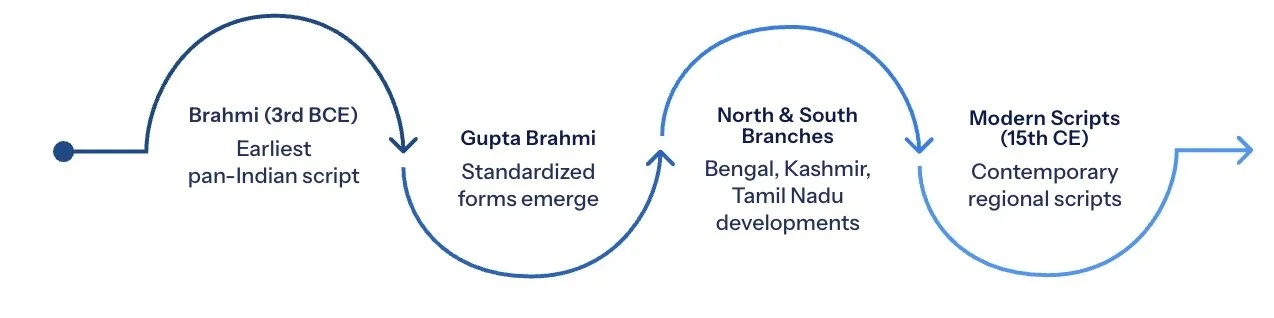
Evolution of Indian Scripts
In the south, Tamil script appeared in the 7th century CE, whilst Telugu, Kannada, and Malayalam scripts developed in the 14th-15th centuries.
Languages of Ancient Inscriptions
The languages used in ancient Indian inscriptions reflect the evolution of linguistic traditions and political power. The earliest Brahmi inscriptions, including those of Ashoka, were composed in dialects of Prakrit. Between the 1st and 4th centuries CE, many inscriptions combined Sanskrit and Prakrit. The first pure Sanskrit inscriptions appeared in the 1st century BCE, with the Junagadh rock inscription of Western Kshatrapa king Rudradaman being the first long Sanskrit inscription. By the end of the 3rd century CE, Sanskrit had gradually replaced Prakrit as the language of inscriptions in northern India.
3rd Century BCE
Prakrit dominates inscriptions including Ashoka's edicts
1st Century BCE
First pure Sanskrit inscriptions appear
3rd Century CE
Sanskrit replaces Prakrit in northern India
4th-6th Centuries CE
Sanskrit emerges as premier language of royal inscriptions
9th-10th Centuries CE
Regional languages begin appearing in inscriptions
In South India, inscriptions in old Tamil appeared in the 2nd century BCE. Tamil became important under the Pallava dynasty, with bilingual Tamil-Sanskrit inscriptions from the 7th century onwards. Kannada inscriptions date to the late 6th/early 7th century CE, whilst Telugu inscriptions began in the late 6th century. Malayalam inscriptions appeared around the 15th century. In North India, Marathi and Oriya inscriptions can be identified from the 11th century, Hindi dialects from the 13th century, and Gujarati from the 15th century.
Classification and Types of Inscriptions
Inscriptions can be classified into official and private records depending on whose behalf they were inscribed. Official records convey royal orders and decisions regarding social, religious, and administrative matters to officials and the general public. Examples include Ashoka's edicts and royal land grants. Private records document grants made by individuals or guilds to temples or religious establishments. Inscriptions can also be categorized according to content and purpose as donative, dedicative, and commemorative inscriptions.
Commemorative
Records of specific events like royal visits or memorial stones for heroes, women who committed sati, and Jaina ascetics
Donative
Gifts of money, cattle, land, and other resources for religious purposes by kings, artisans, and merchants
Royal Grants
Land grants recorded on stone or copper plates, documenting transfers to monks, priests, temples, vassals, and officials
Prashastis
Eulogies of kings' attributes and achievements, ignoring defeats or weaknesses
Thousands of memorial stones are found across India, not always connected with burials. The most common memorial stones honored dead heroes or women who committed sati. Some inscriptions record the building of waterworks, wells, and charitable institutions. A unique series at Junagadh records the construction and repairs of Sudarshana lake from the 4th century BCE through the Mauryan and Gupta periods. Miscellaneous inscriptions include labels, pilgrims' graffiti, religious formulae, writing on seals, and even condensed summaries of Sanskrit grammar.
Inscriptions as Historical Sources: Value and Limitations
Inscriptions possess significant advantages as historical sources. Compared with manuscript texts, they are durable and usually contemporaneous to the events they describe. Their information can be connected to specific times and places, and changes or additions can generally be detected. Compared to literary sources that offer theoretical perspectives, inscriptions often reflect what people were actually doing. They are invaluable for political history, with the geographical spread of a king's inscriptions indicating areas under his control.
Valuable Information Provided
Political structures and administrative systems
Revenue systems and land transactions
Social and economic conditions
Settlement patterns and agrarian relations
History of religious sects and practices
Sources of patronage for religious establishments
Historical geography and site locations
History of languages, literature, and arts
Details about iconography, art, and architecture
Limitations and Problems
Discovery depends on chance
Not all inscriptions from a reign are necessarily found
Movable inscriptions not always found in original place
Royal inscriptions exaggerate achievements
Genealogies sometimes skip names or create confusion
Different inscriptions may contradict each other
Conflicting claims by different dynasties
Early inscriptions contain limited geographical material
Inscriptions shed invaluable light on issues often invisible in other sources. For example, a Chola inscription from 1231 CE reveals that farmers found the burden of arbitrary levies and compulsory labor unbearable. A meeting of the Brahmana assembly and local leaders in the village temple resulted in decisions fixing dues and labor services. Such records provide rare glimpses into the lives and struggles of ordinary people in ancient times.
Numismatics: The Study of Ancient Coins
Numismatics is the study of coins, which served as the primary form of currency in ancient India. Ancient Indian coins were made of metal—copper, silver, gold, and lead—and were produced using clay moulds, especially during the Kushan period. In the absence of modern banking systems, people stored money in earthenware or brass vessels as precious hoards for times of need. Many of these hoards have been discovered across India, containing not only Indian coins but also those minted abroad, such as Roman coins, revealing extensive trade networks.
Materials
Coins were made from copper, silver, gold, and lead, each serving different economic purposes and denominational values in ancient markets.
Production
Coin moulds made of burnt clay have been discovered in large numbers, particularly from the Kushan period, revealing manufacturing techniques.
Contents
Early coins bore symbols; later coins depicted kings and deities and included names and dates, providing valuable chronological information.
Hoards
Discovered hoards of coins reveal patterns of wealth accumulation, trade routes, and economic connections across vast geographical areas.
The evolution of Indian coinage reflects broader social, economic, and political transformations. Stone Age people conducted exchange through barter. The Harappans had extensive trade networks based on barter systems. Whilst Vedic texts mention terms like nishka and hiranyapinda (gold ornaments and globules), these cannot be understood as true coins. The earliest definite evidence of coinage dates from the 6th-5th centuries BCE, coinciding with the emergence of states, urbanization, and expanding trade networks.
Evolution of Indian Coinage
The history of Indian coinage reveals technological advancement and political change. The oldest coins are punch-marked coins, mostly silver with some copper, usually rectangular or square, sometimes irregular in shape. Symbols were hammered onto these coins using dies or punches. Most silver punch-marked coins weighed 32 rattis (about 56 grains) and continued to circulate until the early centuries CE, with longer circulation in peninsular India. The punch-marked coins can be divided into four main series based on weight, punch marks, and circulation areas: Taxila-Gandhara type (north-west), Kosala type (middle Ganga valley), Avanti type (western India), and Magadhan type.
Punch-Marked Coins
6th-5th century BCE: Silver/copper coins with stamped symbols, no legends, likely state issues
Cast Coins
Soon after punch-marked: Copper/alloy coins made using clay/metal moulds, uninscribed
Die-Struck Coins
4th century BCE onwards: Copper/silver coins with symbols struck using carved metal dies
Indo-Greek Coins
2nd-1st century BCE: Well-executed silver coins with ruler portraits and bilingual legends
Changes in coinage patterns mirrored political changes. With the expansion of the Magadhan empire, Magadhan-type punch-marked coins gradually replaced those of other states. Symbols on these coins include geometric designs, plants, animals, the sun, wheel, mountain, tree, and human figures, some having religious or political importance. Although these coins lack legends, most were likely issued by states, with some later evidence of city and guild issues.
Regional Coinage Traditions
Different regions of ancient India developed distinctive coinage traditions reflecting their political, economic, and cultural characteristics. The Kushanas (1st-4th centuries CE) were the first dynasty to mint large quantities of gold coins, with rare silver coins and many low-value copper coins indicating a spreading money economy. Kushana coins showed the king on the obverse and deities from Brahmanical, Buddhist, Greek, Roman, and other pantheons on the reverse. Local coins referred to as indigenous, tribal, janapada, or local coins provide important information about dynasties of northern and central India from the 3rd century BCE to 4th century CE, mostly cast or die-struck in copper or bronze.
Satavahana Coinage
In the Deccan, Satavahana kings issued copper and silver coins, plus small-value lead and potin coins. Most were die-struck with Prakrit legends in Brahmi script, though portrait coins used Dravidian language.
Gupta Gold Coins
Imperial Gupta kings issued well-executed gold dinaras with Sanskrit metrical legends. The obverse showed the king in various poses; the reverse displayed religious symbols indicating the king's affiliations.
Cowrie Currency
Cowries were used as coins with low purchasing power, appearing substantially in post-Gupta times. They were used alongside coins for small transactions or where small-value coins were in short supply.
In South India, some punch-marked coins have been identified as dynastic issues based on their symbols. The double carp fish identified Pandya coins, whilst Chera coins featured the bow and arrow. In the western Deccan, there was a coexistence of Satavahana, Kshatrapa, punch-marked, and Roman coins in the early centuries CE. Roman gold coins flowed into peninsular India in large quantities and may have been used for large-scale transactions, with locally made imitations also found.
Coins as Sources of History
Coins are invaluable sources for reconstructing ancient history. During circulation, coins undergo wear and tear, gradually decreasing in weight—a fact that enables numismatists to arrange them chronologically. Legends on coins provide information on language and script history. As coins were used for donations, payments, and exchange, they illuminate economic history significantly. Coins issued by merchant and goldsmith guilds indicate the importance of crafts and commerce. Monetary history—including production, circulation, values, and frequency of issues—is closely linked to trade history.
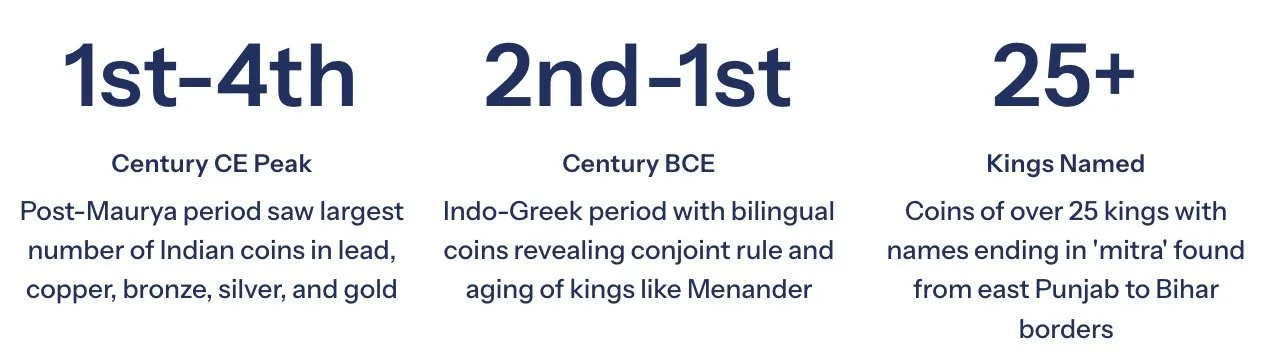
Coins as Sources of History
The wide distribution of Kushana coins indicates flourishing trade during their period. Ships on certain Satavahana coins reflect the importance of maritime trade. Roman coins found across India provide information on Indo-Roman trade. However, historians must exercise caution when interpreting coins. Precious metal coins had intrinsic value and often circulated beyond state borders, sometimes continuing long after a dynasty faded. Multiple currency systems could prevail simultaneously in an area, requiring visualization of overlapping spheres of coin circulation. Numismatic evidence is especially important for Indian political history between c. 200 BCE and 300 CE, when many dynasties are known almost entirely from their coins.
Development of Sanskrit Language
Sanskrit is the most ancient language of India and a remote cousin of most European languages, as indicated by resemblances such as 'pitr' (father) and 'matr' (mother). Ancient Sanskrit was Vedic Sanskrit, with the Rig Veda representing the earliest surviving form, showing similarities with Indo-European languages. After the Rig Veda's composition, Sanskrit developed considerably—old words were forgotten or changed meaning, and new words, mostly borrowed from non-Aryan sources, were introduced. To preserve Vedic purity, India developed sophisticated sciences of phonetics and grammar.
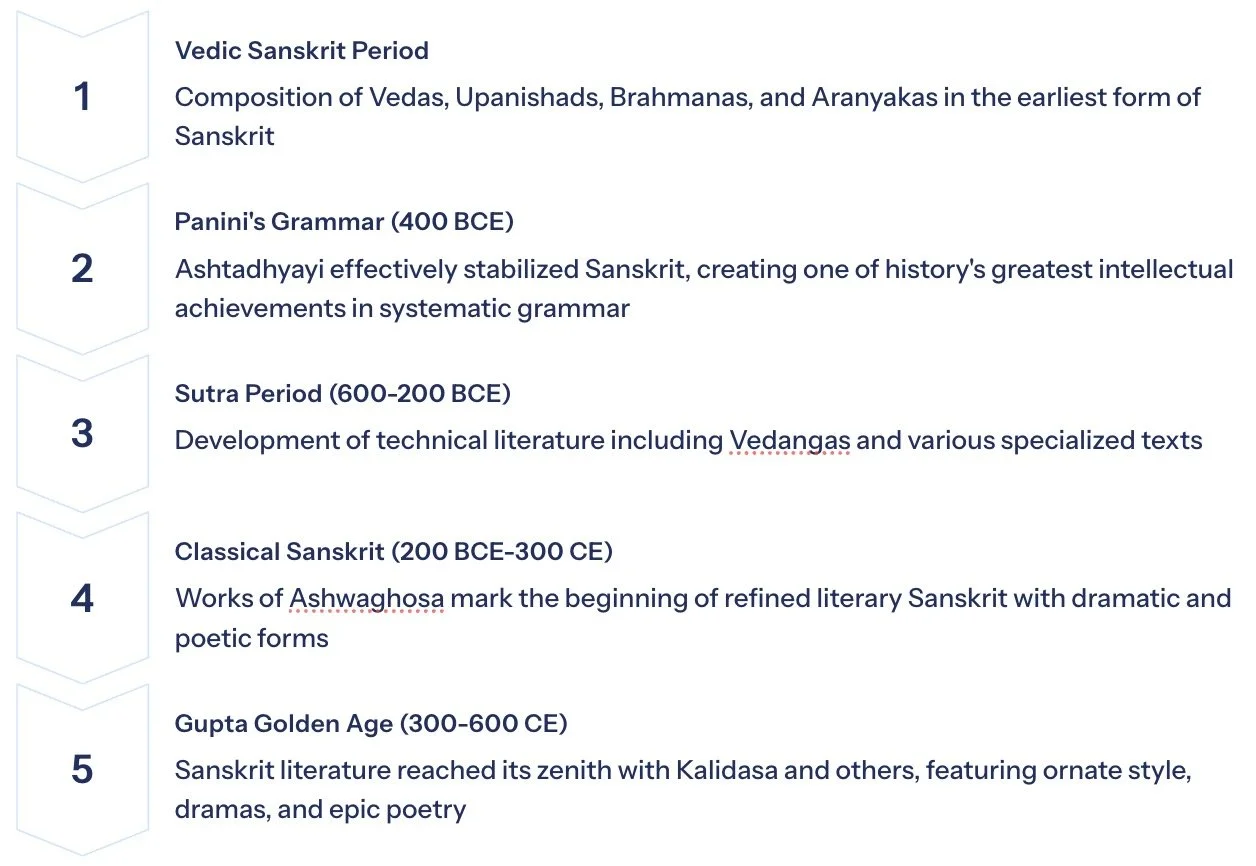
Development of Sanskrit Language
Panini's Ashtadhyayi is recognized as one of the greatest intellectual achievements of any ancient civilization—the most detailed and scientific grammar composed before the 19th century anywhere in the world. With Panini, the language reached its classical form and developed little thereafter except in vocabulary. From Panini's time onwards, the language began to be called 'samskrita'—perfected, refined, or chaste. The first important dynasty to use Sanskrit was the Shakas of Ujjain, with the Junagarh rock inscription of Rudradaman at Girnar being the first major Sanskrit inscription.
Major Categories of Sanskrit Literature
Sanskrit literature is classified into two major forms: Shruti and Smriti. Shruti, meaning 'that which is heard,' refers to the most authoritative ancient religious texts comprising Hinduism's central canon. Shruti was revealed to sages by God and includes the four Vedas with their embedded texts—the Samhitas, early Upanishads, Brahmanas, and Aranyakas. These texts are considered apauruseya (not created by humans). Smriti, meaning 'that which is remembered,' consists of texts attributed to human authors, traditionally written down rather than transmitted orally. All Smriti texts are ultimately rooted in or inspired by Shruti.
Shruti Literature
Four Vedas: Rigveda, Yajurveda, Samaveda, Atharvaveda
Each Veda contains:
Samhitas (collections of hymns)
Brahmanas (ritual explanations)
Aranyakas (forest texts on rituals)
Upanishads (philosophical texts)
Key Features: Authorless, transmitted orally, considered divine revelation, focused on rituals and ultimate reality
Smriti Literature
Includes:
Vedangas (six auxiliary sciences)
Upavedas (applied knowledge)
Itihasas (epics: Mahabharata, Ramayana)
Puranas (ancient narratives)
Dharma texts (law and ethics)
Artha texts (economics and politics)
Kama texts (pleasure and relationships)
Moksha texts (liberation)
Key Features: Attributed to authors, written tradition, derivative of Shruti, covers all aspects of life
Buddhist and Jaina Literature
Buddhist literature, initially composed in Pali (the language of Magadha), is divided into canonical and non-canonical works. The canonical literature is represented by the Tripitakas—three baskets. The Vinaya Pitaka deals with monastic rules and regulations. The Sutta Pitaka, the largest and most important, contains Buddha's teachings divided into five Nikayas (collections). The Abhidhamma Pitaka deals with philosophy and metaphysics. Mahayana sutras, preserved in Chinese, Tibetan, and Sanskrit, form another major body of Buddhist literature. Non-canonical literature includes the Jatakas—over 550 stories of Buddha's previous births—which provide invaluable insights into social and economic conditions from the 6th century BCE to 2nd century BCE.
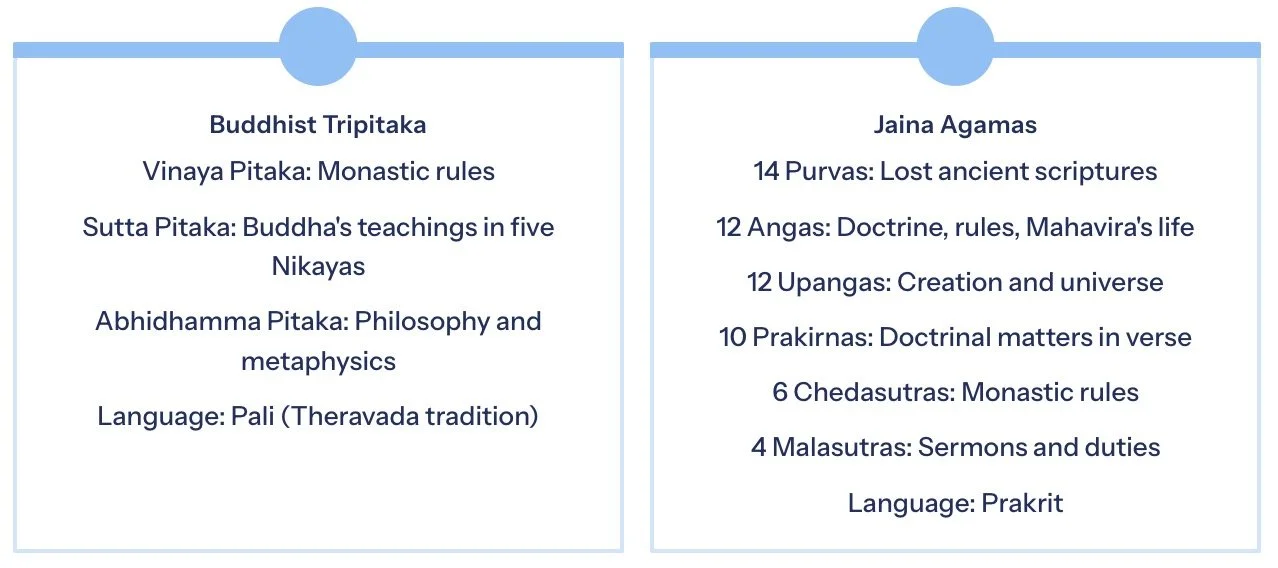
Buddhist and Jaina Literature
Jaina literature, written in Prakrit and finally compiled in the 6th century CE in Valabhi, Gujarat, consists of canonical Agamas. The 14 Purvas, representing the oldest Jaina scriptures preached by all Tirthankaras, have been lost. The 12 Angas are the most important texts, dealing with Jaina doctrine, rules of conduct, and the life of Mahavira. Important Jaina scholars include Haribhadra Suri (8th century CE) and Hemachandra Suri (12th century CE). Jainism contributed significantly to rich literature in poetry, philosophy, and grammar, with texts repeatedly referring to trade and traders, reflecting their commercial patronage base.
Synthesizing Historical Sources: Interpretation and Integration
The various literary and archaeological sources for ancient and early medieval India each possess specific potential and limitations that historians must carefully consider. Interpretation is integral to analyzing evidence from ancient texts, archaeological sites, inscriptions, and coins. Where several sources are available, their evidence must be correlated to construct a comprehensive historical narrative. The co-relation of textual and archaeological evidence is especially important for creating inclusive history, though inherent differences in the nature of literary and archaeological data make seamless integration challenging.
Archaeological Evidence
Material remains reveal everyday life, technology, and cultural processes but provide anonymous history
Literary Sources
Texts offer named individuals, specific events, and theoretical perspectives but reflect elite viewpoints
Epigraphic Records
Inscriptions provide datable information, specific locations, and actual practices but may exaggerate achievements
Numismatic Evidence
Coins reveal economic patterns, political changes, and trade networks but require careful interpretation of circulation patterns
Ethno-Archaeological Data
Modern traditional practices illuminate ancient techniques but must account for historical changes
Scientific Methods
Dating techniques, material analysis, and environmental studies provide chronological and contextual frameworks
A key challenge in early Indian history is fully integrating archaeological evidence, which often gets sidelined once literary sources emerge. Yet, archaeology is crucial for revealing everyday life and is vital even with extensive texts. By critically combining all available sources—textual, epigraphic, numismatic, archaeological, and scientific—historians can build a more complete, nuanced narrative that encompasses both elite accomplishments from texts and the lives of ordinary people through material remains.
