
Congress: The Extremist Phase (1905–1920)
The closing decade of the nineteenth century and the early years of the twentieth century witnessed a fundamental rupture within the Indian National Congress. A new and younger generation — sharply critical of the ideology and methods of the old Moderate leadership — rose to challenge British imperial authority through bolder, more confrontational means. This document examines the origins, causes, philosophy, leaders, and lasting legacy of Indian political Extremism, tracing how it transformed the nationalist movement from cautious petition to mass mobilization.
These "angry young men" advocated the adoption of Swaraj as the Congress's primary goal, to be pursued through self-reliant and independent methods rather than constitutional appeals to British goodwill. Their emergence permanently altered the character of Indian nationalist politics and laid the ideological groundwork for the mass movements that followed under Mahatma Gandhi.
The Rise of Extremism: Background and Context
Extremism on the Indian national scene did not spring up suddenly in the first decade of the twentieth century. In fact, it had been growing slowly since the Revolt of 1857 but remained largely invisible beneath the surface of polite constitutional agitation. The nationalist ideas behind the Revolt of 1857, according to the Extremists, were rooted in the twin concepts of Swadharma (one's own religion and duty) and Swaraj (self-rule). These ideas simmered through subsequent decades before erupting into public politics after 1905.
From 1905 onwards, the Moderate leaders rapidly lost their grip over the National Congress. The Partition of Bengal, announced by Lord Curzon in 1905, served as a dramatic catalyst that propelled Extremist ideas from the margins to the center of Indian nationalist discourse. The Extremist party now stood in sharp contrast to the older Moderate party, and the ideological fault lines between them deepened with each passing year.
The transformation was not merely political but psychological. Indians who had once looked to British institutions for redress began to question the very legitimacy of colonial rule, forging a new political consciousness that would define the next two decades of the freedom struggle.
Causes of the Extremist Movement
The emergence of Extremism was shaped by a convergence of domestic failures and international inspiration. The Moderate leadership's inability to secure meaningful political concessions from the British government had bred deep frustration among younger nationalists. Each legislative disappointment — from the Act of 1892 to Lord Curzon's sweeping administrative overreach — reinforced the perception that petitioning the British was futile.
Domestic Triggers
Failure of Moderate leadership to deliver tangible political gains
Lord Curzon's reactionary and derogatory policies toward Indians
Calcutta Corporation Act, Official Secrets Act, and Indian University Act of 1904
Delhi Durbar of 1903 held during a devastating famine (1899–1900)
Partition of Bengal (1905) as a deliberate divide-and-rule strategy
Increasing Westernization threatening Indian traditions and culture
International Inspiration
Abyssinia's repulsion of the Italian Army (1896) broke the myth of European invincibility
Japan's decisive victory over Russia (1905) electrified Asian nationalists
Nationalist movements in Egypt, Persia, Turkey, and Russia provided models
Humiliating treatment of Indians in British colonies like South Africa galvanized opinion
Western education paradoxically exposed Indians to liberal and revolutionary political thought
Lord Curzon's contemptuous remarks about Indian character were particularly inflammatory. At the Calcutta University Convocation, he declared: "Undoubtedly truth took a high place in the codes of the west before it had been similarly honoured in the East." Such statements wounded Indian pride and stripped away any lingering illusions about benevolent British intent. The Delhi Durbar of 1903 — an extravagant imperial pageant staged while India had barely recovered from a catastrophic famine — was widely condemned as "a pompous pageant to a starving population."
Spiritually, the movement drew strength from the teachings of Swami Vivekananda and Dayananda Saraswati, whose calls for Hindu cultural revival and national self-assertion provided a powerful ideological counterweight to Western liberalism. The growth of spiritual nationalism in India was thus inseparable from the growth of political Extremism.
The Goal of Swaraj: Competing Visions
Unlike the Moderates who sought incremental constitutional reforms within the British imperial framework, the Extremists placed Swaraj — self-rule — at the center of their political program. However, the precise meaning of Swaraj was contested among the Extremist leaders themselves, reflecting the ideological diversity within the broader movement.
Bal Gangadhar Tilak
For Tilak, Swaraj meant Indian control over the administration. He did not initially advocate for a total severance from Great Britain but insisted that Indians must govern themselves. He famously proclaimed: "Swarajya is my birthright, and I shall have it."
Bipin Chandra Pal
Pal held the most radical interpretation. He believed that no genuine self-government was possible under British rule. For him, Swaraj meant complete autonomy, absolutely free from all British control — a position that placed him at the furthest edge of the constitutional spectrum.
Aurobindo Ghosh
Despite his revolutionary writings, Aurobindo initially envisioned Swaraj as self-rule within the parameters of the British imperial structure. Over time, however, his political nationalism was gradually subsumed by a deeper spiritual mission for India's cultural and moral rebirth.
Lala Lajpat Rai
Lajpat Rai approached Swaraj through the lens of Hindu cultural pride and Arya Samaj principles. He wrote passionately about India's subjugation and declared: "A man without a soul is a mere animal. A nation without a soul is only a dumb driven cattle."
Despite these differences in interpretation, all Extremist leaders agreed that Swaraj — in whatever form — was not a distant aspiration to be negotiated politely but an immediate birthright to be asserted with force of will. This shared conviction gave the movement its moral urgency and its power to mobilize popular sentiment far beyond the educated elite.
Philosophy
Nature and Philosophy of Extremism
The Extremist movement was philosophically distinct from Moderate nationalism in several fundamental respects. While Moderates drew their inspiration from Western liberal thought and European political history, the Extremists consciously rooted their ideology in India's own historical traditions, cultural heritage, and spiritual identity. This was not mere nostalgia — it was a deliberate political strategy to forge a mass consciousness that could cut across class lines.
Wide Social Base
The Extremists expanded political participation beyond the educated elite to include the lower middle class and the urban masses. By invoking popular religious festivals and cultural symbols, they connected nationalist sentiment to everyday Indian life in ways the Moderates never could.
Cultural & Historical Inspiration
They drew inspiration from the Vedic past, the empires of Ashoka and Chandragupta, the heroism of Rana Pratap and Shivaji, and the patriotism of Rani Laxmibai. These historical memories were consciously deployed to instill national pride and self-respect among ordinary Indians.
Extra-Constitutional Methods
Unlike Moderates who insisted on constitutional methods exclusively, the Extremists did not hesitate to employ boycott, passive resistance, and other extra-constitutional methods. They argued that an unjust government forfeited its claim to peaceful compliance from those it oppressed.
Spiritual Nationalism
Drawing on the philosophy of Bankim Chandra Chatterjee, Vivekananda, and Dayananda Saraswati, the Extremists gave nationalism a spiritual dimension. India was portrayed not merely as a nation-state but as a sacred motherland deserving devotion comparable to religious duty.
The Extremists also mounted a sharp critique of Western cultural dominance. They argued that the Moderates' idealization of Western civilization constituted a form of cultural capitulation that bred inferiority complexes among Indians and undermined the psychological foundations of the freedom struggle. By contrast, militant nationalism sought to restore Indian self-confidence as a precondition for political liberation.
Leadership
The Lal-Bal-Pal Triumvirate
The three dominant figures of the Extremist movement — Lala Lajpat Rai, Bal Gangadhar Tilak, and Bipin Chandra Pal — formed a formidable triumvirate of assertive nationalism between 1905 and 1918. Each brought a distinct regional base and ideological temperament, and together they gave the Extremist movement its national reach and political coherence. They championed the Swadeshi movement, advocating the boycott of British goods and the promotion of Indian-made products during the anti-Partition agitation in Bengal.
Lala Lajpat Rai — "Punjab Keshari"
(1865–1928) · Author, politician, Arya Samaj devotee · Editor of Arya Gazette · Wrote Unhappy India · Deported to Mandalay (1907) without trial · Fatally injured leading a protest against the Simon Commission (1928) · His death inspired Bhagat Singh's revolutionary oath
Bal Gangadhar Tilak — "Lokmanya"
(1856–1920) · "Father of Indian Unrest" · Founded Ganesh Festival (1893) and Shivaji Festival (1895) · Started weeklies Kesari (Marathi) and Mahratta (English) · Imprisoned in Mandalay (1908–1914); wrote Gita Rahasya in prison · Declared: "Swarajya is my birthright, and I shall have it"
Bipin Chandra Pal
(1858–1932) · Founded journal New India · Called "one of the mightiest prophets of nationalism" by Sri Aurobindo · Advocated complete autonomy from British rule · Retired from active politics as the militant movement waned after Tilak's arrest
The militant nationalist movement gradually faded with the arrest of Tilak and the retirement of Pal and Aurobindo Ghosh from active politics. Yet the triumvirate's contribution was enduring: they demonstrated that mass political mobilization in India required cultural and emotional resonance, not merely rational argument, and they laid the groundwork for the Gandhian era that followed.
Key Figures
Bal Gangadhar Tilak: The Architect of Militant Nationalism
Within the Congress, Tilak stood as the foremost Extremist — described by Valentine Chirol as the "Father of Indian Unrest." His political genius lay in his ability to fuse popular Hindu cultural traditions with nationalist politics, creating forms of mass mobilization that reached far beyond the educated classes. The Ganesh Festival (1893) and the Shivaji Festival (1895) were not merely religious events; they were political assemblies that built solidarity and nationalist consciousness among ordinary Maharashtrian citizens.
Tilak's newspapers — Kesari in Marathi and Mahratta in English — became powerful instruments of political education and agitation. When the bubonic plague of 1896–97 brought harsh British military measures to Pune, Tilak published incendiary articles in Kesari, quoting the Bhagavad Gita to argue that no blame attached to one who killed an oppressor without thought of reward. Following these articles, Commissioner Rand and Lt. Ayerst were shot by the Chapekar brothers on June 22, 1897. Tilak was sentenced to 18 months' imprisonment for sedition.
"Swarajya is my birthright, and I shall have it." — Bal Gangadhar Tilak
Following the Partition of Bengal in 1905, Tilak threw his full weight behind the Swadeshi and Boycott movements. The Surat Congress of 1907 became the watershed moment when the ideological rupture between Moderates and Extremists crystallized into an irreparable organizational split — Tilak, Pal, and Lajpat Rai leading the radical faction. In 1908, Tilak was again arrested for sedition after defending in Kesari the Bengali youths Prafulla Chaki and Khudiram Bose who had thrown a bomb in Muzaffarpur. He was sentenced to six years' transportation to Mandalay, where he composed his celebrated Gita Rahasya. Upon his return in 1914, he sought reconciliation with the Congress and channeled his energies into the Home Rule Movement, forging a notable alliance with Muhammad Ali Jinnah.
Key Figures
Aurobindo Ghosh, V.O.C. Pillai & Lala Lajpat Rai
Aurobindo Ghosh
Educated at King's College, Cambridge, Aurobindo returned to India to pursue both civil service and revolutionary nationalist politics. Imprisoned by the British for writing against British rule, he underwent profound mystical experiences during his incarceration that reoriented his entire life mission. After his release — when the prosecution could produce no evidence — he moved to Pondicherry, where he founded the Sri Aurobindo Ashram in 1926 and devoted himself to spiritual work.
His pamphlet New Lamps for the Old is considered the "Bible of Extremism," in which he described the Congress as being out of touch with the proletariat. His articles in Bande Mataram and the journal Bangadarshan portrayed India as a sacred "Mother," appealing to the emotional and spiritual dimensions of nationalism in a way that proved electrifying to Bengali readers.
V.O. Chidambaram Pillai — "Kappalottiya Tamilan"
(1872–1936) A Tamil political leader and disciple of Tilak, V.O.C. Pillai launched the first indigenous Indian shipping service between Tuticorin and Colombo through the Swadeshi Steam Navigation Company, directly challenging British commercial supremacy on Indian sea routes. He was subsequently charged with sedition, sentenced to life imprisonment, and stripped of his barrister's license — a testament to the threat the British saw in economic nationalism.
Lala Lajpat Rai — Punjab Keshari
A devotee of the Arya Samaj and editor of the Arya Gazette, Lajpat Rai was deported without trial to Mandalay in May 1907 during political agitation in Punjab. Returned in November 1907 after Lord Minto found insufficient evidence, he continued his activism until he was fatally struck by police batons while leading a non-violent protest against the Simon Commission in 1928. His dying words — that the blows struck at him would be "the last nails in the coffin of British rule" — inspired a generation of revolutionaries, including Bhagat Singh.
Analysis
Assessment of the Extremist Movement
The Extremist phase of Indian nationalism represented a decisive break with the politics of deference. Where the Moderates had treated patriotism as, in the memorable phrase, "an academic pastime," the Extremists transformed it into a call for service and suffering for the nation. They expanded the social base of the freedom movement, incorporated the masses into political consciousness, and elevated Swaraj from a distant hope to an immediate moral demand.
Key Achievements
Partition of Bengal was annulled in 1911 — a direct vindication of mass agitation
The goal of Swaraj, though denied by Lord Morley, was no longer regarded as a revolutionary or treasonous demand
Mass political consciousness was awakened far beyond the educated urban elite
The Swadeshi movement planted the seeds of indigenous industry and economic self-reliance
Limitations and Contradictions
Socially, many Extremist leaders drifted toward revivalism — Rai and Pal spoke of a Hindu nation despite advocating social reform
Tilak's opposition to the Age of Consent Bill and his organization of the Ganesh Festival projected him as a leader of Hindu orthodoxy, which deepened Hindu-Muslim tensions
Cow protection movements and communal mobilization risked fragmenting the very national unity the movement sought to build
The movement lacked a coherent organizational structure and waned rapidly with the arrest or retirement of its key leaders
Intellectual Legacy
Extremist thought, rooted in Bankim Chandra, Vivekananda, and Dayananda Saraswati, permanently enriched the ideological vocabulary of Indian nationalism
Aurobindo's spiritual nationalism gave the freedom struggle a metaphysical dimension that resonated deeply in Indian cultural life
Vishnu Shastri Chiplunkar's Nibandhmala and Aurobindo's New Lamps for the Old became foundational texts of the Extremist canon
Until Mahatma Gandhi arrived on the political scene of India, the Extremists dominated the Indian National Congress. Gandhi would inherit much of their rhetoric — Swaraj, Swadeshi, mass mobilization — while redirecting its methods toward non-violent civil disobedience. In this sense, Extremism was not a dead end but a necessary bridge between the Moderate era and the Gandhian mass movement.
Comparative Analysis
Moderates vs. Extremists: A Structural Comparison
The differences between the Moderate and Extremist factions within the Indian National Congress were not merely tactical disagreements — they reflected fundamentally divergent assumptions about the nature of British rule, the capacity of the Indian masses, and the legitimate methods of political struggle. Understanding these differences is essential to appreciating the internal dynamics of the nationalist movement.
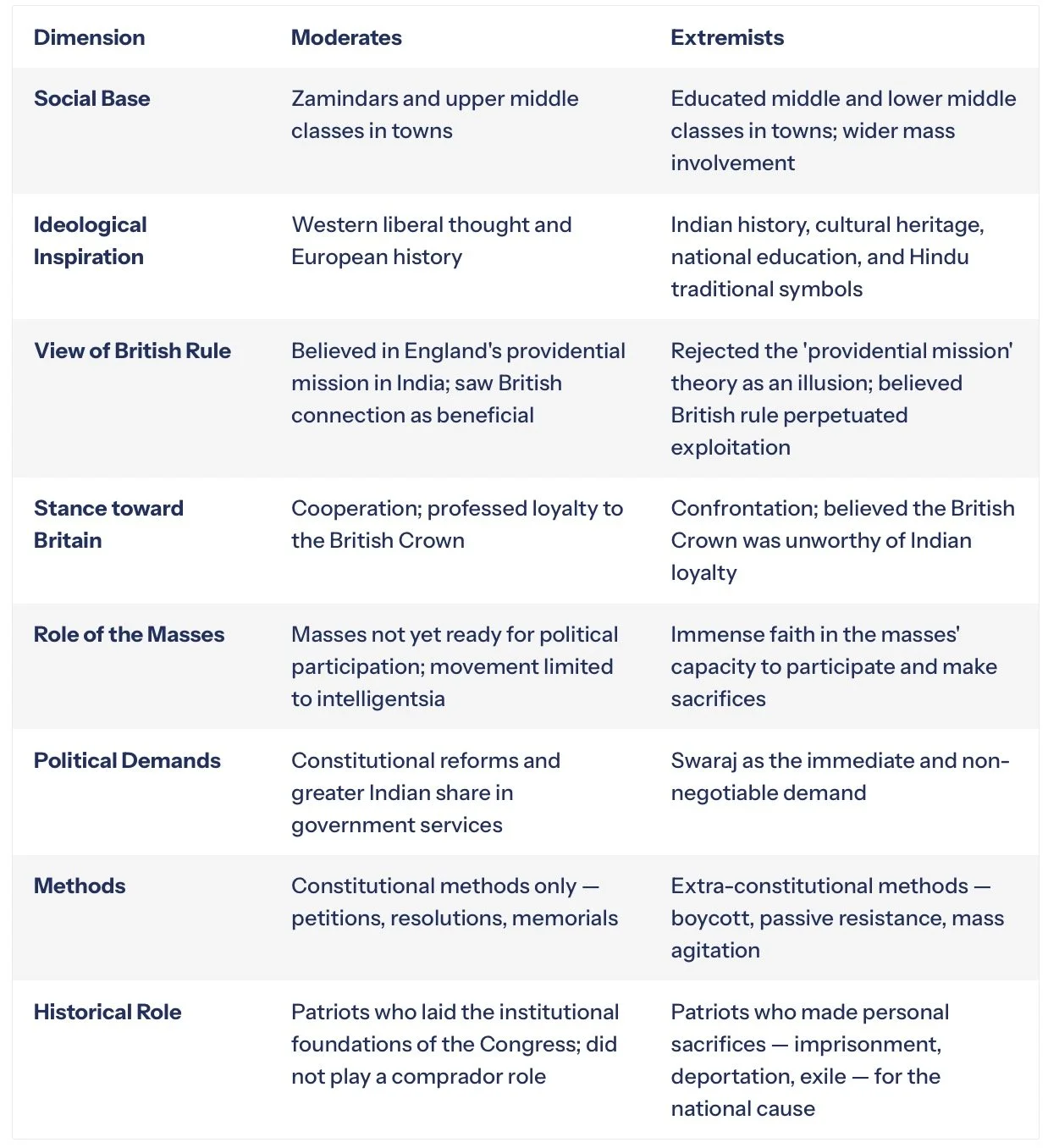
This table reveals that the Moderate-Extremist divide was ultimately a debate about political realism versus moral urgency — about whether an unjust empire could be reformed through patient argument or whether it had to be confronted through popular resistance. History, as subsequent events would show, vindicated the Extremist diagnosis of British intentions, even as Gandhi transformed their methods into something more disciplined, inclusive, and ultimately more effective.
