
British in Bengal: From Plassey to Buxar
The mid-18th century witnessed a dramatic transformation in the political landscape of Bengal, as the British East India Company transitioned from commercial traders to territorial rulers. This pivotal period, marked by the Battles of Plassey (1757) and Buxar (1764), fundamentally altered the course of Indian history. These conflicts were not merely military engagements but represented a complex interplay of diplomacy, conspiracy, and strategic ambition that would eventually lead to British domination over the subcontinent. Understanding these events is crucial for comprehending how a trading company became an imperial power, establishing the foundation for nearly two centuries of colonial rule.
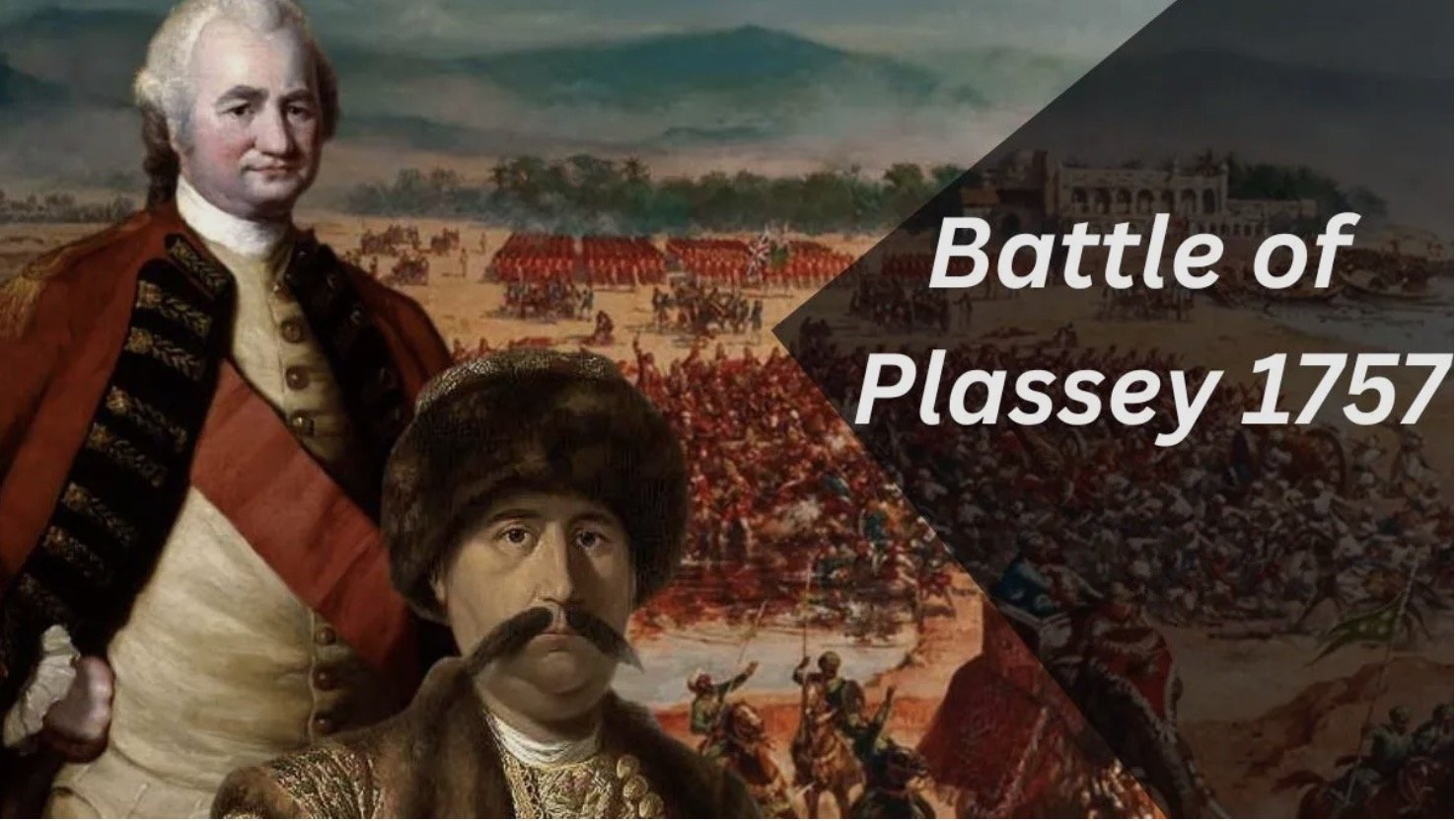
Battle Of Plassey: Background, Outcome, Significance & Impact
The British East India Company's Pre-Conflict Position in Bengal
By the early 18th century, the British East India Company had established three major presidencies in India: Fort St. George in Madras, Fort William in Calcutta, and Bombay Castle in western India. These stations operated independently, governed by a President and Council appointed by the Court of Directors in England. The Company's strategy centred on forming alliances with local princes and Nawabs, offering protection against internal threats in exchange for commercial concessions and trading privileges.
The European rivalry in India was intense, though by this period Dutch and Portuguese influence had waned considerably. The French East India Company, established under Louis XIV, emerged as Britain's principal competitor with significant establishments at Chandernagar in Bengal and Pondicherry on the Carnatic coast. Despite being latecomers to Indian trade, the French quickly established themselves and appeared poised to challenge British commercial supremacy, creating a parallel to the ongoing conflicts in Europe.
Fort William, Calcutta
Bengal's commercial hub and Company headquarters
Fort St. George, Madras
Southern India's administrative centre
Bombay Castle
Western India's strategic trading post
Alivardi Khan and the Prelude to Conflict
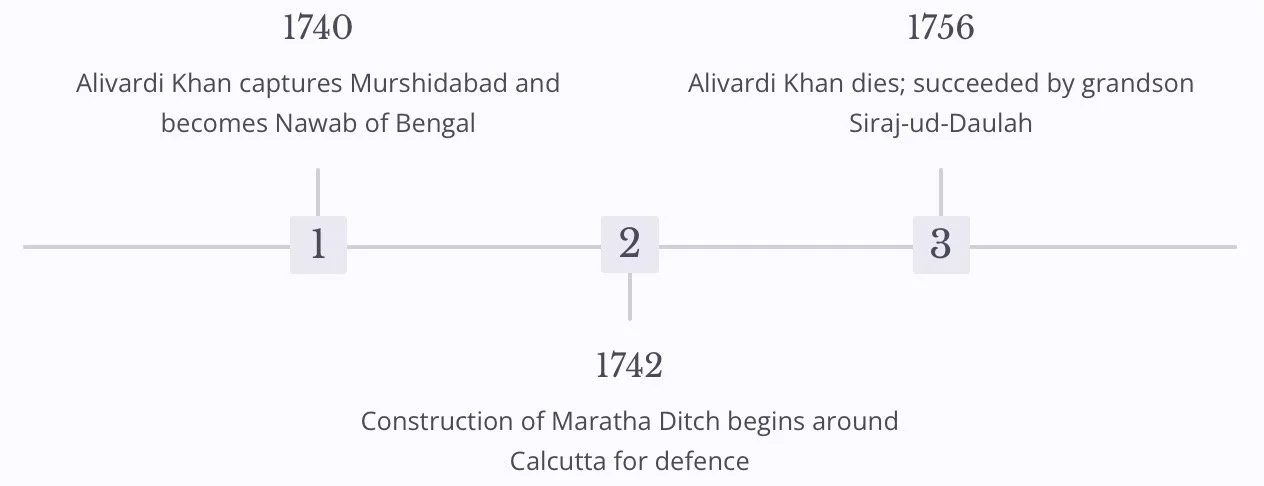
Alivardi Khan ascended to the throne of Bengal in 1740 after his army captured Murshidabad, the provincial capital. His reign was characterised by a cautious and pragmatic approach towards European trading companies. Unlike his predecessors, Alivardi maintained strict control over European activities, having witnessed the proxy wars between British and French forces in southern India using local princes as pawns. He was determined to prevent such destabilisation in his prosperous province.
During his conflicts with the Marathas, Alivardi pragmatically allowed Europeans to strengthen their fortifications, including the construction of the Maratha Ditch around Calcutta in 1742. This defensive moat, three miles in length, was ironically funded by local inhabitants to protect British interests. However, the Marathas never attacked Calcutta, and the ditch later proved ineffective when Siraj-ud-Daulah's forces overran the British settlement in 1756. The structure was eventually filled in 1799 to construct the Circular Road, marking the original boundaries of colonial Calcutta.
Battle Of Plassey: Background, Outcome, Significance & Impact
The continual friction between Alivardi and the British centred on the interpretation of Emperor Farrukhsiyar's farman of 1717. This imperial decree had granted the Company duty-free trading rights across Bengal for a nominal annual payment of three thousand rupees—a remarkably generous concession obtained when the Company's surgeon, William Hamilton, cured the ailing emperor. The British consistently claimed they were prevented from fully enjoying these privileges, whilst simultaneously abusing them by issuing passes to native traders for customs-free trade and imposing heavy duties on goods entering their districts, actions that significantly undermined the Nawab's revenue collection.
The Rise of Siraj-ud-Daulah and the Fall of Calcutta
In April 1756, Alivardi Khan died and was succeeded by his twenty-three-year-old grandson, Siraj-ud-Daulah. Contemporary accounts describe his personality as combining a ferocious temper with limited political understanding. The young Nawab was particularly suspicious of the enormous profits being extracted from Bengal by European trading companies. His suspicions were well-founded—the British were systematically working to occupy Bengal's prosperous regions by undermining both the Nawab's authority and rival European powers.
The immediate crisis arose from British fortification activities at Fort William. With conflict against French forces appearing imminent, the Company began significantly strengthening the fort's defences without seeking the Nawab's permission. Siraj-ud-Daulah viewed this as a direct threat to his sovereignty and provincial independence. When he ordered the British to cease these unauthorised constructions and they refused, the Nawab acted decisively.
Cossimbazar Captured
Siraj's forces surrounded the British factory, taking several officials prisoner
March on Calcutta
The Nawab led nearly 50,000 infantry and cavalry towards the weakly defended city
City Occupied
Calcutta fell on 16 June 1756 with minimal resistance from British forces
Fort Surrenders
On 20 June, Fort William surrendered after the garrison commander fled
The Black Hole of Calcutta Controversy
The "Black Hole of Calcutta" incident has become one of the most controversial episodes in Anglo-Indian history, serving as British propaganda justification for subsequent military action. According to John Zephaniah Holwell, a senior East India Company bureaucrat who had previously served as a military surgeon, 146 British and Anglo-Indian prisoners were confined overnight in Fort William's small dungeon following the fort's capture on 20 June 1756. Holwell claimed that the cramped conditions—a room measuring merely 14 by 18 feet—resulted in 123 deaths from suffocation, heat exhaustion, and crushing by morning.
However, the veracity of Holwell's account has been extensively questioned by historians. In 1915, British scholar J.H. Little systematically challenged the narrative in his article "The 'Black Hole'—The Question of Holwell's Veracity." Little argued that a floor area of 267 square feet could not physically contain 146 European adults, and crucially, that no independent corroboration of such a significant atrocity existed. Given the nature of the alleged incident, the complete absence of supporting evidence from other sources appears highly suspicious. Furthermore, official garrison records listed only forty-three members as missing after Fort William's fall, suggesting the maximum possible deaths could not have exceeded this number.
Holwell's Claims
146 prisoners confined in 14×18 feet room; 123 died overnight from suffocation and heat
Physical Impossibility
267 square feet could not contain 146 European adults—basic mathematics contradicts the account
Lack of Evidence
No independent sources confirm the incident despite its alleged magnitude
Garrison Records
Only 43 personnel listed as missing—maximum possible casualties far lower than claimed
Despite these substantial doubts, the "Black Hole" narrative proved remarkably effective as propaganda, inflaming British public opinion and providing moral justification for Robert Clive's subsequent military expedition. Holwell himself stated that Siraj-ud-Daulah neither ordered the confinement nor was informed about it, attributing responsibility to lower-ranking jailers seeking revenge for casualties during the siege. This exculpation of the Nawab was conveniently overlooked in the subsequent British narrative, which portrayed Siraj as a tyrannical oppressor deserving punishment.
The Battle of Plassey: Conspiracy and Betrayal
When news of Calcutta's fall reached Madras on 16 August 1756, the Council immediately organised a relief expedition. Colonel Robert Clive assumed command of 900 European soldiers and 1,500 sepoys, whilst Admiral Watson commanded the naval squadron. The expedition's objectives extended beyond mere recovery of British settlements—they sought "ample recognition of the Company's privileges and reparation for its losses" whilst exploiting any "signs of dissatisfaction and ambition among the Nawab's subjects."
The British forces successfully recaptured Calcutta on 2 January 1757 after dislodging enemy forces from Budge Budge fort. Following reinforcement of Fort William's defences, they attacked and sacked Hooghly on 9 January. When Siraj-ud-Daulah advanced with his main army—40,000 cavalry, 60,000 infantry, and 50 elephants—Clive launched a pre-emptive strike that routed the Nawab's forces, killing 1,300 whilst losing only 57 British soldiers. This unexpected defeat forced Siraj-ud-Daulah to negotiate, resulting in the Treaty of Alinagar on 9 February 1757.
The treaty restored Company factories, recognised all privileges from the 1717 farman, exempted British goods from customs duties, and permitted fortification of Calcutta and minting of coins. However, this peace proved temporary. Clive had not come to Bengal merely to retake Calcutta—as he wrote before departing Madras, "this expedition will not end with the retaking of Calcutta only." He now turned to eliminating rival European powers and consolidating British dominance through conspiracy.
Clive first captured the French settlement at Chandernagar in March 1757, despite the Nawab's objections. This action, combined with Siraj-ud-Daulah's secret negotiations with the French and redeployment of forces to Plassey, heightened British anxieties about their numerical disadvantage. Clive and his associates then orchestrated an elaborate conspiracy involving disaffected elements at the Nawab's court: Mir Jafar (the demoted army chief), Jagat Seth bankers, Rai Durlabh, Yar Lutuf Khan, and the merchant Omichand.
Secret Alliance Formed
British contact conspirators at Siraj's court promising to install Mir Jafar as Nawab
Double Treaty
Real treaty on white paper; fake treaty on red paper to deceive Omichand's demands
Battle Fixed
Mir Jafar and co-conspirators promised to remain inactive during combat
Nawab Installed
Mir Jafar elevated to throne in exchange for massive payments to British
The Battle of Plassey and Its Aftermath
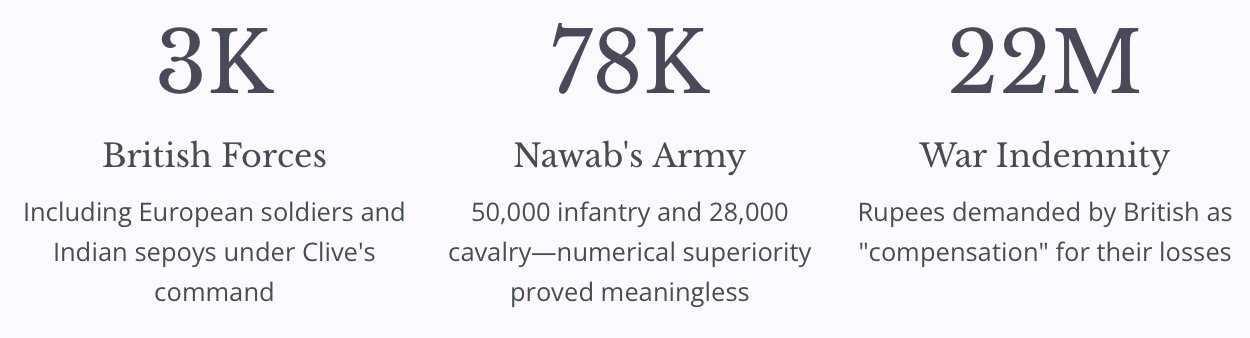
On 23 June 1757, the armies of Siraj-ud-Daulah and Robert Clive confronted each other at Plassey on the banks of the Bhagirathi River. The disparity in forces was staggering: the Nawab commanded 50,000 infantry and 28,000 cavalry, whilst Clive had merely 3,000 men including both European soldiers and Indian sepoys. However, this numerical advantage proved meaningless due to the conspiracy. Three divisions of the Nawab's army, commanded by Mir Jafar, Rai Durlabh, and Yar Lutuf Khan, assembled near the battlefield but made no attempt to engage British forces.
Only two generals, Mohan Lal and Mir Madan, fought desperately for the Nawab. When Mir Madan fell dead, Siraj-ud-Daulah lost his nerve—already warned of impending defeat by his astrologer (quite possibly bribed by the British). Following Mir Jafar's advice to retreat, the Nawab fled on a swift camel. His demoralised army followed suit, and the "battle" ended without significant fighting. Siraj-ud-Daulah was subsequently captured and executed by Mir Jafar's son, Miran. Mir Jafar entered Murshidabad as the new Nawab, installed by British conspiracy rather than military conquest.
Battle Of Plassey: Background, Outcome, Significance & Impact
The treaty between the British and Mir Jafar granted the Company all land within the Maratha Ditch plus 600 yards beyond, zamindari rights over 24 Parganas, confirmation of the 1717 farman, and 22 million rupees in compensation. When it was revealed to Omichand that he would receive nothing despite promises in the forged red-paper treaty, he reportedly went insane. Clive returned to England in 1760 as "Victor of Plassey," honoured with a peerage as Lord Clive, Baron of Plassey.
"So large a sovereignty may possibly be an object too extensive for a mercantile company." — Robert Clive, acknowledging that ruling Bengal was beyond a trading company's intended scope, yet the Company would do precisely that for the next century.
Mir Kasim's Resistance and the Dastak Controversy
Mir Jafar proved an incompetent and financially exhausted puppet. By 1760, unable to meet continued British demands, he was compelled to abdicate in favour of his son-in-law Mir Kasim, who promised larger payments to the Company. Mir Kasim (1761-1763) proved far more capable than his predecessor—vigorous, ambitious, and unwilling to remain a British puppet. He shifted his capital from Murshidabad to Munger, reorganised his military forces on Western lines, established arms manufacturing facilities, and systematically recovered state revenues to replenish his treasury.
The central conflict arose over dastak abuse. The farman of 1717 had granted the East India Company customs-free trade, authorised through dastaks (trade permits). However, this privilege legally applied only to Company trade, not private traders. In practice, corrupt Company servants sold dastaks at inflated prices to both European private traders and native merchants, allowing them to evade customs duties whilst legitimate Indian merchants paid up to 40 per cent in taxes. This systematic fraud devastated the Nawab's revenue and destroyed fair competition.
40% Native Tax Burden
Customs duties paid by Indian merchants whilst British traded duty-free
0% Company Duties
British traders using fraudulent dastaks paid nothing, destroying revenue
Warren Hastings, then British Resident at Murshidabad, conducted an investigation in 1758 that exposed widespread fraud and illegal trading under unauthorised British protection. He urged Calcutta authorities to end these abuses that were bringing "shame on Britain's reputation," but the Council rejected his proposals since many members personally profited from the corrupt trade. Frustrated, Hastings resigned in December 1764 and returned to Britain.
Unable to persuade the Company to cease dastak abuse, Mir Kasim abolished all inland customs duties in 1763, eliminating the British competitive advantage and protecting native merchants from ruin. This action infuriated British traders who had grown rich from their privileged position. Hostilities escalated rapidly—Mir Kasim overran Company offices in Patna, killing several Europeans including the Resident. The British defeated Mir Kasim in three successive battles between June and September 1763, forcing him to flee to Allahabad where he sought alliance with Shuja-ud-Daulah, the Nawab of Awadh.
The Battle of Buxar and the Treaty of Allahabad
The Battle of Buxar, fought on 23 October 1764, proved far more significant than Plassey in establishing British dominance. Unlike Plassey's conspiracy-driven outcome, Buxar demonstrated genuine British military superiority against a properly contested battle. Three rulers united against the British: Mir Kasim seeking to reclaim Bengal, Shuja-ud-Daulah (Nawab of Awadh) wanting to destroy British power, and Mughal Emperor Shah Alam II attempting to reassert sovereignty over Bengal. This formidable alliance commanded substantial resources and represented the last significant challenge to British expansion in northern India.
Despite their combined strength, the allied forces suffered from fatal internal divisions. A bitter quarrel between Shah Alam II and Shuja-ud-Daulah undermined coordination, whilst Mir Kasim proved reluctant to fully engage British forces. The lack of basic cooperation among these desperate allies ensured their decisive defeat. Company forces under Hector Munro crushed the combined army at Katkauli, six kilometres from Buxar. The consequences were catastrophic for Indian sovereignty: Mir Kasim fled northwest and died in obscurity, Shah Alam II abandoned his allies and sought British protection, whilst Shuja-ud-Daulah retreated to Rohilkhand after unsuccessful resistance efforts until 1765.
Robert Clive returned to India in 1765 as Governor-General to negotiate the settlement. Two separate treaties were signed at Allahabad, fundamentally restructuring political authority in northern India. The treaty with Shah Alam II granted the Company diwani rights (fiscal administration and revenue collection) over Bengal, Bihar, and Orissa in exchange for an annual tribute of 26 lakh rupees to the Mughal Emperor and return of Kora and Allahabad districts. Nizamat functions (police and judicial authority) remained nominally with Bengal's Nawab, creating the notorious "Dual System."
The treaty with Shuja-ud-Daulah returned Awadh to his control after payment of 53 lakh rupees war indemnity, but stripped him of Allahabad and Kora. An English Resident was stationed at Lucknow at the Nawab's expense, whilst an offensive-defensive alliance bound him to provide military assistance to the Company without compensation. The Banaras zamindari was transferred to Balwant Rai. These treaties established British paramountcy—the Company now possessed enormous revenues from India's wealthiest provinces, controlled military affairs through alliances, and reduced both the Mughal Emperor and regional Nawabs to dependent pensioners.
Significance and the Dual System of Administration
The Battle of Buxar's historical significance far exceeds that of Plassey. Whilst Plassey established a British foothold through conspiracy and betrayal, Buxar demonstrated clear military superiority in genuinely contested combat. If Plassey defeated Bengal's Nawab, Buxar crushed the Mughal Emperor himself alongside powerful regional rulers. The battle exposed the political weakness and military inadequacy of Indian forces whilst consolidating British territorial control. With Bengal's immense wealth now flowing to Company coffers, the British possessed resources to conquer other Indian regions systematically.
Economic Transformation
Bengal's revenues funded British expansion across India and contributed to financing the Industrial Revolution in Britain. The systematic plunder of Bengal's wealth, estimated at millions of pounds annually, provided capital for British industrial development. Historians note that the Industrial Revolution began around 1770—shortly after Plassey (1757) and Buxar (1764)—suggesting a causal connection between colonial extraction and British industrialisation.
Military Implications
The Company built and trained armies using Indian sepoys, creating the military force that would conquer the entire subcontinent. British military superiority derived not just from European tactics and artillery, but from the ability to recruit, train, and maintain large Indian armies funded by Bengal's revenues. These forces subsequently acquired buffer colonies in Singapore, Penang, Burma, Nepal, and Malacca, establishing British dominance across Asia.
Administrative Innovation
The Dual System of Administration (1765-1772) divided governance between Indian figureheads and British controllers. The Company exercised real power whilst avoiding administrative responsibility—possessing diwani (revenue) rights through deputy diwans (Mohammad Raza Khan for Bengal, Raja Shitab Roy for Bihar) whilst leaving nizamat (police and judicial) functions nominally with the Nawab. In practice, Mohammad Raza Khan handled both roles under British supervision, creating "power without responsibility."
Social Devastation
Bengal's common people suffered catastrophically under Company rule. The Nawab's weakness enabled lawlessness, whilst continuous economic exploitation by Company servants destroyed Bengal's prosperity. The region that had been among the world's wealthiest descended into poverty and periodic famine. Warren Hastings abolished the Dual System in 1772, but the damage to Bengal's economy and society proved long-lasting and profound.
The conflicts between the British and Bengal's Nawabs represented a watershed moment in world history. A European trading company, through military force, diplomatic manipulation, and systematic exploitation, transformed itself into a territorial power controlling one-eighth of India. The Treaty of Allahabad marked the establishment of Company rule "with a single stroke," whilst the Dual System provided a transitional mechanism for extracting wealth whilst avoiding direct administrative accountability. These events not only shaped India's colonial experience but contributed significantly to Britain's emergence as a global industrial and imperial power. For UPSC aspirants, understanding these interconnected political, economic, and military dimensions remains essential for comprehending both the mechanics of British expansion and its profound impact on Indian society and the global economy.
