
The Sangam Age
The Sangam Age: Cheras, Cholas & Pandyas
The Sangam Age — spanning roughly 600 years from c. 300 BCE to 300 CE — represents one of the most vibrant and well-documented periods of early South Indian civilisation. Drawing on a rich corpus of Tamil Sangam literature, Tamil-Brahmi inscriptions, foreign accounts, and archaeological evidence from sites such as Kodumanal, historians have been able to reconstruct the political, economic, and religious contours of this remarkable era. The three great crowned kingdoms — the Cheras of the Kerala coast, the Cholas of the Kaveri basin, and the Pandyas of southern Tamil Nadu — together defined the cultural and political landscape of Tamilakam, the ancient Tamil country stretching from the Tirupati hills to the southernmost tip of the peninsula. Their legacy endures in literature, temple traditions, and the living memory of South India.
Origins, Geography & Sources
The advent of the early historical period in South India is generally dated to the 3rd century BCE, though recent archaeological data from Kodumanal suggests the possibility of even earlier beginnings, perhaps as early as the 4th century BCE. The early kingdoms of Tamilakam emerged in rice-growing areas of rich agricultural potential, each occupying a distinct ecological and geographical niche that shaped its economy, culture, and political character.
The Three Kingdoms & Their Capitals
Cholas — Lower Kaveri valley (modern Tanjore & Trichinopoly); capital at Uraiyur, later Puhar
Pandyas — Tamraparni & Vaigai valleys (modern Tirunelveli, Madurai, Ramnad); capital at Madurai
Cheras — Kerala coast; capital at Karuvur (Vanji)
Major Ports
Chola: Puhar (Kaveripumpattinam)
Pandya: Korkai
Chera: Tondi and Muchiri
Primary Sources
Our knowledge of the Sangam Age rests on a convergence of literary, epigraphic, and archaeological evidence. Each source type carries its own strengths and limitations.
Sangam Literature
Laudatory poems praising rulers — vivid but often prone to exaggeration of royal virtues and achievements.
Tamil-Brahmi Inscriptions
Corroborate the historicity and rough dates of rulers mentioned in texts; record administrative acts and religious patronage.
Archaeological Evidence
Sites like Kodumanal illuminate trade networks, craft production, and the material culture of the age.
Dynasty Profile
The Cheras: Lords of the Western Coast
The Cheras ruled over parts of modern Kerala, with their capital at Vanji (also known as Karuvur) and important seaports at Tondi and Musiri. Their royal emblem was the bow, and they wore garlands of palmyra flowers as their dynastic symbol. The Pugalur inscription of the 1st century CE refers to three generations of Chera rulers, offering rare epigraphic confirmation of the dynasty. The text Padirruppattu provides further detailed information on their kings and their exploits.
Perum Sorru Udhiyan Cheralathan
Early Chera ruler known for his generosity; celebrated in Sangam poetry for feeding warring armies.
Imayavaramban Nedum Cheralathan
Celebrated warrior king; his name references conquest up to the Himalayas (Imayam), reflecting military ambition.
Cheran Senguttuvan
2nd century CE; launched the famous Himalayan expedition, defeating north Indian monarchs. Younger brother of Elango Adigal, author of Silappadikaram.
The most celebrated of all Chera rulers was Cheran Senguttuvan, who belongs to the 2nd century CE. His military achievements were extraordinary — most remarkably his expedition to the Himalayas, during which he reportedly defeated several north Indian monarchs and brought back a stone from the northern mountains. This stone was carved into an idol of Kannagi, the heroine of Silappadikaram, and Senguttuvan thereby introduced the Pattini cult — the worship of Kannagi as the ideal chaste wife — into Tamil Nadu. The consecration ceremony of this idol was attended by princes from across the subcontinent, including Gajabhagu II from Sri Lanka, testifying to the wide political prestige of the Chera king. Senguttuvan's younger brother, Elango Adigal, was the author of the celebrated Tamil epic Silappadikaram, one of the greatest works in classical Tamil literature.
Dynasty Profile
The Cholas: Masters of the Kaveri Basin
The Chola kingdom of the Sangam period extended from modern Tiruchi district to southern Andhra Pradesh, encompassing the fertile, fully irrigated lands of the Kaveri basin — arguably the most agriculturally productive region of ancient South India. Their royal emblem was the tiger, and their capital was initially at Uraiyur before shifting to the great port city of Puhar (Kaveripumpattinam). The Cholas were celebrated not only as warriors but also as great builders and patrons of commerce.
Karikala: The Great Chola King
The most famous ruler of the Sangam Cholas was Karikala, whose life and conquests are vividly portrayed in the poem Pattinappalai. His military genius was demonstrated most spectacularly at the Battle of Venni, where he defeated a powerful confederacy consisting of the Cheras, the Pandyas, and no fewer than eleven minor chieftains — a triumph that reverberated through Sangam poetry for generations. The Battle of Vahaipparandalai was another significant military engagement in which nine enemy chieftains submitted before him, further cementing his dominance over the Tamil country.
Karikala's legacy extended far beyond the battlefield. He was responsible for the reclamation of forest lands and bringing them under cultivation, adding greatly to the agricultural prosperity of the kingdom. He oversaw the construction of the legendary Kallanai (Grand Anicut) across the river Kaveri — one of the oldest water-diversion structures in the world still in use today — as well as numerous irrigation tanks. Trade and commerce flourished under his reign, and the port city of Puhar became a major hub of international maritime trade, connecting South India with the Mediterranean world and Southeast Asia.
Key Achievements at a Glance
Battle of Venni
Defeated Cheras, Pandyas & 11 minor chieftains in one decisive engagement
Kallanai Dam
Built across the Kaveri — one of antiquity's greatest engineering feats, still functional today
Agricultural Expansion
Reclaimed forest lands for cultivation; constructed irrigation tanks across the Kaveri delta
Trade & Commerce
Port of Puhar flourished as a premier hub of maritime and overland trade networks
Dynasty Profile
The Pandyas: Rulers of the Deep South
The Pandyas ruled over what is today southern Tamil Nadu, with their capital at the ancient city of Madurai. Their royal emblem was the fish, and their kingdom encompassed the valleys of the Tamraparni and Vaigai rivers — a region of pastoral lands, coastal littoral, and rich pearl fisheries at Korkai. The earliest kings of the Pandyan dynasty included Nediyon, Palyagasalai Mudukudumi Peruvaludhi, and Mudathirumaran. The dynasty is particularly well-documented through the poems of court bards and the significant text Maduraikkanji.
Mudukudumi Peruvaludhi
One of the earliest celebrated Pandya kings. His title Palshalai means "one who has many sacrificial halls," indicating active patronage of Vedic rituals and Brahmanical culture.
Aryappadai Kadantha Neduncheliyan
Known as "one who won victories over the Aryan forces." He features in the narrative of Silappadikaram as the king responsible for the unjust execution of Kovalan, which led Kannagi to burn Madurai in righteous fury.
Talaiyalanganattu Cheruvenra Neduncheliyan
Won the decisive Battle of Talaiyalanganam (located in Tanjore district), after which he gained control over the entire Tamil country. Praised by the poets Nakkirar and Mangudi Maruthanar.
The text Maduraikkanji, composed by Mangudi Maruthanar, is a particularly valuable source because unlike many purely laudatory poems, it describes in considerable detail the socio-economic condition of the Pandya country — the busy port of Korkai, the bustling markets of Madurai, the prosperity of traders, and the daily life of ordinary people. It offers a rare window into the lived experience of the ancient Pandya kingdom beyond the heroic deeds of its rulers.
Minor Chieftains, the Kalabhras & the End of the Sangam Age
The Kadai Yelu Vallalgal — The Seven Philanthropists
The Sangam Age was not defined solely by its three great kingdoms. A constellation of minor chieftains played a vital role in the cultural and political life of the period. Among the most celebrated were Pari, Kari, Ori, Nalli, Pegan, Ay, and Adiyaman — collectively known as the Kadai Yelu Vallalgal (the Seven Generous Ones of the Final Age). Though subordinate to the crowned kings, they wielded considerable power and popularity in their respective regions.
What set these chieftains apart was their extraordinary philanthropy and patronage of Tamil poets. They are eulogised in Sangam verse for their generosity, bravery, and deep affection for Tamil culture and literature. The Sangam poets praise figures such as Ay, Andiran, and Pari for distributing wealth freely and sheltering bards. Their patronage ensured the survival and flourishing of Tamil literary tradition at a time when the relationship between poet and patron was the very engine of cultural production.
The Kalabhras & Decline
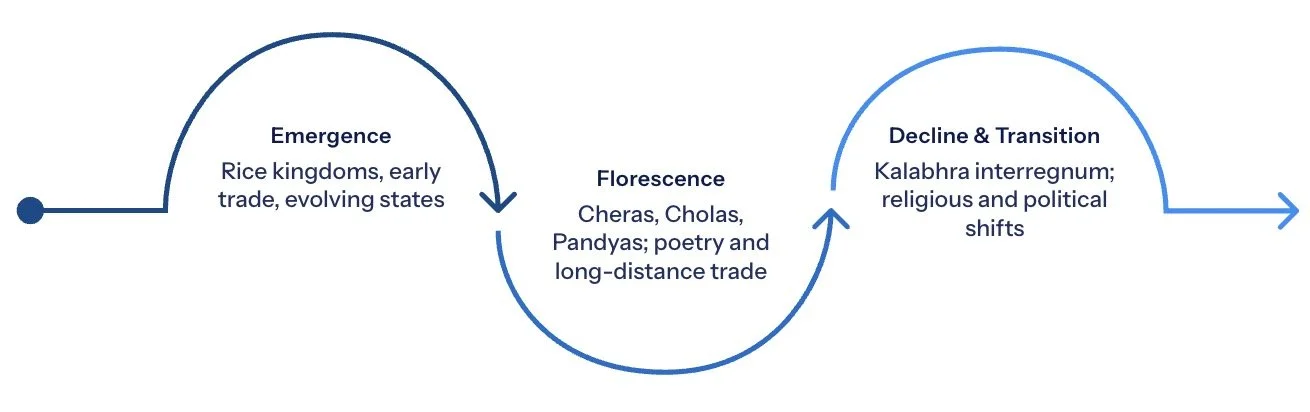
Towards the end of the 3rd century CE, the Sangam period slowly witnessed its decline. A relatively obscure group known as the Kalabhras occupied the Tamil country for approximately two and a half centuries. Little is known about Kalabhra rule — they remain one of the more enigmatic episodes in South Indian history — but it is noted that Jainism and Buddhism became particularly prominent during this interregnum.
The eventual recovery of the Tamil country came through two great powers: the Pallavas in northern Tamil Nadu and the Pandyas in southern Tamil Nadu, who together drove out the Kalabhras and re-established stable monarchical rule, ushering in the next great chapter of South Indian history.
The Kalabhra interlude remains one of the least understood periods in Tamil history — sometimes called the "dark age" — though it was clearly a time of significant religious ferment and social change.
Political Structure & Administration
The Sangam poems offer a remarkable and detailed sketch of the evolution of the state system in South India, providing the earliest evidence of organised political structures in the region. The evidence suggests that the state as a political structure had come into existence, though it was not yet fully stable. Monarchy was the prevailing form of government, with kingship descending by heredity from father to son. The Chera, Chola, and Pandya kings were collectively known as vendar (crowned kings), each possessing special insignia of royalty — the staff, drum, and umbrella. The "king" was called ventan and served as the head of both society and government.
The King (Ventan)
Head of society and government. Equated with gods for divine legitimacy. Led festivals, inaugurated performances, toured the country. Advised by the surram — men who surrounded the king giving counsel. Assisted by five councils of officials.
Five Councils of Officials
Amaichar (ministers), Anthanar (priests), Senapathi (military commanders), Thuthar (envoys), and Orrar (spies). Together they managed the full range of royal administration, from diplomacy to intelligence.
The Two Great Assemblies
Aimperunkulu — council of five ministers, primarily judicial in function. Enperayam — great assembly of eight government officers, advisory in character. Their advice was rarely rejected by the king. These were forerunners of modern panchayat institutions.
Military Organisation
Each ruler maintained a regular army and a tutelary tree (Kodimaram). The four arms of the military were chariot, elephant, cavalry, and infantry. References also exist to a Chera navy. Herostones (nadukal) were erected to commemorate fallen warriors.
At the local level, every administrative unit was governed by a local assembly. The terms avai and manram denote these assemblies in Sangam works, and they were collectively known as arankuravaiyam, celebrated for their just decisions. The Silappadikaram text refers to the two great councils — the Aimperunkulu and the Enperayam — which functioned as administrative and judicial bodies. Their advisory function was so respected that the king rarely rejected their counsel. Tamil-Brahmi inscriptions offer further administrative detail: a kalatika (superintendent of pearl fisheries) is mentioned in a 2nd century BCE Mangulam inscription, and a kanatikan (chief of scribes) appears in a 1st century BCE inscription from Alagarmalai, giving glimpses into the sophisticated bureaucratic organisation of the Pandya state.
Kingship, Legitimacy & the Poet-Patron Bond
Perhaps the most distinctive feature of Sangam political culture was the intimate and reciprocal relationship between king and poet. In a world without mass media, the poet's voice was the primary vehicle for constructing and broadcasting royal reputation. A king who was praised by celebrated bards achieved lasting fame; a king who incurred a poet's wrath risked his reputation and, it was believed, his very fortune. This relationship was so fundamental that it constituted the most important basis of political legitimacy in early historical South India.
The poet was dependent on his patron for material support and well-being. But the king too was dependent on the poet — it was only the poet's praise of his generosity and heroism that could lead to his attaining lasting fame. Conversely, the poet's anger could prove costly for his patron and lead to his ruin.
Beyond the eulogy of poets, Sangam texts also document the emergence of new bases of royal prestige and legitimacy that drew heavily from the Brahmanical and epic traditions of northern India. This reflects a broader process of cultural convergence between the Tamil south and the Sanskrit north during this period.
Vedic Sacrifices
Kings performed yajnas. Pandya ruler Mudukudumi bore the title Palshalai — "one of many sacrificial halls." Certain chiefs claimed birth from sacrificial fire pits of northern sages.
Epic & Deity Links
Rulers sought association with Shiva, Vishnu, and ancient sages. Chola king Senganan was described as devoted to Shiva. Kings claimed connections to the Mahabharata war tradition.
Pattini Cult
Chera king Senguttuvan established the cult of goddess Pattini (Kannagi), deified as the ideal chaste wife — a uniquely Tamil form of religious legitimacy linked to the epic Silappadikaram.
Jaina Patronage
Tamil-Brahmi inscriptions record cave excavations for Jaina monks by kings and chieftains. Pugalur (2nd century CE) records a rock shelter built for a Jaina monk at a Chera prince's investiture ceremony.
Legacy of the Sangam Age
The Sangam Age stands as a foundational chapter in the story of South Asian civilisation. The picture that emerges from Sangam literature and supporting evidence is of a society in dynamic transition — moving from a tribal order towards an organised state system, experimenting with new forms of political legitimacy, and participating in a vibrant network of regional and international trade. While the state was still in the process of crystallisation, its essential structures — monarchy, councils, judicial assemblies, military organisation — were already firmly in place.
Political Legacy
The Sangam Age saw the conception of the state for the first time in South India. Patriarchal and patrimonial systems prevailed, with administrative offices directly controlled by rulers. Local assemblies like the arankuravaiyamforeshadowed later panchayat institutions.
Economic Legacy
Agriculture was the backbone of the Sangam economy. Active trade with the Mediterranean world enriched the region and introduced foreign cultural influences. The great ports of Puhar, Korkai, Muchiri, and Tondi were nodes in a genuinely global commercial network.
Religious Legacy
The beliefs of the Sangam age were complex — combining animism, idol worship, Brahmanical ritual, and patronage of Jaina and Buddhist traditions. Many customs and traditions of the Sangam age survived into later periods and some continue to this day.
Cultural Legacy
The poet-patron relationship produced a body of Tamil literature — the Sangam corpus — of extraordinary richness, psychological depth, and linguistic sophistication. It remains one of the great literary achievements of the ancient world, comparable to classical Greek or Sanskrit literature.
The social structure of the Sangam Age, while marked by Brahmanical influence and certain inequalities, had not yet developed the acute class distinctions that would characterise later periods. The cultural vitality of the age — its poetry, its philosophy of love and war (akam and puram), its rich religious pluralism — ensured that the Sangam tradition would not merely survive the political disruptions that followed, but would continue to nourish Tamil identity, literature, and culture for two millennia to come.
Legacy of the Sangam Age
From the rice fields of the Kaveri delta to the pearl banks of Korkai, from the Himalayan expeditions of Senguttuvan to the courtly debates of Madurai, the Sangam Age compressed into six remarkable centuries the essential drama of South Indian civilisation taking shape — a story that continues to resonate in the temples, languages, and living traditions of Tamil Nadu and Kerala today.
